 NAME : JAM SHOAIB AHMED
 CLASS : BTCV 16A
 SUBJECT : FOUNDATION & PAVEMENT
 SEMESTER : 5TH
 TEACHER : ENGR. MADAM NADIA
SETTLEMENT
 Settlement is the vertical downward
movement of structure
 OR
 The settlement of a structure is the result of
the deformation of the supporting soil,
 OR
 When a soil deposit is loaded, deformation
will occur due to change in stress. The total
vertical downward deformation at the
surface resulting from the load is called
Settlement.
SETTLEMENT
TEMPORARY SETTLEMENT
PERMENENT SETTLEMENT
IMMEDIATE SETTLEMENT
PRIMARY SETTLEMENT
SECONDARY SETTLEMENT
DIFFERENTIAL SETTLEMENT
UNIFORM SETTLEMENT
SETTLEMENT
The total settlement of a foundation comprises three parts as follows
S = Se+Sc+Ss
where, S = total settlement
Se = elastic or immediate settlement
Sc = consolidation settlement
Ss = secondary settlement
 Immediate settlement :
Immediate settlement takes place as the load is applied or within a time period of about 7 days.
Predominates in cohesion less soils and unsaturated clay
Immediate settlement analysis are used for all fine-grained soils including silts and clays with a degree of saturation <
90% and for all coarse grained soils with large co-efficient of permeability (say above 10.2 m/s)
 Primary consolidation settlement :
The consolidation settlement is that part which is due to the expulsion of pore water from the voids and is time-dependent
settlement.
The leaning tower of Pisa in Italy has been undergoing consolidation settlement for over 700 years. The lean is caused by
consolidation settlement being greater on one side. This, however, is an extreme case. The principal settlements for most
projects occur in 3 to 10 years.
Dominates in saturated/nearly saturated fine grained soils where consolidation theory applies.
Here we are interested to estimate both consolidation settlement and how long a time it will take or most of the settlement to
occur.
Secondary settlement :
Secondary settlement normally starts with the completion of the consolidation. It means, during the stage of this settlement, the
pore water pressure is zero and the settlement is only due to the distortion of the soil skeleton
Settlement
Differential settlement
 Footing resting on different type of soil, different bearing capacity and unequal load
distribution will result in the unequal settlement or what we call it a differential settlement .
Differential settlement can cause tilting of the structure. The Tower of Pisa in Italy is the
classic case study of the tilting of the tower at 5.5 degree southward and it is leaning from
1911 and is known as the “Leaning Tower of Pisa”. The reason for the leaning of the tower is
that in the southward side the clay soil is soft and hence more compressible than in the
northward side. There has been many strategies and attempt to prevent the tower from
collapse.
 Uniform settlement :
 Where foundation settlement occurs at roughly the same rate throughout all portions of
a building, it is termed uniform settlement.
SETTLEMENT
SETTLEMENT
 Causes :
 Bearing capacity
 WEAK COMPACTION
 WATER TABLE
 TRANSPIRATION => TREE/PLANTS
 EARTHQUACK
 VARIATION IN MOISTURE CONTENT
 DRAINAGE
 PLUMBING LEAKS
 Design & Construction errors
 POOR SOIL CONDITION
 Structural load
SETTLEMENT
 Bearing capacity :
if the structural load increased to the bearing capacity of soil
then there is the chances of settlement or foundation will
collapse, Each soil Bearing capacity is different from other.
 Weak compaction:
When fill soils are not adequately compacted, they can
compress (settle) under the load of a foundation resulting in
damage to the structure
SETTLEMENT
SETTLEMENT
 GROUND WATER TABLE
It is important to note that both rising and falling groundwater levels can affect
soil behavior. Rise in GWT reduces the bearing capacity of the soil
 Drag down and heave
When footing is located on a compressible soil, there is a chance of foundation
failure by drag down and heave. In plastic soils, new settlements (drag down)
are often accompanied by upward movements and heave some distance away
(Figure 2). When foundation failure does occur, it is usually the result of
differential settlement or heaving of the soil that supports the foundation.
SETTLEMENT
 TRANSPIRATION => TREE/PLANTS :
We all know what perspiration is, but transpiration is a less commonly known
word. It is the word that describes plants removing moisture from the soil. Trees
withdrawing moisture from the soil in the summer can accelerate soil shrinkage
in hot summer months. It is the expansion and shrinking or contraction of soils
that disturb the foundation.
 GROUND WATER TABLE
It is important to note that both rising and falling groundwater levels can affect
soil behavior. Rise in GWT reduces the bearing capacity of the soil
 LATERAL LOADS :
Lateral movement in soil is possible when there is removal of existing side
support adjacent to a building or there is excessive overburden on backfill or
lateral thrust on the backside of a retaining wall. Lateral movement is also
observed during earthquake when structure fails due to lateral movement of soil
beneath the foundation
SETTLEMENT
SETTLEMENT
SETTLEMENT
 Foundation load
 Dead load
 Live load
 Wind load
 Snow load
 Earth pressure
SETTLEMENT
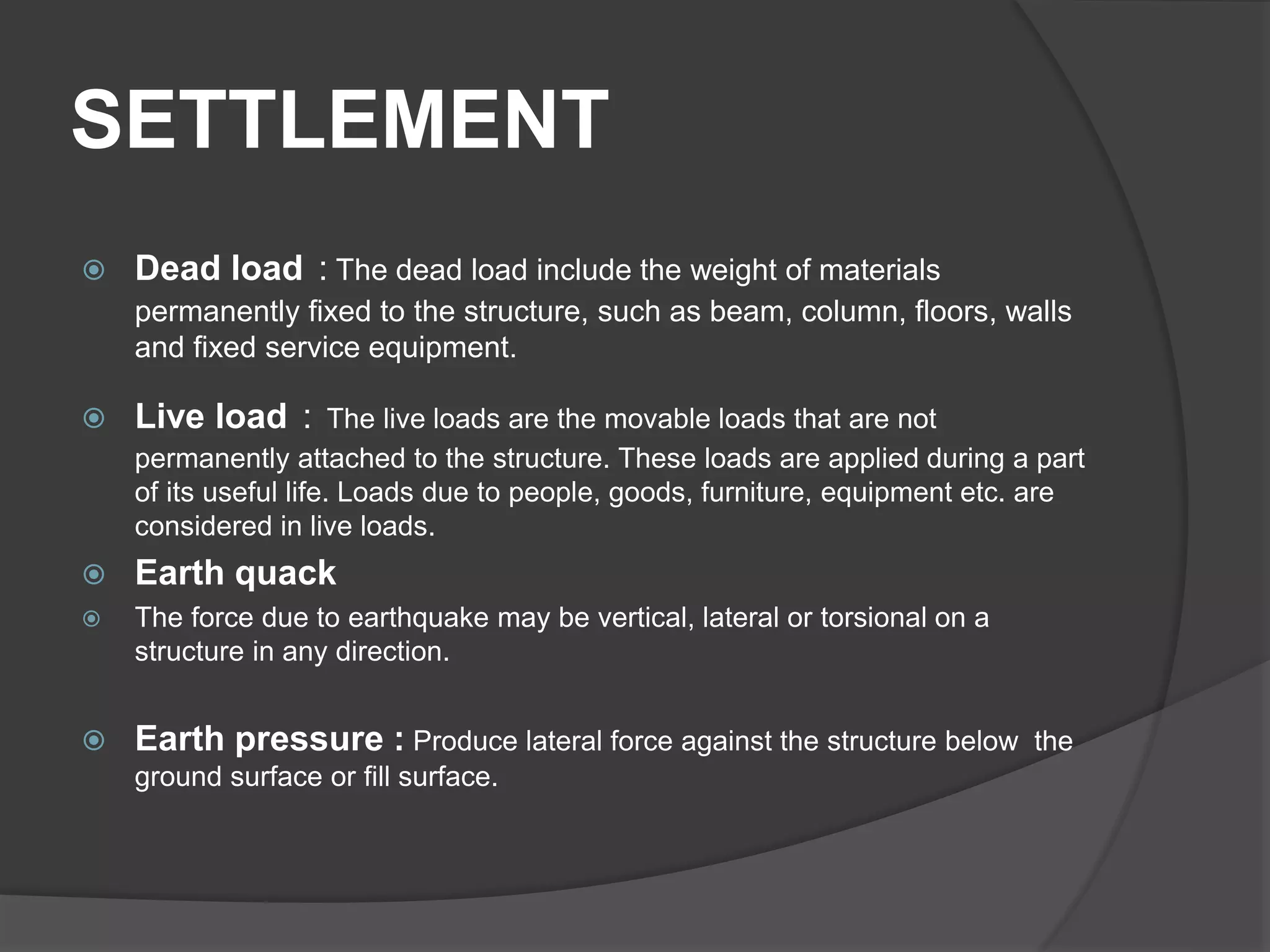
 Dead load : The dead load include the weight of materials
permanently fixed to the structure, such as beam, column, floors, walls
and fixed service equipment.
 Live load : The live loads are the movable loads that are not
permanently attached to the structure. These loads are applied during a part
of its useful life. Loads due to people, goods, furniture, equipment etc. are
considered in live loads.
 Earth quack
 The force due to earthquake may be vertical, lateral or torsional on a
structure in any direction.
 Earth pressure : Produce lateral force against the structure below the
ground surface or fill surface.
SETTLEMENT
 Dead load and live load are computed by
tributary area method.
 According to IS 1904-1978 foundation should
be proportioned for the combination dead load
+ live load and dead load + live load + wind
load or seismic load
 The Foundation pressure should not the
exceed the safe bearing capacity by more than
25% for the combination of dead load, live
load and wind load
Settlement of soil/foundation

Settlement of soil/foundation

  • 1.
     NAME :JAM SHOAIB AHMED  CLASS : BTCV 16A  SUBJECT : FOUNDATION & PAVEMENT  SEMESTER : 5TH  TEACHER : ENGR. MADAM NADIA
  • 3.
    SETTLEMENT  Settlement isthe vertical downward movement of structure  OR  The settlement of a structure is the result of the deformation of the supporting soil,  OR  When a soil deposit is loaded, deformation will occur due to change in stress. The total vertical downward deformation at the surface resulting from the load is called Settlement.
  • 4.
    SETTLEMENT TEMPORARY SETTLEMENT PERMENENT SETTLEMENT IMMEDIATESETTLEMENT PRIMARY SETTLEMENT SECONDARY SETTLEMENT DIFFERENTIAL SETTLEMENT UNIFORM SETTLEMENT
  • 5.
    SETTLEMENT The total settlementof a foundation comprises three parts as follows S = Se+Sc+Ss where, S = total settlement Se = elastic or immediate settlement Sc = consolidation settlement Ss = secondary settlement  Immediate settlement : Immediate settlement takes place as the load is applied or within a time period of about 7 days. Predominates in cohesion less soils and unsaturated clay Immediate settlement analysis are used for all fine-grained soils including silts and clays with a degree of saturation < 90% and for all coarse grained soils with large co-efficient of permeability (say above 10.2 m/s)  Primary consolidation settlement : The consolidation settlement is that part which is due to the expulsion of pore water from the voids and is time-dependent settlement. The leaning tower of Pisa in Italy has been undergoing consolidation settlement for over 700 years. The lean is caused by consolidation settlement being greater on one side. This, however, is an extreme case. The principal settlements for most projects occur in 3 to 10 years. Dominates in saturated/nearly saturated fine grained soils where consolidation theory applies. Here we are interested to estimate both consolidation settlement and how long a time it will take or most of the settlement to occur. Secondary settlement : Secondary settlement normally starts with the completion of the consolidation. It means, during the stage of this settlement, the pore water pressure is zero and the settlement is only due to the distortion of the soil skeleton
  • 6.
    Settlement Differential settlement  Footingresting on different type of soil, different bearing capacity and unequal load distribution will result in the unequal settlement or what we call it a differential settlement . Differential settlement can cause tilting of the structure. The Tower of Pisa in Italy is the classic case study of the tilting of the tower at 5.5 degree southward and it is leaning from 1911 and is known as the “Leaning Tower of Pisa”. The reason for the leaning of the tower is that in the southward side the clay soil is soft and hence more compressible than in the northward side. There has been many strategies and attempt to prevent the tower from collapse.  Uniform settlement :  Where foundation settlement occurs at roughly the same rate throughout all portions of a building, it is termed uniform settlement.
  • 7.
  • 8.
    SETTLEMENT  Causes : Bearing capacity  WEAK COMPACTION  WATER TABLE  TRANSPIRATION => TREE/PLANTS  EARTHQUACK  VARIATION IN MOISTURE CONTENT  DRAINAGE  PLUMBING LEAKS  Design & Construction errors  POOR SOIL CONDITION  Structural load
  • 9.
    SETTLEMENT  Bearing capacity: if the structural load increased to the bearing capacity of soil then there is the chances of settlement or foundation will collapse, Each soil Bearing capacity is different from other.  Weak compaction: When fill soils are not adequately compacted, they can compress (settle) under the load of a foundation resulting in damage to the structure
  • 10.
  • 11.
    SETTLEMENT  GROUND WATERTABLE It is important to note that both rising and falling groundwater levels can affect soil behavior. Rise in GWT reduces the bearing capacity of the soil  Drag down and heave When footing is located on a compressible soil, there is a chance of foundation failure by drag down and heave. In plastic soils, new settlements (drag down) are often accompanied by upward movements and heave some distance away (Figure 2). When foundation failure does occur, it is usually the result of differential settlement or heaving of the soil that supports the foundation.
  • 12.
    SETTLEMENT  TRANSPIRATION =>TREE/PLANTS : We all know what perspiration is, but transpiration is a less commonly known word. It is the word that describes plants removing moisture from the soil. Trees withdrawing moisture from the soil in the summer can accelerate soil shrinkage in hot summer months. It is the expansion and shrinking or contraction of soils that disturb the foundation.  GROUND WATER TABLE It is important to note that both rising and falling groundwater levels can affect soil behavior. Rise in GWT reduces the bearing capacity of the soil  LATERAL LOADS : Lateral movement in soil is possible when there is removal of existing side support adjacent to a building or there is excessive overburden on backfill or lateral thrust on the backside of a retaining wall. Lateral movement is also observed during earthquake when structure fails due to lateral movement of soil beneath the foundation
  • 13.
  • 14.
  • 15.
    SETTLEMENT  Foundation load Dead load  Live load  Wind load  Snow load  Earth pressure
  • 16.
    SETTLEMENT  Dead load: The dead load include the weight of materials permanently fixed to the structure, such as beam, column, floors, walls and fixed service equipment.  Live load : The live loads are the movable loads that are not permanently attached to the structure. These loads are applied during a part of its useful life. Loads due to people, goods, furniture, equipment etc. are considered in live loads.  Earth quack  The force due to earthquake may be vertical, lateral or torsional on a structure in any direction.  Earth pressure : Produce lateral force against the structure below the ground surface or fill surface.
  • 17.
    SETTLEMENT  Dead loadand live load are computed by tributary area method.  According to IS 1904-1978 foundation should be proportioned for the combination dead load + live load and dead load + live load + wind load or seismic load  The Foundation pressure should not the exceed the safe bearing capacity by more than 25% for the combination of dead load, live load and wind load