SELF COMPACTING
CONCRETE
Prepared by-
Meet Shah
IndusInstituteofTechnology& Engineering
• Most revolutionary development in concrete
construction for several decades.
• SCC is modern innovation- does not require
vibration for placement and compaction.
• Flowing consistency, High
Performance, Uniform quality.
22
Contents
 Introduction
 History
 Why Self Compacting Concrete?
 Material Selection
 The Requirements for SCC & Production
 Test Methods for Compactibility
 Complexities involved in SCC
 Application
 Conclusion
21
Introduction
The guiding principle for this type of concrete is
that the sedimentation velocity of a particle is
inversely proportional to the viscosity of the floating
medium in which the particle exists.
A special type of concrete of flowing consistency
to obtain high performance, better and more
reliable and uniform quality.
20
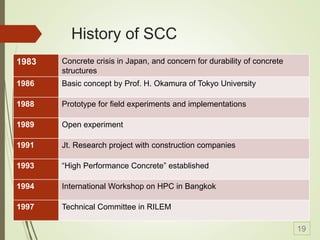
History of SCC
1983 Concrete crisis in Japan, and concern for durability of concrete
structures
1986 Basic concept by Prof. H. Okamura of Tokyo University
1988 Prototype for field experiments and implementations
1989 Open experiment
1991 Jt. Research project with construction companies
1993 “High Performance Concrete” established
1994 International Workshop on HPC in Bangkok
1997 Technical Committee in RILEM
19
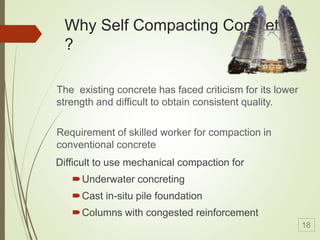
Difficult to use mechanical compaction for
Underwater concreting
Cast in-situ pile foundation
Columns with congested reinforcement
Why Self Compacting Concrete
?
The existing concrete has faced criticism for its lower
strength and difficult to obtain consistent quality.
Requirement of skilled worker for compaction in
conventional concrete
18
Benefits of SCC
 Faster Construction
 Reduction in site manpower
 Better surface finish
 Easier placing
 Improved durability
 Greater freedom in design
 Thinner concrete sections
 Reduced noise level
 Safer working environment
17
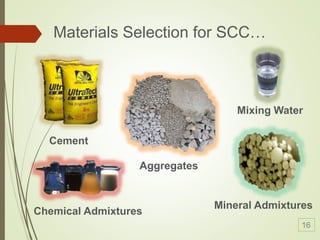
Materials Selection for SCC…
Cement
Aggregates
Chemical Admixtures
Mineral Admixtures
Mixing Water
16
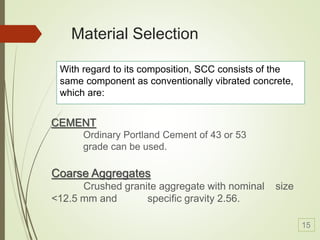
Material Selection
With regard to its composition, SCC consists of the
same component as conventionally vibrated concrete,
which are:
CEMENT
Ordinary Portland Cement of 43 or 53
grade can be used.
Coarse Aggregates
Crushed granite aggregate with nominal size
<12.5 mm and specific gravity 2.56.
15
Continued…
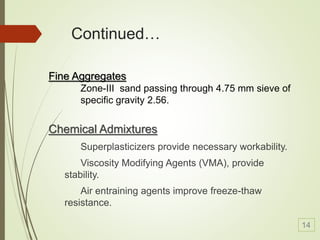
Chemical Admixtures
Superplasticizers provide necessary workability.
Viscosity Modifying Agents (VMA), provide
stability.
Air entraining agents improve freeze-thaw
resistance.
Fine Aggregates
Zone-III sand passing through 4.75 mm sieve of
specific gravity 2.56.
14
Continued…
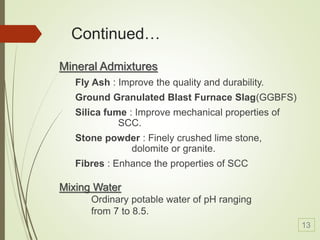
Mineral Admixtures
Fly Ash : Improve the quality and durability.
Ground Granulated Blast Furnace Slag(GGBFS)
Silica fume : Improve mechanical properties of
SCC.
Stone powder : Finely crushed lime stone,
dolomite or granite.
Fibres : Enhance the properties of SCC
Mixing Water
Ordinary potable water of pH ranging
from 7 to 8.5.
13
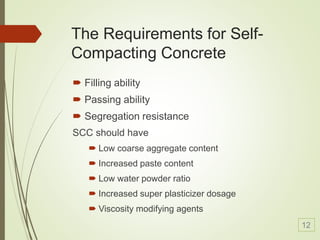
The Requirements for Self-
Compacting Concrete
 Filling ability
 Passing ability
 Segregation resistance
SCC should have
 Low coarse aggregate content
 Increased paste content
 Low water powder ratio
 Increased super plasticizer dosage
 Viscosity modifying agents
12
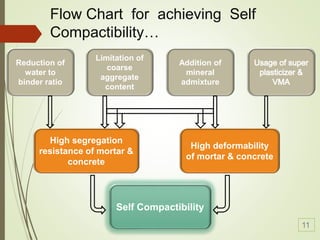
Reduction of
water to
binder ratio
Limitation of
coarse
aggregate
content
Addition of
mineral
admixture
High segregation
resistance of mortar &
concrete
High deformability
of mortar & concrete
Self Compactibility
Flow Chart for achieving Self
Compactibility…
11
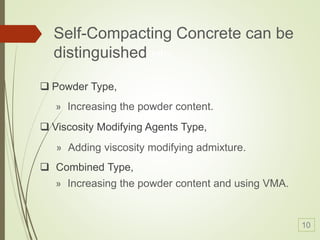
» Increasing the powder content.
» Increasing the powder content and using VMA.
» Adding viscosity modifying admixture.
 Powder Type,
 Viscosity Modifying Agents Type,
 Combined Type,
Self-Compacting Concrete can be
distinguished into:
10
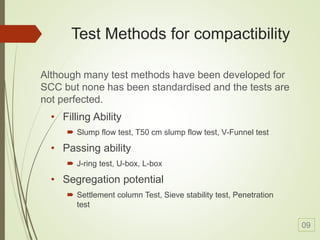
Test Methods for compactibility
• Filling Ability
 Slump flow test, T50 cm slump flow test, V-Funnel test
• Passing ability
 J-ring test, U-box, L-box
• Segregation potential
 Settlement column Test, Sieve stability test, Penetration
test
Although many test methods have been developed for
SCC but none has been standardised and the tests are
not perfected.
09
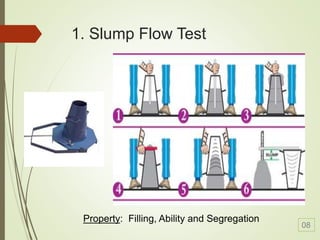
1. Slump Flow Test
Property: Filling, Ability and Segregation
08
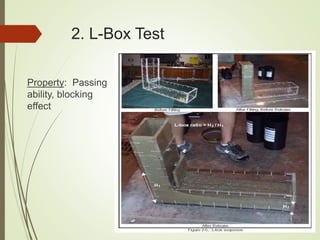
2. L-Box Test
Property: Passing
ability, blocking
effect
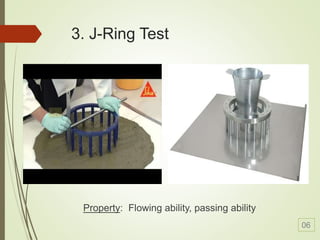
3. J-Ring Test
Property: Flowing ability, passing ability
06
Complexities involved in SCC
 Higher paste volume results in greater
shrinkage and creep.
 Higher strength achievement leads to
reduced workability to unacceptable level.
 Lateral Formwork pressure.
 Limit of flow distance of the concrete.
05
Application
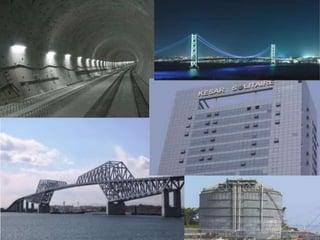
 Two anchorages of Akashi-Kaikyo (Straits) Bridge,
Japan. The volume of the cast concrete in the two
anchorages amounted to 290,000 m3
 The highest use of SCC in India was done at Delhi
metro project. About 10000 m3 of SCC has been
Used.
 At Kaiga nuclear power plant, SCC of Characteristic
strength 30 MPa was used.
04
Conclusion
 We can reduce the in-place cost and maker a safer
working environment for the workers.
 SCC can be effectively placed in most congested areas
and also where normal methods of vibration are not
possible.
 Further research are required to interpret influence on
the hardened properties of SCC more precisely.
 The cost of SCC is 10-15 % higher than the
conventional concrete.
02
OUR ROLE
 Maximum Application of self compacting concrete.
 Learning and guiding workers to implement the self
compacting concrete.
 To identify test methods for SCC to improve its
workability.
 Forming IS codes for the self-compacting concrete.
As an Engineer:
As a Researcher:
01
Self compacting concrete

Self compacting concrete

  • 1.
    SELF COMPACTING CONCRETE Prepared by- MeetShah IndusInstituteofTechnology& Engineering
  • 2.
    • Most revolutionarydevelopment in concrete construction for several decades. • SCC is modern innovation- does not require vibration for placement and compaction. • Flowing consistency, High Performance, Uniform quality. 22
  • 3.
    Contents  Introduction  History Why Self Compacting Concrete?  Material Selection  The Requirements for SCC & Production  Test Methods for Compactibility  Complexities involved in SCC  Application  Conclusion 21
  • 4.
    Introduction The guiding principlefor this type of concrete is that the sedimentation velocity of a particle is inversely proportional to the viscosity of the floating medium in which the particle exists. A special type of concrete of flowing consistency to obtain high performance, better and more reliable and uniform quality. 20
  • 5.
    History of SCC 1983Concrete crisis in Japan, and concern for durability of concrete structures 1986 Basic concept by Prof. H. Okamura of Tokyo University 1988 Prototype for field experiments and implementations 1989 Open experiment 1991 Jt. Research project with construction companies 1993 “High Performance Concrete” established 1994 International Workshop on HPC in Bangkok 1997 Technical Committee in RILEM 19
  • 6.
    Difficult to usemechanical compaction for Underwater concreting Cast in-situ pile foundation Columns with congested reinforcement Why Self Compacting Concrete ? The existing concrete has faced criticism for its lower strength and difficult to obtain consistent quality. Requirement of skilled worker for compaction in conventional concrete 18
  • 7.
    Benefits of SCC Faster Construction  Reduction in site manpower  Better surface finish  Easier placing  Improved durability  Greater freedom in design  Thinner concrete sections  Reduced noise level  Safer working environment 17
  • 8.
    Materials Selection forSCC… Cement Aggregates Chemical Admixtures Mineral Admixtures Mixing Water 16
  • 9.
    Material Selection With regardto its composition, SCC consists of the same component as conventionally vibrated concrete, which are: CEMENT Ordinary Portland Cement of 43 or 53 grade can be used. Coarse Aggregates Crushed granite aggregate with nominal size <12.5 mm and specific gravity 2.56. 15
  • 10.
    Continued… Chemical Admixtures Superplasticizers providenecessary workability. Viscosity Modifying Agents (VMA), provide stability. Air entraining agents improve freeze-thaw resistance. Fine Aggregates Zone-III sand passing through 4.75 mm sieve of specific gravity 2.56. 14
  • 11.
    Continued… Mineral Admixtures Fly Ash: Improve the quality and durability. Ground Granulated Blast Furnace Slag(GGBFS) Silica fume : Improve mechanical properties of SCC. Stone powder : Finely crushed lime stone, dolomite or granite. Fibres : Enhance the properties of SCC Mixing Water Ordinary potable water of pH ranging from 7 to 8.5. 13
  • 12.
    The Requirements forSelf- Compacting Concrete  Filling ability  Passing ability  Segregation resistance SCC should have  Low coarse aggregate content  Increased paste content  Low water powder ratio  Increased super plasticizer dosage  Viscosity modifying agents 12
  • 13.
    Reduction of water to binderratio Limitation of coarse aggregate content Addition of mineral admixture High segregation resistance of mortar & concrete High deformability of mortar & concrete Self Compactibility Flow Chart for achieving Self Compactibility… 11
  • 14.
    » Increasing thepowder content. » Increasing the powder content and using VMA. » Adding viscosity modifying admixture.  Powder Type,  Viscosity Modifying Agents Type,  Combined Type, Self-Compacting Concrete can be distinguished into: 10
  • 15.
    Test Methods forcompactibility • Filling Ability  Slump flow test, T50 cm slump flow test, V-Funnel test • Passing ability  J-ring test, U-box, L-box • Segregation potential  Settlement column Test, Sieve stability test, Penetration test Although many test methods have been developed for SCC but none has been standardised and the tests are not perfected. 09
  • 16.
    1. Slump FlowTest Property: Filling, Ability and Segregation 08
  • 17.
    2. L-Box Test Property:Passing ability, blocking effect
  • 18.
    3. J-Ring Test Property:Flowing ability, passing ability 06
  • 19.
    Complexities involved inSCC  Higher paste volume results in greater shrinkage and creep.  Higher strength achievement leads to reduced workability to unacceptable level.  Lateral Formwork pressure.  Limit of flow distance of the concrete. 05
  • 20.
    Application  Two anchoragesof Akashi-Kaikyo (Straits) Bridge, Japan. The volume of the cast concrete in the two anchorages amounted to 290,000 m3  The highest use of SCC in India was done at Delhi metro project. About 10000 m3 of SCC has been Used.  At Kaiga nuclear power plant, SCC of Characteristic strength 30 MPa was used. 04
  • 22.
    Conclusion  We canreduce the in-place cost and maker a safer working environment for the workers.  SCC can be effectively placed in most congested areas and also where normal methods of vibration are not possible.  Further research are required to interpret influence on the hardened properties of SCC more precisely.  The cost of SCC is 10-15 % higher than the conventional concrete. 02
  • 23.
    OUR ROLE  MaximumApplication of self compacting concrete.  Learning and guiding workers to implement the self compacting concrete.  To identify test methods for SCC to improve its workability.  Forming IS codes for the self-compacting concrete. As an Engineer: As a Researcher: 01