BUILT
IT
UP
PRESENTED BY:
Ms. Tejaswini Narayane
Mst. Vaibhav Phatangare
Mst. Dipesh Dhadave
Mst. Dishank Raut
PROJECT GUIDE:
Prof. Dhanashri Joshi
BY- TEJASWINI NARAYANE
New Horizon Institute Of Technology & Management (Thane)
BRANCH: B.E. CIVIL ENGINEERING. SEMESTER: 4th
TOPIC
DEWATERING IN DIFFERENT
SOIL CONDITIONS:
ELECTRO – OSMOSIS METHOD
BY- TEJASWINI NARAYANE
• WHAT IS DEWATERING?
• IMPORTANCE OF DEWATERING.
• BASIC PROCESS OF DEWATERING.
• METHODS OF DEWATERING.
• ELECTRO – OSMOSIS METHOD OF DEWATERING.
• RESULTS.
• CONCLUSION.
• APPLICATIONS OF ELECTRO-OSMOSIS IN CIVIL
ENGINEERING.
• WATER MANAGEMENT & DISPOSAL OF DEWATERED
WATER.
• EXAMPLES.
BY- TEJASWINI NARAYANE
CONTENTS
WHAT IS DEWATERING?
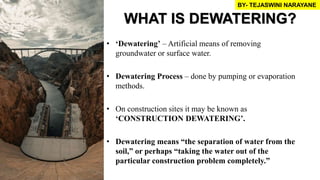
• ‘Dewatering’ – Artificial means of removing
groundwater or surface water.
• Dewatering Process – done by pumping or evaporation
methods.
• On construction sites it may be known as
‘CONSTRUCTION DEWATERING’.
• Dewatering means “the separation of water from the
soil,” or perhaps “taking the water out of the
particular construction problem completely.”
BY- TEJASWINI NARAYANE
• Completely Dry Surface.
• Easy Workability of construction Workers.
• During Excavation – Safety of Workers & to
Achieve Stability of Foundation.
• During Monsoons – for Smooth & Fast
Working Progress.
• Other Essential Reasons – Washing of plant,
etc.
BY- TEJASWINI NARAYANE
IMPORTANCE OF
DEWATERING
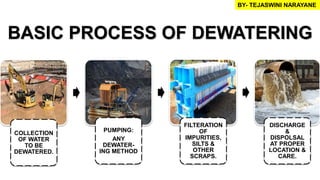
BASIC PROCESS OF DEWATERING
COLLECTION
OF WATER
TO BE
DEWATERED.
PUMPING:
ANY
DEWATER-
ING METHOD
FILTERATION
OF
IMPURITIES,
SILTS &
OTHER
SCRAPS.
DISCHARGE
&
DISPOLSAL
AT PROPER
LOCATION &
CARE.
BY- TEJASWINI NARAYANE
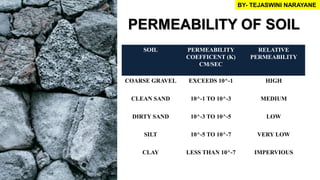
PERMEABILITY OF SOIL
SOIL PERMEABILITY
COEFFICENT (K)
CM/SEC
RELATIVE
PERMEABILITY
COARSE GRAVEL EXCEEDS 10^-1 HIGH
CLEAN SAND 10^-1 TO 10^-3 MEDIUM
DIRTY SAND 10^-3 TO 10^-5 LOW
SILT 10^-5 TO 10^-7 VERY LOW
CLAY LESS THAN 10^-7 IMPERVIOUS
BY- TEJASWINI NARAYANE
METHODS OF
DEWATERING
Factors such as Type of Soil & Nature of Construction
Site will all influence, which Dewatering Method will be
Best Suited for the Project.
• OPEN SUMPS AND DITCHES
• WELL POINT SYSTEMS
• DEEP WELL DRAINAGE
• VACUUM DEWATERING SYSTEMS
• ELECTRO OSMOSIS
BY- TEJASWINI NARAYANE
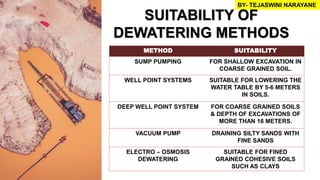
METHOD SUITABILITY
SUMP PUMPING FOR SHALLOW EXCAVATION IN
COARSE GRAINED SOIL.
WELL POINT SYSTEMS SUITABLE FOR LOWERING THE
WATER TABLE BY 5-6 METERS
IN SOILS.
DEEP WELL POINT SYSTEM FOR COARSE GRAINED SOILS
& DEPTH OF EXCAVATIONS OF
MORE THAN 16 METERS.
VACUUM PUMP DRAINING SILTY SANDS WITH
FINE SANDS
ELECTRO – OSMOSIS
DEWATERING
SUITABLE FOR FINED
GRAINED COHESIVE SOILS
SUCH AS CLAYS
BY- TEJASWINI NARAYANE
SUITABILITY OF
DEWATERING METHODS
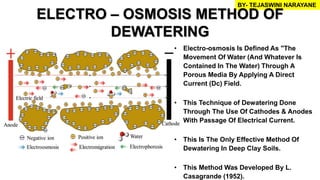
• Electro-osmosis Is Defined As "The
Movement Of Water (And Whatever Is
Contained In The Water) Through A
Porous Media By Applying A Direct
Current (Dc) Field.
• This Technique of Dewatering Done
Through The Use Of Cathodes & Anodes
With Passage Of Electrical Current.
• This Is The Only Effective Method Of
Dewatering In Deep Clay Soils.
• This Method Was Developed By L.
Casagrande (1952).
BY- TEJASWINI NARAYANE
ELECTRO – OSMOSIS METHOD OF
DEWATERING
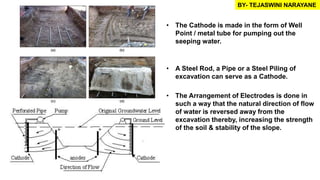
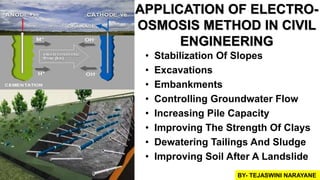
• The Cathode is made in the form of Well
Point / metal tube for pumping out the
seeping water.
• A Steel Rod, a Pipe or a Steel Piling of
excavation can serve as a Cathode.
• The Arrangement of Electrodes is done in
such a way that the natural direction of flow
of water is reversed away from the
excavation thereby, increasing the strength
of the soil & stability of the slope.
BY- TEJASWINI NARAYANE
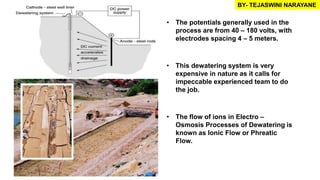
• The potentials generally used in the
process are from 40 – 180 volts, with
electrodes spacing 4 – 5 meters.
• This dewatering system is very
expensive in nature as it calls for
impeccable experienced team to do
the job.
• The flow of ions in Electro –
Osmosis Processes of Dewatering is
known as Ionic Flow or Phreatic
Flow.
BY- TEJASWINI NARAYANE
These Are The Following Results Of Electro-osmosis Method Of Dewatering
When Applied Properly :
• Electro-osmosis Provides Uniform Pore Water Movement In Most Types
Of Soil, Since The Boundary Layer Movement Towards Cathode Provides
The Motive Force For The Bulk Pore Water.
• Electro-osmotic Flow Rate Is Not Sensitive To Pore Size.
• Electro-osmotic Flow Rate Is Primarily A Function Of Applied Voltage.
• The Entire Soil Mass Between The Electrodes Is Basically Treated
Equally.
• Hence, Electro-osmosis Is So Effective In Clayey & Heterogeneous Soils.
RESULTS
BY- TEJASWINI NARAYANE
CONCLUSION
The method of electro-osmotic dewatering has the following
conclusions:
• The sludge is homogeneous and fully saturated.
• The main after effect of this method is the soil consolidation.
• The water in the sludge moves electro osmotically in the one-
dimensional , direction between electrodes.
• The electroosmotic permeability(k), is constant with time; No
electrochemical reactions occur during electro-osmotic
dewatering; Darcy's law and Ohm's law are applicable during
electro-osmotic dewatering.
BY- TEJASWINI NARAYANE
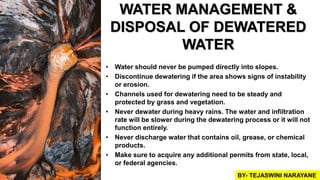
• Stabilization Of Slopes
• Excavations
• Embankments
• Controlling Groundwater Flow
• Increasing Pile Capacity
• Improving The Strength Of Clays
• Dewatering Tailings And Sludge
• Improving Soil After A Landslide
APPLICATION OF ELECTRO-
OSMOSIS METHOD IN CIVIL
ENGINEERING
BY- TEJASWINI NARAYANE
WATER MANAGEMENT &
DISPOSAL OF DEWATERED
WATER
• Water should never be pumped directly into slopes.
• Discontinue dewatering if the area shows signs of instability
or erosion.
• Channels used for dewatering need to be steady and
protected by grass and vegetation.
• Never dewater during heavy rains. The water and infiltration
rate will be slower during the dewatering process or it will not
function entirely.
• Never discharge water that contains oil, grease, or chemical
products.
• Make sure to acquire any additional permits from state, local,
or federal agencies.
BY- TEJASWINI NARAYANE
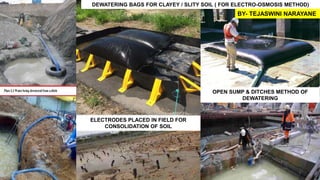
DEWATERING BAGS FOR CLAYEY / SLITY SOIL ( FOR ELECTRO-OSMOSIS METHOD)
ELECTRODES PLACED IN FIELD FOR
CONSOLIDATION OF SOIL
OPEN SUMP & DITCHES METHOD OF
DEWATERING
BY- TEJASWINI NARAYANE
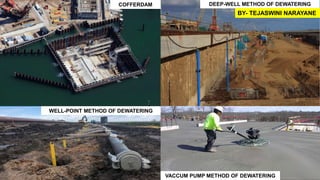
COFFERDAM
WELL-POINT METHOD OF DEWATERING
VACCUM PUMP METHOD OF DEWATERING
DEEP-WELL METHOD OF DEWATERING
BY- TEJASWINI NARAYANE

ELECTRO OSMOSIS METHOD OF DEWATERING

  • 1.
    BUILT IT UP PRESENTED BY: Ms. TejaswiniNarayane Mst. Vaibhav Phatangare Mst. Dipesh Dhadave Mst. Dishank Raut PROJECT GUIDE: Prof. Dhanashri Joshi BY- TEJASWINI NARAYANE New Horizon Institute Of Technology & Management (Thane) BRANCH: B.E. CIVIL ENGINEERING. SEMESTER: 4th
  • 2.
    TOPIC DEWATERING IN DIFFERENT SOILCONDITIONS: ELECTRO – OSMOSIS METHOD BY- TEJASWINI NARAYANE
  • 3.
    • WHAT ISDEWATERING? • IMPORTANCE OF DEWATERING. • BASIC PROCESS OF DEWATERING. • METHODS OF DEWATERING. • ELECTRO – OSMOSIS METHOD OF DEWATERING. • RESULTS. • CONCLUSION. • APPLICATIONS OF ELECTRO-OSMOSIS IN CIVIL ENGINEERING. • WATER MANAGEMENT & DISPOSAL OF DEWATERED WATER. • EXAMPLES. BY- TEJASWINI NARAYANE CONTENTS
  • 4.
    WHAT IS DEWATERING? •‘Dewatering’ – Artificial means of removing groundwater or surface water. • Dewatering Process – done by pumping or evaporation methods. • On construction sites it may be known as ‘CONSTRUCTION DEWATERING’. • Dewatering means “the separation of water from the soil,” or perhaps “taking the water out of the particular construction problem completely.” BY- TEJASWINI NARAYANE
  • 5.
    • Completely DrySurface. • Easy Workability of construction Workers. • During Excavation – Safety of Workers & to Achieve Stability of Foundation. • During Monsoons – for Smooth & Fast Working Progress. • Other Essential Reasons – Washing of plant, etc. BY- TEJASWINI NARAYANE IMPORTANCE OF DEWATERING
  • 6.
    BASIC PROCESS OFDEWATERING COLLECTION OF WATER TO BE DEWATERED. PUMPING: ANY DEWATER- ING METHOD FILTERATION OF IMPURITIES, SILTS & OTHER SCRAPS. DISCHARGE & DISPOLSAL AT PROPER LOCATION & CARE. BY- TEJASWINI NARAYANE
  • 7.
    PERMEABILITY OF SOIL SOILPERMEABILITY COEFFICENT (K) CM/SEC RELATIVE PERMEABILITY COARSE GRAVEL EXCEEDS 10^-1 HIGH CLEAN SAND 10^-1 TO 10^-3 MEDIUM DIRTY SAND 10^-3 TO 10^-5 LOW SILT 10^-5 TO 10^-7 VERY LOW CLAY LESS THAN 10^-7 IMPERVIOUS BY- TEJASWINI NARAYANE
  • 8.
    METHODS OF DEWATERING Factors suchas Type of Soil & Nature of Construction Site will all influence, which Dewatering Method will be Best Suited for the Project. • OPEN SUMPS AND DITCHES • WELL POINT SYSTEMS • DEEP WELL DRAINAGE • VACUUM DEWATERING SYSTEMS • ELECTRO OSMOSIS BY- TEJASWINI NARAYANE
  • 9.
    METHOD SUITABILITY SUMP PUMPINGFOR SHALLOW EXCAVATION IN COARSE GRAINED SOIL. WELL POINT SYSTEMS SUITABLE FOR LOWERING THE WATER TABLE BY 5-6 METERS IN SOILS. DEEP WELL POINT SYSTEM FOR COARSE GRAINED SOILS & DEPTH OF EXCAVATIONS OF MORE THAN 16 METERS. VACUUM PUMP DRAINING SILTY SANDS WITH FINE SANDS ELECTRO – OSMOSIS DEWATERING SUITABLE FOR FINED GRAINED COHESIVE SOILS SUCH AS CLAYS BY- TEJASWINI NARAYANE SUITABILITY OF DEWATERING METHODS
  • 10.
    • Electro-osmosis IsDefined As "The Movement Of Water (And Whatever Is Contained In The Water) Through A Porous Media By Applying A Direct Current (Dc) Field. • This Technique of Dewatering Done Through The Use Of Cathodes & Anodes With Passage Of Electrical Current. • This Is The Only Effective Method Of Dewatering In Deep Clay Soils. • This Method Was Developed By L. Casagrande (1952). BY- TEJASWINI NARAYANE ELECTRO – OSMOSIS METHOD OF DEWATERING
  • 11.
    • The Cathodeis made in the form of Well Point / metal tube for pumping out the seeping water. • A Steel Rod, a Pipe or a Steel Piling of excavation can serve as a Cathode. • The Arrangement of Electrodes is done in such a way that the natural direction of flow of water is reversed away from the excavation thereby, increasing the strength of the soil & stability of the slope. BY- TEJASWINI NARAYANE
  • 12.
    • The potentialsgenerally used in the process are from 40 – 180 volts, with electrodes spacing 4 – 5 meters. • This dewatering system is very expensive in nature as it calls for impeccable experienced team to do the job. • The flow of ions in Electro – Osmosis Processes of Dewatering is known as Ionic Flow or Phreatic Flow. BY- TEJASWINI NARAYANE
  • 13.
    These Are TheFollowing Results Of Electro-osmosis Method Of Dewatering When Applied Properly : • Electro-osmosis Provides Uniform Pore Water Movement In Most Types Of Soil, Since The Boundary Layer Movement Towards Cathode Provides The Motive Force For The Bulk Pore Water. • Electro-osmotic Flow Rate Is Not Sensitive To Pore Size. • Electro-osmotic Flow Rate Is Primarily A Function Of Applied Voltage. • The Entire Soil Mass Between The Electrodes Is Basically Treated Equally. • Hence, Electro-osmosis Is So Effective In Clayey & Heterogeneous Soils. RESULTS BY- TEJASWINI NARAYANE
  • 14.
    CONCLUSION The method ofelectro-osmotic dewatering has the following conclusions: • The sludge is homogeneous and fully saturated. • The main after effect of this method is the soil consolidation. • The water in the sludge moves electro osmotically in the one- dimensional , direction between electrodes. • The electroosmotic permeability(k), is constant with time; No electrochemical reactions occur during electro-osmotic dewatering; Darcy's law and Ohm's law are applicable during electro-osmotic dewatering. BY- TEJASWINI NARAYANE
  • 15.
    • Stabilization OfSlopes • Excavations • Embankments • Controlling Groundwater Flow • Increasing Pile Capacity • Improving The Strength Of Clays • Dewatering Tailings And Sludge • Improving Soil After A Landslide APPLICATION OF ELECTRO- OSMOSIS METHOD IN CIVIL ENGINEERING BY- TEJASWINI NARAYANE
  • 16.
    WATER MANAGEMENT & DISPOSALOF DEWATERED WATER • Water should never be pumped directly into slopes. • Discontinue dewatering if the area shows signs of instability or erosion. • Channels used for dewatering need to be steady and protected by grass and vegetation. • Never dewater during heavy rains. The water and infiltration rate will be slower during the dewatering process or it will not function entirely. • Never discharge water that contains oil, grease, or chemical products. • Make sure to acquire any additional permits from state, local, or federal agencies. BY- TEJASWINI NARAYANE
  • 17.
    DEWATERING BAGS FORCLAYEY / SLITY SOIL ( FOR ELECTRO-OSMOSIS METHOD) ELECTRODES PLACED IN FIELD FOR CONSOLIDATION OF SOIL OPEN SUMP & DITCHES METHOD OF DEWATERING BY- TEJASWINI NARAYANE
  • 18.
    COFFERDAM WELL-POINT METHOD OFDEWATERING VACCUM PUMP METHOD OF DEWATERING DEEP-WELL METHOD OF DEWATERING BY- TEJASWINI NARAYANE