Gerard B. Hawkins
Managing Director
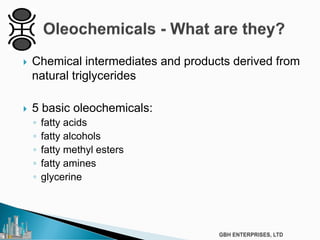
 Chemical intermediates and products derived from
natural triglycerides
 5 basic oleochemicals:
◦ fatty acids
◦ fatty alcohols
◦ fatty methyl esters
◦ fatty amines
◦ glycerine
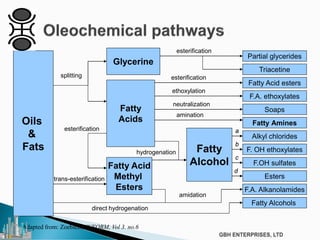
Glycerine
Fatty
Acids
Fatty Acid
Methyl
Esters
Fatty
Alcohol
Oils
&
Fats
splitting
esterification
trans-esterification
Partial glycerides
Triacetine
Fatty Acid esters
F.A. ethoxylates
Soaps
Fatty Amines
Alkyl chlorides
F. OH ethoxylates
F.OH sulfates
Esters
F.A. Alkanolamides
Fatty Alcohols
esterification
esterification
ethoxylation
neutralization
amination
hydrogenation
amidation
direct hydrogenation
Adapted from: Zoeblein, INFORM, Vol 3. no.6
a
b
c
d
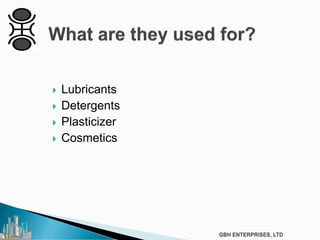
 Lubricants
 Detergents
 Plasticizer
 Cosmetics
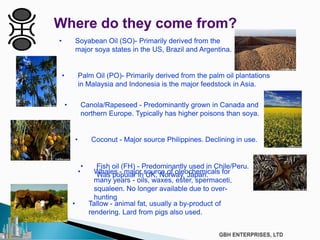
• Palm Oil (PO)- Primarily derived from the palm oil plantations
in Malaysia and Indonesia is the major feedstock in Asia.
• Coconut - Major source Philippines. Declining in use.
• Fish oil (FH) - Predominantly used in Chile/Peru.
Was popular in UK, Norway, Japan.
• Canola/Rapeseed - Predominantly grown in Canada and
northern Europe. Typically has higher poisons than soya.
• Soyabean Oil (SO)- Primarily derived from the
major soya states in the US, Brazil and Argentina.
• Tallow - animal fat, usually a by-product of
rendering. Lard from pigs also used.
Where do they come from?
• Whales - major source of oleochemicals for
many years - oils, waxes, ester, spermaceti,
squaleen. No longer available due to over-
hunting
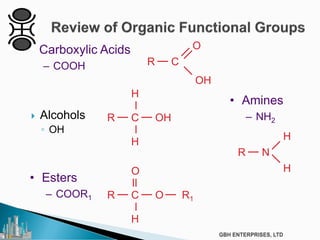
 Alcohols
◦ OH
OH
O
CR
OH
H
CR
H
H
H
NR
O
O
CR
H
R1
• Amines
– NH2
• Esters
– COOR1
• Carboxylic Acids
– COOH
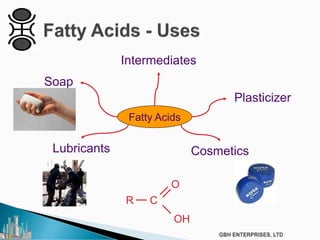
Fatty Acids
Soap
CosmeticsLubricants
Plasticizer
Intermediates
OH
O
CR
 Splitting
 Hydrogenation
 Distillation
 Different Process
◦ Twitchell
 used catalyst
◦ Continuos
 Colgate-Emery higher T & P than Twitchell
◦ Enzymatic
 lipases
 limited interest to date
 Usually to full saturatiuon
◦ i.e. break all double bonds
 Catalysts used
◦ Ni on silica powder; slurry phase
◦ Pd on C powder; slurry phase
◦ Pd on C; fixed bed
 Reactor systems
◦ Batch Dead End reactors
◦ Continuous Plug flow continuous reactors
◦ Loop reactors
◦ typical conditions 200°C & 20bar
 Typically a 22-25% Ni on silica or kieselguhr
support
 Used by the majority of the market
 Particle diameter 6-14 microns
 Narrow pores to prevent Ni dissolution
 Used once and then must be discarded
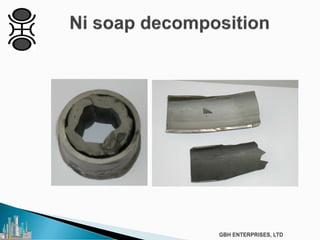
 Dissolved Ni soaps end up in distillate residues
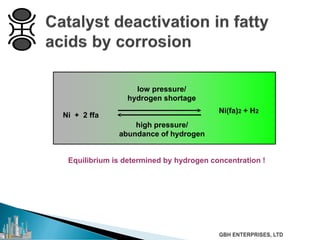
Equilibrium is determined by hydrogen concentration !
Ni(fa)2 + H2
low pressure/
hydrogen shortage
high pressure/
abundance of hydrogen
Ni + 2 ffa
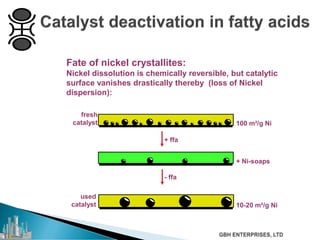
Fate of nickel crystallites:
Nickel dissolution is chemically reversible, but catalytic
surface vanishes drastically thereby (loss of Nickel
dispersion):
+ ffa
- ffa
+ Ni-soaps
fresh
catalyst 100 m²/g Ni
used
catalyst 10-20 m²/g Ni
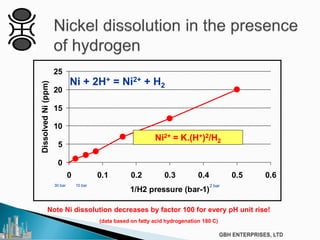
0
5
10
15
20
25
0 0.1 0.2 0.3 0.4 0.5 0.6
1/H2 pressure (bar-1)
DissolvedNi(ppm)
2 bar10 bar30 bar
Ni2+ = K.(H+)2/H2
Ni + 2H+ = Ni2+ + H2
Note Ni dissolution decreases by factor 100 for every pH unit rise!
(data based on fatty acid hydrogenation 180 C)
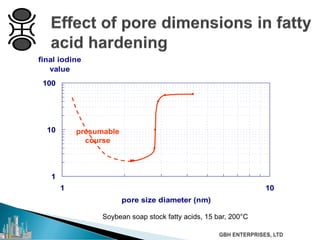
Smaller pore sizes impede diffusion of larger
molecules, i.e. triglycerides (Gly(fa)3) or nickel
soaps (Ni(fa)2)
Soybean soap stock fatty acids, 15 bar, 200°C
1
10
100
1 10
pore size diameter (nm)
final iodine
value
presumable
course
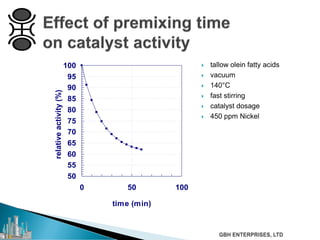
 tallow olein fatty acids
 vacuum
 140°C
 fast stirring
 catalyst dosage
 450 ppm Nickel
50
55
60
65
70
75
80
85
90
95
100
0 50 100
time (min)
relativeactivity(%)
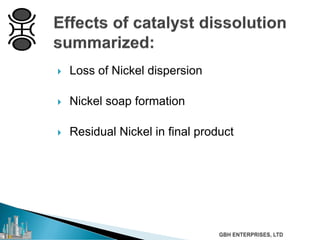
 Loss of Nickel dispersion
 Nickel soap formation
 Residual Nickel in final product
 Minimize contact time in absence of hydrogen
◦ Dose Ni to reactor just before addition of H2 or when it is
already under H2 pressure
◦ Filter catalyst from FA as quickly as possible
 If melting of catalyst pellets required, melt in
triglyceride
 Ni residues
 Environment
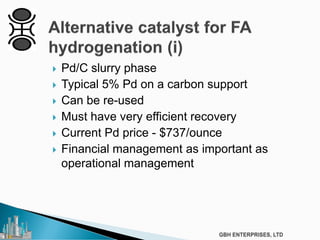
 Pd/C slurry phase
 Typical 5% Pd on a carbon support
 Can be re-used
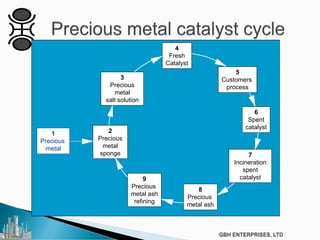
 Must have very efficient recovery
 Current Pd price - $737/ounce
 Financial management as important as
operational management
4
Fresh
Catalyst
6
Spent
catalyst
7
Incineration
spent
catalyst
8
Precious
metal ash
2
Precious
metal
sponge
3
Precious
metal
salt solution
1
Precious
metal
5
Customers
process
9
Precious
metal ash
refining
 Pd/C fixed bed
 Extrudates / Gauze
 High working capital use
 Efficient, continuous
production
 Ni fixed bed has proved
difficult (basic supports,
posion resistance)
IV < 1
unsat FA
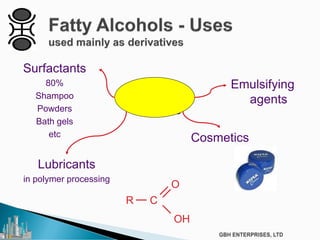
Fatty
Alcohols
Surfactants
80%
Shampoo
Powders
Bath gels
etc
Cosmetics
Lubricants
in polymer processing
Emulsifying
agents
OH
O
CR
 “Natural” fatty alcohols
◦ Hydrogenation (hydrogenolysis) of fatty methyl esters
◦ direct hydrogenation of fatty acids
 Synthetic fatty alcohols
◦ Oxo-Alcohols
◦ Ziegler process
 Catalysts used:
◦ CuCr
◦ CuZn
◦ CuSi
◦ Raney Cu
 Fixed bed and slurry phase units in operation
 Move to eliminate Cr
 Feed: methyl esters
 Gas phase FB
◦ 2900-3600psi; 230-250°C
 Trickle-bed
◦ 2900-4350psi; 250 °C
 Higher cat consumption than FB
 Greater flexibility
 Vertical plug-flow reactor
◦ 3600psi; 250-300°C
 Direct hydrogenolysis of fatty acids (Lurgi)
◦ Acid-resistant catalyst required
◦ Excess of fatty OH and loop employed
◦ 4350psi; 300°C
 Carbonyls in fatty OH can give unwanted
color, odor, etc
 Can be removed by hydrogenation with Ni
◦ e.g. fixed bed process with PRICAT HTC
 Ni impregnated alumina trilobe extrudate
◦ 100-150°C; 20-50bar
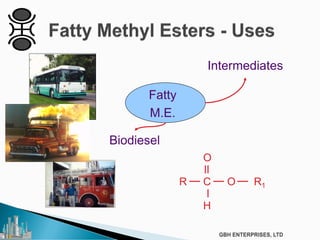
Fatty
M.E.
Intermediates
Biodiesel
O
O
CR
H
R1
 Usually manufactured directly from oils via
methanolysis with alkaline catalysts (e.g.
sodium methylate)
CH2OH
CHOH
CH2OH
3CHOH 3RCOOCH3
RCOOCH2
RCOOCH
RCOOCH2
NaOCH3
+ +
methyl ester
 Lower energy consumption
 Less corrosive -> less expensive equipment
 More concentrated glycerine
 Easier to distill
 Superiority in some reactions
 However the use of MeOH can have its
downsides
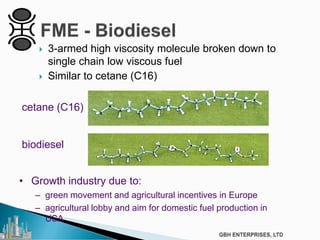
 3-armed high viscosity molecule broken down to
single chain low viscous fuel
 Similar to cetane (C16)
• Growth industry due to:
– green movement and agricultural incentives in Europe
– agricultural lobby and aim for domestic fuel production in
USA
cetane (C16)
biodiesel
Most uses depend on the cationic nature of the amine
Fatty
Amines
Corrosion
Inhibitors
Fabric
Softeners
Lubricant
Additive
Organoclays
Sanitizing
Agents
H
H
NR
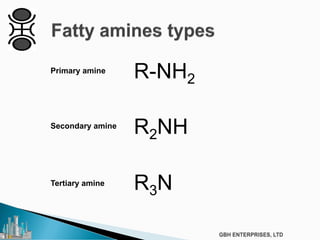
Primary amine
Secondary amine
Tertiary amine
R-NH2
R2NH
R3N
Which amines are produced depends on:
 reaction conditions
◦ NH3 pressure
◦ temperature
 Catalyst choice
◦ Raney Ni
◦ Supported Ni powders
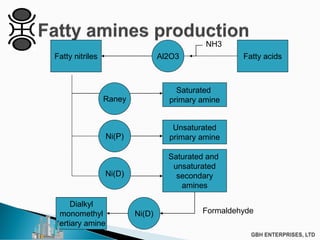
Fatty nitriles Fatty acidsAl2O3
NH3
Unsaturated
primary amine
Saturated
primary amine
Saturated and
unsaturated
secondary
amines
Dialkyl
monomethyl
tertiary amine
Ni(P)
Raney
Ni(D)
Ni(D) Formaldehyde
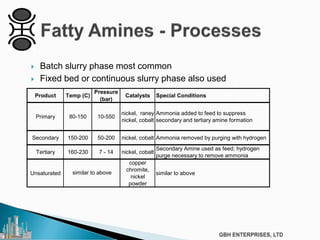
 Batch slurry phase most common
 Fixed bed or continuous slurry phase also used
Product Temp (C)
Pressure
(bar)
Catalysts Special Conditions
Primary 80-150 10-550
nickel, raney
nickel, cobalt
Ammonia added to feed to suppress
secondary and tertiary amine formation
Secondary 150-200 50-200 nickel, cobalt Ammonia removed by purging with hydrogen
Tertiary 160-230 7 - 14 nickel, cobalt
Secondary Amine used as feed; hydrogen
purge necessary to remove ammonia
Unsaturated
copper
chromite,
nickel
powder
similar to abovesimilar to above
R-COOH + NH3 R-COONH4
R-COONH4 R-CONH2 + H2O
ammonium salt
amide
R-CONH2 R-CN + H2O
nitrile
R-CN + 2H2 FATTY AMINES
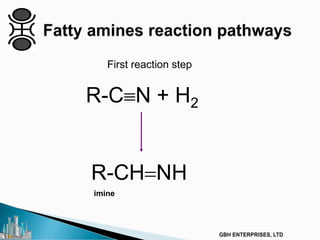
R-C≡N + H2
R-CH=NH
imine
First reaction step
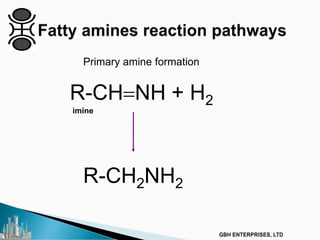
R-CH=NH + H2
imine
Primary amine formation
R-CH2NH2
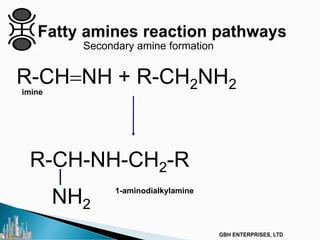
Secondary amine formation
R-CH=NH + R-CH2NH2imine
R-CH-NH-CH2-R
NH2
1-aminodialkylamine
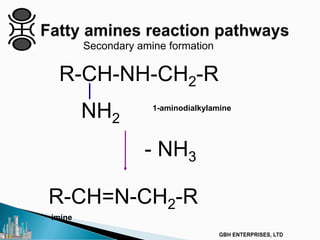
Secondary amine formation
R-CH-NH-CH2-R
NH2
1-aminodialkylamine
R-CH=N-CH2-R
- NH3
imine
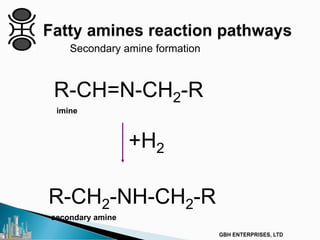
Secondary amine formation
R-CH2-NH-CH2-R
secondary amine
R-CH=N-CH2-R
imine
+H2
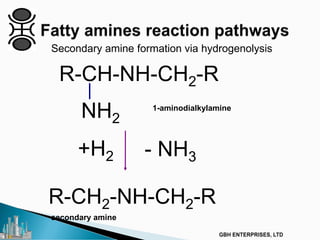
Secondary amine formation via hydrogenolysis
R-CH-NH-CH2-R
NH2
1-aminodialkylamine
R-CH2-NH-CH2-R
- NH3
secondary amine
+H2
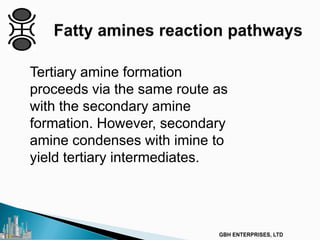
Tertiary amine formation
proceeds via the same route as
with the secondary amine
formation. However, secondary
amine condenses with imine to
yield tertiary intermediates.
 By-product during manufacture of
◦ fatty acid
◦ methyl esters & bio-diesel
◦ fatty alcohols
 Also synthetic manufacturing
 Supply-Demand balance always difficult
 What to do with it all?
Personal Care
Glycerine
Tobacco
Pharmaceutical
Food
Explosives
 Supply will increase
◦ increasing production of biodiesel and use of oils and fats
as industrial feedstock
 New demands must be found/created
◦ some of these may involve catalytic processes
◦ e.g. glycerine to glyceric acid over gold catalyst
Oleochemicals and Catalysts Used

Oleochemicals and Catalysts Used

  • 1.
  • 2.
     Chemical intermediatesand products derived from natural triglycerides  5 basic oleochemicals: ◦ fatty acids ◦ fatty alcohols ◦ fatty methyl esters ◦ fatty amines ◦ glycerine
  • 3.
    Glycerine Fatty Acids Fatty Acid Methyl Esters Fatty Alcohol Oils & Fats splitting esterification trans-esterification Partial glycerides Triacetine FattyAcid esters F.A. ethoxylates Soaps Fatty Amines Alkyl chlorides F. OH ethoxylates F.OH sulfates Esters F.A. Alkanolamides Fatty Alcohols esterification esterification ethoxylation neutralization amination hydrogenation amidation direct hydrogenation Adapted from: Zoeblein, INFORM, Vol 3. no.6 a b c d
  • 4.
     Lubricants  Detergents Plasticizer  Cosmetics
  • 5.
    • Palm Oil(PO)- Primarily derived from the palm oil plantations in Malaysia and Indonesia is the major feedstock in Asia. • Coconut - Major source Philippines. Declining in use. • Fish oil (FH) - Predominantly used in Chile/Peru. Was popular in UK, Norway, Japan. • Canola/Rapeseed - Predominantly grown in Canada and northern Europe. Typically has higher poisons than soya. • Soyabean Oil (SO)- Primarily derived from the major soya states in the US, Brazil and Argentina. • Tallow - animal fat, usually a by-product of rendering. Lard from pigs also used. Where do they come from? • Whales - major source of oleochemicals for many years - oils, waxes, ester, spermaceti, squaleen. No longer available due to over- hunting
  • 6.
     Alcohols ◦ OH OH O CR OH H CR H H H NR O O CR H R1 •Amines – NH2 • Esters – COOR1 • Carboxylic Acids – COOH
  • 7.
  • 8.
  • 9.
     Different Process ◦Twitchell  used catalyst ◦ Continuos  Colgate-Emery higher T & P than Twitchell ◦ Enzymatic  lipases  limited interest to date
  • 10.
     Usually tofull saturatiuon ◦ i.e. break all double bonds  Catalysts used ◦ Ni on silica powder; slurry phase ◦ Pd on C powder; slurry phase ◦ Pd on C; fixed bed  Reactor systems ◦ Batch Dead End reactors ◦ Continuous Plug flow continuous reactors ◦ Loop reactors ◦ typical conditions 200°C & 20bar
  • 11.
     Typically a22-25% Ni on silica or kieselguhr support  Used by the majority of the market  Particle diameter 6-14 microns  Narrow pores to prevent Ni dissolution  Used once and then must be discarded  Dissolved Ni soaps end up in distillate residues
  • 12.
    Equilibrium is determinedby hydrogen concentration ! Ni(fa)2 + H2 low pressure/ hydrogen shortage high pressure/ abundance of hydrogen Ni + 2 ffa
  • 13.
    Fate of nickelcrystallites: Nickel dissolution is chemically reversible, but catalytic surface vanishes drastically thereby (loss of Nickel dispersion): + ffa - ffa + Ni-soaps fresh catalyst 100 m²/g Ni used catalyst 10-20 m²/g Ni
  • 15.
    0 5 10 15 20 25 0 0.1 0.20.3 0.4 0.5 0.6 1/H2 pressure (bar-1) DissolvedNi(ppm) 2 bar10 bar30 bar Ni2+ = K.(H+)2/H2 Ni + 2H+ = Ni2+ + H2 Note Ni dissolution decreases by factor 100 for every pH unit rise! (data based on fatty acid hydrogenation 180 C)
  • 16.
    Smaller pore sizesimpede diffusion of larger molecules, i.e. triglycerides (Gly(fa)3) or nickel soaps (Ni(fa)2)
  • 17.
    Soybean soap stockfatty acids, 15 bar, 200°C 1 10 100 1 10 pore size diameter (nm) final iodine value presumable course
  • 18.
     tallow oleinfatty acids  vacuum  140°C  fast stirring  catalyst dosage  450 ppm Nickel 50 55 60 65 70 75 80 85 90 95 100 0 50 100 time (min) relativeactivity(%)
  • 19.
     Loss ofNickel dispersion  Nickel soap formation  Residual Nickel in final product
  • 20.
     Minimize contacttime in absence of hydrogen ◦ Dose Ni to reactor just before addition of H2 or when it is already under H2 pressure ◦ Filter catalyst from FA as quickly as possible  If melting of catalyst pellets required, melt in triglyceride
  • 21.
  • 22.
     Pd/C slurryphase  Typical 5% Pd on a carbon support  Can be re-used  Must have very efficient recovery  Current Pd price - $737/ounce  Financial management as important as operational management
  • 23.
  • 24.
     Pd/C fixedbed  Extrudates / Gauze  High working capital use  Efficient, continuous production  Ni fixed bed has proved difficult (basic supports, posion resistance) IV < 1 unsat FA
  • 25.
  • 26.
     “Natural” fattyalcohols ◦ Hydrogenation (hydrogenolysis) of fatty methyl esters ◦ direct hydrogenation of fatty acids  Synthetic fatty alcohols ◦ Oxo-Alcohols ◦ Ziegler process
  • 27.
     Catalysts used: ◦CuCr ◦ CuZn ◦ CuSi ◦ Raney Cu  Fixed bed and slurry phase units in operation  Move to eliminate Cr
  • 28.
     Feed: methylesters  Gas phase FB ◦ 2900-3600psi; 230-250°C  Trickle-bed ◦ 2900-4350psi; 250 °C
  • 29.
     Higher catconsumption than FB  Greater flexibility  Vertical plug-flow reactor ◦ 3600psi; 250-300°C  Direct hydrogenolysis of fatty acids (Lurgi) ◦ Acid-resistant catalyst required ◦ Excess of fatty OH and loop employed ◦ 4350psi; 300°C
  • 30.
     Carbonyls infatty OH can give unwanted color, odor, etc  Can be removed by hydrogenation with Ni ◦ e.g. fixed bed process with PRICAT HTC  Ni impregnated alumina trilobe extrudate ◦ 100-150°C; 20-50bar
  • 31.
  • 32.
     Usually manufactureddirectly from oils via methanolysis with alkaline catalysts (e.g. sodium methylate) CH2OH CHOH CH2OH 3CHOH 3RCOOCH3 RCOOCH2 RCOOCH RCOOCH2 NaOCH3 + + methyl ester
  • 33.
     Lower energyconsumption  Less corrosive -> less expensive equipment  More concentrated glycerine  Easier to distill  Superiority in some reactions  However the use of MeOH can have its downsides
  • 34.
     3-armed highviscosity molecule broken down to single chain low viscous fuel  Similar to cetane (C16) • Growth industry due to: – green movement and agricultural incentives in Europe – agricultural lobby and aim for domestic fuel production in USA cetane (C16) biodiesel
  • 35.
    Most uses dependon the cationic nature of the amine Fatty Amines Corrosion Inhibitors Fabric Softeners Lubricant Additive Organoclays Sanitizing Agents H H NR
  • 36.
  • 37.
    Which amines areproduced depends on:  reaction conditions ◦ NH3 pressure ◦ temperature  Catalyst choice ◦ Raney Ni ◦ Supported Ni powders
  • 38.
    Fatty nitriles FattyacidsAl2O3 NH3 Unsaturated primary amine Saturated primary amine Saturated and unsaturated secondary amines Dialkyl monomethyl tertiary amine Ni(P) Raney Ni(D) Ni(D) Formaldehyde
  • 39.
     Batch slurryphase most common  Fixed bed or continuous slurry phase also used Product Temp (C) Pressure (bar) Catalysts Special Conditions Primary 80-150 10-550 nickel, raney nickel, cobalt Ammonia added to feed to suppress secondary and tertiary amine formation Secondary 150-200 50-200 nickel, cobalt Ammonia removed by purging with hydrogen Tertiary 160-230 7 - 14 nickel, cobalt Secondary Amine used as feed; hydrogen purge necessary to remove ammonia Unsaturated copper chromite, nickel powder similar to abovesimilar to above
  • 40.
    R-COOH + NH3R-COONH4 R-COONH4 R-CONH2 + H2O ammonium salt amide R-CONH2 R-CN + H2O nitrile R-CN + 2H2 FATTY AMINES
  • 41.
  • 42.
    R-CH=NH + H2 imine Primaryamine formation R-CH2NH2
  • 43.
    Secondary amine formation R-CH=NH+ R-CH2NH2imine R-CH-NH-CH2-R NH2 1-aminodialkylamine
  • 44.
  • 45.
  • 46.
    Secondary amine formationvia hydrogenolysis R-CH-NH-CH2-R NH2 1-aminodialkylamine R-CH2-NH-CH2-R - NH3 secondary amine +H2
  • 47.
    Tertiary amine formation proceedsvia the same route as with the secondary amine formation. However, secondary amine condenses with imine to yield tertiary intermediates.
  • 48.
     By-product duringmanufacture of ◦ fatty acid ◦ methyl esters & bio-diesel ◦ fatty alcohols  Also synthetic manufacturing  Supply-Demand balance always difficult  What to do with it all?
  • 49.
  • 50.
     Supply willincrease ◦ increasing production of biodiesel and use of oils and fats as industrial feedstock  New demands must be found/created ◦ some of these may involve catalytic processes ◦ e.g. glycerine to glyceric acid over gold catalyst