Prepared 1/2019
Nico Sutmoller
Global Lightweight Fill Specialist
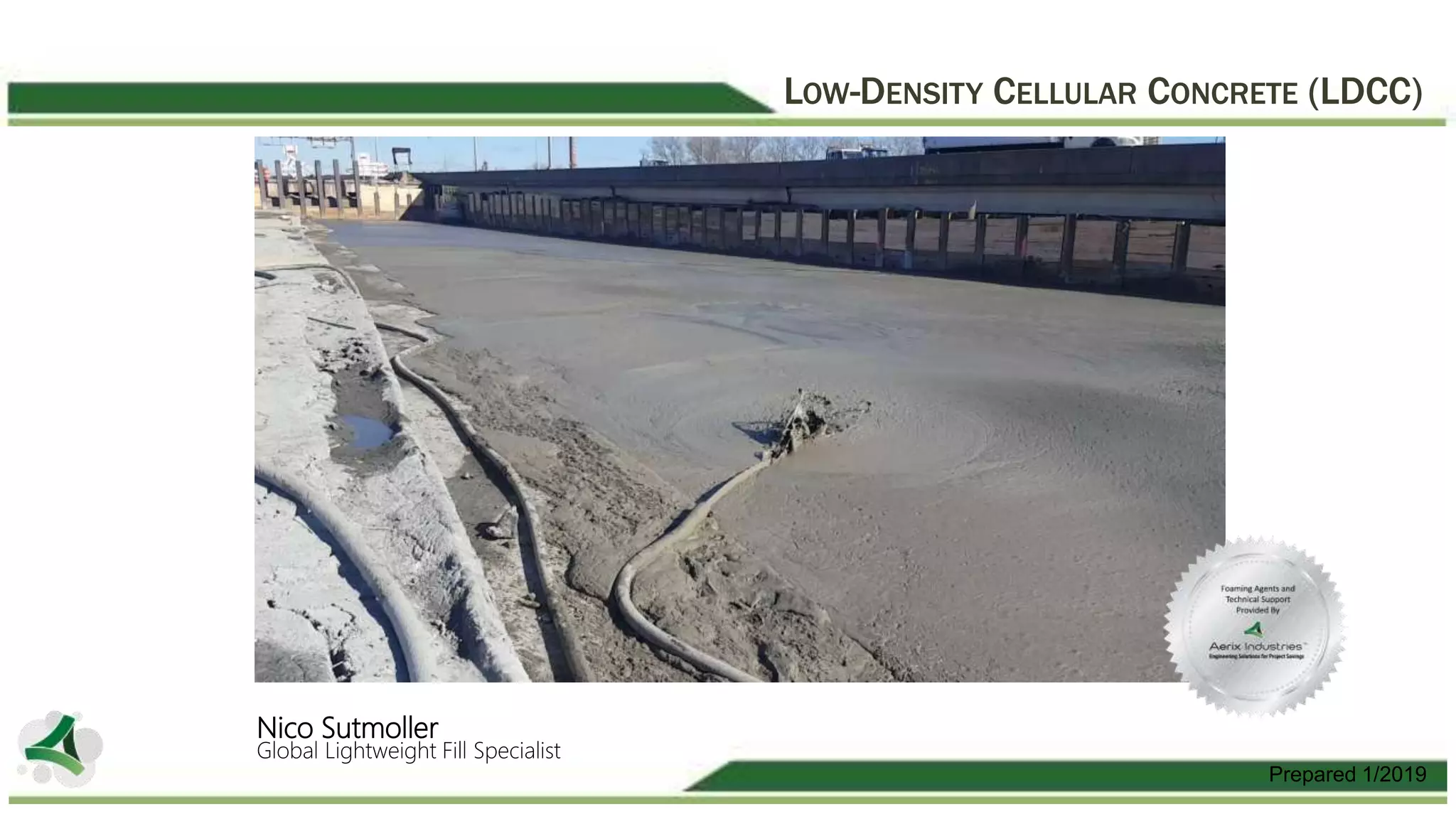
LOW-DENSITY CELLULAR CONCRETE (LDCC)
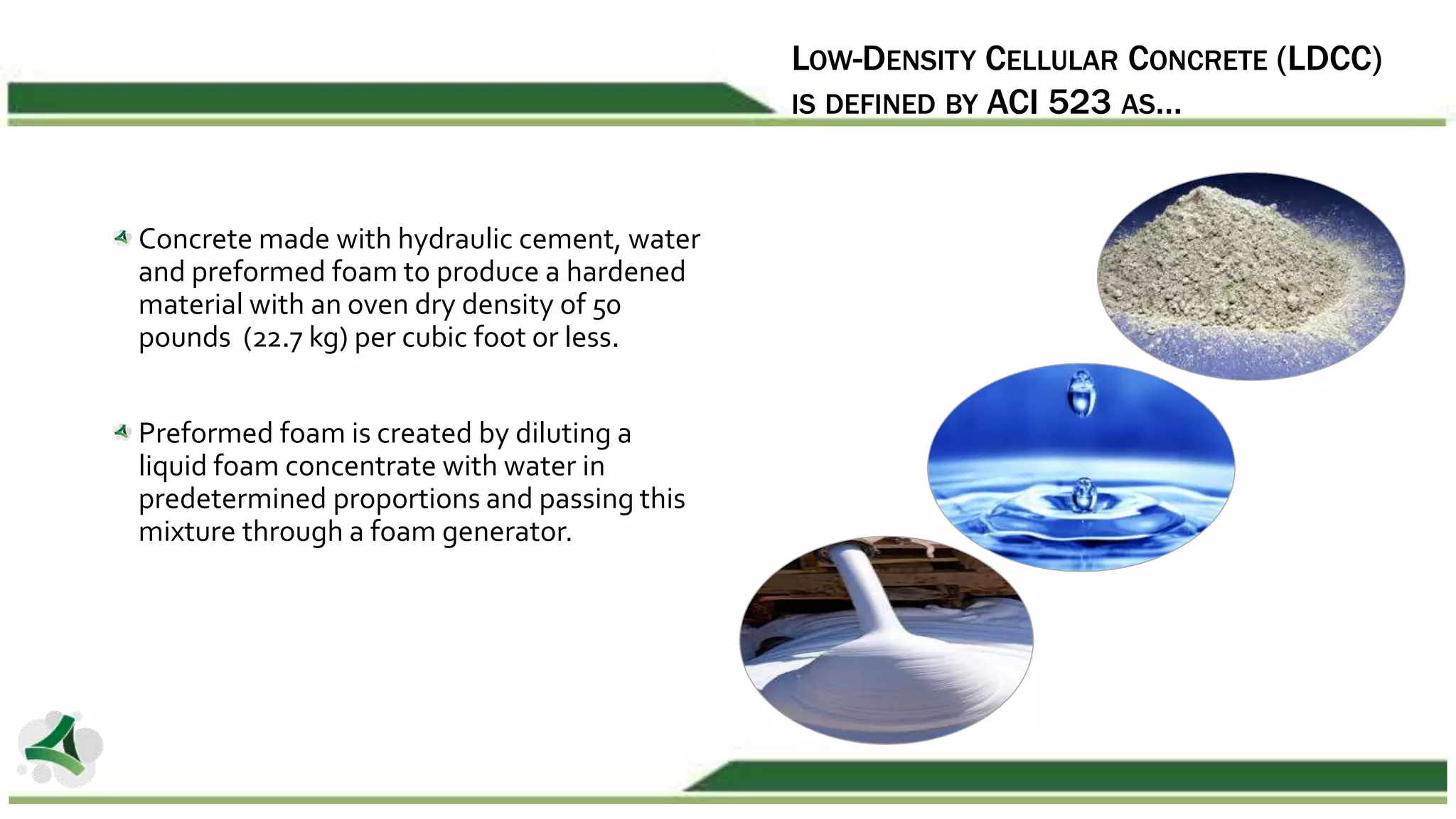
Concrete made with hydraulic cement, water
and preformed foam to produce a hardened
material with an oven dry density of 50
pounds (22.7 kg) per cubic foot or less.
Preformed foam is created by diluting a
liquid foam concentrate with water in
predetermined proportions and passing this
mixture through a foam generator.
LOW-DENSITY CELLULAR CONCRETE (LDCC)
IS DEFINED BY ACI 523 AS…
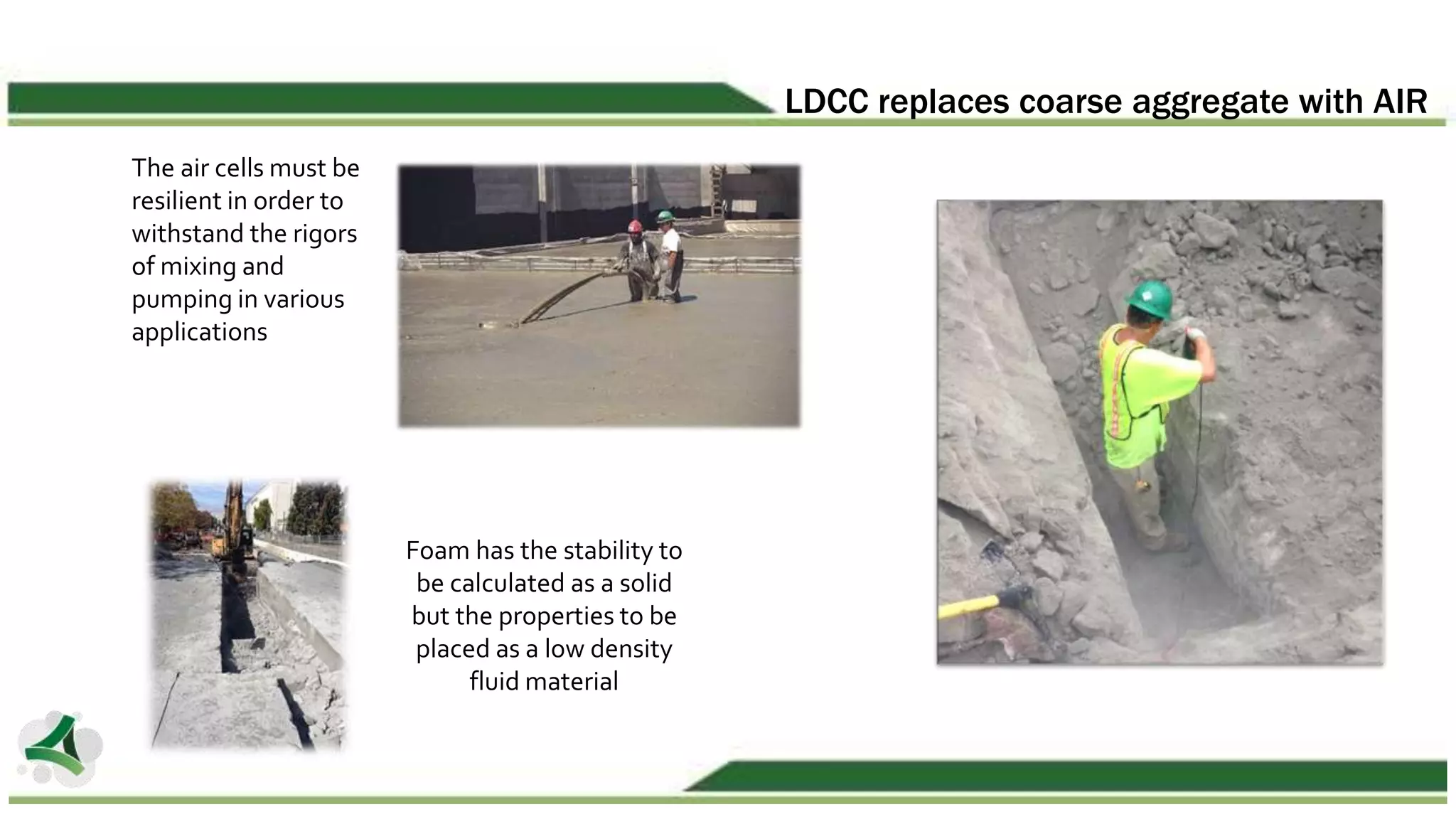
LDCC replaces coarse aggregate with AIR
The air cells must be
resilient in order to
withstand the rigors
of mixing and
pumping in various
applications
Foam has the stability to
be calculated as a solid
but the properties to be
placed as a low density
fluid material
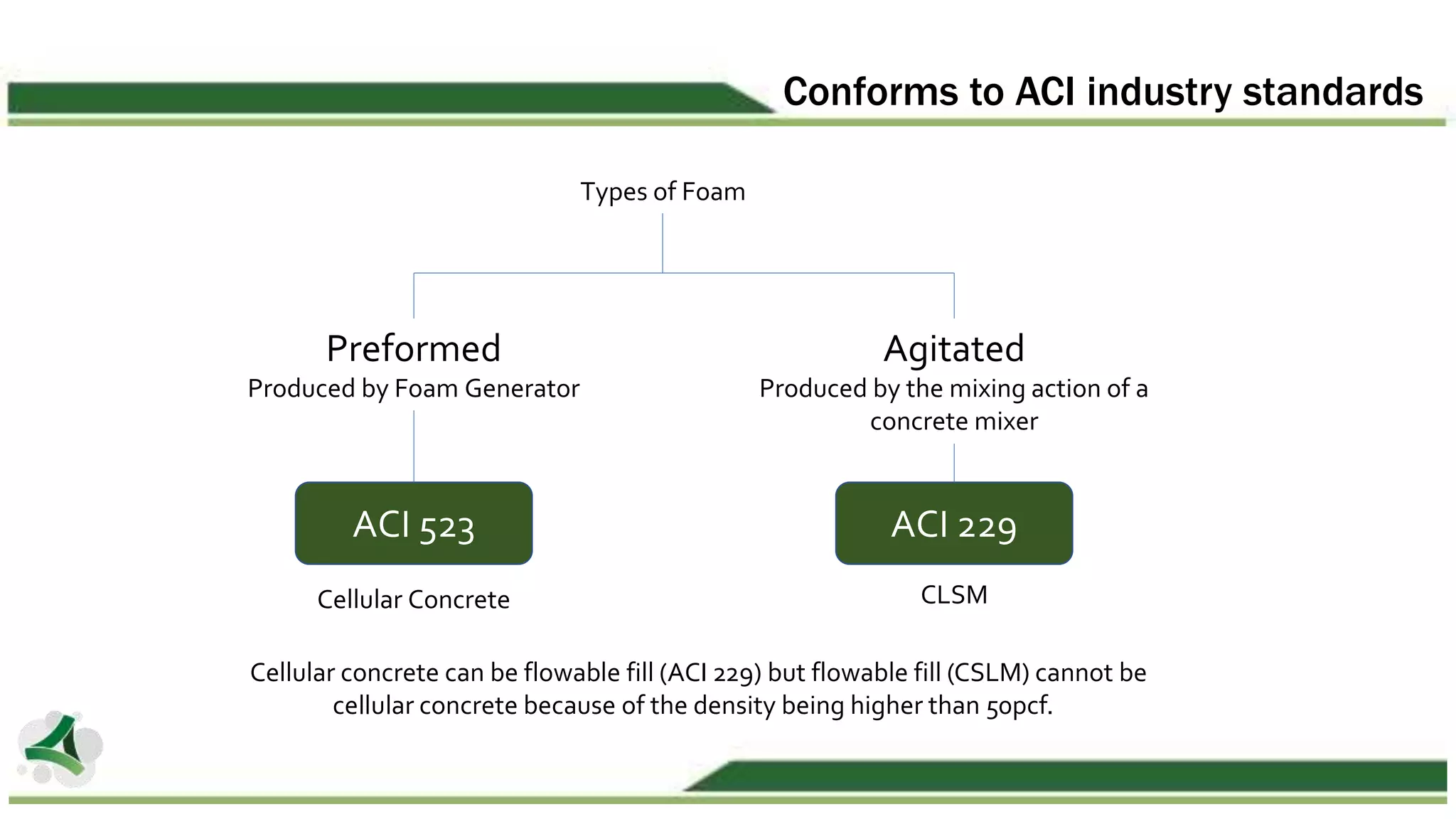
Conforms to ACI industry standards
Types of Foam
Preformed
Produced by Foam Generator
Agitated
Produced by the mixing action of a
concrete mixer
ACI 523 ACI 229
Cellular Concrete CLSM
Cellular concrete can be flowable fill (ACI 229) but flowable fill (CSLM) cannot be
cellular concrete because of the density being higher than 50pcf.
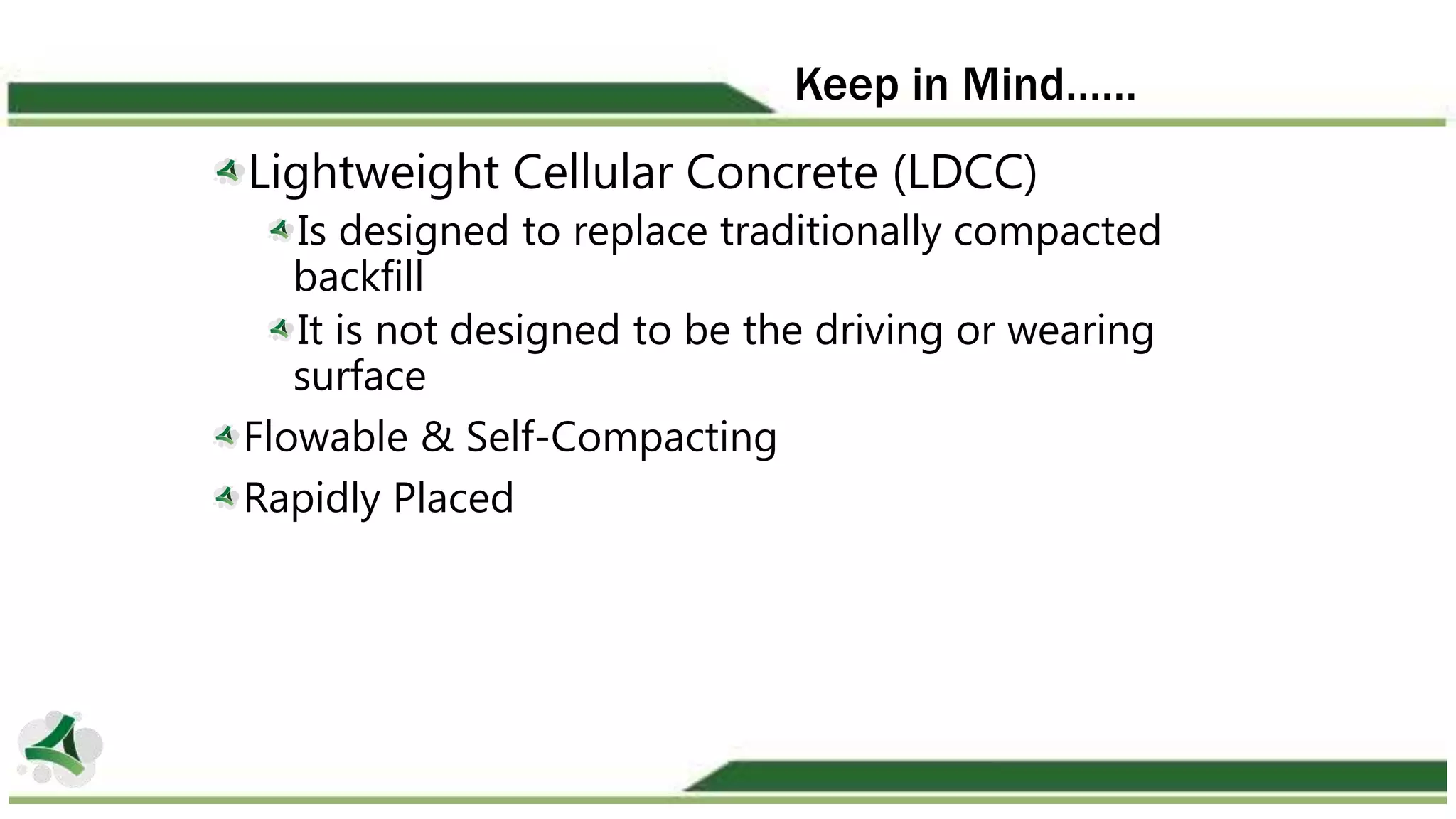
Keep in Mind……
Lightweight Cellular Concrete (LDCC)
Is designed to replace traditionally compacted
backfill
It is not designed to be the driving or wearing
surface
Flowable & Self-Compacting
Rapidly Placed
LDCC pore structure when cured
Cementitious materials encapsulate the air
bubbles, then dissipate, leaving a void
structure as a replacement to traditional
aggregate
LightweightCellular Concrete differs from
conventional aggregate concrete in the
methods of production, the density of the
material and the extensive range of end
uses.
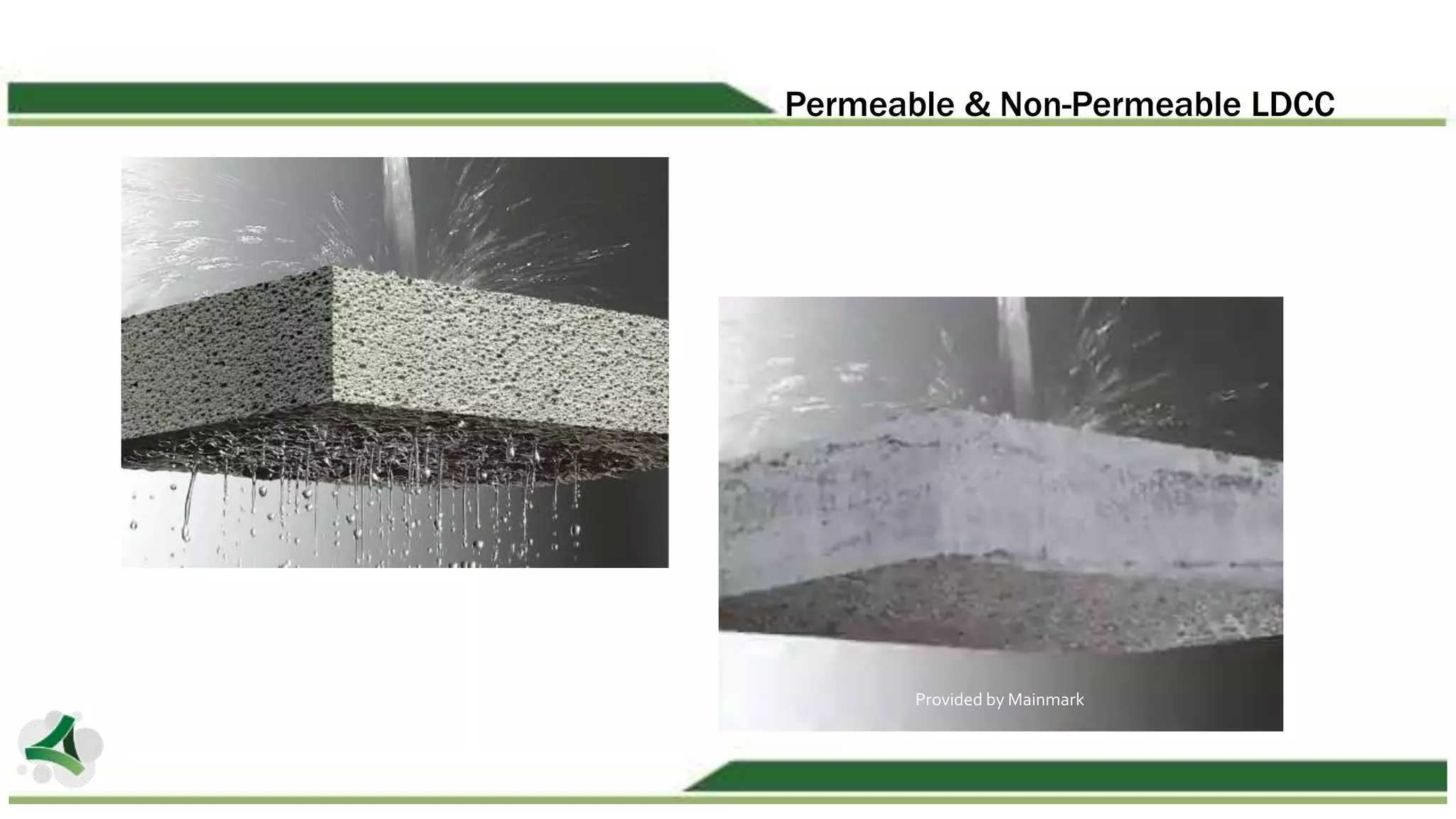
Permeable & Non-Permeable LDCC
Provided by Mainmark
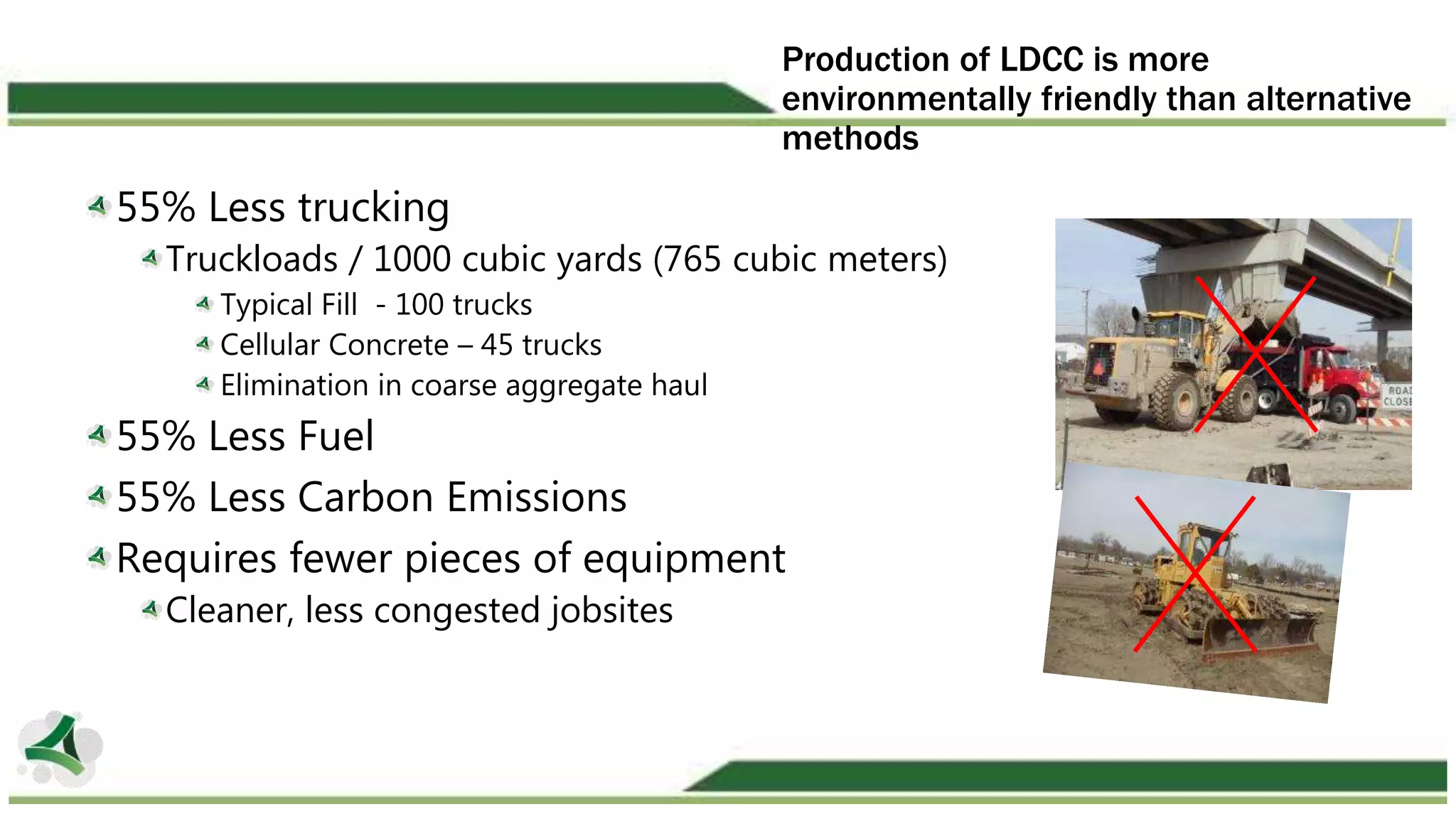
Production of LDCC is more
environmentally friendly than alternative
methods
55% Less trucking
Truckloads / 1000 cubic yards (765 cubic meters)
Typical Fill - 100 trucks
Cellular Concrete – 45 trucks
Elimination in coarse aggregate haul
55% Less Fuel
55% Less Carbon Emissions
Requires fewer pieces of equipment
Cleaner, less congested jobsites
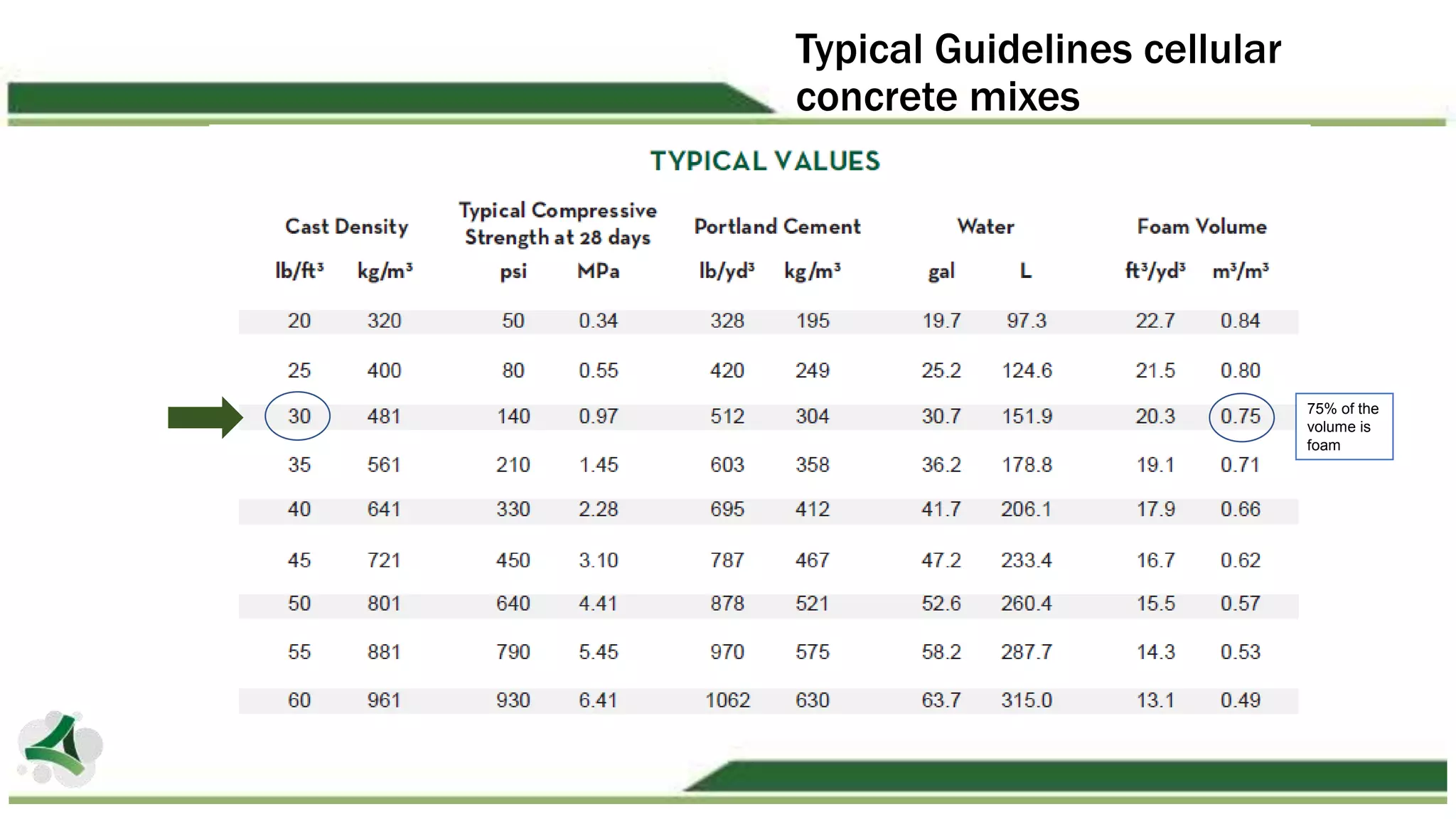
Typical Guidelines cellular
concrete mixes
75% of the
volume is
foam
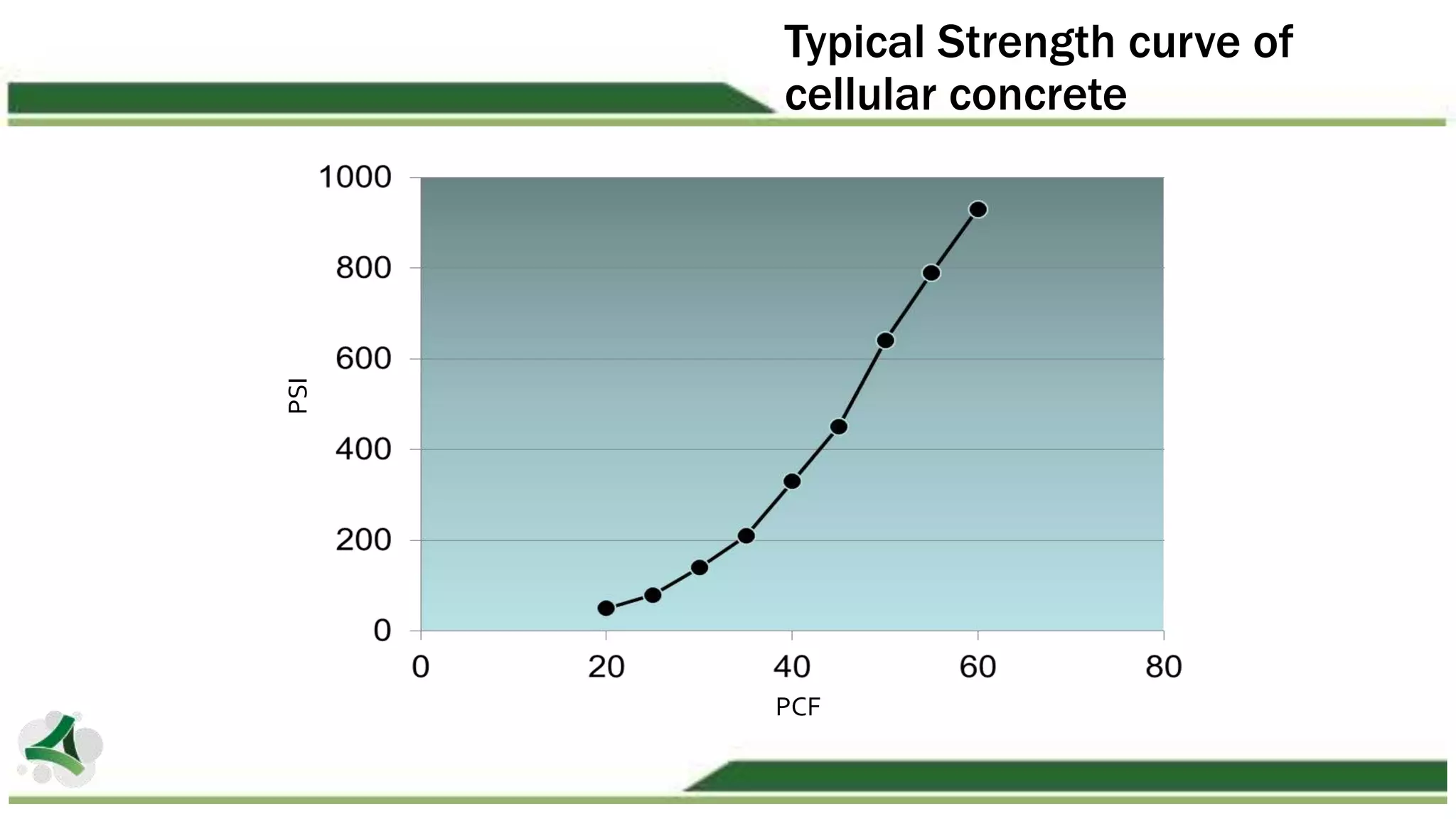
PCF
PSI
Typical Strength curve of
cellular concrete
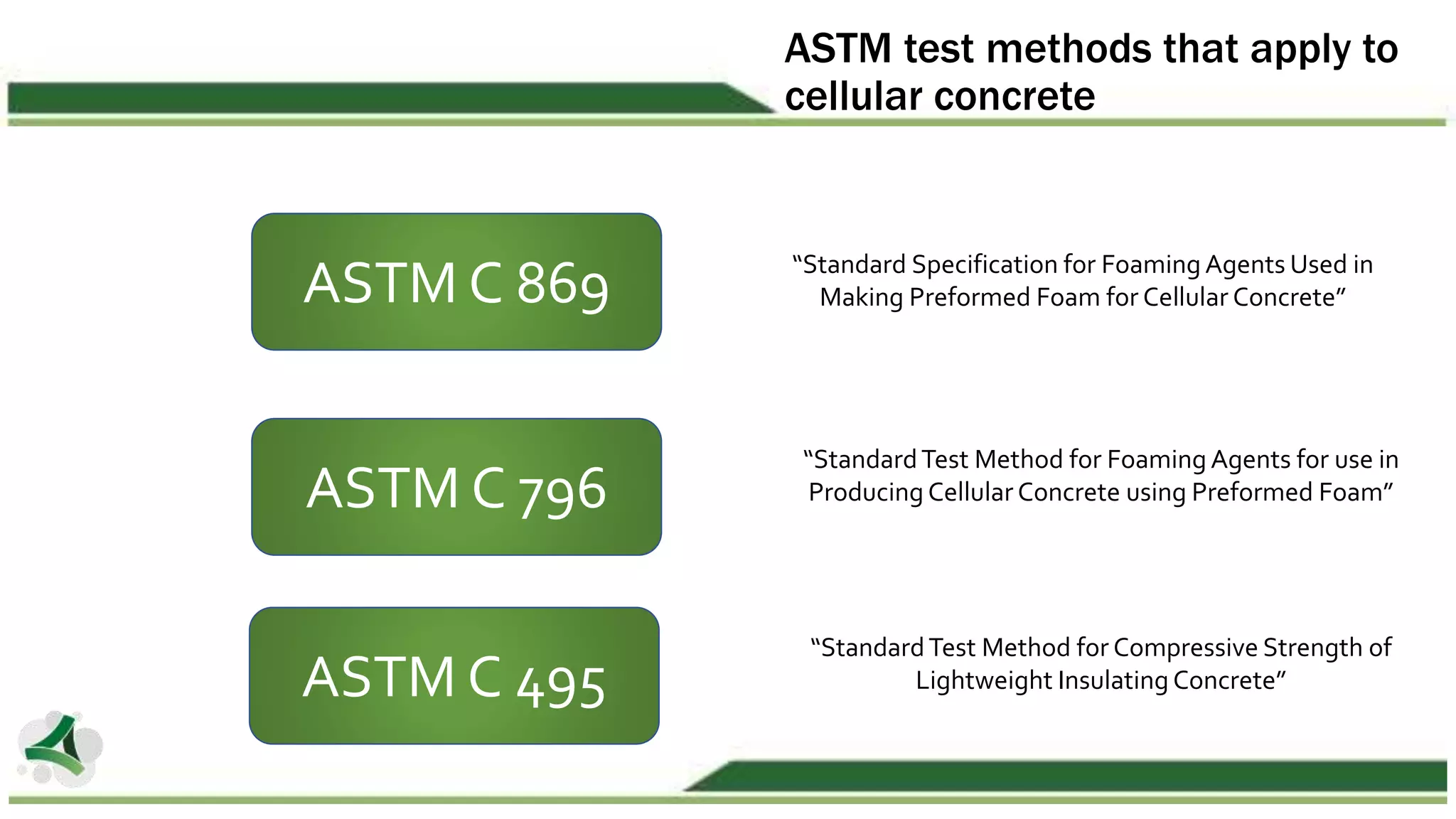
ASTM test methods that apply to
cellular concrete
ASTM C 495
ASTM C 796
“StandardTest Method for Compressive Strength of
Lightweight Insulating Concrete”
“StandardTest Method for Foaming Agents for use in
Producing Cellular Concrete using Preformed Foam”
ASTM C 869 “Standard Specification for Foaming Agents Used in
Making Preformed Foam for Cellular Concrete”
Quality Control is Always
Measured in the field
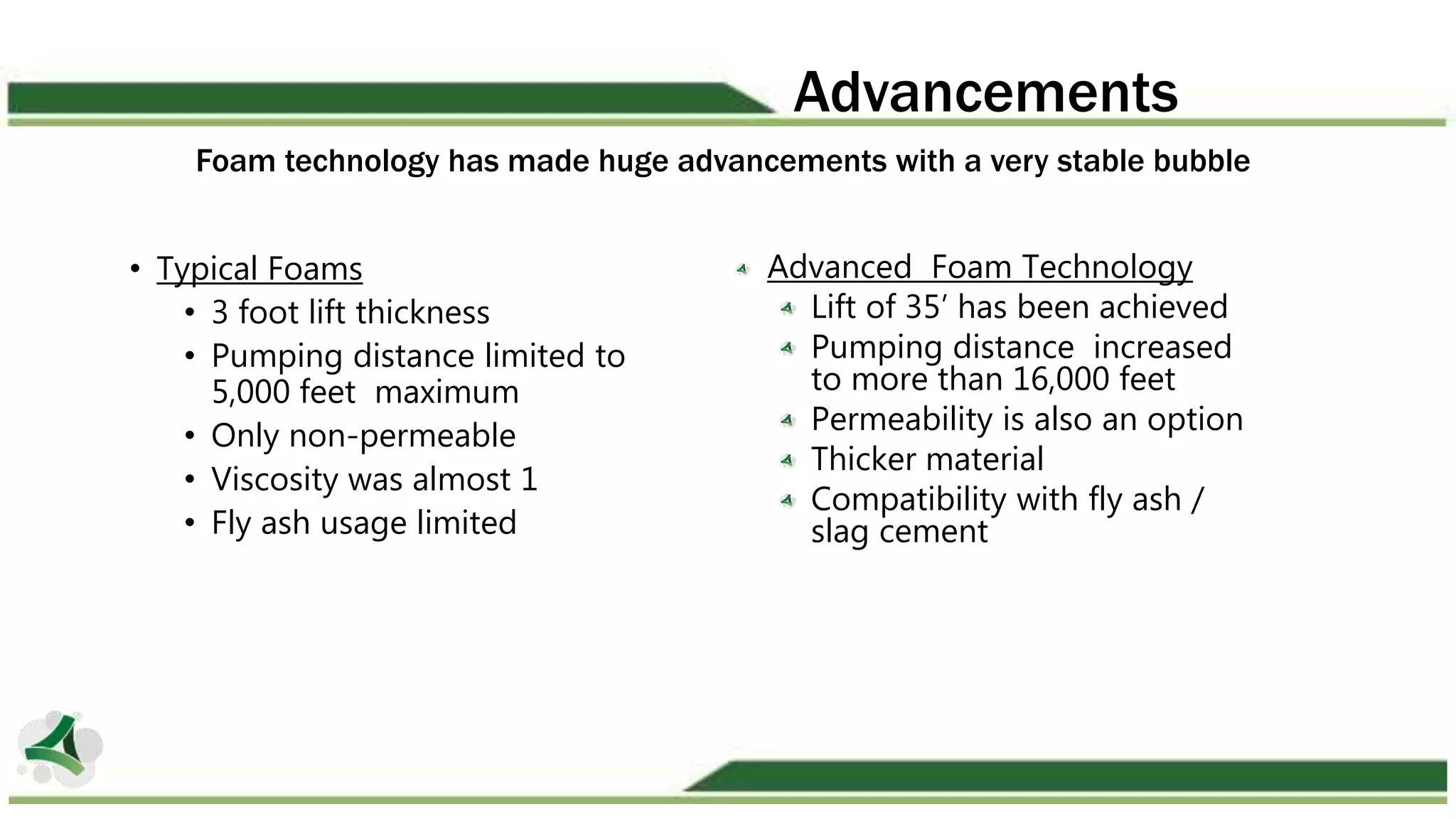
Foam technology has made huge advancements with a very stable bubble
• Typical Foams
• 3 foot lift thickness
• Pumping distance limited to
5,000 feet maximum
• Only non-permeable
• Viscosity was almost 1
• Fly ash usage limited
Advanced Foam Technology
Lift of 35’ has been achieved
Pumping distance increased
to more than 16,000 feet
Permeability is also an option
Thicker material
Compatibility with fly ash /
slag cement
Advancements
Typical Applications
Tunnel & Mine Abandonment
Annular Fills for Tunnels, Water & Sewer Lines
Void Fills
Soft Soil Remediation
Tremie Applications
Retaining Structure Backfills
Slope Stabilization
Fill for Underground Utility, Conduit & Pipes
Tanks & Pipeline Abandonment
Fill Around Conduits and Pipes
Green Roof Applications
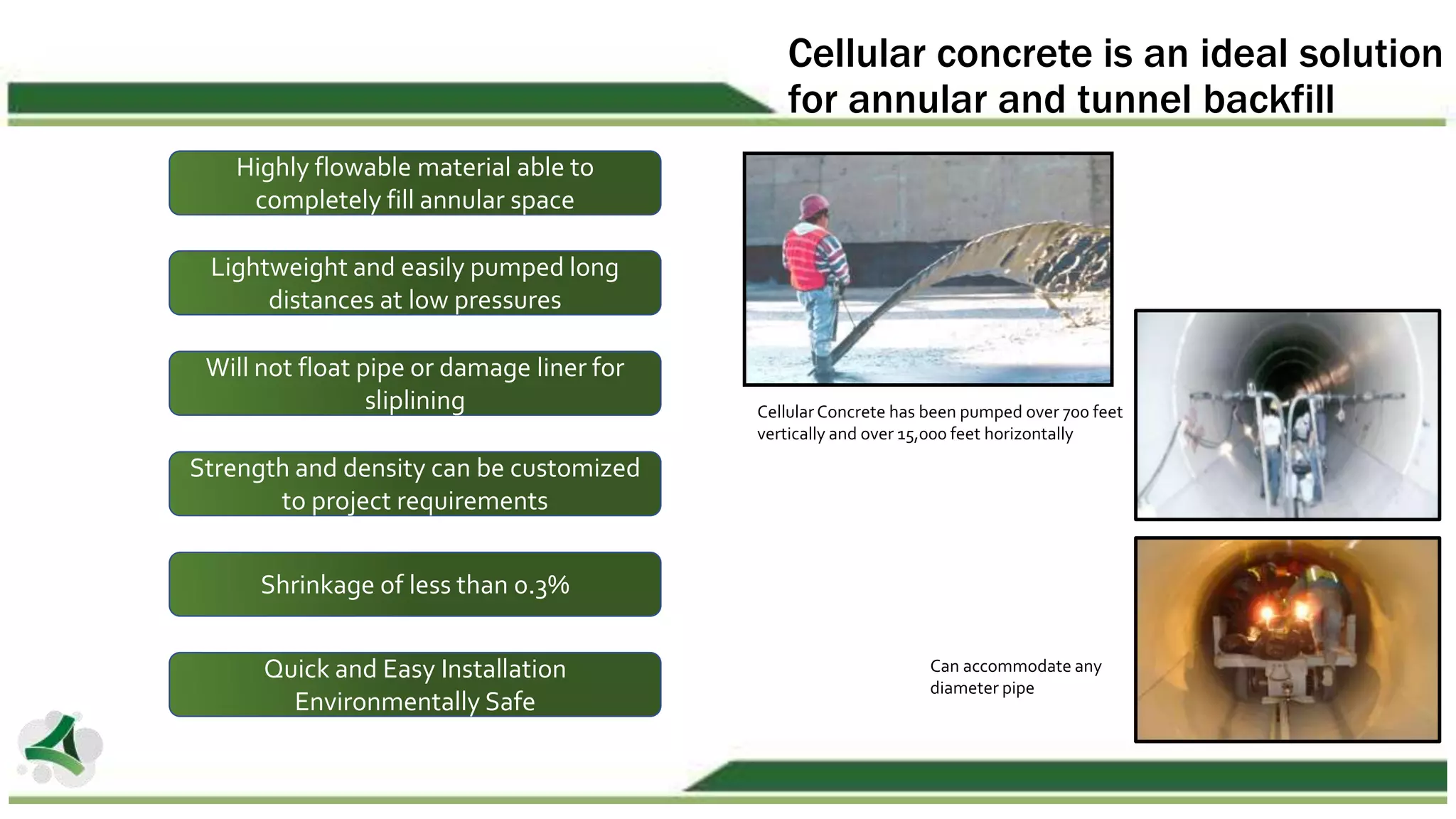
Cellular concrete is an ideal solution
for annular and tunnel backfill
Highly flowable material able to
completely fill annular space
Lightweight and easily pumped long
distances at low pressures
Will not float pipe or damage liner for
sliplining
Shrinkage of less than 0.3%
Quick and Easy Installation
Environmentally Safe
Strength and density can be customized
to project requirements
Cellular Concrete has been pumped over 700 feet
vertically and over 15,000 feet horizontally
Can accommodate any
diameter pipe
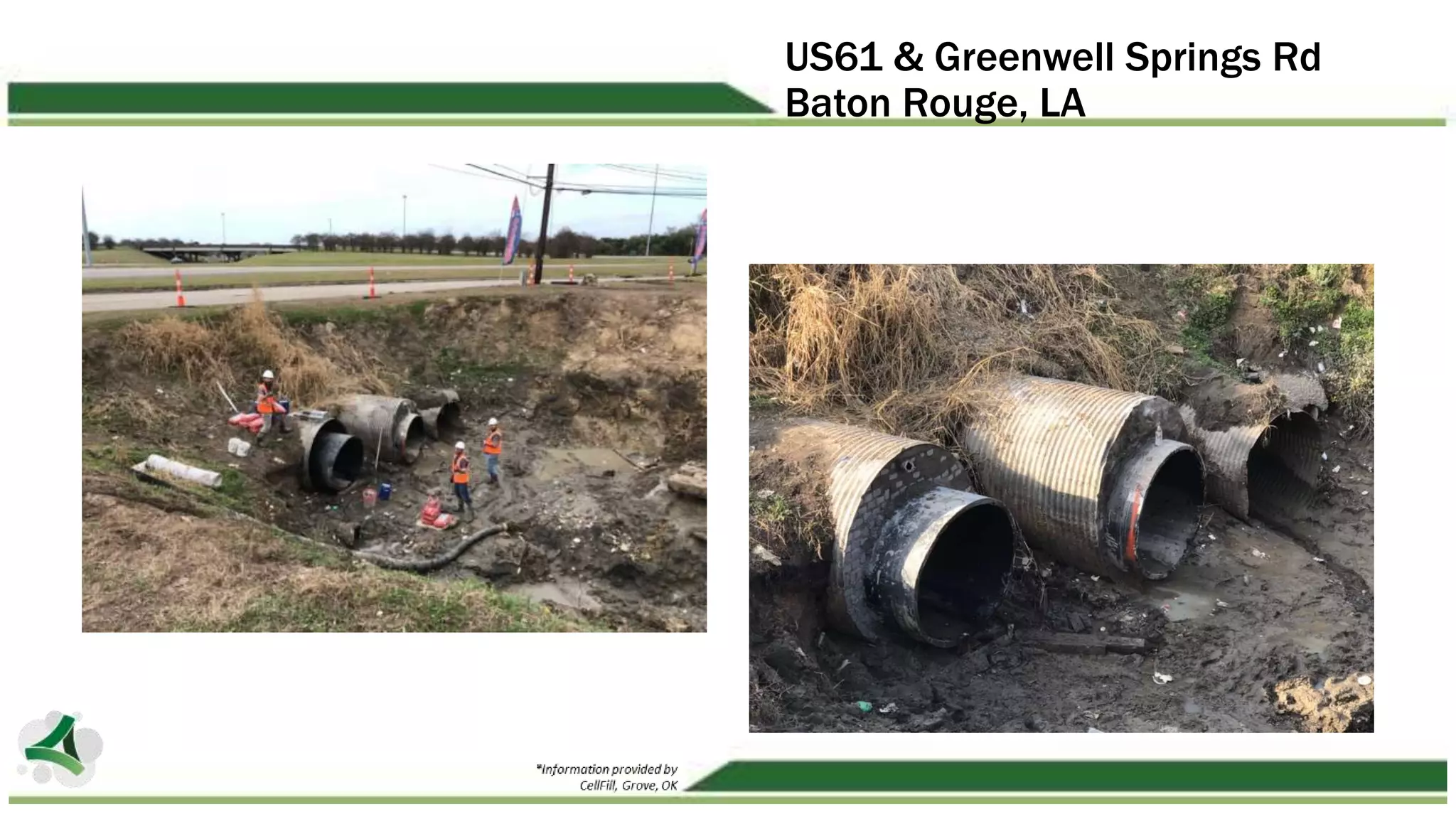
Culvert or Annular Application
150 yd3 (114 m3)of 500psi (3.4 MPa) pumped
100ft (30.5m) under SR 1 for MaineDot
Photo Courtesy of SnapTite
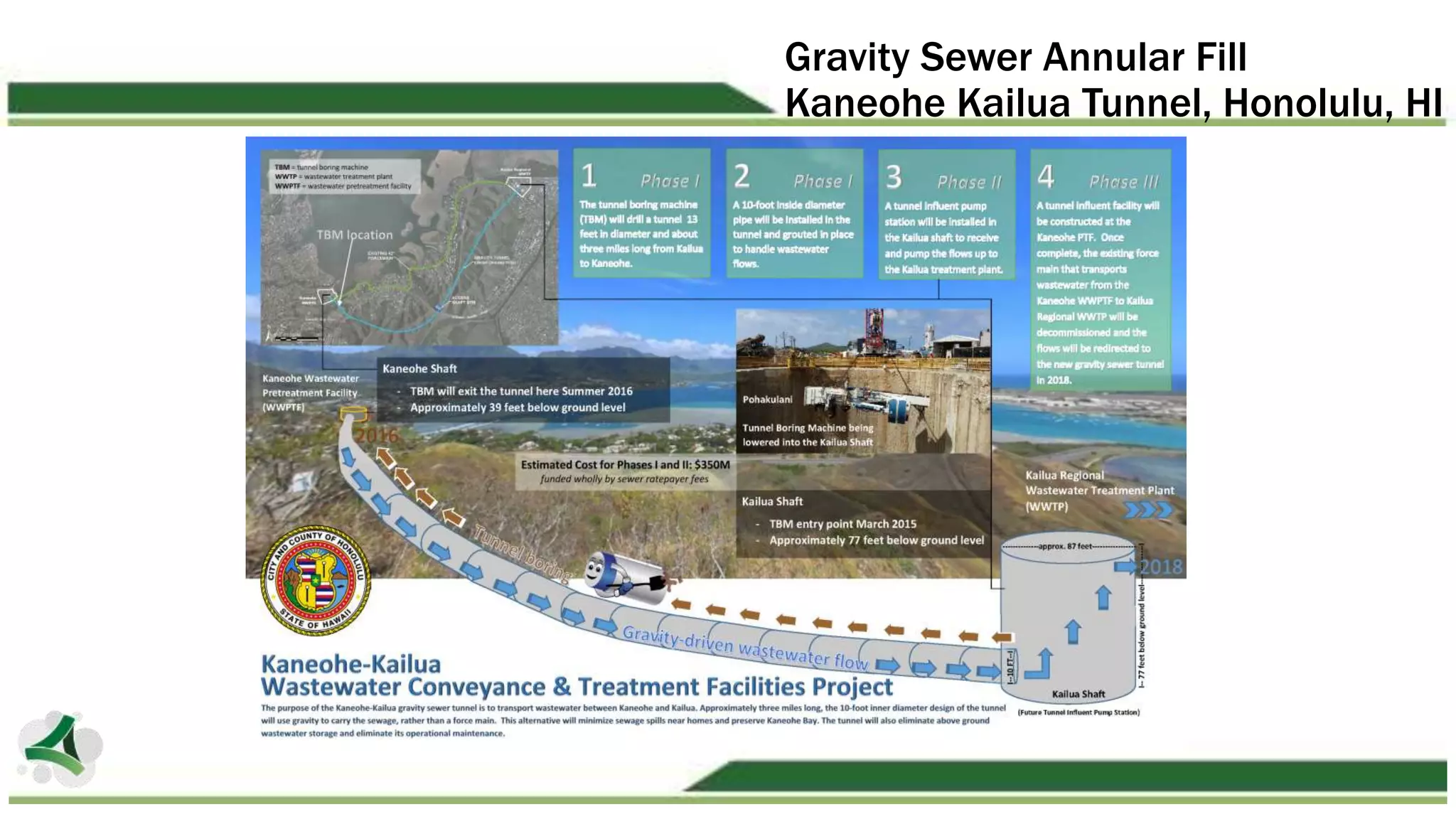
Gravity Sewer Annular Fill
Kaneohe Kailua Tunnel, Honolulu, HI
*Information provided by
Southland/Mole JV, Kaneohe, HI
28,000yd³ 50pcf
4” injection line
Material pumped for 3
miles
Water chilled from 70° to
50°
Maintained 18” to 24”
controlled lifts due to
distance and heat
“Aerix Industries provided a quality bubble and the
physical bubble was not compromised at all over the
entire distance pumped”
Don Painter, Project Manager of Southland/Mole JV
Gravity Sewer Annular Fill
Kaneohe Kailua Tunnel, Honolulu, HI
US61 & Greenwell Springs Rd
Baton Rouge, LA
Utility/Tunnel Abandonment
*Information provided by
Mainmark, Australia
San Pedro Fuel Depot
(UST Tank Farm)
UST Abandonment project – largest volume
LDCC project known.
Was used to receive, store and distribute
diesel and jet fuels for military use in
California, Arizona and Nevada.
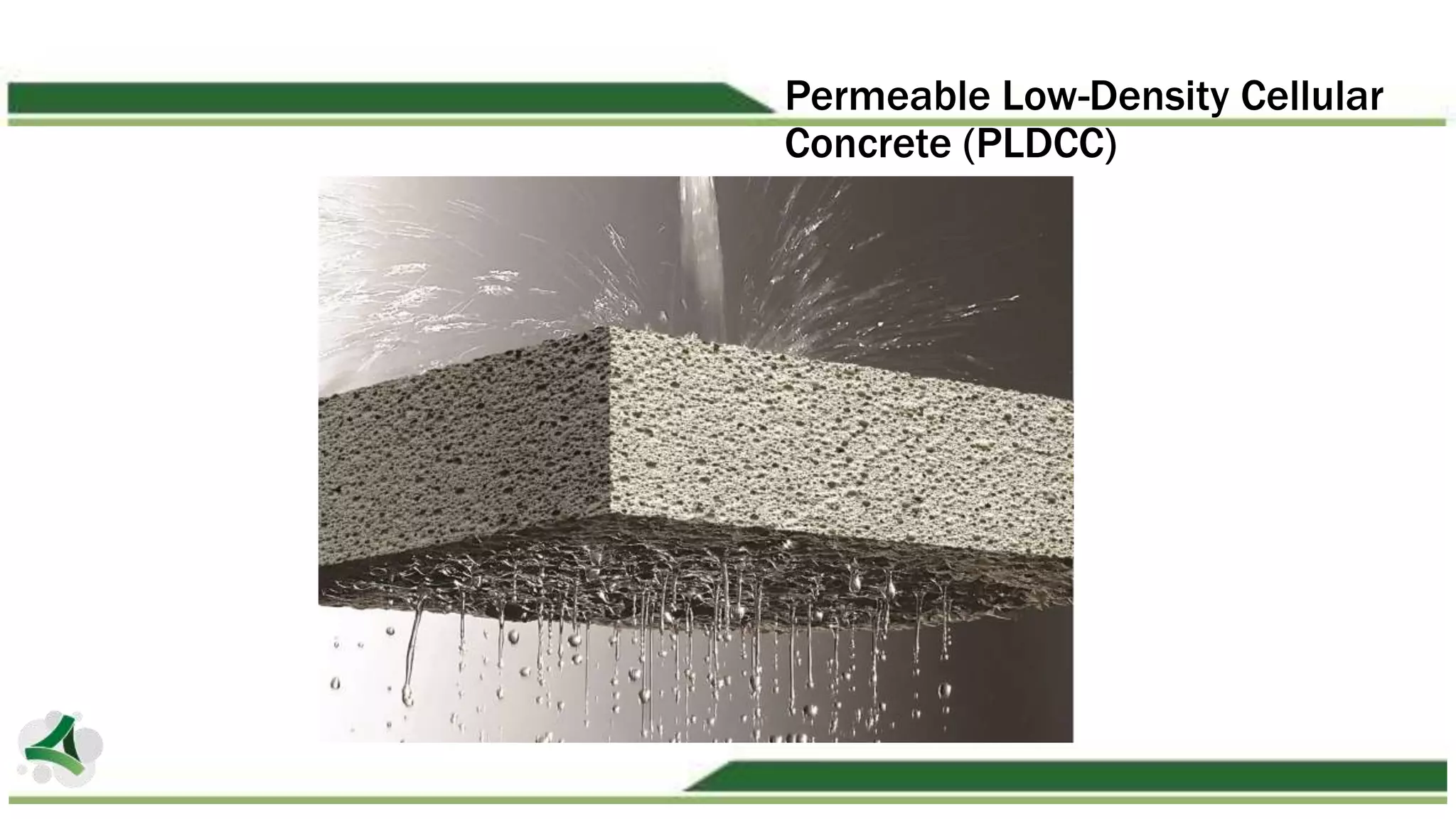
Permeable Low-Density Cellular
Concrete (PLDCC)
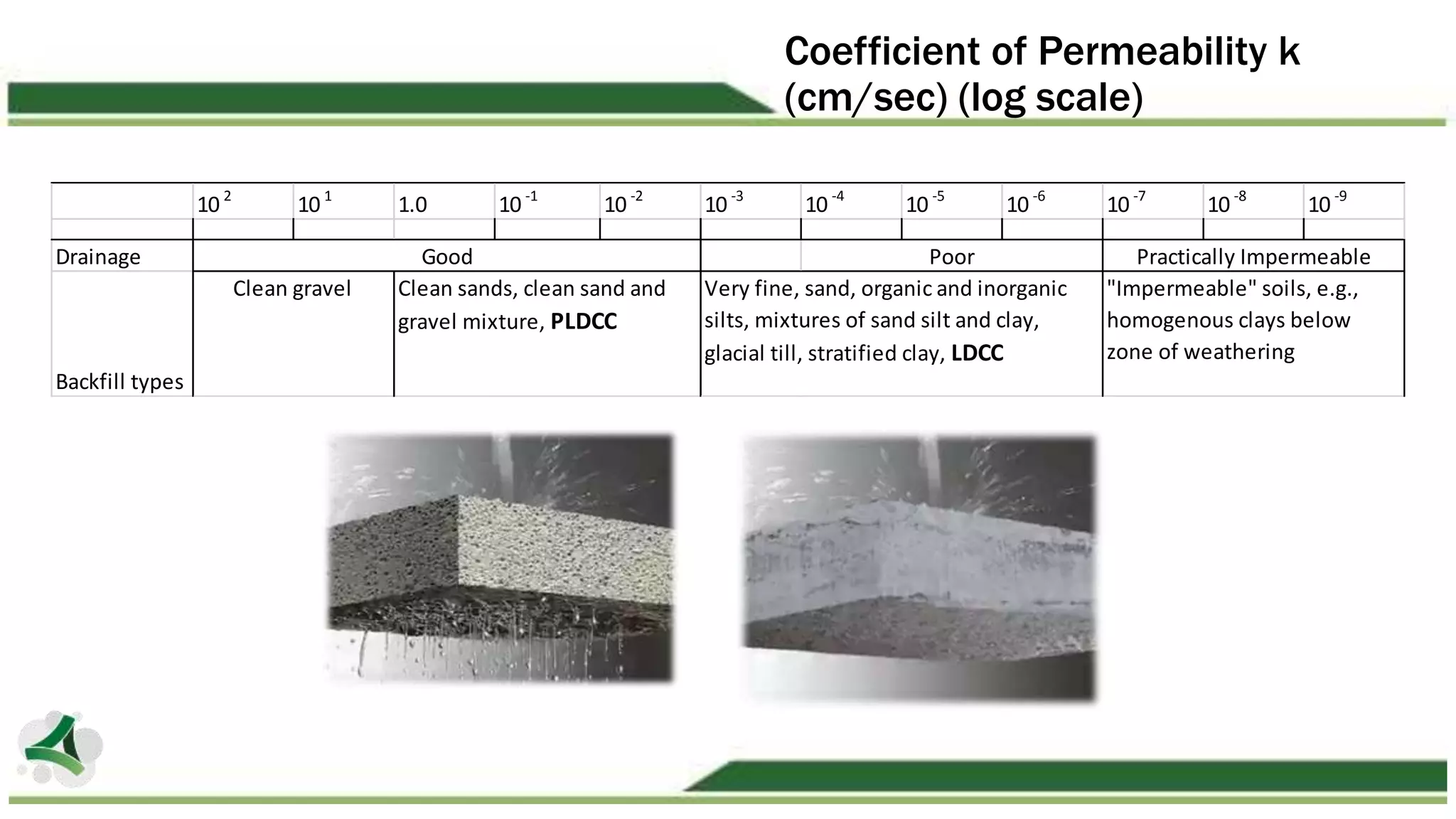
Coefficient of Permeability k
(cm/sec) (log scale)
10 2
10 1
1.0 10 -1
10 -2
10 -3
10 -4
10 -5
10 -6
10 -7
10 -8
10 -9
Drainage
Backfill types
Coefficient of Permeability k (cm/sec) (log scale)
Poor Practically Impermeable
Clean gravel Clean sands, clean sand and
gravel mixture, PLDCC
Very fine, sand, organic and inorganic
silts, mixtures of sand silt and clay,
glacial till, stratified clay, LDCC
"Impermeable" soils, e.g.,
homogenous clays below
zone of weathering
Good
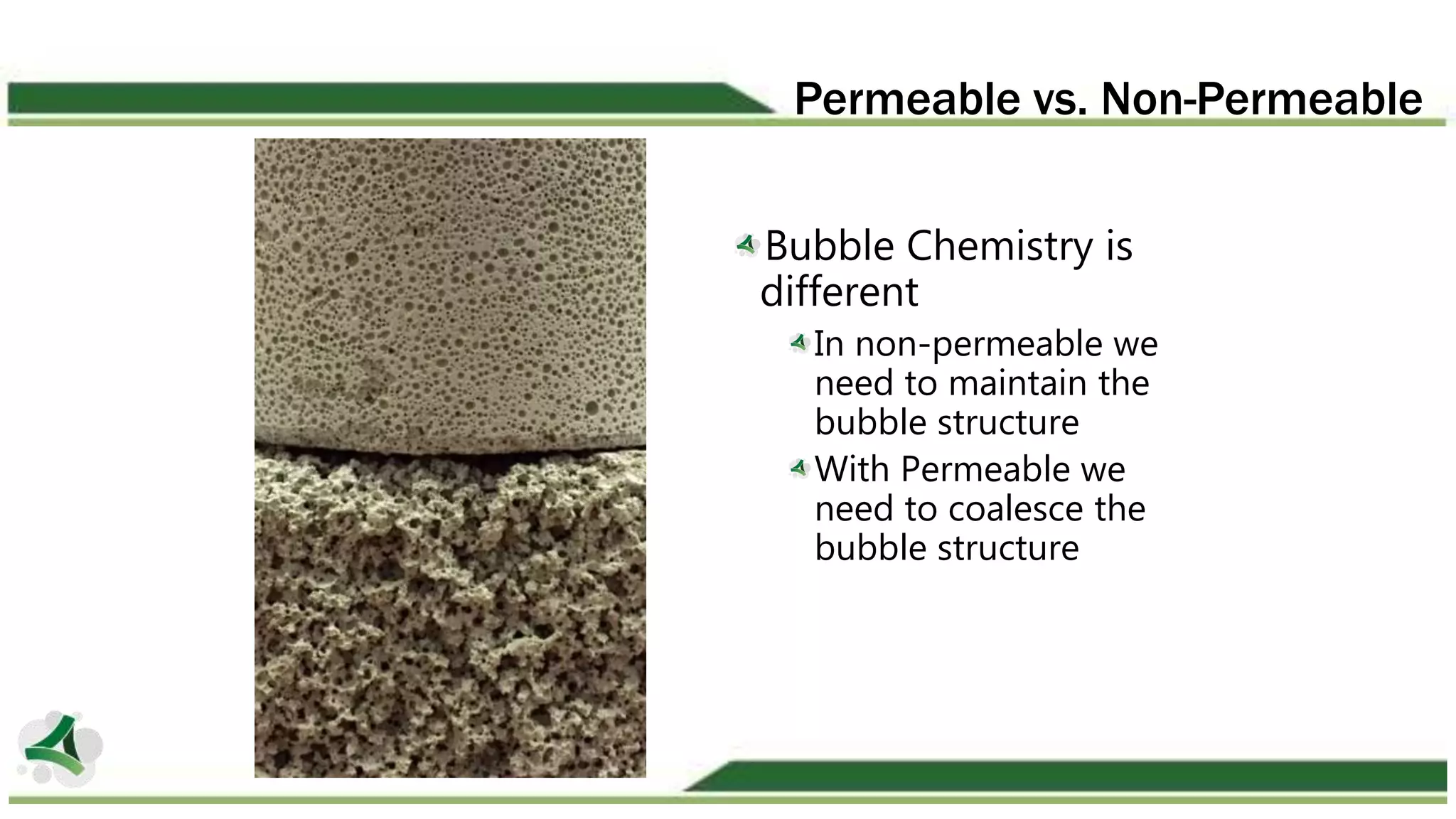
Permeable vs. Non-Permeable
Bubble Chemistry is
different
In non-permeable we
need to maintain the
bubble structure
With Permeable we
need to coalesce the
bubble structure
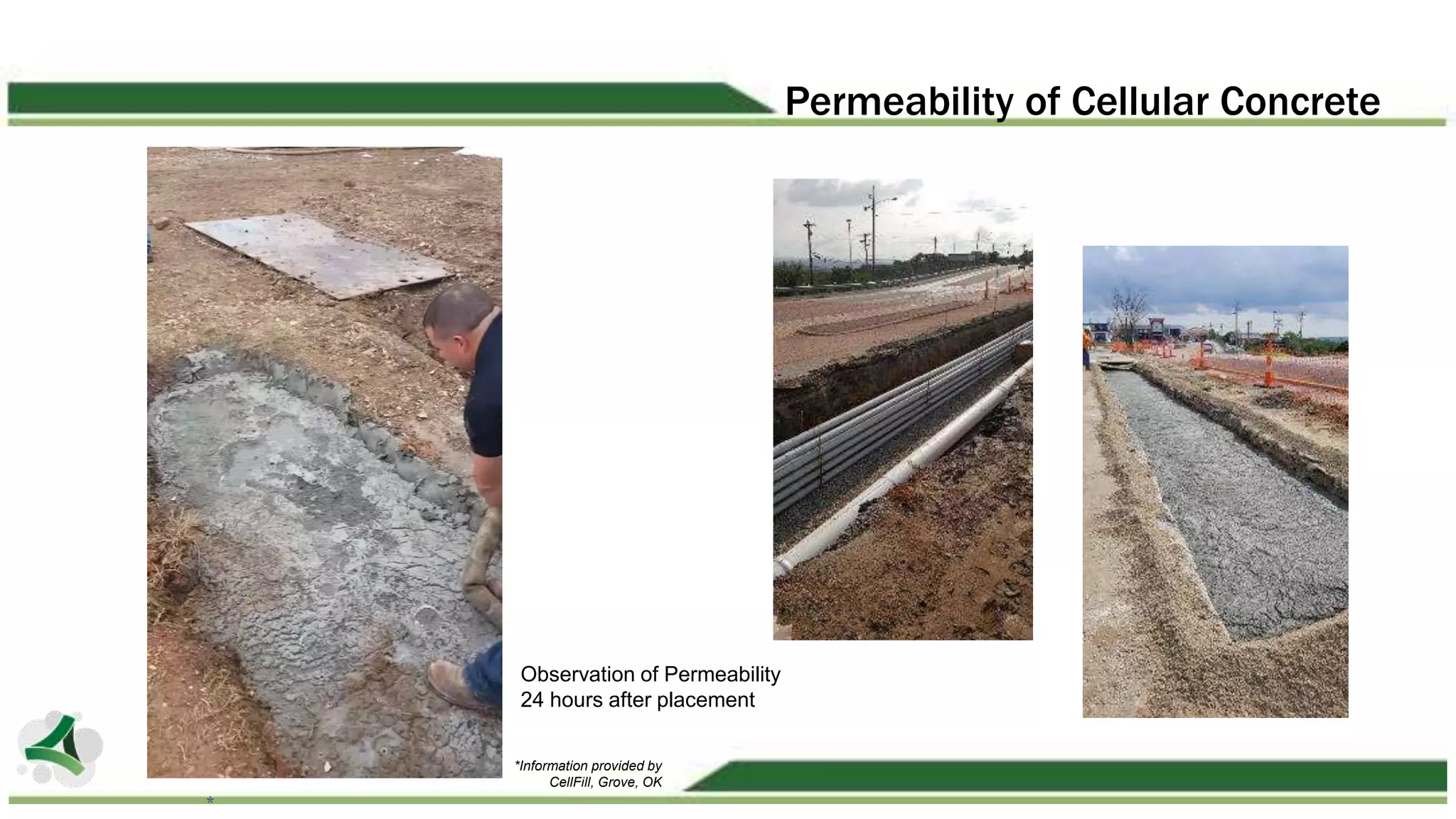
PLDCC Permeability / Infiltration
Permeability of Cellular Concrete
Observation of Permeability
24 hours after placement
*Information provided by
CellFill, Grove, OK
*
Void Factors of PLDCC
** University of Missouri - Kansas City, J.T. Kevern
Slab Support
South Street Landing, Providence, RI
*Information provided by
GZA., Providence, RI
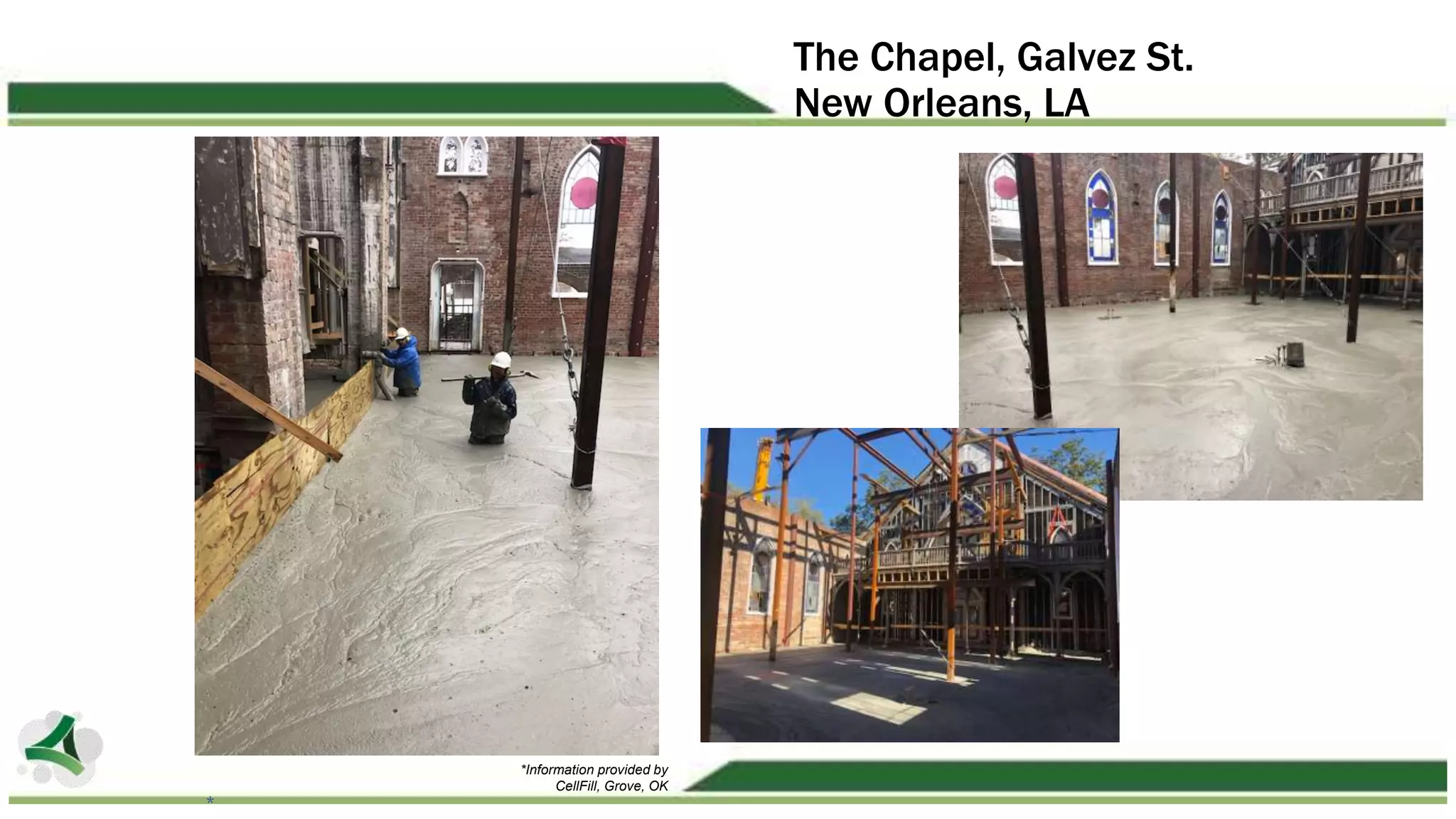
The Chapel, Galvez St.
New Orleans, LA
*Information provided by
CellFill, Grove, OK
*
Typical Applications
Tunnel & Mine Abandonment
Annular Fills for Tunnels, Water & Sewer Lines
Void Fills
Soft Soil Remediation
Tremie Applications
Retaining Structure Backfills
Slope Stabilization
Fill for Underground Utility, Conduit & Pipes
Tanks & Pipeline Abandonment
Fill Around Conduits and Pipes
Green Roof Applications
Use cellular concrete for subgrade modification
when existing soils are undesirable
LDCC/PLDCC Advantages
Reduce Vertical Dead Loads
Increase Strength/Stability with Minimal Weight
Insulating
Improve Seismic Stability
Reduce Settlement Potential
Increase Bearing Capacity
SR 50, Ocoee, FL
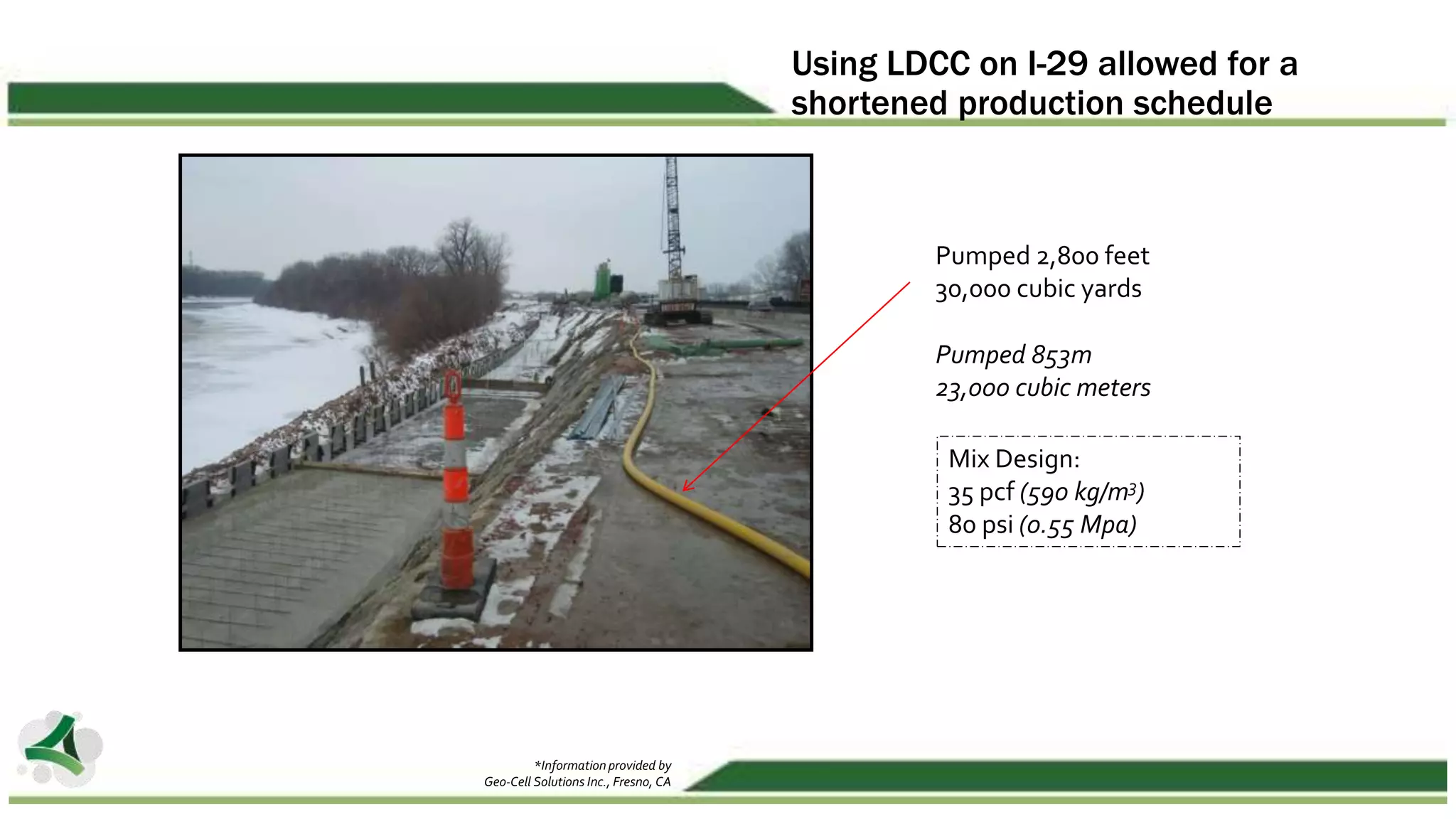
River scouring embankment on I-29
threatened safety of motorists
Big Sioux River
Using LDCC on I-29 allowed for a
shortened production schedule
Pumped 2,800 feet
30,000 cubic yards
Pumped 853m
23,000 cubic meters
Mix Design:
35 pcf (590 kg/m3)
80 psi (0.55 Mpa)
*Information provided by
Geo-Cell Solutions Inc., Fresno, CA
I-29/I-80, Council Bluffs, IA
*Information provided by
MixOnSite, Buffalo Grove, IL
113,900 yd³ 32pcf LDCC
± 1,500 yd³ /day
Louis Armstrong Airport
New Orleans, LA
*
*Project by
MixOnSite USA Inc., Buffalo Grove, IL
Louis Armstrong Airport
New Orleans, LA
*
*Project by
MixOnSite USA Inc., Buffalo Grove, IL
Typical Applications
Tunnel & Mine Abandonment
Annular Fills for Tunnels, Water & Sewer Lines
Void Fills
Soft Soil Remediation
Tremie Applications
Retaining Structure Backfills
Slope Stabilization
Fill for Underground Utility, Conduit & Pipes
Tanks & Pipeline Abandonment
Fill Around Conduits and Pipes
Green Roof Applications
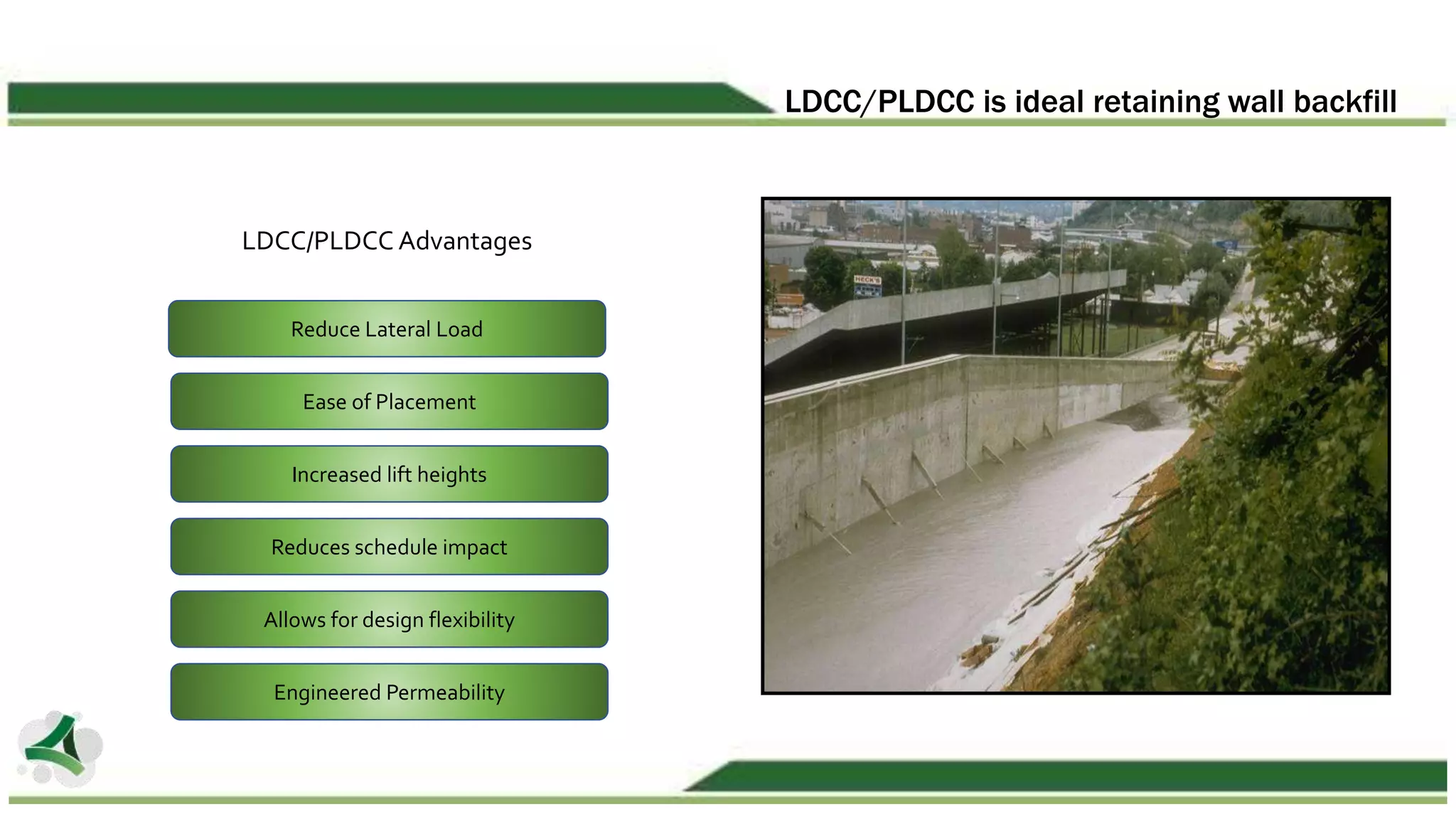
LDCC/PLDCC is ideal retaining wall backfill
LDCC/PLDCC Advantages
Reduce Lateral Load
Ease of Placement
Increased lift heights
Reduces schedule impact
Allows for design flexibility
Engineered Permeability
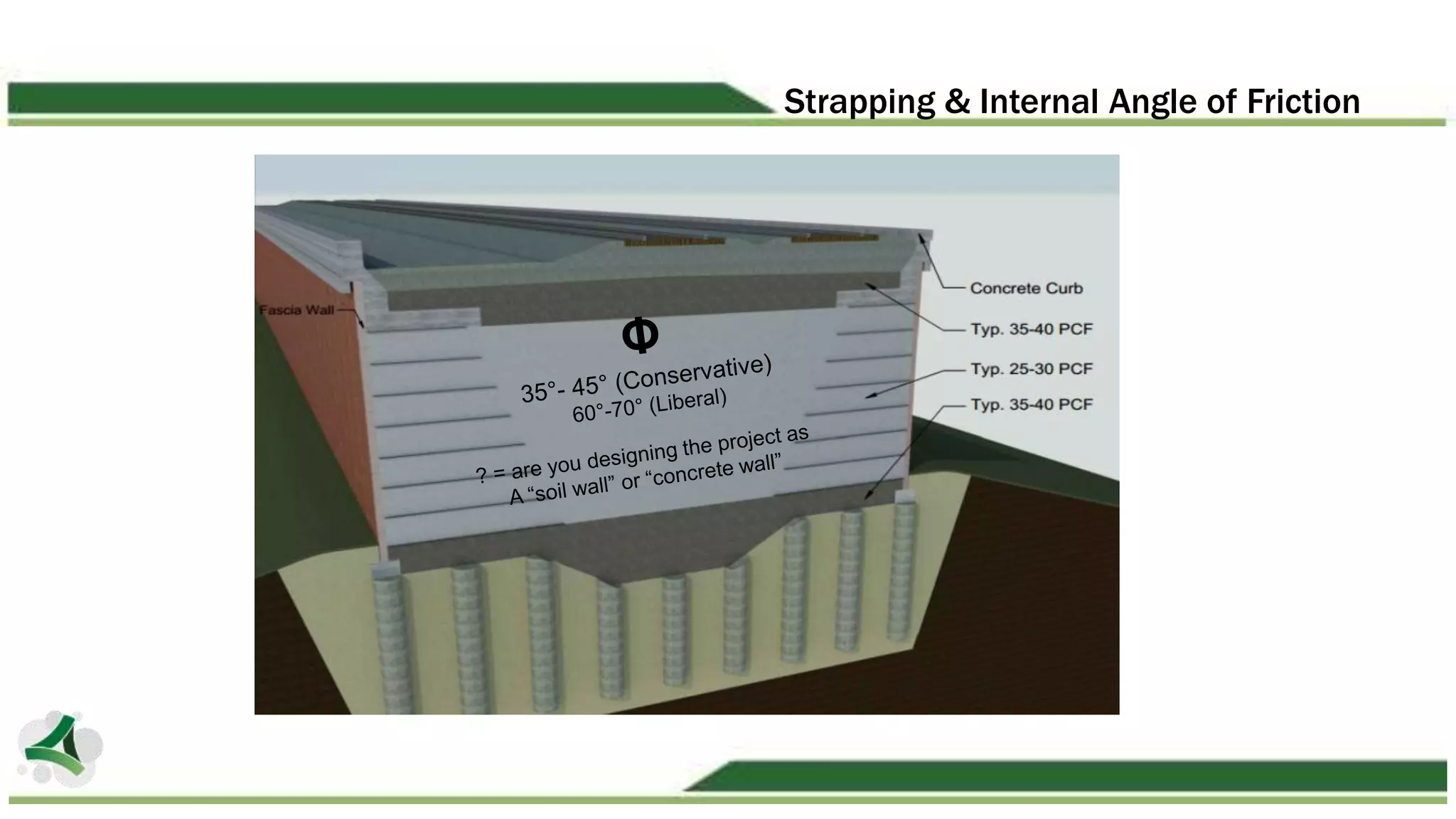
Segmental Wall Configuration
Strapping & Internal Angle of Friction
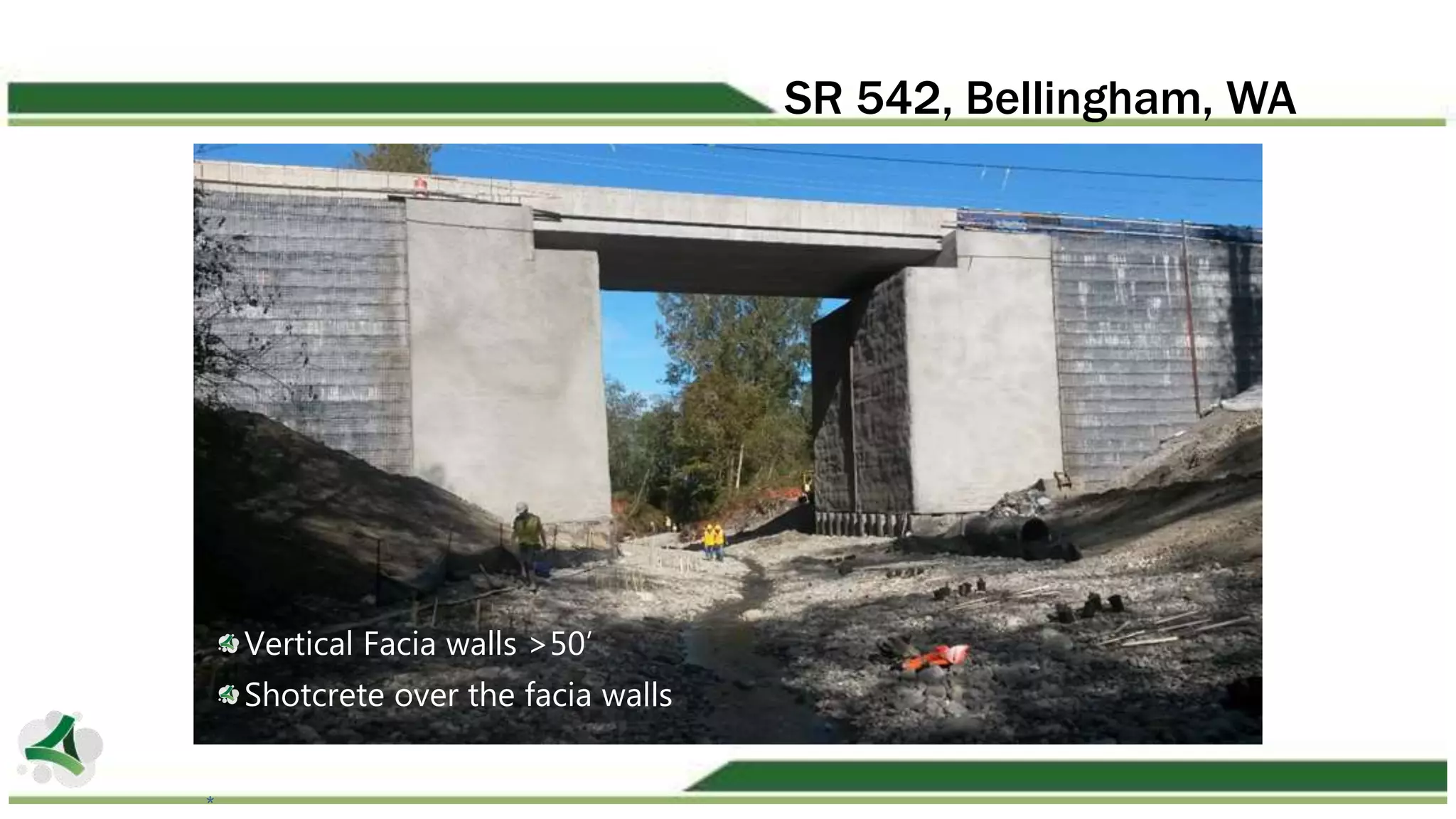
SR 542, Bellingham, WA
Vertical Facia walls >50’
Shotcrete over the facia walls
*
Grade Separation for UP RR Mainline
*Photos provided by California Nevada Cement
Association
Typical Applications
Tunnel & Mine Abandonment
Annular Fills for Tunnels, Water & Sewer Lines
Void Fills
Soft Soil Remediation
Tremie Applications
Retaining Structure Backfills
Slope Stabilization
Fill for Underground Utility, Conduit & Pipes
Tanks & Pipeline Abandonment
Fill Around Conduits and Pipes
Green Roof Applications
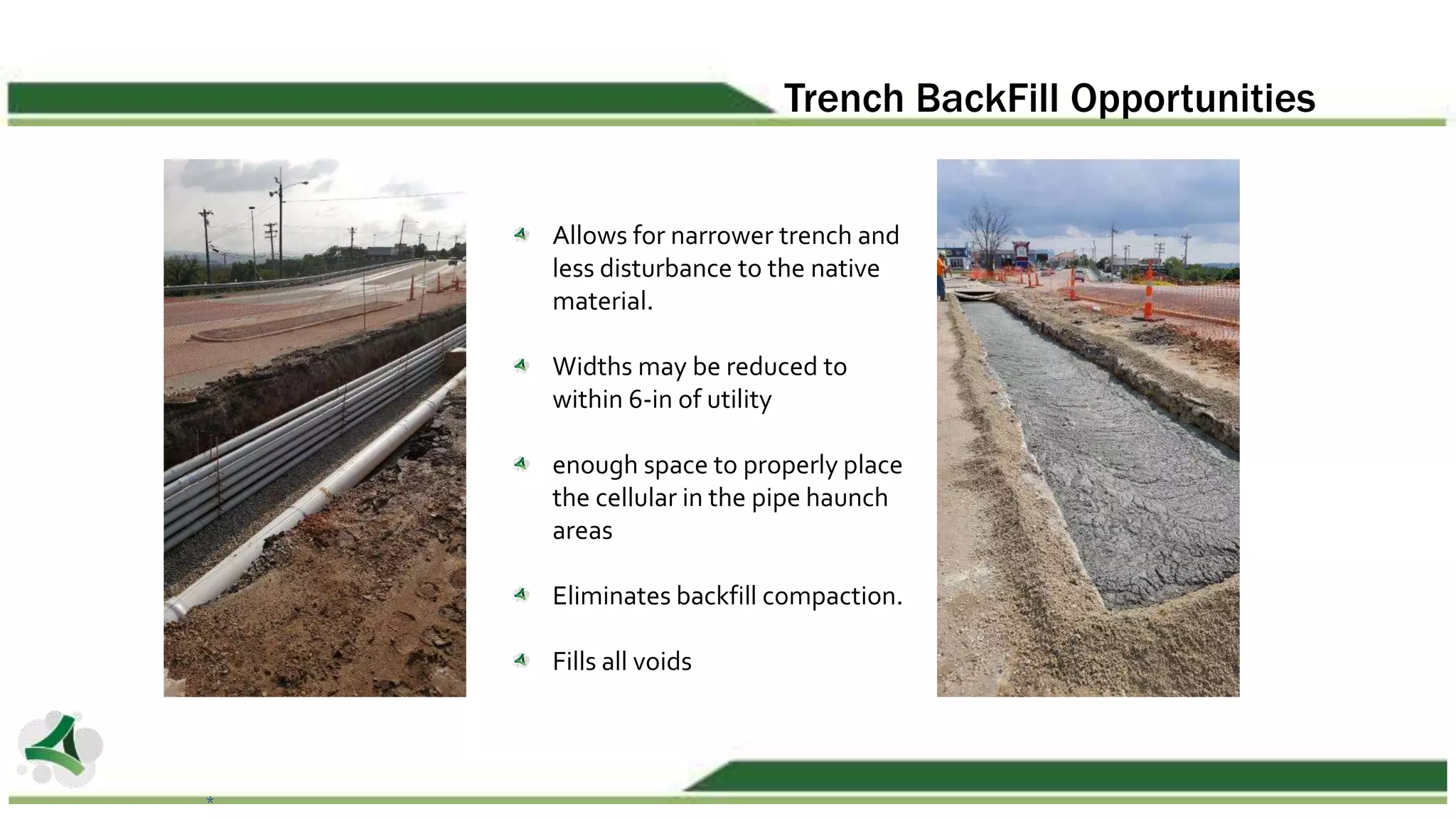
Trench BackFill Opportunities
Allows for narrower trench and
less disturbance to the native
material.
Widths may be reduced to
within 6-in of utility
enough space to properly place
the cellular in the pipe haunch
areas
Eliminates backfill compaction.
Fills all voids
*
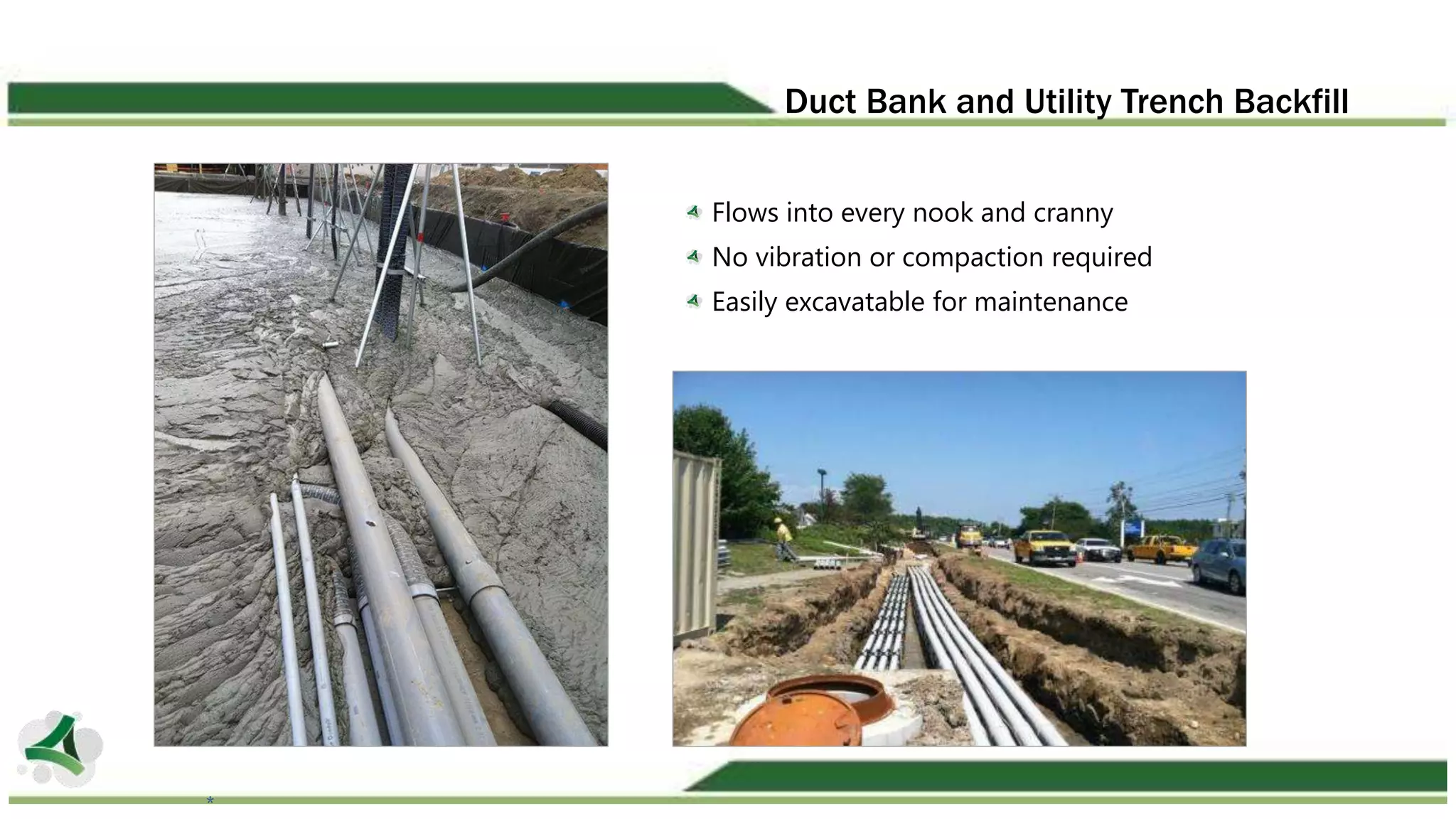
Duct Bank and Utility Trench Backfill
Flows into every nook and cranny
No vibration or compaction required
Easily excavatable for maintenance
*
Identify Buried Utilities with a Dye
clear indicator for
future operators
Different colors can be
used
Red - fiber optics or
high voltage lines
Blue – water lines
Yellow – sewer lines
Photo Courtesy ofThroopCellular Concrete
Fully Excavatable & Versatile
Photo Courtesy of A-DeckPhoto Courtesy of Throop Cellular
Typical Applications
Tunnel & Mine Abandonment
Annular Fills for Tunnels, Water & Sewer Lines
Void Fills
Soft Soil Remediation
Tremie Applications
Retaining Structure Backfills
Slope Stabilization
Fill for Underground Utility, Conduit & Pipes
Tanks & Pipeline Abandonment
Fill Around Conduits and Pipes
Green Roof Applications
Other Applications
2424 Tulane Stormwater Detention System
New Orleans, LA
2424 Tulane Stormwater Detention System
New Orleans, LA
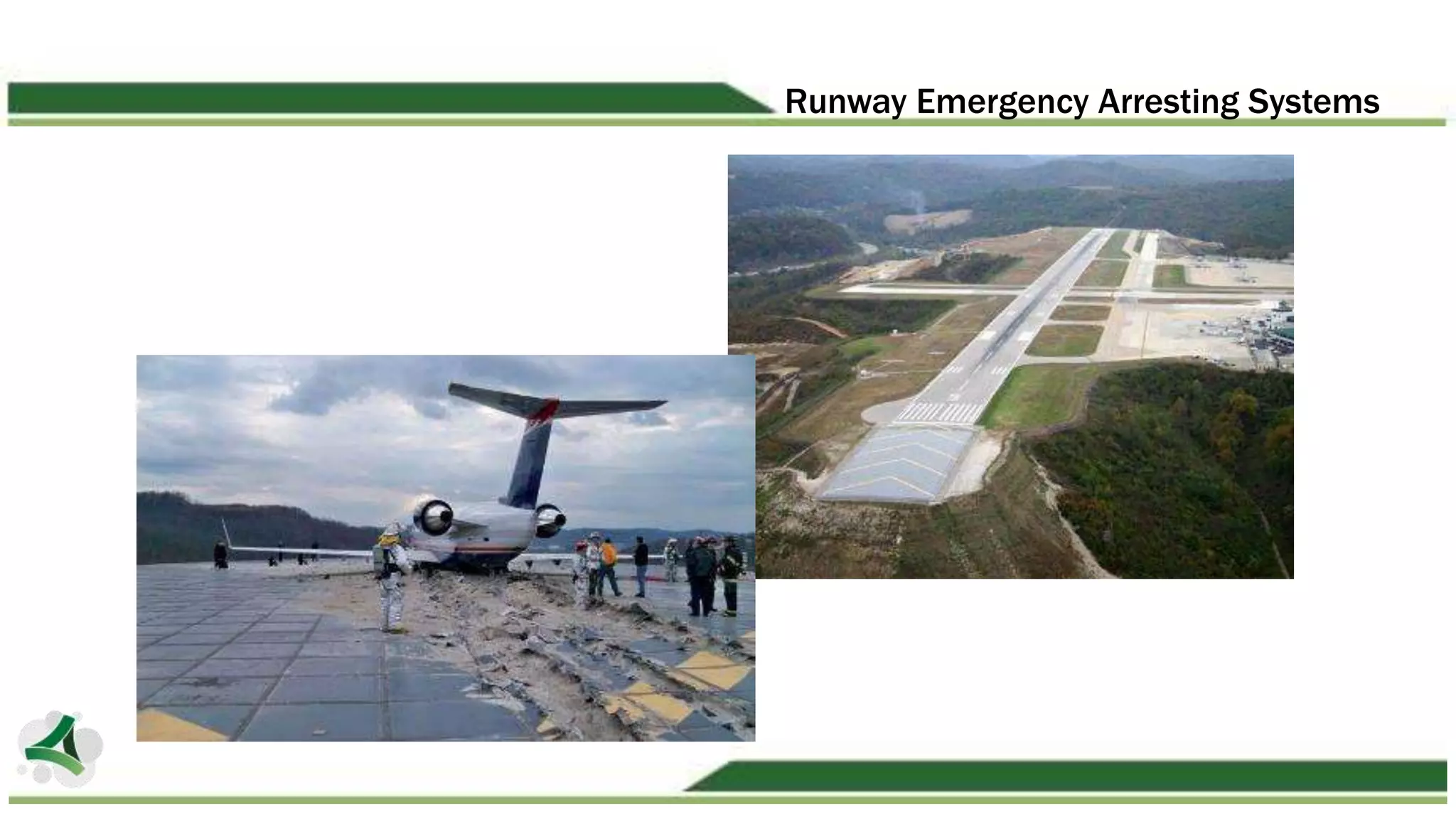
Runway Emergency Arresting Systems
What conclusions can we draw
about LDCC/PLDCC?
Broad Range of Densities
Economical
Versatile
Easily Placed
Rapid Installation
Durable
Permanent and Stable
Environmentally Friendly
Nico Sutmoller
Global Lightweight Fill Specialist
7020 Snowdrift Rd.
Allentown, PA 18106
(610) 398-7833 ext 117
(303) 903-4981
nsutmoller@aerixindustries.com
Contact Information

Low Density Cellular Concrete

  • 1.
    Prepared 1/2019 Nico Sutmoller GlobalLightweight Fill Specialist LOW-DENSITY CELLULAR CONCRETE (LDCC)
  • 2.
    Concrete made withhydraulic cement, water and preformed foam to produce a hardened material with an oven dry density of 50 pounds (22.7 kg) per cubic foot or less. Preformed foam is created by diluting a liquid foam concentrate with water in predetermined proportions and passing this mixture through a foam generator. LOW-DENSITY CELLULAR CONCRETE (LDCC) IS DEFINED BY ACI 523 AS…
  • 3.
    LDCC replaces coarseaggregate with AIR The air cells must be resilient in order to withstand the rigors of mixing and pumping in various applications Foam has the stability to be calculated as a solid but the properties to be placed as a low density fluid material
  • 4.
    Conforms to ACIindustry standards Types of Foam Preformed Produced by Foam Generator Agitated Produced by the mixing action of a concrete mixer ACI 523 ACI 229 Cellular Concrete CLSM Cellular concrete can be flowable fill (ACI 229) but flowable fill (CSLM) cannot be cellular concrete because of the density being higher than 50pcf.
  • 5.
    Keep in Mind…… LightweightCellular Concrete (LDCC) Is designed to replace traditionally compacted backfill It is not designed to be the driving or wearing surface Flowable & Self-Compacting Rapidly Placed
  • 6.
    LDCC pore structurewhen cured Cementitious materials encapsulate the air bubbles, then dissipate, leaving a void structure as a replacement to traditional aggregate LightweightCellular Concrete differs from conventional aggregate concrete in the methods of production, the density of the material and the extensive range of end uses.
  • 7.
    Permeable & Non-PermeableLDCC Provided by Mainmark
  • 8.
    Production of LDCCis more environmentally friendly than alternative methods 55% Less trucking Truckloads / 1000 cubic yards (765 cubic meters) Typical Fill - 100 trucks Cellular Concrete – 45 trucks Elimination in coarse aggregate haul 55% Less Fuel 55% Less Carbon Emissions Requires fewer pieces of equipment Cleaner, less congested jobsites
  • 9.
    Typical Guidelines cellular concretemixes 75% of the volume is foam
  • 10.
    PCF PSI Typical Strength curveof cellular concrete
  • 11.
    ASTM test methodsthat apply to cellular concrete ASTM C 495 ASTM C 796 “StandardTest Method for Compressive Strength of Lightweight Insulating Concrete” “StandardTest Method for Foaming Agents for use in Producing Cellular Concrete using Preformed Foam” ASTM C 869 “Standard Specification for Foaming Agents Used in Making Preformed Foam for Cellular Concrete”
  • 12.
    Quality Control isAlways Measured in the field
  • 13.
    Foam technology hasmade huge advancements with a very stable bubble • Typical Foams • 3 foot lift thickness • Pumping distance limited to 5,000 feet maximum • Only non-permeable • Viscosity was almost 1 • Fly ash usage limited Advanced Foam Technology Lift of 35’ has been achieved Pumping distance increased to more than 16,000 feet Permeability is also an option Thicker material Compatibility with fly ash / slag cement Advancements
  • 14.
    Typical Applications Tunnel &Mine Abandonment Annular Fills for Tunnels, Water & Sewer Lines Void Fills Soft Soil Remediation Tremie Applications Retaining Structure Backfills Slope Stabilization Fill for Underground Utility, Conduit & Pipes Tanks & Pipeline Abandonment Fill Around Conduits and Pipes Green Roof Applications
  • 15.
    Cellular concrete isan ideal solution for annular and tunnel backfill Highly flowable material able to completely fill annular space Lightweight and easily pumped long distances at low pressures Will not float pipe or damage liner for sliplining Shrinkage of less than 0.3% Quick and Easy Installation Environmentally Safe Strength and density can be customized to project requirements Cellular Concrete has been pumped over 700 feet vertically and over 15,000 feet horizontally Can accommodate any diameter pipe
  • 16.
    Culvert or AnnularApplication 150 yd3 (114 m3)of 500psi (3.4 MPa) pumped 100ft (30.5m) under SR 1 for MaineDot Photo Courtesy of SnapTite
  • 17.
    Gravity Sewer AnnularFill Kaneohe Kailua Tunnel, Honolulu, HI
  • 18.
    *Information provided by Southland/MoleJV, Kaneohe, HI 28,000yd³ 50pcf 4” injection line Material pumped for 3 miles Water chilled from 70° to 50° Maintained 18” to 24” controlled lifts due to distance and heat “Aerix Industries provided a quality bubble and the physical bubble was not compromised at all over the entire distance pumped” Don Painter, Project Manager of Southland/Mole JV Gravity Sewer Annular Fill Kaneohe Kailua Tunnel, Honolulu, HI
  • 19.
    US61 & GreenwellSprings Rd Baton Rouge, LA
  • 20.
  • 21.
    San Pedro FuelDepot (UST Tank Farm) UST Abandonment project – largest volume LDCC project known. Was used to receive, store and distribute diesel and jet fuels for military use in California, Arizona and Nevada.
  • 22.
  • 23.
    Coefficient of Permeabilityk (cm/sec) (log scale) 10 2 10 1 1.0 10 -1 10 -2 10 -3 10 -4 10 -5 10 -6 10 -7 10 -8 10 -9 Drainage Backfill types Coefficient of Permeability k (cm/sec) (log scale) Poor Practically Impermeable Clean gravel Clean sands, clean sand and gravel mixture, PLDCC Very fine, sand, organic and inorganic silts, mixtures of sand silt and clay, glacial till, stratified clay, LDCC "Impermeable" soils, e.g., homogenous clays below zone of weathering Good
  • 24.
    Permeable vs. Non-Permeable BubbleChemistry is different In non-permeable we need to maintain the bubble structure With Permeable we need to coalesce the bubble structure
  • 25.
  • 26.
    Permeability of CellularConcrete Observation of Permeability 24 hours after placement *Information provided by CellFill, Grove, OK *
  • 27.
    Void Factors ofPLDCC ** University of Missouri - Kansas City, J.T. Kevern
  • 28.
    Slab Support South StreetLanding, Providence, RI *Information provided by GZA., Providence, RI
  • 29.
    The Chapel, GalvezSt. New Orleans, LA *Information provided by CellFill, Grove, OK *
  • 30.
    Typical Applications Tunnel &Mine Abandonment Annular Fills for Tunnels, Water & Sewer Lines Void Fills Soft Soil Remediation Tremie Applications Retaining Structure Backfills Slope Stabilization Fill for Underground Utility, Conduit & Pipes Tanks & Pipeline Abandonment Fill Around Conduits and Pipes Green Roof Applications
  • 31.
    Use cellular concretefor subgrade modification when existing soils are undesirable LDCC/PLDCC Advantages Reduce Vertical Dead Loads Increase Strength/Stability with Minimal Weight Insulating Improve Seismic Stability Reduce Settlement Potential Increase Bearing Capacity SR 50, Ocoee, FL
  • 32.
    River scouring embankmenton I-29 threatened safety of motorists Big Sioux River
  • 33.
    Using LDCC onI-29 allowed for a shortened production schedule Pumped 2,800 feet 30,000 cubic yards Pumped 853m 23,000 cubic meters Mix Design: 35 pcf (590 kg/m3) 80 psi (0.55 Mpa) *Information provided by Geo-Cell Solutions Inc., Fresno, CA
  • 34.
    I-29/I-80, Council Bluffs,IA *Information provided by MixOnSite, Buffalo Grove, IL 113,900 yd³ 32pcf LDCC ± 1,500 yd³ /day
  • 35.
    Louis Armstrong Airport NewOrleans, LA * *Project by MixOnSite USA Inc., Buffalo Grove, IL
  • 36.
    Louis Armstrong Airport NewOrleans, LA * *Project by MixOnSite USA Inc., Buffalo Grove, IL
  • 37.
    Typical Applications Tunnel &Mine Abandonment Annular Fills for Tunnels, Water & Sewer Lines Void Fills Soft Soil Remediation Tremie Applications Retaining Structure Backfills Slope Stabilization Fill for Underground Utility, Conduit & Pipes Tanks & Pipeline Abandonment Fill Around Conduits and Pipes Green Roof Applications
  • 38.
    LDCC/PLDCC is idealretaining wall backfill LDCC/PLDCC Advantages Reduce Lateral Load Ease of Placement Increased lift heights Reduces schedule impact Allows for design flexibility Engineered Permeability
  • 39.
  • 40.
    Strapping & InternalAngle of Friction
  • 41.
    SR 542, Bellingham,WA Vertical Facia walls >50’ Shotcrete over the facia walls *
  • 42.
    Grade Separation forUP RR Mainline *Photos provided by California Nevada Cement Association
  • 43.
    Typical Applications Tunnel &Mine Abandonment Annular Fills for Tunnels, Water & Sewer Lines Void Fills Soft Soil Remediation Tremie Applications Retaining Structure Backfills Slope Stabilization Fill for Underground Utility, Conduit & Pipes Tanks & Pipeline Abandonment Fill Around Conduits and Pipes Green Roof Applications
  • 44.
    Trench BackFill Opportunities Allowsfor narrower trench and less disturbance to the native material. Widths may be reduced to within 6-in of utility enough space to properly place the cellular in the pipe haunch areas Eliminates backfill compaction. Fills all voids *
  • 45.
    Duct Bank andUtility Trench Backfill Flows into every nook and cranny No vibration or compaction required Easily excavatable for maintenance *
  • 46.
    Identify Buried Utilitieswith a Dye clear indicator for future operators Different colors can be used Red - fiber optics or high voltage lines Blue – water lines Yellow – sewer lines Photo Courtesy ofThroopCellular Concrete
  • 47.
    Fully Excavatable &Versatile Photo Courtesy of A-DeckPhoto Courtesy of Throop Cellular
  • 48.
    Typical Applications Tunnel &Mine Abandonment Annular Fills for Tunnels, Water & Sewer Lines Void Fills Soft Soil Remediation Tremie Applications Retaining Structure Backfills Slope Stabilization Fill for Underground Utility, Conduit & Pipes Tanks & Pipeline Abandonment Fill Around Conduits and Pipes Green Roof Applications Other Applications
  • 49.
    2424 Tulane StormwaterDetention System New Orleans, LA
  • 50.
    2424 Tulane StormwaterDetention System New Orleans, LA
  • 51.
  • 52.
    What conclusions canwe draw about LDCC/PLDCC? Broad Range of Densities Economical Versatile Easily Placed Rapid Installation Durable Permanent and Stable Environmentally Friendly
  • 53.
    Nico Sutmoller Global LightweightFill Specialist 7020 Snowdrift Rd. Allentown, PA 18106 (610) 398-7833 ext 117 (303) 903-4981 nsutmoller@aerixindustries.com Contact Information

Editor's Notes

  • #5 CLSM – Controlled Low Strength Material (Flowable Fill)
  • #19 Retarders used
  • #20 275 yd3 30pcf material
  • #22 B&I Federal Services LLC of Baton Rouge will close 20 large concrete underground storage tanks, six large steel underground storage tanks and one small steel underground tank. The Defense Fuel Support Point depot was built during World War II to receive, store and distribute diesel and jet fuels for military use in California, Arizona and Nevada. In 1980, control of the site was shifted from the Navy to the Defense Logistics Agency. It’s still commonly referred to in San Pedro as the Navy Fuel Depot.
  • #26 The density listed is the fresh density for the samples rounded to the nearest 0.1 pcf so they were spot on. The dry unit weight and voids were determined using ASTM C1754 with the exception of the using the boiling procedure in ASTM C642 to determine the saturated mass. Otherwise even keeping them under water using weights they are still buoyant and don’t produce believable numbers. The permeability was determined using the falling head technique described by ACI committee 522 on pervious concrete where cylinder samples are wrapped in shrink wrap before confining in a rubber sleeve before testing. Infiltration was determined according to ASTM C1701 on slab 24in.x 24 in. x 6 in. We scraped the outside to remove the skin that forms during curing and vacuumed before testing. All values are above the 0.01 cm/s threshold typically used to define pervious. These all represent an average of triplicate testing.
  • #28 The density listed is the fresh density for the samples rounded to the nearest 0.1 pcf so they were spot on. The dry unit weight and voids were determined using ASTM C1754 with the exception of the using the boiling procedure in ASTM C642 to determine the saturated mass. Otherwise even keeping them under water using weights they are still buoyant and don’t produce believable numbers. The permeability was determined using the falling head technique described by ACI committee 522 on pervious concrete where cylinder samples are wrapped in shrink wrap before confining in a rubber sleeve before testing. Infiltration was determined according to ASTM C1701 on slab 24in.x 24 in. x 6 in. We scraped the outside to remove the skin that forms during curing and vacuumed before testing. All values are above the 0.01 cm/s threshold typically used to define pervious. These all represent an average of triplicate testing.
  • #41 Φ 35°-45° (Conservative) 60°-70° (Liberal) ? = are you designing the project as a “soil wall” or “concrete wall”
  • #42 a restored natural creek bed opened an additional 9 miles of habitat for several species of salmon, steelhead and trout native to the creek.
  • #52 Pictured – Yeager Airport, Charlestown, WV essentially a rectangular bed of 2,000 to 4,000 collapsible cubes glued in place at the end of a runway, nearly level with the ground. As a plane careens into the cubes, the cubes break apart. A typical bed measures 600 feet by 500 feet but the ones at SFO are slightly smaller due to space constraints.