SOIL STABILIZATION USING
LIME AND CEMENT
University of Asia Pacific (UAP)
Contents
• Introduction
• Objective of this study
• Literature Review
• Test Program
• Analysis of Experimental Results
• Conclusions
Introduction
Soil Improvement
• To increase bearing capacity and stability (avoid failure )
• To reduce post construction settlements
• To reduce liquefaction risk (seismic areas)
Before soil improvement:
• Check for suitability or feasibility of using different types of
foundation (pile / raft)
• Soil replacement
• Expensive
• Different Methods:
• Soil stabilization
• Dynamic compaction and replacement
• Vertical drains
• Vibroflottation
• Stone columns
• Inclusions
Soil Improvement Techniques
Impact of Present Study in Bangladesh
• Seismic zone
• Filled zones are susceptible to liquefaction
• Factor of safety against liquefaction is more, if filled
material contains fine materials
• Soil stabilization would be a possible method for
minimizing the probability of liquefaction during
earthquake loading.
Soil Stabilization
Bell (1993):
• Soil stabilization is the process of mixing additives with soil to
improve
• volume stability
• strength
• permeability and
• durability
Objective of this study
• To study the effect of additives (lime and cement) on
soil properties, in terms of the following parameters:
• Atterberg limits
• Maximum dry density
• Optimum moisture content
Literature Review
• Review the literature on soil stabilization using different additives
• Lime Stabilization
• Plasticity reduction
• Reduction in moisture-holding capacity (drying)
• Swell reduction
• Improved stability
• Cement Stabilization
• It is widely available
• Cost is relatively low
• It is highly durable
• Soil cement is quite weather resistant and strong.
• Flyash Stabilization
• Strength - to increase the strength and bearing capacity.
• Volume stability - to control the swell-shrink characteristics caused by
moisture changes.
• Durability - to increase the resistance to erosion, weathering or traffic
loading.
• To reduce the pavement thickness as well as cost.
• Blast Furnace Slug
• strength - to increase the strength and bearing capacity.
• volume stability - to control the swell-shrink characteristics caused by
moisture changes.
• durability - to increase the resistance to erosion, weathering or traffic
loading.
Literature Review
Literature Review
Method of Soil Stabilization
1. Soil Lime Stabilization
2. Cement Lime Stabilization
• Soil Type: Natural clay soil
• Location: Ekiti State, Nigeria
• It was collected at 1m depth below the ground level
• Additive: Hydrated high calcium lime, Ca(OH)2
Soil Stabilization: Lime as Additive
Flaherty.C 2002
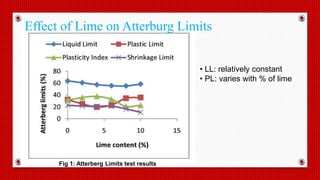
Effect of Lime on Atterburg Limits
• LL: relatively constant
• PL: varies with % of lime
Fig 1: Atterberg Limits test results
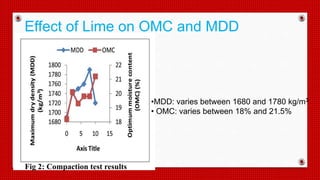
Effect of Lime on OMC and MDD
Fig 2: Compaction test results
•MDD: varies between 1680 and 1780 kg/m3
• OMC: varies between 18% and 21.5%
• Soil Type: Reddish brown laterite soil
• Classified as A-2-7(0) using AASHTO soil classification system
• Location: 22 km from Makurdi, Nigeria
• Obtained from: River Benue in Makurdi
• Additives: Ordinary Portland cement
Soil Stabilization: Cement as Additives
Feng.T 2002
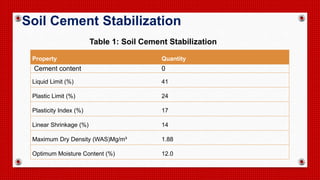
Property Quantity
Cement content 0
Liquid Limit (%) 41
Plastic Limit (%) 24
Plasticity Index (%) 17
Linear Shrinkage (%) 14
Maximum Dry Density (WAS)Mg/m³ 1.88
Optimum Moisture Content (%) 12.0
Soil Cement Stabilization
Table 1: Soil Cement Stabilization
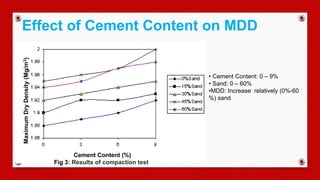
Effect of Cement Content on MDDMaximumDryDensity(Mg/m3)
• Cement Content: 0 – 9%
• Sand: 0 – 60%
•MDD: Increase relatively (0%-60
%) sand
Cement Content (%)
Fig 3: Results of compaction test
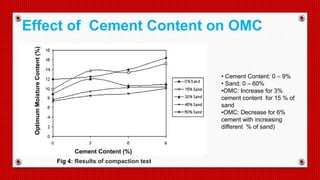
Effect of Cement Content on OMC
OptimumMoistureContent(%)
• Cement Content: 0 – 9%
• Sand: 0 – 60%
•OMC: Increase for 3%
cement content for 15 % of
sand
•OMC: Decrease for 6%
cement with increasing
different % of sand)
Cement Content (%)
Fig 4: Results of compaction test
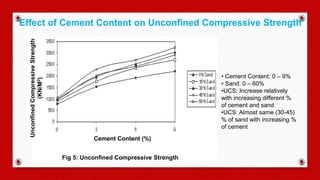
Effect of Cement Content on Unconfined Compressive Strength
• Cement Content: 0 – 9%
• Sand: 0 – 60%
•UCS: Increase relatively
with increasing different %
of cement and sand
•UCS: Almost same (30-45)
% of sand with increasing %
of cement
Cement Content (%)
UnconfinedCompressiveStrength
(KN/M2)
Fig 5: Unconfined Compressive Strength
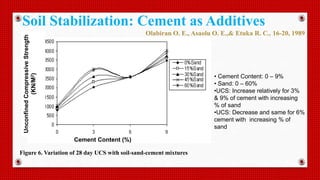
Soil Stabilization: Cement as Additives
Olabiran O. E., Asaolu O. E.,& Etuka R. C., 16-20, 1989
Figure 6. Variation of 28 day UCS with soil-sand-cement mixtures
• Cement Content: 0 – 9%
• Sand: 0 – 60%
•UCS: Increase relatively for 3%
& 9% of cement with increasing
% of sand
•UCS: Decrease and same for 6%
cement with increasing % of
sand
Cement Content (%)
UnconfinedCompressiveStrength
(KN/M2)
Soil Stabilization: Fly ash
Cokca, E. (2001)
• Red soil of tirupur district, India
• Additives: Fly Ash (class C and class F)
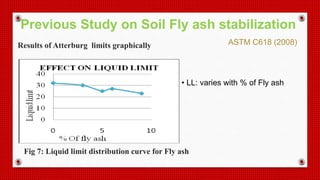
Results of Atterburg limits graphically
Fig 7: Liquid limit distribution curve for Fly ash
Previous Study on Soil Fly ash stabilization
ASTM C618 (2008)
• LL: varies with % of Fly ash
Fig 8: Plastic limit distribution curve for Fly ash
Results of Atterburg limits graphically
Previous Study on Soil Fly ash stabilization
[ASTM C618 (2008)]
•PL: varies with % of Fly ash
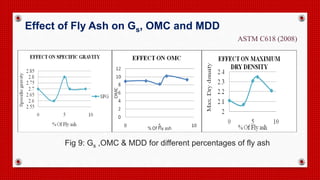
Effect of Fly Ash on Gs, OMC and MDD
ASTM C618 (2008)
Fig 9: Gs ,OMC & MDD for different percentages of fly ash
Previous Study on Soil Fly ash Stabilization
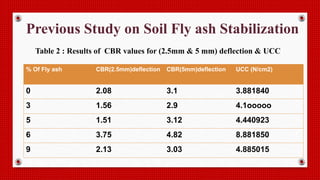
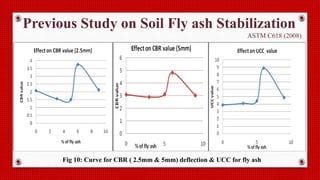
% Of Fly ash CBR(2.5mm)deflection CBR(5mm)deflection UCC (N/cm2)
0 2.08 3.1 3.881840
3 1.56 2.9 4.1ooooo
5 1.51 3.12 4.440923
6 3.75 4.82 8.881850
9 2.13 3.03 4.885015
Table 2 : Results of CBR values for (2.5mm & 5 mm) deflection & UCC
Previous Study on Soil Fly ash Stabilization
ASTM C618 (2008)
Fig 10: Curve for CBR ( 2.5mm & 5mm) deflection & UCC for fly ash
Present Study
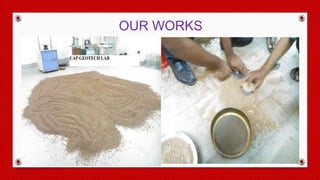
OUR WORKS
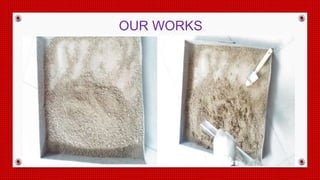
OUR WORKS
OUR WORKS
Present Study on Soil Stabilization
Soil types: Two types of soil used in this study which are
Soil A[Dhaka Clay, Silty Clay] and Soil B[River Sand,
Sandy Sand]
Location: Soil A is collected from Green Road Dhaka and
Soil B is collected from Kanchpur River
Additives:
• Portland Cement
• Hydrated Lime [Ca(OH)2]
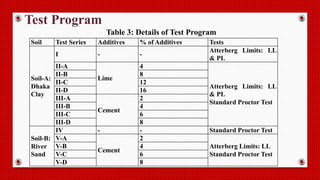
Soil Test Series Additives % of Additives Tests
Soil-A:
Dhaka
Clay
I - -
Atterberg Limits: LL
& PL
II-A
Lime
4
Atterberg Limits: LL
& PL
Standard Proctor Test
II-B 8
II-C 12
II-D 16
III-A
Cement
2
III-B 4
III-C 6
III-D 8
Soil-B:
River
Sand
IV - - Standard Proctor Test
V-A
Cement
2
Atterberg Limits: LL
Standard Proctor Test
V-B 4
V-C 6
V-D 8
Test Program
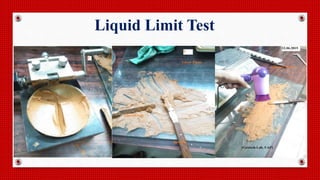
Table 3: Details of Test Program
Liquid Limit Test
0
10
20
30
40
50
60
1 10 100
WaterContent,W%
No. of blows, N
Liquid Limit Chart
LL= 35%
Fig 11: Flow Curve of Soil A Series I (No Additives)
Liquid Limit of Soil A [Dhaka Clay]
0
10
20
30
40
50
60
1 10 100
WaterContent,W%
No. of blows, N
Liquid Limit Chart
LL = 39%
Fig 12: Flow Curve of Soil A Series II-A
Liquid Limit of Soil A [Dhaka Clay]
0
10
20
30
40
50
60
1 10 100
Watercontent,W%
No. of blows, N
Liquid Limit Chart
LL= 40%
Fig 13: Flow Curve of Soil A Series II-B
Liquid Limit of Soil A [Dhaka Clay]
0
10
20
30
40
50
60
1 10 100
WaterContent,W%
No. of blows, N
Liquid Limit Chart
LL= 40%
Fig 14: Flow Curve of Soil A Series II-C
Liquid Limit of Soil A [Dhaka Clay]
0
5
10
15
20
25
30
1 10 100
WaterContent,W%
No of Blows , N
Liquid Limit Chart
LL = 21%
Fig 15: Flow Curve of Soil A Series III-A
Liquid Limit of Soil A [Dhaka Clay]
0
5
10
15
20
25
30
35
1 10 100
WaterContent,W%
No of Blows , N
Liquid Limit Chart
LL = 19%
Fig 16: Flow Curve of Soil A Series III-B
Liquid Limit of Soil A [Dhaka Clay]
0
2
4
6
8
10
12
14
16
1 10 100
WaterContent,W%
No of Blows, N
Liquid Limit Chart
LL = 9%
Fig 17: Flow Curve of Soil A Series III-C
Liquid Limit of Soil A [Dhaka Clay]
0
2
4
6
8
10
12
14
16
18
20
1 10 100
WaterContent,W%
No of Blows, N
Liquid Limit Chart
LL = 12%
Fig 18: Flow Curve of Soil-B Series V-A
Liquid Limit of Soil B[River Sand]
0
5
10
15
20
25
1 10 100
WaterContent,W%
No of Blows, N
Liquid Limit Chart
LL = 7%
Fig 19: Flow Curve of Soil-B Series V-B
Liquid Limit of Soil B[River Sand]
0
2
4
6
8
10
12
14
16
1 10 100
WaterContent,W%
No of Blows, N
Liquid Limit Chart
LL = 6%
Fig 20: Flow Curve of Soil-B Series V-C
Liquid Limit of Soil B[River Sand]
0
2
4
6
8
10
12
14
16
18
1 10 100
WaterContent,W%
No of Blows, N
Liquid Limit Chart
LL = 9%
Fig 21: Flow Curve of Soil-B Series V-D
Liquid Limit of Soil B[River Sand]
Effect of different types of Additives on
Liquid Limit
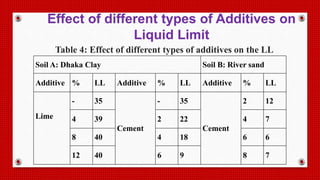
Table 4: Effect of different types of additives on the LL
Soil A: Dhaka Clay Soil B: River sand
Additive % LL Additive % LL Additive % LL
Lime
- 35
Cement
- 35
Cement
2 12
4 39 2 22 4 7
8 40 4 18 6 6
12 40 6 9 8 7
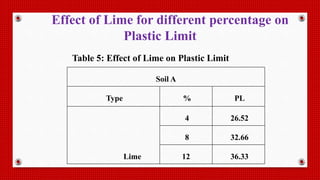
Plastic Limit Test
Soil A
Type % PL
Lime
4 26.52
8 32.66
12 36.33
Table 5: Effect of Lime on Plastic Limit
Effect of Lime for different percentage on
Plastic Limit
Standard Proctor Test
1560.00
1580.00
1600.00
1620.00
1640.00
1660.00
1680.00
1700.00
1720.00
0.00 5.00 10.00 15.00 20.00 25.00
MaximumDryDensitykg/m3
Water Content (%)
Fig 22: Compaction Curve for Soil A Series-II-A
Compaction Curve for Soil A [Dhaka Clay]
1580.00
1590.00
1600.00
1610.00
1620.00
1630.00
1640.00
1650.00
1660.00
1670.00
1680.00
1690.00
0.00 5.00 10.00 15.00 20.00 25.00 30.00
MaximumDryDensitykg/m3
Water Content (%)
Fig 23: Compaction Curve for Soil A Series-II-B
Compaction Curve for Soil A [Dhaka Clay]
1625.00
1630.00
1635.00
1640.00
1645.00
1650.00
1655.00
1660.00
1665.00
1670.00
1675.00
0.00 5.00 10.00 15.00 20.00 25.00
MaximumDryDensitykg/m3
Water Content (%)
Fig 24: Compaction Curve for Soil A Series-II-C
Compaction Curve for Soil A [Dhaka Clay]
1480.00
1500.00
1520.00
1540.00
1560.00
1580.00
1600.00
1620.00
1640.00
1660.00
1680.00
0.00 5.00 10.00 15.00 20.00 25.00 30.00 35.00
MaximumDryDensitykg/m3
Water Content (%)
Fig 25: Compaction Curve for Soil A [Series-II-D]
Compaction Curve for Soil A [Dhaka Clay]
1520.00
1540.00
1560.00
1580.00
1600.00
1620.00
1640.00
1660.00
1680.00
1700.00
0.00 5.00 10.00 15.00 20.00 25.00 30.00
MaximumDryDensitykg/m3
Water Content (%)
Fig 26: Compaction Curve for Soil A Series-III-A
Compaction Curve for Soil A [Dhaka Clay]
1500.00
1550.00
1600.00
1650.00
1700.00
1750.00
0.00 5.00 10.00 15.00 20.00 25.00
MaximumDryDensitykg/m3
Water Content (%)
Fig 27: Compaction Curve for Soil A Series-III-B
Compaction Curve for Soil A [Dhaka Clay]
1600.00
1620.00
1640.00
1660.00
1680.00
1700.00
1720.00
1740.00
1760.00
1780.00
1800.00
0.00 5.00 10.00 15.00 20.00 25.00
MaximumDryDensitykg/m3
Water Content (%)
Fig 28: Compaction Curve for Soil A [Series-III-C]
Compaction Curve for Soil A [Dhaka Clay]
1550.00
1600.00
1650.00
1700.00
1750.00
1800.00
1850.00
0.00 5.00 10.00 15.00 20.00 25.00 30.00
MaximumDryDensitykg/m3
Water Content (%)
Fig 29: Compaction Curve for Soil A [Series-III-D]
Compaction Curve for Soil A [Dhaka Clay]
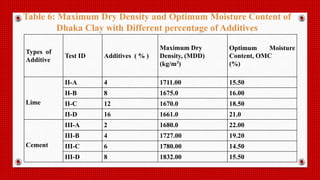
Types of
Additive
Test ID Additives ( % )
Maximum Dry
Density, (MDD)
(kg/m3)
Optimum Moisture
Content, OMC
(%)
Lime
II-A 4 1711.00 15.50
II-B 8 1675.0 16.00
II-C 12 1670.0 18.50
II-D 16 1661.0 21.0
Cement
III-A 2 1680.0 22.00
III-B 4 1727.00 19.20
III-C 6 1780.00 14.50
III-D 8 1832.00 15.50
Table 6: Maximum Dry Density and Optimum Moisture Content of
Dhaka Clay with Different percentage of Additives
1480.00
1490.00
1500.00
1510.00
1520.00
1530.00
1540.00
1550.00
1560.00
1570.00
1580.00
1590.00
1600.00
1610.00
0.00 5.00 10.00 15.00 20.00 25.00 30.00
MaximumDryDensitykg/m3
Water Content (%)
Fig 30: Compaction Curve for Soil B [Series-IV]
Compaction Curve for Soil B [River Sand]
1585.00
1590.00
1595.00
1600.00
1605.00
1610.00
1615.00
1620.00
1625.00
1630.00
1635.00
1640.00
0.00 5.00 10.00 15.00 20.00 25.00
MaximumDryDensitykg/m3
Water content (%)
Fig 31: Compaction Curve for Soil B [Series V-A]
Compaction Curve for Soil B [River Sand]
1560.00
1580.00
1600.00
1620.00
1640.00
1660.00
1680.00
1700.00
1720.00
0.00 5.00 10.00 15.00 20.00 25.00
MaximumDryDensitykg/m3
Water content (%)
Fig 32: Compaction Curve for Soil B [Series-VB]
Compaction Curve for Soil B [River Sand]
1600.00
1620.00
1640.00
1660.00
1680.00
1700.00
1720.00
1740.00
1760.00
0.00 5.00 10.00 15.00 20.00 25.00
MaximumDryDensitykg/m3
Water content (%)
Fig 33: Compaction Curve for Soil B [Series V-C]
Compaction Curve for Soil B [River Sand]
1620.00
1640.00
1660.00
1680.00
1700.00
1720.00
1740.00
1760.00
1780.00
0.00 2.00 4.00 6.00 8.00 10.00 12.00 14.00 16.00 18.00
MaximumDryDensitykg/m3
Water Content (%)
Fig 34: Compaction Curve for Soil B [Series V-D]
Compaction Curve for Soil B [River Sand]
Types of
Additive
Test ID Additives ( % )
Maximum Dry
Density, (MDD)
(kg/m3)
Optimum Moisture
Content, OMC
(%)
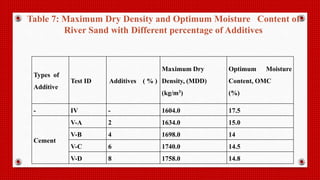
- IV - 1604.0 17.5
Cement
V-A 2 1634.0 15.0
V-B 4 1698.0 14
V-C 6 1740.0 14.5
V-D 8 1758.0 14.8
Table 7: Maximum Dry Density and Optimum Moisture Content of
River Sand with Different percentage of Additives
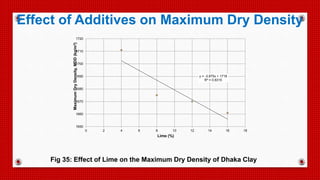
Analysis of Experimental Results
y = -3.875x + 1718
R² = 0.8315
1650
1660
1670
1680
1690
1700
1710
1720
0 2 4 6 8 10 12 14 16 18
MaximumDryDensity,MDD(kg/m3)
Lime (%)
Fig 35: Effect of Lime on the Maximum Dry Density of Dhaka Clay
Effect of Additives on Maximum Dry Density
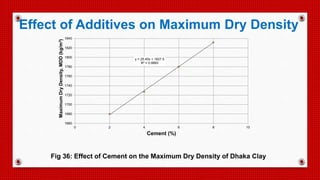
y = 25.45x + 1627.5
R² = 0.9993
1660
1680
1700
1720
1740
1760
1780
1800
1820
1840
0 2 4 6 8 10
MaximumDryDensity,MDD(kg/m3)
Cement (%)
Fig 36: Effect of Cement on the Maximum Dry Density of Dhaka Clay
Effect of Additives on Maximum Dry Density
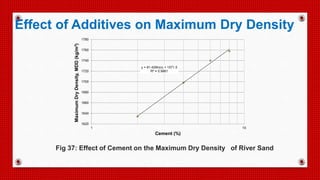
y = 91.429ln(x) + 1571.5
R² = 0.9961
1620
1640
1660
1680
1700
1720
1740
1760
1780
1 10
MaximumDryDensity,MDD(kg/m3)
Cement (%)
Fig 37: Effect of Cement on the Maximum Dry Density of River Sand
Effect of Additives on Maximum Dry Density
0
5
10
15
20
25
0 2 4 6 8 10 12 14 16 18
Additives (%)
Lime Cement
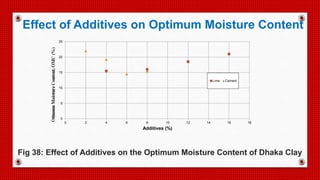
Fig 38: Effect of Additives on the Optimum Moisture Content of Dhaka Clay
Effect of Additives on Optimum Moisture Content
 It was found that Liquid limit also are same for lime content but plastic limit
varied with increasing % of lime content for Dhaka clay [Soil A] but the liquid
limit change with increasing % of cement both Dhaka clay [Soil A] and River
sand [Soil B].
 It was found that Maximum Dry Density (MDD) decreased with the
increase in % of lime content for Dhaka Clay but MDD increased with
increasing % of cement content both Dhaka Clay and River Sand
 Optimum Moisture Content decreased with increasing ( 0-6) % of cement
content but it increased for 8% of cement content
CONCLUSION
CONCLUSION
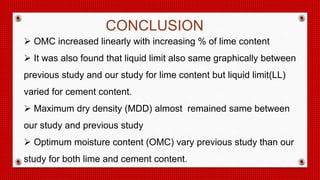
 OMC increased linearly with increasing % of lime content
 It was also found that liquid limit also same graphically between
previous study and our study for lime content but liquid limit(LL)
varied for cement content.
 Maximum dry density (MDD) almost remained same between
our study and previous study
 Optimum moisture content (OMC) vary previous study than our
study for both lime and cement content.
SOIL STABILIZATION USING LIME AND CEMENT

SOIL STABILIZATION USING LIME AND CEMENT

  • 1.
    SOIL STABILIZATION USING LIMEAND CEMENT University of Asia Pacific (UAP)
  • 2.
    Contents • Introduction • Objectiveof this study • Literature Review • Test Program • Analysis of Experimental Results • Conclusions
  • 3.
    Introduction Soil Improvement • Toincrease bearing capacity and stability (avoid failure ) • To reduce post construction settlements • To reduce liquefaction risk (seismic areas) Before soil improvement: • Check for suitability or feasibility of using different types of foundation (pile / raft) • Soil replacement
  • 4.
    • Expensive • DifferentMethods: • Soil stabilization • Dynamic compaction and replacement • Vertical drains • Vibroflottation • Stone columns • Inclusions Soil Improvement Techniques
  • 5.
    Impact of PresentStudy in Bangladesh • Seismic zone • Filled zones are susceptible to liquefaction • Factor of safety against liquefaction is more, if filled material contains fine materials • Soil stabilization would be a possible method for minimizing the probability of liquefaction during earthquake loading.
  • 6.
    Soil Stabilization Bell (1993): •Soil stabilization is the process of mixing additives with soil to improve • volume stability • strength • permeability and • durability
  • 7.
    Objective of thisstudy • To study the effect of additives (lime and cement) on soil properties, in terms of the following parameters: • Atterberg limits • Maximum dry density • Optimum moisture content
  • 8.
    Literature Review • Reviewthe literature on soil stabilization using different additives • Lime Stabilization • Plasticity reduction • Reduction in moisture-holding capacity (drying) • Swell reduction • Improved stability • Cement Stabilization • It is widely available • Cost is relatively low • It is highly durable • Soil cement is quite weather resistant and strong.
  • 9.
    • Flyash Stabilization •Strength - to increase the strength and bearing capacity. • Volume stability - to control the swell-shrink characteristics caused by moisture changes. • Durability - to increase the resistance to erosion, weathering or traffic loading. • To reduce the pavement thickness as well as cost. • Blast Furnace Slug • strength - to increase the strength and bearing capacity. • volume stability - to control the swell-shrink characteristics caused by moisture changes. • durability - to increase the resistance to erosion, weathering or traffic loading. Literature Review
  • 10.
    Literature Review Method ofSoil Stabilization 1. Soil Lime Stabilization 2. Cement Lime Stabilization
  • 11.
    • Soil Type:Natural clay soil • Location: Ekiti State, Nigeria • It was collected at 1m depth below the ground level • Additive: Hydrated high calcium lime, Ca(OH)2 Soil Stabilization: Lime as Additive Flaherty.C 2002
  • 12.
    Effect of Limeon Atterburg Limits • LL: relatively constant • PL: varies with % of lime Fig 1: Atterberg Limits test results
  • 13.
    Effect of Limeon OMC and MDD Fig 2: Compaction test results •MDD: varies between 1680 and 1780 kg/m3 • OMC: varies between 18% and 21.5%
  • 14.
    • Soil Type:Reddish brown laterite soil • Classified as A-2-7(0) using AASHTO soil classification system • Location: 22 km from Makurdi, Nigeria • Obtained from: River Benue in Makurdi • Additives: Ordinary Portland cement Soil Stabilization: Cement as Additives Feng.T 2002
  • 15.
    Property Quantity Cement content0 Liquid Limit (%) 41 Plastic Limit (%) 24 Plasticity Index (%) 17 Linear Shrinkage (%) 14 Maximum Dry Density (WAS)Mg/m³ 1.88 Optimum Moisture Content (%) 12.0 Soil Cement Stabilization Table 1: Soil Cement Stabilization
  • 16.
    Effect of CementContent on MDDMaximumDryDensity(Mg/m3) • Cement Content: 0 – 9% • Sand: 0 – 60% •MDD: Increase relatively (0%-60 %) sand Cement Content (%) Fig 3: Results of compaction test
  • 17.
    Effect of CementContent on OMC OptimumMoistureContent(%) • Cement Content: 0 – 9% • Sand: 0 – 60% •OMC: Increase for 3% cement content for 15 % of sand •OMC: Decrease for 6% cement with increasing different % of sand) Cement Content (%) Fig 4: Results of compaction test
  • 18.
    Effect of CementContent on Unconfined Compressive Strength • Cement Content: 0 – 9% • Sand: 0 – 60% •UCS: Increase relatively with increasing different % of cement and sand •UCS: Almost same (30-45) % of sand with increasing % of cement Cement Content (%) UnconfinedCompressiveStrength (KN/M2) Fig 5: Unconfined Compressive Strength
  • 19.
    Soil Stabilization: Cementas Additives Olabiran O. E., Asaolu O. E.,& Etuka R. C., 16-20, 1989 Figure 6. Variation of 28 day UCS with soil-sand-cement mixtures • Cement Content: 0 – 9% • Sand: 0 – 60% •UCS: Increase relatively for 3% & 9% of cement with increasing % of sand •UCS: Decrease and same for 6% cement with increasing % of sand Cement Content (%) UnconfinedCompressiveStrength (KN/M2)
  • 20.
    Soil Stabilization: Flyash Cokca, E. (2001) • Red soil of tirupur district, India • Additives: Fly Ash (class C and class F)
  • 21.
    Results of Atterburglimits graphically Fig 7: Liquid limit distribution curve for Fly ash Previous Study on Soil Fly ash stabilization ASTM C618 (2008) • LL: varies with % of Fly ash
  • 22.
    Fig 8: Plasticlimit distribution curve for Fly ash Results of Atterburg limits graphically Previous Study on Soil Fly ash stabilization [ASTM C618 (2008)] •PL: varies with % of Fly ash
  • 23.
    Effect of FlyAsh on Gs, OMC and MDD ASTM C618 (2008) Fig 9: Gs ,OMC & MDD for different percentages of fly ash
  • 24.
    Previous Study onSoil Fly ash Stabilization % Of Fly ash CBR(2.5mm)deflection CBR(5mm)deflection UCC (N/cm2) 0 2.08 3.1 3.881840 3 1.56 2.9 4.1ooooo 5 1.51 3.12 4.440923 6 3.75 4.82 8.881850 9 2.13 3.03 4.885015 Table 2 : Results of CBR values for (2.5mm & 5 mm) deflection & UCC
  • 25.
    Previous Study onSoil Fly ash Stabilization ASTM C618 (2008) Fig 10: Curve for CBR ( 2.5mm & 5mm) deflection & UCC for fly ash
  • 26.
  • 27.
  • 28.
  • 29.
  • 30.
    Present Study onSoil Stabilization Soil types: Two types of soil used in this study which are Soil A[Dhaka Clay, Silty Clay] and Soil B[River Sand, Sandy Sand] Location: Soil A is collected from Green Road Dhaka and Soil B is collected from Kanchpur River Additives: • Portland Cement • Hydrated Lime [Ca(OH)2]
  • 31.
    Soil Test SeriesAdditives % of Additives Tests Soil-A: Dhaka Clay I - - Atterberg Limits: LL & PL II-A Lime 4 Atterberg Limits: LL & PL Standard Proctor Test II-B 8 II-C 12 II-D 16 III-A Cement 2 III-B 4 III-C 6 III-D 8 Soil-B: River Sand IV - - Standard Proctor Test V-A Cement 2 Atterberg Limits: LL Standard Proctor Test V-B 4 V-C 6 V-D 8 Test Program Table 3: Details of Test Program
  • 32.
  • 33.
    0 10 20 30 40 50 60 1 10 100 WaterContent,W% No.of blows, N Liquid Limit Chart LL= 35% Fig 11: Flow Curve of Soil A Series I (No Additives) Liquid Limit of Soil A [Dhaka Clay]
  • 34.
    0 10 20 30 40 50 60 1 10 100 WaterContent,W% No.of blows, N Liquid Limit Chart LL = 39% Fig 12: Flow Curve of Soil A Series II-A Liquid Limit of Soil A [Dhaka Clay]
  • 35.
    0 10 20 30 40 50 60 1 10 100 Watercontent,W% No.of blows, N Liquid Limit Chart LL= 40% Fig 13: Flow Curve of Soil A Series II-B Liquid Limit of Soil A [Dhaka Clay]
  • 36.
    0 10 20 30 40 50 60 1 10 100 WaterContent,W% No.of blows, N Liquid Limit Chart LL= 40% Fig 14: Flow Curve of Soil A Series II-C Liquid Limit of Soil A [Dhaka Clay]
  • 37.
    0 5 10 15 20 25 30 1 10 100 WaterContent,W% Noof Blows , N Liquid Limit Chart LL = 21% Fig 15: Flow Curve of Soil A Series III-A Liquid Limit of Soil A [Dhaka Clay]
  • 38.
    0 5 10 15 20 25 30 35 1 10 100 WaterContent,W% Noof Blows , N Liquid Limit Chart LL = 19% Fig 16: Flow Curve of Soil A Series III-B Liquid Limit of Soil A [Dhaka Clay]
  • 39.
    0 2 4 6 8 10 12 14 16 1 10 100 WaterContent,W% Noof Blows, N Liquid Limit Chart LL = 9% Fig 17: Flow Curve of Soil A Series III-C Liquid Limit of Soil A [Dhaka Clay]
  • 40.
    0 2 4 6 8 10 12 14 16 18 20 1 10 100 WaterContent,W% Noof Blows, N Liquid Limit Chart LL = 12% Fig 18: Flow Curve of Soil-B Series V-A Liquid Limit of Soil B[River Sand]
  • 41.
    0 5 10 15 20 25 1 10 100 WaterContent,W% Noof Blows, N Liquid Limit Chart LL = 7% Fig 19: Flow Curve of Soil-B Series V-B Liquid Limit of Soil B[River Sand]
  • 42.
    0 2 4 6 8 10 12 14 16 1 10 100 WaterContent,W% Noof Blows, N Liquid Limit Chart LL = 6% Fig 20: Flow Curve of Soil-B Series V-C Liquid Limit of Soil B[River Sand]
  • 43.
    0 2 4 6 8 10 12 14 16 18 1 10 100 WaterContent,W% Noof Blows, N Liquid Limit Chart LL = 9% Fig 21: Flow Curve of Soil-B Series V-D Liquid Limit of Soil B[River Sand]
  • 44.
    Effect of differenttypes of Additives on Liquid Limit Table 4: Effect of different types of additives on the LL Soil A: Dhaka Clay Soil B: River sand Additive % LL Additive % LL Additive % LL Lime - 35 Cement - 35 Cement 2 12 4 39 2 22 4 7 8 40 4 18 6 6 12 40 6 9 8 7
  • 45.
  • 46.
    Soil A Type %PL Lime 4 26.52 8 32.66 12 36.33 Table 5: Effect of Lime on Plastic Limit Effect of Lime for different percentage on Plastic Limit
  • 47.
  • 48.
    1560.00 1580.00 1600.00 1620.00 1640.00 1660.00 1680.00 1700.00 1720.00 0.00 5.00 10.0015.00 20.00 25.00 MaximumDryDensitykg/m3 Water Content (%) Fig 22: Compaction Curve for Soil A Series-II-A Compaction Curve for Soil A [Dhaka Clay]
  • 49.
    1580.00 1590.00 1600.00 1610.00 1620.00 1630.00 1640.00 1650.00 1660.00 1670.00 1680.00 1690.00 0.00 5.00 10.0015.00 20.00 25.00 30.00 MaximumDryDensitykg/m3 Water Content (%) Fig 23: Compaction Curve for Soil A Series-II-B Compaction Curve for Soil A [Dhaka Clay]
  • 50.
    1625.00 1630.00 1635.00 1640.00 1645.00 1650.00 1655.00 1660.00 1665.00 1670.00 1675.00 0.00 5.00 10.0015.00 20.00 25.00 MaximumDryDensitykg/m3 Water Content (%) Fig 24: Compaction Curve for Soil A Series-II-C Compaction Curve for Soil A [Dhaka Clay]
  • 51.
    1480.00 1500.00 1520.00 1540.00 1560.00 1580.00 1600.00 1620.00 1640.00 1660.00 1680.00 0.00 5.00 10.0015.00 20.00 25.00 30.00 35.00 MaximumDryDensitykg/m3 Water Content (%) Fig 25: Compaction Curve for Soil A [Series-II-D] Compaction Curve for Soil A [Dhaka Clay]
  • 52.
    1520.00 1540.00 1560.00 1580.00 1600.00 1620.00 1640.00 1660.00 1680.00 1700.00 0.00 5.00 10.0015.00 20.00 25.00 30.00 MaximumDryDensitykg/m3 Water Content (%) Fig 26: Compaction Curve for Soil A Series-III-A Compaction Curve for Soil A [Dhaka Clay]
  • 53.
    1500.00 1550.00 1600.00 1650.00 1700.00 1750.00 0.00 5.00 10.0015.00 20.00 25.00 MaximumDryDensitykg/m3 Water Content (%) Fig 27: Compaction Curve for Soil A Series-III-B Compaction Curve for Soil A [Dhaka Clay]
  • 54.
    1600.00 1620.00 1640.00 1660.00 1680.00 1700.00 1720.00 1740.00 1760.00 1780.00 1800.00 0.00 5.00 10.0015.00 20.00 25.00 MaximumDryDensitykg/m3 Water Content (%) Fig 28: Compaction Curve for Soil A [Series-III-C] Compaction Curve for Soil A [Dhaka Clay]
  • 55.
    1550.00 1600.00 1650.00 1700.00 1750.00 1800.00 1850.00 0.00 5.00 10.0015.00 20.00 25.00 30.00 MaximumDryDensitykg/m3 Water Content (%) Fig 29: Compaction Curve for Soil A [Series-III-D] Compaction Curve for Soil A [Dhaka Clay]
  • 56.
    Types of Additive Test IDAdditives ( % ) Maximum Dry Density, (MDD) (kg/m3) Optimum Moisture Content, OMC (%) Lime II-A 4 1711.00 15.50 II-B 8 1675.0 16.00 II-C 12 1670.0 18.50 II-D 16 1661.0 21.0 Cement III-A 2 1680.0 22.00 III-B 4 1727.00 19.20 III-C 6 1780.00 14.50 III-D 8 1832.00 15.50 Table 6: Maximum Dry Density and Optimum Moisture Content of Dhaka Clay with Different percentage of Additives
  • 57.
    1480.00 1490.00 1500.00 1510.00 1520.00 1530.00 1540.00 1550.00 1560.00 1570.00 1580.00 1590.00 1600.00 1610.00 0.00 5.00 10.0015.00 20.00 25.00 30.00 MaximumDryDensitykg/m3 Water Content (%) Fig 30: Compaction Curve for Soil B [Series-IV] Compaction Curve for Soil B [River Sand]
  • 58.
    1585.00 1590.00 1595.00 1600.00 1605.00 1610.00 1615.00 1620.00 1625.00 1630.00 1635.00 1640.00 0.00 5.00 10.0015.00 20.00 25.00 MaximumDryDensitykg/m3 Water content (%) Fig 31: Compaction Curve for Soil B [Series V-A] Compaction Curve for Soil B [River Sand]
  • 59.
    1560.00 1580.00 1600.00 1620.00 1640.00 1660.00 1680.00 1700.00 1720.00 0.00 5.00 10.0015.00 20.00 25.00 MaximumDryDensitykg/m3 Water content (%) Fig 32: Compaction Curve for Soil B [Series-VB] Compaction Curve for Soil B [River Sand]
  • 60.
    1600.00 1620.00 1640.00 1660.00 1680.00 1700.00 1720.00 1740.00 1760.00 0.00 5.00 10.0015.00 20.00 25.00 MaximumDryDensitykg/m3 Water content (%) Fig 33: Compaction Curve for Soil B [Series V-C] Compaction Curve for Soil B [River Sand]
  • 61.
    1620.00 1640.00 1660.00 1680.00 1700.00 1720.00 1740.00 1760.00 1780.00 0.00 2.00 4.006.00 8.00 10.00 12.00 14.00 16.00 18.00 MaximumDryDensitykg/m3 Water Content (%) Fig 34: Compaction Curve for Soil B [Series V-D] Compaction Curve for Soil B [River Sand]
  • 62.
    Types of Additive Test IDAdditives ( % ) Maximum Dry Density, (MDD) (kg/m3) Optimum Moisture Content, OMC (%) - IV - 1604.0 17.5 Cement V-A 2 1634.0 15.0 V-B 4 1698.0 14 V-C 6 1740.0 14.5 V-D 8 1758.0 14.8 Table 7: Maximum Dry Density and Optimum Moisture Content of River Sand with Different percentage of Additives
  • 63.
  • 64.
    y = -3.875x+ 1718 R² = 0.8315 1650 1660 1670 1680 1690 1700 1710 1720 0 2 4 6 8 10 12 14 16 18 MaximumDryDensity,MDD(kg/m3) Lime (%) Fig 35: Effect of Lime on the Maximum Dry Density of Dhaka Clay Effect of Additives on Maximum Dry Density
  • 65.
    y = 25.45x+ 1627.5 R² = 0.9993 1660 1680 1700 1720 1740 1760 1780 1800 1820 1840 0 2 4 6 8 10 MaximumDryDensity,MDD(kg/m3) Cement (%) Fig 36: Effect of Cement on the Maximum Dry Density of Dhaka Clay Effect of Additives on Maximum Dry Density
  • 66.
    y = 91.429ln(x)+ 1571.5 R² = 0.9961 1620 1640 1660 1680 1700 1720 1740 1760 1780 1 10 MaximumDryDensity,MDD(kg/m3) Cement (%) Fig 37: Effect of Cement on the Maximum Dry Density of River Sand Effect of Additives on Maximum Dry Density
  • 67.
    0 5 10 15 20 25 0 2 46 8 10 12 14 16 18 Additives (%) Lime Cement Fig 38: Effect of Additives on the Optimum Moisture Content of Dhaka Clay Effect of Additives on Optimum Moisture Content
  • 68.
     It wasfound that Liquid limit also are same for lime content but plastic limit varied with increasing % of lime content for Dhaka clay [Soil A] but the liquid limit change with increasing % of cement both Dhaka clay [Soil A] and River sand [Soil B].  It was found that Maximum Dry Density (MDD) decreased with the increase in % of lime content for Dhaka Clay but MDD increased with increasing % of cement content both Dhaka Clay and River Sand  Optimum Moisture Content decreased with increasing ( 0-6) % of cement content but it increased for 8% of cement content CONCLUSION
  • 69.
    CONCLUSION  OMC increasedlinearly with increasing % of lime content  It was also found that liquid limit also same graphically between previous study and our study for lime content but liquid limit(LL) varied for cement content.  Maximum dry density (MDD) almost remained same between our study and previous study  Optimum moisture content (OMC) vary previous study than our study for both lime and cement content.