Group C
 Faarax Xasan Shiil Salaad ID:595
 Cabdiraxmaan Cusman Cabdulaahi ID:579
 Abdishakuur Abdiqaadir Abuukar ID:582
 Nuur Axmed Sabriye ID:618
 Caadil Shariif Ciise ID:589
 Saafi Abshir Geedi ID:623
 Xasan Cabdi Cali ID:598
 Xussein Cabdi Cilmi ID:601
SOIL STABLIZATION
INTRODUCTION
 Soil stabilization is a method of improving soil properties
by blending and mixing other materials.
 Soil stabilization is the process of improving the shear strength
. parameters of soil and thus increasing the bearing capacity of soil.
It is required when the soil available for construction is not suitable
to carry structural load.
 Soil stabilization is used to reduce permeability and compressibility
of the soil mass in earth structures and to increase its shear strength.
Thus to reduce the settlement of structures.
 Soil stabilization involves the use of stabilizing agents (binder materials)
in weak soils to improve its geotechnical properties such as compressibility,
strength, permeability and durability.
PURPOSE OF SOIL STABILIZATION
 Since one of de most Requirements of Pavement is to distribute
de wheel load safely into de Subgrade ( the Natural soil located
along the horizontal alignment of the pavement which serves as
the pavement structure’s foundation ) It’s so important de soil to
have and adequate bearing capacity that can withstand de load
that will be imposed by de traffic. So that it’s so important to
make a site feasibility.
 Site feasibility study for Highway or even geotechnical and civil
engineering projects is of far most beneficial before a project can
take off. Site survey usually takes place before the design process
begins in order to understand the characteristics of subsoil upon
which the decision on location of the project can be made.
CONT....
 The following geotechnical design criteria have to be considered during site
selection:-
1) Design load and function of the structure
2) Type of foundation to be used.
3) Bearing capacity of subsoil.
 As we know generally Soil can be classified into two distinct categories which
are cohesion less and cohesive soil
 As a subgrade of highways either of the two types alone can not take the traffic
independently
 Sands are cohesion less and spread laterally under vertical load.
 And clays when wet lose all strength .Combination of the two in certain specific
proportions and compact with or without the use of additives like lime, cement,
bitumen etc. may result in a stable subgrade. So A question Arises, Do we
consider being better of de soil by it’s load bearing capacity ? or we Consider it
by different types of soil that'll encountered at the site As the Geologists do ?
CONT...
 After we do A site feasibility and Allow de traffic to be passed on de subgrade and
Acquire(Obtain) that Our soil is poor and can’t resist de traffic there r methods which
can improve it.
 So Once the bearing capacity of the soil was poor, the following were options:-
  Change the design to suit site condition.
  Remove and replace the in situ soil.
  Abandon the site
 De third one (Abandoned sites due to undesirable soil bearing capacities )dramatically
increased, and de outcome of this was the scarcity of land and increased demand for
natural resources. However, in most Engineering projects, it is not possible to obtain a
construction site that will meet de design requirements without ground modification.
De current practice is to modify the engineering properties of the native problematic
soils to meet the design specifications. In order to improve de Soil we use method of
soil’s Stabilization.
CONT...
 Soil stabilization : Preparing of A surface with coarser and finer
varieties of de soil both available near the sites with or without
de use of admixtures and compacted so as not to allow it lose its
strength under traffic is called stabilized surface. And de
process of preparing such stabilized surface may be termed as a
soil stabilization.
 In order to reduce the cost of stabilized surface it is necessary to
know exactly the location along the road or in the near vicinity
where from one or the other type of the soil shall be available
 A through soil survey is required to be conducted for the
purpose before making the final alignment of de road and
designing it.
CONT...
 Stabilizing Agents
 The commonly used binders are:
1) cement
2) lime.
3) fly ash
 Cement stabilized soils have the following improved properties:
1) decreased cohesiveness (Plasticity)
2) decreased volume expansion or compressibility
3) increased strength (PCA-IS 411, 2003).
Soil Stabilization Methods
 In road construction projects, soil or gravelly material is used as the road
main body in pavement layers. To have required strength against tensile
stresses and strains spectrum, the soil used for constructing pavement
should have special specification. Through soil stabilization, unbound
materials can be stabilized with cementitious materials (cement, lime, fly
ash, bitumen or combination of these). The stabilized soil materials have
a higher strength, lower permeability and lower compressibility than the
native soil. The method can be achieved in two ways, namely
1) Mechanical Stabilization
2) Chemical Stabilization
Mechanical Stabilization
 Mechanical Stabilization is the process of improving the properties of the
soil by changing its gradation. This process includes soil compaction and
densification by application of mechanical energy using various sorts of
rollers, rammers, vibration techniques and sometime blasting. The stability
of the soil in this method relies on the inherent properties of the soil
material. Two or more types of natural soils are mixed to obtain a
composite material which is superior to any of its components.
Mechanical stabilization is accomplished by mixing or blending soils of
two or more gradations to obtain a material meeting the required
specification
Chemical Stabilization
 Chemical stabilization is better when area
predominant in one type of soil, in order to stabilize
mechanically high clayey soil as much 70 to 80% by
weight of sandy soil is needed and the cost of
transportation if not locally available shall be very high
 in such case some type of additive when added to de
soil shall react chemically with it producing stable
particles by changing some of the basic properties of the
soil.
 Addition of 2 to 10% by weight of lime is very
effective in case of clayey soil.
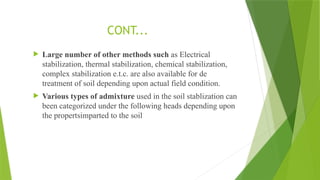
 Large number of other methods such as Electrical
stabilization, thermal stabilization, chemical stabilization,
complex stabilization e.t.c. are also available for de
treatment of soil depending upon actual field condition.
 Various types of admixture used in the soil stablization can
been categorized under the following heads depending upon
the propertsimparted to the soil
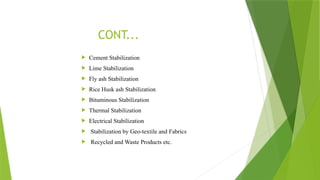
CONT...
 Cement Stabilization
 Lime Stabilization
 Fly ash Stabilization
 Rice Husk ash Stabilization
 Bituminous Stabilization
 Thermal Stabilization
 Electrical Stabilization
 Stabilization by Geo-textile and Fabrics
 Recycled and Waste Products etc.
CONT...
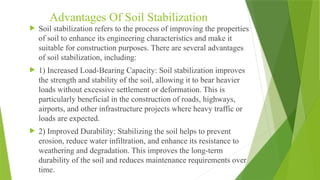
Advantages Of Soil Stabilization
 Soil stabilization refers to the process of improving the properties
of soil to enhance its engineering characteristics and make it
suitable for construction purposes. There are several advantages
of soil stabilization, including:
 1) Increased Load-Bearing Capacity: Soil stabilization improves
the strength and stability of the soil, allowing it to bear heavier
loads without excessive settlement or deformation. This is
particularly beneficial in the construction of roads, highways,
airports, and other infrastructure projects where heavy traffic or
loads are expected.
 2) Improved Durability: Stabilizing the soil helps to prevent
erosion, reduce water infiltration, and enhance its resistance to
weathering and degradation. This improves the long-term
durability of the soil and reduces maintenance requirements over
time.
 3) Enhanced Slope Stability: Stabilizing soil can help prevent
slope failures and landslides by increasing the shear strength and
stability of the soil mass. This is critical in hilly or mountainous
areas where slope stability is a concern for infrastructure
development and protection against natural hazards.
 4) Reduced Swelling and Shrinkage: Certain types of soils, such
as expansive clays, exhibit significant volume changes with
changes in moisture content. Soil stabilization techniques can
help minimize these swelling and shrinkage tendencies, reducing
the risk of damage to structures built on such soils.
CONT...
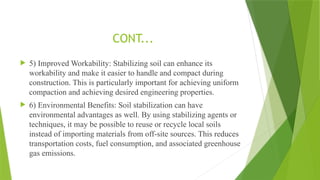
 5) Improved Workability: Stabilizing soil can enhance its
workability and make it easier to handle and compact during
construction. This is particularly important for achieving uniform
compaction and achieving desired engineering properties.
 6) Environmental Benefits: Soil stabilization can have
environmental advantages as well. By using stabilizing agents or
techniques, it may be possible to reuse or recycle local soils
instead of importing materials from off-site sources. This reduces
transportation costs, fuel consumption, and associated greenhouse
gas emissions.
CONT...
 7) Cost Savings: Soil stabilization can lead to cost savings in
construction projects. By improving the properties of the existing soil,
it may be possible to reduce the amount of imported materials, thereby
lowering construction costs. Additionally, the enhanced stability and
durability of the stabilized soil can reduce maintenance and repair
expenses in the long run.
 8) Faster Construction: Soil stabilization techniques can expedite the
construction process by reducing the time required for soil preparation
and improvement. Instead of waiting for unsuitable soil to naturally
consolidate or undergo time-consuming treatments, stabilization allows
for immediate construction on the stabilized soil.
CONT...
 Soil stabilization is a process used to improve the engineering
properties of soil in order to make it suitable for construction
purposes. It involves various techniques and methods aimed at
enhancing the strength, stability, and durability of the soil.
 The natural properties of soil can vary significantly, and not all
soils are ideal for construction. Some soils may have low load-
bearing capacity, high compressibility, or poor resistance to
erosion. These soil characteristics can pose challenges for
building foundations, roads, embankments, and other
infrastructure projects.
Summary
 Soil stabilization techniques are employed to overcome these
challenges and transform the soil into a stable and reliable
construction material. The specific method chosen for soil
stabilization depends on factors such as the soil type, project
requirements, environmental considerations, and cost-
effectiveness.
 There are several common soil stabilization techniques.
Mechanical stabilization involves compacting the soil to improve
its density and strength. Chemical stabilization involves adding
certain chemical additives, such as lime, cement, or fly ash, to
enhance the soil's properties. Geosynthetic stabilization utilizes
geotextiles or geogrids to reinforce the soil and improve its
strength and stability.
CONT...
 The benefits of soil stabilization are numerous. It increases the load-bearing capacity
of the soil, allowing it to support heavy structures and loads without excessive
settlement. It improves the durability of the soil, making it more resistant to erosion,
weathering, and degradation. Stabilization also enhances slope stability, reduces
swelling and shrinkage tendencies, and improves the workability of the soil during
construction.
 When de Subgrade doesn’t have N Ability to withstand de load imposed by de traffic
we can use two options:-
1) Abandon the site
2) To improve de soil in de site
 But de 1st
one (Abandon the site) is so costly . so for costly we use stabilization of soil
which can be done by :-
1) Chemical
2) mechanical
CONT...
END

SOIL STABILIZATION by using all methods.pptx

  • 1.
    Group C  FaaraxXasan Shiil Salaad ID:595  Cabdiraxmaan Cusman Cabdulaahi ID:579  Abdishakuur Abdiqaadir Abuukar ID:582  Nuur Axmed Sabriye ID:618  Caadil Shariif Ciise ID:589  Saafi Abshir Geedi ID:623  Xasan Cabdi Cali ID:598  Xussein Cabdi Cilmi ID:601
  • 2.
  • 3.
    INTRODUCTION  Soil stabilizationis a method of improving soil properties by blending and mixing other materials.  Soil stabilization is the process of improving the shear strength . parameters of soil and thus increasing the bearing capacity of soil. It is required when the soil available for construction is not suitable to carry structural load.  Soil stabilization is used to reduce permeability and compressibility of the soil mass in earth structures and to increase its shear strength. Thus to reduce the settlement of structures.  Soil stabilization involves the use of stabilizing agents (binder materials) in weak soils to improve its geotechnical properties such as compressibility, strength, permeability and durability.
  • 4.
    PURPOSE OF SOILSTABILIZATION  Since one of de most Requirements of Pavement is to distribute de wheel load safely into de Subgrade ( the Natural soil located along the horizontal alignment of the pavement which serves as the pavement structure’s foundation ) It’s so important de soil to have and adequate bearing capacity that can withstand de load that will be imposed by de traffic. So that it’s so important to make a site feasibility.  Site feasibility study for Highway or even geotechnical and civil engineering projects is of far most beneficial before a project can take off. Site survey usually takes place before the design process begins in order to understand the characteristics of subsoil upon which the decision on location of the project can be made.
  • 5.
    CONT....  The followinggeotechnical design criteria have to be considered during site selection:- 1) Design load and function of the structure 2) Type of foundation to be used. 3) Bearing capacity of subsoil.  As we know generally Soil can be classified into two distinct categories which are cohesion less and cohesive soil  As a subgrade of highways either of the two types alone can not take the traffic independently  Sands are cohesion less and spread laterally under vertical load.  And clays when wet lose all strength .Combination of the two in certain specific proportions and compact with or without the use of additives like lime, cement, bitumen etc. may result in a stable subgrade. So A question Arises, Do we consider being better of de soil by it’s load bearing capacity ? or we Consider it by different types of soil that'll encountered at the site As the Geologists do ?
  • 6.
    CONT...  After wedo A site feasibility and Allow de traffic to be passed on de subgrade and Acquire(Obtain) that Our soil is poor and can’t resist de traffic there r methods which can improve it.  So Once the bearing capacity of the soil was poor, the following were options:-   Change the design to suit site condition.   Remove and replace the in situ soil.   Abandon the site  De third one (Abandoned sites due to undesirable soil bearing capacities )dramatically increased, and de outcome of this was the scarcity of land and increased demand for natural resources. However, in most Engineering projects, it is not possible to obtain a construction site that will meet de design requirements without ground modification. De current practice is to modify the engineering properties of the native problematic soils to meet the design specifications. In order to improve de Soil we use method of soil’s Stabilization.
  • 7.
    CONT...  Soil stabilization: Preparing of A surface with coarser and finer varieties of de soil both available near the sites with or without de use of admixtures and compacted so as not to allow it lose its strength under traffic is called stabilized surface. And de process of preparing such stabilized surface may be termed as a soil stabilization.  In order to reduce the cost of stabilized surface it is necessary to know exactly the location along the road or in the near vicinity where from one or the other type of the soil shall be available  A through soil survey is required to be conducted for the purpose before making the final alignment of de road and designing it.
  • 8.
    CONT...  Stabilizing Agents The commonly used binders are: 1) cement 2) lime. 3) fly ash  Cement stabilized soils have the following improved properties: 1) decreased cohesiveness (Plasticity) 2) decreased volume expansion or compressibility 3) increased strength (PCA-IS 411, 2003).
  • 9.
    Soil Stabilization Methods In road construction projects, soil or gravelly material is used as the road main body in pavement layers. To have required strength against tensile stresses and strains spectrum, the soil used for constructing pavement should have special specification. Through soil stabilization, unbound materials can be stabilized with cementitious materials (cement, lime, fly ash, bitumen or combination of these). The stabilized soil materials have a higher strength, lower permeability and lower compressibility than the native soil. The method can be achieved in two ways, namely 1) Mechanical Stabilization 2) Chemical Stabilization
  • 10.
    Mechanical Stabilization  MechanicalStabilization is the process of improving the properties of the soil by changing its gradation. This process includes soil compaction and densification by application of mechanical energy using various sorts of rollers, rammers, vibration techniques and sometime blasting. The stability of the soil in this method relies on the inherent properties of the soil material. Two or more types of natural soils are mixed to obtain a composite material which is superior to any of its components. Mechanical stabilization is accomplished by mixing or blending soils of two or more gradations to obtain a material meeting the required specification
  • 11.
    Chemical Stabilization  Chemicalstabilization is better when area predominant in one type of soil, in order to stabilize mechanically high clayey soil as much 70 to 80% by weight of sandy soil is needed and the cost of transportation if not locally available shall be very high  in such case some type of additive when added to de soil shall react chemically with it producing stable particles by changing some of the basic properties of the soil.  Addition of 2 to 10% by weight of lime is very effective in case of clayey soil.
  • 12.
     Large numberof other methods such as Electrical stabilization, thermal stabilization, chemical stabilization, complex stabilization e.t.c. are also available for de treatment of soil depending upon actual field condition.  Various types of admixture used in the soil stablization can been categorized under the following heads depending upon the propertsimparted to the soil CONT...
  • 13.
     Cement Stabilization Lime Stabilization  Fly ash Stabilization  Rice Husk ash Stabilization  Bituminous Stabilization  Thermal Stabilization  Electrical Stabilization  Stabilization by Geo-textile and Fabrics  Recycled and Waste Products etc. CONT...
  • 14.
    Advantages Of SoilStabilization  Soil stabilization refers to the process of improving the properties of soil to enhance its engineering characteristics and make it suitable for construction purposes. There are several advantages of soil stabilization, including:  1) Increased Load-Bearing Capacity: Soil stabilization improves the strength and stability of the soil, allowing it to bear heavier loads without excessive settlement or deformation. This is particularly beneficial in the construction of roads, highways, airports, and other infrastructure projects where heavy traffic or loads are expected.  2) Improved Durability: Stabilizing the soil helps to prevent erosion, reduce water infiltration, and enhance its resistance to weathering and degradation. This improves the long-term durability of the soil and reduces maintenance requirements over time.
  • 15.
     3) EnhancedSlope Stability: Stabilizing soil can help prevent slope failures and landslides by increasing the shear strength and stability of the soil mass. This is critical in hilly or mountainous areas where slope stability is a concern for infrastructure development and protection against natural hazards.  4) Reduced Swelling and Shrinkage: Certain types of soils, such as expansive clays, exhibit significant volume changes with changes in moisture content. Soil stabilization techniques can help minimize these swelling and shrinkage tendencies, reducing the risk of damage to structures built on such soils. CONT...
  • 16.
     5) ImprovedWorkability: Stabilizing soil can enhance its workability and make it easier to handle and compact during construction. This is particularly important for achieving uniform compaction and achieving desired engineering properties.  6) Environmental Benefits: Soil stabilization can have environmental advantages as well. By using stabilizing agents or techniques, it may be possible to reuse or recycle local soils instead of importing materials from off-site sources. This reduces transportation costs, fuel consumption, and associated greenhouse gas emissions. CONT...
  • 17.
     7) CostSavings: Soil stabilization can lead to cost savings in construction projects. By improving the properties of the existing soil, it may be possible to reduce the amount of imported materials, thereby lowering construction costs. Additionally, the enhanced stability and durability of the stabilized soil can reduce maintenance and repair expenses in the long run.  8) Faster Construction: Soil stabilization techniques can expedite the construction process by reducing the time required for soil preparation and improvement. Instead of waiting for unsuitable soil to naturally consolidate or undergo time-consuming treatments, stabilization allows for immediate construction on the stabilized soil. CONT...
  • 18.
     Soil stabilizationis a process used to improve the engineering properties of soil in order to make it suitable for construction purposes. It involves various techniques and methods aimed at enhancing the strength, stability, and durability of the soil.  The natural properties of soil can vary significantly, and not all soils are ideal for construction. Some soils may have low load- bearing capacity, high compressibility, or poor resistance to erosion. These soil characteristics can pose challenges for building foundations, roads, embankments, and other infrastructure projects. Summary
  • 19.
     Soil stabilizationtechniques are employed to overcome these challenges and transform the soil into a stable and reliable construction material. The specific method chosen for soil stabilization depends on factors such as the soil type, project requirements, environmental considerations, and cost- effectiveness.  There are several common soil stabilization techniques. Mechanical stabilization involves compacting the soil to improve its density and strength. Chemical stabilization involves adding certain chemical additives, such as lime, cement, or fly ash, to enhance the soil's properties. Geosynthetic stabilization utilizes geotextiles or geogrids to reinforce the soil and improve its strength and stability. CONT...
  • 20.
     The benefitsof soil stabilization are numerous. It increases the load-bearing capacity of the soil, allowing it to support heavy structures and loads without excessive settlement. It improves the durability of the soil, making it more resistant to erosion, weathering, and degradation. Stabilization also enhances slope stability, reduces swelling and shrinkage tendencies, and improves the workability of the soil during construction.  When de Subgrade doesn’t have N Ability to withstand de load imposed by de traffic we can use two options:- 1) Abandon the site 2) To improve de soil in de site  But de 1st one (Abandon the site) is so costly . so for costly we use stabilization of soil which can be done by :- 1) Chemical 2) mechanical CONT...
  • 21.