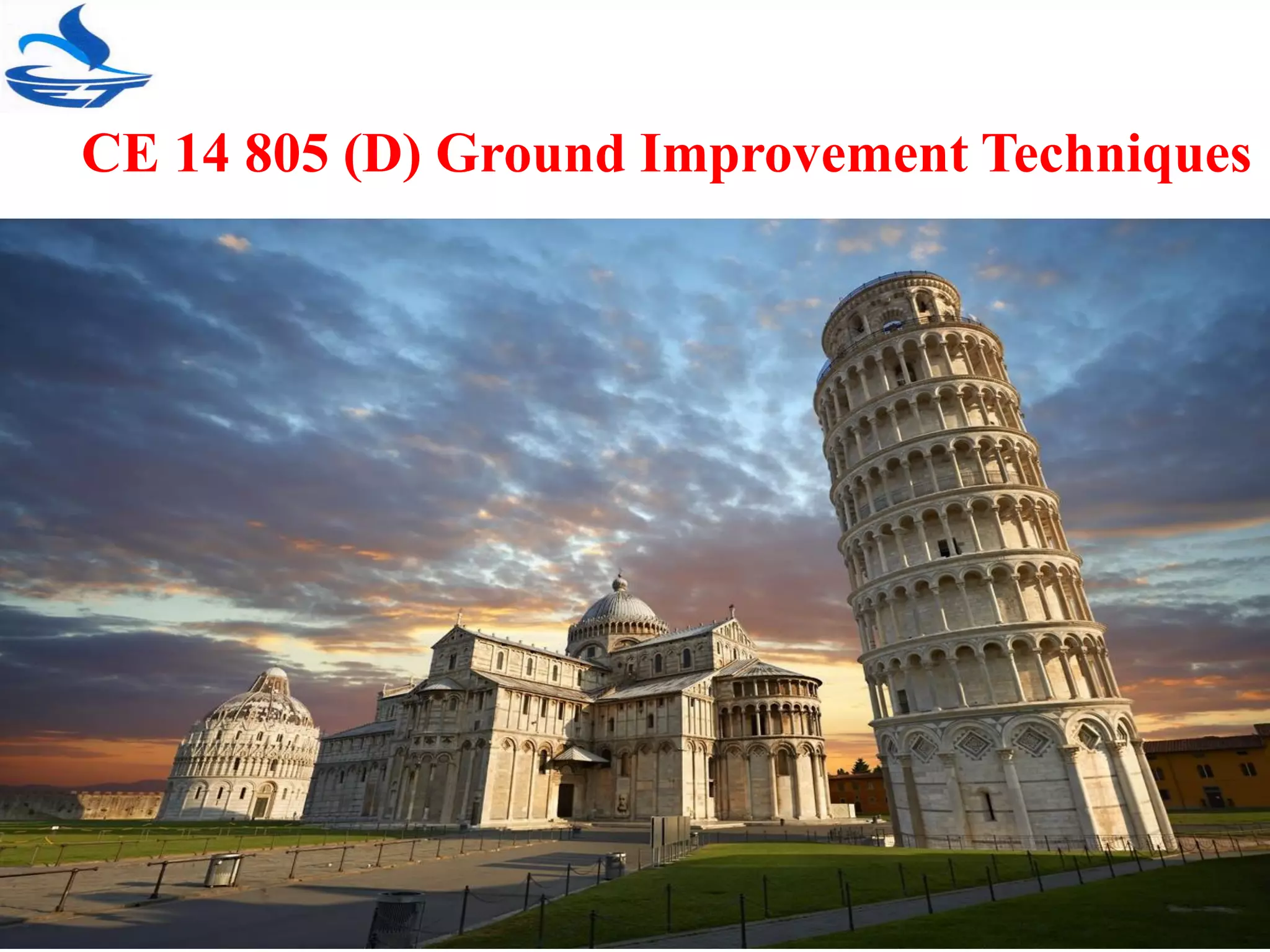
CE 14 805 (D) Ground Improvement Techniques
Why??
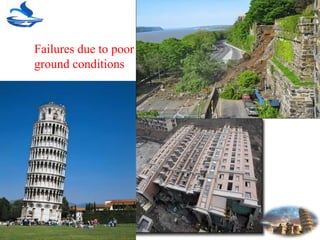
Failures due to poor
ground conditions
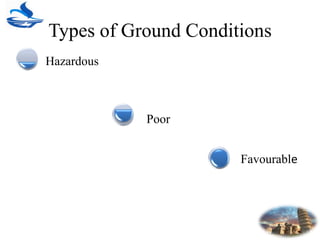
Types of Ground Conditions
Hazardous
Poor
Favourable
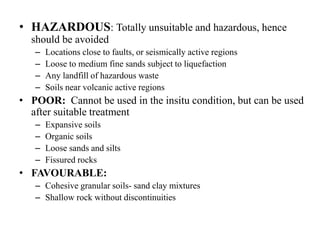
• HAZARDOUS: Totally unsuitable and hazardous, hence
should be avoided
– Locations close to faults, or seismically active regions
– Loose to medium fine sands subject to liquefaction
– Any landfill of hazardous waste
– Soils near volcanic active regions
• POOR: Cannot be used in the insitu condition, but can be used
after suitable treatment
– Expansive soils
– Organic soils
– Loose sands and silts
– Fissured rocks
• FAVOURABLE:
– Cohesive granular soils- sand clay mixtures
– Shallow rock without discontinuities
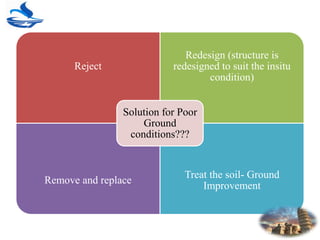
Reject
Redesign (structure is
redesigned to suit the insitu
condition)
Remove and replace
Treat the soil- Ground
Improvement
Solution for Poor
Ground
conditions???
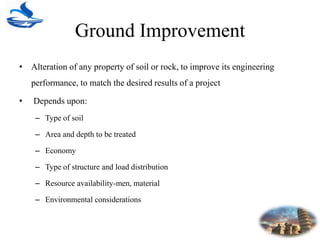
Ground Improvement
• Alteration of any property of soil or rock, to improve its engineering
performance, to match the desired results of a project
• Depends upon:
– Type of soil
– Area and depth to be treated
– Economy
– Type of structure and load distribution
– Resource availability-men, material
– Environmental considerations
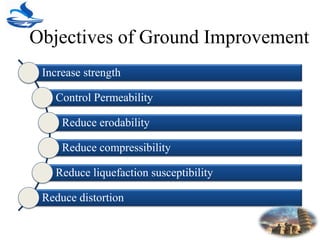
Objectives of Ground Improvement
Increase strength
Control Permeability
Reduce erodability
Reduce compressibility
Reduce liquefaction susceptibility
Reduce distortion
Factors affecting suitable GIT
• Soil type
• Area and depth of treatment
• Type of structure and load distribution
• Soil properties
• Permissible total and differential settlements
• Material availability
• Availability of skills and equipment
• Environment considerations
• Economy
Types of ground improvement techniques
• In-situ ground improvement methods without the addition of
new materials (Module 1)
• With the addition of new material (Module 2)
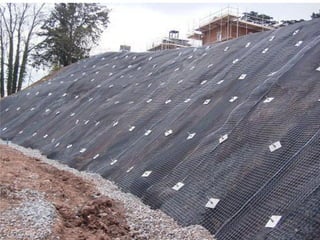
• Geosynthetics (Module 3)
• Inclusions- soil reinforcement (Module 4)
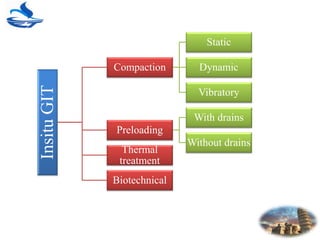
InsituGIT
Compaction
Static
Dynamic
Vibratory
Preloading
With drains
Without drains
Thermal
treatment
Biotechnical
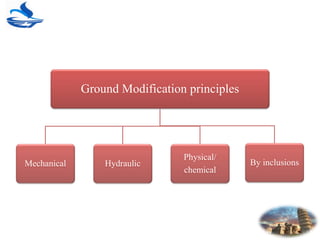
Ground Modification principles
Mechanical Hydraulic
Physical/
chemical
By inclusions
Major Techniques
• Compaction-static, dynamic, vibratory
• Preloading- with and without drains
• Thermal treatment
• Biotechnical stabilization
• Blending
• Grouting
• Geosynthetics
• Soil Reinforcement
COMPACTION
• Most common and visible technique used in field
• Involves improving mechanical properties of soil by densifying the
particles using compactive effort
• Soil strength and density will be maximum when compacted at optimum
moisture content
• Compaction causes densification, reducing the voids thereby improving the
strength and stability of the soil
Principle /Mechanism
• Reorientation of particles
• Fracture of grains or bonds followed by reorientation
• Bending and distortion of particles and their adsorbed layers
• For cohesive soils: particle distortion followed by reorientation
• Cohesionless soils: Reorientation and readjustment of particles
to a closer packing
Objectives of Compaction
• Increase density
• Increase shear strength
• Reduce compressibility
• Reduce permeability
• Reduce liquefaction potential
• Reduce swelling and shrinkage potential
• Increase long term stability
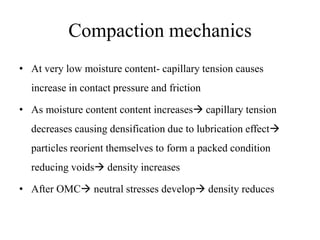
Compaction mechanics
• At very low moisture content- capillary tension causes
increase in contact pressure and friction
• As moisture content content increases capillary tension
decreases causing densification due to lubrication effect
particles reorient themselves to form a packed condition
reducing voids density increases
• After OMC neutral stresses develop density reduces
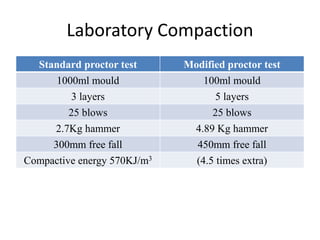
Laboratory Compaction
Standard proctor test Modified proctor test
1000ml mould 100ml mould
3 layers 5 layers
25 blows 25 blows
2.7Kg hammer 4.89 Kg hammer
300mm free fall 450mm free fall
Compactive energy 570KJ/m3 (4.5 times extra)
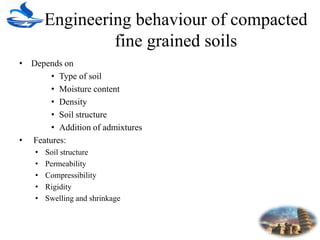
Engineering behaviour of compacted
fine grained soils
• Depends on
• Type of soil
• Moisture content
• Density
• Soil structure
• Addition of admixtures
• Features:
• Soil structure
• Permeability
• Compressibility
• Rigidity
• Swelling and shrinkage
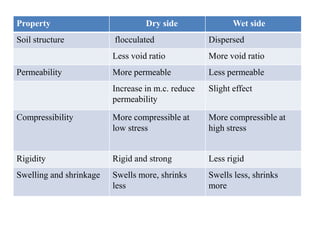
Property Dry side Wet side
Soil structure flocculated Dispersed
Less void ratio More void ratio
Permeability More permeable Less permeable
Increase in m.c. reduce
permeability
Slight effect
Compressibility More compressible at
low stress
More compressible at
high stress
Rigidity Rigid and strong Less rigid
Swelling and shrinkage Swells more, shrinks
less
Swells less, shrinks
more
Field Compaction
• Different means: Kneading, tamping , vibrating, impact
– Cohesive soils: Kneading tamping and impact
– Cohesionless: vibration
• Compaction specification
1. Performance type: specifying some physical properties of the
compacted layer
– Eg. 95% of maximum dry density achieved in lab
2. Work type: includes specification of type of equipment, lift thickness,
moisture content, and amount of work required
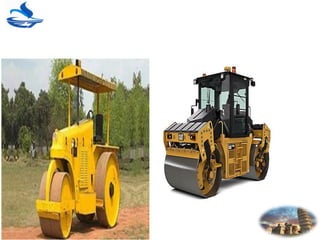
a)Smooth wheeled rollers
• Bicycle or tricycle configurations
• Ballasted or unballasted
• self propelled
• Static or vibratory
• Large contact area hence less pressure(300-400kPa)
• Only for thin layer compaction- subgrade, pavement layers etc.
• Each layer to be scarified before next- to prevent weak planes
• Vibratory roller for granular soils
• 3-6km/hr speed
• Lift thickness 10-20cm
• Relative compaction can be monitored
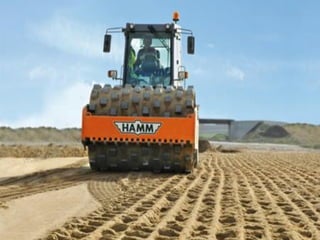
b) Sheepsfoot rollers
• Tamping foot rollers
• Protruding studs /feet that penetrate into soil
• Tamping and kneading action
• Suitable for predominantly clayey soils, not for coarse grained soils
• Ballasted or unballasted
• Contact pressure: 1500-7000 kPa
• Walkout process
• Self propelled or towed
• Usual roller speed 3-6km/hr, self propelled  upto 9km/hr
• Vibrating tamping foot rollers can be used for silty and clayey sands
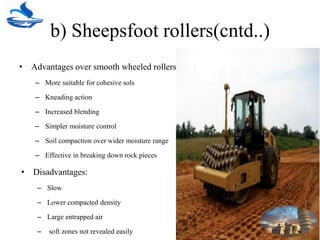
b) Sheepsfoot rollers(cntd..)
• Advantages over smooth wheeled rollers
– More suitable for cohesive sols
– Kneading action
– Increased blending
– Simpler moisture control
– Soil compaction over wider moisture range
– Effective in breaking down rock pieces
• Disadvantages:
– Slow
– Lower compacted density
– Large entrapped air
– soft zones not revealed easily
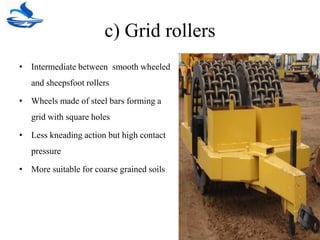
c) Grid rollers
• Intermediate between smooth wheeled
and sheepsfoot rollers
• Wheels made of steel bars forming a
grid with square holes
• Less kneading action but high contact
pressure
• More suitable for coarse grained soils
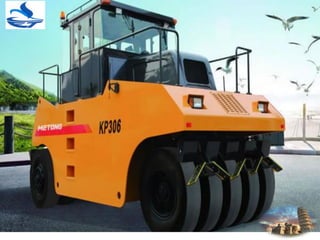
d) Pneumatic tyred rollers
• By Kneading action
• Suitable for both cohesive and cohesionless soils
• Can be ballasted
• Wobble-wheel effect
• Front and rear wheels not in alignment for better efficiency
• Speed 6-12 km/hr
• Smoother finish
• Lift thickness: 15-30 cm based on roller weight
• Heavier in weight hence lesser no; of passes required; thicker lifts, reveal
weak zones
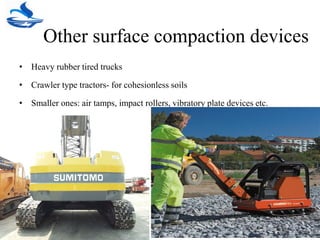
Other surface compaction devices
• Heavy rubber tired trucks
• Crawler type tractors- for cohesionless soils
• Smaller ones: air tamps, impact rollers, vibratory plate devices etc.
Roller selection
• Economy
• Type of soil and relative compaction required
• Sheepsfoot and smooth wheeled cohesive
• Vibratory and crawler type cohesionless
Deep compaction techniques
• Vibrocompaction
• Dynamic compaction
• Compaction grouting
• Prefabricated Vertical drains
• Blasting
Dynamic compaction
• Repeated blows of a heavy weight (10-50 tonnes) from height
(10-40m)
• Type of deep compaction
• Densification depends on: ?
• Compacted in intervals
• Top surface craters formed  compacted later
• Spacing depends on:?
• Energy transfer by Seismic wave propagation
• Merits?
Methods of dynamic compaction
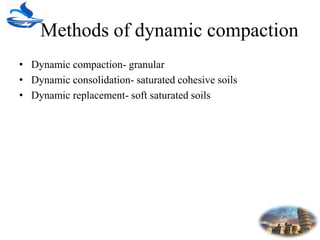
• Dynamic compaction- granular
• Dynamic consolidation- saturated cohesive soils
• Dynamic replacement- soft saturated soils
Compaction Control
• Effective Depth of compaction: Empirical relation
Dmax = n√(W H)
Where,
Dmax = Max depth of improvement, m
n = Coefficient that caters for soil and equipment variability
W =Weight of tamper, tons
H = Height of fall of tamper, m
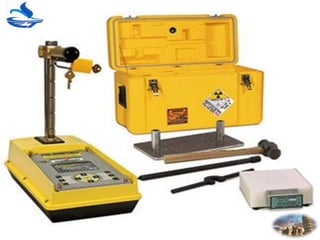
• Compacted materials tested for moisture content and density
Nuclear density meter
Hill’s Method
Other Insitu Evaluation Techniques
• Pore pressure, settlement , energy consumed by the equipment
etc. can be monitored
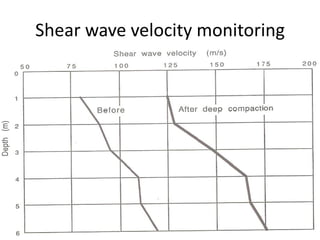
• Values before and after compaction is compared
• SPT and CPT
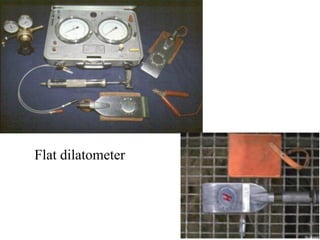
• Pressuremeter and dilatometer tests stress strain behaviour
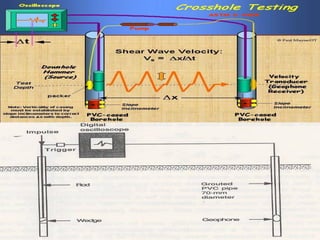
• Shear wave velocity measurements
Flat dilatometer
Shear wave velocity monitoring
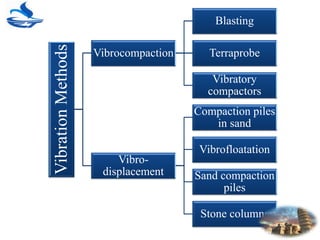
VibrationMethods
Vibrocompaction
Blasting
Terraprobe
Vibratory
compactors
Vibro-
displacement
Compaction piles
in sand
Vibrofloatation
Sand compaction
piles
Stone columns
VIBRODISPLACEMENT
• Vibrations with active displacement of particles subsequent
backfilling
• Vibro displacement and vibro replacement
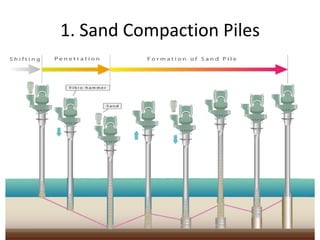
1. Sand Compaction Piles
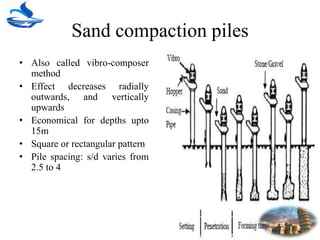
Sand compaction piles
• Also called vibro-composer
method
• Effect decreases radially
outwards, and vertically
upwards
• Economical for depths upto
15m
• Square or rectangular pattern
• Pile spacing: s/d varies from
2.5 to 4
2. Compaction Piles in sand
• Simplest vibro-displacement techniques
• Driving piles into sand to densify it- usually timber piles
• Most effective in cohesionless sands above WT
• Effect decreases with increase in fines content and decrease in
permeability
• Effective to a distance upto 8d from center of pile.
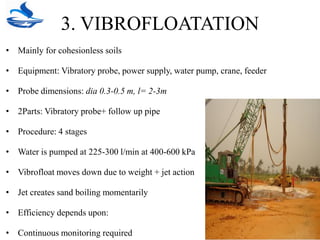
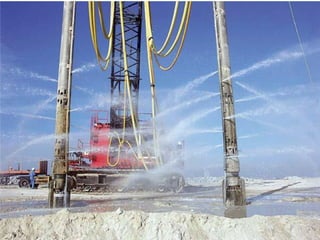
3. VIBROFLOATATION
• Mainly for cohesionless soils
• Equipment: Vibratory probe, power supply, water pump, crane, feeder
• Probe dimensions: dia 0.3-0.5 m, l= 2-3m
• 2Parts: Vibratory probe+ follow up pipe
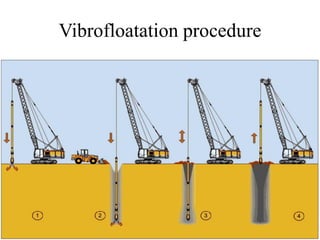
• Procedure: 4 stages
• Water is pumped at 225-300 l/min at 400-600 kPa
• Vibrofloat moves down due to weight + jet action
• Jet creates sand boiling momentarily
• Efficiency depends upon:
• Continuous monitoring required
Vibrofloatation procedure
• Backfill required: almost 10% of compacted volume
• In one penetration, cylindrical columns of 2.5-3m diameter will be formed
• Withdrawal rate: 0.3-0.6/min
• Effective upto 20m normally 70% rel.den
• Soil suitability:
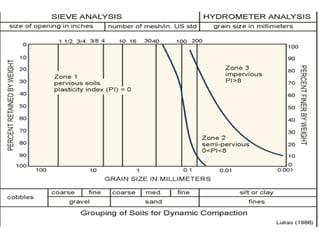
– Zone A,B,C (refer )
– Most suitable for soils under zone B
• Suitable for granular soils with silt content less than 10%
• Linear, square or triangular pattern
• Spacing depends on :
• Backfill suitability: Brown’s suitability Number
Vibrofloatation in clays
• Used in soils that do not respond well to vibration alone. (to stiff, more than
15% silt)
• The improvement is achieved by creating columns of either crushed stone
or concrete (of which can be reinforced).
• The process enables increased load bearing, reduces settlement and even
improves the shear resistance of the ground being treated.
• The process is technically proven worldwide and very cost effective
VIBROCOMPACTION
• Rapid densification technique for saturated cohesionless soils
• Localized liquefaction followed by densification and compaction
• Effectiveness decrease with increase in percentage fines
• Blasting, Terraprobe, Vibratory Compactors
1.EXPLOSIONS IN SAND
• Controlled blasting
• Explosive charge buried in soil and detonated
• Principle: shock waves produced by blasting--. Densification
• Procedure:
• Detonated large holes created by lateral displacement Backfilled
• Spacing -
• Spacing , pattern and blast timing must be carefully planned
• Depth less than 10m blast in one tier
• 70-80% relative density achieved
• Adequate data regarding soil type, depth , degree of saturation, relative
density to be achieved, is required
2. Vibratory Compactors
• Vibrating drums, pneumatic tyred rollers, vibrating plate etc.
• 1500-2500 cpm
• 3-6 km/hr
• Rel.densities 85-90%
• Lift thickness, roller type and soil type should match
3.Vibratory probe/Terraprobe
• Vibrodriver with open ended steel tubular probe of 760mm dia and
15m length
• Vibration: 15Hz
• Held 30-60 seconds before extraction
• Spacing 1-3m- square pattern
• Influence area- 1m cylinder and 1m deeper than probe depth
• Great depths
• Saturation preferrable
• Less cost
• More useful in offshore locations
• faster
• Less effective than vibrofloatation
STONE COLUMNS
• Most versatile
• Applicable to wide range of soils
• Multiple functions:
– Densification- Increase shear strength & BC
– Drainage path- Accelerates consolidation– reduce settlement
– Increase stiffness- reinforcement
– Prevents pore pressure built up  Reduce liquefaction potential
• Applications-
– Embankment fill stability
– Foundation in soft soils
Suitable soils
• Weak Cohesive Soils
• Granular Soils with High Fines Content (in excess of 15%)
• Organic Soils
• Marine/Alluvial Clays
• Liquefiable Soils
• Waste Fills
Methods of installation
Cased Borehole method/ Rammed stone
column
Vibration Methods- Vibrofloatation /
Vibrocomposer
Cased Borehole Method/ Rammed stone
column
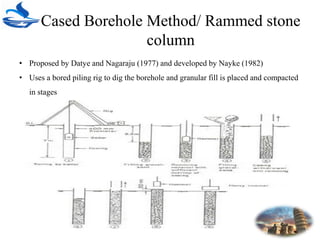
• Proposed by Datye and Nagaraju (1977) and developed by Nayke (1982)
• Uses a bored piling rig to dig the borehole and granular fill is placed and compacted
in stages
Cased Borehole Method/ Rammed
stone column
• Proposed by Datye and Nagaraju (1977) and developed by Nayke(1982)
• Uses a bored piling rig to dig the borehole and granular fill is placed and
compacted in stages
Construction steps:
1. Cased borehole is prepared
2. Granular material (2-75mm ) filled upto 2-3m depth from surface
3. Each layer compacted using rammer of 15-20kN from height about 1.5m
4. Casing is withdrawn in stages
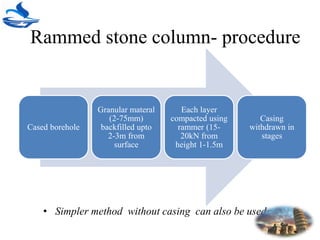
Rammed stone column- procedure
Cased borehole
Granular materal
(2-75mm)
backfilled upto
2-3m from
surface
Each layer
compacted using
rammer (15-
20kN from
height 1-1.5m
Casing
withdrawn in
stages
• Simpler method without casing can also be used
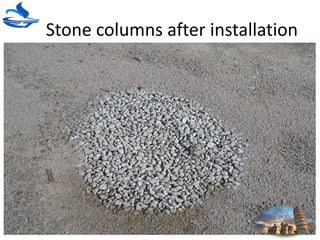
Stone columns after installation
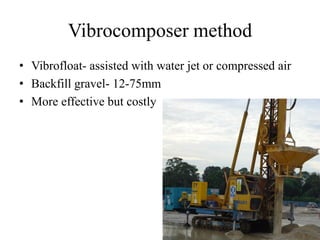
Vibrocomposer method
• Vibrofloat- assisted with water jet or compressed air
• Backfill gravel- 12-75mm
• More effective but costly
Conventional method
• Auger boring followed by manual cleaning
• Gravel-sand mixture (2: 1) proportion preferable for more
densification
• Granular piles 20-30mm stone aggregate + 20-25% sand on
top of each layer
• Each two layer unit compacted by 1250kN hammer with free
fall 750mm
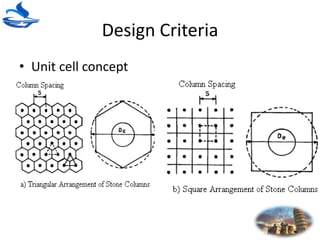
Design Criteria
• Unit cell concept
• Area replacement ratio
• Spacing and diameter
• Length
• Load carrying capacity
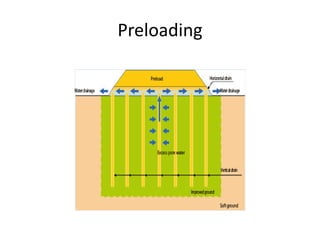
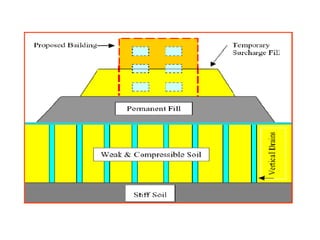
Preloading
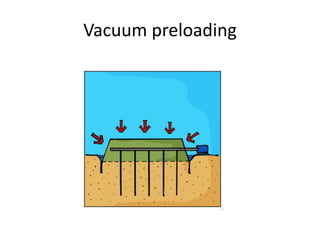
Vacuum preloading
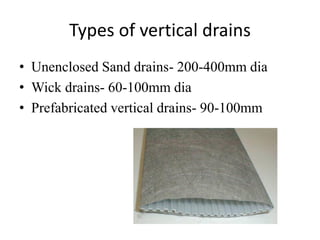
Types of vertical drains
• Unenclosed Sand drains- 200-400mm dia
• Wick drains- 60-100mm dia
• Prefabricated vertical drains- 90-100mm
Advantages of PVD
• Easy installation
• Quality control
• Efficiency
• Economy
• Assured continuity
• Less material storage
• Minimal displacement
• No spoil removal
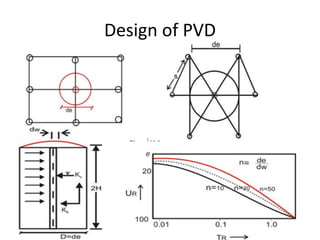
Design of PVD
Thermal Methods
Stabilisation
by heating
Ground
Freezing
Stabilisation by Heating
• More Suitable for partially saturated fine grained soils
• Effects:
– Reduces electric repulsion
– Increased pore water flow rate
– Reduced moisture content
– Reduces compressibility and swelling potential
– Produces cementation effect in sands
• 1000 c Drying strength enhanced
• 5000 c permanent structural change decrease in plasticity
and moisture adsorption capacity
• 10000c fusion of clay particles into solid brick
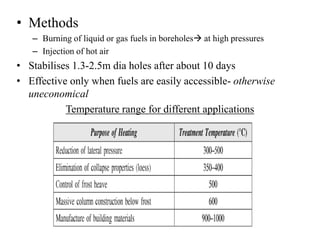
• Methods
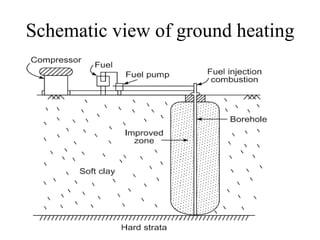
– Burning of liquid or gas fuels in boreholes at high pressures
– Injection of hot air
• Stabilises 1.3-2.5m dia holes after about 10 days
• Effective only when fuels are easily accessible- otherwise
uneconomical
Temperature range for different applications
Schematic view of ground heating
GROUND FREEZING
 Developed by German scientist F. Hermann Poetsch in 1863
 Making water-bearing strata impermeable, by freezing the
pore water into ice
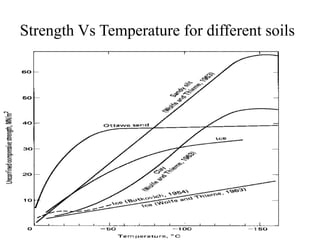
 Increases strength and decreases permeability
 On freezing, grain structure binds stronger, hence more
strength and less impermeability
 Pore water  ice  ice wall
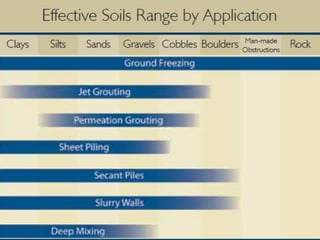
 Suitable in all soils
 Strength and freezing time, depends on temperature and
moisture content of soil
Strength Vs Temperature for different soils
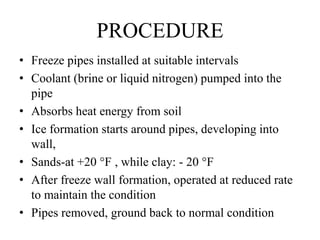
• Freeze pipes installed at suitable intervals
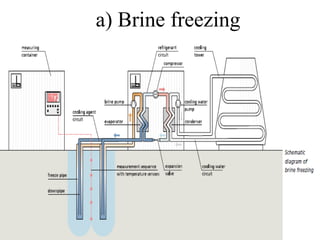
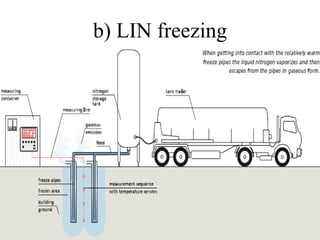
• Coolant (brine or liquid nitrogen) pumped into the
pipe
• Absorbs heat energy from soil
• Ice formation starts around pipes, developing into
wall,
• Sands-at +20 °F , while clay: - 20 °F
• After freeze wall formation, operated at reduced rate
to maintain the condition
• Pipes removed, ground back to normal condition
PROCEDURE
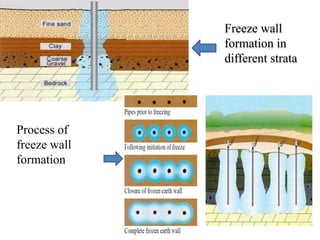
Freeze wall
formation in
different strata
Process of
freeze wall
formation
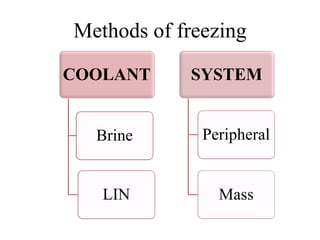
Methods of freezing
COOLANT
Brine
LIN
SYSTEM
Peripheral
Mass
a) Brine freezing
b) LIN freezing
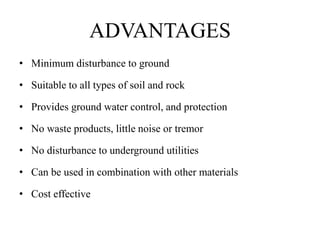
ADVANTAGES
• Minimum disturbance to ground
• Suitable to all types of soil and rock
• Provides ground water control, and protection
• No waste products, little noise or tremor
• No disturbance to underground utilities
• Can be used in combination with other materials
• Cost effective
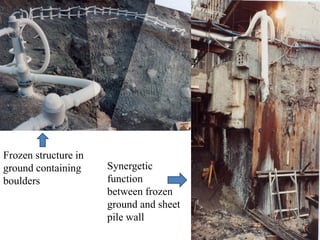
Frozen structure in
ground containing
boulders
Synergetic
function
between frozen
ground and sheet
pile wall
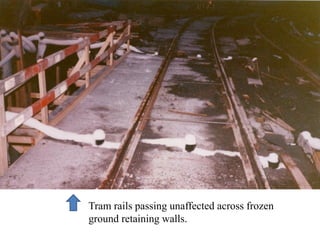
Tram rails passing unaffected across frozen
ground retaining walls.
Parameters
Design parameters-
• Soil and groundwater conditions;
• Shape of structure, and pipe spacing
Monitored parameters
• ground and coolant temperature
• Groundwater level
• Coolant flow and pressure
• Refrigeration data
Applications..
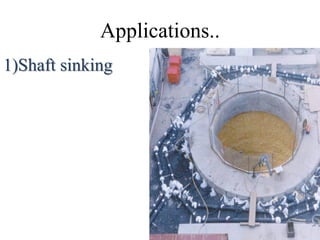
1)Shaft sinking
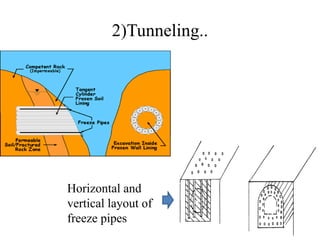
2)Tunneling..
Horizontal and
vertical layout of
freeze pipes
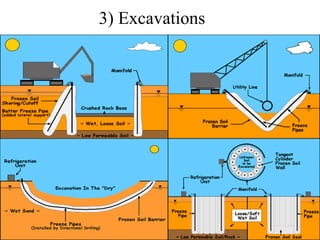
3) Excavations
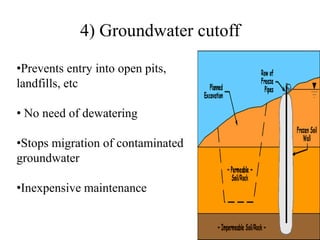
4) Groundwater cutoff
•Prevents entry into open pits,
landfills, etc
• No need of dewatering
•Stops migration of contaminated
groundwater
•Inexpensive maintenance
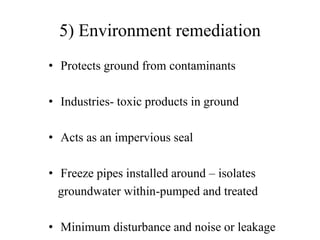
• Protects ground from contaminants
• Industries- toxic products in ground
• Acts as an impervious seal
• Freeze pipes installed around – isolates
groundwater within-pumped and treated
• Minimum disturbance and noise or leakage
5) Environment remediation
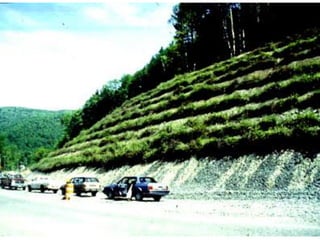
Biotechnical stabilisation
• Sometimes called bioengineering - combines live and dead
plant materials with structural engineering techniques to
stabilize slopes and stream banks.
• now emerging as a more cost-effective, aesthetically pleasing,
and environmentally acceptable solution.
• natural process of soil stabilization and plant regeneration
following erosion or slope failure events.
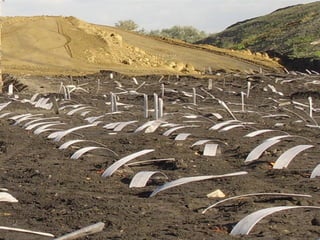
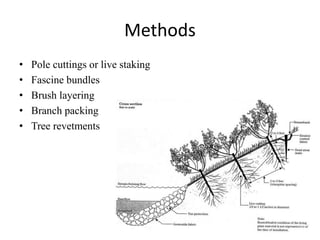
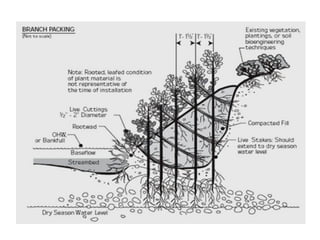
Methods
• Pole cuttings or live staking
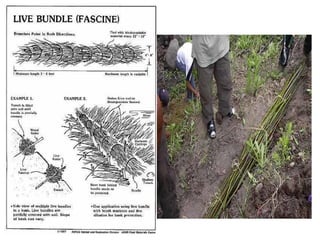
• Fascine bundles
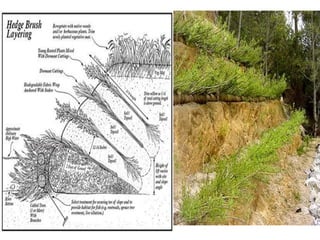
• Brush layering
• Branch packing
• Tree revetments
Benefits of Biotechnical soil
stabilization techniques
• Soil structural reinforcement
• Provides for hydraulic wicking (water absorption)
• Provides barrier to sedimentation
• Produces shade – temperature control
• Provides habitat
• Aesthetics – minor site disturbance and less obtrusive
• Cost-effective for small scale projects
• Long-lasting, strengthening over time
Drawbacks to Biotechnical soil stabilization
techniques:
• Results are not immediate – Time variant as plants establish
• Applications are difficult to engineer for precise calculations
• Large scale projects are more costly and less popular.
• Availability of plant material
• Soils must support plant growth
• Difficult to duplicate – each site requires specific design considerations
• Maintenance may be required
Ground improvement techniques  compaction vibration

Ground improvement techniques compaction vibration

  • 1.
    CE 14 805(D) Ground Improvement Techniques
  • 2.
  • 3.
    Failures due topoor ground conditions
  • 4.
    Types of GroundConditions Hazardous Poor Favourable
  • 5.
    • HAZARDOUS: Totallyunsuitable and hazardous, hence should be avoided – Locations close to faults, or seismically active regions – Loose to medium fine sands subject to liquefaction – Any landfill of hazardous waste – Soils near volcanic active regions • POOR: Cannot be used in the insitu condition, but can be used after suitable treatment – Expansive soils – Organic soils – Loose sands and silts – Fissured rocks • FAVOURABLE: – Cohesive granular soils- sand clay mixtures – Shallow rock without discontinuities
  • 6.
    Reject Redesign (structure is redesignedto suit the insitu condition) Remove and replace Treat the soil- Ground Improvement Solution for Poor Ground conditions???
  • 7.
    Ground Improvement • Alterationof any property of soil or rock, to improve its engineering performance, to match the desired results of a project • Depends upon: – Type of soil – Area and depth to be treated – Economy – Type of structure and load distribution – Resource availability-men, material – Environmental considerations
  • 8.
    Objectives of GroundImprovement Increase strength Control Permeability Reduce erodability Reduce compressibility Reduce liquefaction susceptibility Reduce distortion
  • 9.
    Factors affecting suitableGIT • Soil type • Area and depth of treatment • Type of structure and load distribution • Soil properties • Permissible total and differential settlements • Material availability • Availability of skills and equipment • Environment considerations • Economy
  • 10.
    Types of groundimprovement techniques • In-situ ground improvement methods without the addition of new materials (Module 1) • With the addition of new material (Module 2) • Geosynthetics (Module 3) • Inclusions- soil reinforcement (Module 4)
  • 11.
  • 12.
    Ground Modification principles MechanicalHydraulic Physical/ chemical By inclusions
  • 13.
    Major Techniques • Compaction-static,dynamic, vibratory • Preloading- with and without drains • Thermal treatment • Biotechnical stabilization • Blending • Grouting • Geosynthetics • Soil Reinforcement
  • 19.
    COMPACTION • Most commonand visible technique used in field • Involves improving mechanical properties of soil by densifying the particles using compactive effort • Soil strength and density will be maximum when compacted at optimum moisture content • Compaction causes densification, reducing the voids thereby improving the strength and stability of the soil
  • 20.
    Principle /Mechanism • Reorientationof particles • Fracture of grains or bonds followed by reorientation • Bending and distortion of particles and their adsorbed layers • For cohesive soils: particle distortion followed by reorientation • Cohesionless soils: Reorientation and readjustment of particles to a closer packing
  • 21.
    Objectives of Compaction •Increase density • Increase shear strength • Reduce compressibility • Reduce permeability • Reduce liquefaction potential • Reduce swelling and shrinkage potential • Increase long term stability
  • 22.
    Compaction mechanics • Atvery low moisture content- capillary tension causes increase in contact pressure and friction • As moisture content content increases capillary tension decreases causing densification due to lubrication effect particles reorient themselves to form a packed condition reducing voids density increases • After OMC neutral stresses develop density reduces
  • 23.
    Laboratory Compaction Standard proctortest Modified proctor test 1000ml mould 100ml mould 3 layers 5 layers 25 blows 25 blows 2.7Kg hammer 4.89 Kg hammer 300mm free fall 450mm free fall Compactive energy 570KJ/m3 (4.5 times extra)
  • 24.
    Engineering behaviour ofcompacted fine grained soils • Depends on • Type of soil • Moisture content • Density • Soil structure • Addition of admixtures • Features: • Soil structure • Permeability • Compressibility • Rigidity • Swelling and shrinkage
  • 25.
    Property Dry sideWet side Soil structure flocculated Dispersed Less void ratio More void ratio Permeability More permeable Less permeable Increase in m.c. reduce permeability Slight effect Compressibility More compressible at low stress More compressible at high stress Rigidity Rigid and strong Less rigid Swelling and shrinkage Swells more, shrinks less Swells less, shrinks more
  • 26.
    Field Compaction • Differentmeans: Kneading, tamping , vibrating, impact – Cohesive soils: Kneading tamping and impact – Cohesionless: vibration • Compaction specification 1. Performance type: specifying some physical properties of the compacted layer – Eg. 95% of maximum dry density achieved in lab 2. Work type: includes specification of type of equipment, lift thickness, moisture content, and amount of work required
  • 27.
    a)Smooth wheeled rollers •Bicycle or tricycle configurations • Ballasted or unballasted • self propelled • Static or vibratory • Large contact area hence less pressure(300-400kPa) • Only for thin layer compaction- subgrade, pavement layers etc. • Each layer to be scarified before next- to prevent weak planes • Vibratory roller for granular soils • 3-6km/hr speed • Lift thickness 10-20cm • Relative compaction can be monitored
  • 29.
    b) Sheepsfoot rollers •Tamping foot rollers • Protruding studs /feet that penetrate into soil • Tamping and kneading action • Suitable for predominantly clayey soils, not for coarse grained soils • Ballasted or unballasted • Contact pressure: 1500-7000 kPa • Walkout process • Self propelled or towed • Usual roller speed 3-6km/hr, self propelled  upto 9km/hr • Vibrating tamping foot rollers can be used for silty and clayey sands
  • 30.
    b) Sheepsfoot rollers(cntd..) •Advantages over smooth wheeled rollers – More suitable for cohesive sols – Kneading action – Increased blending – Simpler moisture control – Soil compaction over wider moisture range – Effective in breaking down rock pieces • Disadvantages: – Slow – Lower compacted density – Large entrapped air – soft zones not revealed easily
  • 31.
    c) Grid rollers •Intermediate between smooth wheeled and sheepsfoot rollers • Wheels made of steel bars forming a grid with square holes • Less kneading action but high contact pressure • More suitable for coarse grained soils
  • 32.
    d) Pneumatic tyredrollers • By Kneading action • Suitable for both cohesive and cohesionless soils • Can be ballasted • Wobble-wheel effect • Front and rear wheels not in alignment for better efficiency • Speed 6-12 km/hr • Smoother finish • Lift thickness: 15-30 cm based on roller weight • Heavier in weight hence lesser no; of passes required; thicker lifts, reveal weak zones
  • 34.
    Other surface compactiondevices • Heavy rubber tired trucks • Crawler type tractors- for cohesionless soils • Smaller ones: air tamps, impact rollers, vibratory plate devices etc.
  • 35.
    Roller selection • Economy •Type of soil and relative compaction required • Sheepsfoot and smooth wheeled cohesive • Vibratory and crawler type cohesionless
  • 36.
    Deep compaction techniques •Vibrocompaction • Dynamic compaction • Compaction grouting • Prefabricated Vertical drains • Blasting
  • 37.
    Dynamic compaction • Repeatedblows of a heavy weight (10-50 tonnes) from height (10-40m) • Type of deep compaction • Densification depends on: ? • Compacted in intervals • Top surface craters formed  compacted later • Spacing depends on:? • Energy transfer by Seismic wave propagation • Merits?
  • 39.
    Methods of dynamiccompaction • Dynamic compaction- granular • Dynamic consolidation- saturated cohesive soils • Dynamic replacement- soft saturated soils
  • 40.
    Compaction Control • EffectiveDepth of compaction: Empirical relation Dmax = n√(W H) Where, Dmax = Max depth of improvement, m n = Coefficient that caters for soil and equipment variability W =Weight of tamper, tons H = Height of fall of tamper, m • Compacted materials tested for moisture content and density Nuclear density meter Hill’s Method
  • 42.
    Other Insitu EvaluationTechniques • Pore pressure, settlement , energy consumed by the equipment etc. can be monitored • Values before and after compaction is compared • SPT and CPT • Pressuremeter and dilatometer tests stress strain behaviour • Shear wave velocity measurements
  • 44.
  • 45.
  • 46.
  • 47.
    VIBRODISPLACEMENT • Vibrations withactive displacement of particles subsequent backfilling • Vibro displacement and vibro replacement
  • 48.
  • 49.
    Sand compaction piles •Also called vibro-composer method • Effect decreases radially outwards, and vertically upwards • Economical for depths upto 15m • Square or rectangular pattern • Pile spacing: s/d varies from 2.5 to 4
  • 50.
    2. Compaction Pilesin sand • Simplest vibro-displacement techniques • Driving piles into sand to densify it- usually timber piles • Most effective in cohesionless sands above WT • Effect decreases with increase in fines content and decrease in permeability • Effective to a distance upto 8d from center of pile.
  • 51.
    3. VIBROFLOATATION • Mainlyfor cohesionless soils • Equipment: Vibratory probe, power supply, water pump, crane, feeder • Probe dimensions: dia 0.3-0.5 m, l= 2-3m • 2Parts: Vibratory probe+ follow up pipe • Procedure: 4 stages • Water is pumped at 225-300 l/min at 400-600 kPa • Vibrofloat moves down due to weight + jet action • Jet creates sand boiling momentarily • Efficiency depends upon: • Continuous monitoring required
  • 52.
  • 53.
    • Backfill required:almost 10% of compacted volume • In one penetration, cylindrical columns of 2.5-3m diameter will be formed • Withdrawal rate: 0.3-0.6/min • Effective upto 20m normally 70% rel.den • Soil suitability: – Zone A,B,C (refer ) – Most suitable for soils under zone B • Suitable for granular soils with silt content less than 10% • Linear, square or triangular pattern • Spacing depends on : • Backfill suitability: Brown’s suitability Number
  • 55.
    Vibrofloatation in clays •Used in soils that do not respond well to vibration alone. (to stiff, more than 15% silt) • The improvement is achieved by creating columns of either crushed stone or concrete (of which can be reinforced). • The process enables increased load bearing, reduces settlement and even improves the shear resistance of the ground being treated. • The process is technically proven worldwide and very cost effective
  • 56.
    VIBROCOMPACTION • Rapid densificationtechnique for saturated cohesionless soils • Localized liquefaction followed by densification and compaction • Effectiveness decrease with increase in percentage fines • Blasting, Terraprobe, Vibratory Compactors
  • 57.
    1.EXPLOSIONS IN SAND •Controlled blasting • Explosive charge buried in soil and detonated • Principle: shock waves produced by blasting--. Densification • Procedure: • Detonated large holes created by lateral displacement Backfilled • Spacing - • Spacing , pattern and blast timing must be carefully planned • Depth less than 10m blast in one tier • 70-80% relative density achieved • Adequate data regarding soil type, depth , degree of saturation, relative density to be achieved, is required
  • 58.
    2. Vibratory Compactors •Vibrating drums, pneumatic tyred rollers, vibrating plate etc. • 1500-2500 cpm • 3-6 km/hr • Rel.densities 85-90% • Lift thickness, roller type and soil type should match
  • 59.
    3.Vibratory probe/Terraprobe • Vibrodriverwith open ended steel tubular probe of 760mm dia and 15m length • Vibration: 15Hz • Held 30-60 seconds before extraction • Spacing 1-3m- square pattern • Influence area- 1m cylinder and 1m deeper than probe depth • Great depths • Saturation preferrable • Less cost • More useful in offshore locations • faster • Less effective than vibrofloatation
  • 60.
    STONE COLUMNS • Mostversatile • Applicable to wide range of soils • Multiple functions: – Densification- Increase shear strength & BC – Drainage path- Accelerates consolidation– reduce settlement – Increase stiffness- reinforcement – Prevents pore pressure built up  Reduce liquefaction potential • Applications- – Embankment fill stability – Foundation in soft soils
  • 61.
    Suitable soils • WeakCohesive Soils • Granular Soils with High Fines Content (in excess of 15%) • Organic Soils • Marine/Alluvial Clays • Liquefiable Soils • Waste Fills
  • 62.
    Methods of installation CasedBorehole method/ Rammed stone column Vibration Methods- Vibrofloatation / Vibrocomposer
  • 63.
    Cased Borehole Method/Rammed stone column • Proposed by Datye and Nagaraju (1977) and developed by Nayke (1982) • Uses a bored piling rig to dig the borehole and granular fill is placed and compacted in stages
  • 64.
    Cased Borehole Method/Rammed stone column • Proposed by Datye and Nagaraju (1977) and developed by Nayke(1982) • Uses a bored piling rig to dig the borehole and granular fill is placed and compacted in stages Construction steps: 1. Cased borehole is prepared 2. Granular material (2-75mm ) filled upto 2-3m depth from surface 3. Each layer compacted using rammer of 15-20kN from height about 1.5m 4. Casing is withdrawn in stages
  • 65.
    Rammed stone column-procedure Cased borehole Granular materal (2-75mm) backfilled upto 2-3m from surface Each layer compacted using rammer (15- 20kN from height 1-1.5m Casing withdrawn in stages • Simpler method without casing can also be used
  • 66.
    Stone columns afterinstallation
  • 67.
    Vibrocomposer method • Vibrofloat-assisted with water jet or compressed air • Backfill gravel- 12-75mm • More effective but costly
  • 68.
    Conventional method • Augerboring followed by manual cleaning • Gravel-sand mixture (2: 1) proportion preferable for more densification • Granular piles 20-30mm stone aggregate + 20-25% sand on top of each layer • Each two layer unit compacted by 1250kN hammer with free fall 750mm
  • 69.
  • 70.
    • Area replacementratio • Spacing and diameter • Length • Load carrying capacity
  • 71.
  • 73.
  • 74.
    Types of verticaldrains • Unenclosed Sand drains- 200-400mm dia • Wick drains- 60-100mm dia • Prefabricated vertical drains- 90-100mm
  • 75.
    Advantages of PVD •Easy installation • Quality control • Efficiency • Economy • Assured continuity • Less material storage • Minimal displacement • No spoil removal
  • 76.
  • 77.
  • 78.
    Stabilisation by Heating •More Suitable for partially saturated fine grained soils • Effects: – Reduces electric repulsion – Increased pore water flow rate – Reduced moisture content – Reduces compressibility and swelling potential – Produces cementation effect in sands • 1000 c Drying strength enhanced • 5000 c permanent structural change decrease in plasticity and moisture adsorption capacity • 10000c fusion of clay particles into solid brick
  • 79.
    • Methods – Burningof liquid or gas fuels in boreholes at high pressures – Injection of hot air • Stabilises 1.3-2.5m dia holes after about 10 days • Effective only when fuels are easily accessible- otherwise uneconomical Temperature range for different applications
  • 80.
    Schematic view ofground heating
  • 81.
    GROUND FREEZING  Developedby German scientist F. Hermann Poetsch in 1863  Making water-bearing strata impermeable, by freezing the pore water into ice  Increases strength and decreases permeability  On freezing, grain structure binds stronger, hence more strength and less impermeability  Pore water  ice  ice wall  Suitable in all soils  Strength and freezing time, depends on temperature and moisture content of soil
  • 82.
    Strength Vs Temperaturefor different soils
  • 83.
    • Freeze pipesinstalled at suitable intervals • Coolant (brine or liquid nitrogen) pumped into the pipe • Absorbs heat energy from soil • Ice formation starts around pipes, developing into wall, • Sands-at +20 °F , while clay: - 20 °F • After freeze wall formation, operated at reduced rate to maintain the condition • Pipes removed, ground back to normal condition PROCEDURE
  • 84.
    Freeze wall formation in differentstrata Process of freeze wall formation
  • 85.
  • 86.
  • 87.
  • 88.
    ADVANTAGES • Minimum disturbanceto ground • Suitable to all types of soil and rock • Provides ground water control, and protection • No waste products, little noise or tremor • No disturbance to underground utilities • Can be used in combination with other materials • Cost effective
  • 90.
    Frozen structure in groundcontaining boulders Synergetic function between frozen ground and sheet pile wall
  • 91.
    Tram rails passingunaffected across frozen ground retaining walls.
  • 92.
    Parameters Design parameters- • Soiland groundwater conditions; • Shape of structure, and pipe spacing Monitored parameters • ground and coolant temperature • Groundwater level • Coolant flow and pressure • Refrigeration data
  • 93.
  • 94.
  • 95.
  • 96.
    4) Groundwater cutoff •Preventsentry into open pits, landfills, etc • No need of dewatering •Stops migration of contaminated groundwater •Inexpensive maintenance
  • 97.
    • Protects groundfrom contaminants • Industries- toxic products in ground • Acts as an impervious seal • Freeze pipes installed around – isolates groundwater within-pumped and treated • Minimum disturbance and noise or leakage 5) Environment remediation
  • 98.
    Biotechnical stabilisation • Sometimescalled bioengineering - combines live and dead plant materials with structural engineering techniques to stabilize slopes and stream banks. • now emerging as a more cost-effective, aesthetically pleasing, and environmentally acceptable solution. • natural process of soil stabilization and plant regeneration following erosion or slope failure events.
  • 99.
    Methods • Pole cuttingsor live staking • Fascine bundles • Brush layering • Branch packing • Tree revetments
  • 103.
    Benefits of Biotechnicalsoil stabilization techniques • Soil structural reinforcement • Provides for hydraulic wicking (water absorption) • Provides barrier to sedimentation • Produces shade – temperature control • Provides habitat • Aesthetics – minor site disturbance and less obtrusive • Cost-effective for small scale projects • Long-lasting, strengthening over time
  • 104.
    Drawbacks to Biotechnicalsoil stabilization techniques: • Results are not immediate – Time variant as plants establish • Applications are difficult to engineer for precise calculations • Large scale projects are more costly and less popular. • Availability of plant material • Soils must support plant growth • Difficult to duplicate – each site requires specific design considerations • Maintenance may be required