M.Prasad Naidu
MSc Medical Biochemistry,
Ph.D.Research Scholar
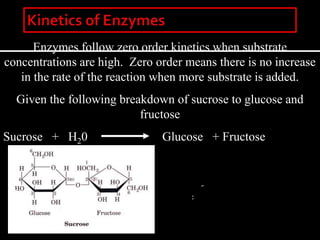
Enzymes follow zero order kinetics when substrate
concentrations are high. Zero order means there is no increase
in the rate of the reaction when more substrate is added.
Given the following breakdown of sucrose to glucose and
fructose
Sucrose + H20 Glucose + Fructose
O
H
HO
H
HO
H
OH
OHH
H
OH
OH
HO
H
H OH
O
H
H
HO
H
H
H
OH
PEESSE 2
1
1-
k
k
k
E = Enzyme S = Substrate P = Product
ES = Enzyme-Substrate complex
k1 rate constant for the forward reaction
k-1 = rate constant for the breakdown of the ES to
substrate
k2 = rate constant for the formation of the
products
When the substrate concentration becomes large
enough to force the equilibrium to form completely
all ES the second step in the reaction becomes rate
limiting because no more ES can be made and the
enzyme-substrate complex is at its maximum value.
ES
P
2k
dt
d
v
[ES] is the difference between the
rates of ES formation minus the
rates of its disappearance.
ESESSE
ES
211 kkk
dt
d
1
Assumption of equilibrium
k-1>>k2 the formation of product is so
much slower than the formation of the ES
complex. That we can assume:
ES
SE
1
1
k
k
Ks
Ks is the dissociation constant for the ES complex.
Assumption of steady state
Transient phase where in the course of a reaction the
concentration of ES does not change
0
ES
dt
d
2
ESEE T 3
Combining 1 + 2 + 3
ESkkSES-Ek 21-T1
SEkSkkkES T1121-
SK
SE
ES T
M
1
21-
k
kk
KM
rearranging
Divide by k1 and solve for [ES] Where
SK
SE
ES
P T2
2
0 Mt
o
k
k
dt
d
v
vo is the initial velocity when the reaction is just starting out.
And is the maximum velocityT2max EkV
SK
SVmax
M
ov
The Michaelis - Menten
equation
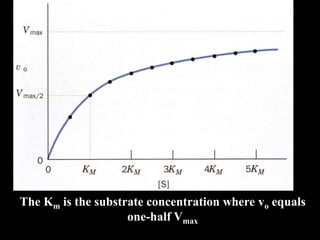
The Km is the substrate concentration where vo equals
one-half Vmax
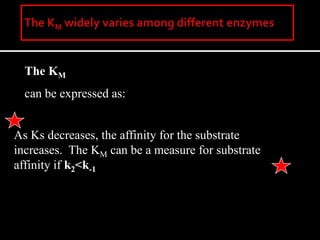
The KM
can be expressed as:
1
2
1
2
1
1
KK
k
k
k
k
k
k
sM
As Ks decreases, the affinity for the substrate
increases. The KM can be a measure for substrate
affinity if k2<k-1
There are a wide range of KM, Vmax , and efficiency
seen in enzymes
But how do we analyze kinetic data?
maxmax
M
V
1
S
1
V
K1
ov
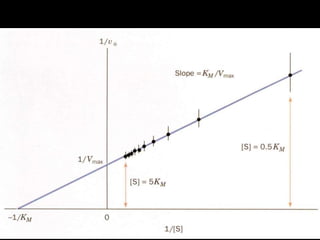
Lineweaver-Burk plot: slope = KM/Vmax,
1/vo intercept is equal to 1/Vmax
the extrapolated x intercept is equal to -1/KM
For small errors in at low [S] leads to large errors in 1/vo
T
max
E
V
catk
kcat is how many reactions an
enzyme can catalyze per second
The turnover number
For Michaelis -Menton kinetics k2= kcat
When [S] << KM very little ES is formed and [E] = [E]T
and
SE
K
k
SE
K
k
M
cat
T
M
2
ov
Kcat/KM is a measure of catalytic efficiency
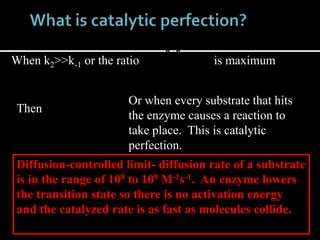
When k2>>k-1 or the ratio
21
21
kk
kk
is maximum
Then
1
MK
k
kcat
Or when every substrate that hits
the enzyme causes a reaction to
take place. This is catalytic
perfection.
Diffusion-controlled limit- diffusion rate of a substrate
is in the range of 108 to 109 M-1s-1. An enzyme lowers
the transition state so there is no activation energy
and the catalyzed rate is as fast as molecules collide.
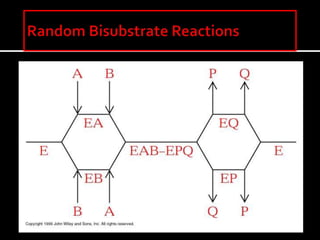
 All substrates must combine with enzyme
before reaction can occur
Bisubstrate reactions
 Group transfer reactions
 One or more products released before all
substrates added
Although a phenomenological description can be
obtained the nature of the reaction intermediates
remain indeterminate and other independent
measurements are needed.
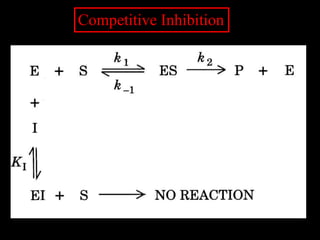
There are three types of inhibition kinetics competitive,
mixed and uncompetitive.
•Competitive- Where the inhibitor competes with the
substrate.
Competitive Inhibition
SK
SV
M
max
ov
IK
I
1
EI
IE
KI
Competitive Inhibition: Lineweaver-Burke Plot
Uncompetitive Inhibition
Uncompetitive Inhibition: Lineweaver-Burke Plot
Mixed inhibition is when the inhibitor binds to the
enzyme at a location distinct from the substrate
binding site. The binding of the inhibitor will either
alter the KM or Vmax or both.
EI
IE
KI
ESI
IES
KI
SK
SV
M
max
ov
IK
I
1
Enzyme Kinetics
Enzyme Kinetics
Enzyme Kinetics
Enzyme Kinetics

Enzyme Kinetics

  • 1.
    M.Prasad Naidu MSc MedicalBiochemistry, Ph.D.Research Scholar
  • 2.
    Enzymes follow zeroorder kinetics when substrate concentrations are high. Zero order means there is no increase in the rate of the reaction when more substrate is added. Given the following breakdown of sucrose to glucose and fructose Sucrose + H20 Glucose + Fructose O H HO H HO H OH OHH H OH OH HO H H OH O H H HO H H H OH
  • 3.
    PEESSE 2 1 1- k k k E =Enzyme S = Substrate P = Product ES = Enzyme-Substrate complex k1 rate constant for the forward reaction k-1 = rate constant for the breakdown of the ES to substrate k2 = rate constant for the formation of the products
  • 4.
    When the substrateconcentration becomes large enough to force the equilibrium to form completely all ES the second step in the reaction becomes rate limiting because no more ES can be made and the enzyme-substrate complex is at its maximum value. ES P 2k dt d v [ES] is the difference between the rates of ES formation minus the rates of its disappearance. ESESSE ES 211 kkk dt d 1
  • 5.
    Assumption of equilibrium k-1>>k2the formation of product is so much slower than the formation of the ES complex. That we can assume: ES SE 1 1 k k Ks Ks is the dissociation constant for the ES complex.
  • 6.
    Assumption of steadystate Transient phase where in the course of a reaction the concentration of ES does not change 0 ES dt d 2
  • 7.
    ESEE T 3 Combining1 + 2 + 3 ESkkSES-Ek 21-T1 SEkSkkkES T1121- SK SE ES T M 1 21- k kk KM rearranging Divide by k1 and solve for [ES] Where
  • 8.
    SK SE ES P T2 2 0 Mt o k k dt d v vois the initial velocity when the reaction is just starting out. And is the maximum velocityT2max EkV SK SVmax M ov The Michaelis - Menten equation
  • 9.
    The Km isthe substrate concentration where vo equals one-half Vmax
  • 10.
    The KM can beexpressed as: 1 2 1 2 1 1 KK k k k k k k sM As Ks decreases, the affinity for the substrate increases. The KM can be a measure for substrate affinity if k2<k-1
  • 11.
    There are awide range of KM, Vmax , and efficiency seen in enzymes But how do we analyze kinetic data?
  • 12.
  • 14.
    Lineweaver-Burk plot: slope= KM/Vmax, 1/vo intercept is equal to 1/Vmax the extrapolated x intercept is equal to -1/KM For small errors in at low [S] leads to large errors in 1/vo T max E V catk kcat is how many reactions an enzyme can catalyze per second The turnover number
  • 15.
    For Michaelis -Mentonkinetics k2= kcat When [S] << KM very little ES is formed and [E] = [E]T and SE K k SE K k M cat T M 2 ov Kcat/KM is a measure of catalytic efficiency
  • 16.
    When k2>>k-1 orthe ratio 21 21 kk kk is maximum Then 1 MK k kcat Or when every substrate that hits the enzyme causes a reaction to take place. This is catalytic perfection. Diffusion-controlled limit- diffusion rate of a substrate is in the range of 108 to 109 M-1s-1. An enzyme lowers the transition state so there is no activation energy and the catalyzed rate is as fast as molecules collide.
  • 17.
     All substratesmust combine with enzyme before reaction can occur
  • 18.
  • 20.
     Group transferreactions  One or more products released before all substrates added
  • 21.
    Although a phenomenologicaldescription can be obtained the nature of the reaction intermediates remain indeterminate and other independent measurements are needed.
  • 22.
    There are threetypes of inhibition kinetics competitive, mixed and uncompetitive. •Competitive- Where the inhibitor competes with the substrate.
  • 23.
  • 24.
  • 27.
  • 28.
  • 29.
  • 32.
    Mixed inhibition iswhen the inhibitor binds to the enzyme at a location distinct from the substrate binding site. The binding of the inhibitor will either alter the KM or Vmax or both. EI IE KI ESI IES KI SK SV M max ov IK I 1