ENZYME ASSAYS
• Laboratory method for measuring enzyme
activity.
• Vital for study of enzyme kinetics and enzyme
inhibition.
• Measurement of enzyme activity – follow the
change in concentration of substrate or
product – measure reaction rate.
DIRECT CONTINUOUS ASSAYS
• Difference in properties of substrate and product –
measured directly.
• Continuous observation of the progress curve – most
preferred.
• Change in
– Absorbance. - Fluorescence.
– pH. - Optical rotation.
– Enthalpy. - Viscosity.
– Volume of reaction mixture.
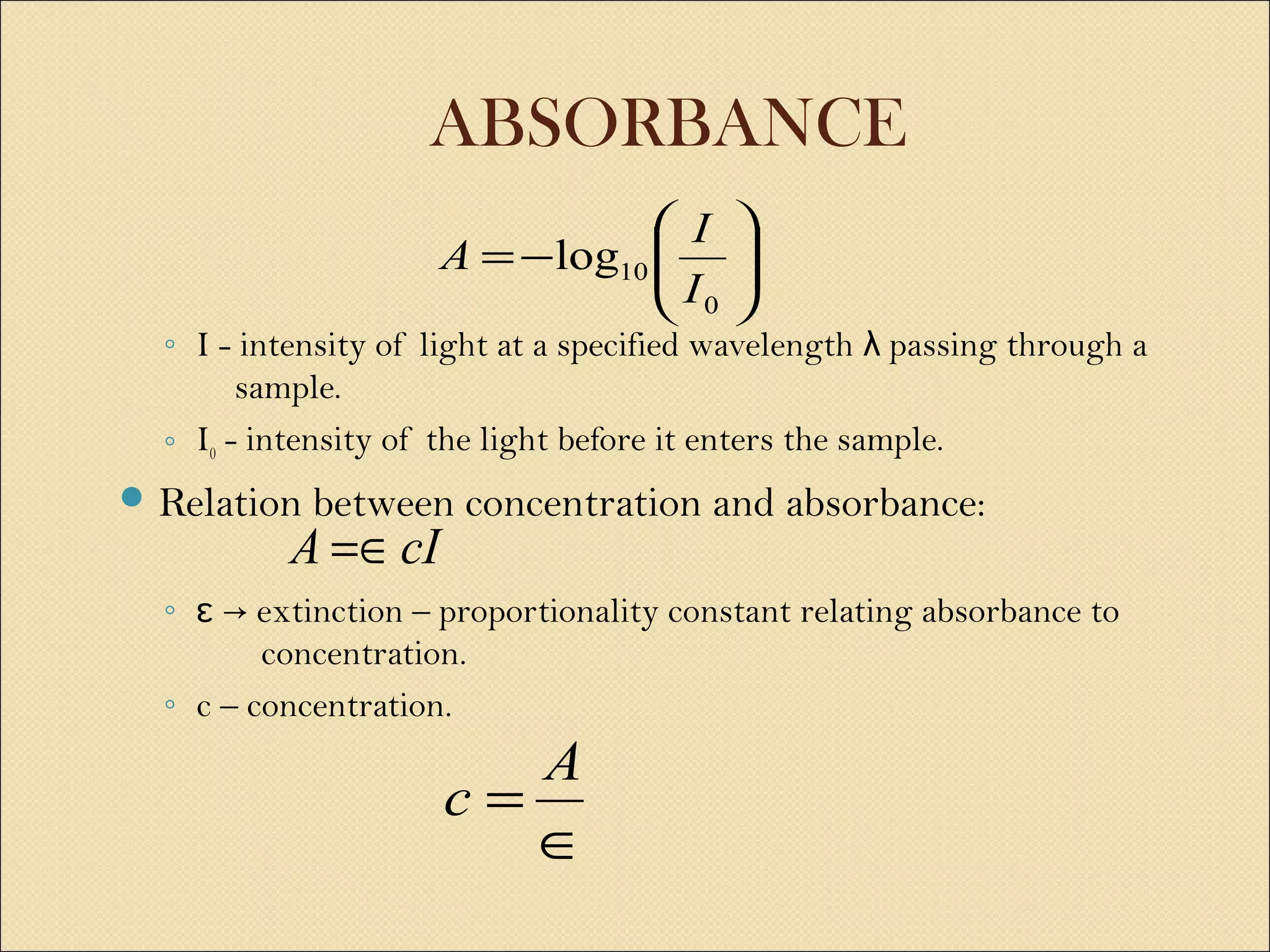
ABSORBANCE
◦ I - intensity of light at a specified wavelength passing through aλ
sample.
◦ I0 - intensity of the light before it enters the sample.
 Relation between concentration and absorbance:
◦ extinction – proportionality constant relating absorbance toɛ →
concentration.
◦ c – concentration.






−=
0
10log
I
I
A
cIA =∈
∈
=
A
c
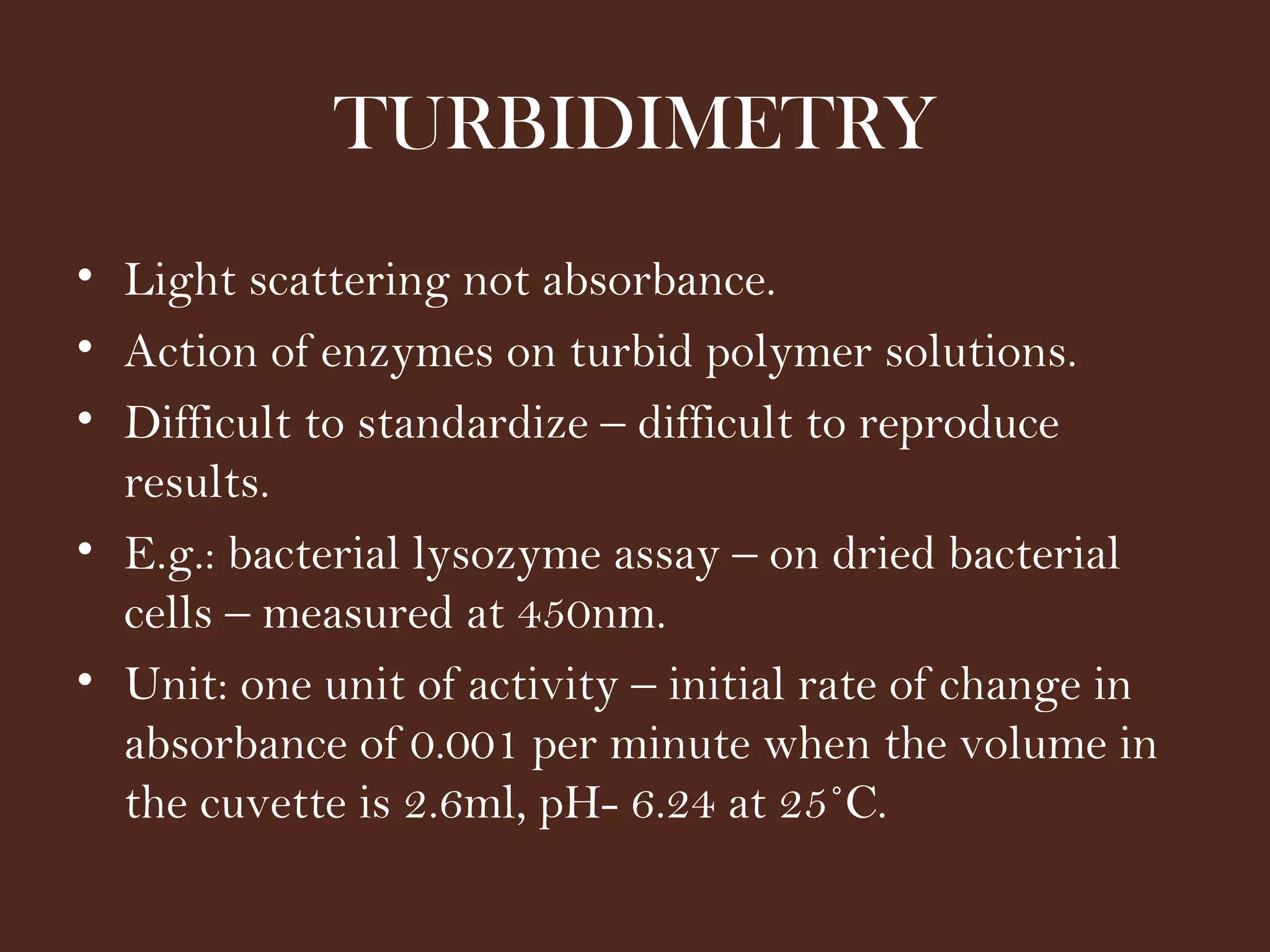
TURBIDIMETRY
• Light scattering not absorbance.
• Action of enzymes on turbid polymer solutions.
• Difficult to standardize – difficult to reproduce
results.
• E.g.: bacterial lysozyme assay – on dried bacterial
cells – measured at 450nm.
• Unit: one unit of activity – initial rate of change in
absorbance of 0.001 per minute when the volume in
the cuvette is 2.6ml, pH- 6.24 at 25˚C.
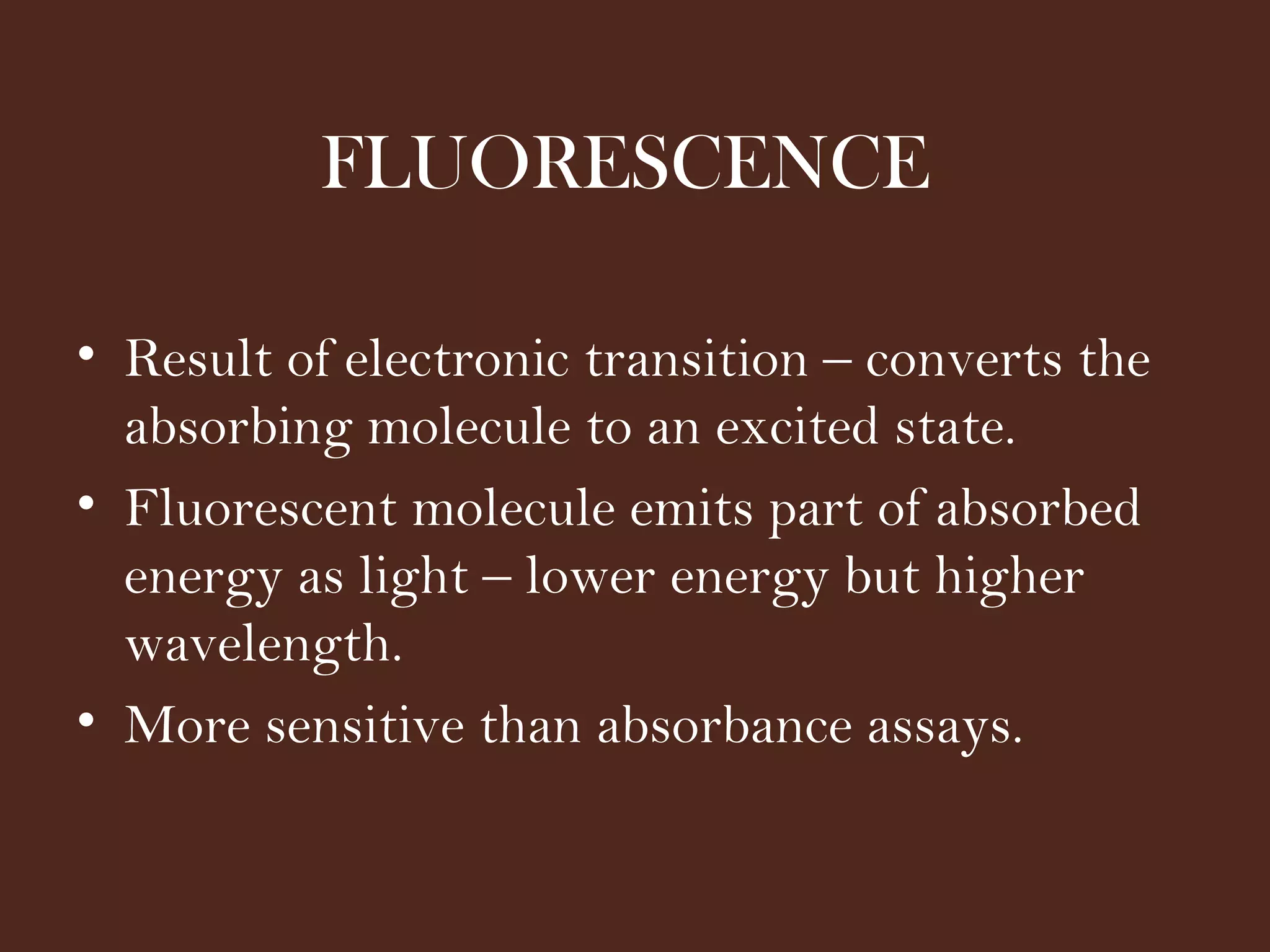
FLUORESCENCE
• Result of electronic transition – converts the
absorbing molecule to an excited state.
• Fluorescent molecule emits part of absorbed
energy as light – lower energy but higher
wavelength.
• More sensitive than absorbance assays.
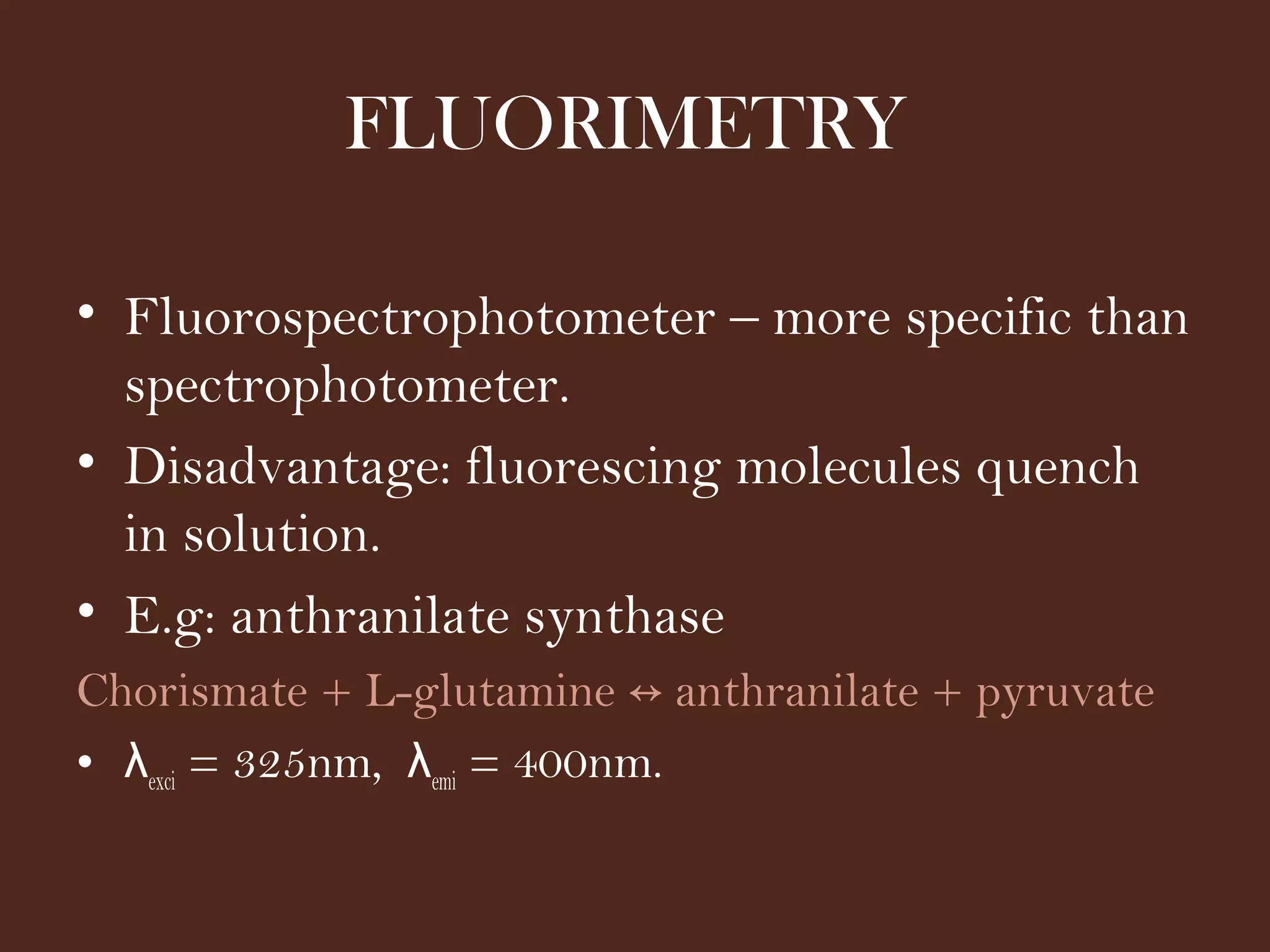
FLUORIMETRY
• Fluorospectrophotometer – more specific than
spectrophotometer.
• Disadvantage: fluorescing molecules quench
in solution.
• E.g: anthranilate synthase
Chorismate + L-glutamine anthranilate + pyruvate↔
• λexci = 325nm, λemi = 400nm.
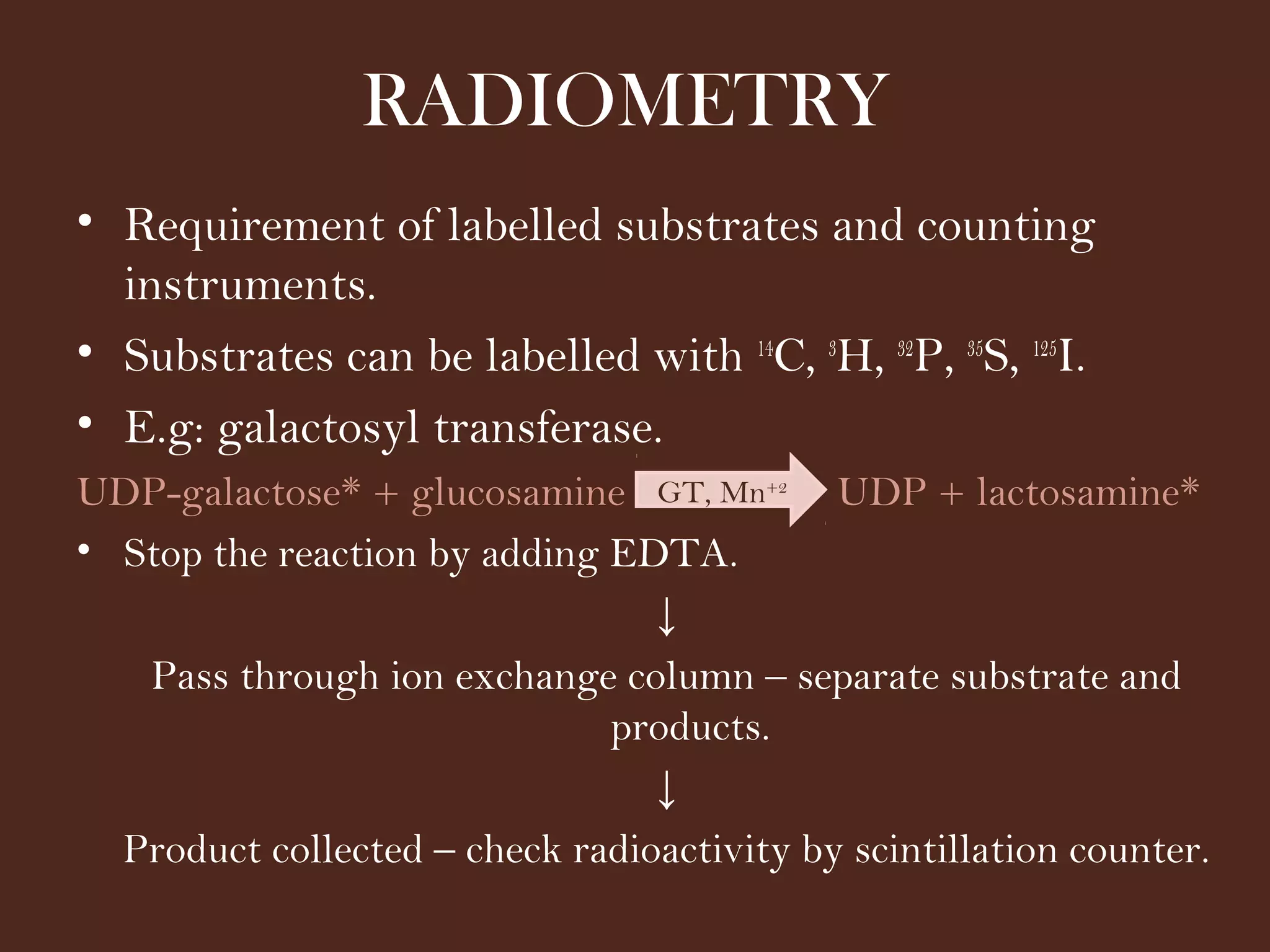
RADIOMETRY
• Requirement of labelled substrates and counting
instruments.
• Substrates can be labelled with 14
C, 3
H, 32
P, 35
S, 125
I.
• E.g: galactosyl transferase.
UDP-galactose* + glucosamine UDP + lactosamine*
• Stop the reaction by adding EDTA.
↓
Pass through ion exchange column – separate substrate and
products.
↓
Product collected – check radioactivity by scintillation counter.
GT, Mn+2
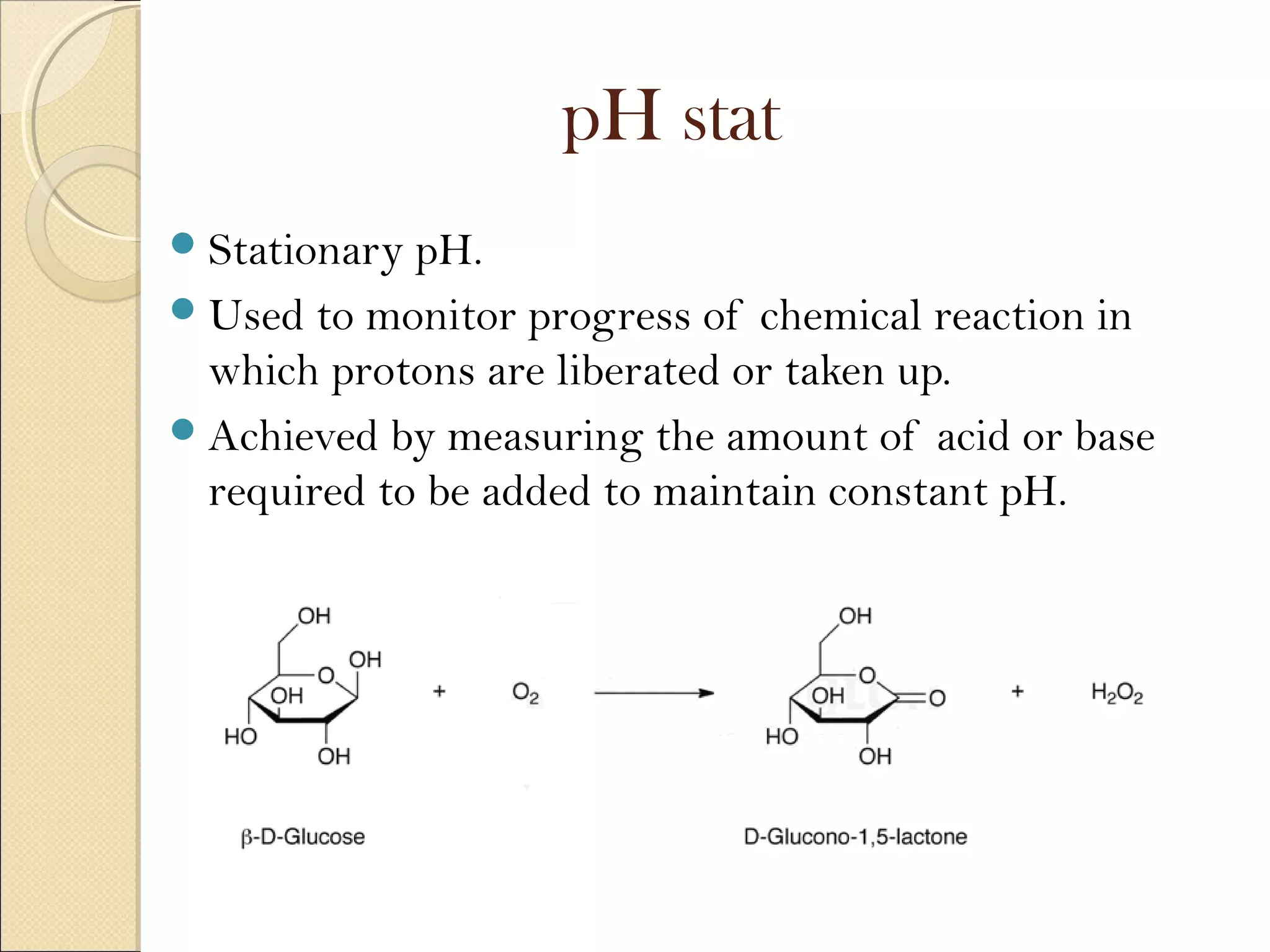
pH stat
Stationary pH.
Used to monitor progress of chemical reaction in
which protons are liberated or taken up.
Achieved by measuring the amount of acid or base
required to be added to maintain constant pH.
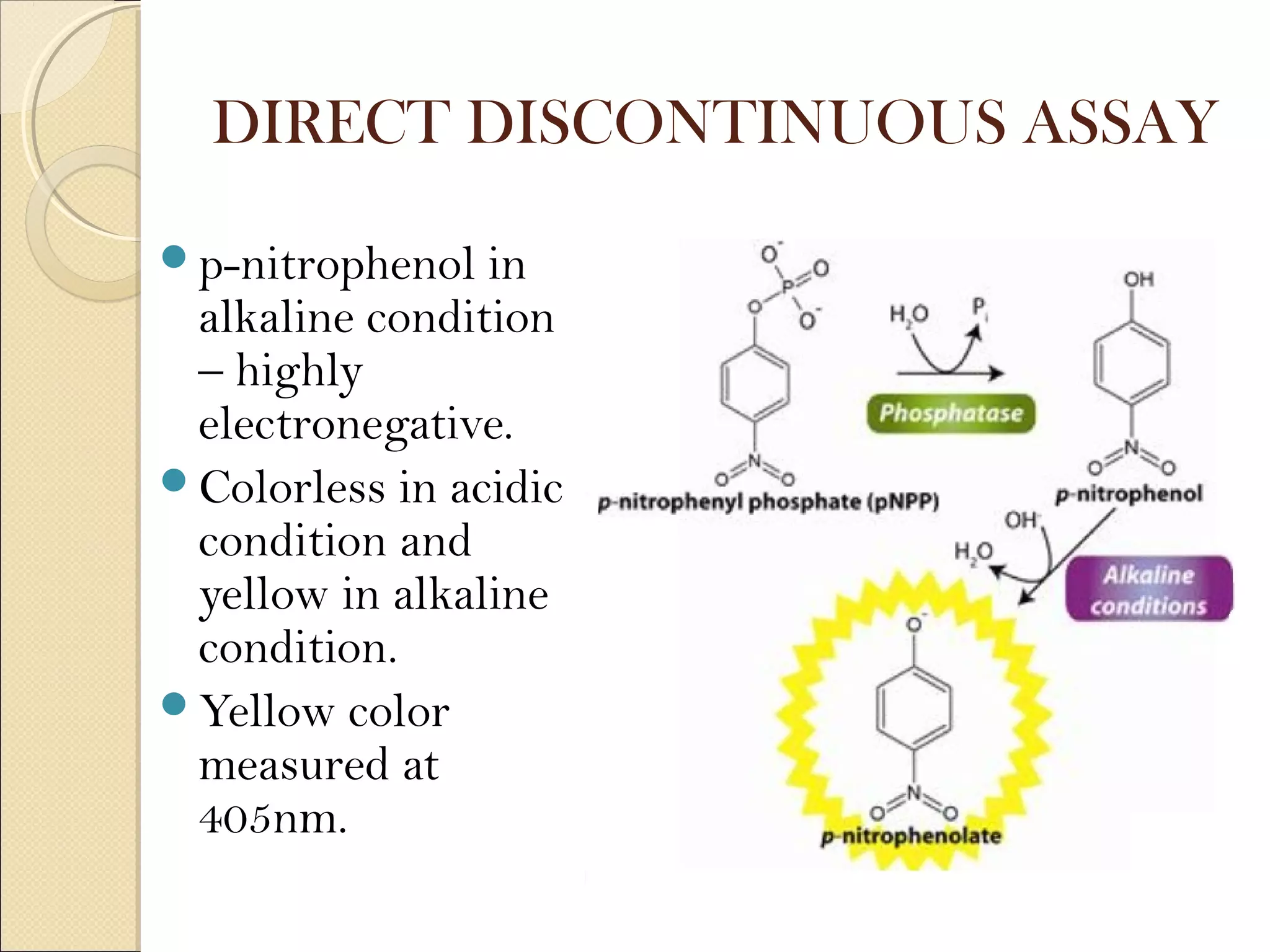
DIRECT DISCONTINUOUS ASSAY
p-nitrophenol in
alkaline condition
– highly
electronegative.
Colorless in acidic
condition and
yellow in alkaline
condition.
Yellow color
measured at
405nm.
INDIRECT ASSAYS
• Further treatment of reaction mixture –
produce a measurable product or increase
sensitivity of assay procedure.
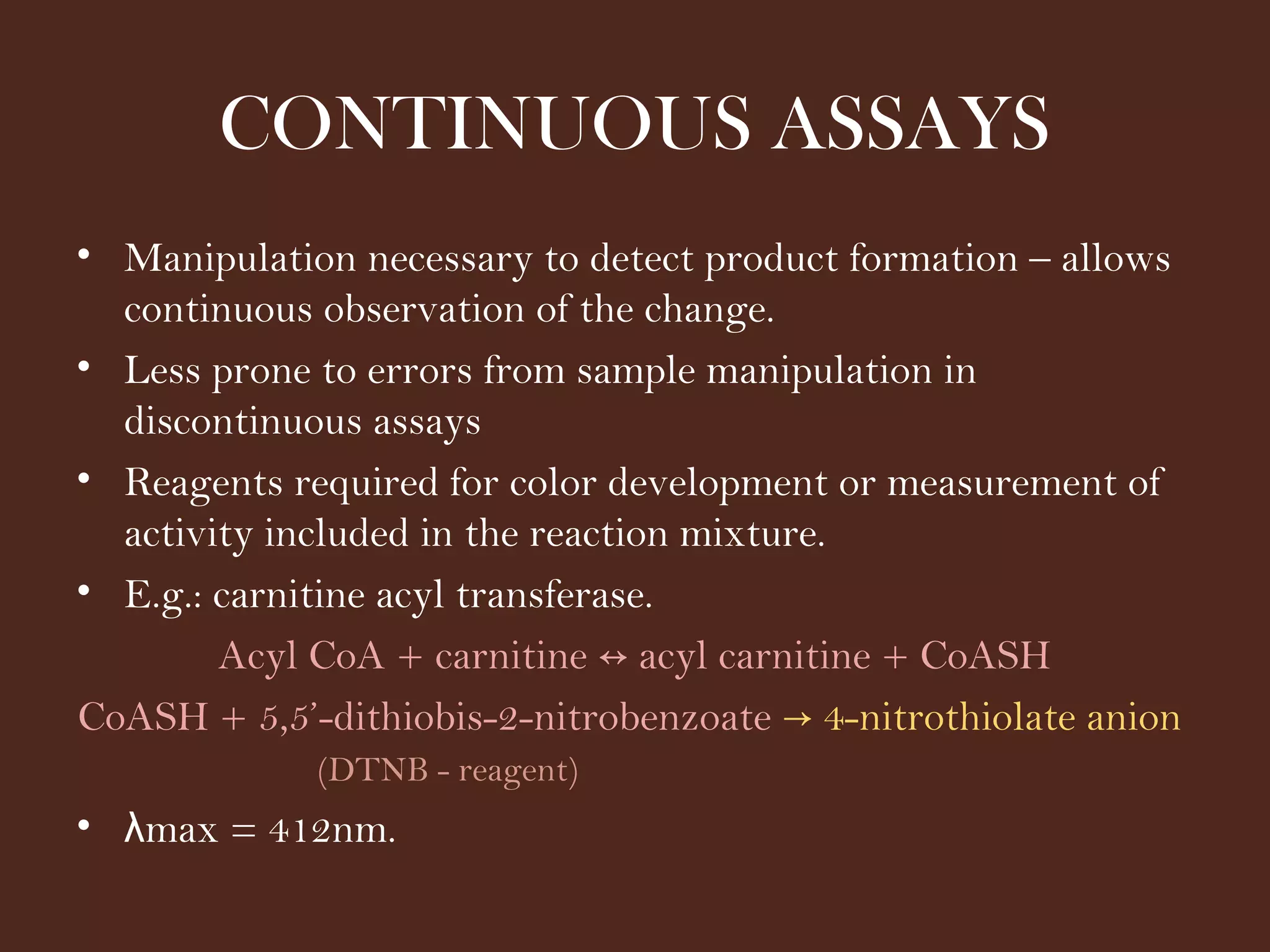
CONTINUOUS ASSAYS
• Manipulation necessary to detect product formation – allows
continuous observation of the change.
• Less prone to errors from sample manipulation in
discontinuous assays
• Reagents required for color development or measurement of
activity included in the reaction mixture.
• E.g.: carnitine acyl transferase.
Acyl CoA + carnitine acyl carnitine + CoASH↔
CoASH + 5,5’-dithiobis-2-nitrobenzoate 4-nitrothiolate anion→
(DTNB - reagent)
• λmax = 412nm.
DISCONTINUOUS ASSAYS
• Also called sampling assay.
• Stopping reaction - after a fixed time.
• Treating the reaction mixture to separate the product for
analysis or produce a measurable change in properties of
substrates or product.
• Separate product for analysis (radiochemical assay)
– No modification made on the substrate/product can be considered→
as a direct assay.
• Produce change in properties of one substrate/product can→
be measured.
– Formation of ATP can be determined by measuring light intensity in
the presence of luciferase.
ATP + luciferin +O2 oxyluciferin + PPi +CO→ 2 + AMP + light
Coupled assays
• Use of one or more additional enzymes to
catalyse a reaction of one of the products to
yield a compound that can be directly
detected.
• Additional enzyme – coupled enzymes.
Examples
• Hexokinase.
– Coupling of the
formation of
glucose-6-
phosphate to the
reduction of
NADP+
in the
presence of G6P
dehydrogenase.
Glucose
ATP, Mg2+
ADP, Mg2+
Glucose 6-phosphate
NADP+
NADPH + H+
6-Phosphogluconolactone
G6P
DEHYDROGENASE
HEXOKINASE
Fructose 6-phosphate PHOSPHOFRUCTOKINASE Fructose 1,6-bisphosphate
ATP ADP
Pyruvate Phosphoenolpyruvate
NADH + H+
NAD+
PYRUVATE
KINASE
LDH
Lactate
Phosphofructokinase
Coupled continuous assay
1. Aspartate amino transferase (serum glutamate
oxaloacetate transaminase)
• AST/SGOT – 30˚C, pH 7-8 in 80mM tris.→
• Change in A340 measured.
Aspartate + α-ketoglutarate oxaloacetate + glutamate↔
Oxaloacetate + NADH + H+
malate + NAD↔ +
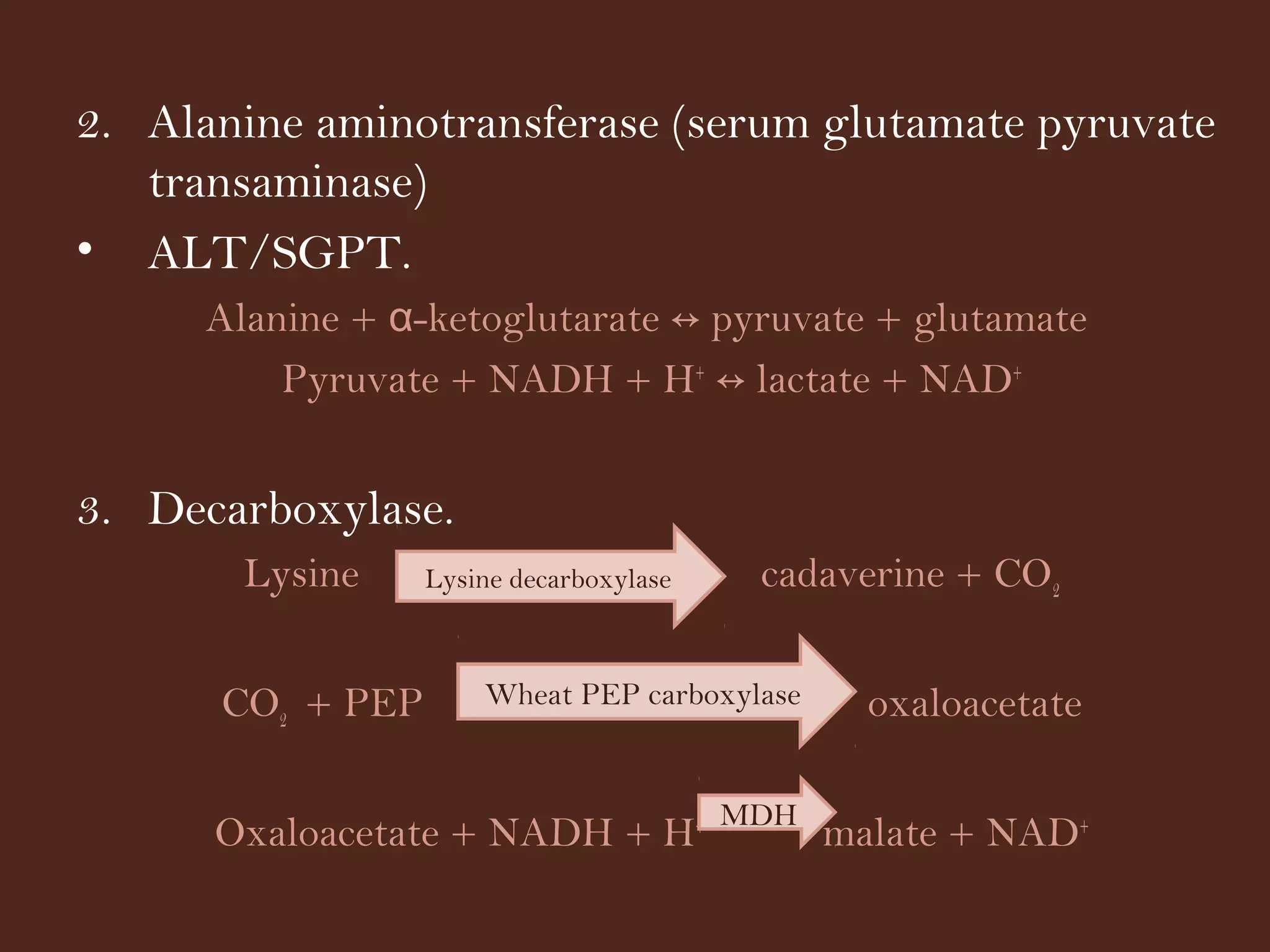
2. Alanine aminotransferase (serum glutamate pyruvate
transaminase)
• ALT/SGPT.
Alanine + α-ketoglutarate pyruvate + glutamate↔
Pyruvate + NADH + H+
lactate + NAD↔ +
3. Decarboxylase.
Lysine cadaverine + CO2
CO2 + PEP oxaloacetate
Oxaloacetate + NADH + H+
malate + NAD+
Lysine decarboxylase
Wheat PEP carboxylase
MDH
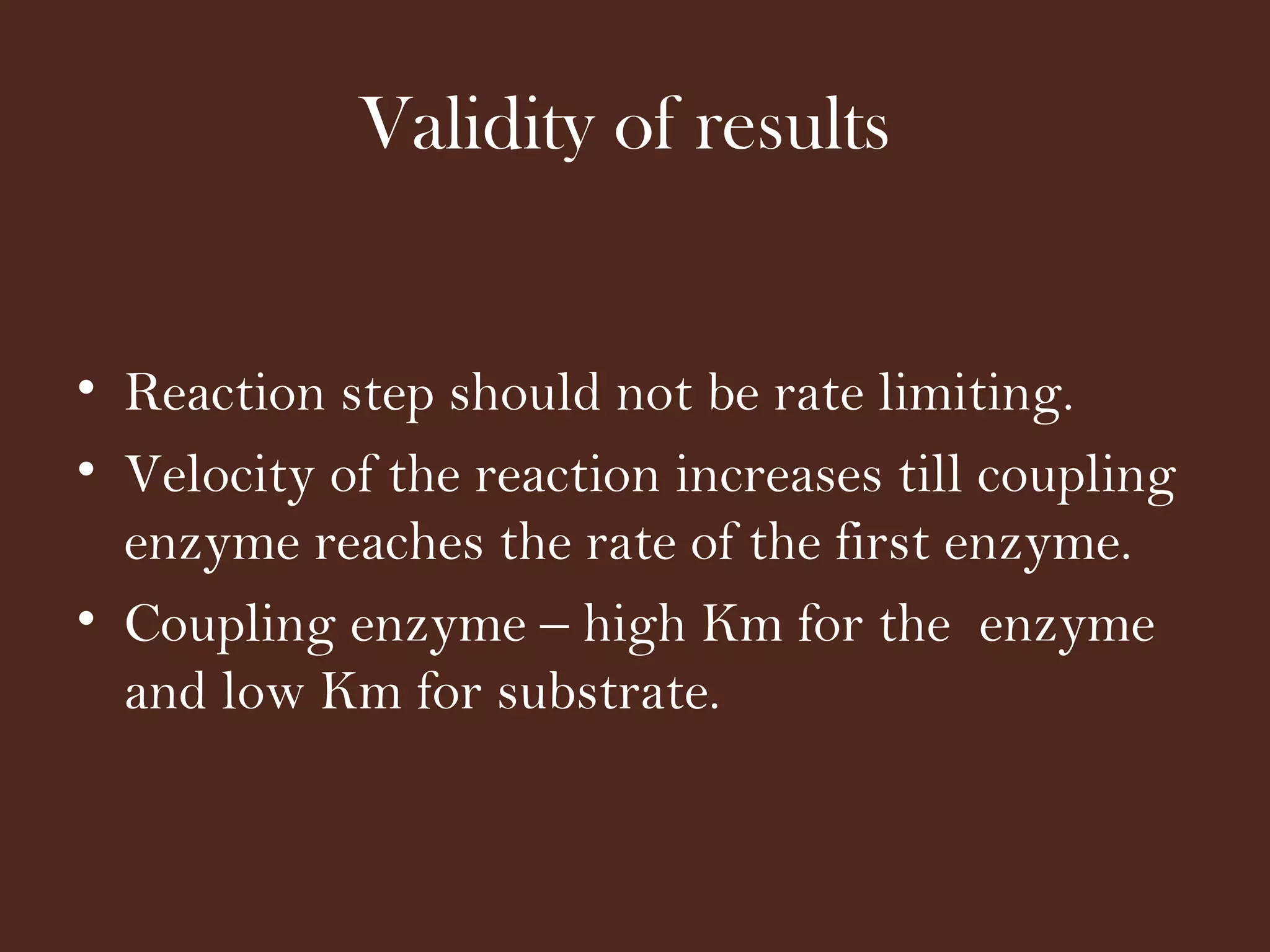
Validity of results
• Reaction step should not be rate limiting.
• Velocity of the reaction increases till coupling
enzyme reaches the rate of the first enzyme.
• Coupling enzyme – high Km for the enzyme
and low Km for substrate.
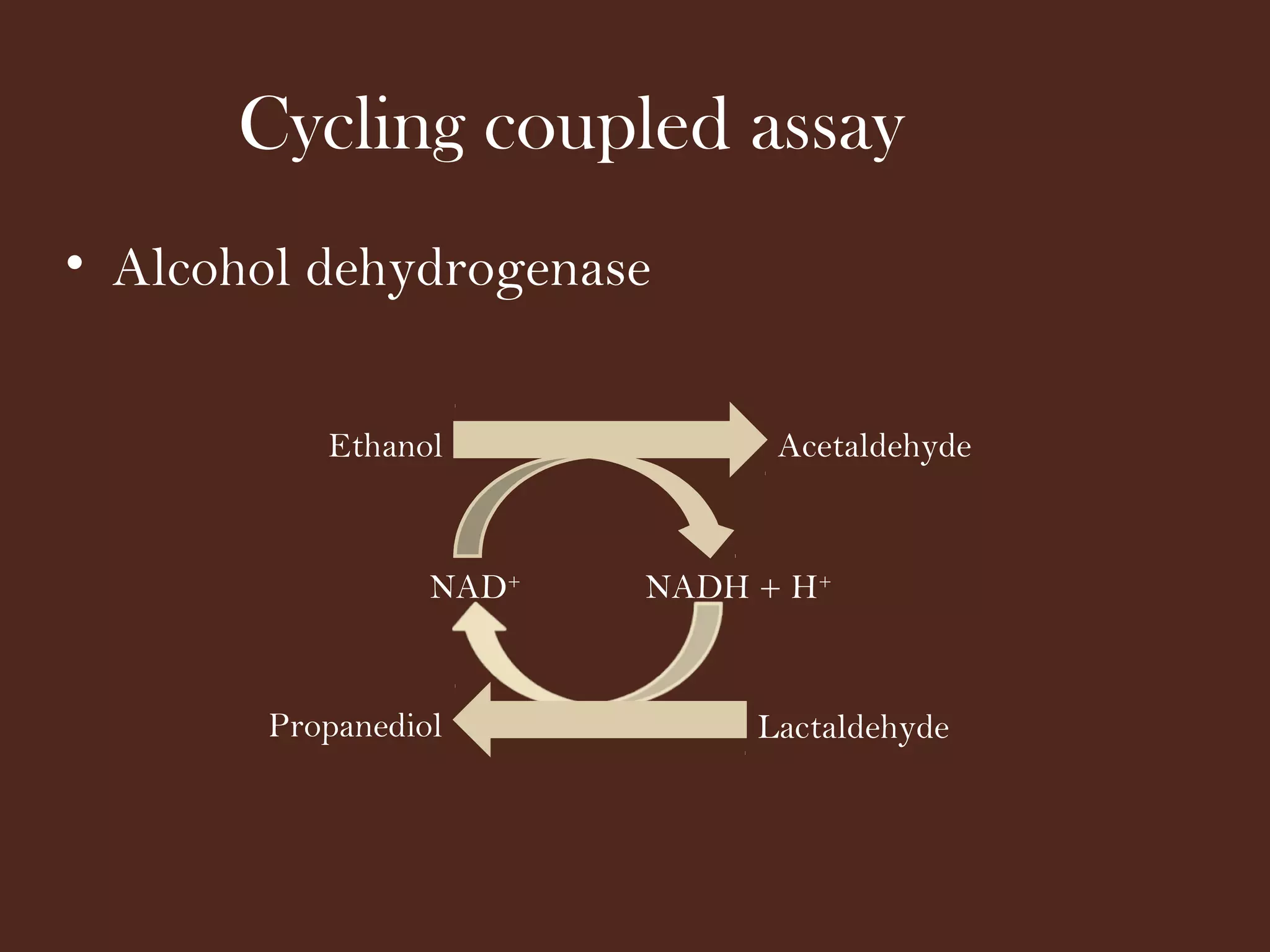
Cycling coupled assay
• Alcohol dehydrogenase
Ethanol
NAD+
NADH + H+
Acetaldehyde
LactaldehydePropanediol
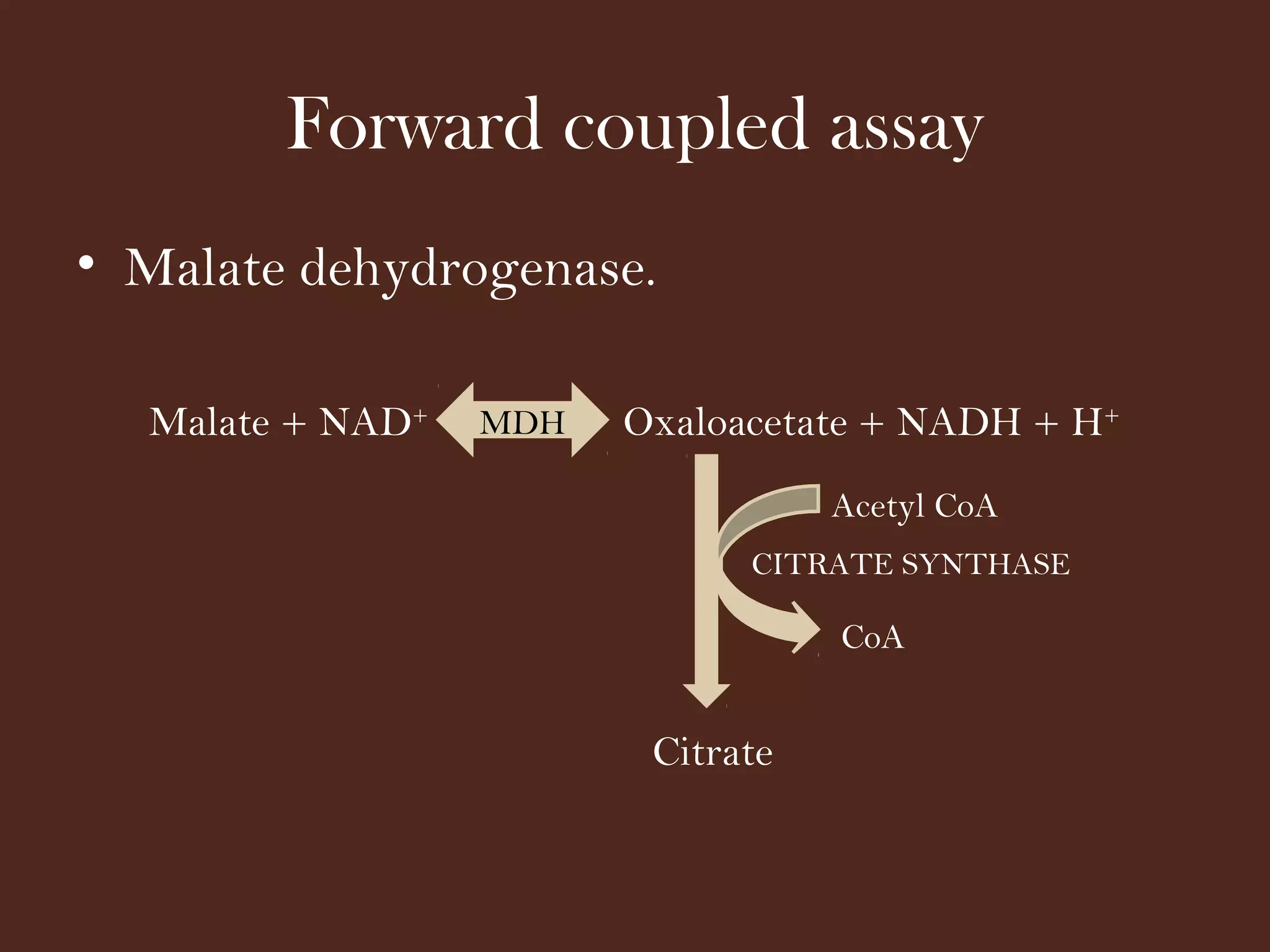
Forward coupled assay
• Malate dehydrogenase.
Malate + NAD+ MDH Oxaloacetate + NADH + H+
Acetyl CoA
CoA
CITRATE SYNTHASE
Citrate
References
• Enzyme Assays by Robert Eisenthal.
• Photometric assays – Robert A. John.
• Principles of enzyme assays and kinetic
studies – Keith F. Tipton.

Enzyme assays

  • 1.
  • 2.
    • Laboratory methodfor measuring enzyme activity. • Vital for study of enzyme kinetics and enzyme inhibition. • Measurement of enzyme activity – follow the change in concentration of substrate or product – measure reaction rate.
  • 4.
    DIRECT CONTINUOUS ASSAYS •Difference in properties of substrate and product – measured directly. • Continuous observation of the progress curve – most preferred. • Change in – Absorbance. - Fluorescence. – pH. - Optical rotation. – Enthalpy. - Viscosity. – Volume of reaction mixture.
  • 5.
    ABSORBANCE ◦ I -intensity of light at a specified wavelength passing through aλ sample. ◦ I0 - intensity of the light before it enters the sample.  Relation between concentration and absorbance: ◦ extinction – proportionality constant relating absorbance toɛ → concentration. ◦ c – concentration.       −= 0 10log I I A cIA =∈ ∈ = A c
  • 6.
    TURBIDIMETRY • Light scatteringnot absorbance. • Action of enzymes on turbid polymer solutions. • Difficult to standardize – difficult to reproduce results. • E.g.: bacterial lysozyme assay – on dried bacterial cells – measured at 450nm. • Unit: one unit of activity – initial rate of change in absorbance of 0.001 per minute when the volume in the cuvette is 2.6ml, pH- 6.24 at 25˚C.
  • 7.
    FLUORESCENCE • Result ofelectronic transition – converts the absorbing molecule to an excited state. • Fluorescent molecule emits part of absorbed energy as light – lower energy but higher wavelength. • More sensitive than absorbance assays.
  • 8.
    FLUORIMETRY • Fluorospectrophotometer –more specific than spectrophotometer. • Disadvantage: fluorescing molecules quench in solution. • E.g: anthranilate synthase Chorismate + L-glutamine anthranilate + pyruvate↔ • λexci = 325nm, λemi = 400nm.
  • 9.
    RADIOMETRY • Requirement oflabelled substrates and counting instruments. • Substrates can be labelled with 14 C, 3 H, 32 P, 35 S, 125 I. • E.g: galactosyl transferase. UDP-galactose* + glucosamine UDP + lactosamine* • Stop the reaction by adding EDTA. ↓ Pass through ion exchange column – separate substrate and products. ↓ Product collected – check radioactivity by scintillation counter. GT, Mn+2
  • 10.
    pH stat Stationary pH. Usedto monitor progress of chemical reaction in which protons are liberated or taken up. Achieved by measuring the amount of acid or base required to be added to maintain constant pH.
  • 11.
    DIRECT DISCONTINUOUS ASSAY p-nitrophenolin alkaline condition – highly electronegative. Colorless in acidic condition and yellow in alkaline condition. Yellow color measured at 405nm.
  • 12.
    INDIRECT ASSAYS • Furthertreatment of reaction mixture – produce a measurable product or increase sensitivity of assay procedure.
  • 13.
    CONTINUOUS ASSAYS • Manipulationnecessary to detect product formation – allows continuous observation of the change. • Less prone to errors from sample manipulation in discontinuous assays • Reagents required for color development or measurement of activity included in the reaction mixture. • E.g.: carnitine acyl transferase. Acyl CoA + carnitine acyl carnitine + CoASH↔ CoASH + 5,5’-dithiobis-2-nitrobenzoate 4-nitrothiolate anion→ (DTNB - reagent) • λmax = 412nm.
  • 14.
    DISCONTINUOUS ASSAYS • Alsocalled sampling assay. • Stopping reaction - after a fixed time. • Treating the reaction mixture to separate the product for analysis or produce a measurable change in properties of substrates or product. • Separate product for analysis (radiochemical assay) – No modification made on the substrate/product can be considered→ as a direct assay. • Produce change in properties of one substrate/product can→ be measured. – Formation of ATP can be determined by measuring light intensity in the presence of luciferase. ATP + luciferin +O2 oxyluciferin + PPi +CO→ 2 + AMP + light
  • 15.
    Coupled assays • Useof one or more additional enzymes to catalyse a reaction of one of the products to yield a compound that can be directly detected. • Additional enzyme – coupled enzymes.
  • 16.
    Examples • Hexokinase. – Couplingof the formation of glucose-6- phosphate to the reduction of NADP+ in the presence of G6P dehydrogenase. Glucose ATP, Mg2+ ADP, Mg2+ Glucose 6-phosphate NADP+ NADPH + H+ 6-Phosphogluconolactone G6P DEHYDROGENASE HEXOKINASE
  • 17.
    Fructose 6-phosphate PHOSPHOFRUCTOKINASEFructose 1,6-bisphosphate ATP ADP Pyruvate Phosphoenolpyruvate NADH + H+ NAD+ PYRUVATE KINASE LDH Lactate Phosphofructokinase
  • 18.
    Coupled continuous assay 1.Aspartate amino transferase (serum glutamate oxaloacetate transaminase) • AST/SGOT – 30˚C, pH 7-8 in 80mM tris.→ • Change in A340 measured. Aspartate + α-ketoglutarate oxaloacetate + glutamate↔ Oxaloacetate + NADH + H+ malate + NAD↔ +
  • 19.
    2. Alanine aminotransferase(serum glutamate pyruvate transaminase) • ALT/SGPT. Alanine + α-ketoglutarate pyruvate + glutamate↔ Pyruvate + NADH + H+ lactate + NAD↔ + 3. Decarboxylase. Lysine cadaverine + CO2 CO2 + PEP oxaloacetate Oxaloacetate + NADH + H+ malate + NAD+ Lysine decarboxylase Wheat PEP carboxylase MDH
  • 20.
    Validity of results •Reaction step should not be rate limiting. • Velocity of the reaction increases till coupling enzyme reaches the rate of the first enzyme. • Coupling enzyme – high Km for the enzyme and low Km for substrate.
  • 21.
    Cycling coupled assay •Alcohol dehydrogenase Ethanol NAD+ NADH + H+ Acetaldehyde LactaldehydePropanediol
  • 22.
    Forward coupled assay •Malate dehydrogenase. Malate + NAD+ MDH Oxaloacetate + NADH + H+ Acetyl CoA CoA CITRATE SYNTHASE Citrate
  • 23.
    References • Enzyme Assaysby Robert Eisenthal. • Photometric assays – Robert A. John. • Principles of enzyme assays and kinetic studies – Keith F. Tipton.

Editor's Notes

  • #7 Photometric assays – Robert A. John.
  • #8 Photometric assays – Robert A. John
  • #9 Photometric assays – Robert A. John
  • #13 Principles of enzyme assays and kinetic studies – Keith F. Tipton. Enzyme Assays - Robert Eisenthal and Michael J. Danson
  • #16 Principles of enzyme assay and kinetic studies – Keith F. Tipton