ENZYMES
10
                                  Enzymes
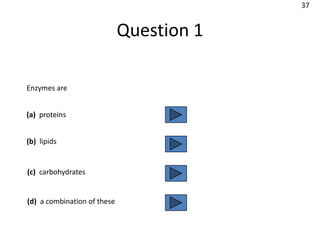
-Enzymes are proteins that function as biological catalysts
-Catalyst: a substance that speeds up a chemical reaction
and is not changed by the reaction.

They are present in the cytoplasm of all cells

There are hundreds of different enzymes but each enzyme
speeds up only one kind of reaction. They are specific.


For example, glucose and fructose might join up slowly to
form sucrose

                            glucose-      -fructose

 With the right enzyme present, the reaction happens faster

                               glucose-     -fructose
12
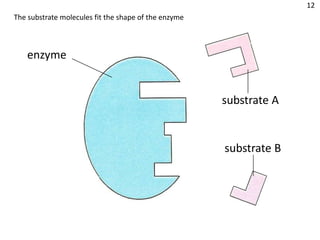
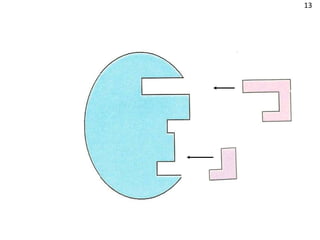
The substrate molecules fit the shape of the enzyme


    enzyme


                                                      substrate A


                                                      substrate B
13
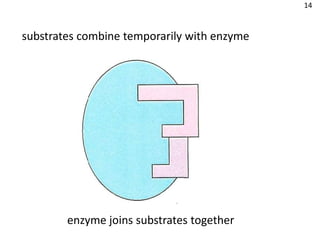
14


substrates combine temporarily with enzyme


        enzyme joins substrates together
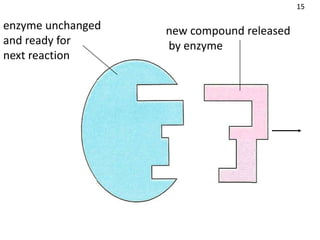
15

enzyme unchanged   new compound released
and ready for      by enzyme
next reaction
16
Different types of enzyme reaction
 The last 4 slides show how an enzyme is involved in
 combining substrates to create a larger molecule


  For example, the enzyme could be building up a sucrose
  molecule from glucose and fructose (anabolic reaction)


  The next sequence shows how an enzyme can help to
  break a large molecule into smaller molecules (catabolic
  reaction)


  For example an enzyme can split a sucrose molecule
  into the smaller glucose and fructose molecules
17
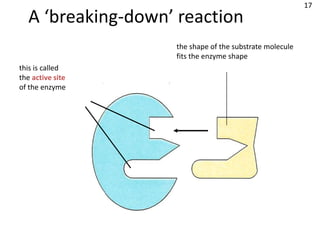
  A ‘breaking-down’ reaction
                   the shape of the substrate molecule
                   fits the enzyme shape
this is called
the active site
of the enzyme
18

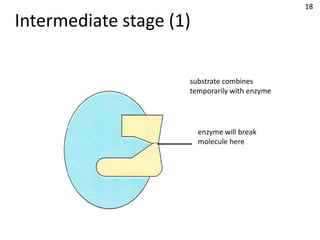
Intermediate stage (1)

                     substrate combines
                     temporarily with enzyme


                         enzyme will break
                         molecule here
19

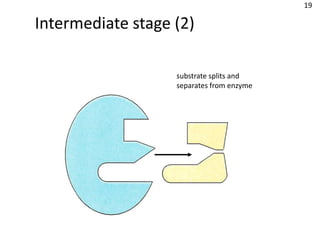
Intermediate stage (2)

                   substrate splits and
                   separates from enzyme
20

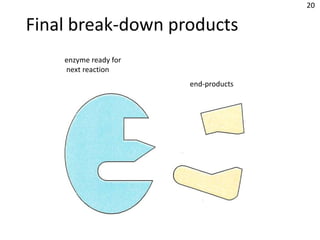
Final break-down products
    enzyme ready for
    next reaction
                       end-products
21
    Properties of enzymes
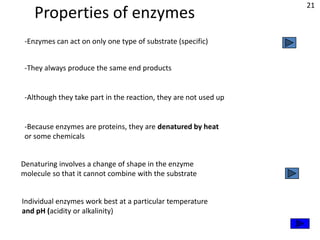
 -Enzymes can act on only one type of substrate (specific)


 -They always produce the same end products


 -Although they take part in the reaction, they are not used up


 -Because enzymes are proteins, they are denatured by heat
 or some chemicals


Denaturing involves a change of shape in the enzyme
molecule so that it cannot combine with the substrate


Individual enzymes work best at a particular temperature
and pH (acidity or alkalinity)
22
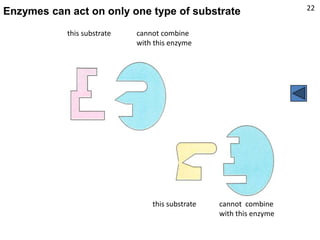
Enzymes can act on only one type of substrate
            this substrate   cannot combine
                             with this enzyme


                                 this substrate   cannot combine
                                                  with this enzyme
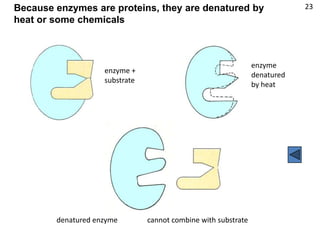
Because enzymes are proteins, they are denatured by                         23
heat or some chemicals


                                                                enzyme
                    enzyme +
                                                                denatured
                    substrate
                                                                by heat


        denatured enzyme        cannot combine with substrate
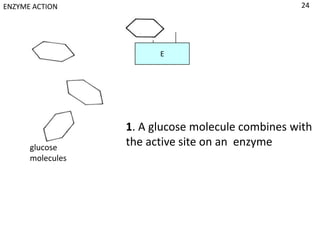
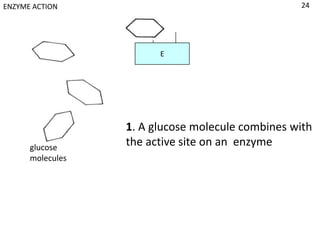
ENZYME ACTION                                         24


                  1
                            E


                      1. A glucose molecule combines with
      glucose
                      the active site on an enzyme
      molecules
ENZYME ACTION                                         24


                  1
                            E


                      1. A glucose molecule combines with
      glucose
                      the active site on an enzyme
      molecules
25


                               E


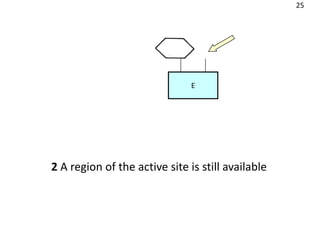
2 A region of the active site is still available
26

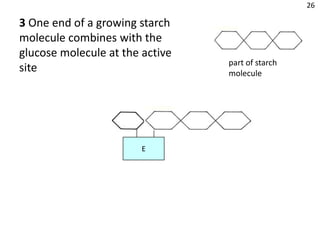
3 One end of a growing starch
molecule combines with the
glucose molecule at the active
                                 part of starch
site                             molecule


                        E
27


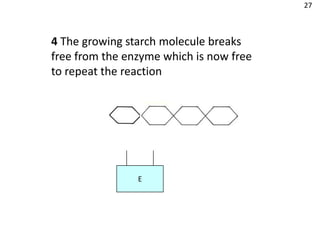
4 The growing starch molecule breaks
free from the enzyme which is now free
to repeat the reaction


                E
28
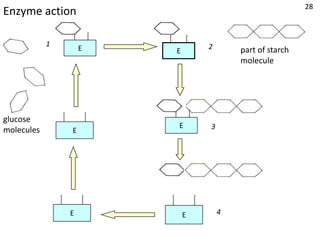
Enzyme action

            11                   2
                     E   E               part of starch
                                         molecule


glucose
                         E       3
molecules        E


                 E           E       4
Enzyme activity
How fast an enzyme is working
      Rate of Reaction
Enzyme activity
                     How fast an enzyme is working
                           Rate of Reaction

Rate of Reaction = Amount of substrate changed (or amount product formed)
                    in a given period of time.
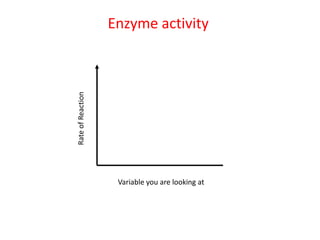
Enzyme activity


Rate of Reaction


                    Variable you are looking at
Enzyme activity


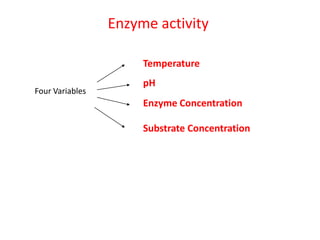
Four Variables
Enzyme activity

                      Temperature
                      pH
Four Variables
                      Enzyme Concentration

                      Substrate Concentration
Rate of Reaction
                   Temperature
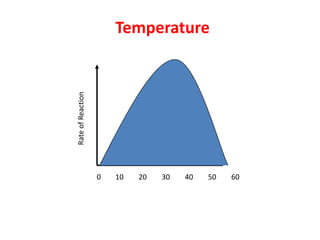
Temperature

Rate of Reaction


                   0   10   20   30   40   50   60
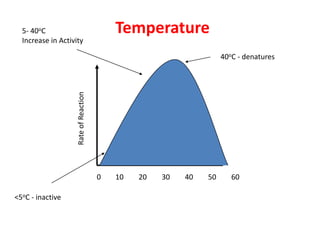
5- 40oC                                  Temperature
  Increase in Activity

                                                                    40oC - denatures


                    Rate of Reaction


                                       0   10   20   30   40   50      60

<5oC - inactive
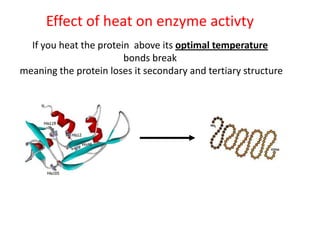
Effect of heat on enzyme activty
  If you heat the protein above its optimal temperature
                        bonds break
meaning the protein loses it secondary and tertiary structure
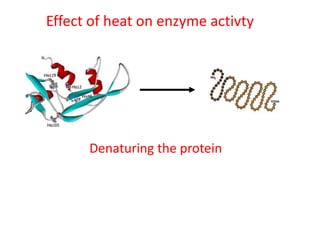
Effect of heat on enzyme activty


      Denaturing the protein
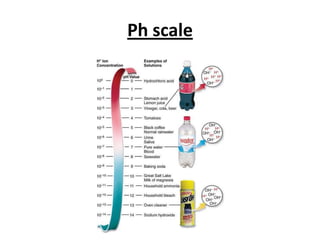
ph
• The ph scale measures how acidic or alkaline a
  substance is.
• The chemical properties of many solutions enable
  them to be divided into 3 categories:
 1) Neutral: solutions with a ph of 7.
 2) Alkaline: solutions with a ph greater than 7
 3) Acidic: solutions with a ph less than 7.
Ph scale
Rate of Reaction
                   pH
Rate of Reaction


1
2
3
4
5
                       pH


6
7
8
9
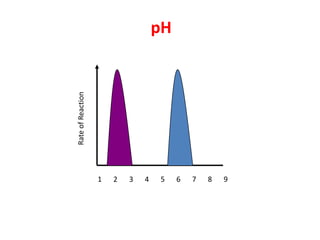
pH
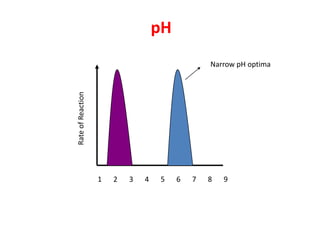
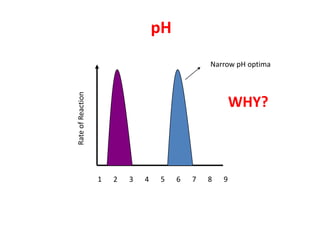
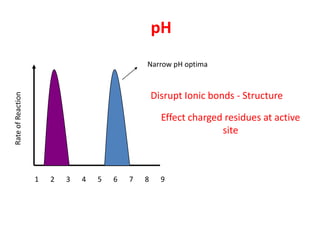
                                                Narrow pH optima

Rate of Reaction


                   1   2   3   4   5    6   7   8   9
pH
                                                Narrow pH optima

Rate of Reaction

                                                        WHY?


                   1   2   3   4   5    6   7   8   9
pH
                                               Narrow pH optima


                                                   Disrupt Ionic bonds - Structure
Rate of Reaction


                                                     Effect charged residues at active
                                                                   site


                   1   2   3   4   5   6   7   8     9
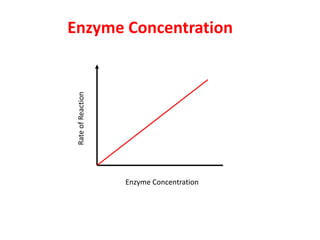
Enzyme Concentration

 Rate of Reaction
Enzyme Concentration

 Rate of Reaction


                    Enzyme Concentration
Substrate Concentration

  Rate of Reaction
Substrate Concentration

  Rate of Reaction


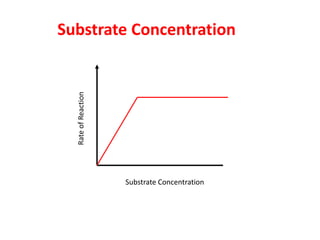
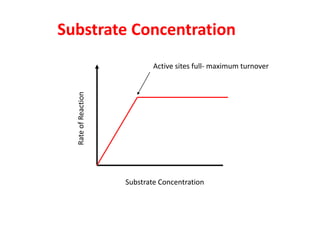
                     Substrate Concentration
Substrate Concentration
                             Active sites full- maximum turnover
  Rate of Reaction


                     Substrate Concentration
37


                             Question 1

Enzymes are


(a) proteins


(b) lipids


(c) carbohydrates


(d) a combination of these
38


                           Question 2

An enzyme can


(a) change a reaction


(b) prevent a reaction


(c) slow down a reaction


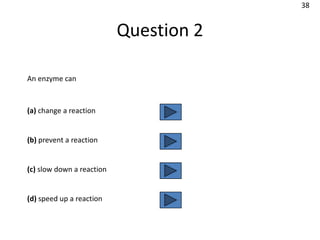
(d) speed up a reaction
39

                            Question 3

 A substrate is a substance which


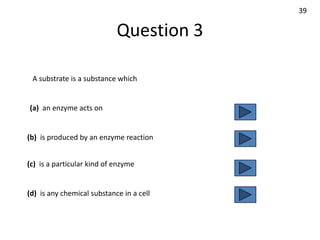
(a) an enzyme acts on


(b) is produced by an enzyme reaction


(c) is a particular kind of enzyme


(d) is any chemical substance in a cell
40


                             Question 4

 An enzyme can


(a) combine with different substrates


(b) form different kinds of end-product


(c) function at temperatures above 90oC


(d) speed up a reaction in the cytoplasm
41


                           Question 5

The part of an enzyme which combines with the substrate
is called


(a) the reaction centre


(b) the active site


(c) the action centre


(d) the reaction site
42


                             Question 6

After being exposed to a high temperature an enzyme
cannot function because


   (a) it has been broken down


   (b) its shape has been changed


   (c) its composition has been changed


   (d) it cannot separate from its substrate

Powerpoint enzymes

  • 1.
  • 2.
    10 Enzymes -Enzymes are proteins that function as biological catalysts -Catalyst: a substance that speeds up a chemical reaction and is not changed by the reaction. They are present in the cytoplasm of all cells There are hundreds of different enzymes but each enzyme speeds up only one kind of reaction. They are specific. For example, glucose and fructose might join up slowly to form sucrose glucose- -fructose With the right enzyme present, the reaction happens faster glucose- -fructose
  • 3.
    12 The substrate moleculesfit the shape of the enzyme enzyme substrate A substrate B
  • 4.
  • 5.
    14 substrates combine temporarilywith enzyme enzyme joins substrates together
  • 6.
    15 enzyme unchanged new compound released and ready for by enzyme next reaction
  • 7.
    16 Different types ofenzyme reaction The last 4 slides show how an enzyme is involved in combining substrates to create a larger molecule For example, the enzyme could be building up a sucrose molecule from glucose and fructose (anabolic reaction) The next sequence shows how an enzyme can help to break a large molecule into smaller molecules (catabolic reaction) For example an enzyme can split a sucrose molecule into the smaller glucose and fructose molecules
  • 8.
    17 A‘breaking-down’ reaction the shape of the substrate molecule fits the enzyme shape this is called the active site of the enzyme
  • 9.
    18 Intermediate stage (1) substrate combines temporarily with enzyme enzyme will break molecule here
  • 10.
    19 Intermediate stage (2) substrate splits and separates from enzyme
  • 11.
    20 Final break-down products enzyme ready for next reaction end-products
  • 12.
    21 Properties of enzymes -Enzymes can act on only one type of substrate (specific) -They always produce the same end products -Although they take part in the reaction, they are not used up -Because enzymes are proteins, they are denatured by heat or some chemicals Denaturing involves a change of shape in the enzyme molecule so that it cannot combine with the substrate Individual enzymes work best at a particular temperature and pH (acidity or alkalinity)
  • 13.
    22 Enzymes can acton only one type of substrate this substrate cannot combine with this enzyme this substrate cannot combine with this enzyme
  • 14.
    Because enzymes areproteins, they are denatured by 23 heat or some chemicals enzyme enzyme + denatured substrate by heat denatured enzyme cannot combine with substrate
  • 15.
    ENZYME ACTION 24 1 E 1. A glucose molecule combines with glucose the active site on an enzyme molecules
  • 16.
    ENZYME ACTION 24 1 E 1. A glucose molecule combines with glucose the active site on an enzyme molecules
  • 17.
    25 E 2 A region of the active site is still available
  • 18.
    26 3 One endof a growing starch molecule combines with the glucose molecule at the active part of starch site molecule E
  • 19.
    27 4 The growingstarch molecule breaks free from the enzyme which is now free to repeat the reaction E
  • 20.
    28 Enzyme action 11 2 E E part of starch molecule glucose E 3 molecules E E E 4
  • 21.
    Enzyme activity How fastan enzyme is working Rate of Reaction
  • 22.
    Enzyme activity How fast an enzyme is working Rate of Reaction Rate of Reaction = Amount of substrate changed (or amount product formed) in a given period of time.
  • 23.
    Enzyme activity Rate ofReaction Variable you are looking at
  • 24.
  • 25.
    Enzyme activity Temperature pH Four Variables Enzyme Concentration Substrate Concentration
  • 26.
    Rate of Reaction Temperature
  • 27.
    Temperature Rate of Reaction 0 10 20 30 40 50 60
  • 28.
    5- 40oC Temperature Increase in Activity 40oC - denatures Rate of Reaction 0 10 20 30 40 50 60 <5oC - inactive
  • 29.
    Effect of heaton enzyme activty If you heat the protein above its optimal temperature bonds break meaning the protein loses it secondary and tertiary structure
  • 30.
    Effect of heaton enzyme activty Denaturing the protein
  • 31.
    ph • The phscale measures how acidic or alkaline a substance is. • The chemical properties of many solutions enable them to be divided into 3 categories: 1) Neutral: solutions with a ph of 7. 2) Alkaline: solutions with a ph greater than 7 3) Acidic: solutions with a ph less than 7.
  • 32.
  • 33.
  • 34.
  • 35.
    pH Narrow pH optima Rate of Reaction 1 2 3 4 5 6 7 8 9
  • 36.
    pH Narrow pH optima Rate of Reaction WHY? 1 2 3 4 5 6 7 8 9
  • 37.
    pH Narrow pH optima Disrupt Ionic bonds - Structure Rate of Reaction Effect charged residues at active site 1 2 3 4 5 6 7 8 9
  • 38.
  • 39.
    Enzyme Concentration Rateof Reaction Enzyme Concentration
  • 40.
    Substrate Concentration Rate of Reaction
  • 41.
    Substrate Concentration Rate of Reaction Substrate Concentration
  • 42.
    Substrate Concentration Active sites full- maximum turnover Rate of Reaction Substrate Concentration
  • 43.
    37 Question 1 Enzymes are (a) proteins (b) lipids (c) carbohydrates (d) a combination of these
  • 44.
    38 Question 2 An enzyme can (a) change a reaction (b) prevent a reaction (c) slow down a reaction (d) speed up a reaction
  • 45.
    39 Question 3 A substrate is a substance which (a) an enzyme acts on (b) is produced by an enzyme reaction (c) is a particular kind of enzyme (d) is any chemical substance in a cell
  • 46.
    40 Question 4 An enzyme can (a) combine with different substrates (b) form different kinds of end-product (c) function at temperatures above 90oC (d) speed up a reaction in the cytoplasm
  • 47.
    41 Question 5 The part of an enzyme which combines with the substrate is called (a) the reaction centre (b) the active site (c) the action centre (d) the reaction site
  • 48.
    42 Question 6 After being exposed to a high temperature an enzyme cannot function because (a) it has been broken down (b) its shape has been changed (c) its composition has been changed (d) it cannot separate from its substrate