Enzyme Kinetics
Enzyme Kinetics
• Enzyme Kinetics – Quantitative measurement of the rates
of enzyme catalyzed reactions
&
• The systematic study of factors that affect these rates
• Enzyme kinetics began in 1902 when Adrina Brown
reported an investigation of the rate of hydrolysis of sucrose
as catalyzed by the yeast enzyme inveratase.
• Brown demonstrated – when sucrose concentration is
much higher than that of the enzyme, reaction rate
becomes independent of sucrose concentration
Enzyme Kinetics
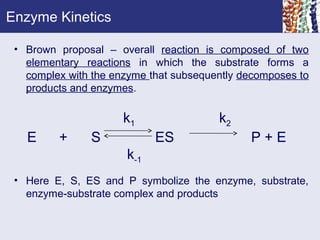
• Brown proposal – overall reaction is composed of two
elementary reactions in which the substrate forms a
complex with the enzyme that subsequently decomposes to
products and enzymes.
• Here E, S, ES and P symbolize the enzyme, substrate,
enzyme-substrate complex and products
k1 k2
E + S ES P + E
k-1
Enzyme Kinetics
• According to this model
• When the substrate concentration becomes high enough
to entirely convert the enzyme to the ES form, the
second step of the reaction becomes rate limiting step.
• The overall reaction rate becomes insensitive to further
increase in substrate concentration.
• The general expression of the velocity (rate) of this
reaction is
][
][
2
ESk
dt
Pd
v ==
Enzyme Kinetics
• The overall rate of production of [ES] – Difference between the
rates of elementary reactions leading to its appearance and
those resulting in its disappearance.
• At this point, an assumption is required to achieve an analytical
solution.
• The rapid equilibrium assumption
• Michaelis - Menten Approach.
• The steady-state assumption.
• Briggs and Haldane Approach.
][2][1]][[1
][
ESkESkSEk
dt
ESd
−−−=
EP
k
ES +→ 2
E+S
K-1
K1
Michaelis - Menten Approach
The rapid equilibrium assumption:
• Assumes a rapid equilibrium between the
enzyme and substrate to form an [ES] complex.
• The equilibrium constant Km can be expressed by
the following equation in a dilute system.
EP
k
ES +→ 2
E+S
K-1
K1
][1]][[1 ESkSEk −=
][
]][[
1
1
ES
SE
k
k
Km == −
Michaelis - Menten Approach
• Since the enzyme is not consumed, the
conservation equation on the enzyme yields
• Then rearrange the equilibrium constant
equation
• Substituting [E] in the above equation with
enzyme mass conservation equation
][]0[][ ESEE −=
][
]][[
1
1
ES
SE
k
k
Km == −
mK
SE
ES
]][[
][ ==
mK
SESE
ES
]])[[]([
][ 0 −
==
Michaelis - Menten Approach
mK
SESE
ES
]])[[]([
][ 0 −
==
]][[]][[][ 0 SESSEKES m −==
]][[]][[][ 0 SESESKES m ==+
]][[])[]([ 0 SESKES m ==+
][
]][[
][ 0
SK
SE
ES
m +
==
Michaelis - Menten Approach
• Then the rate of production formation v can
be expressed in terms of [S]
• Where
][
][
][
]][[
][
][ 02
2
SK
SV
SK
SEk
ESk
dt
Pd
v
mm +
=
+
=== max
][ 02
EkV =max
Steady State Assumption (SSA)
• Progress curve for the
components of a simple
michaelis-Menten
reaction
• Except the transition
phase of the reaction
(before shaded block)
[ES] remains constant
until the substrate is
nearly exhausted.
• Hence synthesis of ES
must equals to its
consumption over the
course of reaction i.e. ES
maintain steady state
•Now: Base on steady state assumption, d[ES]/dt = 0
•d[ES]/dt = k1[E][S] –k-1[ES] – k2[ES] = 0
(steady state assumption)
•solve for [ES] (do some algebra)
•[ES] = [E][S] k1/(k-1 + k2)
•Define KM (Michealis Constant)
•KM = (k-1 + k2)/k1 => [ES] = [E][S]/KM
SSA and Rate Equation
• Substitute in KM = [E][S]/[ES]][]0[][ ESEE −=
][
]])[[]([ 0
ES
SESE
Km
−
=
];])[[]([][ 0 SESEESKm −= ]][[]][[][ 0 SESSEKES m −==
]][[]][[][ 0 SESESKES m ==+
]][[])[]([ 0 SESKES m ==+
][
]][[
][ 0
SK
SE
ES
m +
==
SSA and Rate Equation
SSA lead to Michaelis - Menten
• Then the rate of production formation v can
be expressed in terms of [S]
• Where
• Michaelis Menten Equation
][
][
][
]][[
][
][ 02
2
SK
SV
SK
SEk
ESk
dt
Pd
v
mm +
=
+
=== max
][ 02
EkV =max
][
][
SK
SV
v
m +
= max
Michaelis Menten Equation
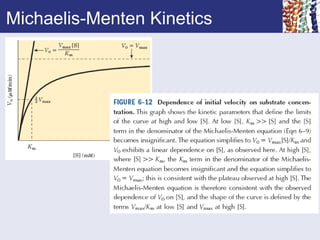
• Michaelis-Menten equation, the rate equation for
a one-substrate enzyme-catalyzed reaction.
• It is a statement of the quantitative relationship
between the initial velocity V0, the maximum velocity
Vmax, and the initial substrate concentration [S], all
related through the Michaelis constant Km.
Michaelis Menten Equation
• Numerical relationship emerges from the Michaelis-
Menten equation in the special case when V0 is
exactly one-half of Vmax
• On dividing by Vmax we obtained
• Solving for Km, we get Km + [S] = 2[S]
Km = [S] when
maxVv
2
1
0 =
Km
• KM is the substrate concentration required to reach
half-maximal velocity (vmax/2).
• KM is a measure
of a substrate’s
affinity for the
enzyme.
• A small KM
means the
substrate binds
tightly to the
enzyme and
saturates the
Vmax
• Considering the total enzyme concentration the
maximal rate, that the enzyme can attain is Vmax,.
• Vmax is equal to the product of the catalytic rate
constant (kcat) and the concentration of the enzyme.
• The Michaelis-Menten equation can then be
rewritten as V= Kcat [Enzyme] [S] / (Km + [S]).
• Kcat is equal to K2, and it measures the number of
substrate molecules "turned over" by enzyme per
second.
• The higher the Kcat is, the more substrates get
turned over in one second.
Michaelis-Menten Kinetics
Features of Michaelis-Menten
• Assumes the formation of Enzyme substrate
complex
• Assumes that the ES complex is in rapid equilibrium
with free enzyme
• Breakdown of ES to form products assumed to be
slower than
1. Formation of ES and
2. Breakdown of ES to reform E and S
][
][max
0
SK
SV
v
m +
=
Michaelis-Menten Kinetics
• KA is an equilibrium association constant (units: M-1
)
• KD is an equilibrium dissociation constant (units: M)
• Tight binding implies a low dissociation constant
and a high association constant
]][[
][
SE
ES
KA =
][
]][[
ES
SE
KD =
Transformations of the Michaelis-Menten
Equation: The Double-Reciprocal Plot
• The direct measurement of the numeric value of Vmax
and therefore the calculation of Km often requires
impractically high concentrations of substrate to
achieve saturating conditions
• The Michaelis-Menten equation
can be algebraically transformed
into equations that are more useful
in plotting experimental data.
][
][max
0
SK
SV
v
m +
=
Lineweaver-Burk Equation
• Starting with the MM equation
• Reciprocal of MM equation
• Lineweaver-Burk Equation
• Equation is the equation for a straight line, y = ax +
b, where y = 1/v0 and x = 1/[S].
][
][max
0
SK
SV
v
m +
=
maxmax0
1
][
1
VSV
K
v
m
+=
maxmax0
1
][
1
)(
1
VSV
K
v
m
+=
Lineweaver-Burk Equation
• A plot of 1/v0 as y as a function of 1/[S] as x therefore
gives a straight line whose y intercept is 1/Vmax and
whose slope is Km/Vmax.
• Such a plot is called a
double reciprocal or
Lineweaver-Burk plot
• Setting the y term of equation
equal to zero and solving for
x reveals that the x intercept
is −1/Km
Lineweaver-Burk Equation
• Lineweaver-Burk plot, has the great
advantage of allowing a more accurate
determination of Vmax, which can only be
approximated from a simple plot of V0 versus
[S]
• The double-reciprocal plot of enzyme reaction
rates is very useful in distinguishing between
certain types of enzymatic reaction
mechanisms.
Kinetics of Isosteric enzymes
• Isosteric enzymes
(with only one enzyme
conformation, 1), the
efficiency of
substrate binding
(dashed curve)
declines constantly
with increasing [A],
because the number
of free binding sites is
constantly decreasing.
Kinetics of allosteric enzymes
• Allosteric enzymes, the
binding efficiency initially
rises with increasing [A],
because the free enzyme
is present in a low-affinity
conformation (square
symbols), which is
gradually converted into a
higher-affinity form(round
symbols) as a result of
binding with A.
• It is only at high [A] values
that a lack of free binding
sites becomes noticeable
and the binding strength
decreases again.
Enzyme Kinetics - Factors
• The catalytic properties of enzymes, and
consequently their activity, are influenced by
numerous factors.
• These factors include
• Physical quantities (temperature, pressure),
• The chemical properties of the solution (pH value,
ionic strength),
• The concentrations of the relevant substrates,
cofactors, and inhibitors.
pH Dependency of Enzyme Activity
• Effect of enzymes is strongly dependent on the pH
• Activity is plotted against pH, a bell-shaped curve is
usually obtained
• Bell shape of the activity–pH profile results from the
fact that amino acid residues with ionizable groups in
the side chain are essential for catalysis.
pH Dependency of Enzyme Activity
• a basic group B (pKa = 8),
which has to be protonated
in order to become active.
• a second acidic amino acid
AH (pKa = 6), which is only
active in a dissociated state.
• At the optimum pH of 7,
around 90% of both groups
are present in the active form
• at higher and lower values,
one or the other of the
groups increasingly passes
into the inactive state.
Temperature Dependency of Enzyme
Activity
• The temperature
dependency of enzymatic
activity is usually
asymmetric.
• With increasing temperature,
the increased thermal
movement of the molecules
initially leads to a rate
acceleration
• At a certain temperature, the
enzyme then becomes
unstable, and its activity is
lost within a narrow
temperature difference as a
result of denaturation
Bisubstrate Kinetics
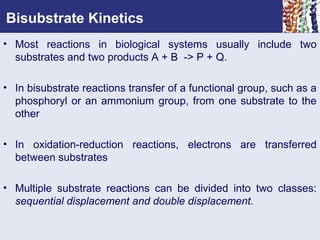
• Most reactions in biological systems usually include two
substrates and two products A + B -> P + Q.
• In bisubstrate reactions transfer of a functional group, such as a
phosphoryl or an ammonium group, from one substrate to the
other
• In oxidation-reduction reactions, electrons are transferred
between substrates
• Multiple substrate reactions can be divided into two classes:
sequential displacement and double displacement.
Bisubstrate Kinetics
Sequential Displacement
• In the sequential mechanism, all substrates must bind to the
enzyme before any product is released.
• Sequential mechanisms are of two types: ordered, in which the
substrates bind the enzyme in a defined sequence, and
random.
• Many enzymes that have NAD+ or NADH as a substrate exhibit
the sequential ordered mechanism
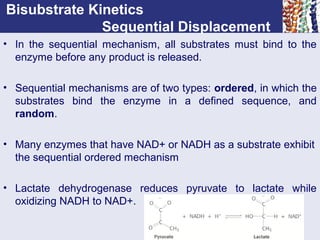
• Lactate dehydrogenase reduces pyruvate to lactate while
oxidizing NADH to NAD+.
Bisubstrate Kinetics
Sequential Displacement
• In the ordered sequential mechanism, the coenzyme always
binds first and the lactate is always released first.
Bisubstrate Kinetics
Sequential Displacement
• Random sequential mechanism, the order of addition of
substrates and release of products is random.
• E.g. formation of phosphocreatine and ADP from ATP and
creatine, a reaction catalyzed by creatine kinase
• Sequential random reactions can also be depicted in the
notation.
Bisubstrate Kinetics – Ping-Pong
• In double-displacement, or
Ping-Pong, reactions, one or
more products are released
before all substrates bind the
enzyme.
• Mechanisms in which the
first substrate A is bound and
immediately cleaved.
• A part of this substrate
remains bound to the
enzyme, and is then
transferred to the second
substrate B after the first
product C has been
released. – Ping-Pong
Bisubstrate Kinetics – Ping-Pong
• The enzyme aspartate aminotransferase catalyzes the transfer
of an amino group from aspartate to a-ketoglutarate.
• After aspartate binds to the enzyme, the enzyme removes aspartate's
amino group to form the substituted enzyme intermediate.
• The first product, oxaloacetate, subsequently departs.
• The second substrate, a-ketoglutarate, binds to the enzyme, accepts the
amino group from the modified enzyme, and is then released as the final
product, glutamate.

Enzyme kinetics

  • 1.
  • 2.
    Enzyme Kinetics • EnzymeKinetics – Quantitative measurement of the rates of enzyme catalyzed reactions & • The systematic study of factors that affect these rates • Enzyme kinetics began in 1902 when Adrina Brown reported an investigation of the rate of hydrolysis of sucrose as catalyzed by the yeast enzyme inveratase. • Brown demonstrated – when sucrose concentration is much higher than that of the enzyme, reaction rate becomes independent of sucrose concentration
  • 3.
    Enzyme Kinetics • Brownproposal – overall reaction is composed of two elementary reactions in which the substrate forms a complex with the enzyme that subsequently decomposes to products and enzymes. • Here E, S, ES and P symbolize the enzyme, substrate, enzyme-substrate complex and products k1 k2 E + S ES P + E k-1
  • 4.
    Enzyme Kinetics • Accordingto this model • When the substrate concentration becomes high enough to entirely convert the enzyme to the ES form, the second step of the reaction becomes rate limiting step. • The overall reaction rate becomes insensitive to further increase in substrate concentration. • The general expression of the velocity (rate) of this reaction is ][ ][ 2 ESk dt Pd v ==
  • 5.
    Enzyme Kinetics • Theoverall rate of production of [ES] – Difference between the rates of elementary reactions leading to its appearance and those resulting in its disappearance. • At this point, an assumption is required to achieve an analytical solution. • The rapid equilibrium assumption • Michaelis - Menten Approach. • The steady-state assumption. • Briggs and Haldane Approach. ][2][1]][[1 ][ ESkESkSEk dt ESd −−−= EP k ES +→ 2 E+S K-1 K1
  • 6.
    Michaelis - MentenApproach The rapid equilibrium assumption: • Assumes a rapid equilibrium between the enzyme and substrate to form an [ES] complex. • The equilibrium constant Km can be expressed by the following equation in a dilute system. EP k ES +→ 2 E+S K-1 K1 ][1]][[1 ESkSEk −= ][ ]][[ 1 1 ES SE k k Km == −
  • 7.
    Michaelis - MentenApproach • Since the enzyme is not consumed, the conservation equation on the enzyme yields • Then rearrange the equilibrium constant equation • Substituting [E] in the above equation with enzyme mass conservation equation ][]0[][ ESEE −= ][ ]][[ 1 1 ES SE k k Km == − mK SE ES ]][[ ][ == mK SESE ES ]])[[]([ ][ 0 − ==
  • 8.
    Michaelis - MentenApproach mK SESE ES ]])[[]([ ][ 0 − == ]][[]][[][ 0 SESSEKES m −== ]][[]][[][ 0 SESESKES m ==+ ]][[])[]([ 0 SESKES m ==+ ][ ]][[ ][ 0 SK SE ES m + ==
  • 9.
    Michaelis - MentenApproach • Then the rate of production formation v can be expressed in terms of [S] • Where ][ ][ ][ ]][[ ][ ][ 02 2 SK SV SK SEk ESk dt Pd v mm + = + === max ][ 02 EkV =max
  • 10.
    Steady State Assumption(SSA) • Progress curve for the components of a simple michaelis-Menten reaction • Except the transition phase of the reaction (before shaded block) [ES] remains constant until the substrate is nearly exhausted. • Hence synthesis of ES must equals to its consumption over the course of reaction i.e. ES maintain steady state
  • 11.
    •Now: Base onsteady state assumption, d[ES]/dt = 0 •d[ES]/dt = k1[E][S] –k-1[ES] – k2[ES] = 0 (steady state assumption) •solve for [ES] (do some algebra) •[ES] = [E][S] k1/(k-1 + k2) •Define KM (Michealis Constant) •KM = (k-1 + k2)/k1 => [ES] = [E][S]/KM SSA and Rate Equation
  • 12.
    • Substitute inKM = [E][S]/[ES]][]0[][ ESEE −= ][ ]])[[]([ 0 ES SESE Km − = ];])[[]([][ 0 SESEESKm −= ]][[]][[][ 0 SESSEKES m −== ]][[]][[][ 0 SESESKES m ==+ ]][[])[]([ 0 SESKES m ==+ ][ ]][[ ][ 0 SK SE ES m + == SSA and Rate Equation
  • 13.
    SSA lead toMichaelis - Menten • Then the rate of production formation v can be expressed in terms of [S] • Where • Michaelis Menten Equation ][ ][ ][ ]][[ ][ ][ 02 2 SK SV SK SEk ESk dt Pd v mm + = + === max ][ 02 EkV =max ][ ][ SK SV v m + = max
  • 14.
    Michaelis Menten Equation •Michaelis-Menten equation, the rate equation for a one-substrate enzyme-catalyzed reaction. • It is a statement of the quantitative relationship between the initial velocity V0, the maximum velocity Vmax, and the initial substrate concentration [S], all related through the Michaelis constant Km.
  • 15.
    Michaelis Menten Equation •Numerical relationship emerges from the Michaelis- Menten equation in the special case when V0 is exactly one-half of Vmax • On dividing by Vmax we obtained • Solving for Km, we get Km + [S] = 2[S] Km = [S] when maxVv 2 1 0 =
  • 16.
    Km • KM isthe substrate concentration required to reach half-maximal velocity (vmax/2). • KM is a measure of a substrate’s affinity for the enzyme. • A small KM means the substrate binds tightly to the enzyme and saturates the
  • 17.
    Vmax • Considering thetotal enzyme concentration the maximal rate, that the enzyme can attain is Vmax,. • Vmax is equal to the product of the catalytic rate constant (kcat) and the concentration of the enzyme. • The Michaelis-Menten equation can then be rewritten as V= Kcat [Enzyme] [S] / (Km + [S]). • Kcat is equal to K2, and it measures the number of substrate molecules "turned over" by enzyme per second. • The higher the Kcat is, the more substrates get turned over in one second.
  • 18.
  • 19.
    Features of Michaelis-Menten •Assumes the formation of Enzyme substrate complex • Assumes that the ES complex is in rapid equilibrium with free enzyme • Breakdown of ES to form products assumed to be slower than 1. Formation of ES and 2. Breakdown of ES to reform E and S ][ ][max 0 SK SV v m + =
  • 20.
    Michaelis-Menten Kinetics • KAis an equilibrium association constant (units: M-1 ) • KD is an equilibrium dissociation constant (units: M) • Tight binding implies a low dissociation constant and a high association constant ]][[ ][ SE ES KA = ][ ]][[ ES SE KD =
  • 21.
    Transformations of theMichaelis-Menten Equation: The Double-Reciprocal Plot • The direct measurement of the numeric value of Vmax and therefore the calculation of Km often requires impractically high concentrations of substrate to achieve saturating conditions • The Michaelis-Menten equation can be algebraically transformed into equations that are more useful in plotting experimental data. ][ ][max 0 SK SV v m + =
  • 22.
    Lineweaver-Burk Equation • Startingwith the MM equation • Reciprocal of MM equation • Lineweaver-Burk Equation • Equation is the equation for a straight line, y = ax + b, where y = 1/v0 and x = 1/[S]. ][ ][max 0 SK SV v m + = maxmax0 1 ][ 1 VSV K v m += maxmax0 1 ][ 1 )( 1 VSV K v m +=
  • 23.
    Lineweaver-Burk Equation • Aplot of 1/v0 as y as a function of 1/[S] as x therefore gives a straight line whose y intercept is 1/Vmax and whose slope is Km/Vmax. • Such a plot is called a double reciprocal or Lineweaver-Burk plot • Setting the y term of equation equal to zero and solving for x reveals that the x intercept is −1/Km
  • 24.
    Lineweaver-Burk Equation • Lineweaver-Burkplot, has the great advantage of allowing a more accurate determination of Vmax, which can only be approximated from a simple plot of V0 versus [S] • The double-reciprocal plot of enzyme reaction rates is very useful in distinguishing between certain types of enzymatic reaction mechanisms.
  • 25.
    Kinetics of Isostericenzymes • Isosteric enzymes (with only one enzyme conformation, 1), the efficiency of substrate binding (dashed curve) declines constantly with increasing [A], because the number of free binding sites is constantly decreasing.
  • 26.
    Kinetics of allostericenzymes • Allosteric enzymes, the binding efficiency initially rises with increasing [A], because the free enzyme is present in a low-affinity conformation (square symbols), which is gradually converted into a higher-affinity form(round symbols) as a result of binding with A. • It is only at high [A] values that a lack of free binding sites becomes noticeable and the binding strength decreases again.
  • 27.
    Enzyme Kinetics -Factors • The catalytic properties of enzymes, and consequently their activity, are influenced by numerous factors. • These factors include • Physical quantities (temperature, pressure), • The chemical properties of the solution (pH value, ionic strength), • The concentrations of the relevant substrates, cofactors, and inhibitors.
  • 28.
    pH Dependency ofEnzyme Activity • Effect of enzymes is strongly dependent on the pH • Activity is plotted against pH, a bell-shaped curve is usually obtained • Bell shape of the activity–pH profile results from the fact that amino acid residues with ionizable groups in the side chain are essential for catalysis.
  • 29.
    pH Dependency ofEnzyme Activity • a basic group B (pKa = 8), which has to be protonated in order to become active. • a second acidic amino acid AH (pKa = 6), which is only active in a dissociated state. • At the optimum pH of 7, around 90% of both groups are present in the active form • at higher and lower values, one or the other of the groups increasingly passes into the inactive state.
  • 30.
    Temperature Dependency ofEnzyme Activity • The temperature dependency of enzymatic activity is usually asymmetric. • With increasing temperature, the increased thermal movement of the molecules initially leads to a rate acceleration • At a certain temperature, the enzyme then becomes unstable, and its activity is lost within a narrow temperature difference as a result of denaturation
  • 31.
    Bisubstrate Kinetics • Mostreactions in biological systems usually include two substrates and two products A + B -> P + Q. • In bisubstrate reactions transfer of a functional group, such as a phosphoryl or an ammonium group, from one substrate to the other • In oxidation-reduction reactions, electrons are transferred between substrates • Multiple substrate reactions can be divided into two classes: sequential displacement and double displacement.
  • 32.
    Bisubstrate Kinetics Sequential Displacement •In the sequential mechanism, all substrates must bind to the enzyme before any product is released. • Sequential mechanisms are of two types: ordered, in which the substrates bind the enzyme in a defined sequence, and random. • Many enzymes that have NAD+ or NADH as a substrate exhibit the sequential ordered mechanism • Lactate dehydrogenase reduces pyruvate to lactate while oxidizing NADH to NAD+.
  • 33.
    Bisubstrate Kinetics Sequential Displacement •In the ordered sequential mechanism, the coenzyme always binds first and the lactate is always released first.
  • 34.
    Bisubstrate Kinetics Sequential Displacement •Random sequential mechanism, the order of addition of substrates and release of products is random. • E.g. formation of phosphocreatine and ADP from ATP and creatine, a reaction catalyzed by creatine kinase • Sequential random reactions can also be depicted in the notation.
  • 35.
    Bisubstrate Kinetics –Ping-Pong • In double-displacement, or Ping-Pong, reactions, one or more products are released before all substrates bind the enzyme. • Mechanisms in which the first substrate A is bound and immediately cleaved. • A part of this substrate remains bound to the enzyme, and is then transferred to the second substrate B after the first product C has been released. – Ping-Pong
  • 36.
    Bisubstrate Kinetics –Ping-Pong • The enzyme aspartate aminotransferase catalyzes the transfer of an amino group from aspartate to a-ketoglutarate. • After aspartate binds to the enzyme, the enzyme removes aspartate's amino group to form the substituted enzyme intermediate. • The first product, oxaloacetate, subsequently departs. • The second substrate, a-ketoglutarate, binds to the enzyme, accepts the amino group from the modified enzyme, and is then released as the final product, glutamate.