ENZYMES- KINETICS
DR. MANOJ ACHARYA
JUNIOR RESIDENT (1st YEAR)
DEPARTMENT OF BIOCHEMISTRY
BPKIHS
OBJECTIVES
• Introduction
• Models for enzyme kinetics
• - To know about Michaelis-Menten kinetics
• - To know about Lineweaver Burk plot
• To know about types enzyme inhibitors and its kinetics
INTRODUCTION
● Several approaches to study the mechanism of
action of purified enzymes.
● Is the study of the rates of enzyme-catalyzed
reactions.
● A kinetic description of enzyme activity which helps
to understand how enzymes function.
● Function of Enzyme - to increase the rate of a
reaction by lowering activation energy but do not
affect reaction equilibria.
TERMINOLOGIES
● In its normal state form any molecule (such as S or P) contains
a characteristic amount of energy called free energy (G).
● Free-energy difference between products and reactants is
denoted by ΔG. For spontaneous reaction, ΔG should be
negative.
● The free energy change for the reaction under standard
conditions (i.e. temperature 298 K, partial pressure of each gas
1 atm and concentration of each solute 1 M) is standard free
energy change (ΔGᵒ).
 The standard free-energy change at pH 7.0 is the
biochemical standard free-energy change (ΔG΄ᵒ).
 The difference between the energy levels of the
ground state and the transition state is the activation
energy (ΔG‡).
Substrate concentration and rate of
enzyme catalyzed reaction
● A key factor affecting the rate of a reaction
catalyzed by an enzyme is [S].
● One simplifying approach in kinetics experiments is
to measure the initial rate (Vₒ), when [S] > [E].
● In the beginning of reaction, changes in [S] can be
limited to a few percent and [S] can be regarded as
constant.
 At relatively low
concentrations of substrate,
Vₒ increases almost linearly
with an increase in [S].
 At higher substrate
concentrations, Vₒ increases
by smaller and smaller
amounts in response to
increases in [S].
 Finally, a point is reached
beyond which increases in
Vₒ are vanishingly small as
[S] increases.
 This plateau-like Vₒ region
is close to the maximum
velocity, Vmax.
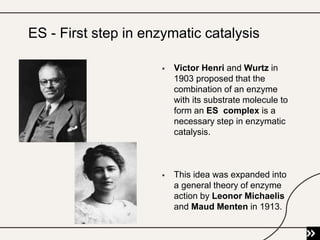
 Victor Henri and Wurtz in
1903 proposed that the
combination of an enzyme
with its substrate molecule to
form an ES complex is a
necessary step in enzymatic
catalysis.
 This idea was expanded into
a general theory of enzyme
action by Leonor Michaelis
and Maud Menten in 1913.
ES - First step in enzymatic catalysis
 They postulated that the enzyme first combines
reversibly with its substrate to form an enzyme-
substrate complex in a relatively fast reversible step.
 The ES complex then breaks down in a slower
second step to yield the free enzyme and the
reaction product P.
This is the rate limiting step.
 At any given instant in an enzyme-catalyzed
reaction, the enzyme exists in two forms:
o Free or uncombined form E
o Combined form ES
 At low [S], enzymes are in uncombined form.
 Vmax is observed when virtually all the enzyme is
present as the ES complex and [E] is vanishingly
small.
Michaelis- Menten equation
 Michaelis and Menten derived this equation starting
from their basic hypothesis that the rate limiting step
in enzymatic reactions is the breakdown of the ES
complex to product and free enzyme.
 The equation:
Where, Vₒ = Initial velocity
Vmax= Maximal velocity
[S]= Substrate concentration
Km= Michaelis constant
 The derivation starts with two basic steps of the
formation and breakdown of ES.
 Vₒ is determined by the breakdown of ES to form
product, which is determined by [ES]
Step 1
Step 2
- At steady state
Step 3
 First, the left side is multiplied out and the right side
simplified to give:
 Adding the term k1[ES][S] to both sides of the
equation and simplifying gives:
 This can now be simplified further, combining the
rate constants into one expression:
 The term (k2+k-1)/k1 is defined as the Michaelis
constant, Km.
 Substituting this into above equation:
Step 4
 We can now express Vₒ in terms of [ES].
 Maximum velocity occurs when the enzyme is
saturated (with [ES]=[Et]). Vmax can be defined as
k2[Et].
 This is the Michaelis- Menten equation, the rate
equation for a one-substrate enzyme-catalyzed
reaction.
 When Vₒ is exactly one-half Vmax :
 On dividing by Vmax :
 Km can vary greatly from enzyme to enzyme and
even for different substrates of the same enzyme.
 For most enzymes, Km value lies between 10-1 and
10-7 M.
 The Michaelis constant Km has two meanings:
1) Km is concentration of substrate at which half of
active sites are filled.
2) Km is related to rate constant of individual step in
catalytic scheme.
 We know Km= (k2+k-1)/k1.
 Consider a limiting case in which k-1 is much
greater than k2.
 This mean dissociation of ES complex is rapid than
formation of E and P.
 Then Km will be Km = k-1/k1. This is called
dissociation constant.
 Km is equal to the dissociation constant of the ES
complex if k2 is much smaller than k-1.
 When this condition is met, Km is a measure of the
strength of the ES complex.
 A high Km indicates weak binding; a low Km
indicates strong binding
Interpretation of Michaelis - Menten Kinetics:
1. When Km = [S], the equation
reduces to:
2. When Km >> [S], the equation
reduces to:
3. When Km << [S], the equation
reduces to:
Catalytic constants
1) Turnover number:
 Number of substrate molecules converted to
product by an enzyme molecule in a unit time when
the enzyme is fully saturated with substrate.
 It is equal to kinetic constant k2.
 Vmax / moles of enzyme present.
2) Catalytic constant (Kcat ):
● At saturating [S], maximum rate, Vmax = kcat [Et]
- where kcat is the rate constant for ES E+P in
these conditions (only process occurring since enzyme
is saturated)
- and [Et] is the total enzyme concentration (i.e.
number of active sites)
Kcat is termed as the catalytic constant or turnover
number.
Catalytic efficiency (kcat/Km)
The Double- Reciprocal Plot (Lineweaver- Burk
Equation)
 The equation for a hyperbola can be transformed
into the equation for a straight line by taking the
reciprocal of each side.
 The Michaelis- Menten equation:
 Taking the reciprocal of both sides:
 Separating the components of the numerator on the
right side of the equation gives:
 Which simplifies to:
 This form of the Michaelis- Menten equation is
called the Lineweaver-Burk equation.
 It is useful in distinguishing between different enzyme
mechanisms, analyzing enzyme inhibitions and accurate
determination of Vmax.
Eadie- Hofstee transform
 This is used to avoid the bunching of
values that occurs about the lower
end of the double- reciprocal plot.
 The Eadie- Hofstee transform can be
written as:
 This shows the straight line graph
obtained by plotting V against V/[S],
where-
y intercept = Vmax, x intercept = Vmax /[S]
and slope = –Km.
Enzyme- catalyzed reactions with two or
more substrates
 The order of substrate addition and product release
in most enzymatic reactions follow two reaction
mechanisms:
1) Sequential or Single- Displacement Reactions
 Both substrates must combine with the enzyme to
form a ternary complex before catalysis can
proceed.
 Based on the addition of substrate:
a) Random order
b) Compulsory order
2) Ping- Pong Reactions
 One or more products are released from the
enzyme before all the substrates have been added.
 Covalent catalysis and a transient, modified form of
the enzyme.
 Double displacement reactions.
Factors affecting enzyme action
 Temperature
 Hydrogen ion concentration (pH)
 Enzyme concentration
 Substrate concentration
 Presence of activators
 Product concentration
Effect of Temperature:
● Each enzyme is most active at a specific temperature
which is called its optimum temperature.
● Increase with temperature
● Bell shape curve
● Q10 (temperature coefficient)- factor by which the rate
of biological reaction increases for a 10ºC increase in
temperature
● Effect of pH
 The enzymatic activity is maximum at a particular
pH which is called its optimum pH.
● Bell shape curve.
Optimum temperature.
● Trypsin- 7.6
● Pepsin- 2-2.5
● Acid phosphatase- 5
● Alkaline phosphatase- 9-10
● Enzymes from fungi- 4-6
Effects of enzyme concentration
As the enzyme concentration increases the rate of
reaction increases.
● Effect of substrate concentration
For a given enzyme concentration, the value of
enzyme reaction increases with increasing substrate
concentration. But at higher concentration enzymes
molecules become saturated, so adding more
substrate doesn’t make difference.
Presence of activators
 In presence of certain inorganic ions, some
enzymes show higher activity. Thus, chloride ions
activate salivary amylase and calcium ions activate
lipase.
Products concentration
 Products formed as a result of enzymatic reaction
may accumulate and this excess of product may
lower the enzymatic reaction by occupying the
active site of the enzyme.
 High concentration of products reverse a reaction,
may favor forming back the substrate.
Enzyme inhibition
 Any substance that can diminish the velocity of an
enzyme-catalyzed reaction is called an inhibitor.
 There are two types of inhibition:
1. Reversible inhibition
2. Irreversible inhibition
Reversible inhibition
 Reversible inhibitors typically bind to enzymes
through noncovalent bonds, thus dilution of the
enzyme inhibitor complex results in dissociation of
the reversibly bound inhibitor and recovery of
enzyme activity.
 Divided into three types:
o Competitive inhibition
o Uncompetitive inhibition
o Noncompetitive inhibition
Competitive inhibition
 A competitive inhibitor competes with the substrate
for the active site of an enzyme.
 While the inhibitor (I) occupies the active site it
prevents binding of the substrate to the enzyme.
Uncompetitive inhibition
● An uncompetitive inhibitor binds at a site distinct from
the substrate active site and unlike a competitive
inhibitor, binds only to the ES complex.
Noncompetitive inhibition
 Inhibitor and substrate can bind simultaneously to
an enzyme molecule at different binding site.
 Unlike uncompetitive inhibition, a noncompetitive
inhibitor can bind free enzyme or the enzyme
substrate complex.
Irreversible inhibition
 Bind covalently with or destroy a functional group on
an enzyme and inactivate them, which is
irreversible.
 Cannot be treated by Michaelis- Menten principle.
 A variety of poisons, such as iodoacetate, heavy
metal ions (lead, mercury) and oxidising agents act
as irreversible inhibitors.
Suicide Inhibition
 Special class of irreversible inhibition.
 The inhibitor binds to the active site where it is modified by the
enzyme to produce a reactive group that reacts irreversibly to
form a stable inhibitor-enzyme complex.
 So enzymes itself converts inhibitor into a powerful inhibitor.
 Used in "rational drug design"  create a novel substrate,
based on already known mechanisms and substrates.
 Main goal of this approach is to create substrates that are
unreactive until within that enzyme's active site and at the
same time being highly specific.
Clinical examples of suicide inhibitors
 Disulfiram inhibits the acetaldehyde dehydrogenase enzyme.
 Aspirin inhibits cyclooxygenase 1 and 2 enzymes.
 Penicillin inhibits transpeptidase from building bacterial cell
walls.
 Zidovudine used to inhibit reverse transcriptase.
 5-fluorouracil acts as a suicide inhibitor of thymidylate
synthase during synthesis of thymine from uridine.
 Allopurinol inhibits xanthine oxidase, gets converted to
alloxanthine, more effective inhibitor.
Hill equation
 The Hill–Langmuir equation was originally
formulated by Archibald Hill in 1910 to describe the
sigmoidal O2 binding curve of haemoglobin, to
describe the cooperative binding of oxygen by
hemoglobin.
 The equation is arranged in a form that predicts a
straight line, where k′ is a complex constant.
 When [S] is low relative to k′, the initial reaction
velocity increases as the nth power of [S].
 A graph of log vi /(Vmax −vi) versus log [S] gives a straight line
where the slope of the line n is the Hill coefficient.
 When n= 1, all binding sites behave independently and simple
Michaelis-Menten kinetic behavior is observed.
 If n>1, the enzyme is said to exhibit positive cooperativity.
● The greater the value for n, the higher the degree of
cooperativity and the more sigmoidal will be the plot
of vi versus [S].
REFERENCES
Lehninger Principles of Biochemistry 6th edition
Lippincotts Illustrared Reviews 5th edition
Harper's Illustrated Biochemistry 31st edition
U. Satyanarayana Biochemistry 4th edition
enzme kinetics.pptx

enzme kinetics.pptx

  • 1.
    ENZYMES- KINETICS DR. MANOJACHARYA JUNIOR RESIDENT (1st YEAR) DEPARTMENT OF BIOCHEMISTRY BPKIHS
  • 2.
    OBJECTIVES • Introduction • Modelsfor enzyme kinetics • - To know about Michaelis-Menten kinetics • - To know about Lineweaver Burk plot • To know about types enzyme inhibitors and its kinetics
  • 3.
    INTRODUCTION ● Several approachesto study the mechanism of action of purified enzymes. ● Is the study of the rates of enzyme-catalyzed reactions. ● A kinetic description of enzyme activity which helps to understand how enzymes function. ● Function of Enzyme - to increase the rate of a reaction by lowering activation energy but do not affect reaction equilibria.
  • 4.
    TERMINOLOGIES ● In itsnormal state form any molecule (such as S or P) contains a characteristic amount of energy called free energy (G). ● Free-energy difference between products and reactants is denoted by ΔG. For spontaneous reaction, ΔG should be negative. ● The free energy change for the reaction under standard conditions (i.e. temperature 298 K, partial pressure of each gas 1 atm and concentration of each solute 1 M) is standard free energy change (ΔGᵒ).
  • 5.
     The standardfree-energy change at pH 7.0 is the biochemical standard free-energy change (ΔG΄ᵒ).  The difference between the energy levels of the ground state and the transition state is the activation energy (ΔG‡).
  • 6.
    Substrate concentration andrate of enzyme catalyzed reaction ● A key factor affecting the rate of a reaction catalyzed by an enzyme is [S]. ● One simplifying approach in kinetics experiments is to measure the initial rate (Vₒ), when [S] > [E]. ● In the beginning of reaction, changes in [S] can be limited to a few percent and [S] can be regarded as constant.
  • 7.
     At relativelylow concentrations of substrate, Vₒ increases almost linearly with an increase in [S].  At higher substrate concentrations, Vₒ increases by smaller and smaller amounts in response to increases in [S].  Finally, a point is reached beyond which increases in Vₒ are vanishingly small as [S] increases.  This plateau-like Vₒ region is close to the maximum velocity, Vmax.
  • 8.
     Victor Henriand Wurtz in 1903 proposed that the combination of an enzyme with its substrate molecule to form an ES complex is a necessary step in enzymatic catalysis.  This idea was expanded into a general theory of enzyme action by Leonor Michaelis and Maud Menten in 1913. ES - First step in enzymatic catalysis
  • 9.
     They postulatedthat the enzyme first combines reversibly with its substrate to form an enzyme- substrate complex in a relatively fast reversible step.  The ES complex then breaks down in a slower second step to yield the free enzyme and the reaction product P. This is the rate limiting step.
  • 10.
     At anygiven instant in an enzyme-catalyzed reaction, the enzyme exists in two forms: o Free or uncombined form E o Combined form ES  At low [S], enzymes are in uncombined form.  Vmax is observed when virtually all the enzyme is present as the ES complex and [E] is vanishingly small.
  • 11.
    Michaelis- Menten equation Michaelis and Menten derived this equation starting from their basic hypothesis that the rate limiting step in enzymatic reactions is the breakdown of the ES complex to product and free enzyme.  The equation: Where, Vₒ = Initial velocity Vmax= Maximal velocity [S]= Substrate concentration Km= Michaelis constant
  • 12.
     The derivationstarts with two basic steps of the formation and breakdown of ES.  Vₒ is determined by the breakdown of ES to form product, which is determined by [ES]
  • 13.
    Step 1 Step 2 -At steady state
  • 14.
    Step 3  First,the left side is multiplied out and the right side simplified to give:  Adding the term k1[ES][S] to both sides of the equation and simplifying gives:
  • 15.
     This cannow be simplified further, combining the rate constants into one expression:  The term (k2+k-1)/k1 is defined as the Michaelis constant, Km.  Substituting this into above equation:
  • 16.
    Step 4  Wecan now express Vₒ in terms of [ES].  Maximum velocity occurs when the enzyme is saturated (with [ES]=[Et]). Vmax can be defined as k2[Et].
  • 17.
     This isthe Michaelis- Menten equation, the rate equation for a one-substrate enzyme-catalyzed reaction.  When Vₒ is exactly one-half Vmax :  On dividing by Vmax :
  • 18.
     Km canvary greatly from enzyme to enzyme and even for different substrates of the same enzyme.  For most enzymes, Km value lies between 10-1 and 10-7 M.
  • 19.
     The Michaelisconstant Km has two meanings: 1) Km is concentration of substrate at which half of active sites are filled. 2) Km is related to rate constant of individual step in catalytic scheme.  We know Km= (k2+k-1)/k1.  Consider a limiting case in which k-1 is much greater than k2.
  • 20.
     This meandissociation of ES complex is rapid than formation of E and P.  Then Km will be Km = k-1/k1. This is called dissociation constant.  Km is equal to the dissociation constant of the ES complex if k2 is much smaller than k-1.  When this condition is met, Km is a measure of the strength of the ES complex.  A high Km indicates weak binding; a low Km indicates strong binding
  • 21.
    Interpretation of Michaelis- Menten Kinetics: 1. When Km = [S], the equation reduces to: 2. When Km >> [S], the equation reduces to: 3. When Km << [S], the equation reduces to:
  • 22.
    Catalytic constants 1) Turnovernumber:  Number of substrate molecules converted to product by an enzyme molecule in a unit time when the enzyme is fully saturated with substrate.  It is equal to kinetic constant k2.  Vmax / moles of enzyme present.
  • 23.
    2) Catalytic constant(Kcat ): ● At saturating [S], maximum rate, Vmax = kcat [Et] - where kcat is the rate constant for ES E+P in these conditions (only process occurring since enzyme is saturated) - and [Et] is the total enzyme concentration (i.e. number of active sites) Kcat is termed as the catalytic constant or turnover number.
  • 24.
  • 26.
    The Double- ReciprocalPlot (Lineweaver- Burk Equation)  The equation for a hyperbola can be transformed into the equation for a straight line by taking the reciprocal of each side.  The Michaelis- Menten equation:  Taking the reciprocal of both sides:
  • 27.
     Separating thecomponents of the numerator on the right side of the equation gives:  Which simplifies to:  This form of the Michaelis- Menten equation is called the Lineweaver-Burk equation.
  • 28.
     It isuseful in distinguishing between different enzyme mechanisms, analyzing enzyme inhibitions and accurate determination of Vmax.
  • 29.
    Eadie- Hofstee transform This is used to avoid the bunching of values that occurs about the lower end of the double- reciprocal plot.  The Eadie- Hofstee transform can be written as:  This shows the straight line graph obtained by plotting V against V/[S], where- y intercept = Vmax, x intercept = Vmax /[S] and slope = –Km.
  • 30.
    Enzyme- catalyzed reactionswith two or more substrates  The order of substrate addition and product release in most enzymatic reactions follow two reaction mechanisms: 1) Sequential or Single- Displacement Reactions  Both substrates must combine with the enzyme to form a ternary complex before catalysis can proceed.  Based on the addition of substrate: a) Random order b) Compulsory order
  • 32.
    2) Ping- PongReactions  One or more products are released from the enzyme before all the substrates have been added.  Covalent catalysis and a transient, modified form of the enzyme.  Double displacement reactions.
  • 33.
    Factors affecting enzymeaction  Temperature  Hydrogen ion concentration (pH)  Enzyme concentration  Substrate concentration  Presence of activators  Product concentration
  • 34.
    Effect of Temperature: ●Each enzyme is most active at a specific temperature which is called its optimum temperature. ● Increase with temperature ● Bell shape curve ● Q10 (temperature coefficient)- factor by which the rate of biological reaction increases for a 10ºC increase in temperature
  • 35.
    ● Effect ofpH  The enzymatic activity is maximum at a particular pH which is called its optimum pH. ● Bell shape curve. Optimum temperature. ● Trypsin- 7.6 ● Pepsin- 2-2.5 ● Acid phosphatase- 5 ● Alkaline phosphatase- 9-10 ● Enzymes from fungi- 4-6
  • 36.
    Effects of enzymeconcentration As the enzyme concentration increases the rate of reaction increases.
  • 37.
    ● Effect ofsubstrate concentration For a given enzyme concentration, the value of enzyme reaction increases with increasing substrate concentration. But at higher concentration enzymes molecules become saturated, so adding more substrate doesn’t make difference.
  • 38.
    Presence of activators In presence of certain inorganic ions, some enzymes show higher activity. Thus, chloride ions activate salivary amylase and calcium ions activate lipase. Products concentration  Products formed as a result of enzymatic reaction may accumulate and this excess of product may lower the enzymatic reaction by occupying the active site of the enzyme.  High concentration of products reverse a reaction, may favor forming back the substrate.
  • 39.
    Enzyme inhibition  Anysubstance that can diminish the velocity of an enzyme-catalyzed reaction is called an inhibitor.  There are two types of inhibition: 1. Reversible inhibition 2. Irreversible inhibition
  • 40.
    Reversible inhibition  Reversibleinhibitors typically bind to enzymes through noncovalent bonds, thus dilution of the enzyme inhibitor complex results in dissociation of the reversibly bound inhibitor and recovery of enzyme activity.  Divided into three types: o Competitive inhibition o Uncompetitive inhibition o Noncompetitive inhibition
  • 41.
    Competitive inhibition  Acompetitive inhibitor competes with the substrate for the active site of an enzyme.  While the inhibitor (I) occupies the active site it prevents binding of the substrate to the enzyme.
  • 43.
    Uncompetitive inhibition ● Anuncompetitive inhibitor binds at a site distinct from the substrate active site and unlike a competitive inhibitor, binds only to the ES complex.
  • 44.
    Noncompetitive inhibition  Inhibitorand substrate can bind simultaneously to an enzyme molecule at different binding site.  Unlike uncompetitive inhibition, a noncompetitive inhibitor can bind free enzyme or the enzyme substrate complex.
  • 47.
    Irreversible inhibition  Bindcovalently with or destroy a functional group on an enzyme and inactivate them, which is irreversible.  Cannot be treated by Michaelis- Menten principle.  A variety of poisons, such as iodoacetate, heavy metal ions (lead, mercury) and oxidising agents act as irreversible inhibitors.
  • 48.
    Suicide Inhibition  Specialclass of irreversible inhibition.  The inhibitor binds to the active site where it is modified by the enzyme to produce a reactive group that reacts irreversibly to form a stable inhibitor-enzyme complex.  So enzymes itself converts inhibitor into a powerful inhibitor.  Used in "rational drug design"  create a novel substrate, based on already known mechanisms and substrates.  Main goal of this approach is to create substrates that are unreactive until within that enzyme's active site and at the same time being highly specific.
  • 49.
    Clinical examples ofsuicide inhibitors  Disulfiram inhibits the acetaldehyde dehydrogenase enzyme.  Aspirin inhibits cyclooxygenase 1 and 2 enzymes.  Penicillin inhibits transpeptidase from building bacterial cell walls.  Zidovudine used to inhibit reverse transcriptase.  5-fluorouracil acts as a suicide inhibitor of thymidylate synthase during synthesis of thymine from uridine.  Allopurinol inhibits xanthine oxidase, gets converted to alloxanthine, more effective inhibitor.
  • 50.
    Hill equation  TheHill–Langmuir equation was originally formulated by Archibald Hill in 1910 to describe the sigmoidal O2 binding curve of haemoglobin, to describe the cooperative binding of oxygen by hemoglobin.  The equation is arranged in a form that predicts a straight line, where k′ is a complex constant.  When [S] is low relative to k′, the initial reaction velocity increases as the nth power of [S].
  • 51.
     A graphof log vi /(Vmax −vi) versus log [S] gives a straight line where the slope of the line n is the Hill coefficient.  When n= 1, all binding sites behave independently and simple Michaelis-Menten kinetic behavior is observed.  If n>1, the enzyme is said to exhibit positive cooperativity.
  • 52.
    ● The greaterthe value for n, the higher the degree of cooperativity and the more sigmoidal will be the plot of vi versus [S].
  • 53.
    REFERENCES Lehninger Principles ofBiochemistry 6th edition Lippincotts Illustrared Reviews 5th edition Harper's Illustrated Biochemistry 31st edition U. Satyanarayana Biochemistry 4th edition

Editor's Notes

  • #4 A reaction is at equilibrium when the amounts of reactants or products no longer change.
  • #5 Enthalpy = sum of internal energy and flows energy. It is a kind of energy Entropy – it is the measurement of randomness of the molecule. It is a kind of property
  • #8 The rate of reaction is directly proportional to the substrate concentrations that is first order kinectics (S) is very less than Km) V max is the state where all enzymes is present as the ES complex, so further effect in (S) have no rate effect. (this is saturation effect) Rate of reaction is independent of substrate concentration that is zero order kinetics. ((S) is greater than Km)
  • #11 Vmax is the point where enzyme is highly saturated with substrate.
  • #12 Km – is just the MM constant. Km gives affinity between substrate and enzyme, Km is inversly propertional to affinity so if km is large less affinity (i.e) more substrate is reqd to attain vmax and vice versa.
  • #16 Km is a constant value so doesnot change with change in substrate and enzyme concentration. Km = The enzyme substrate complex over the rate constants for its formation.
  • #17 A rate equation for a one substrate enzyme catalyzed reaction. Velocity depends upon enzyme and substrate concentration.
  • #19 Km is the signature of the enzymes because it is constant for an enzyme but different in each enzymes. Eg LDH 1 and LDH 2 have different km. Mutation can make an enzyme with a different Km value.
  • #22 When S is less than Km v is directly proportional to the substrate concentration. 3rd ma if S is more than km then V0 is equal to v max, means velocity is independent of further increase in velocity.
  • #24 Catalase ko k cat is maximum. 4 X 10power 7
  • #25 We can slot it with MM equation. At very low substrate concentration km +S is km so we can ignore S. Now we slot kcatE to vmax. Further rearranging, now this kcat / km is like a second order reaction measured for an enzyme. Higher kcat / km higher the enzyme reaction.
  • #27 Modification in MM graph to make it a straight line graph.
  • #30 y = mx + b is the general equation of any straight line. y = mx + b is a linear equation and the variables x and y relate to coordinates on the line.
  • #31 We discussed 1 enzyme and 1 substrate interaction now we are going to look for the multisubstrate concentration.
  • #35 Minimun temperature – in a temprature at which an enzyme become operational. Maximum temperature – temperature beyond which enzyme activity is lost. Some enzyme may be active above body temperature e.g. sanke venom phosphokinase, muscle adenylate kinase, urease, enzymes in thermophillic bacteria
  • #37 At very high enzyme concentration the substrate concentration may become rate limiting so, reaction stops increasing.
  • #39 Metal activated enzymes = ATPase (Mg and Ca) Metalloenzymes – cytochrome oxidase (iron and copper)
  • #40 Allosteric enzymes are enzymes that have an additional binding site for effector molecules other than the active site. Allosteric inhibitor donot bind in concentration dependent manner, so adding more substrate to enzyme cannot displace modifier, This means adding more substrate donot affect the concentration because inhibitors binds to regulatory site not active site.
  • #42 In C I the affinity between enzyme and substrate decreases so Km increases in this case ie CI decrease the affinity of substrate but vmax is same.
  • #44 Both km and vmax are decreased
  • #45 NCI bind to regulatory site so in this case km remains the same and vmax is decreased.
  • #48 Iodoacetate is an irreversible inhibitor of the enzymes like papain and glycerldehyde.
  • #51 Enzymes containing more subunits don not follow MM equation because the subunits follows cooperative phenomenon (cooperate in other functioning of enzyme) so the curve will be sigmoid not hyperbola. Log is the inverse function of exponentiation
  • #52 N – degree of cooperativity.
  • #53 So if n=1 no cooperativity, n greater than 1 then positive cooperativity and if n is less than 1 negative cooperativity.