Catalysis
Catalysis is aprocess that increases the rate at
which a reaction approaches equilibrium
Amino acid side chains that can donate or accept protons can participate in
chemical reactions as acid or base catalysts.
Nucleophilic groups can catalyze reactions through the transient formation of
covalent bonds with the substrate.
In metal ion catalysis, the unique electronic properties of the metal ion facilitate the
reaction.
Enzymes accelerate reactions by bringing reacting groups together and orienting
them for reaction.
Transition state stabilization can significantly lower the activation energy for a
reaction.
3.
1) Acid- basecatalysis.
2) Covalent catalysis.
3) Metal ion catalysis.
4) Electrosatic catalysis.
5) Proximity and orientation effects.
6) Preferential binding of the transition state complex.
4.
Acid- base catalysis
•General acid catalysis: Proton transfer from an acid lowers
the free energy of a reaction’s transition state
Example: an uncatalyzed keto–enol tautomerization
reaction occurs quite slowly as a result of the high free
energy of its carbanion-like transition state.
• A reaction may also be stimulated by general base
catalysis if its rate is increased by proton abstraction by a
base.
• Some reactions may be simultaneously subject to both
processes; these are concerted acid–base catalyzed
reactions.
1
5.
(c) General basecatalyzed.
The acid is represented as
H¬A and the base as .
(a) Uncatalyzed.
)b) General acid catalyzed
6.
Example:
Linear form
α –D- Glucose
[α]²ºD= 112.2o
β – D- Glucose
[α]²ºD= 18.7o
Cyclic form
Cyclic form
8.
• Many typesof biochemical reactions are susceptible to acid
and/or base catalysis.
• These include the hydrolysis of peptides and esters, the
reactions of phosphate groups, tautomerizations, and additions
to carbonyl groups.
• The side chains of the amino acid residues Asp, Glu, His, Cys,
Tyr, and Lys have pK’s in or near the physiological pH range
10.
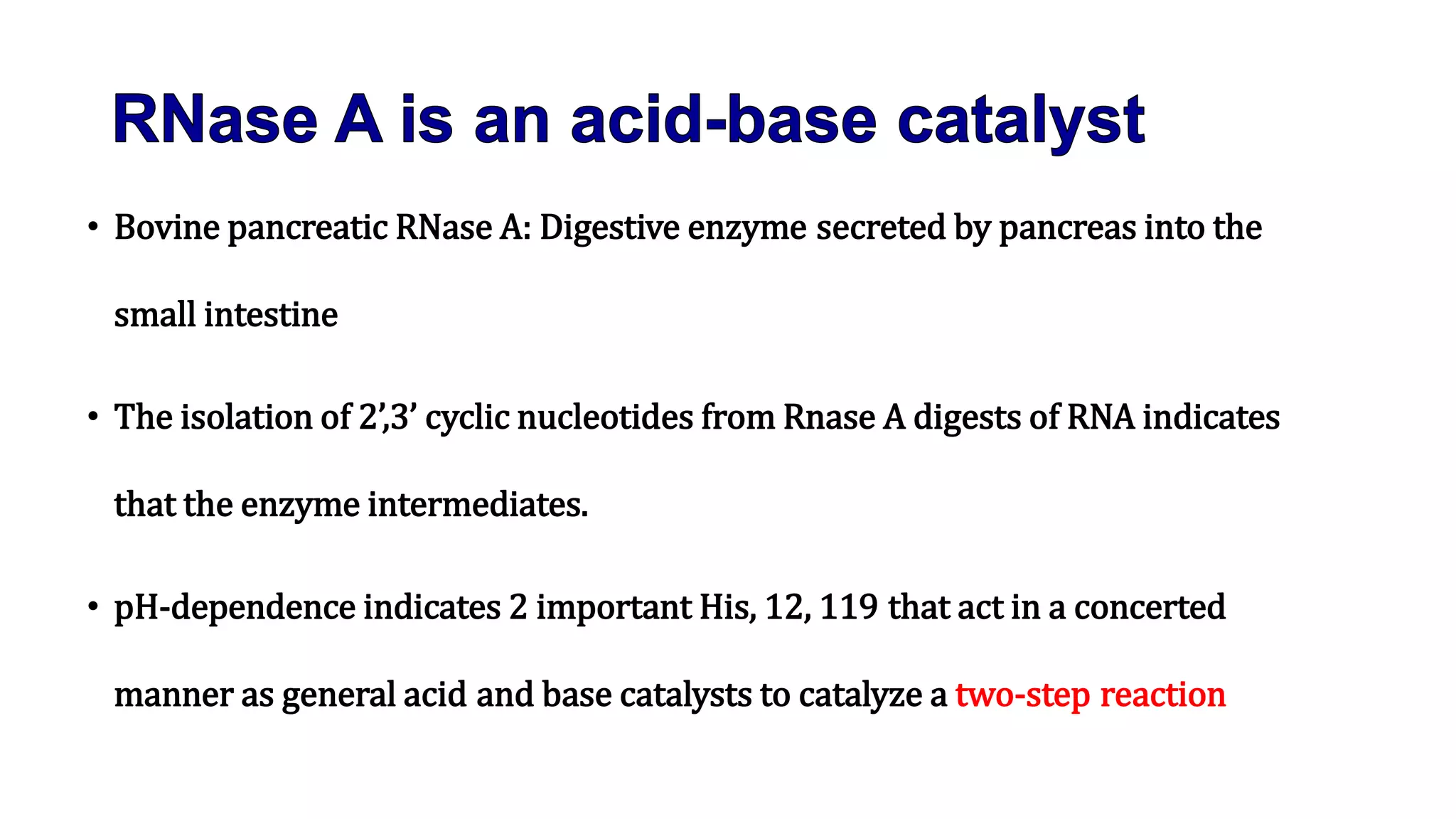
• Bovine pancreaticRNase A: Digestive enzyme secreted by pancreas into the
small intestine
• The isolation of 2’,3’ cyclic nucleotides from Rnase A digests of RNA indicates
that the enzyme intermediates.
• pH-dependence indicates 2 important His, 12, 119 that act in a concerted
manner as general acid and base catalysts to catalyze a two-step reaction
11.
The RNase Amechanism
His 12 acts as a
general base and His
119 as a general acid
to Promote
nucleophilic attack
and bond cleavage.
12.
His 12 actsas a
general acid and His
119 as a general base
to promote hydrolysis.
13.
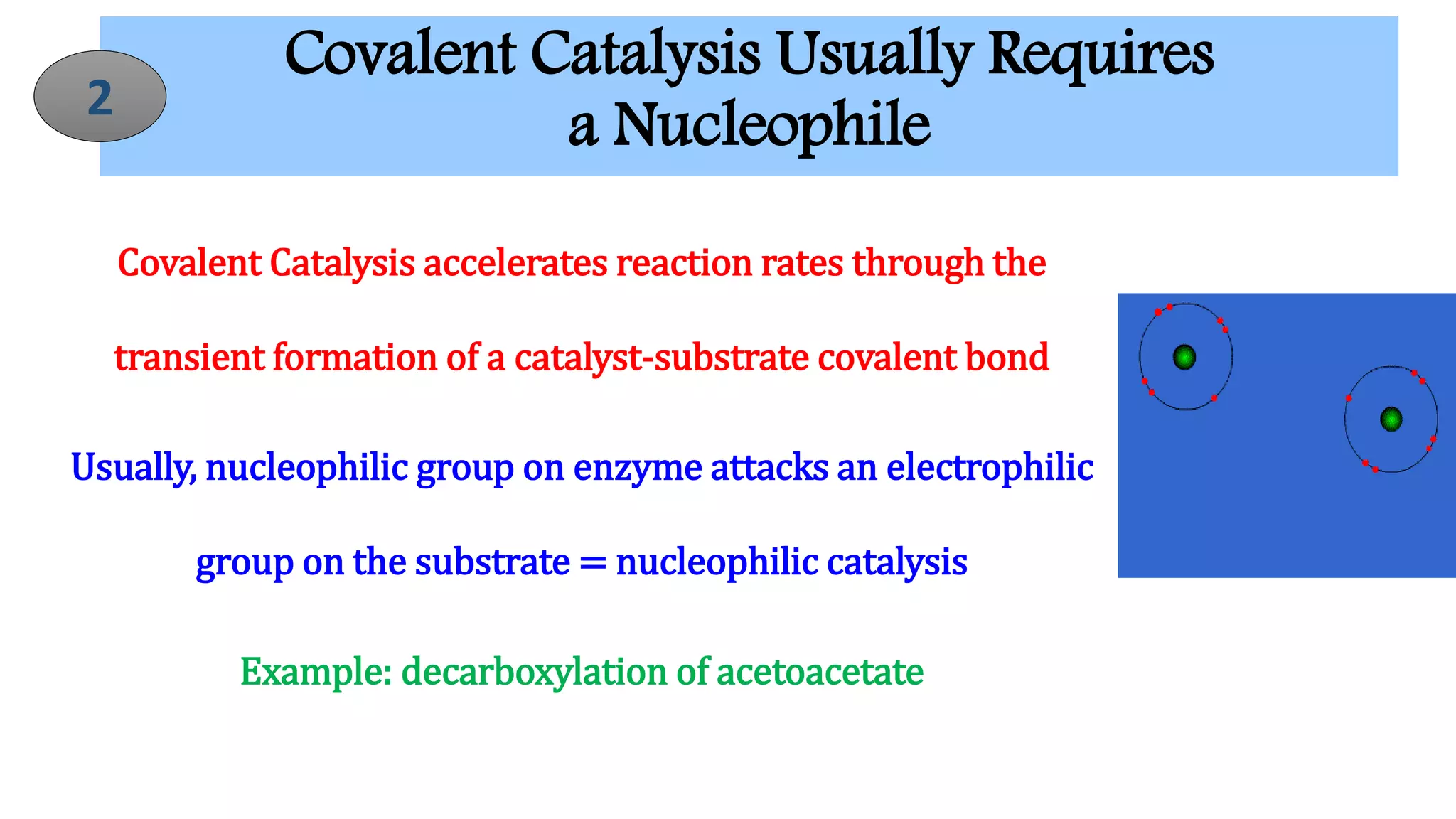
Covalent Catalysis acceleratesreaction rates through the
transient formation of a catalyst-substrate covalent bond
Usually, nucleophilic group on enzyme attacks an electrophilic
group on the substrate = nucleophilic catalysis
Example: decarboxylation of acetoacetate
Covalent Catalysis Usually Requires
a Nucleophile
2
Three stages ofCovalent Catalysis
1. Nucleophilic attack of enzyme on substrate
2. Withdrawal of electrons from the reaction center by the
now electrophilic catalyst.
3. Elimination of catalysts by reversion of step 1.
16.
Important aspect ofcovalent catalysis
The more stable the covalent bond formed, the less easily it can be decomposed in the final step of a
reaction
Good covalent catalysis must be:
(i) highly nucleophile
(ii) the ability to form a good leaving group. Groups with high polarizability (highly mobile electrons),
such as :
Functional groups in proteins include (the unprotonated amino group of Lys, the imidazole group of
His, the thiol group of Cys, the carboxyl group of Asp, and the hydroxyl group of Ser).
In addition, several coenzymes, notably (thiamine pyrophosphate and pyridoxal phosphate).
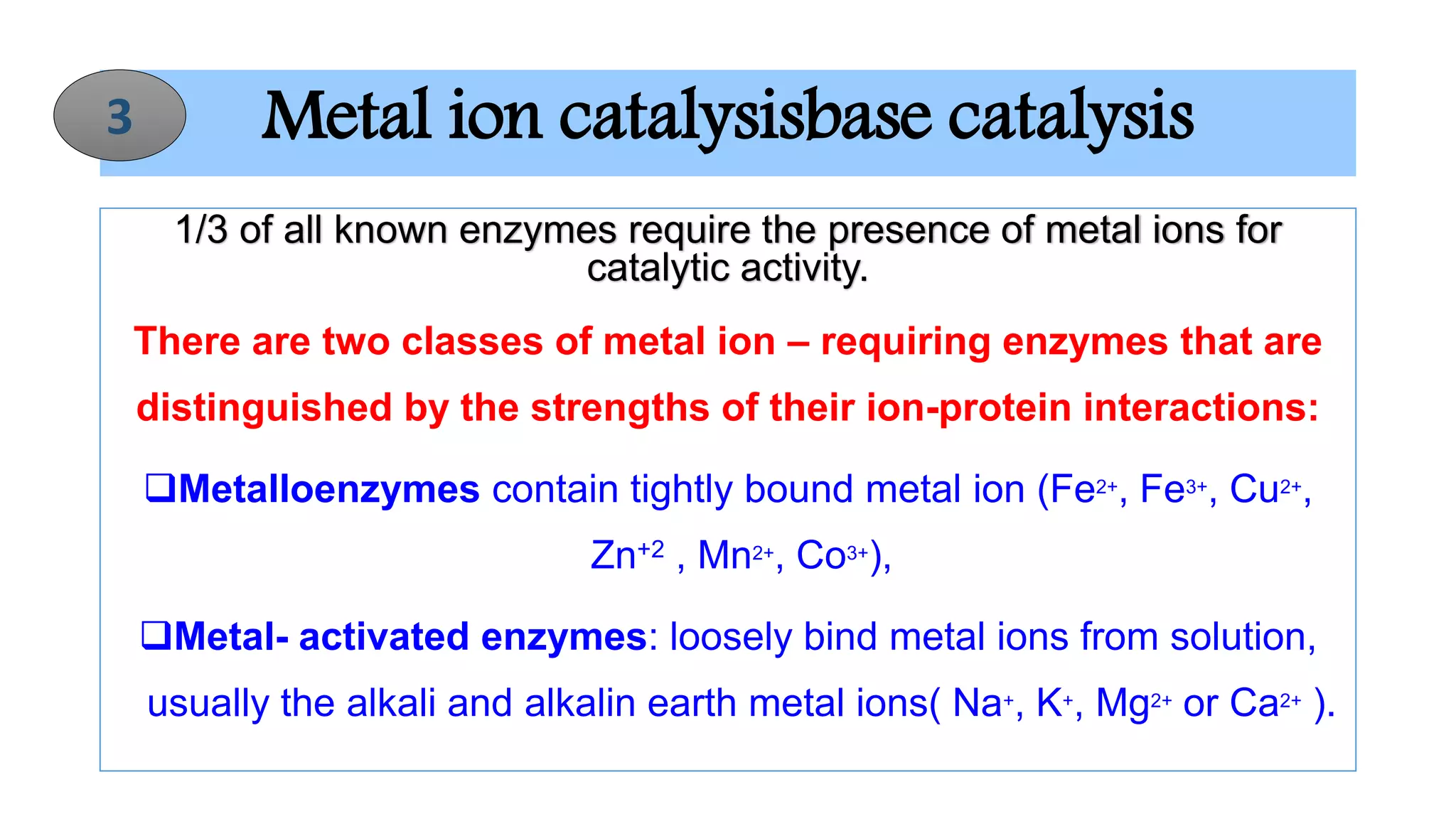
1/3 of allknown enzymes require the presence of metal ions for
catalytic activity.
There are two classes of metal ion – requiring enzymes that are
distinguished by the strengths of their ion-protein interactions:
Metalloenzymes contain tightly bound metal ion (Fe2+, Fe3+, Cu2+,
Zn+2 , Mn2+, Co3+),
Metal- activated enzymes: loosely bind metal ions from solution,
usually the alkali and alkalin earth metal ions( Na+, K+, Mg2+ or Ca2+ ).
Metal ion catalysisbase catalysis3
19.
Metal Ion CofactorsAct as Catalysts
Metal ions participate in the catalytic process in three major ways:
1. By binding to substrate to orient them properly for reaction
2. By mediating oxidation-reduction reactions through reversible
changes in the metal ions oxidation state
3. By electrostatically stabilizing or shielding negative charges
Often: Metal ion acts similar to a proton, or polarizes water to
generate OH
20.
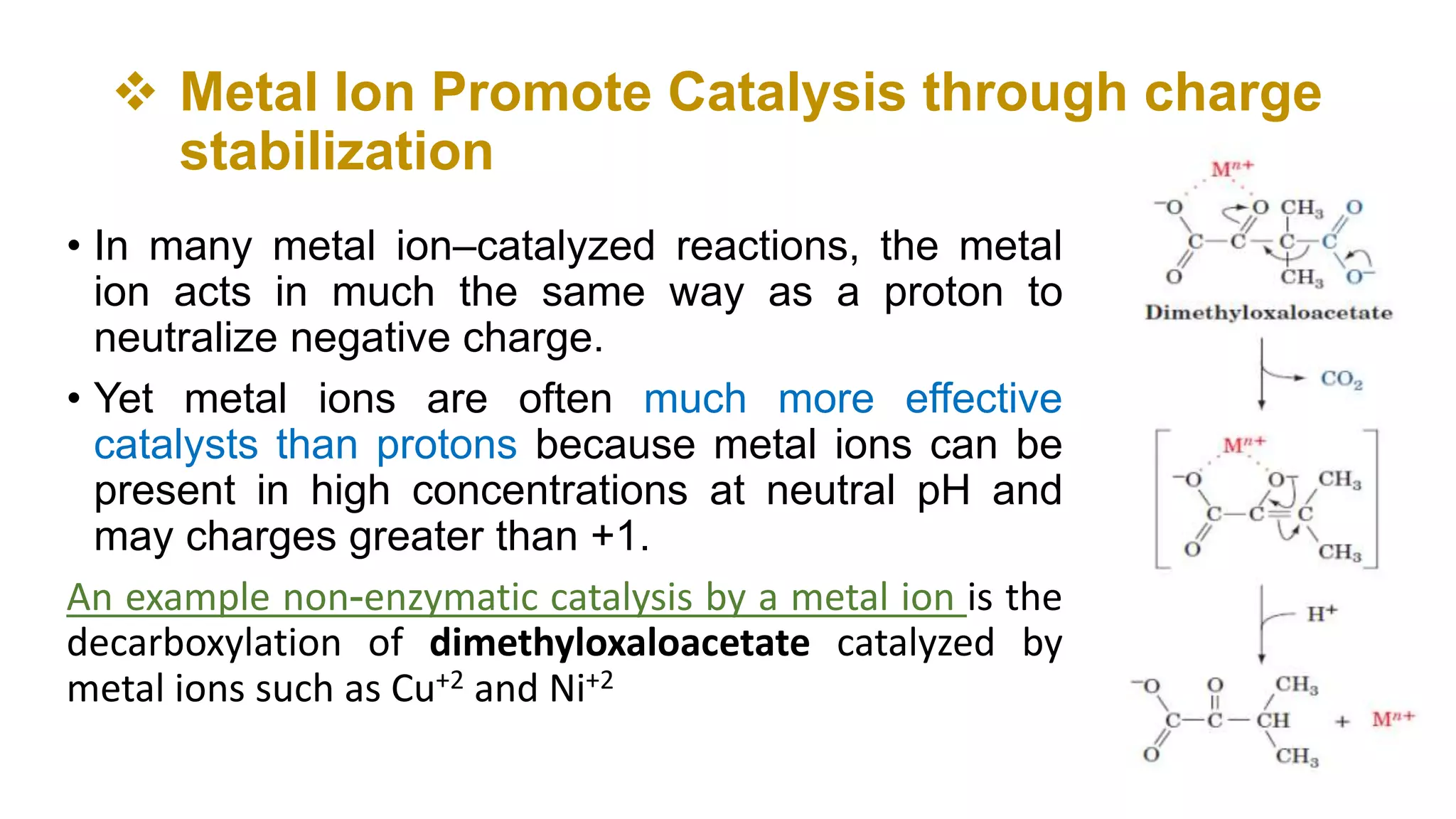
Metal IonPromote Catalysis through charge
stabilization
• In many metal ion–catalyzed reactions, the metal
ion acts in much the same way as a proton to
neutralize negative charge.
• Yet metal ions are often much more effective
catalysts than protons because metal ions can be
present in high concentrations at neutral pH and
may charges greater than +1.
An example non-enzymatic catalysis by a metal ion is the
decarboxylation of dimethyloxaloacetate catalyzed by
metal ions such as Cu+2 and Ni+2
21.
Metal IonsPromote Nucleophilic Catalysis
via Water Ionization
• When a metal ion binds with water molecules, the charge of the
metal ion causes that water molecule to be more acidic than free
H2O and therefore a source of OH− ions even below neutral pH’s.
• For example, the water molecule of (NH3)5Co3+ (H2O) ionizes
according to the reaction:
with a pK of 6.6, which is ~9 pH units below the pK of free H2O. The
resulting metal ion–bound hydroxyl group is a potent nucleophile.
22.
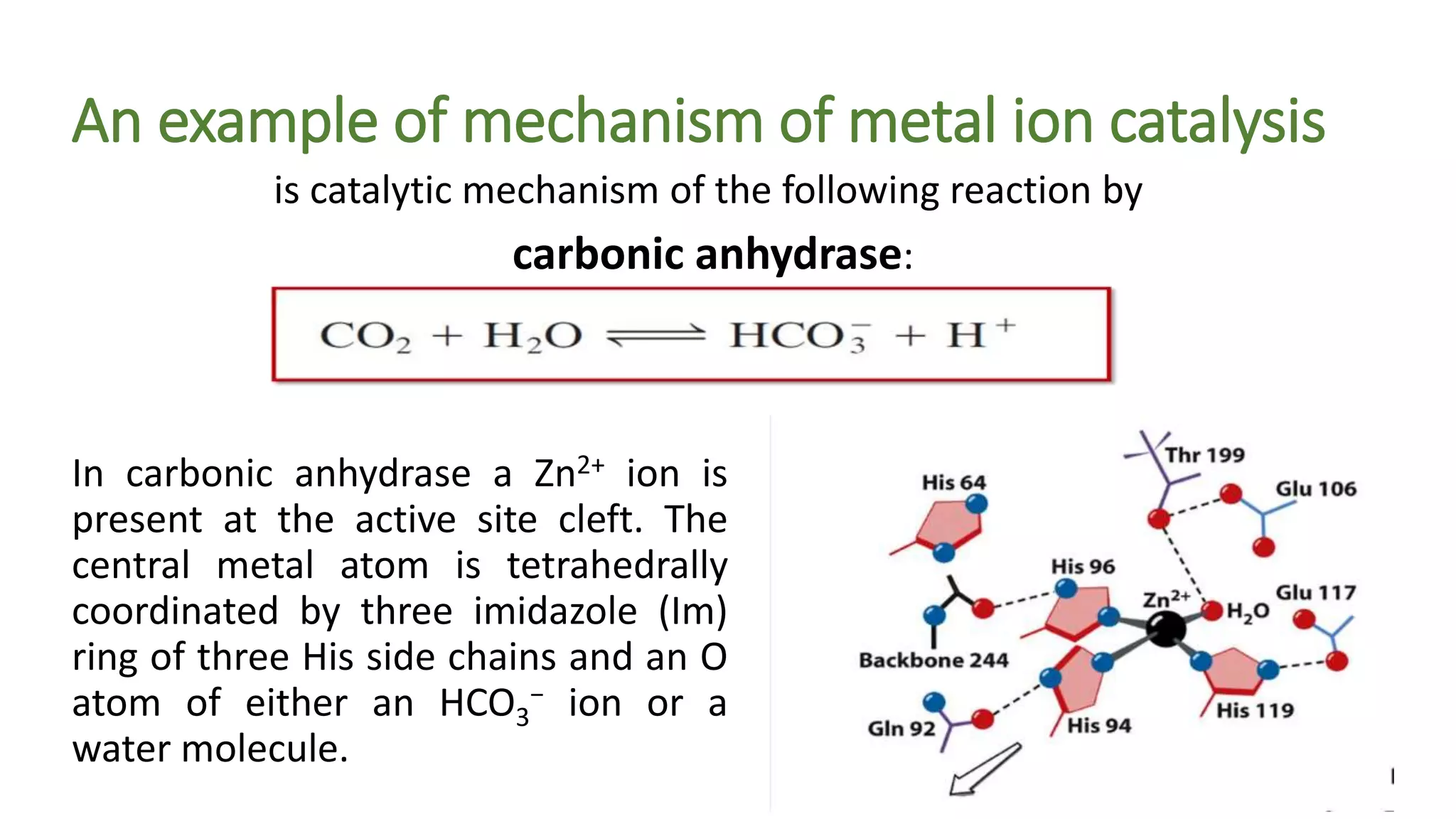
An example ofmechanism of metal ion catalysis
is catalytic mechanism of the following reaction by
carbonic anhydrase:
In carbonic anhydrase a Zn2+ ion is
present at the active site cleft. The
central metal atom is tetrahedrally
coordinated by three imidazole (Im)
ring of three His side chains and an O
atom of either an HCO3
− ion or a
water molecule.
23.
The role ofZn2+ in carbonic anhydrase
1- We begin with a water
molecule bound to the protein
in the Zn+2 ion’s fourth
liganding position. This Zn+2-
polarized H2O ionizes in a
process facilitated through
general base catalysis by His 64
in its “in” conformation.
24.
The role ofZn2+ in carbonic anhydrase
2. The resulting Zn+2-bound OH- ion nucleophilically
attacks the nearby enzymatically bound CO2, thereby
converting it to HCO3
-.
In doing so, the Zn+2-bound OH group donates a hydrogen
bond to Thr 199, which in turn donates a hydrogen bond to
Glu 106.
25.
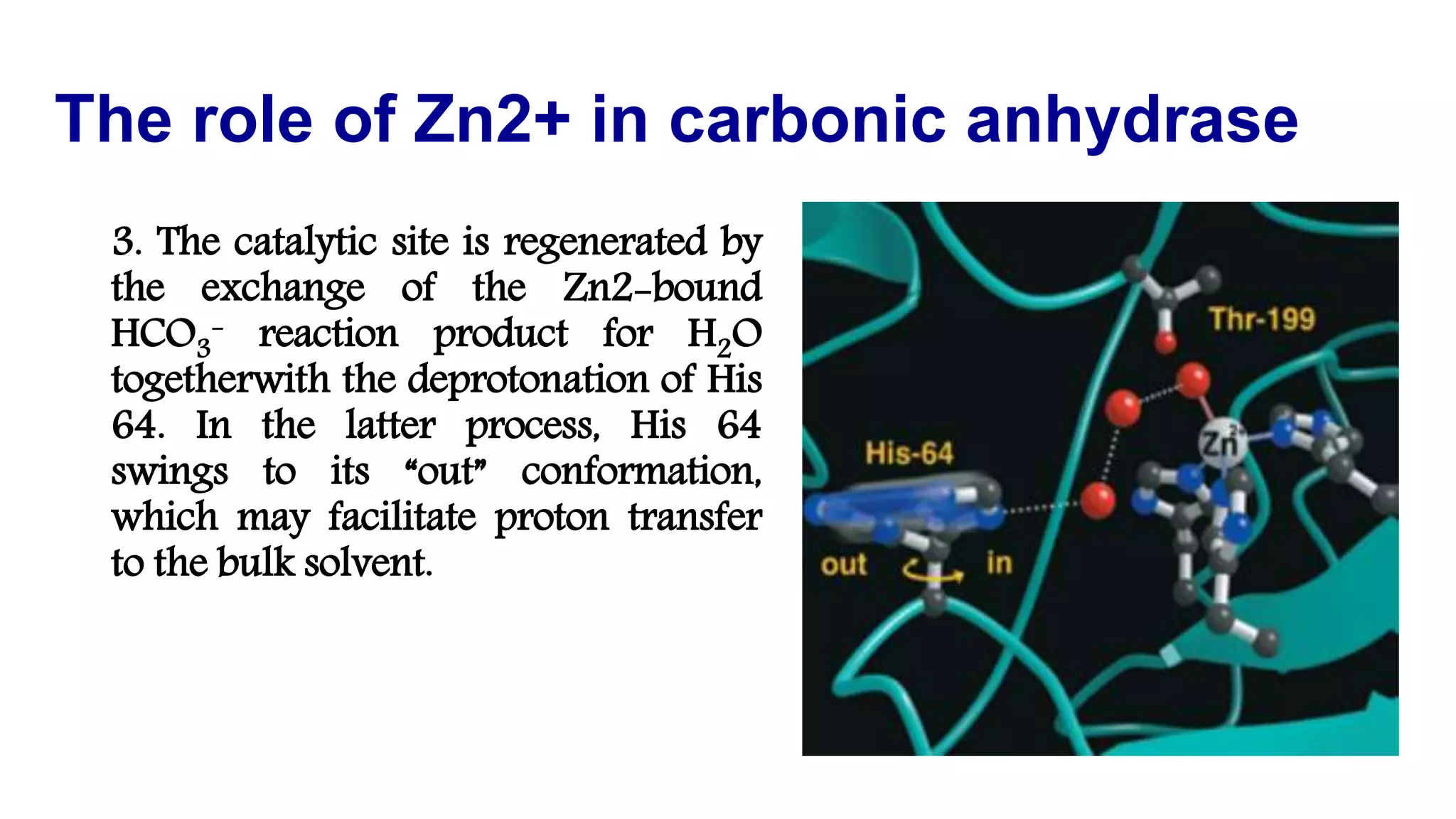
The role ofZn2+ in carbonic anhydrase
3. The catalytic site is regenerated by
the exchange of the Zn2-bound
HCO3
- reaction product for H2O
togetherwith the deprotonation of His
64. In the latter process, His 64
swings to its “out” conformation,
which may facilitate proton transfer
to the bulk solvent.
26.
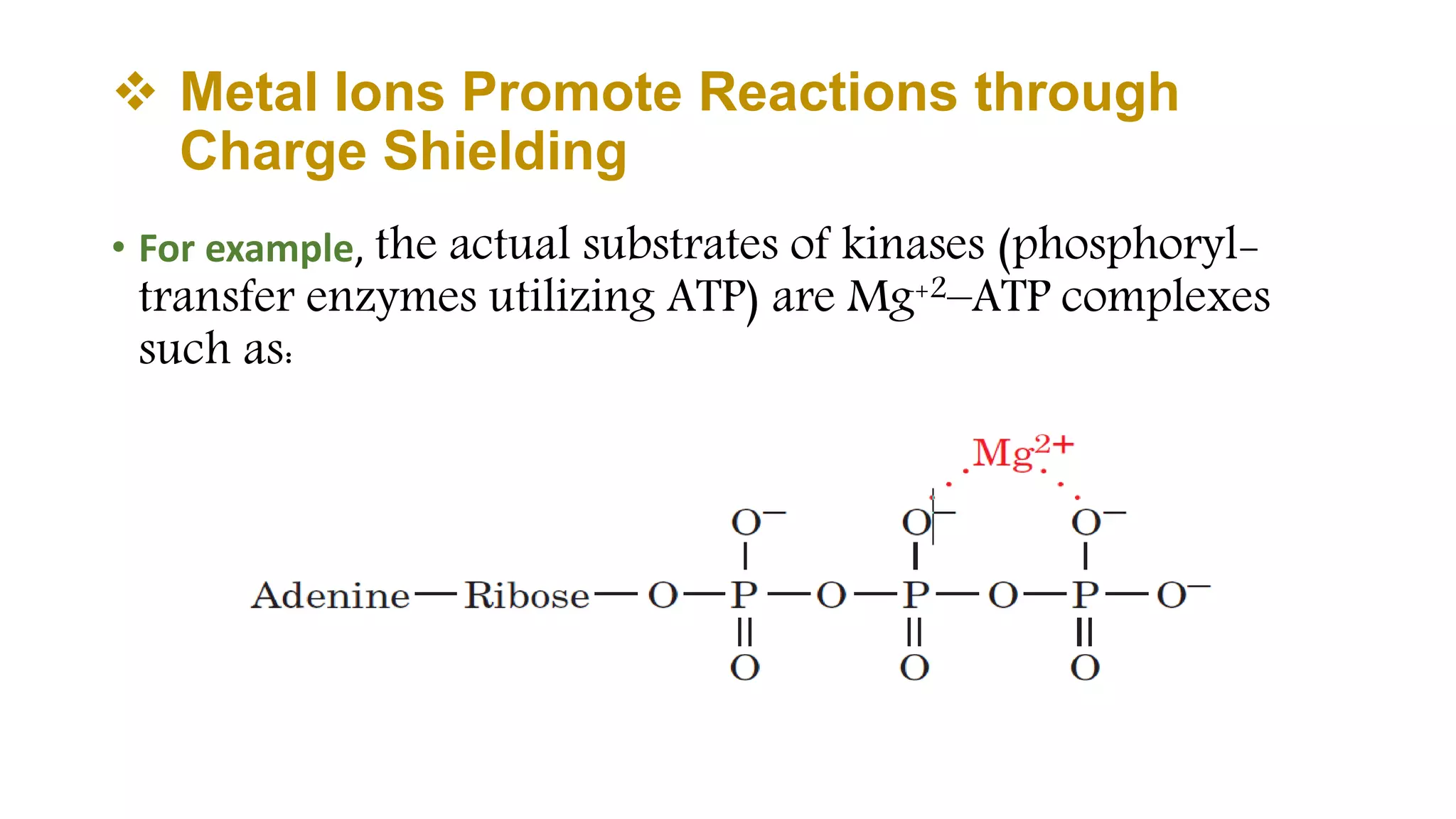
Metal IonsPromote Reactions through
Charge Shielding
• For example, the actual substrates of kinases (phosphoryl-
transfer enzymes utilizing ATP) are Mg+2–ATP complexes
such as:
27.
• concept notalways "listed" separately because it’s involved in many
other aspects of catalytic mechanisms
:
– providing lower dielectric constant of environment in
active site (hydrophobic environment)
– altering pK values of specific functional groups
– stabilizing a particular conformation of critical groups in
active site by electrostatic interactions
– stabilizing (binding) a charged intermediate or transition
state by providing an oppositely charged enzyme group
nearby.
Electrosatic catalysis4
28.
Catalysis can occurthrough proximity
and orientation effects
• Enzymes are much more efficient catalysts than organic model
compounds
• Due to proximity and orientation effects
• Reactants come together with proper spatial relationship
• Example: he bimolecular reaction of imidazole with p-nitrophenylacetate.
intramolecular reaction is 24 times faster
5
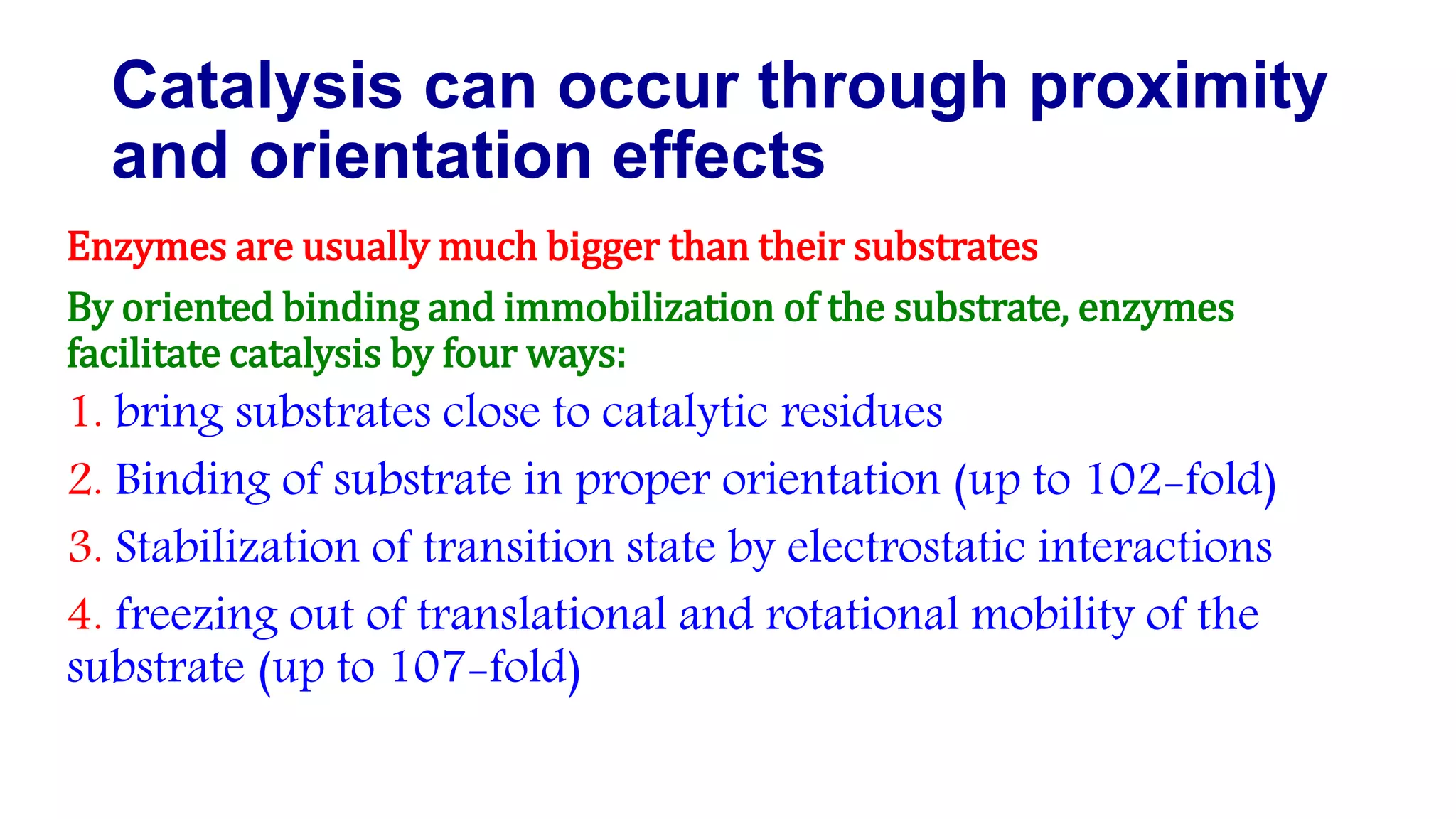
Catalysis can occurthrough proximity
and orientation effects
Enzymes are usually much bigger than their substrates
By oriented binding and immobilization of the substrate, enzymes
facilitate catalysis by four ways:
1. bring substrates close to catalytic residues
2. Binding of substrate in proper orientation (up to 102-fold)
3. Stabilization of transition state by electrostatic interactions
4. freezing out of translational and rotational mobility of the
substrate (up to 107-fold)
31.
Proximity Alone ContributesRelatively
Little to Catalysis
1. Reactant species, that is, functional groups, are about the size of
water molecules.
2. Each reactant species in solution has 12 nearestneighbor
molecules, as do packed spheres of identical size.
3. Chemical reactions occur only between reactants that are in
contact.
4. The reactant concentration in solution is low enough so that the
probability of any reactant species being in simultaneous contact
with more than one other reactant molecule is negligible.
Properly Orienting Reactantsand Arresting Their Relative
Motions Can Result in Large Catalytic Rate Enhancements
they react most readily only if they have the
proper relative orientation
For example, in an SN2 (bimolecular nucleophilic
substitution) reaction
an effect termed stereoelectronic assistance
Enzymes catalyze reactionsby
preferentially binding the transition state
An enzyme may binds the transition state of the reaction with greater
affinity than its substrate or products
This together with the previously discussed factors accounts for the
high rate of catalysis
For example, if enzyme binds the transition state with 34.2 kJ/mol (=
2 hydrogen bonds) it results in 106-fold rate enhancement
6
•Explain the Mechanismsof keto-enol tautomerization as
an example of Acid- base catalysis?
•What is the role of Zn2+ in carbonic anhydrase?
•What are stages of Covalent Catalysis with an example ?
•Metal Ion Promote Catalysis through charge stabilization,
Explain with example?
#17 Groups with high polarizability (highly mobile electrons), such as imidazole and thiol groups, have these properties and hence make good covalent catalysts. Functional groups in proteins that act in this way include the unprotonated amino group of Lys, the imidazole group of His, the thiol group of Cys, the carboxyl group of Asp, and the hydroxyl group of Ser. In addition, several coenzymes, notably thiamine pyrophosphate (Section 15-3B) and pyridoxal phosphate (Section 21-2A), function in association with their apoenzymes as covalent catalysts
#38 The reaction coordinate diagram for a hypothetical enzymecatalyzed reaction involving a single substrate is blue, and the diagram for the corresponding uncatalyzed reaction is red¢G‡ N. is the free energy of activation for the nonenzymatic reaction and ¢G‡E is the free energy of activation for the enzyme-catalyzed reaction. The small dips in the reaction coordinate diagram for the enzyme-catalyzed reaction arise from the binding of substrate and product to the enzyme.
#39 both of which bind to the enzyme with 160-fold greater affinity than does proline. These compounds are therefore thought to be analogs of the transition state in the proline racemase reaction. Hundreds of transition state analogs for various enzymes have been reported. Some are naturally occurring antibiotics. Others were designed to investigate the mechanism of particular enzymes or to act as specific enzyme inhibitors for therapeutic or agricultural use. Indeed, the theory that enzymes bind transition states with higher affinity than substrates has led to a rational basis for drug design based on the understanding of specific enzyme reaction mechanisms


![Example:
Linear form
α – D- Glucose
[α]²ºD= 112.2o
β – D- Glucose
[α]²ºD= 18.7o
Cyclic form
Cyclic form](https://image.slidesharecdn.com/catalysismecanisms-180312211233/75/Catalysis-mechanisms-6-2048.jpg)