ENZYME CATALYSIS
Department of Pharmacy
University of Peshawar
Contents
 Enzyme catalysis
 Mechanisms of enzyme catalysis
 Enzyme inhibition
 Types and mechanisms of enzyme inhibition
Definition
Catalysis
“An increase in the rate of reaction due to participation of a catalyst”.
Enzyme Catalysis
It is a sub-type of catalysis and is defined as “an increase in the rate of a chemical
reaction due to the participation of an enzyme”.
Characteristics of Enzyme Catalysis
The main characteristics of enzymatic catalysis include:
Efficiency
Enzymes are highly efficient, one molecule of an enzyme can transform more than one
million molecules of substrate a minute.
Specificity
Enzymes are highly selective and produce only one type of product
Activity
Enzymes are highly active under optimum temperature and pH
Classification of Enzyme
Based on their function enzymes are classified in to six classes
Oxidoreductases
Catalyzes oxidation-reduction reactions by the transfer of electrons as addition or removal of hydrogen atoms e.g. Cytochrome P450
Transferases
Catalyzes transfer of group usually attached to a co-factor e.g. Hexokinase, Methyl transferase
Hydrolases
Catalyzes hydrolysis reactions i.e. transfer of functional groups of water e.g. Chymotrypsin.
Lyases
Catalyzes the addition of a functional group by breaking a double bond or vice versa e.g. Deaminase
Isomerases
Catalyzes the transfer of functional groups within a molecule forming isomers e.g. Phosphoglucose isomerase.
Ligases
Catalyzes the formation of a C-C, C-S, C-N, C-O bonds due to condensation reaction e.g. DNA ligase
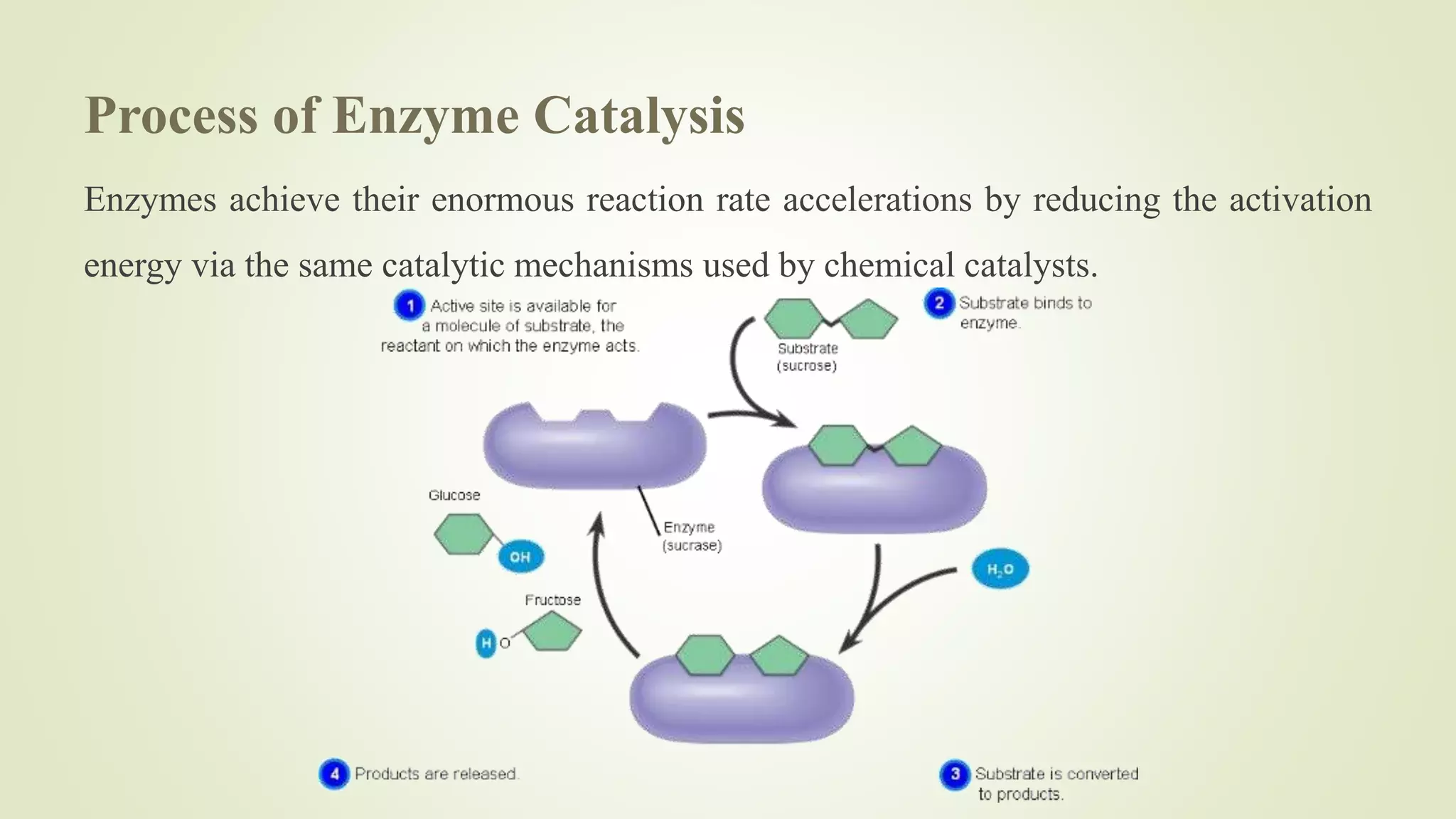
Process of Enzyme Catalysis
Enzymes achieve their enormous reaction rate accelerations by reducing the activation
energy via the same catalytic mechanisms used by chemical catalysts.
Mechanisms of Enzyme Catalysis
Enzymes carryout their function by the following mechanisms:
 Acid-Base Catalysis
 Covalent Bond Catalysis
 Metal-Ion Catalysis
 Proximity & Orientation Based Catalysis
Acid-Base Catalysis
 A proton transfer from an acid or hydroxyl from a base lowers the activation energy
of a reaction
 Ionizable functional groups of amino acyl side chains and of prosthetic groups
contribute to catalysis by acting as acid or base
 The catalytic activity is pH sensitive
 Functional groups of amino acids such as glutamic acid, aspartic acid, lysine,
histidine act as an acid or base.
Example
 Bovine pancreatic RNase A is an acid-base catalyst, it hydrolyzes RNA to its
component nucleotides in the intestine.
Covalent Bond Catalysis
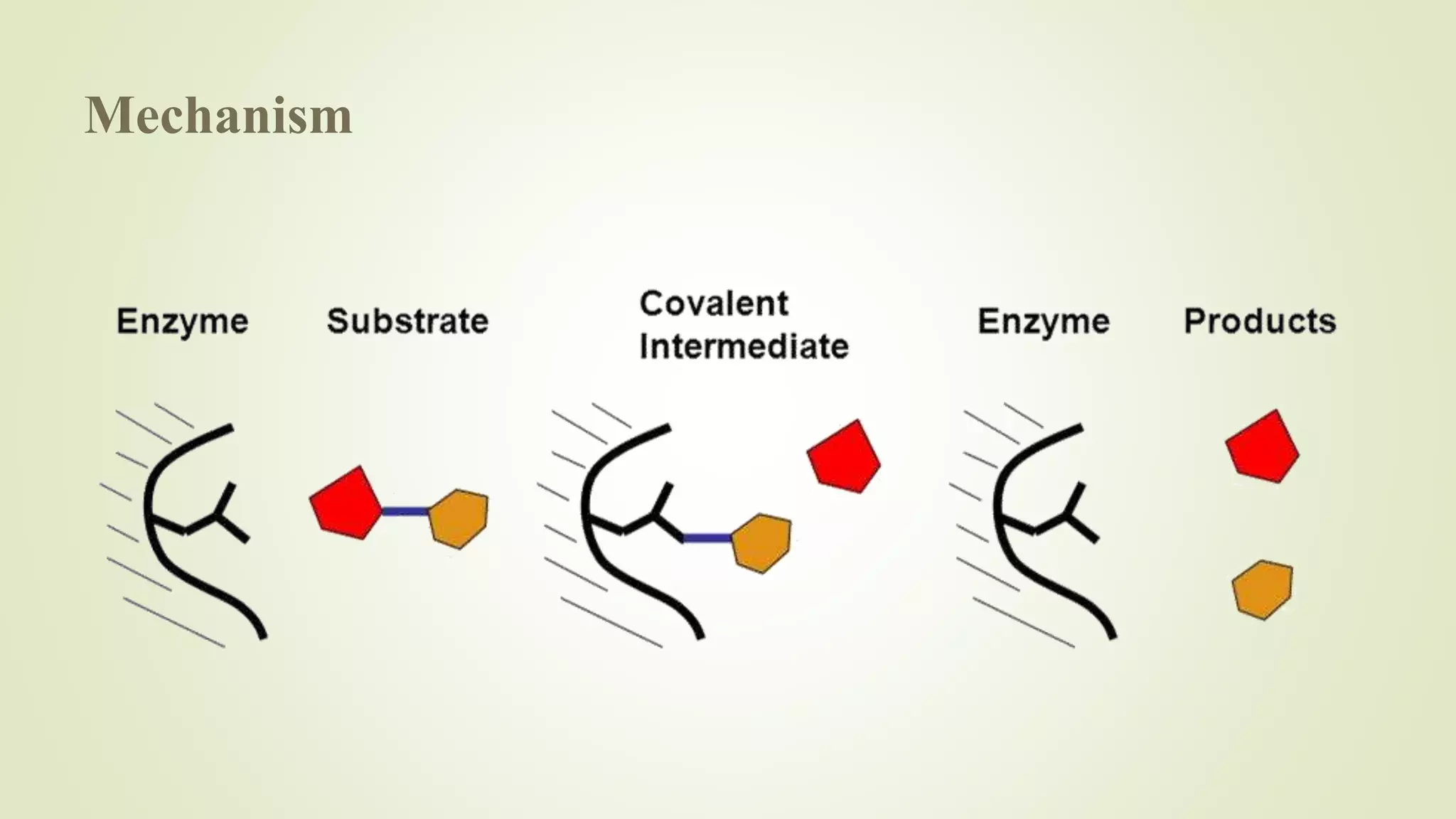
 Catalysis is achieved by the transient formation of a covalent bond between the
enzyme and substrate.
 Usually the covalent bond is formed by the reaction of a nucleophilic group on the
catalyst with an electrophilic group on the substrate. Therefore, it is also known as
nucleophilic catalysis.
 The following functional group may form a covalent bond.
• Amino group of Lysine
• Imidazole group of Histidine
• Carboxyl group of Aspartic acid
• Hydroxyl group of Serine
Examples
• Acetylcholine esterase, Chymotrypsin, Trypsin, elastase and alkaline phosphatase
Mechanism
Metal-Ion Catalysis
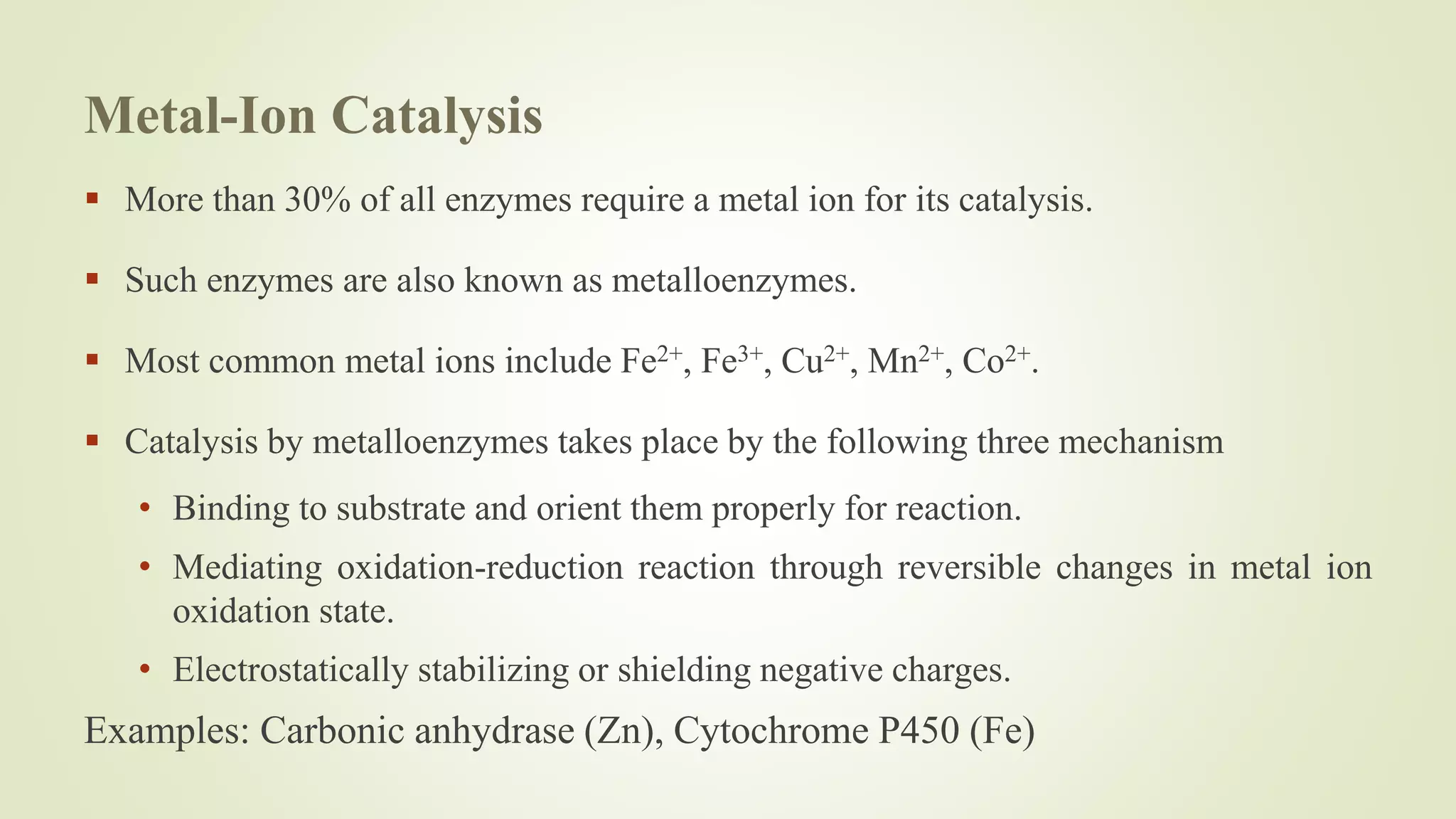
 More than 30% of all enzymes require a metal ion for its catalysis.
 Such enzymes are also known as metalloenzymes.
 Most common metal ions include Fe2+, Fe3+, Cu2+, Mn2+, Co2+.
 Catalysis by metalloenzymes takes place by the following three mechanism
• Binding to substrate and orient them properly for reaction.
• Mediating oxidation-reduction reaction through reversible changes in metal ion
oxidation state.
• Electrostatically stabilizing or shielding negative charges.
Examples: Carbonic anhydrase (Zn), Cytochrome P450 (Fe)
Mechanism
Proximity & Orientation Based Catalysis
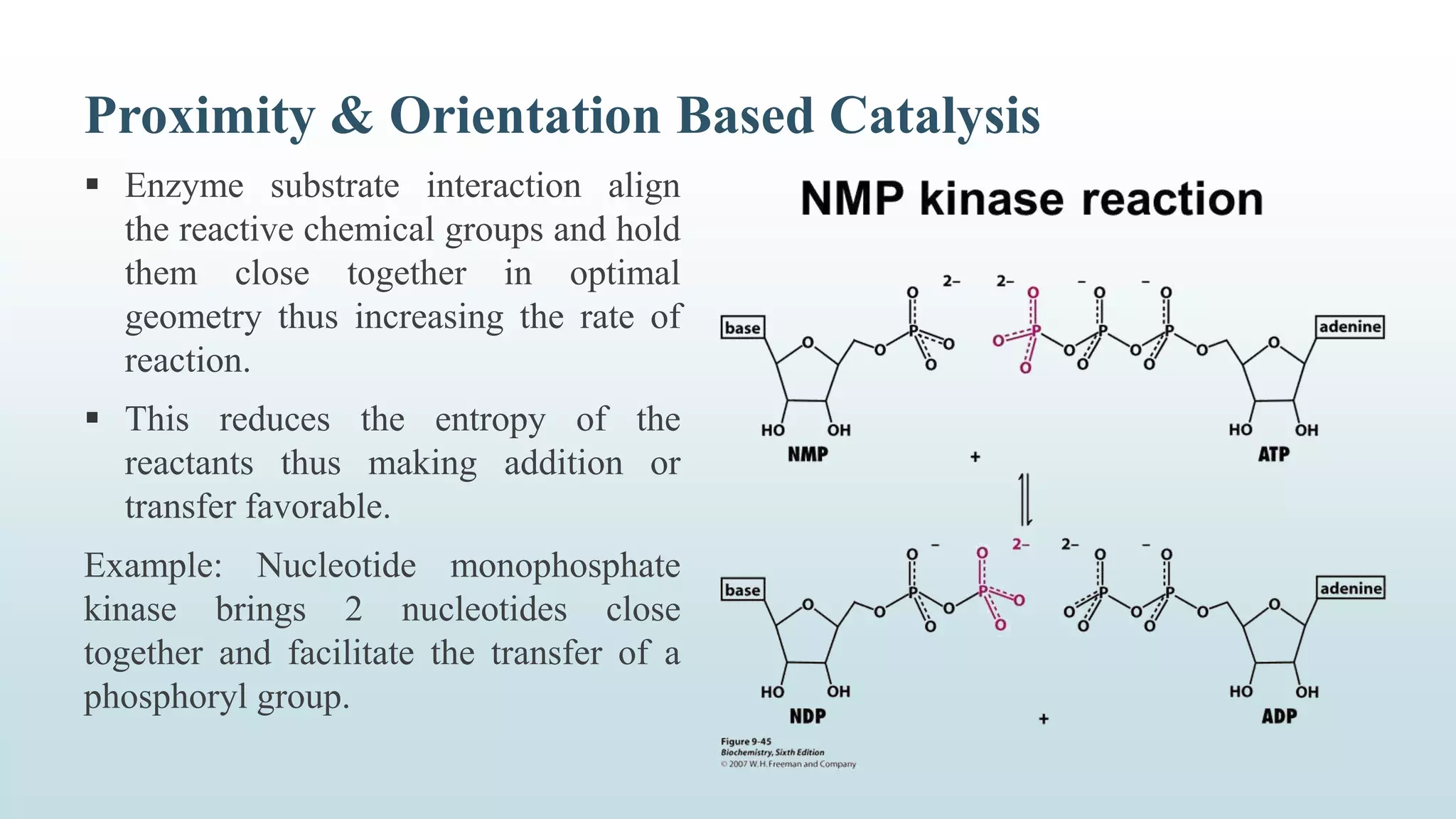
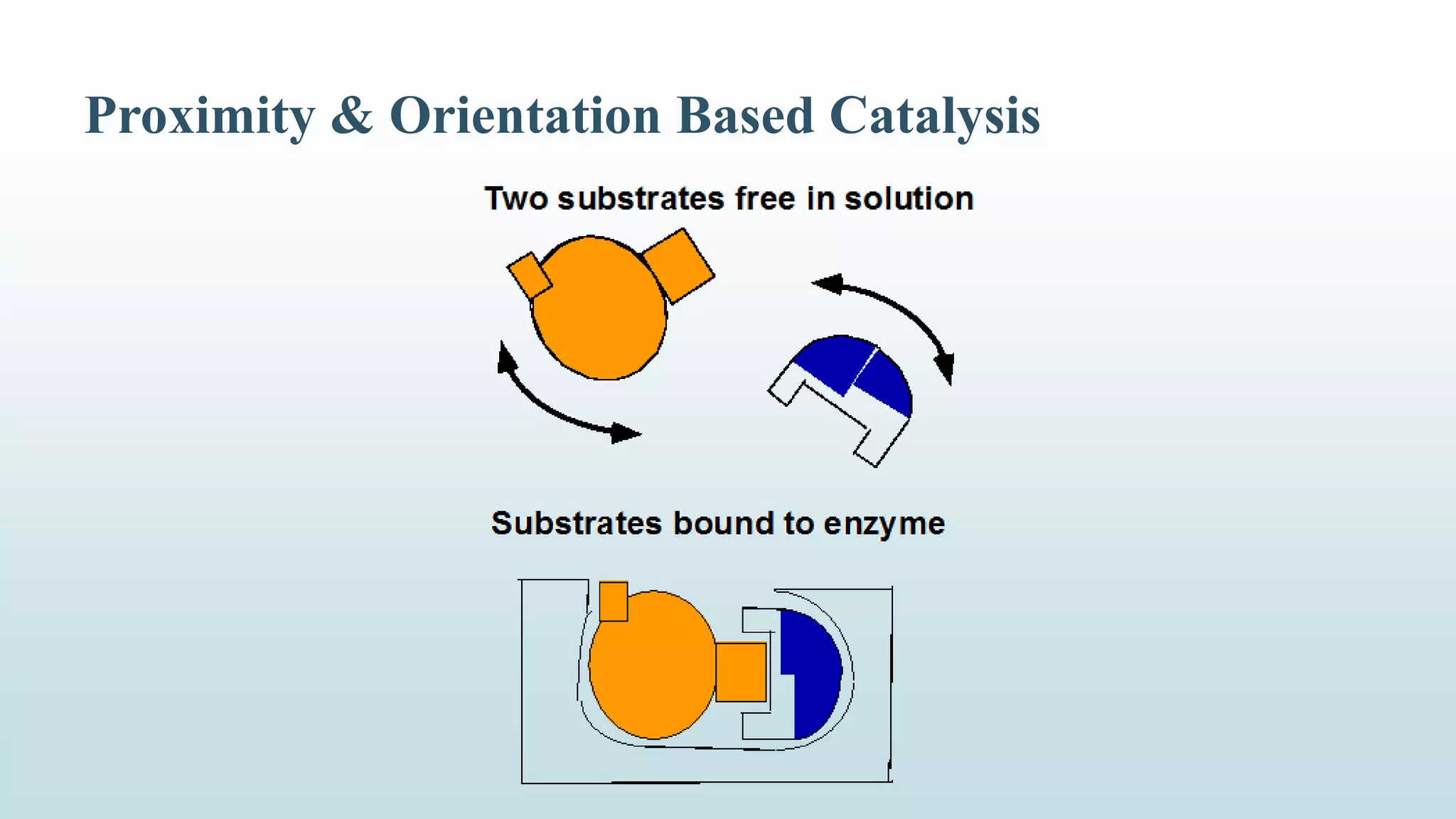
 Enzyme substrate interaction align
the reactive chemical groups and hold
them close together in optimal
geometry thus increasing the rate of
reaction.
 This reduces the entropy of the
reactants thus making addition or
transfer favorable.
Example: Nucleotide monophosphate
kinase brings 2 nucleotides close
together and facilitate the transfer of a
phosphoryl group.
Proximity & Orientation Based Catalysis
Enzyme Inhibition
Enzyme inhibition is process of reducing or abolishing the catalytic activity of an
enzyme due to the interaction of an enzyme inhibitor.
Enzyme Inhibitor
They are low molecular weight compounds that bind to an enzyme and inhibit or reduce
its activity by either preventing the formation or breakdown of enzyme substrate
complex.
Types of Enzyme Inhibition
Enzyme Inhibitors
Reversible
Competitive
Non-Competitive
Un-Competitive
Irreversible Suicide
Allosteric
Reversible inhibition
 Reversible inhibitors bind to enzyme with noncovalent interactions, such as hydrogen
bonds, ionic bonds, and hydrophobic interactions.
 Can be rapidly dissociated
 Can be readily removed by dialysis
 Fully active enzyme can be recovered
Competitive Inhibition
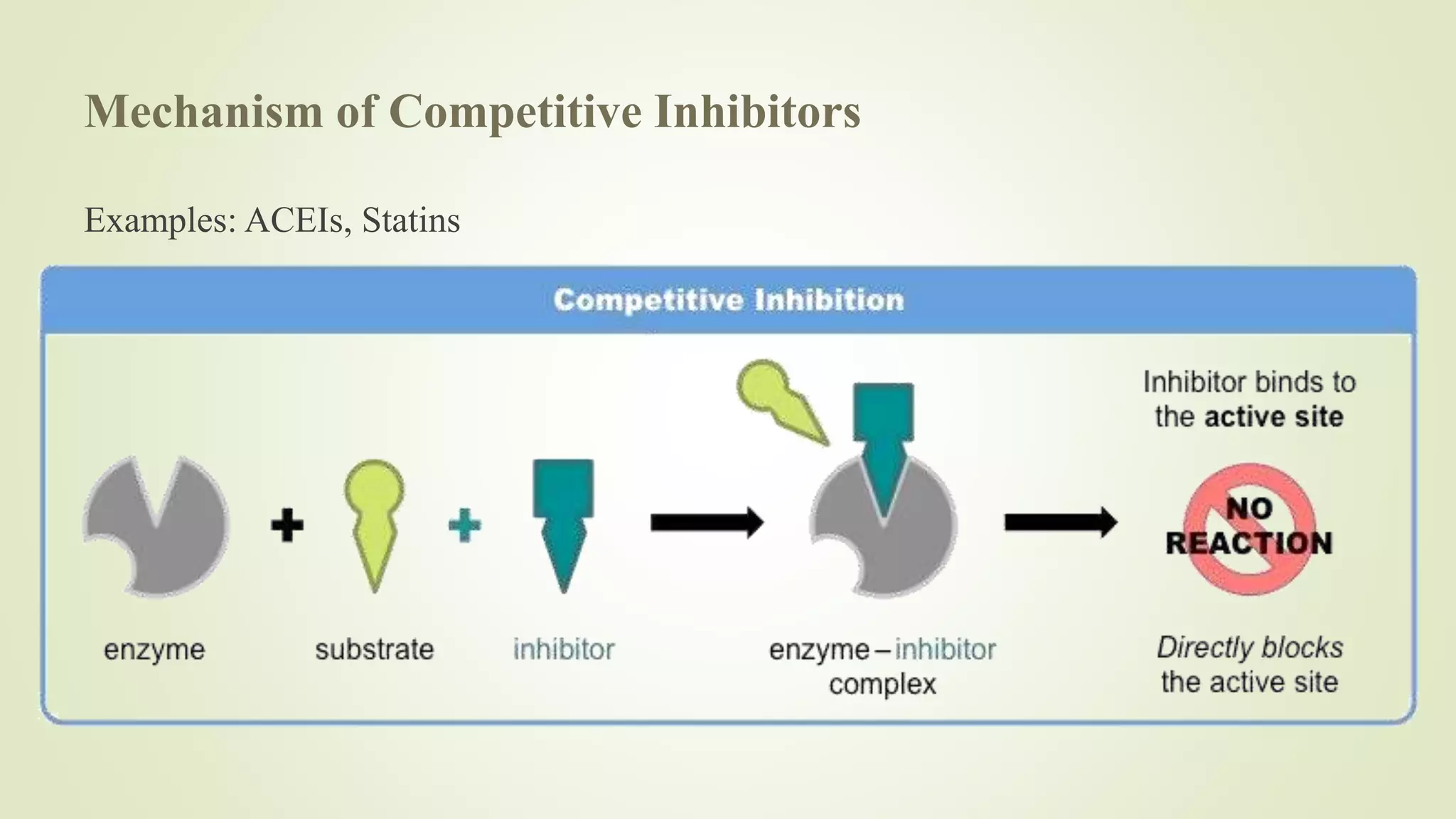
 A Competitive inhibitor is any compound which closely resembles the chemical structure
and geometry of the substrate for an enzyme.
 The inhibitor competes for the same active site as the substrate molecule.
 The inhibitor interacts with the active site of the enzyme but no interaction takes place.
 Because of the presence of inhibitor fewer sites are available for substrate. Since the
enzyme's overall structure is unaffected by the inhibitor, it is still able to catalyze the reaction
on substrate molecules that do bind to an active site.
 Since the inhibitor and substrate bind at the same site, competitive inhibition can be
overcome simply by raising the substrate concentration.
 Therefore, the amount of enzyme inhibition depends upon the inhibitor concentration,
substrate concentration, and the relative affinities of the inhibitor and substrate for the active
site.
 Its inhibitory action is proportional to concentration.
Mechanism of Competitive Inhibitors
Examples: ACEIs, Statins
Non-Competitive Inhibitors
 The inhibitor usually binds non-covalently to a domain on the enzyme other than the
substrate binding site.
 This occurs when the substances do not resemble the geometry of the substrate & do
not exhibit mutual competition.
 They are not influenced by concentration of the substrate.
 Strong affinity for inhibitors prevent catalysis possibly due to distortion in enzyme
conformation.
Examples of Non-Competitive Inhibitors
 Cytochrome C oxidase (Fe) inhibition by cyanide, Organophosphates bind with the
serine residue to acetyl choline esterases, MAOIs, .
Un-Competitive Inhibitors
 Inhibitor has no affinity for the enzyme free
enzyme. Inhibitor binds to enzyme substrate
complex.
Example: Arsenic inhibition of Glyceraldehyde 3-
phosphate dehydrogenase (Glycolysis), Lithium
inhibition of inositol monophosphate.
Irreversible Inhibition
 Destroys a functional group necessary for the catalytic action.
 The catalytic activity of enzyme is completely lost.
 The enzyme can only be restored by synthesizing new molecules.
 Enzyme bonds covalently with the inhibitor.
 It includes:
• Suicide inhibition
Mechanism
Suicide Inhibition
 It is a specialized type of irreversible inhibition (aka. Mechanism based inhibition).
 The structural analogue is converted into a more effective inhibitor due to enzymatic
action.
 The substrate like compound initially binds with the enzyme and the first few steps
of the pathway are catalyzed.
 This new product irreversibly binds to the enzyme and inhibits further reactions.
 Example: Allopurinol forms alloxathine which permanently inhibits xanthine
oxidase, 5-fluorouracil forms 5-fluorodeoxyuridylate which inhibitis thymidylate
synthase, Organophosphates with Ach.
Allosteric Inhibition
 Allosteric means other site.
 When an inhibitor binds to the allosteric site it induces a conformational change in
the structure of the enzyme, which results in distorted shape of the active site, hence
the substrate can’t bind to it.
 The inhibitor is not a substrate analogue.
 It is partially reversible when excess substrate is added.
Example: Citric acid inhibiting blood clotting.
Mechanism
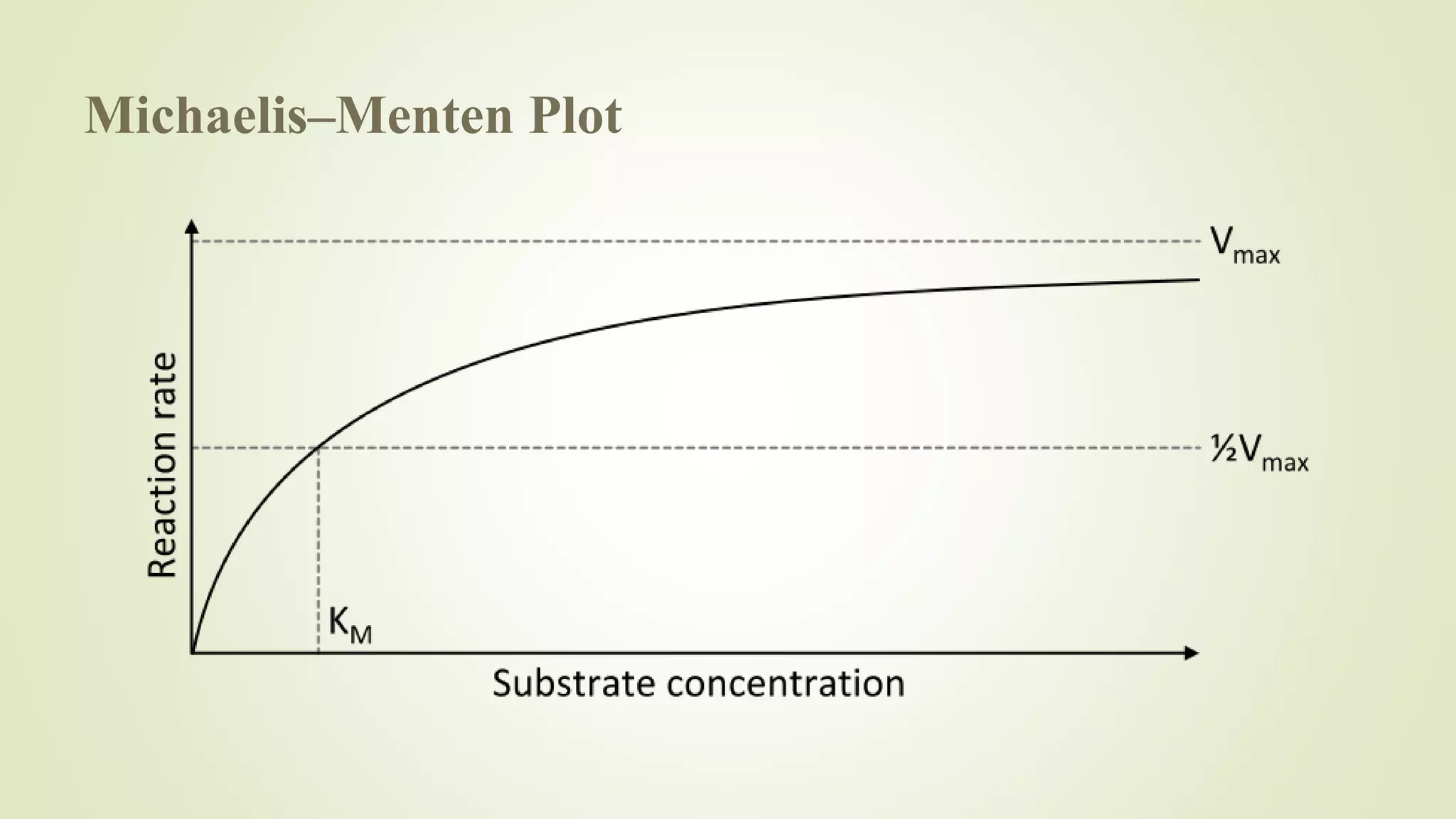
Michaelis–Menten kinetics
 It is named after German biochemist Leonor Michaelis and Canadian physician
Maud Menten.
 The model takes the form of an equation describing the rate of enzymatic reactions,
by relating reaction rate to the concentration of a substrate.
 The Michaelis-Menten equation has been used to predict the rate of product
formation in enzymatic reactions for more than a century.
Vo= Rate of reaction
Vmax= Maximum reaction rate
[S]= Substrate concentration
KM= Michaelis constant
Michaelis–Menten Plot
Lineweaver-Burk Kinetics
 The Lineweaver–Burk plot (double reciprocal plot) is a graphical representation of
the Lineweaver–Burk equation of enzyme kinetics.
 It was first described by Hans Lineweaver and Dean Burk in 1934.
 The plot provides a useful graphical method for analysis of the Michaelis–Menten
equation.
 The Lineweaver–Burk plot was widely used to determine important terms in enzyme
kinetics, such as Km and Vmax, before the wide availability of powerful computers
and non-linear regression software.
Lineweaver-Burk Kinetics
 The y-intercept of such a graph is equivalent to the inverse of Vmax.
 The x-intercept of the graph represents −1/Km.
 It also gives a quick, visual impression of the different forms of enzyme inhibition.
Lineweaver-Burk Kinetics
 When used for determining the type of enzyme inhibition, the Lineweaver–Burk plot
can distinguish competitive, non-competitive and uncompetitive inhibitors.
 Competitive inhibitors have the same y-intercept as uninhibited enzyme (since Vmax
is unaffected by competitive inhibitors the inverse of Vmax also doesn't change) but
there are different slopes and x-intercepts between the two data sets.
 Non-competitive inhibition produces plots with the same x-intercept as uninhibited
enzyme (Km is unaffected) but different slopes and y-intercepts.
 Uncompetitive inhibition causes different intercepts on both the y- and x-axes .
Lineweaver-Burk Plot
THANK YOU

Basics of Enzyme Catalysis

  • 1.
    ENZYME CATALYSIS Department ofPharmacy University of Peshawar
  • 2.
    Contents  Enzyme catalysis Mechanisms of enzyme catalysis  Enzyme inhibition  Types and mechanisms of enzyme inhibition
  • 3.
    Definition Catalysis “An increase inthe rate of reaction due to participation of a catalyst”. Enzyme Catalysis It is a sub-type of catalysis and is defined as “an increase in the rate of a chemical reaction due to the participation of an enzyme”.
  • 4.
    Characteristics of EnzymeCatalysis The main characteristics of enzymatic catalysis include: Efficiency Enzymes are highly efficient, one molecule of an enzyme can transform more than one million molecules of substrate a minute. Specificity Enzymes are highly selective and produce only one type of product Activity Enzymes are highly active under optimum temperature and pH
  • 5.
    Classification of Enzyme Basedon their function enzymes are classified in to six classes Oxidoreductases Catalyzes oxidation-reduction reactions by the transfer of electrons as addition or removal of hydrogen atoms e.g. Cytochrome P450 Transferases Catalyzes transfer of group usually attached to a co-factor e.g. Hexokinase, Methyl transferase Hydrolases Catalyzes hydrolysis reactions i.e. transfer of functional groups of water e.g. Chymotrypsin. Lyases Catalyzes the addition of a functional group by breaking a double bond or vice versa e.g. Deaminase Isomerases Catalyzes the transfer of functional groups within a molecule forming isomers e.g. Phosphoglucose isomerase. Ligases Catalyzes the formation of a C-C, C-S, C-N, C-O bonds due to condensation reaction e.g. DNA ligase
  • 6.
    Process of EnzymeCatalysis Enzymes achieve their enormous reaction rate accelerations by reducing the activation energy via the same catalytic mechanisms used by chemical catalysts.
  • 7.
    Mechanisms of EnzymeCatalysis Enzymes carryout their function by the following mechanisms:  Acid-Base Catalysis  Covalent Bond Catalysis  Metal-Ion Catalysis  Proximity & Orientation Based Catalysis
  • 8.
    Acid-Base Catalysis  Aproton transfer from an acid or hydroxyl from a base lowers the activation energy of a reaction  Ionizable functional groups of amino acyl side chains and of prosthetic groups contribute to catalysis by acting as acid or base  The catalytic activity is pH sensitive  Functional groups of amino acids such as glutamic acid, aspartic acid, lysine, histidine act as an acid or base. Example  Bovine pancreatic RNase A is an acid-base catalyst, it hydrolyzes RNA to its component nucleotides in the intestine.
  • 9.
    Covalent Bond Catalysis Catalysis is achieved by the transient formation of a covalent bond between the enzyme and substrate.  Usually the covalent bond is formed by the reaction of a nucleophilic group on the catalyst with an electrophilic group on the substrate. Therefore, it is also known as nucleophilic catalysis.  The following functional group may form a covalent bond. • Amino group of Lysine • Imidazole group of Histidine • Carboxyl group of Aspartic acid • Hydroxyl group of Serine Examples • Acetylcholine esterase, Chymotrypsin, Trypsin, elastase and alkaline phosphatase
  • 10.
  • 11.
    Metal-Ion Catalysis  Morethan 30% of all enzymes require a metal ion for its catalysis.  Such enzymes are also known as metalloenzymes.  Most common metal ions include Fe2+, Fe3+, Cu2+, Mn2+, Co2+.  Catalysis by metalloenzymes takes place by the following three mechanism • Binding to substrate and orient them properly for reaction. • Mediating oxidation-reduction reaction through reversible changes in metal ion oxidation state. • Electrostatically stabilizing or shielding negative charges. Examples: Carbonic anhydrase (Zn), Cytochrome P450 (Fe)
  • 12.
  • 13.
    Proximity & OrientationBased Catalysis  Enzyme substrate interaction align the reactive chemical groups and hold them close together in optimal geometry thus increasing the rate of reaction.  This reduces the entropy of the reactants thus making addition or transfer favorable. Example: Nucleotide monophosphate kinase brings 2 nucleotides close together and facilitate the transfer of a phosphoryl group.
  • 14.
    Proximity & OrientationBased Catalysis
  • 15.
    Enzyme Inhibition Enzyme inhibitionis process of reducing or abolishing the catalytic activity of an enzyme due to the interaction of an enzyme inhibitor. Enzyme Inhibitor They are low molecular weight compounds that bind to an enzyme and inhibit or reduce its activity by either preventing the formation or breakdown of enzyme substrate complex.
  • 16.
    Types of EnzymeInhibition Enzyme Inhibitors Reversible Competitive Non-Competitive Un-Competitive Irreversible Suicide Allosteric
  • 17.
    Reversible inhibition  Reversibleinhibitors bind to enzyme with noncovalent interactions, such as hydrogen bonds, ionic bonds, and hydrophobic interactions.  Can be rapidly dissociated  Can be readily removed by dialysis  Fully active enzyme can be recovered
  • 18.
    Competitive Inhibition  ACompetitive inhibitor is any compound which closely resembles the chemical structure and geometry of the substrate for an enzyme.  The inhibitor competes for the same active site as the substrate molecule.  The inhibitor interacts with the active site of the enzyme but no interaction takes place.  Because of the presence of inhibitor fewer sites are available for substrate. Since the enzyme's overall structure is unaffected by the inhibitor, it is still able to catalyze the reaction on substrate molecules that do bind to an active site.  Since the inhibitor and substrate bind at the same site, competitive inhibition can be overcome simply by raising the substrate concentration.  Therefore, the amount of enzyme inhibition depends upon the inhibitor concentration, substrate concentration, and the relative affinities of the inhibitor and substrate for the active site.  Its inhibitory action is proportional to concentration.
  • 19.
    Mechanism of CompetitiveInhibitors Examples: ACEIs, Statins
  • 20.
    Non-Competitive Inhibitors  Theinhibitor usually binds non-covalently to a domain on the enzyme other than the substrate binding site.  This occurs when the substances do not resemble the geometry of the substrate & do not exhibit mutual competition.  They are not influenced by concentration of the substrate.  Strong affinity for inhibitors prevent catalysis possibly due to distortion in enzyme conformation.
  • 21.
    Examples of Non-CompetitiveInhibitors  Cytochrome C oxidase (Fe) inhibition by cyanide, Organophosphates bind with the serine residue to acetyl choline esterases, MAOIs, .
  • 22.
    Un-Competitive Inhibitors  Inhibitorhas no affinity for the enzyme free enzyme. Inhibitor binds to enzyme substrate complex. Example: Arsenic inhibition of Glyceraldehyde 3- phosphate dehydrogenase (Glycolysis), Lithium inhibition of inositol monophosphate.
  • 23.
    Irreversible Inhibition  Destroysa functional group necessary for the catalytic action.  The catalytic activity of enzyme is completely lost.  The enzyme can only be restored by synthesizing new molecules.  Enzyme bonds covalently with the inhibitor.  It includes: • Suicide inhibition
  • 24.
  • 25.
    Suicide Inhibition  Itis a specialized type of irreversible inhibition (aka. Mechanism based inhibition).  The structural analogue is converted into a more effective inhibitor due to enzymatic action.  The substrate like compound initially binds with the enzyme and the first few steps of the pathway are catalyzed.  This new product irreversibly binds to the enzyme and inhibits further reactions.  Example: Allopurinol forms alloxathine which permanently inhibits xanthine oxidase, 5-fluorouracil forms 5-fluorodeoxyuridylate which inhibitis thymidylate synthase, Organophosphates with Ach.
  • 26.
    Allosteric Inhibition  Allostericmeans other site.  When an inhibitor binds to the allosteric site it induces a conformational change in the structure of the enzyme, which results in distorted shape of the active site, hence the substrate can’t bind to it.  The inhibitor is not a substrate analogue.  It is partially reversible when excess substrate is added. Example: Citric acid inhibiting blood clotting.
  • 27.
  • 28.
    Michaelis–Menten kinetics  Itis named after German biochemist Leonor Michaelis and Canadian physician Maud Menten.  The model takes the form of an equation describing the rate of enzymatic reactions, by relating reaction rate to the concentration of a substrate.  The Michaelis-Menten equation has been used to predict the rate of product formation in enzymatic reactions for more than a century. Vo= Rate of reaction Vmax= Maximum reaction rate [S]= Substrate concentration KM= Michaelis constant
  • 29.
  • 30.
  • 31.
    Lineweaver-Burk Kinetics  TheLineweaver–Burk plot (double reciprocal plot) is a graphical representation of the Lineweaver–Burk equation of enzyme kinetics.  It was first described by Hans Lineweaver and Dean Burk in 1934.  The plot provides a useful graphical method for analysis of the Michaelis–Menten equation.  The Lineweaver–Burk plot was widely used to determine important terms in enzyme kinetics, such as Km and Vmax, before the wide availability of powerful computers and non-linear regression software.
  • 32.
    Lineweaver-Burk Kinetics  They-intercept of such a graph is equivalent to the inverse of Vmax.  The x-intercept of the graph represents −1/Km.  It also gives a quick, visual impression of the different forms of enzyme inhibition.
  • 33.
    Lineweaver-Burk Kinetics  Whenused for determining the type of enzyme inhibition, the Lineweaver–Burk plot can distinguish competitive, non-competitive and uncompetitive inhibitors.  Competitive inhibitors have the same y-intercept as uninhibited enzyme (since Vmax is unaffected by competitive inhibitors the inverse of Vmax also doesn't change) but there are different slopes and x-intercepts between the two data sets.  Non-competitive inhibition produces plots with the same x-intercept as uninhibited enzyme (Km is unaffected) but different slopes and y-intercepts.  Uncompetitive inhibition causes different intercepts on both the y- and x-axes .
  • 34.
  • 35.