ENZYMES
Submitted to:

Dr. Gul Shahnaz
Submitted by:

Group 1 A
Adeel Afzal
Fatima Saleh
Fatima Zahid
Maida Shafiq
Najia Hafeez
CONTENTS
 Chemistry

 Classification
 Mechanism

of Enzyme Action
 Enzyme Kinetics
 Inhibition
 Activation
 Specificity
CHEMISTRY
Introduction


Enzymes are biological catalysts that speed
up the rate of the biochemical reaction.



Most enzymes are three dimensional globular
proteins (tertiary and quaternary structure).



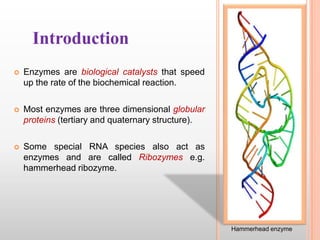
Some special RNA species also act as
enzymes and are called Ribozymes e.g.
hammerhead ribozyme.

Hammerhead enzyme
STRUCTURE OF ENZYMES


The active site of an enzyme is the region that binds
substrates, co-factors and prosthetic groups and contains
residue that helps to hold the substrate.



Active sites generally occupy less than 5% of the total surface
area of enzyme.



Active site has a specific shape due to tertiary structure of
protein.



A change in the shape of protein affects the shape of active
site and function of the enzyme.
ACTIVE SITE
o

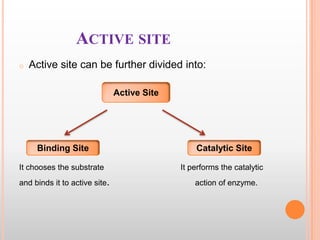
Active site can be further divided into:
Active Site

Binding Site

Catalytic Site

It chooses the substrate

It performs the catalytic

and binds it to active site.

action of enzyme.
CO-FACTORS
o

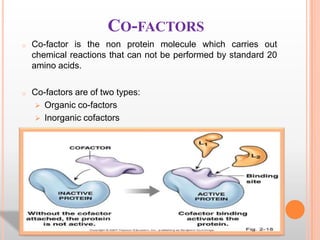
Co-factor is the non protein molecule which carries out
chemical reactions that can not be performed by standard 20
amino acids.

o

Co-factors are of two types:
 Organic co-factors
 Inorganic cofactors
INORGANIC CO-FACTORS
These are the inorganic molecules required for the proper
activity of enzymes.
Examples:
++
Enzyme carbonic anhydrase requires Zn for it‟s activity.
Hexokinase has co-factor Mg

o




++

ORGANIC CO-FACTORS
o



These are the organic molecules required for the proper
activity of enzymes.
Example:
Glycogen phosphorylase requires the small organic
molecule pyridoxal phosphate.
TYPES OF ORGANIC CO-FACTORS
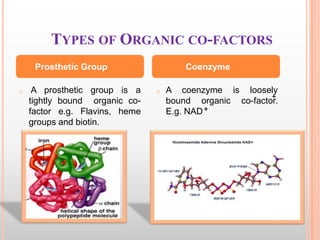
Prosthetic Group
o

A prosthetic group is a
tightly bound organic cofactor e.g. Flavins, heme
groups and biotin.

Coenzyme
o

A coenzyme is loosely
+
bound organic co-factor.
E.g. NAD +
Types of co-factors

Continued…



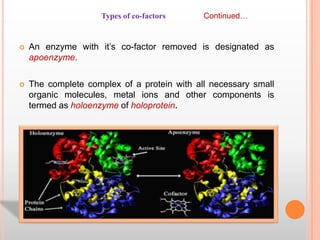
An enzyme with it‟s co-factor removed is designated as
apoenzyme.



The complete complex of a protein with all necessary small
organic molecules, metal ions and other components is
termed as holoenzyme of holoprotein.
SUBSTRATE


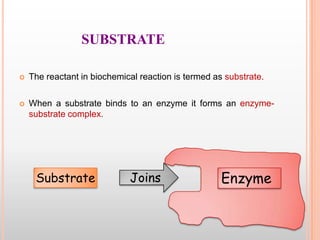
The reactant in biochemical reaction is termed as substrate.



When a substrate binds to an enzyme it forms an enzymesubstrate complex.

Substrate

Joins

Enzyme
SITES OF ENZYME SYNTHESIS
o

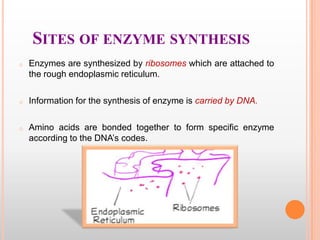
Enzymes are synthesized by ribosomes which are attached to
the rough endoplasmic reticulum.

o

Information for the synthesis of enzyme is carried by DNA.

o

Amino acids are bonded together to form specific enzyme
according to the DNA‟s codes.
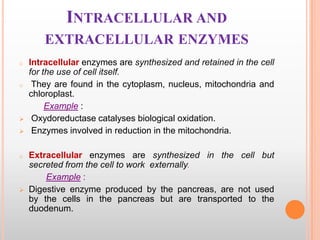
INTRACELLULAR AND
EXTRACELLULAR ENZYMES
o

o




o



Intracellular enzymes are synthesized and retained in the cell
for the use of cell itself.
They are found in the cytoplasm, nucleus, mitochondria and
chloroplast.
Example :
Oxydoreductase catalyses biological oxidation.
Enzymes involved in reduction in the mitochondria.
Extracellular enzymes are synthesized in the cell but
secreted from the cell to work externally.
Example :
Digestive enzyme produced by the pancreas, are not used
by the cells in the pancreas but are transported to the
duodenum.
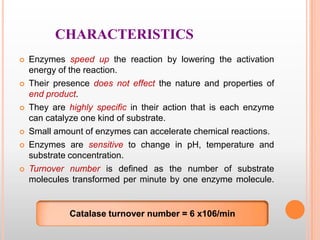
CHARACTERISTICS











Enzymes speed up the reaction by lowering the activation
energy of the reaction.
Their presence does not effect the nature and properties of
end product.
They are highly specific in their action that is each enzyme
can catalyze one kind of substrate.
Small amount of enzymes can accelerate chemical reactions.
Enzymes are sensitive to change in pH, temperature and
substrate concentration.
Turnover number is defined as the number of substrate
molecules transformed per minute by one enzyme molecule.

Catalase turnover number = 6 x10⁶/min
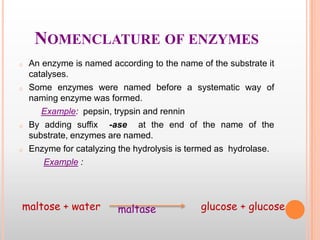
NOMENCLATURE OF ENZYMES
o

o

o

o

An enzyme is named according to the name of the substrate it
catalyses.
Some enzymes were named before a systematic way of
naming enzyme was formed.
Example: pepsin, trypsin and rennin
By adding suffix -ase at the end of the name of the
substrate, enzymes are named.
Enzyme for catalyzing the hydrolysis is termed as hydrolase.
Example :

maltose + water

maltase

glucose + glucose
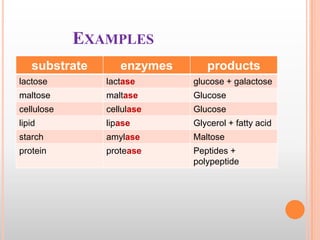
EXAMPLES
substrate

enzymes

products

lactose

lactase

glucose + galactose

maltose

maltase

Glucose

cellulose

cellulase

Glucose

lipid

lipase

Glycerol + fatty acid

starch

amylase

Maltose

protein

protease

Peptides +
polypeptide
CLASSIFICATION
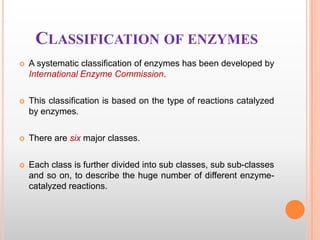
CLASSIFICATION OF ENZYMES


A systematic classification of enzymes has been developed by
International Enzyme Commission.



This classification is based on the type of reactions catalyzed
by enzymes.



There are six major classes.



Each class is further divided into sub classes, sub sub-classes
and so on, to describe the huge number of different enzymecatalyzed reactions.
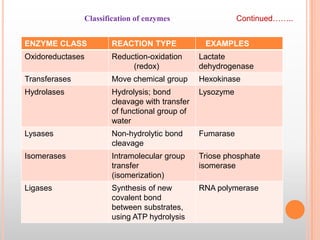
Continued……..

Classification of enzymes
ENZYME CLASS

REACTION TYPE

EXAMPLES

Oxidoreductases

Reduction-oxidation
(redox)

Lactate
dehydrogenase

Transferases

Move chemical group

Hexokinase

Hydrolases

Hydrolysis; bond
cleavage with transfer
of functional group of
water

Lysozyme

Lysases

Non-hydrolytic bond
cleavage

Fumarase

Isomerases

Intramolecular group
transfer
(isomerization)

Triose phosphate
isomerase

Ligases

Synthesis of new
covalent bond
between substrates,
using ATP hydrolysis

RNA polymerase
MECHANISM OF ENZYME
ACTION
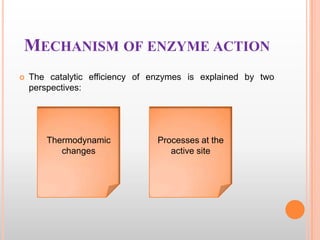
MECHANISM OF ENZYME ACTION


The catalytic efficiency of enzymes is explained by two
perspectives:

Thermodynamic
changes

Processes at the
active site
THERMODYNAMIC CHANGES


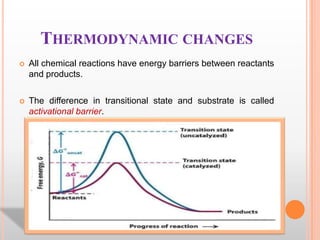
All chemical reactions have energy barriers between reactants
and products.



The difference in transitional state and substrate is called
activational barrier.
THERMODYNAMIC CHANGES











Only a few substances cross the activation barrier and change
into products.
That is why rate of uncatalyzed reactions is much slow.
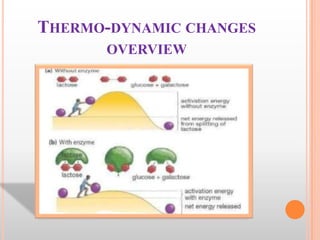
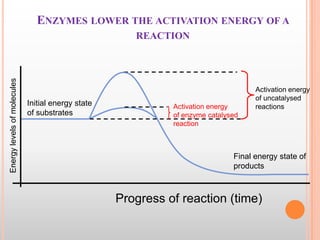
Enzymes provide an alternate pathway for conversion of
substrate into products.
Enzymes accelerate reaction rates by forming transitional
state having low activational energy.
Hence, the reaction rate is increased many folds in the
presence of enzymes.
The total energy of the system remains the same and
equilibrium state is not disturbed.
THERMO-DYNAMIC CHANGES
OVERVIEW
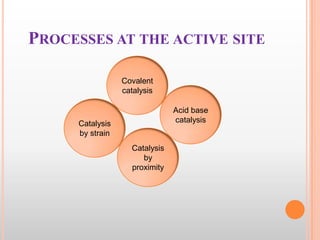
PROCESSES AT THE ACTIVE SITE
Covalent
catalysis
Acid base
catalysis

Catalysis
by strain
Catalysis
by
proximity
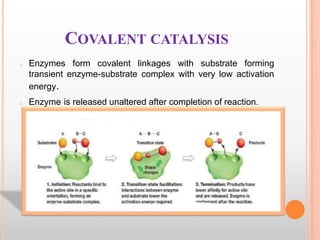
COVALENT CATALYSIS
o

Enzymes form covalent linkages with substrate forming
transient enzyme-substrate complex with very low activation
energy.

o

Enzyme is released unaltered after completion of reaction.
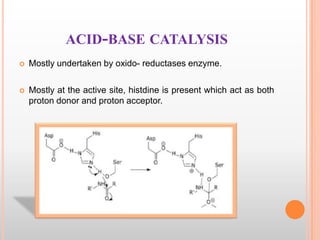
ACID-BASE CATALYSIS


Mostly undertaken by oxido- reductases enzyme.



Mostly at the active site, histdine is present which act as both
proton donor and proton acceptor.
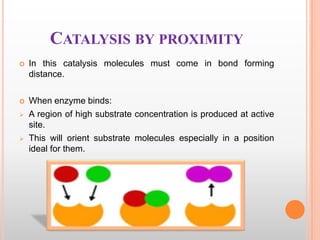
CATALYSIS BY PROXIMITY


In this catalysis molecules must come in bond forming
distance.



When enzyme binds:
A region of high substrate concentration is produced at active
site.
This will orient substrate molecules especially in a position
ideal for them.




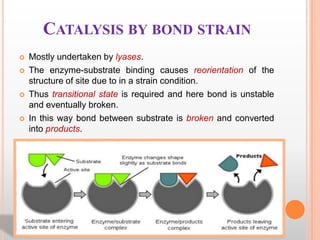
CATALYSIS BY BOND STRAIN







Mostly undertaken by lyases.
The enzyme-substrate binding causes reorientation of the
structure of site due to in a strain condition.
Thus transitional state is required and here bond is unstable
and eventually broken.
In this way bond between substrate is broken and converted
into products.
LOCK AND KEY MODEL





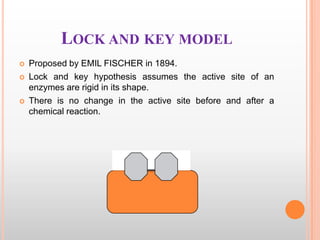
Proposed by EMIL FISCHER in 1894.
Lock and key hypothesis assumes the active site of an
enzymes are rigid in its shape.
There is no change in the active site before and after a
chemical reaction.
INDUCED FIT MODEL




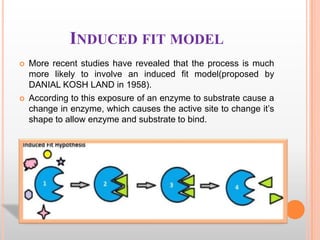
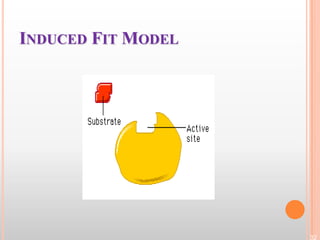
More recent studies have revealed that the process is much
more likely to involve an induced fit model(proposed by
DANIAL KOSH LAND in 1958).
According to this exposure of an enzyme to substrate cause a
change in enzyme, which causes the active site to change it‟s
shape to allow enzyme and substrate to bind.
INDUCED FIT MODEL

32
ENZYMES KINETICS
INTRODUCTION
“It is a branch of biochemistry in which we study the rate of
enzyme catalyzed reactions.”


Kinetic analysis reveals the number and order of the individual
steps by which enzymes transform substrate into products



Studying an enzyme's kinetics in this way can reveal the
catalytic
mechanism
of
that
enzyme,
its
role
in metabolism, how its activity is controlled, and how a drug or
an agonist might inhibit the enzyme
RATES OF REACTION AND THEIR
DEPENDENCE ON ACTIVATION ENERGY
Activation Energy (Ea):
“The least amount of energy needed for a chemical reaction to
take place.”
 Enzyme (as a catalyst) acts on substrate in such a way that
they lower the activation energy by changing the route of the
reaction.
 The reduction of activation energy (Ea) increases the amount
of reactant molecules that achieve a sufficient level of
energy, so that they reach the activation energy and form the
product.
Example:
 Carbonic anhydrase catalyses the hydration of
10⁶ CO₂
molecules per second which is 10⁷x faster than spontaneous
hydration.

ENZYMES LOWER THE ACTIVATION ENERGY OF A

Energy levels of molecules

REACTION

Initial energy state
of substrates

Activation energy
of enzyme catalysed
reaction

Activation energy
of uncatalysed
reactions

Final energy state of
products

Progress of reaction (time)
KINETICS OF ENZYMES CATALYSIS


Enzymes catalysis:

“ It is an increase in the rate of reaction with the help of
enzyme(as catalyst).”




Catalysis by enzymes that proceed via unique reaction
mechanism, typically occurs when the transition state
intermediate forms a covalent bond with the enzyme(covalent
catalysis).
During the process of catalysis enzymes always emerge
unchanged at the completion of the reaction.
FACTORS AFFECTING RATE OF
ENZYME CATALYZED REACTIONS
Temperature
 Hydrogen ion concentration(pH)
 Substrate concentration

EFFECT OF TEMPERATURE









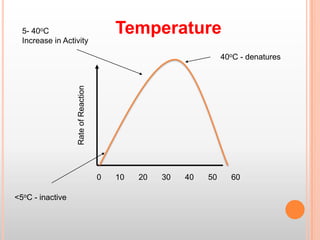
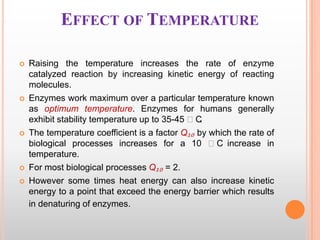
Raising the temperature increases the rate of enzyme
catalyzed reaction by increasing kinetic energy of reacting
molecules.
Enzymes work maximum over a particular temperature known
as optimum temperature. Enzymes for humans generally
exhibit stability temperature up to 35-45 ᵒC
.
The temperature coefficient is a factor Q₁₀ by which the rate of
biological processes increases for a 10 ᵒC increase in
temperature.
For most biological processes Q₁₀ = 2.
However some times heat energy can also increase kinetic
energy to a point that exceed the energy barrier which results
in denaturing of enzymes.
Temperature

5- 40oC
Increase in Activity

Rate of Reaction

40oC - denatures

0
<5oC - inactive

10

20

30

40

50

60
EFFECT OF PH






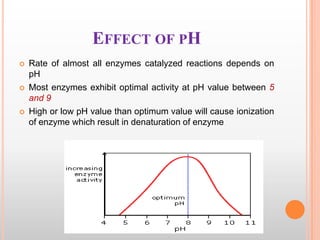
Rate of almost all enzymes catalyzed reactions depends on
pH
Most enzymes exhibit optimal activity at pH value between 5
and 9
High or low pH value than optimum value will cause ionization
of enzyme which result in denaturation of enzyme
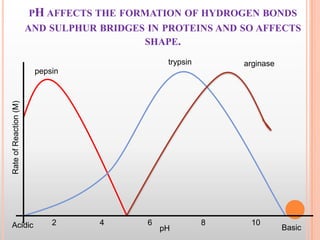
PH AFFECTS THE FORMATION OF HYDROGEN BONDS
AND SULPHUR BRIDGES IN PROTEINS AND SO AFFECTS
SHAPE.
trypsin

arginase

Rate of Reaction (M)

pepsin

Acidic

2

4

6

pH

8

10

Basic
MICHAELIS-MENTEN MODEL & EFFECTS OF
SUBSTRATE CONCENTRATION


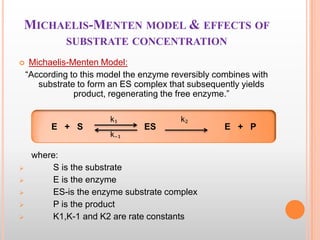
Michaelis-Menten Model:
“According to this model the enzyme reversibly combines with
substrate to form an ES complex that subsequently yields
product, regenerating the free enzyme.”

E + S







k₁
k₋₁

ES

k₂

where:
S is the substrate
E is the enzyme
ES-is the enzyme substrate complex
P is the product
K1,K-1 and K2 are rate constants

E + P
MICHAELIS-MENTEN EQUATION


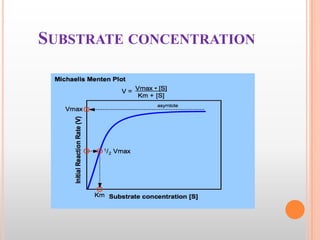
Michaelis-Menten Equation:

“It is an equation which describes how reaction velocity varies
with substrate concentration.”

Vmax [S]
Vo=

Km+[S]






Where
Vo is the initial reaction velocity.
Vmax is the maximum velocity.
Km is the Michaelis constant = (k₋₁+k₂)/k₁.
[S] is the substrate concentration.
ASSUMPTIONS FOR MICHAELIS-MENTEN
EQUATION






Following assumptions are made in deriving the MichaelisMenten equation:
Relative concentrations of E and S.
Steady-State assumptions
Initial Velocity
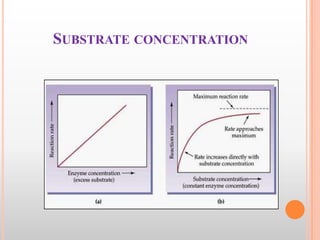
SUBSTRATE CONCENTRATION
PHARMACEUTICAL IMPORTANCE


Enzymes are virtually involved in all physiological processes
which makes them the targets of choice for drugs that cure or
ameliorate human disease.



Applied enzyme kinetics represents the principal tool by which
scientist identify and characterize therapeutic agents that
selectively inhibit the rates of specific enzymes catalyzed
processes.



Enzymes kinetics thus play a critical role in drug discovery as
well as elaborating the mode of action of drugs.
INHIBITION
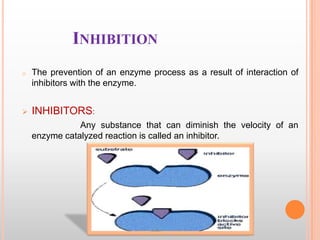
INHIBITION
o

The prevention of an enzyme process as a result of interaction of
inhibitors with the enzyme.



INHIBITORS:
Any substance that can diminish the velocity of an
enzyme catalyzed reaction is called an inhibitor.
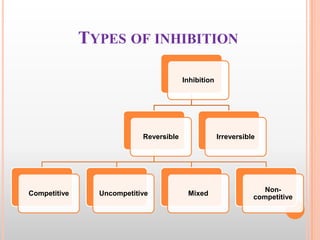
TYPES OF INHIBITION
Inhibition

Reversible

Competitive

Uncompetitive

Irreversible

Mixed

Noncompetitive
REVERSIBLE INHIBITION
o

It is an inhibition of enzyme activity in which the inhibiting
molecular entity can associate and dissociate from the
protein„s binding site.

TYPES OF REVERSIBLE INHIBITION
o

There are four types:



Competitive inhibition.



Uncompetitive inhibition.



Mixed inhibition.



Non-competitive inhibition.
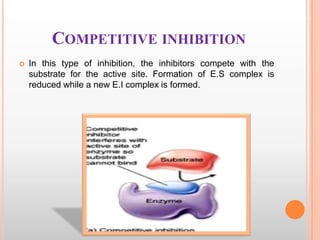
COMPETITIVE INHIBITION


In this type of inhibition, the inhibitors compete with the
substrate for the active site. Formation of E.S complex is
reduced while a new E.I complex is formed.
EXAMPLES OF COMPETITIVE INHIBITION


Statin Drug As Example Of Competitive Inhibition:



Statin drugs such as lipitor compete with HMG-CoA(substrate)
and inhibit the active site of HMG CoA-REDUCTASE (that
bring about the catalysis of cholesterol synthesis).
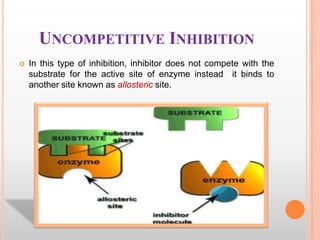
UNCOMPETITIVE INHIBITION


In this type of inhibition, inhibitor does not compete with the
substrate for the active site of enzyme instead it binds to
another site known as allosteric site.
EXAMPLES OF UNCOMPETITIVE
INHIBITION


Drugs to treat cases of poisoning by methanol or ethylene
glycol act as uncompetitive inhibitors.



Tetramethylene sulfoxide and 3- butylthiolene 1-oxide are
uncompetitive inhibitors of liver alcohaldehydrogenase.
MIXED INHIBITION
o

o

In this type of inhibition both E.I and E.S.I complexes are
formed.
Both complexes are catalytically inactive.

NON COMPETITIVE INHIBITION
o
o

It is a special case of inhibition.
In this inhibitor has the same affinity for either enzyme E or
the E.S complex.
IRREVERSIBLE INHIBITION





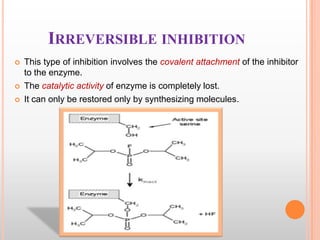
This type of inhibition involves the covalent attachment of the inhibitor
to the enzyme.
The catalytic activity of enzyme is completely lost.
It can only be restored only by synthesizing molecules.
EXAMPLES OF IRREVERSIBLE
INHIBITION


Aspirin which targets and covalently modifies a key enzyme
involved in inflammation is an irreversible inhibitor.



SUICIDE INHIBITION :
It is an unusual type of irreversible inhibition where the
enzyme converts the inhibitor into a reactive form in its active
site.


ACTIVATION
ACTIVATION


Activation is defined as the conversion of an inactive form of
an enzyme to active form which processes the metabolic
activity.

TYPES OF ACTIVATION



Activation by co-factors.
Conversion of an enzyme precursor.
ACTIVATION BY CO FACTORS


Many enzymes are activated by co-factors.

Examples:




DNA polymerase is a holoenzyme that catalyzes the
polymerization of de -oxyribonucleotide into a DNA strand. It
uses Mg- ion for catalytic activity.
Horse liver dehydrogenase uses Zn- ion for it‟s activation.
CONVERSION OF AN ENZYME
PRECURSOR


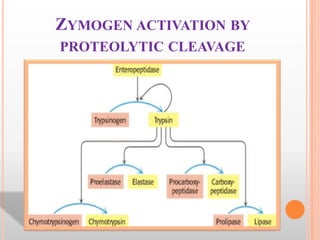
Specific proteolysis is a common method of activating
enzymes and other proteins in biological system.
Example:



The generation of trypsin from trypsinogen leads to the
activation of other zymogens.
ZYMOGEN ACTIVATION BY
PROTEOLYTIC CLEAVAGE
ENZYME SPECIFICITY
ENZYME SPECIFICITY






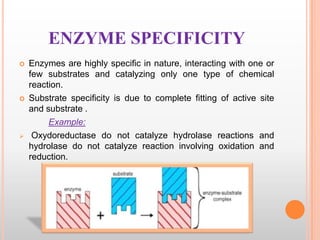
Enzymes are highly specific in nature, interacting with one or
few substrates and catalyzing only one type of chemical
reaction.
Substrate specificity is due to complete fitting of active site
and substrate .
Example:
Oxydoreductase do not catalyze hydrolase reactions and
hydrolase do not catalyze reaction involving oxidation and
reduction.
TYPES OF ENZYME SPECIFICITY


Enzymes show different degrees of specificity:



Bond specificity.
Group specificity.
Absolute specificity.
Optical or stereo-specificity.
Dual specificity.





BOND SPECIFICITY




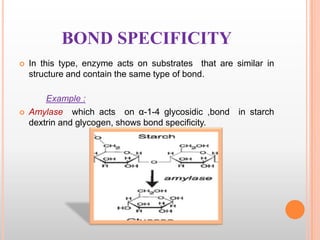
In this type, enzyme acts on substrates that are similar in
structure and contain the same type of bond.
Example :
Amylase which acts on α-1-4 glycosidic ,bond
dextrin and glycogen, shows bond specificity.

in starch
GROUP SPECIFICITY




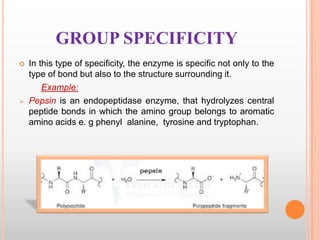
In this type of specificity, the enzyme is specific not only to the
type of bond but also to the structure surrounding it.
Example:
Pepsin is an endopeptidase enzyme, that hydrolyzes central
peptide bonds in which the amino group belongs to aromatic
amino acids e. g phenyl alanine, tyrosine and tryptophan.
SUBSTRATE SPECIFICITY






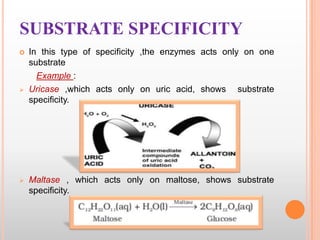
In this type of specificity ,the enzymes acts only on one
substrate
Example :
Uricase ,which acts only on uric acid, shows substrate
specificity.

Maltase , which acts only on maltose, shows substrate
specificity.
OPTICAL / STEREO-SPECIFICITY






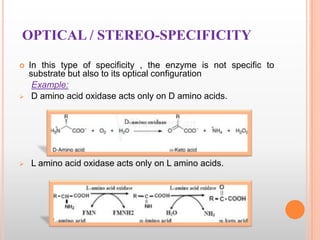
In this type of specificity , the enzyme is not specific to
substrate but also to its optical configuration
Example:
D amino acid oxidase acts only on D amino acids.

L amino acid oxidase acts only on L amino acids.
DUAL SPECIFICITY





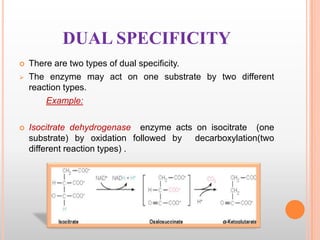
There are two types of dual specificity.
The enzyme may act on one substrate by two different
reaction types.
Example:
Isocitrate dehydrogenase enzyme acts on isocitrate (one
substrate) by oxidation followed by decarboxylation(two
different reaction types) .
DUAL SPECIFICITY


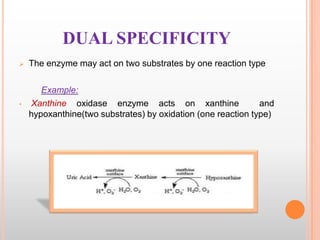
The enzyme may act on two substrates by one reaction type

•

Example:
Xanthine oxidase enzyme acts on xanthine
and
hypoxanthine(two substrates) by oxidation (one reaction type)
REFERENCES
Woodbury.: Biochemistry for the Pharmaceutical
Sciences
 Lehninger.: Principles of biochemistry
 Lippincott.: Biochemistry
 Harper's Illustrated Biochemistry
 Mushtaq Ahmed.: Essentials of Medical
Biochemistry
 Pfeiffer, J.: Enzymes, the Physics and Chemistry of
Life
 Martinek, R.: Practical Clinical Enzymology

Enzymes

Enzymes

  • 1.
    ENZYMES Submitted to: Dr. GulShahnaz Submitted by: Group 1 A Adeel Afzal Fatima Saleh Fatima Zahid Maida Shafiq Najia Hafeez
  • 2.
    CONTENTS  Chemistry  Classification Mechanism of Enzyme Action  Enzyme Kinetics  Inhibition  Activation  Specificity
  • 3.
  • 4.
    Introduction  Enzymes are biologicalcatalysts that speed up the rate of the biochemical reaction.  Most enzymes are three dimensional globular proteins (tertiary and quaternary structure).  Some special RNA species also act as enzymes and are called Ribozymes e.g. hammerhead ribozyme. Hammerhead enzyme
  • 5.
    STRUCTURE OF ENZYMES  Theactive site of an enzyme is the region that binds substrates, co-factors and prosthetic groups and contains residue that helps to hold the substrate.  Active sites generally occupy less than 5% of the total surface area of enzyme.  Active site has a specific shape due to tertiary structure of protein.  A change in the shape of protein affects the shape of active site and function of the enzyme.
  • 6.
    ACTIVE SITE o Active sitecan be further divided into: Active Site Binding Site Catalytic Site It chooses the substrate It performs the catalytic and binds it to active site. action of enzyme.
  • 7.
    CO-FACTORS o Co-factor is thenon protein molecule which carries out chemical reactions that can not be performed by standard 20 amino acids. o Co-factors are of two types:  Organic co-factors  Inorganic cofactors
  • 8.
    INORGANIC CO-FACTORS These arethe inorganic molecules required for the proper activity of enzymes. Examples: ++ Enzyme carbonic anhydrase requires Zn for it‟s activity. Hexokinase has co-factor Mg o   ++ ORGANIC CO-FACTORS o  These are the organic molecules required for the proper activity of enzymes. Example: Glycogen phosphorylase requires the small organic molecule pyridoxal phosphate.
  • 9.
    TYPES OF ORGANICCO-FACTORS Prosthetic Group o A prosthetic group is a tightly bound organic cofactor e.g. Flavins, heme groups and biotin. Coenzyme o A coenzyme is loosely + bound organic co-factor. E.g. NAD +
  • 10.
    Types of co-factors Continued…  Anenzyme with it‟s co-factor removed is designated as apoenzyme.  The complete complex of a protein with all necessary small organic molecules, metal ions and other components is termed as holoenzyme of holoprotein.
  • 11.
    SUBSTRATE  The reactant inbiochemical reaction is termed as substrate.  When a substrate binds to an enzyme it forms an enzymesubstrate complex. Substrate Joins Enzyme
  • 12.
    SITES OF ENZYMESYNTHESIS o Enzymes are synthesized by ribosomes which are attached to the rough endoplasmic reticulum. o Information for the synthesis of enzyme is carried by DNA. o Amino acids are bonded together to form specific enzyme according to the DNA‟s codes.
  • 13.
    INTRACELLULAR AND EXTRACELLULAR ENZYMES o o   o  Intracellularenzymes are synthesized and retained in the cell for the use of cell itself. They are found in the cytoplasm, nucleus, mitochondria and chloroplast. Example : Oxydoreductase catalyses biological oxidation. Enzymes involved in reduction in the mitochondria. Extracellular enzymes are synthesized in the cell but secreted from the cell to work externally. Example : Digestive enzyme produced by the pancreas, are not used by the cells in the pancreas but are transported to the duodenum.
  • 14.
    CHARACTERISTICS       Enzymes speed upthe reaction by lowering the activation energy of the reaction. Their presence does not effect the nature and properties of end product. They are highly specific in their action that is each enzyme can catalyze one kind of substrate. Small amount of enzymes can accelerate chemical reactions. Enzymes are sensitive to change in pH, temperature and substrate concentration. Turnover number is defined as the number of substrate molecules transformed per minute by one enzyme molecule. Catalase turnover number = 6 x10⁶/min
  • 15.
    NOMENCLATURE OF ENZYMES o o o o Anenzyme is named according to the name of the substrate it catalyses. Some enzymes were named before a systematic way of naming enzyme was formed. Example: pepsin, trypsin and rennin By adding suffix -ase at the end of the name of the substrate, enzymes are named. Enzyme for catalyzing the hydrolysis is termed as hydrolase. Example : maltose + water maltase glucose + glucose
  • 16.
  • 17.
  • 18.
    CLASSIFICATION OF ENZYMES  Asystematic classification of enzymes has been developed by International Enzyme Commission.  This classification is based on the type of reactions catalyzed by enzymes.  There are six major classes.  Each class is further divided into sub classes, sub sub-classes and so on, to describe the huge number of different enzymecatalyzed reactions.
  • 19.
    Continued…….. Classification of enzymes ENZYMECLASS REACTION TYPE EXAMPLES Oxidoreductases Reduction-oxidation (redox) Lactate dehydrogenase Transferases Move chemical group Hexokinase Hydrolases Hydrolysis; bond cleavage with transfer of functional group of water Lysozyme Lysases Non-hydrolytic bond cleavage Fumarase Isomerases Intramolecular group transfer (isomerization) Triose phosphate isomerase Ligases Synthesis of new covalent bond between substrates, using ATP hydrolysis RNA polymerase
  • 20.
  • 21.
    MECHANISM OF ENZYMEACTION  The catalytic efficiency of enzymes is explained by two perspectives: Thermodynamic changes Processes at the active site
  • 22.
    THERMODYNAMIC CHANGES  All chemicalreactions have energy barriers between reactants and products.  The difference in transitional state and substrate is called activational barrier.
  • 23.
    THERMODYNAMIC CHANGES       Only afew substances cross the activation barrier and change into products. That is why rate of uncatalyzed reactions is much slow. Enzymes provide an alternate pathway for conversion of substrate into products. Enzymes accelerate reaction rates by forming transitional state having low activational energy. Hence, the reaction rate is increased many folds in the presence of enzymes. The total energy of the system remains the same and equilibrium state is not disturbed.
  • 24.
  • 25.
    PROCESSES AT THEACTIVE SITE Covalent catalysis Acid base catalysis Catalysis by strain Catalysis by proximity
  • 26.
    COVALENT CATALYSIS o Enzymes formcovalent linkages with substrate forming transient enzyme-substrate complex with very low activation energy. o Enzyme is released unaltered after completion of reaction.
  • 27.
    ACID-BASE CATALYSIS  Mostly undertakenby oxido- reductases enzyme.  Mostly at the active site, histdine is present which act as both proton donor and proton acceptor.
  • 28.
    CATALYSIS BY PROXIMITY  Inthis catalysis molecules must come in bond forming distance.  When enzyme binds: A region of high substrate concentration is produced at active site. This will orient substrate molecules especially in a position ideal for them.  
  • 29.
    CATALYSIS BY BONDSTRAIN     Mostly undertaken by lyases. The enzyme-substrate binding causes reorientation of the structure of site due to in a strain condition. Thus transitional state is required and here bond is unstable and eventually broken. In this way bond between substrate is broken and converted into products.
  • 30.
    LOCK AND KEYMODEL    Proposed by EMIL FISCHER in 1894. Lock and key hypothesis assumes the active site of an enzymes are rigid in its shape. There is no change in the active site before and after a chemical reaction.
  • 31.
    INDUCED FIT MODEL   Morerecent studies have revealed that the process is much more likely to involve an induced fit model(proposed by DANIAL KOSH LAND in 1958). According to this exposure of an enzyme to substrate cause a change in enzyme, which causes the active site to change it‟s shape to allow enzyme and substrate to bind.
  • 32.
  • 33.
  • 34.
    INTRODUCTION “It is abranch of biochemistry in which we study the rate of enzyme catalyzed reactions.”  Kinetic analysis reveals the number and order of the individual steps by which enzymes transform substrate into products  Studying an enzyme's kinetics in this way can reveal the catalytic mechanism of that enzyme, its role in metabolism, how its activity is controlled, and how a drug or an agonist might inhibit the enzyme
  • 35.
    RATES OF REACTIONAND THEIR DEPENDENCE ON ACTIVATION ENERGY Activation Energy (Ea): “The least amount of energy needed for a chemical reaction to take place.”  Enzyme (as a catalyst) acts on substrate in such a way that they lower the activation energy by changing the route of the reaction.  The reduction of activation energy (Ea) increases the amount of reactant molecules that achieve a sufficient level of energy, so that they reach the activation energy and form the product. Example:  Carbonic anhydrase catalyses the hydration of 10⁶ CO₂ molecules per second which is 10⁷x faster than spontaneous hydration. 
  • 36.
    ENZYMES LOWER THEACTIVATION ENERGY OF A Energy levels of molecules REACTION Initial energy state of substrates Activation energy of enzyme catalysed reaction Activation energy of uncatalysed reactions Final energy state of products Progress of reaction (time)
  • 37.
    KINETICS OF ENZYMESCATALYSIS  Enzymes catalysis: “ It is an increase in the rate of reaction with the help of enzyme(as catalyst).”   Catalysis by enzymes that proceed via unique reaction mechanism, typically occurs when the transition state intermediate forms a covalent bond with the enzyme(covalent catalysis). During the process of catalysis enzymes always emerge unchanged at the completion of the reaction.
  • 38.
    FACTORS AFFECTING RATEOF ENZYME CATALYZED REACTIONS Temperature  Hydrogen ion concentration(pH)  Substrate concentration 
  • 39.
    EFFECT OF TEMPERATURE      Raisingthe temperature increases the rate of enzyme catalyzed reaction by increasing kinetic energy of reacting molecules. Enzymes work maximum over a particular temperature known as optimum temperature. Enzymes for humans generally exhibit stability temperature up to 35-45 ᵒC . The temperature coefficient is a factor Q₁₀ by which the rate of biological processes increases for a 10 ᵒC increase in temperature. For most biological processes Q₁₀ = 2. However some times heat energy can also increase kinetic energy to a point that exceed the energy barrier which results in denaturing of enzymes.
  • 40.
    Temperature 5- 40oC Increase inActivity Rate of Reaction 40oC - denatures 0 <5oC - inactive 10 20 30 40 50 60
  • 41.
    EFFECT OF PH    Rateof almost all enzymes catalyzed reactions depends on pH Most enzymes exhibit optimal activity at pH value between 5 and 9 High or low pH value than optimum value will cause ionization of enzyme which result in denaturation of enzyme
  • 42.
    PH AFFECTS THEFORMATION OF HYDROGEN BONDS AND SULPHUR BRIDGES IN PROTEINS AND SO AFFECTS SHAPE. trypsin arginase Rate of Reaction (M) pepsin Acidic 2 4 6 pH 8 10 Basic
  • 43.
    MICHAELIS-MENTEN MODEL &EFFECTS OF SUBSTRATE CONCENTRATION  Michaelis-Menten Model: “According to this model the enzyme reversibly combines with substrate to form an ES complex that subsequently yields product, regenerating the free enzyme.” E + S      k₁ k₋₁ ES k₂ where: S is the substrate E is the enzyme ES-is the enzyme substrate complex P is the product K1,K-1 and K2 are rate constants E + P
  • 44.
    MICHAELIS-MENTEN EQUATION  Michaelis-Menten Equation: “Itis an equation which describes how reaction velocity varies with substrate concentration.” Vmax [S] Vo= Km+[S]      Where Vo is the initial reaction velocity. Vmax is the maximum velocity. Km is the Michaelis constant = (k₋₁+k₂)/k₁. [S] is the substrate concentration.
  • 45.
    ASSUMPTIONS FOR MICHAELIS-MENTEN EQUATION     Followingassumptions are made in deriving the MichaelisMenten equation: Relative concentrations of E and S. Steady-State assumptions Initial Velocity
  • 46.
  • 47.
  • 48.
    PHARMACEUTICAL IMPORTANCE  Enzymes arevirtually involved in all physiological processes which makes them the targets of choice for drugs that cure or ameliorate human disease.  Applied enzyme kinetics represents the principal tool by which scientist identify and characterize therapeutic agents that selectively inhibit the rates of specific enzymes catalyzed processes.  Enzymes kinetics thus play a critical role in drug discovery as well as elaborating the mode of action of drugs.
  • 49.
  • 50.
    INHIBITION o The prevention ofan enzyme process as a result of interaction of inhibitors with the enzyme.  INHIBITORS: Any substance that can diminish the velocity of an enzyme catalyzed reaction is called an inhibitor.
  • 51.
  • 52.
    REVERSIBLE INHIBITION o It isan inhibition of enzyme activity in which the inhibiting molecular entity can associate and dissociate from the protein„s binding site. TYPES OF REVERSIBLE INHIBITION o There are four types:  Competitive inhibition.  Uncompetitive inhibition.  Mixed inhibition.  Non-competitive inhibition.
  • 53.
    COMPETITIVE INHIBITION  In thistype of inhibition, the inhibitors compete with the substrate for the active site. Formation of E.S complex is reduced while a new E.I complex is formed.
  • 54.
    EXAMPLES OF COMPETITIVEINHIBITION  Statin Drug As Example Of Competitive Inhibition:  Statin drugs such as lipitor compete with HMG-CoA(substrate) and inhibit the active site of HMG CoA-REDUCTASE (that bring about the catalysis of cholesterol synthesis).
  • 55.
    UNCOMPETITIVE INHIBITION  In thistype of inhibition, inhibitor does not compete with the substrate for the active site of enzyme instead it binds to another site known as allosteric site.
  • 56.
    EXAMPLES OF UNCOMPETITIVE INHIBITION  Drugsto treat cases of poisoning by methanol or ethylene glycol act as uncompetitive inhibitors.  Tetramethylene sulfoxide and 3- butylthiolene 1-oxide are uncompetitive inhibitors of liver alcohaldehydrogenase.
  • 57.
    MIXED INHIBITION o o In thistype of inhibition both E.I and E.S.I complexes are formed. Both complexes are catalytically inactive. NON COMPETITIVE INHIBITION o o It is a special case of inhibition. In this inhibitor has the same affinity for either enzyme E or the E.S complex.
  • 58.
    IRREVERSIBLE INHIBITION    This typeof inhibition involves the covalent attachment of the inhibitor to the enzyme. The catalytic activity of enzyme is completely lost. It can only be restored only by synthesizing molecules.
  • 59.
    EXAMPLES OF IRREVERSIBLE INHIBITION  Aspirinwhich targets and covalently modifies a key enzyme involved in inflammation is an irreversible inhibitor.  SUICIDE INHIBITION : It is an unusual type of irreversible inhibition where the enzyme converts the inhibitor into a reactive form in its active site. 
  • 60.
  • 61.
    ACTIVATION  Activation is definedas the conversion of an inactive form of an enzyme to active form which processes the metabolic activity. TYPES OF ACTIVATION   Activation by co-factors. Conversion of an enzyme precursor.
  • 62.
    ACTIVATION BY COFACTORS  Many enzymes are activated by co-factors. Examples:   DNA polymerase is a holoenzyme that catalyzes the polymerization of de -oxyribonucleotide into a DNA strand. It uses Mg- ion for catalytic activity. Horse liver dehydrogenase uses Zn- ion for it‟s activation.
  • 63.
    CONVERSION OF ANENZYME PRECURSOR  Specific proteolysis is a common method of activating enzymes and other proteins in biological system. Example:  The generation of trypsin from trypsinogen leads to the activation of other zymogens.
  • 64.
  • 65.
  • 66.
    ENZYME SPECIFICITY    Enzymes arehighly specific in nature, interacting with one or few substrates and catalyzing only one type of chemical reaction. Substrate specificity is due to complete fitting of active site and substrate . Example: Oxydoreductase do not catalyze hydrolase reactions and hydrolase do not catalyze reaction involving oxidation and reduction.
  • 67.
    TYPES OF ENZYMESPECIFICITY  Enzymes show different degrees of specificity:  Bond specificity. Group specificity. Absolute specificity. Optical or stereo-specificity. Dual specificity.    
  • 68.
    BOND SPECIFICITY   In thistype, enzyme acts on substrates that are similar in structure and contain the same type of bond. Example : Amylase which acts on α-1-4 glycosidic ,bond dextrin and glycogen, shows bond specificity. in starch
  • 69.
    GROUP SPECIFICITY   In thistype of specificity, the enzyme is specific not only to the type of bond but also to the structure surrounding it. Example: Pepsin is an endopeptidase enzyme, that hydrolyzes central peptide bonds in which the amino group belongs to aromatic amino acids e. g phenyl alanine, tyrosine and tryptophan.
  • 70.
    SUBSTRATE SPECIFICITY    In thistype of specificity ,the enzymes acts only on one substrate Example : Uricase ,which acts only on uric acid, shows substrate specificity. Maltase , which acts only on maltose, shows substrate specificity.
  • 71.
    OPTICAL / STEREO-SPECIFICITY    Inthis type of specificity , the enzyme is not specific to substrate but also to its optical configuration Example: D amino acid oxidase acts only on D amino acids. L amino acid oxidase acts only on L amino acids.
  • 72.
    DUAL SPECIFICITY    There aretwo types of dual specificity. The enzyme may act on one substrate by two different reaction types. Example: Isocitrate dehydrogenase enzyme acts on isocitrate (one substrate) by oxidation followed by decarboxylation(two different reaction types) .
  • 73.
    DUAL SPECIFICITY  The enzymemay act on two substrates by one reaction type • Example: Xanthine oxidase enzyme acts on xanthine and hypoxanthine(two substrates) by oxidation (one reaction type)
  • 74.
    REFERENCES Woodbury.: Biochemistry forthe Pharmaceutical Sciences  Lehninger.: Principles of biochemistry  Lippincott.: Biochemistry  Harper's Illustrated Biochemistry  Mushtaq Ahmed.: Essentials of Medical Biochemistry  Pfeiffer, J.: Enzymes, the Physics and Chemistry of Life  Martinek, R.: Practical Clinical Enzymology 

Editor's Notes