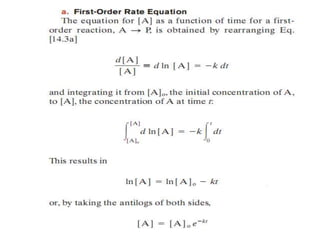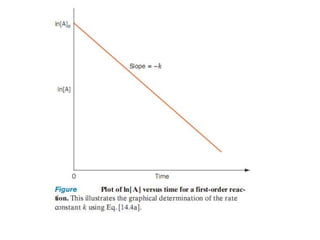
ENZYME KINETICS
Chemical Kinetics
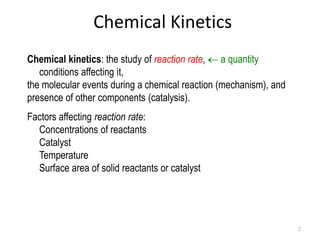
Chemical kinetics: the study of reaction rate, a quantity
   conditions affecting it,
the molecular events during a chemical reaction (mechanism), and
presence of other components (catalysis).
Factors affecting reaction rate:
  Concentrations of reactants
  Catalyst
  Temperature
  Surface area of solid reactants or catalyst


                                                                   2
Elementary vs. overall reactions

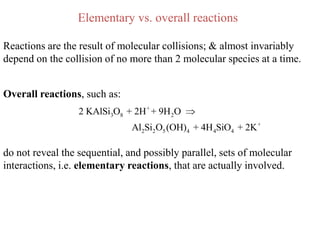
Reactions are the result of molecular collisions; & almost invariably
depend on the collision of no more than 2 molecular species at a time.


Overall reactions, such as:
                  2 KAlSi3O8 + 2H + + 9H 2O
                               Al2Si2O5 (OH)4 + 4H 4SiO4 + 2K +

do not reveal the sequential, and possibly parallel, sets of molecular
interactions, i.e. elementary reactions, that are actually involved.
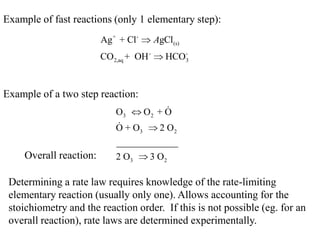
Example of fast reactions (only 1 elementary step):
                        Ag + + Cl -     AgCl(s)
                        CO2,aq + OH -         -
                                           HCO3


Example of a two step reaction:
                            O3     O2 + O
                            
                            O + O3     2 O2
                            _____________
    Overall reaction:       2 O3   3 O2

 Determining a rate law requires knowledge of the rate-limiting
 elementary reaction (usually only one). Allows accounting for the
 stoichiometry and the reaction order. If this is not possible (eg. for an
 overall reaction), rate laws are determined experimentally.
Reaction Rate Defined
Reaction rate: changes in a
concentration of a product or a
                                    []
reactant per unit time.
                [ ] concentration
Reaction rate = ——
                 t change                        [
                                             ]
                                         t


                                                     t
Expressing reaction rates
For a chemical reaction, there are many ways to express the
reaction rate. The relationships among expressions depend on
the equation.
Note the expression and reasons for their relations for the
reaction
       2 NO + O2 (g) = 2 NO2 (g)
                  [O2]        1 [NO]   1 [NO2]
Reaction rate = – ——— = – — ———— = — ———
                   t   2    t    2   t
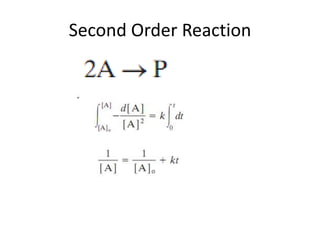
Second Order Reaction
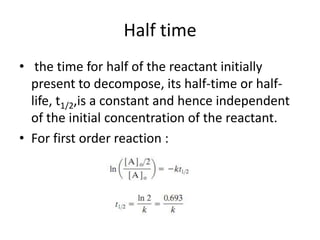
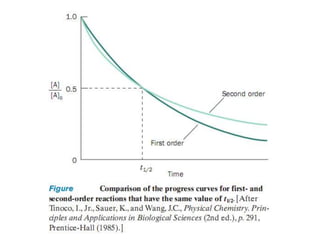
Half time
• the time for half of the reactant initially
  present to decompose, its half-time or half-
  life, t1/2,is a constant and hence independent
  of the initial concentration of the reactant.
• For first order reaction :
Variation of Reaction rates and Order
                  2nd order, rate = k [A]2

  rate

                  First order, rate = k [A]

                          k = rate, 0th
                          order

                          [A]
         [A] = ___?
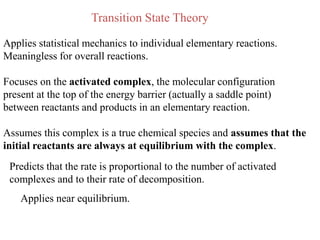
Transition State Theory

Applies statistical mechanics to individual elementary reactions.
Meaningless for overall reactions.

Focuses on the activated complex, the molecular configuration
present at the top of the energy barrier (actually a saddle point)
between reactants and products in an elementary reaction.

Assumes this complex is a true chemical species and assumes that the
initial reactants are always at equilibrium with the complex.
 Predicts that the rate is proportional to the number of activated
 complexes and to their rate of decomposition.
    Applies near equilibrium.
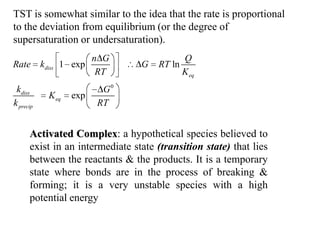
TST is somewhat similar to the idea that the rate is proportional
to the deviation from equilibrium (or the degree of
supersaturation or undersaturation).
                          n G                Q
Rate       kdiss 1 exp           G   RT ln
                           RT                K eq
 kdiss                     G0
             K eq   exp
k precip                  RT


      Activated Complex: a hypothetical species believed to
      exist in an intermediate state (transition state) that lies
      between the reactants & the products. It is a temporary
      state where bonds are in the process of breaking &
      forming; it is a very unstable species with a high
      potential energy
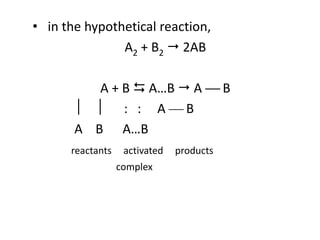
• in the hypothetical reaction,
               A2 + B2  2AB

          A + B  A…B  A                 B
              : : A B
       A B A…B
      reactants    activated   products
                  complex
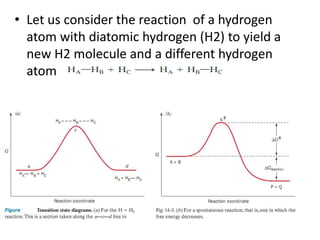
• Let us consider the reaction of a hydrogen
  atom with diatomic hydrogen (H2) to yield a
  new H2 molecule and a different hydrogen
  atom
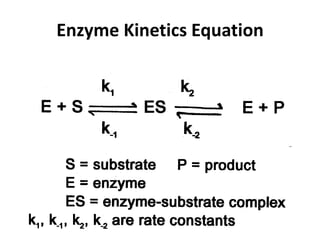
Enzyme Kinetics Equation
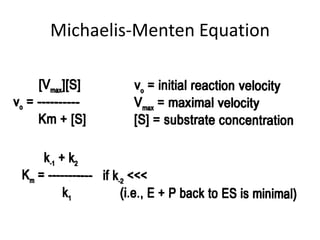
Michaelis-Menten Equation
Initial Velocity (vo) and [S]
• The concentration of substrate [S] present will greatly
  influence the rate of product formation, termed the
  velocity (v) of a reaction. Studying the effects of [S] on
  the velocity of a reaction is complicated by the
  reversibility of enzyme reactions, e.g. conversion of
  product back to substrate. To overcome this problem,
  the use of initial velocity (vo) measurements are used.
  At the start of a reaction, [S] is in large excess of [P],
  thus the initial velocity of the reaction will be
  dependent on substrate concentration
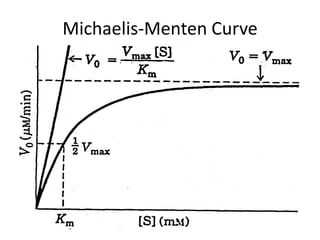
Michaelis-Menten Curve
Initial Velocity (vo) and [S] (cont)
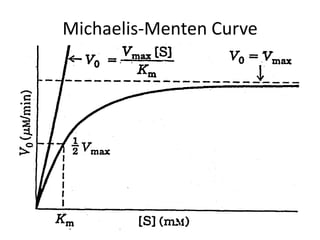
• When initial velocity is plotted against [S], a
  hyperbolic curve results, where Vmax
  represents the maximum reaction velocity. At
  this point in the reaction, if [S] >> E, all
  available enzyme is "saturated" with bound
  substrate, meaning only the ES complex is
  present.
Michaelis-Menten Curve
Substrate Saturation of an Enzyme


A. Low [S] B. 50% [S] or Km C. High, saturating [S]
Steady State Assumption
• The M-M equation was derived in part by making
  several assumptions. An important one was: the
  concentration of substrate must be much greater than
  the enzyme concentration. In the situation where [S]
  >> [E] and at initial velocity rates, it is assumed that the
  changes in the concentration of the intermediate ES
  complex are very small over time (vo). This condition is
  termed a steady-state rate, and is referred to as
  steady-state kinetics. Therefore, it follows that the
  rate of ES formation will be equal to the rate ES
  breakdown.
Michaelis-Menten Equation
               Derivation


• Rate of ES formation = k1([ET] - [ES])[S]
  (where [ET] is total concentration of
  enzyme E and k-2 is considered neglible)
• Rate of ES breakdown to product = k-
  1[ES] + k2[ES]
Michaelis-Menten Equation
            Derivation (cont)

• Thus for the steady state assumption:

• k1([ET] - [ES])[S] = k-1[ES] + k2[ES]

• This equation is the basis for the final Michaelis-
  Menten following algebraic rearrangement and
  substitution of Km and Vmax terms.
Meaning of Km
• An important relationship that can be derived from the
  Michaelis-Menten equation is the following: If vo is set
  equal to 1/2 Vmax, then the relation Vmax /2 = Vmax[S]/Km
  + [S] can be simplied to Km + [S] = 2[S], or Km = [S].
  This means that at one half of the maximal
  velocity, the substrate concentration at this
  velocity will be equal to the Km. This relationship
  has been shown experimentally to be valid for many
  enzymes much more complex in regards to the number of
  substrates and catalytic steps than the simple single
  substrate model used to derive it.
Meaning of Km (cont)
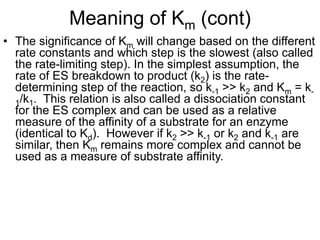
• The significance of Km will change based on the different
  rate constants and which step is the slowest (also called
  the rate-limiting step). In the simplest assumption, the
  rate of ES breakdown to product (k2) is the rate-
  determining step of the reaction, so k-1 >> k2 and Km = k-
  1/k1. This relation is also called a dissociation constant
  for the ES complex and can be used as a relative
  measure of the affinity of a substrate for an enzyme
  (identical to Kd). However if k2 >> k-1 or k2 and k-1 are
  similar, then Km remains more complex and cannot be
  used as a measure of substrate affinity.
Uses of Km
• Experimentally, Km is a useful parameter for
  characterizing the number and/or types of substrates that
  a particular enzyme will utilize (an example will be
  discussed). It is also useful for comparing similar
  enzymes from different tissues or different organisms.
  Also, it is the Km of the rate-limiting enzyme in many of
  the biochemical metabolic pathways that determines the
  amount of product and overall regulation of a given
  pathway. Clinically, Km comparisons are useful for
  evaluating the effects mutations have on protein function
  for some inherited genetic diseases.
Meaning of Vmax
• The values of Vmax will vary widely for different enzymes and
  can be used as an indicator of an enzymes catalytic efficiency.
  It does not find much clinical use.
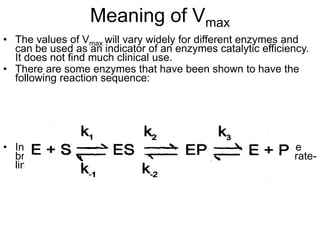
• There are some enzymes that have been shown to have the
  following reaction sequence:


• In this situation, the formation of product is dependent on the
  breakdown of an enzyme-product complex, and is thus the rate-
  limiting step defined by k3.
Important Conclusions of Michaels -
            Menten Kinetics
• when [S]= KM, the equation reduces to


• when [S] >> KM, the equation reduces to


• when [S] << KM, the equation reduces to
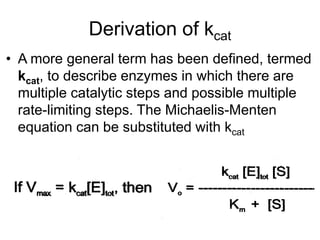
Derivation of kcat
• A more general term has been defined, termed
  kcat, to describe enzymes in which there are
  multiple catalytic steps and possible multiple
  rate-limiting steps. The Michaelis-Menten
  equation can be substituted with kcat
Definition and Use of kcat
• The constant, kcat (units of sec-1), is also called
  the turnover number because under saturating
  substrate conditions, it represents the number
  of substrate molecules converted to product in
  a given unit of time on a single enzyme
  molecule. In practice, kcat values (not Vmax) are
  most often used for comparing the catalytic
  efficiencies of related enzyme classes or
  among different mutant forms of an enzyme.
Lineweaver-Burk (double reciprocal
                   plot)
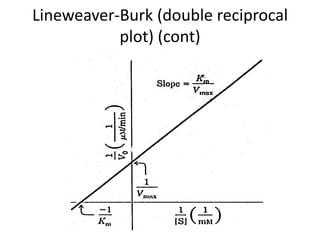
• If the reciprocal (1/X) of the Michaelis-Menten
  equation is done, after algebraic simplification the
  following equation results:


• This relation is written in the format of the equation
  for a straight line, y = mx + b, where y = 1/vo, m
  (slope) = Km/Vmax, x = 1/[S] and the y-intercept, b
  = 1/Vmax. When this relation is plotted,the result is
  a straight line graph
Lineweaver-Burk (double reciprocal
           plot) (cont)
Uses of double reciprocal plot
• The x intercept value is equal to -1/Km.
  The biggest advantage to using the double
  reciprocal plot is a more accurate
  determination of Vmax, and hence Km. It is
  also useful in characterizing the effects of
  enzyme inhibitors and distinguishing
  between different enzyme mechanisms.

Enzyme kinetics

  • 1.
  • 2.
    Chemical Kinetics Chemical kinetics:the study of reaction rate, a quantity conditions affecting it, the molecular events during a chemical reaction (mechanism), and presence of other components (catalysis). Factors affecting reaction rate: Concentrations of reactants Catalyst Temperature Surface area of solid reactants or catalyst 2
  • 3.
    Elementary vs. overallreactions Reactions are the result of molecular collisions; & almost invariably depend on the collision of no more than 2 molecular species at a time. Overall reactions, such as: 2 KAlSi3O8 + 2H + + 9H 2O Al2Si2O5 (OH)4 + 4H 4SiO4 + 2K + do not reveal the sequential, and possibly parallel, sets of molecular interactions, i.e. elementary reactions, that are actually involved.
  • 4.
    Example of fastreactions (only 1 elementary step): Ag + + Cl - AgCl(s) CO2,aq + OH - - HCO3 Example of a two step reaction: O3 O2 + O  O + O3 2 O2 _____________ Overall reaction: 2 O3 3 O2 Determining a rate law requires knowledge of the rate-limiting elementary reaction (usually only one). Allows accounting for the stoichiometry and the reaction order. If this is not possible (eg. for an overall reaction), rate laws are determined experimentally.
  • 5.
    Reaction Rate Defined Reactionrate: changes in a concentration of a product or a [] reactant per unit time. [ ] concentration Reaction rate = —— t change [ ] t t
  • 6.
    Expressing reaction rates Fora chemical reaction, there are many ways to express the reaction rate. The relationships among expressions depend on the equation. Note the expression and reasons for their relations for the reaction 2 NO + O2 (g) = 2 NO2 (g) [O2] 1 [NO] 1 [NO2] Reaction rate = – ——— = – — ———— = — ——— t 2 t 2 t
  • 9.
  • 10.
    Half time • thetime for half of the reactant initially present to decompose, its half-time or half- life, t1/2,is a constant and hence independent of the initial concentration of the reactant. • For first order reaction :
  • 12.
    Variation of Reactionrates and Order 2nd order, rate = k [A]2 rate First order, rate = k [A] k = rate, 0th order [A] [A] = ___?
  • 13.
    Transition State Theory Appliesstatistical mechanics to individual elementary reactions. Meaningless for overall reactions. Focuses on the activated complex, the molecular configuration present at the top of the energy barrier (actually a saddle point) between reactants and products in an elementary reaction. Assumes this complex is a true chemical species and assumes that the initial reactants are always at equilibrium with the complex. Predicts that the rate is proportional to the number of activated complexes and to their rate of decomposition. Applies near equilibrium.
  • 14.
    TST is somewhatsimilar to the idea that the rate is proportional to the deviation from equilibrium (or the degree of supersaturation or undersaturation). n G Q Rate kdiss 1 exp G RT ln RT K eq kdiss G0 K eq exp k precip RT Activated Complex: a hypothetical species believed to exist in an intermediate state (transition state) that lies between the reactants & the products. It is a temporary state where bonds are in the process of breaking & forming; it is a very unstable species with a high potential energy
  • 15.
    • in thehypothetical reaction, A2 + B2  2AB A + B  A…B  A B : : A B A B A…B reactants activated products complex
  • 16.
    • Let usconsider the reaction of a hydrogen atom with diatomic hydrogen (H2) to yield a new H2 molecule and a different hydrogen atom
  • 17.
  • 18.
  • 19.
    Initial Velocity (vo)and [S] • The concentration of substrate [S] present will greatly influence the rate of product formation, termed the velocity (v) of a reaction. Studying the effects of [S] on the velocity of a reaction is complicated by the reversibility of enzyme reactions, e.g. conversion of product back to substrate. To overcome this problem, the use of initial velocity (vo) measurements are used. At the start of a reaction, [S] is in large excess of [P], thus the initial velocity of the reaction will be dependent on substrate concentration
  • 20.
  • 21.
    Initial Velocity (vo)and [S] (cont) • When initial velocity is plotted against [S], a hyperbolic curve results, where Vmax represents the maximum reaction velocity. At this point in the reaction, if [S] >> E, all available enzyme is "saturated" with bound substrate, meaning only the ES complex is present.
  • 22.
  • 23.
    Substrate Saturation ofan Enzyme A. Low [S] B. 50% [S] or Km C. High, saturating [S]
  • 24.
    Steady State Assumption •The M-M equation was derived in part by making several assumptions. An important one was: the concentration of substrate must be much greater than the enzyme concentration. In the situation where [S] >> [E] and at initial velocity rates, it is assumed that the changes in the concentration of the intermediate ES complex are very small over time (vo). This condition is termed a steady-state rate, and is referred to as steady-state kinetics. Therefore, it follows that the rate of ES formation will be equal to the rate ES breakdown.
  • 25.
    Michaelis-Menten Equation Derivation • Rate of ES formation = k1([ET] - [ES])[S] (where [ET] is total concentration of enzyme E and k-2 is considered neglible) • Rate of ES breakdown to product = k- 1[ES] + k2[ES]
  • 26.
    Michaelis-Menten Equation Derivation (cont) • Thus for the steady state assumption: • k1([ET] - [ES])[S] = k-1[ES] + k2[ES] • This equation is the basis for the final Michaelis- Menten following algebraic rearrangement and substitution of Km and Vmax terms.
  • 27.
    Meaning of Km •An important relationship that can be derived from the Michaelis-Menten equation is the following: If vo is set equal to 1/2 Vmax, then the relation Vmax /2 = Vmax[S]/Km + [S] can be simplied to Km + [S] = 2[S], or Km = [S]. This means that at one half of the maximal velocity, the substrate concentration at this velocity will be equal to the Km. This relationship has been shown experimentally to be valid for many enzymes much more complex in regards to the number of substrates and catalytic steps than the simple single substrate model used to derive it.
  • 28.
    Meaning of Km(cont) • The significance of Km will change based on the different rate constants and which step is the slowest (also called the rate-limiting step). In the simplest assumption, the rate of ES breakdown to product (k2) is the rate- determining step of the reaction, so k-1 >> k2 and Km = k- 1/k1. This relation is also called a dissociation constant for the ES complex and can be used as a relative measure of the affinity of a substrate for an enzyme (identical to Kd). However if k2 >> k-1 or k2 and k-1 are similar, then Km remains more complex and cannot be used as a measure of substrate affinity.
  • 29.
    Uses of Km •Experimentally, Km is a useful parameter for characterizing the number and/or types of substrates that a particular enzyme will utilize (an example will be discussed). It is also useful for comparing similar enzymes from different tissues or different organisms. Also, it is the Km of the rate-limiting enzyme in many of the biochemical metabolic pathways that determines the amount of product and overall regulation of a given pathway. Clinically, Km comparisons are useful for evaluating the effects mutations have on protein function for some inherited genetic diseases.
  • 30.
    Meaning of Vmax •The values of Vmax will vary widely for different enzymes and can be used as an indicator of an enzymes catalytic efficiency. It does not find much clinical use. • There are some enzymes that have been shown to have the following reaction sequence: • In this situation, the formation of product is dependent on the breakdown of an enzyme-product complex, and is thus the rate- limiting step defined by k3.
  • 31.
    Important Conclusions ofMichaels - Menten Kinetics • when [S]= KM, the equation reduces to • when [S] >> KM, the equation reduces to • when [S] << KM, the equation reduces to
  • 32.
    Derivation of kcat •A more general term has been defined, termed kcat, to describe enzymes in which there are multiple catalytic steps and possible multiple rate-limiting steps. The Michaelis-Menten equation can be substituted with kcat
  • 33.
    Definition and Useof kcat • The constant, kcat (units of sec-1), is also called the turnover number because under saturating substrate conditions, it represents the number of substrate molecules converted to product in a given unit of time on a single enzyme molecule. In practice, kcat values (not Vmax) are most often used for comparing the catalytic efficiencies of related enzyme classes or among different mutant forms of an enzyme.
  • 34.
    Lineweaver-Burk (double reciprocal plot) • If the reciprocal (1/X) of the Michaelis-Menten equation is done, after algebraic simplification the following equation results: • This relation is written in the format of the equation for a straight line, y = mx + b, where y = 1/vo, m (slope) = Km/Vmax, x = 1/[S] and the y-intercept, b = 1/Vmax. When this relation is plotted,the result is a straight line graph
  • 35.
  • 36.
    Uses of doublereciprocal plot • The x intercept value is equal to -1/Km. The biggest advantage to using the double reciprocal plot is a more accurate determination of Vmax, and hence Km. It is also useful in characterizing the effects of enzyme inhibitors and distinguishing between different enzyme mechanisms.