2/13/2013   By Mohd Anzar Sakharkar   1
Enzymes
     Enzymes are proteins
    which        acts       as
    biocatalyst. It alters the
    rate of reaction in
    biological process.
2/13/2013    By Mohd Anzar Sakharkar
                                       2
Enzyme action
 Like all catalysts, enzymes accelerate the rates of
reactions while experiencing no permanent
chemical modification as a result of their
participation.
 Enzymes can accelerate, often by several orders of
magnitude, reactions that under the mild
conditions                        of        cellular
concentrations, temperature, p H, and pressure
would proceed imperceptibly in the absence of the
enzyme.
2/13/2013           By Mohd Anzar Sakharkar       3
Enzyme Kinetics
   Enzyme kinetics is the study of the chemical
   reactions that are catalysed by enzymes.
   In enzyme kinetics, the reaction rate is measured
   and the effects of varying the conditions of the
   reaction is investigated.
   Studying an enzyme's kinetics in this way can
   reveal the catalytic mechanism of this enzyme


2/13/2013           By Mohd Anzar Sakharkar        4
• Enzymes are usually protein molecules that
    manipulate other molecules               the enzymes'
    substrates.
• These target molecules bind to an enzyme's active
    site and are transformed into products through a
    series of steps known as the enzymatic
    mechanism.
• These mechanisms can be divided into single-
    substrate and multiple-substrate mechanisms.
• Kinetic studies on enzymes that only bind one
    substrate, such as triosephosphate isomerase, aim
    to measure the affinity with which the enzyme
    binds this substrateMohd Anzar Sakharkar
2/13/2013             By and the turnover rate.         5
Michealis-Menten
                 Analysis
• Michaelis–Menten kinetics is one of the simplest
  and best-known models of enzyme kinetics.
• The model serves to explain how an enzyme can
  cause kinetic rate enhancement of a reaction and
  why the rate of a reaction depends on the
  concentration of enzyme present.


 2/13/2013         By Mohd Anzar Sakharkar       6
• To begin our discussion of enzyme
  kinetics, let's define the number of moles of
  product (P) formed per time as V.
• The variable, V, is also referred to as the rate
  of catalysis of an enzyme.
• For different enzymes, V varies with the
  concentration of the substrate, S.
• At low S, V is linearly proportional to S, but
  when S is high relative to the amount of total
  enzyme, V is independent of S.
 2/13/2013         By Mohd Anzar Sakharkar      7
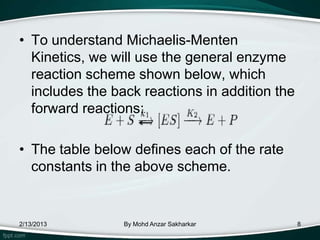
• To understand Michaelis-Menten
  Kinetics, we will use the general enzyme
  reaction scheme shown below, which
  includes the back reactions in addition the
  forward reactions:

• The table below defines each of the rate
  constants in the above scheme.


2/13/2013        By Mohd Anzar Sakharkar        8
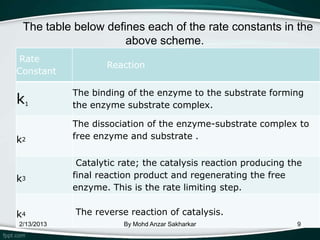
The table below defines each of the rate constants in the
                     above scheme.
Rate
                   Reaction
Constant

            The binding of the enzyme to the substrate forming
k1          the enzyme substrate complex.

            The dissociation of the enzyme-substrate complex to
k2          free enzyme and substrate .

             Catalytic rate; the catalysis reaction producing the
k3          final reaction product and regenerating the free
            enzyme. This is the rate limiting step.


k4          The reverse reaction of catalysis.
2/13/2013              By Mohd Anzar Sakharkar                 9
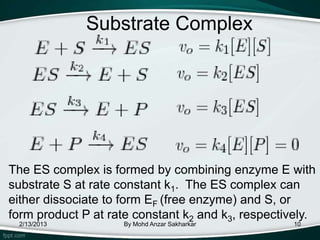
Substrate Complex


The ES complex is formed by combining enzyme E with
substrate S at rate constant k1. The ES complex can
either dissociate to form EF (free enzyme) and S, or
form product P at rate constant k2 and k3, respectively.
 2/13/2013           By Mohd Anzar Sakharkar        10
The velocity equation can be
         derived following method:
• The rates of formation and breakdown of
  the E - S complex are given in terms of
  known quantities:
o The rate of formation of E-S =
     (with the assumption that [P] =0)
o The rate of breakdown of E-S =
                              =
2/13/2013        By Mohd Anzar Sakharkar    11
• At steady state,

                =

 Therefore, rate of formation of E-S = rate of breakdown of E-S

 So,


Dividing through by k1: [E] [S] =                 [E-S]

 Substituting                       with kM:


                                        kM =
   2/13/2013                 By Mohd Anzar Sakharkar        12
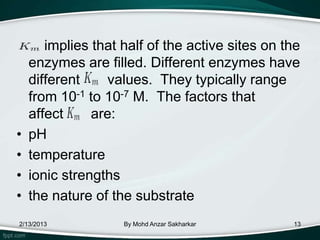
implies that half of the active sites on the
    enzymes are filled. Different enzymes have
    different    values. They typically range
    from 10-1 to 10-7 M. The factors that
    affect     are:
•   pH
•   temperature
•   ionic strengths
•   the nature of the substrate
2/13/2013           By Mohd Anzar Sakharkar      13
• Substituting [EF] with [ET]-[ES]:
                 ET = [ES] + [EF]

            ([ET] - [ES]) [S] = kM [ES]
            [ET] [S] -[ES][S] = kM [ES]
            [ET] [S] = [ES] [S] + kM [ES]
            [ET] [S] = [ES] ([S] + kM)

• Solving for [ES]: [ES] =

2/13/2013         By Mohd Anzar Sakharkar   14
• The rate equation from the rate limiting step is:

                      Vo   =        = k2[ES]
    Multiplying both sides of the equation by k2:
                       k2 [ES] =


                      Vo =

When S>>KM, vo is approximately equal to k2[ET]. When
the [S] great, most of the enzyme is found in the bound
state ([ES]) and Vo = Vmax

We can then substitue k2[ET] with Vmax to get the Michaelis
Menten Kinetic Equation:
  2/13/2013        vo = By Mohd Anzar Sakharkar          15
Lineweaver-Burk Plot
• The Lineweaver–Burk plot is a graphical
  representation of the Lineweaver–Burk equation
  of enzyme kinetics, described by Hans
  Lineweaver and Dean Burk in 1934.


2/13/2013        By Mohd Anzar Sakharkar      16
Derivation
• The plot provides a useful graphical method for
  analysis of the Michaelis-Menten equation:

• Taking the reciprocal gives


                                  Km is the Michaelis–Menten constant
                                   [S] is the
                                   substrate concentration
                                   V is the reaction velocity (the reaction
                                   rate)
2/13/2013          By Mohd Anzar Sakharkar the maximum reaction velocity
                                   Vmax is                             17
2/13/2013   By Mohd Anzar Sakharkar   18
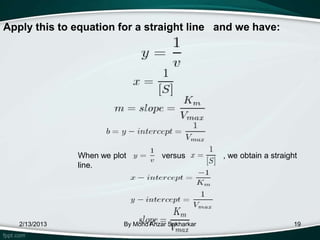
Apply this to equation for a straight line and we have:


               When we plot           versus        , we obtain a straight
               line.


   2/13/2013              By Mohd Anzar Sakharkar                        19
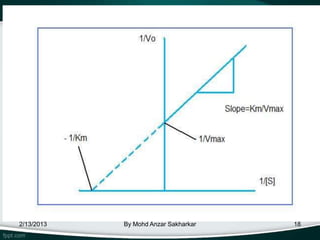
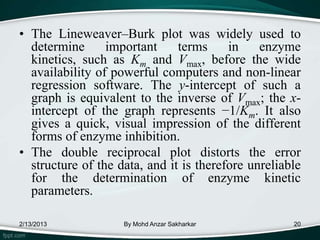
• The Lineweaver–Burk plot was widely used to
  determine      important     terms     in    enzyme
  kinetics, such as Km and Vmax, before the wide
  availability of powerful computers and non-linear
  regression software. The y-intercept of such a
  graph is equivalent to the inverse of Vmax; the x-
  intercept of the graph represents −1/Km. It also
  gives a quick, visual impression of the different
  forms of enzyme inhibition.
• The double reciprocal plot distorts the error
  structure of the data, and it is therefore unreliable
  for the determination of enzyme kinetic
  parameters.

2/13/2013           By Mohd Anzar Sakharkar          20
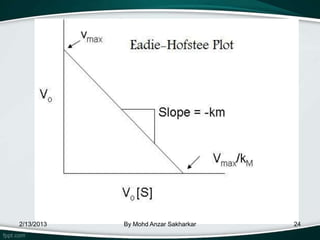
Eadie–Hofstee diagram
• Eadie–Hofstee diagram is a graphical
  representation of enzyme kinetics in
  which reaction velocity is plotted as
  a      function    of      the     velocity
  vs. substrate concentration ratio:

                                        V =reaction velocity

                                        Km = Michaelis–Menten constant
                                       [S] = substrate concentration
                                       Vmax = maximum reaction velocity.
2/13/2013         By Mohd Anzar Sakharkar                         21
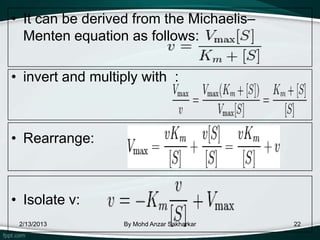
• It can be derived from the Michaelis–
  Menten equation as follows:

• invert and multiply with :


• Rearrange:


• Isolate v:
 2/13/2013        By Mohd Anzar Sakharkar   22
• A plot of v vs v/[S] will yield Vmax as the y-
  intercept, Vmax/Km as the x-intercept, and Km as the
  negative slope.
• Like other techniques that linearize the Michaelis–
  Menten equation, the Eadie-Hofstee plot was used
  historically for rapid identification of important kinetic
  terms like Km and Vmax, but has been superseded
  by nonlinear regression methods that are significantly
  more accurate and no longer computationally
  inaccessible.
• It is also more robust against error-prone data than
  the Lineweaver–Burk plot, particularly because it
  gives equal weight to data points in any range of
  substrate concentration or reaction velocity.
• Both plots remain useful as a means to present data
  graphically.
 2/13/2013            By Mohd Anzar Sakharkar           23
2/13/2013   By Mohd Anzar Sakharkar   24
BIBILIOGRAPHY
• Atkins, Peter and de Paula, Julio. Physical
  Chemistry for the Life Sciences. New
  York, NY: W. H. Freeman and
  Company, 2006. Page 309-313.
• Stryer, Lubert. Biochemistry (Third Edition).
  New York, NY: W.H. Freeman and
  Company, 1988. Page 187-191.
• Chang, Raymond. Physical Chemistry for the
  Biosciences. Sansalito, CA: University
  Science, 2005. Page 363-371.

2/13/2013        By Mohd Anzar Sakharkar      25

Enzyme kinetics

  • 1.
    2/13/2013 By Mohd Anzar Sakharkar 1
  • 2.
    Enzymes Enzymes are proteins which acts as biocatalyst. It alters the rate of reaction in biological process. 2/13/2013 By Mohd Anzar Sakharkar 2
  • 3.
    Enzyme action Likeall catalysts, enzymes accelerate the rates of reactions while experiencing no permanent chemical modification as a result of their participation. Enzymes can accelerate, often by several orders of magnitude, reactions that under the mild conditions of cellular concentrations, temperature, p H, and pressure would proceed imperceptibly in the absence of the enzyme. 2/13/2013 By Mohd Anzar Sakharkar 3
  • 4.
    Enzyme Kinetics Enzyme kinetics is the study of the chemical reactions that are catalysed by enzymes. In enzyme kinetics, the reaction rate is measured and the effects of varying the conditions of the reaction is investigated. Studying an enzyme's kinetics in this way can reveal the catalytic mechanism of this enzyme 2/13/2013 By Mohd Anzar Sakharkar 4
  • 5.
    • Enzymes areusually protein molecules that manipulate other molecules the enzymes' substrates. • These target molecules bind to an enzyme's active site and are transformed into products through a series of steps known as the enzymatic mechanism. • These mechanisms can be divided into single- substrate and multiple-substrate mechanisms. • Kinetic studies on enzymes that only bind one substrate, such as triosephosphate isomerase, aim to measure the affinity with which the enzyme binds this substrateMohd Anzar Sakharkar 2/13/2013 By and the turnover rate. 5
  • 6.
    Michealis-Menten Analysis • Michaelis–Menten kinetics is one of the simplest and best-known models of enzyme kinetics. • The model serves to explain how an enzyme can cause kinetic rate enhancement of a reaction and why the rate of a reaction depends on the concentration of enzyme present. 2/13/2013 By Mohd Anzar Sakharkar 6
  • 7.
    • To beginour discussion of enzyme kinetics, let's define the number of moles of product (P) formed per time as V. • The variable, V, is also referred to as the rate of catalysis of an enzyme. • For different enzymes, V varies with the concentration of the substrate, S. • At low S, V is linearly proportional to S, but when S is high relative to the amount of total enzyme, V is independent of S. 2/13/2013 By Mohd Anzar Sakharkar 7
  • 8.
    • To understandMichaelis-Menten Kinetics, we will use the general enzyme reaction scheme shown below, which includes the back reactions in addition the forward reactions: • The table below defines each of the rate constants in the above scheme. 2/13/2013 By Mohd Anzar Sakharkar 8
  • 9.
    The table belowdefines each of the rate constants in the above scheme. Rate Reaction Constant The binding of the enzyme to the substrate forming k1 the enzyme substrate complex. The dissociation of the enzyme-substrate complex to k2 free enzyme and substrate . Catalytic rate; the catalysis reaction producing the k3 final reaction product and regenerating the free enzyme. This is the rate limiting step. k4 The reverse reaction of catalysis. 2/13/2013 By Mohd Anzar Sakharkar 9
  • 10.
    Substrate Complex The EScomplex is formed by combining enzyme E with substrate S at rate constant k1. The ES complex can either dissociate to form EF (free enzyme) and S, or form product P at rate constant k2 and k3, respectively. 2/13/2013 By Mohd Anzar Sakharkar 10
  • 11.
    The velocity equationcan be derived following method: • The rates of formation and breakdown of the E - S complex are given in terms of known quantities: o The rate of formation of E-S = (with the assumption that [P] =0) o The rate of breakdown of E-S = = 2/13/2013 By Mohd Anzar Sakharkar 11
  • 12.
    • At steadystate, = Therefore, rate of formation of E-S = rate of breakdown of E-S So, Dividing through by k1: [E] [S] = [E-S] Substituting with kM: kM = 2/13/2013 By Mohd Anzar Sakharkar 12
  • 13.
    implies that halfof the active sites on the enzymes are filled. Different enzymes have different values. They typically range from 10-1 to 10-7 M. The factors that affect are: • pH • temperature • ionic strengths • the nature of the substrate 2/13/2013 By Mohd Anzar Sakharkar 13
  • 14.
    • Substituting [EF]with [ET]-[ES]: ET = [ES] + [EF] ([ET] - [ES]) [S] = kM [ES] [ET] [S] -[ES][S] = kM [ES] [ET] [S] = [ES] [S] + kM [ES] [ET] [S] = [ES] ([S] + kM) • Solving for [ES]: [ES] = 2/13/2013 By Mohd Anzar Sakharkar 14
  • 15.
    • The rateequation from the rate limiting step is: Vo = = k2[ES] Multiplying both sides of the equation by k2: k2 [ES] = Vo = When S>>KM, vo is approximately equal to k2[ET]. When the [S] great, most of the enzyme is found in the bound state ([ES]) and Vo = Vmax We can then substitue k2[ET] with Vmax to get the Michaelis Menten Kinetic Equation: 2/13/2013 vo = By Mohd Anzar Sakharkar 15
  • 16.
    Lineweaver-Burk Plot • TheLineweaver–Burk plot is a graphical representation of the Lineweaver–Burk equation of enzyme kinetics, described by Hans Lineweaver and Dean Burk in 1934. 2/13/2013 By Mohd Anzar Sakharkar 16
  • 17.
    Derivation • The plotprovides a useful graphical method for analysis of the Michaelis-Menten equation: • Taking the reciprocal gives Km is the Michaelis–Menten constant [S] is the substrate concentration V is the reaction velocity (the reaction rate) 2/13/2013 By Mohd Anzar Sakharkar the maximum reaction velocity Vmax is 17
  • 18.
    2/13/2013 By Mohd Anzar Sakharkar 18
  • 19.
    Apply this toequation for a straight line and we have: When we plot versus , we obtain a straight line. 2/13/2013 By Mohd Anzar Sakharkar 19
  • 20.
    • The Lineweaver–Burkplot was widely used to determine important terms in enzyme kinetics, such as Km and Vmax, before the wide availability of powerful computers and non-linear regression software. The y-intercept of such a graph is equivalent to the inverse of Vmax; the x- intercept of the graph represents −1/Km. It also gives a quick, visual impression of the different forms of enzyme inhibition. • The double reciprocal plot distorts the error structure of the data, and it is therefore unreliable for the determination of enzyme kinetic parameters. 2/13/2013 By Mohd Anzar Sakharkar 20
  • 21.
    Eadie–Hofstee diagram • Eadie–Hofsteediagram is a graphical representation of enzyme kinetics in which reaction velocity is plotted as a function of the velocity vs. substrate concentration ratio: V =reaction velocity Km = Michaelis–Menten constant [S] = substrate concentration Vmax = maximum reaction velocity. 2/13/2013 By Mohd Anzar Sakharkar 21
  • 22.
    • It canbe derived from the Michaelis– Menten equation as follows: • invert and multiply with : • Rearrange: • Isolate v: 2/13/2013 By Mohd Anzar Sakharkar 22
  • 23.
    • A plotof v vs v/[S] will yield Vmax as the y- intercept, Vmax/Km as the x-intercept, and Km as the negative slope. • Like other techniques that linearize the Michaelis– Menten equation, the Eadie-Hofstee plot was used historically for rapid identification of important kinetic terms like Km and Vmax, but has been superseded by nonlinear regression methods that are significantly more accurate and no longer computationally inaccessible. • It is also more robust against error-prone data than the Lineweaver–Burk plot, particularly because it gives equal weight to data points in any range of substrate concentration or reaction velocity. • Both plots remain useful as a means to present data graphically. 2/13/2013 By Mohd Anzar Sakharkar 23
  • 24.
    2/13/2013 By Mohd Anzar Sakharkar 24
  • 25.
    BIBILIOGRAPHY • Atkins, Peterand de Paula, Julio. Physical Chemistry for the Life Sciences. New York, NY: W. H. Freeman and Company, 2006. Page 309-313. • Stryer, Lubert. Biochemistry (Third Edition). New York, NY: W.H. Freeman and Company, 1988. Page 187-191. • Chang, Raymond. Physical Chemistry for the Biosciences. Sansalito, CA: University Science, 2005. Page 363-371. 2/13/2013 By Mohd Anzar Sakharkar 25