Kinetics of
Enzyme
catalyzed
reaction
MICHAELIS MENTEN EQUATION
Devised in 1913
By Leonor Michaelis and Maud Menten
While studying about the enzyme Invertase- converts disaccharide into monosaccharide
It explains the relationship between Reaction velocity and Substrate concentration
MICHAELIS MENTEN HYPOTHESIS
The theory is, however, based on the following assumptions :
 Only a single substrate and a single product are involved
 The process proceeds essentially to completion
 The concentration of the substrate is much greater than that of the enzyme in the system
 An intermediate enzyme-substrate complex is formed
 The rate of decomposition of the substrate is proportional to the concentration of
the enzyme substrate complex
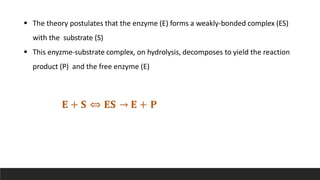
 The theory postulates that the enzyme (E) forms a weakly-bonded complex (ES)
with the substrate (S)
 This enyzme-substrate complex, on hydrolysis, decomposes to yield the reaction
product (P) and the free enzyme (E)
𝐄 + 𝐒 ⇔ 𝐄𝐒 → 𝐄 + 𝐏
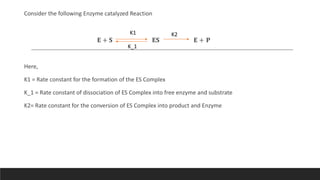
Consider the following Enzyme catalyzed Reaction
𝐄 + 𝐒 𝐄𝐒 𝐄 + 𝐏
Here,
K1 = Rate constant for the formation of the ES Complex
K_1 = Rate constant of dissociation of ES Complex into free enzyme and substrate
K2= Rate constant for the conversion of ES Complex into product and Enzyme
K1
K_1
K2
𝐄 + 𝐒 𝐄𝐒 𝐄 + 𝐏
Rate of formation of ES = k1[E][S].
Rate of consumption of ES = k-1[ES] + k2 [ES]
In the steady state, k-1[ES] + k2 [ES] = k1[E][S]
(k-1 + k2) [ES] = k1[E][S]
(k-1 + k2)/k1 = [E][S]/[ES]
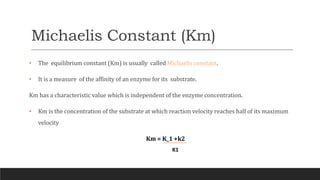
The equilibrium constant (Km) is usually called Michaelis constant
Km = (k-1 + k2)/k1
[E] = [E]total - [ES]
Km = ([E]total - [ES]) [S]/[ES]
K1
K_1
K2
Factor [ES] from the left-hand terms:
[ES](Km + [S]) = [E]total [S]
finally, divide both sides by (Km + [S]):
[ES] = [E]total [S]/(Km + [S])
V = k2 [E]total [S]/(Km + [S])
( Vmax = k2 [E]total)
𝑽 =
𝑽𝒎𝒂𝒙[𝑺]
𝑲𝒎+[𝑺]
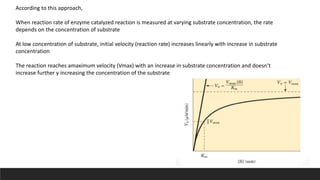
According to this approach,
When reaction rate of enzyme catalyzed reaction is measured at varying substrate concentration, the rate
depends on the concentration of substrate
At low concentration of substrate, initial velocity (reaction rate) increases linearly with increase in substrate
concentration
The reaction reaches amaximum velocity (Vmax) with an increase in substrate concentration and doesn’t
increase further y increasing the concentration of the substrate
The Reaction Velocity Vs Substrate concentration graph gives a parabolic plot.
The plot provides a useful graphical method for analysis of the Michaelis–Menten equation, as it is
difficult to determine precisely the Vmax of an enzyme-catalysed reaction:
The slope of this plot;
𝟏
𝑽
=
𝑲𝒎 + [𝑺]
𝑽𝒎𝒂𝒙[𝑺]
=
𝑲𝒎
𝑽𝒎𝒂𝒙
𝟏
[𝑺]
+
𝟏
𝑽𝒎𝒂𝒙
𝑽 =
𝑽𝒎𝒂𝒙[𝑺]
𝑲𝒎 + [𝑺]
𝑽 =
𝑽𝒎𝒂𝒙[𝑺]
𝑲𝒎+[𝑺]
V =Velocity/Speed of reaction
Vmax = Max. Velocity of reaction
S =Substrate concentration
Km= Michaelis Menten Constant
• This can be used to calculate Km after experimentally determining the reaction rates at various
substrate concentrations
 At low concentration of substrate, Km >> [S]
V= Vm [S]
Km
the rate is of 1st order, depends on the [S]
 At high concentration of substrate, Km << [S]
V= Vm
The rate is zero order
 The value of Km can also be obtained from the plot.
When Km = [S], then
V= Vm/ 2
Michaelis Constant (Km)
• The equilibrium constant (Km) is usually called Michaelis constant.
• It is a measure of the affinity of an enzyme for its substrate.
Km has a characteristic value which is independent of the enzyme concentration.
• Km is the concentration of the substrate at which reaction velocity reaches half of its maximum
velocity
Km = K_1 +k2
K1
Significance of value of Km
 Km value is used as a measure of an enzyme’s affinity for its substrate.
The lower the Km value the higher the enzyme’s affinity for the substrate and vice versa
 It provides an idea of the strength of binding of the substrate to the enzyme molecule.
The lower the Km value the more tightly bound the substrate is to the enzyme for the reaction to
be catalyzed and vice versa.
 The value indicates the lowest concentration of the substrate [S] the enzyme can
recognize before reaction catalysis can occur.
• An enzyme's Km describes- the substrate concentration at which half the enzyme's active sites are
occupied by substrate
• Km value is also used as a measure of the substrate concentration [S] when the reaction rate half
maximal velocity (50%). i.e Km = [S] at ½ Vmax.
Significance of value of Vm
It is the maximum Reaction rate that can be attained by enzyme in a given concentration
ie, rate at which total enzyme concentration exist as Enzyme-Substrate complex
The maximal rate (Vmax) reveals the turnover number of an enzyme
i.e. the number of substrate molecules being catalysed per second.
This varies considerably from enzymes to enzyme
Eg) Vm= 10 for lysozyme
Vm= 600,000 for carbonic anhydrase.
Lineweaver Burk Plot
It is very difficult to determine Vm directly from a plot of V against [S]
Thus the Michaelis Menten equation can be rearranged to give convenient representation.
The plot between 1/V and 1/[S] is known as Lineweaver-Burk Plot
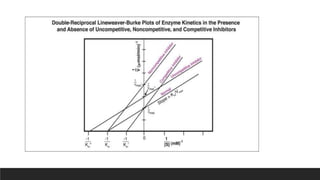
The Lineweaver–Burk plot was widely used to determine important terms in enzyme kinetics, such
as Km and Vmax.
The y-intercept of such a graph is equivalent to the inverse of Vmax; the x-intercept of the graph
represents 1/Km.
It also gives a quick, visual impression of the different forms of enzyme inhibition.
We can distinguish competitive, non-competitive and uncompetitive inhibitors from this plot.
• Competitive inhibitors have the same y-intercept as uninhibited enzyme (since Vmax is
unaffected by competitive inhibitors the inverse of Vmax also doesn't change) but there are
different slopes and x-intercepts between the plots.
• Non-competitive inhibition produces plots with the same x-intercept as uninhibited enzyme
(Km is unaffected) but different slopes and y-intercepts.
• Uncompetitive inhibition causes different intercepts on both the y- and x-axes .
THANK YOU

Michaelis Menten Reaction

  • 1.
  • 2.
    MICHAELIS MENTEN EQUATION Devisedin 1913 By Leonor Michaelis and Maud Menten While studying about the enzyme Invertase- converts disaccharide into monosaccharide It explains the relationship between Reaction velocity and Substrate concentration
  • 3.
    MICHAELIS MENTEN HYPOTHESIS Thetheory is, however, based on the following assumptions :  Only a single substrate and a single product are involved  The process proceeds essentially to completion  The concentration of the substrate is much greater than that of the enzyme in the system  An intermediate enzyme-substrate complex is formed  The rate of decomposition of the substrate is proportional to the concentration of the enzyme substrate complex
  • 4.
     The theorypostulates that the enzyme (E) forms a weakly-bonded complex (ES) with the substrate (S)  This enyzme-substrate complex, on hydrolysis, decomposes to yield the reaction product (P) and the free enzyme (E) 𝐄 + 𝐒 ⇔ 𝐄𝐒 → 𝐄 + 𝐏
  • 5.
    Consider the followingEnzyme catalyzed Reaction 𝐄 + 𝐒 𝐄𝐒 𝐄 + 𝐏 Here, K1 = Rate constant for the formation of the ES Complex K_1 = Rate constant of dissociation of ES Complex into free enzyme and substrate K2= Rate constant for the conversion of ES Complex into product and Enzyme K1 K_1 K2
  • 6.
    𝐄 + 𝐒𝐄𝐒 𝐄 + 𝐏 Rate of formation of ES = k1[E][S]. Rate of consumption of ES = k-1[ES] + k2 [ES] In the steady state, k-1[ES] + k2 [ES] = k1[E][S] (k-1 + k2) [ES] = k1[E][S] (k-1 + k2)/k1 = [E][S]/[ES] The equilibrium constant (Km) is usually called Michaelis constant Km = (k-1 + k2)/k1 [E] = [E]total - [ES] Km = ([E]total - [ES]) [S]/[ES] K1 K_1 K2
  • 7.
    Factor [ES] fromthe left-hand terms: [ES](Km + [S]) = [E]total [S] finally, divide both sides by (Km + [S]): [ES] = [E]total [S]/(Km + [S]) V = k2 [E]total [S]/(Km + [S]) ( Vmax = k2 [E]total) 𝑽 = 𝑽𝒎𝒂𝒙[𝑺] 𝑲𝒎+[𝑺]
  • 8.
    According to thisapproach, When reaction rate of enzyme catalyzed reaction is measured at varying substrate concentration, the rate depends on the concentration of substrate At low concentration of substrate, initial velocity (reaction rate) increases linearly with increase in substrate concentration The reaction reaches amaximum velocity (Vmax) with an increase in substrate concentration and doesn’t increase further y increasing the concentration of the substrate
  • 9.
    The Reaction VelocityVs Substrate concentration graph gives a parabolic plot. The plot provides a useful graphical method for analysis of the Michaelis–Menten equation, as it is difficult to determine precisely the Vmax of an enzyme-catalysed reaction: The slope of this plot; 𝟏 𝑽 = 𝑲𝒎 + [𝑺] 𝑽𝒎𝒂𝒙[𝑺] = 𝑲𝒎 𝑽𝒎𝒂𝒙 𝟏 [𝑺] + 𝟏 𝑽𝒎𝒂𝒙 𝑽 = 𝑽𝒎𝒂𝒙[𝑺] 𝑲𝒎 + [𝑺]
  • 10.
    𝑽 = 𝑽𝒎𝒂𝒙[𝑺] 𝑲𝒎+[𝑺] V =Velocity/Speedof reaction Vmax = Max. Velocity of reaction S =Substrate concentration Km= Michaelis Menten Constant • This can be used to calculate Km after experimentally determining the reaction rates at various substrate concentrations
  • 11.
     At lowconcentration of substrate, Km >> [S] V= Vm [S] Km the rate is of 1st order, depends on the [S]  At high concentration of substrate, Km << [S] V= Vm The rate is zero order  The value of Km can also be obtained from the plot. When Km = [S], then V= Vm/ 2
  • 12.
    Michaelis Constant (Km) •The equilibrium constant (Km) is usually called Michaelis constant. • It is a measure of the affinity of an enzyme for its substrate. Km has a characteristic value which is independent of the enzyme concentration. • Km is the concentration of the substrate at which reaction velocity reaches half of its maximum velocity Km = K_1 +k2 K1
  • 13.
    Significance of valueof Km  Km value is used as a measure of an enzyme’s affinity for its substrate. The lower the Km value the higher the enzyme’s affinity for the substrate and vice versa  It provides an idea of the strength of binding of the substrate to the enzyme molecule. The lower the Km value the more tightly bound the substrate is to the enzyme for the reaction to be catalyzed and vice versa.  The value indicates the lowest concentration of the substrate [S] the enzyme can recognize before reaction catalysis can occur.
  • 14.
    • An enzyme'sKm describes- the substrate concentration at which half the enzyme's active sites are occupied by substrate • Km value is also used as a measure of the substrate concentration [S] when the reaction rate half maximal velocity (50%). i.e Km = [S] at ½ Vmax.
  • 15.
    Significance of valueof Vm It is the maximum Reaction rate that can be attained by enzyme in a given concentration ie, rate at which total enzyme concentration exist as Enzyme-Substrate complex The maximal rate (Vmax) reveals the turnover number of an enzyme i.e. the number of substrate molecules being catalysed per second. This varies considerably from enzymes to enzyme Eg) Vm= 10 for lysozyme Vm= 600,000 for carbonic anhydrase.
  • 16.
    Lineweaver Burk Plot Itis very difficult to determine Vm directly from a plot of V against [S] Thus the Michaelis Menten equation can be rearranged to give convenient representation. The plot between 1/V and 1/[S] is known as Lineweaver-Burk Plot
  • 17.
    The Lineweaver–Burk plotwas widely used to determine important terms in enzyme kinetics, such as Km and Vmax. The y-intercept of such a graph is equivalent to the inverse of Vmax; the x-intercept of the graph represents 1/Km. It also gives a quick, visual impression of the different forms of enzyme inhibition. We can distinguish competitive, non-competitive and uncompetitive inhibitors from this plot. • Competitive inhibitors have the same y-intercept as uninhibited enzyme (since Vmax is unaffected by competitive inhibitors the inverse of Vmax also doesn't change) but there are different slopes and x-intercepts between the plots. • Non-competitive inhibition produces plots with the same x-intercept as uninhibited enzyme (Km is unaffected) but different slopes and y-intercepts. • Uncompetitive inhibition causes different intercepts on both the y- and x-axes .
  • 19.