IONIC COMPOUNDS
NKCSD
Formation and Properties of Ionic Compounds
Why do ionic bonds form?
How are ionic compounds formed?
What are the properties of ionic compounds?
1
Recall:
• Elements are the simplest of substances that cannot
be broken down further by chemical or physical
means.
• Each element is made up of just one particular type
of atom, which is different from the atoms in any
other element.
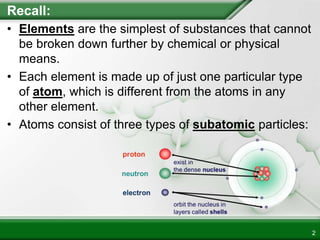
• Atoms consist of three types of subatomic particles:
2
Recall:
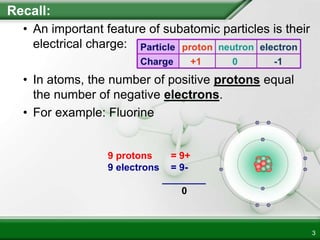
• An important feature of subatomic particles is their
electrical charge:
• In atoms, the number of positive protons equal
the number of negative electrons.
• For example: Fluorine
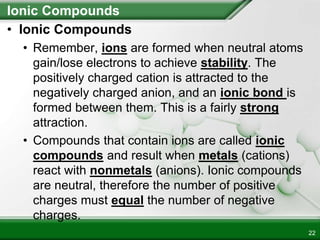
3
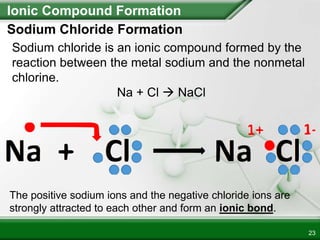
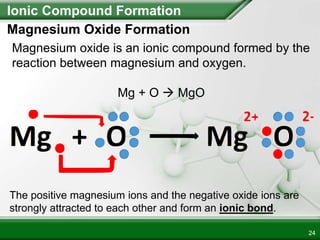
9 protons
9 electrons
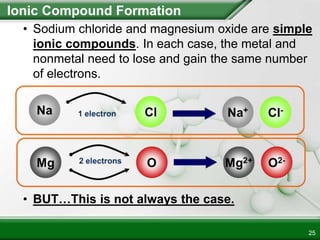
________
0
= 9+
= 9-
Chemical Bonds:
• Valence electrons are the electrons in an atom’s
outermost energy level that determine the
chemical properties of an element. It is valence
electrons that are responsible for holding two or
more atoms together in a chemical bond.
• Bonding occurs because atoms with incomplete
outer energy levels are unstable. By forming
bonds, atoms completely fill their outer energy
levels and become stable (the octet rule).
• The octet rule states that atoms lose, gain, or
share electrons in order to acquire a full set of
eight valence electrons (the stable electron
configuration of a noble gas).
4
5
Bond, Ionic Bond
6
Ionic Bonds
Ionic bonds form when electrons are
transferred from metals to nonmetals
(atoms will gain or lose electrons in an
effort to acquire a full set of 8 valence
electrons).
• When electrons are transferred, atoms become
ions (specifically, cations and anions).
• Unlike atoms, ions have an electrical charge
because they contain an unequal number of
protons and electrons.
7
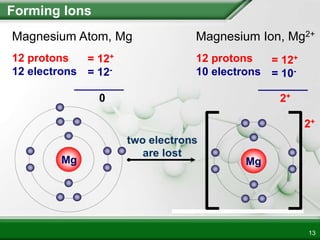
Forming Ions
8
Forming Ions
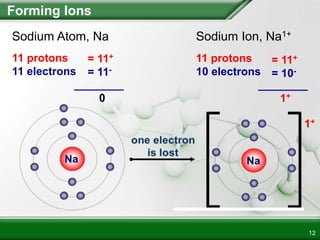
• Formation of Cations
• Cations are positively charged ions; they are formed
when an atom (usually a metal) loses valence
electrons.
• Atoms that lose electrons have more protons than
electrons and so have an overall positive charge
(and are smaller in size than the original atom).
• The charge of cations is given by the number of
electrons lost, followed by a “+” symbol (ex. 2+).
• The formula of cations is given by the chemical
symbol followed by the charge (ex. Mg2+).
9
Forming Ions
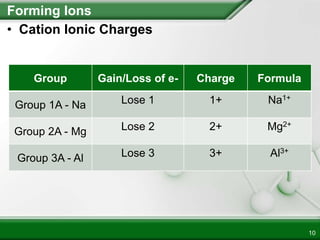
• Cation Ionic Charges
10
Group Gain/Loss of e- Charge Formula
Group 1A - Na Lose 1 1+ Na1+
Group 2A - Mg Lose 2 2+ Mg2+
Group 3A - Al Lose 3 3+ Al3+
Forming Ions
11
Forming Ions
12
1+
Sodium Atom, Na
11 protons
11 electrons
________
0
11 protons
10 electrons
________
1+
Sodium Ion, Na1+
= 11+
= 11-
= 11+
= 10-
Forming Ions
13
2+
Magnesium Atom, Mg
12 protons
12 electrons
________
0
12 protons
10 electrons
________
2+
Magnesium Ion, Mg2+
= 12+
= 12-
= 12+
= 10-
14
Concept Check
Draw the electron-dot structures for the following atoms
and their respective ions:
• sodium
15
Forming Ions
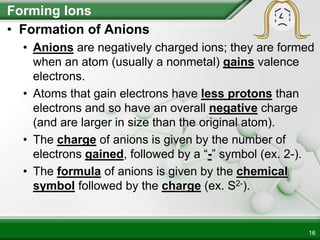
• Formation of Anions
• Anions are negatively charged ions; they are formed
when an atom (usually a nonmetal) gains valence
electrons.
• Atoms that gain electrons have less protons than
electrons and so have an overall negative charge
(and are larger in size than the original atom).
• The charge of anions is given by the number of
electrons gained, followed by a “-” symbol (ex. 2-).
• The formula of anions is given by the chemical
symbol followed by the charge (ex. S2-).
16
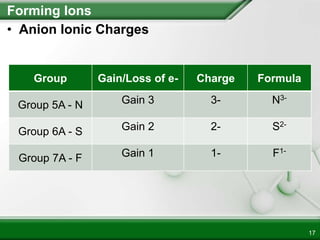
Forming Ions
• Anion Ionic Charges
17
Group Gain/Loss of e- Charge Formula
Group 5A - N Gain 3 3- N3-
Group 6A - S Gain 2 2- S2-
Group 7A - F Gain 1 1- F1-
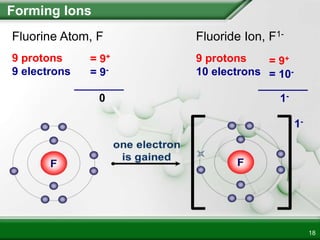
Forming Ions
18
1-
Fluorine Atom, F
9 protons
9 electrons
________
0
9 protons
10 electrons
________
1-
Fluoride Ion, F1-
= 9+
= 9-
= 9+
= 10-
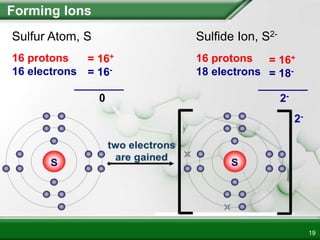
Forming Ions
19
2-
Sulfur Atom, S
16 protons
16 electrons
________
0
16 protons
18 electrons
________
2-
Sulfide Ion, S2-
= 16+
= 16-
= 16+
= 18-
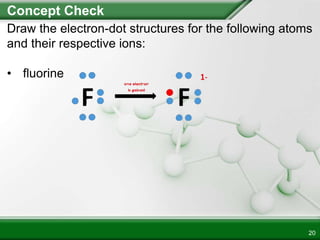
Concept Check
Draw the electron-dot structures for the following atoms
and their respective ions:
• fluorine
20
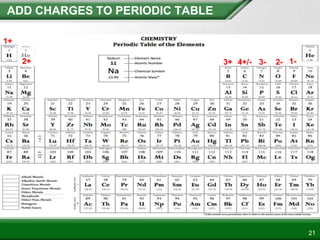
ADD CHARGES TO PERIODIC TABLE
21
1+
2+ 3+ 4+/- 1-2-3-
Ionic Compounds
• Ionic Compounds
• Remember, ions are formed when neutral atoms
gain/lose electrons to achieve stability. The
positively charged cation is attracted to the
negatively charged anion, and an ionic bond is
formed between them. This is a fairly strong
attraction.
• Compounds that contain ions are called ionic
compounds and result when metals (cations)
react with nonmetals (anions). Ionic compounds
are neutral, therefore the number of positive
charges must equal the number of negative
charges.
22
Ionic Compound Formation
Sodium Chloride Formation
Sodium chloride is an ionic compound formed by the
reaction between the metal sodium and the nonmetal
chlorine.
Na + Cl  NaCl
The positive sodium ions and the negative chloride ions are
strongly attracted to each other and form an ionic bond.
23
Ionic Compound Formation
Magnesium Oxide Formation
Magnesium oxide is an ionic compound formed by the
reaction between magnesium and oxygen.
Mg + O  MgO
The positive magnesium ions and the negative oxide ions are
strongly attracted to each other and form an ionic bond.
24
Ionic Compound Formation
• Sodium chloride and magnesium oxide are simple
ionic compounds. In each case, the metal and
nonmetal need to lose and gain the same number
of electrons.
• BUT…This is not always the case.
25
Ionic Compound Formation
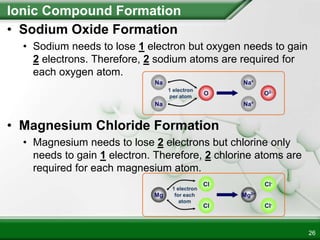
• Sodium Oxide Formation
• Sodium needs to lose 1 electron but oxygen needs to gain
2 electrons. Therefore, 2 sodium atoms are required for
each oxygen atom.
• Magnesium Chloride Formation
• Magnesium needs to lose 2 electrons but chlorine only
needs to gain 1 electron. Therefore, 2 chlorine atoms are
required for each magnesium atom.
26
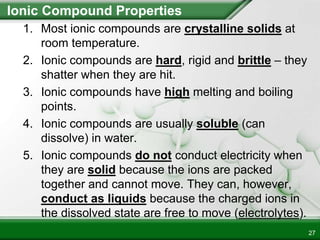
Ionic Compound Properties
1. Most ionic compounds are crystalline solids at
room temperature.
2. Ionic compounds are hard, rigid and brittle – they
shatter when they are hit.
3. Ionic compounds have high melting and boiling
points.
4. Ionic compounds are usually soluble (can
dissolve) in water.
5. Ionic compounds do not conduct electricity when
they are solid because the ions are packed
together and cannot move. They can, however,
conduct as liquids because the charged ions in
the dissolved state are free to move (electrolytes).
27
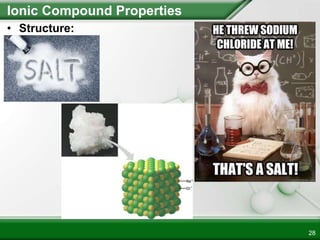
Ionic Compound Properties
• Structure:
28

Properties and Formation of Ionic Compounds Powerpoint

  • 1.
    IONIC COMPOUNDS NKCSD Formation andProperties of Ionic Compounds Why do ionic bonds form? How are ionic compounds formed? What are the properties of ionic compounds? 1
  • 2.
    Recall: • Elements arethe simplest of substances that cannot be broken down further by chemical or physical means. • Each element is made up of just one particular type of atom, which is different from the atoms in any other element. • Atoms consist of three types of subatomic particles: 2
  • 3.
    Recall: • An importantfeature of subatomic particles is their electrical charge: • In atoms, the number of positive protons equal the number of negative electrons. • For example: Fluorine 3 9 protons 9 electrons ________ 0 = 9+ = 9-
  • 4.
    Chemical Bonds: • Valenceelectrons are the electrons in an atom’s outermost energy level that determine the chemical properties of an element. It is valence electrons that are responsible for holding two or more atoms together in a chemical bond. • Bonding occurs because atoms with incomplete outer energy levels are unstable. By forming bonds, atoms completely fill their outer energy levels and become stable (the octet rule). • The octet rule states that atoms lose, gain, or share electrons in order to acquire a full set of eight valence electrons (the stable electron configuration of a noble gas). 4
  • 5.
  • 6.
  • 7.
    Ionic Bonds Ionic bondsform when electrons are transferred from metals to nonmetals (atoms will gain or lose electrons in an effort to acquire a full set of 8 valence electrons). • When electrons are transferred, atoms become ions (specifically, cations and anions). • Unlike atoms, ions have an electrical charge because they contain an unequal number of protons and electrons. 7
  • 8.
  • 9.
    Forming Ions • Formationof Cations • Cations are positively charged ions; they are formed when an atom (usually a metal) loses valence electrons. • Atoms that lose electrons have more protons than electrons and so have an overall positive charge (and are smaller in size than the original atom). • The charge of cations is given by the number of electrons lost, followed by a “+” symbol (ex. 2+). • The formula of cations is given by the chemical symbol followed by the charge (ex. Mg2+). 9
  • 10.
    Forming Ions • CationIonic Charges 10 Group Gain/Loss of e- Charge Formula Group 1A - Na Lose 1 1+ Na1+ Group 2A - Mg Lose 2 2+ Mg2+ Group 3A - Al Lose 3 3+ Al3+
  • 11.
  • 12.
    Forming Ions 12 1+ Sodium Atom,Na 11 protons 11 electrons ________ 0 11 protons 10 electrons ________ 1+ Sodium Ion, Na1+ = 11+ = 11- = 11+ = 10-
  • 13.
    Forming Ions 13 2+ Magnesium Atom,Mg 12 protons 12 electrons ________ 0 12 protons 10 electrons ________ 2+ Magnesium Ion, Mg2+ = 12+ = 12- = 12+ = 10-
  • 14.
  • 15.
    Concept Check Draw theelectron-dot structures for the following atoms and their respective ions: • sodium 15
  • 16.
    Forming Ions • Formationof Anions • Anions are negatively charged ions; they are formed when an atom (usually a nonmetal) gains valence electrons. • Atoms that gain electrons have less protons than electrons and so have an overall negative charge (and are larger in size than the original atom). • The charge of anions is given by the number of electrons gained, followed by a “-” symbol (ex. 2-). • The formula of anions is given by the chemical symbol followed by the charge (ex. S2-). 16
  • 17.
    Forming Ions • AnionIonic Charges 17 Group Gain/Loss of e- Charge Formula Group 5A - N Gain 3 3- N3- Group 6A - S Gain 2 2- S2- Group 7A - F Gain 1 1- F1-
  • 18.
    Forming Ions 18 1- Fluorine Atom,F 9 protons 9 electrons ________ 0 9 protons 10 electrons ________ 1- Fluoride Ion, F1- = 9+ = 9- = 9+ = 10-
  • 19.
    Forming Ions 19 2- Sulfur Atom,S 16 protons 16 electrons ________ 0 16 protons 18 electrons ________ 2- Sulfide Ion, S2- = 16+ = 16- = 16+ = 18-
  • 20.
    Concept Check Draw theelectron-dot structures for the following atoms and their respective ions: • fluorine 20
  • 21.
    ADD CHARGES TOPERIODIC TABLE 21 1+ 2+ 3+ 4+/- 1-2-3-
  • 22.
    Ionic Compounds • IonicCompounds • Remember, ions are formed when neutral atoms gain/lose electrons to achieve stability. The positively charged cation is attracted to the negatively charged anion, and an ionic bond is formed between them. This is a fairly strong attraction. • Compounds that contain ions are called ionic compounds and result when metals (cations) react with nonmetals (anions). Ionic compounds are neutral, therefore the number of positive charges must equal the number of negative charges. 22
  • 23.
    Ionic Compound Formation SodiumChloride Formation Sodium chloride is an ionic compound formed by the reaction between the metal sodium and the nonmetal chlorine. Na + Cl  NaCl The positive sodium ions and the negative chloride ions are strongly attracted to each other and form an ionic bond. 23
  • 24.
    Ionic Compound Formation MagnesiumOxide Formation Magnesium oxide is an ionic compound formed by the reaction between magnesium and oxygen. Mg + O  MgO The positive magnesium ions and the negative oxide ions are strongly attracted to each other and form an ionic bond. 24
  • 25.
    Ionic Compound Formation •Sodium chloride and magnesium oxide are simple ionic compounds. In each case, the metal and nonmetal need to lose and gain the same number of electrons. • BUT…This is not always the case. 25
  • 26.
    Ionic Compound Formation •Sodium Oxide Formation • Sodium needs to lose 1 electron but oxygen needs to gain 2 electrons. Therefore, 2 sodium atoms are required for each oxygen atom. • Magnesium Chloride Formation • Magnesium needs to lose 2 electrons but chlorine only needs to gain 1 electron. Therefore, 2 chlorine atoms are required for each magnesium atom. 26
  • 27.
    Ionic Compound Properties 1.Most ionic compounds are crystalline solids at room temperature. 2. Ionic compounds are hard, rigid and brittle – they shatter when they are hit. 3. Ionic compounds have high melting and boiling points. 4. Ionic compounds are usually soluble (can dissolve) in water. 5. Ionic compounds do not conduct electricity when they are solid because the ions are packed together and cannot move. They can, however, conduct as liquids because the charged ions in the dissolved state are free to move (electrolytes). 27
  • 28.

Editor's Notes

  • #2 So, we learned that electrolytes are important when considering an after-workout drink and that electrolytes are considered a property of ionic compounds. Before we discuss other properties of ionic compounds, lets discuss how they are formed.
  • #5 Only electrons can be added or taken away!
  • #8 occurs because of the attraction between a positively charged cation and a negatively charged anion.
  • #9 Recall from our last section of notes that ions form from the gain or loss of valence electrons so that the atom has a full valence shell (full outermost energy level; 8 valence electrons…)
  • #10 For atoms with a nearly empty outer energy level (usually metals), it takes less energy to lose electrons in order to have a full outer energy level than it does to gain electrons.
  • #11 Group 1A Lose 1 1+ Group 2A Lose 2 2+ Transition Metals Lose 2 or more 2+ or more Group 4A Lose 4 4+ Alright…write these charges on the periodic table…
  • #16 Since bonds are formed by valence electrons, we will actually use electron-dot structures to show the formation of ions. Which one is more stable? Why?
  • #17 For atoms with a nearly full outer energy level (usually nonmetals), it takes less energy to gain electrons in order to have a full outer shell than it does to lose electrons.
  • #18 Group 4A gain 4- Group 5A gain 3- Group 6A gain 2- Group 7A gain 1- Alright…write these charges on the periodic table…
  • #21 Since bonds are formed by valence electrons, we will actually use electron-dot structures to show the formation of ions. Which one is more stable? Why?
  • #24 Sodium chloride is an ionic compound formed by the reaction between the metal sodium and the nonmetal chlorine. Sodium has 1 electron in its outer shell. If it loses this electron, it will have a full outer energy level. Chlorine has 7 electrons in its outer shell. If it gains 1 electron, it will completely fill its outer energy level.
  • #25 More than one electron can be transferred during ionic bonding. Magnesium has 2 electrons in its outer shell. If it loses these, it will have a full outer energy level. Oxygen has 6 electrons in its outer shell. If it gains two electrons, it will completely fill its outer energy level.
  • #28 Crystalline Solids: millions and millions of ions are packed together in a regular 3D cubic arrangement joined by ionic bonds. Brittle: When the crystal is hit, a layer of ions is shifted so that ions with the same charges are lined up together. These like charges repel each other, thereby splitting the lattice. High MP/BP: Ionic bonds are strong and require a lot of heat to break them.
  • #29 When the lattice is hit, a layer of ions is shifted so that ions with the same charges are lined up together. These like charges repel each other, thereby splitting the lattice. High PB/MP: