METALLURGY:-
Metallurgy can be defined as the process of extraction
of metals in pure state
from their respective ores.
OCCURRENCE OF METALS IN NATURE:-
1. COMBINED STATE:-
Most of the highly reactive metal are found in form of
their compounds such as
Sulphates , carbonates, Oxides etc.
Example:-sodium, iron etc.
2. NATIVE STATE :-
Generally, less reactive metals occur in their free
metallic state .
Example:- Silver, Gold Etc.
SOME IMPORTANT TERMS REGARDING
METALLURGY:-
1.Minerals:-
The basic or the natural form in which any metal is found in
nature
In nature is called as Minerals.
2.Ore:-
The mineral from which a metal can be
extracted in a profitable amount is called
as an ore.
The different types of Ores present in our
nature
Are Sulphide ores, oxide ores , carbonates
Ores ,
Sulphate Ores, Hallides Ores Etc.
TYPES OF ORES:-
Oxides
Ores
Carbonates Sulphates Sulphides
Haematite
{Fe2O3}
Limestone
[CaCO3]
Espom Salt
[MgSO4.7H2O]
Galena
[Pbs]
Magnetite
[Fe3O4]
Dolomite
[CaCo3.MgCo3]
Gypsum
[Caso4.2H2O]
Cinnabar
[HgS]
Bauxite
{Al2o3.2H2O}
Malachite
[CuCo3.Cu(OH)2
]
Barytes
[BaSO4]
Zinc Blende
[ZnS]
Magnesite
{MgCO3}
Calamine
[ZnCO3]
Anglesite
[PbSO4]
Argentite
[Ag2S]
Zincite{ZnO
}
Siderite[FeCO3] Thernardite[Na2SO4] Iron pyrite[FeS2]
Corundum
{Al2O3}
Azurite
[Cu(OH)2.2CuCO
3
Polyhalite
[K2Ca2MgSO4.2H2O]
Chalcopyrite
[CuFeS2]
Carriterite
{SnO2}
EXAMPLES OF FEW IRON FAMOUS ORES:-
3.GANGUE OR MATRIX:-
The impurities like sand , clay Etc. which are present
alongwith the Ores are Called as Gangue or Matrix.
4. FLUX:-
The substance which reacts with the ores for Removal of
Impurities in molten state are called as Flux.
a) Acidic Flux:-
It coverts Basic Impurities Into Slag.
Ex. FeO + SiO2(Acidic Flux) = FeSiO3(Slag)
BASIC FLUX :-
It converts Acidic Impurities Into Slag .
Ex. SiO2 +CaO(Basic flux) = CaSiO3( Slag)
5. Slag :-
The category Compound Formed When Impurities
Reacts
Flux is called as slag.
The slag is infusible and can”t be used to Get
starting
Materials again.
PROCESSES RELATED TO METALLURY :-
1. MINING OF ORE:-
Mining is the process of taking out a desires ore
from the Earth’s crust by digging in order to follow
further
Processing.
2. SIZING OF ORE:-
Sizing is the process of conversion of a large
sized ore
Into powdered form with the help of different
machines .
3. CONCENTRATION OF ORE:-
The process of removal of impurities from ores
using
Various purification techniques is called
concentration
Of ore.
Concentration technique Involves Magnetic
Separation ,
Leaching , Gravity Separation , Froth Floatation
etc.
4. Oxidation of Ore :-
It is done because reduction of metal oxides is
easier
Than reduction of other compounds of metals.
PROCESSES OF OXIDATION OF ORE:-
1. Calcination:-
Calcination is process of conversion of a
carbonate ore
Into oxides by heating in absence of oxygen.
Hydrated ore undergo calcination to remove
moisture:-
Ex . Al2O3.2H2O= Al2O3+2H2O
2Fe2O3.3H2O=2Fe2O3 + 3H2O
CARBONATE ORE UNDERGO CALCINATION TO
REMOVE CO2 :-
Ex. CaCO3 = CaO + CO2
CaCO3.MgCo3 = CaO +MgO + 2CO2
2.Roasting:-
Roasting is the process of Conversion of an ore
into it’s
Oxide form in presence of oxygen (used for
Oxidation)
It is generally Carried out in Sulphide Ores.
Ex. 2PbS+3O2=2PbO+2SO2
2Cu2S+3O2=2CU2O+2SO2
REVERBERATORY FURANCE:-
5. REDUCTION OF ORE:-
The Metal Oxides Are Finally Converted Into Metals By
Reduction process.
1.Smelting :-
It is the process of reduction in which carbon is used
As a reducing agent and the oxide is heated to a very
Temperature about its melting point.
Ex. PbO+C=Pb+CO
Fe2O3+3C=2Fe+3CO
Al2O3+3C=2Al+3CO
BLAST FURANCE:-
2. THERMITE PROCESS:-
It is a method used for reduction in which aluminium
Is used as a reducing agent .
In this process, a mixture of metal oxide and aluminium is mixed
Which is called as thermite is taken in a vessel to which
An ignition mixture of magnesium powder and barium
Peroxide is added.
Upon completion of process aluminium oxide along with molten metal are
produced.
Ex. Cr2O3+2Al=2Cr+Al203
3Mn3O4+8Al=9Mn+4Al2O3
The reduction of a metal oxide by aluminium powder as a reducing agent is
Known as Thermite process
FE2O3+2AL=2FE+AL2O3+HEAT
This process is used in thermite welding which is
an
Highly exothermic reaction.
This process is also called as GOLD-SCHMID
ALUMINO
THERMIC REDUCTION .
3. SELF- REDUCTION:-
In this method no external reducing agent is used
but the
Oxide ore is further heated in air to convert part of
Sulphide ore into oxide which then reacts with
remaining
Sulphide ore to give metal and sulphur dioxide.
Ex. 1. 2HgS+3O2=2HgO+2SO2
2HgO=2Hg+O2
2. 2PbS+3O2=2PbO+2SO2
2PbO+PbS=3Pb+SO2
4. ELECTROLYTIC REDUCTION:-
Highly reactive metals like Na,K,Mg,Al etc. are
reduced
By electrolysis of their respective oxides,
hydroxides,
Or chlorides in molten state .
Ex. NaCl(molten) =Na++Cl-
At cathode – Na+ + e-
At Anode – 2Cl- - e-
5. AMALGAMATION PROCESS:-
This method is used for reduction of very less
reactive metal or noble metals like gold, silver
etc. from their
Native state.
ORE+HG=AMALGAM=MERCURY
VAPOURS+METAL
(DISTILLATION)
6. ELECRTROLYTIC REFINING:-
THE REDUCED METALS OBTAINED ARE
GENERALLY IMPURE WHICH MAY BE
ASSOCIATED WITH SOME
TYPES OF IMPURITIES SUCH AS CARBON ,
PHOSPHORUS
SILICON, UNCHARGED ORE ETC.
So for removal of these impurities electrolytical
refining
Is performed.
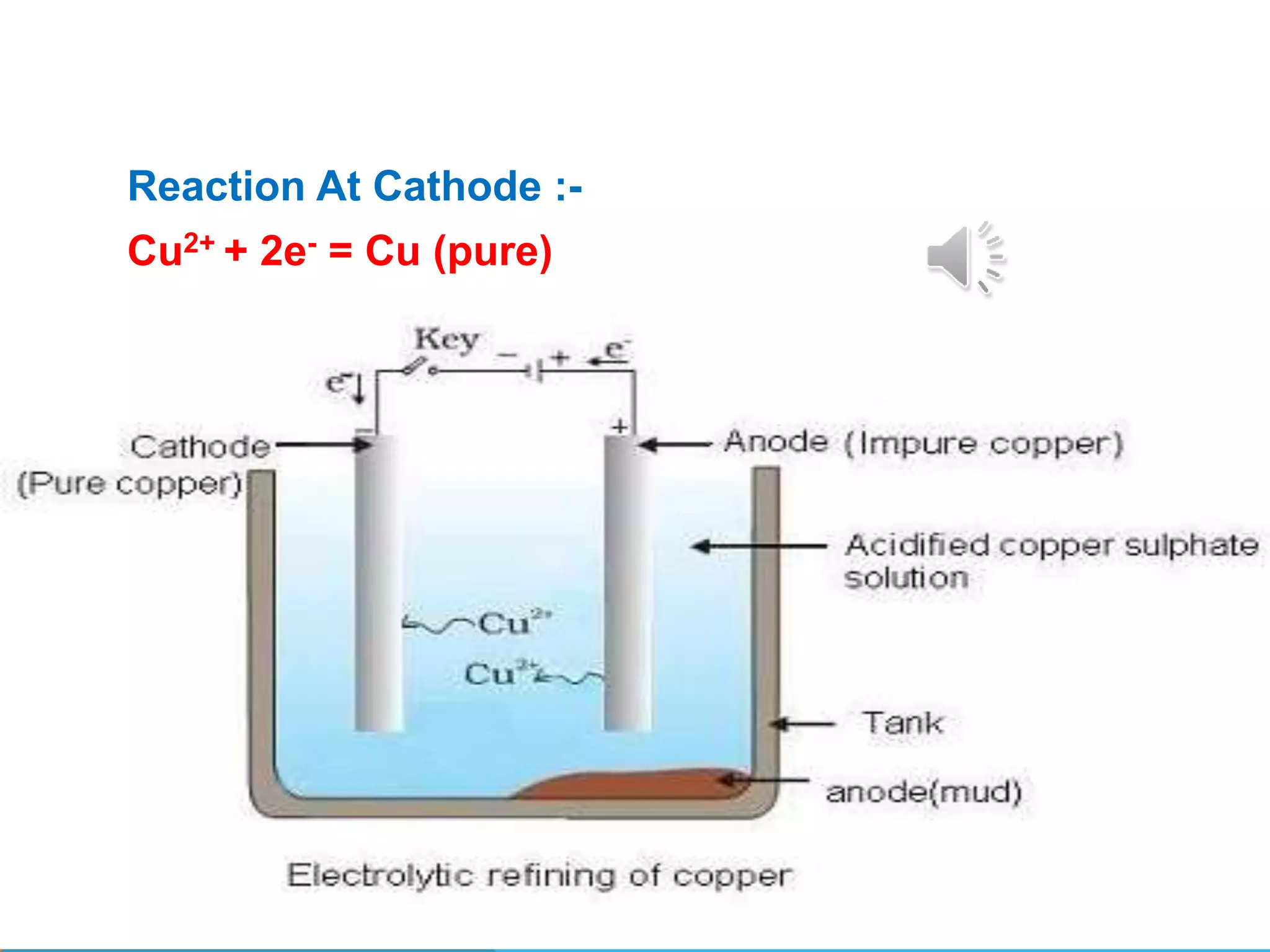
ELECTROLYTIC REFNING OF COPPER:-
In this process a copper sulphate solution along
with few drops of h2so4 is used as an
electrolyte.
A thick block of impure copper is placed at anode
and
A thin block of pure copper is placed at cathode
which
Are connected to positive and negative terminals
of
Battery. On passing current impure Copper from
anode
Dissolves in copper sulphate solution and pure
copper
In copper sulphate solution moves towards the
Cathode.
Then the soluble impurities goes into solution and
Insoluble impurities settle down at bottom in form
of
ANODE MUD.
REACTION OF ELECTROLYTE:-
CuSO4 = Cu2++SO42-
REACTION AT ANODE:-
Cu= 2Cu2+ + 2e-
Reaction At Cathode :-
Cu2+ + 2e- = Cu (pure)

Metallurgy

  • 2.
    METALLURGY:- Metallurgy can bedefined as the process of extraction of metals in pure state from their respective ores. OCCURRENCE OF METALS IN NATURE:- 1. COMBINED STATE:- Most of the highly reactive metal are found in form of their compounds such as Sulphates , carbonates, Oxides etc. Example:-sodium, iron etc.
  • 3.
    2. NATIVE STATE:- Generally, less reactive metals occur in their free metallic state . Example:- Silver, Gold Etc. SOME IMPORTANT TERMS REGARDING METALLURGY:- 1.Minerals:- The basic or the natural form in which any metal is found in nature In nature is called as Minerals.
  • 4.
    2.Ore:- The mineral fromwhich a metal can be extracted in a profitable amount is called as an ore. The different types of Ores present in our nature Are Sulphide ores, oxide ores , carbonates Ores , Sulphate Ores, Hallides Ores Etc.
  • 5.
    TYPES OF ORES:- Oxides Ores CarbonatesSulphates Sulphides Haematite {Fe2O3} Limestone [CaCO3] Espom Salt [MgSO4.7H2O] Galena [Pbs] Magnetite [Fe3O4] Dolomite [CaCo3.MgCo3] Gypsum [Caso4.2H2O] Cinnabar [HgS] Bauxite {Al2o3.2H2O} Malachite [CuCo3.Cu(OH)2 ] Barytes [BaSO4] Zinc Blende [ZnS] Magnesite {MgCO3} Calamine [ZnCO3] Anglesite [PbSO4] Argentite [Ag2S] Zincite{ZnO } Siderite[FeCO3] Thernardite[Na2SO4] Iron pyrite[FeS2] Corundum {Al2O3} Azurite [Cu(OH)2.2CuCO 3 Polyhalite [K2Ca2MgSO4.2H2O] Chalcopyrite [CuFeS2] Carriterite {SnO2}
  • 6.
    EXAMPLES OF FEWIRON FAMOUS ORES:-
  • 7.
    3.GANGUE OR MATRIX:- Theimpurities like sand , clay Etc. which are present alongwith the Ores are Called as Gangue or Matrix. 4. FLUX:- The substance which reacts with the ores for Removal of Impurities in molten state are called as Flux. a) Acidic Flux:- It coverts Basic Impurities Into Slag. Ex. FeO + SiO2(Acidic Flux) = FeSiO3(Slag)
  • 8.
    BASIC FLUX :- Itconverts Acidic Impurities Into Slag . Ex. SiO2 +CaO(Basic flux) = CaSiO3( Slag) 5. Slag :- The category Compound Formed When Impurities Reacts Flux is called as slag. The slag is infusible and can”t be used to Get starting Materials again.
  • 9.
    PROCESSES RELATED TOMETALLURY :- 1. MINING OF ORE:- Mining is the process of taking out a desires ore from the Earth’s crust by digging in order to follow further Processing. 2. SIZING OF ORE:- Sizing is the process of conversion of a large sized ore Into powdered form with the help of different machines .
  • 10.
    3. CONCENTRATION OFORE:- The process of removal of impurities from ores using Various purification techniques is called concentration Of ore. Concentration technique Involves Magnetic Separation , Leaching , Gravity Separation , Froth Floatation etc. 4. Oxidation of Ore :- It is done because reduction of metal oxides is easier Than reduction of other compounds of metals.
  • 11.
    PROCESSES OF OXIDATIONOF ORE:- 1. Calcination:- Calcination is process of conversion of a carbonate ore Into oxides by heating in absence of oxygen. Hydrated ore undergo calcination to remove moisture:- Ex . Al2O3.2H2O= Al2O3+2H2O 2Fe2O3.3H2O=2Fe2O3 + 3H2O
  • 12.
    CARBONATE ORE UNDERGOCALCINATION TO REMOVE CO2 :- Ex. CaCO3 = CaO + CO2 CaCO3.MgCo3 = CaO +MgO + 2CO2 2.Roasting:- Roasting is the process of Conversion of an ore into it’s Oxide form in presence of oxygen (used for Oxidation) It is generally Carried out in Sulphide Ores. Ex. 2PbS+3O2=2PbO+2SO2 2Cu2S+3O2=2CU2O+2SO2
  • 13.
  • 14.
    5. REDUCTION OFORE:- The Metal Oxides Are Finally Converted Into Metals By Reduction process. 1.Smelting :- It is the process of reduction in which carbon is used As a reducing agent and the oxide is heated to a very Temperature about its melting point. Ex. PbO+C=Pb+CO Fe2O3+3C=2Fe+3CO Al2O3+3C=2Al+3CO
  • 15.
  • 16.
    2. THERMITE PROCESS:- Itis a method used for reduction in which aluminium Is used as a reducing agent . In this process, a mixture of metal oxide and aluminium is mixed Which is called as thermite is taken in a vessel to which An ignition mixture of magnesium powder and barium Peroxide is added. Upon completion of process aluminium oxide along with molten metal are produced. Ex. Cr2O3+2Al=2Cr+Al203 3Mn3O4+8Al=9Mn+4Al2O3 The reduction of a metal oxide by aluminium powder as a reducing agent is Known as Thermite process
  • 17.
    FE2O3+2AL=2FE+AL2O3+HEAT This process isused in thermite welding which is an Highly exothermic reaction. This process is also called as GOLD-SCHMID ALUMINO THERMIC REDUCTION .
  • 18.
    3. SELF- REDUCTION:- Inthis method no external reducing agent is used but the Oxide ore is further heated in air to convert part of Sulphide ore into oxide which then reacts with remaining Sulphide ore to give metal and sulphur dioxide. Ex. 1. 2HgS+3O2=2HgO+2SO2 2HgO=2Hg+O2 2. 2PbS+3O2=2PbO+2SO2 2PbO+PbS=3Pb+SO2
  • 19.
    4. ELECTROLYTIC REDUCTION:- Highlyreactive metals like Na,K,Mg,Al etc. are reduced By electrolysis of their respective oxides, hydroxides, Or chlorides in molten state . Ex. NaCl(molten) =Na++Cl- At cathode – Na+ + e- At Anode – 2Cl- - e-
  • 20.
    5. AMALGAMATION PROCESS:- Thismethod is used for reduction of very less reactive metal or noble metals like gold, silver etc. from their Native state. ORE+HG=AMALGAM=MERCURY VAPOURS+METAL (DISTILLATION)
  • 21.
    6. ELECRTROLYTIC REFINING:- THEREDUCED METALS OBTAINED ARE GENERALLY IMPURE WHICH MAY BE ASSOCIATED WITH SOME TYPES OF IMPURITIES SUCH AS CARBON , PHOSPHORUS SILICON, UNCHARGED ORE ETC. So for removal of these impurities electrolytical refining Is performed.
  • 22.
    ELECTROLYTIC REFNING OFCOPPER:- In this process a copper sulphate solution along with few drops of h2so4 is used as an electrolyte. A thick block of impure copper is placed at anode and A thin block of pure copper is placed at cathode which Are connected to positive and negative terminals of Battery. On passing current impure Copper from anode Dissolves in copper sulphate solution and pure copper In copper sulphate solution moves towards the Cathode.
  • 23.
    Then the solubleimpurities goes into solution and Insoluble impurities settle down at bottom in form of ANODE MUD. REACTION OF ELECTROLYTE:- CuSO4 = Cu2++SO42- REACTION AT ANODE:- Cu= 2Cu2+ + 2e-
  • 24.
    Reaction At Cathode:- Cu2+ + 2e- = Cu (pure)