General
Chemistry
1
ALYSSA MAE ANTONIO, LPT.
1. Use quantum numbers to describe an
electron in an atom. (STEM_GC11ESIIa-b-54)
2. Determine the magnetic property of the
atom based on its electronic configuration.
(STEM_GC11ESIIa-b-57)
3. Draw an orbital diagram to represent the
electronic configuration of atoms.
(STEM_GC11ESIIa-b-58) 2
Learning Competencies:
Quantum
Numbers
- Quantum numbers describe values of
conserved quantities of a quantum system.
- An important aspect of quantum mechanics
is the quantization of observable quantities,
which is possible through quantum
numbers since they are discrete sets of
integers and half-integers (they can
approach infinity in some cases).
- This makes quantum mechanics different
from classical mechanics where mass,
charge, or momentum values range
4
- Particles have quantum numbers that can
represent their properties.
- This is because the set of quantum
numbers is unique for every electron.
- Pauli's exclusion principle states that no
two identical electrons may occupy the
same quantum state in an atom
simultaneously.
- Thus, no two electrons in an atom can have
exactly the same set of quantum numbers.
5
6
7
The Four types of
quantum numbers:
- This describes the energy level of an
electron.
- The value of n ranges from 1 to the electron
shell or energy level containing the
outermost electron of the atom.
- The larger the value of n, the farther the
distance of the electron in the orbital from
the nucleus. 8
1. Principal quantum
number (n)
- Also, as the distance from the nucleus
increases, the energy of each orbital
increases.
- This means that higher n values have
higher energies.
9
1. Principal quantum
number (n)
Example: Fluorine (F)
- Fluorine has an electron configuration of
1s2
2s2
2p5
.
- Through its electron configuration, we can tell
that its outermost electrons or valence
electrons are in the second energy level.
- Therefore, an electron in fluorine can have an
n value of 1 to 2.
- Angular quantum number is also called
azimuthal quantum number.
- This describes the shape of the orbital and
the magnitude of the orbital angular
momentum.
- l has values ranging from 0 to (n - 1).
11
2. Angular quantum
number (ℓ)
- Thus, the value of l depends on the value of
n. If n = 1, there is one possible value of l,
and that is 0. If n = 2, there are two possible
values of l, which are 0 and 1. If n = 3, the
three possible values of l are 0, 1, and 2.
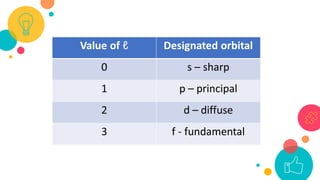
- The values of I can also be determined by
the designated orbital of its valence
electrons. 12
2. Angular quantum
number (ℓ)
Example: Fluorine (5F)
- Since fluorine has an n value of 2, its possible
{ values are only 0 and 1.
- From its electron configuration, it has its
valence electrons in the p orbital.
- Therefore, its angular quantum number is 1.
- This describes the orientation of the
electron cloud.
- The value of m, depends on the value of l.
Given a value l, the range of m, values is
from -l to +l.
- Therefore, it can be a negative integer, zero,
or a positive integer.
15
3. Magnetic quantum
number (m)
Example: Fluorine (F)
- Fluorine has an { value of 1. Therefore, its
possible m, values are -1, 0, or 1.
- Using the Hund's rule, we can draw its five
valence electrons.
- Hund's rule states that every orbital in a
subshell must be singly occupied before it can
be doubly occupied.
Example: Fluorine (F)
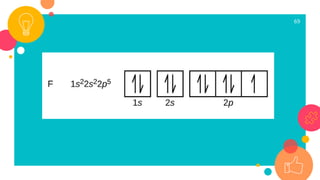
- From the orbital diagram of fluorine, we can
see that it fills up to the 2p orbital, even if it is
only partially filled.
- If it has an electron on the 2p, orbital, it will
have an ml value of -1.
Example: Fluorine (F)
- If it has an electron on the 2p, orbital, it will
have an m, value of 0. Lastly, if it has an
electron on the 2p, orbital, it will have an m,
value of +1.
- Therefore, fluorine has an m, value of +1.
- This describes the spin of the electron. Its
values can be + 1/2 represented by an
upward arrow, or – 1/2 , represented by a
downward arrow.
- Electrons occupy each orbital singly first
before pairing up and filling the other
orbitals, as stated by the Hund's rule.
20
4. Electron spin quantum number
(m)
- The last inserted spin will be the quantum
spin of the atom.
- An orbital can accommodate only two
electrons with opposite spins in each
orbital.
21
4. Electron spin quantum number
(m)
Example: Fluorine (F)
- Since fluorine has only one electron in the 3p
orbital, it will have a "spin down" so its
electron spin quantum number is - ½.
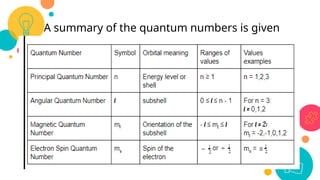
A summary of the quantum numbers is given
below.
24
Electron
Configuration
- The electron configuration of an atom is a
representation of its arrangement and
distribution.
- Electron configuration is used not only to
describe the orbitals of an atom in its
ground state, but also to represent cations
or anions by reflecting loss or gain of
electrons in their subsequent orbitals. 25
Electron Configuration
- Many of the physical and chemical
properties of elements can be explained by
their unique electron configuration.
- The valence electrons, or the electrons in
the outermost shell, determine the unique
chemistry of the element.
26
Electron Configuration
27
Shells
- A simple way to show the arrangement of
electrons around an atom is to arrange the
electrons in energy levels or shells around the
nucleus of an atom.
- Electrons that are closest to the nucleus, or
those occupying the first energy level,
have the lowest energy.
- Electrons that are farther away from the
nucleus have higher energy. 28
Shells
29
Orbitals
- Although electrons can be represented in
shells circling the nucleus of an atom, they
in fact, move along complicated paths.
- These paths are called orbitals or
subshells.
- There are four different orbital shapes: s,
p, d, and f.
30
Orbitals
31
32
Rules for
Assigning Orbitals
- The nucleus of an atom contains protons
and neutrons. Surrounding the nucleus
are the electrons.
- Electrons have the same negative charge;
they also have the same mass.
- However, each electron in an atom has a
different amount of energy.
33
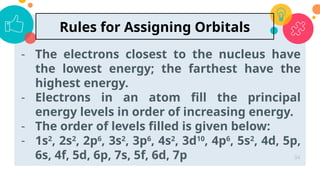
Rules for Assigning Orbitals
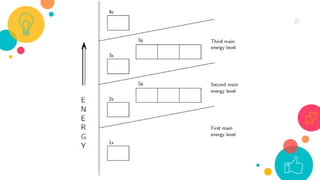
- The electrons closest to the nucleus have
the lowest energy; the farthest have the
highest energy.
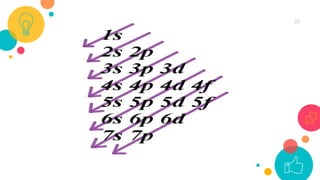
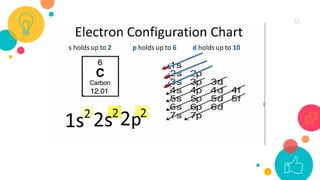
- Electrons in an atom fill the principal
energy levels in order of increasing energy.
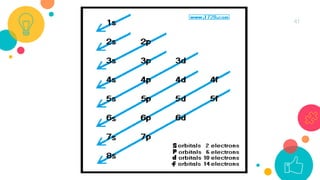
- The order of levels filled is given below:
- 1s2
, 2s2
, 2p6
, 3s2
, 3p6
, 4s2
, 3d10
, 4p6
, 5s2
, 4d, 5p,
6s, 4f, 5d, 6p, 7s, 5f, 6d, 7p 34
Rules for Assigning Orbitals
35
36
Hund's Rule
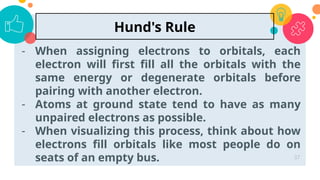
- When assigning electrons to orbitals, each
electron will first fill all the orbitals with the
same energy or degenerate orbitals before
pairing with another electron.
- Atoms at ground state tend to have as many
unpaired electrons as possible.
- When visualizing this process, think about how
electrons fill orbitals like most people do on
seats of an empty bus. 37
Hund's Rule
- A passenger would not sit next to a total
stranger if there are still empty rows
available.
- Only after all the seats are taken would a
passenger sit next to someone or pair up.
- This is why this rule is also often called, "the
empty bus seat rule."
38
Hund's Rule
39
The Aufbau
Principle
- Aufbau is derived from the German word
aufbauen, which means "to build."
- Electron configurations are written in such
a way that orbitals are built up from atom
to atom.
- In writing the electron configuration of an
atom, orbitals are filled in order of
increasing atomic number 40
The Aufbau Principle
41
42
Writing Electron
Configurations
- An electron configuration is written
according to the following considerations:
• First, write the energy level (the period).
• Then, write the subshell to be filled.
• Then, write the superscript -- the number
of electrons in that subshell.
43
Writing Electron Configurations
- The total number of electrons is the atomic
number, Z.
- The rules above hold for writing the
electron configurations of all the elements
in the periodic table.
44
Writing Electron Configurations
- Three methods are used to write electron
configurations:
1. orbital diagram
2. spdf notation
3. noble gas notation
- Each method has its advantages and
disadvantages.
45
Writing Electron Configurations
46
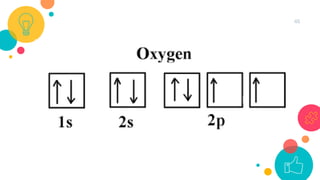
Orbital Diagram
- An orbital diagram is a representation of
electron configuration by which each of the
separate orbitals and the spins of the
electrons are shown.
- This is carried out by determining the
subshell (s, p, d, or f) and then drawing each
electron following the three considerations
in writing electron configurations. 47
Orbital Diagram
48
49
spdf Notation
- The spdf notation is perhaps the most
common way of writing electron
configuration ions.
- Unlike an orbital diagram, the distribution
of electrons in each orbital is not shown.
- The total number of electrons in each
energy level is indicated by a superscript.
50
spdf Notation
51
52
Noble Gas
Notation
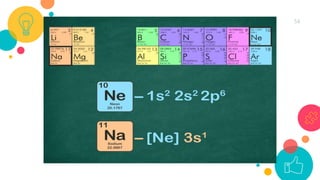
- Noble gas notation is a simpler way of
writing electron configurations compared
to the spdf notation.
- Noble gases, which are also known as inert
gases, have the most stable electron
configurations.
- Because noble gases have their subshells
filled, they can be used as a simpler way of
writing electron configurations for
53
Noble Gas Notation
54
55
Magnetic
Properties
- Magnetism is a physical phenomenon
produced by the motion of electric charges.
- This can result in attraction or repulsion,
depending on the force between the atoms.
- It is also a property of a material to respond
to a particular magnetic field.
56
Magnetic Properties
57
Paramagnetism
- Paramagnetism is the magnetic state of an
atom with one or more unpaired electrons.
- According to Hund's rule, each orbital must
be filled singly before it can be doubly
occupied.
- Thus, this results in unpaired electrons.
58
Paramagnetism
- The unpaired electrons can orient in either
direction causing the material's electrons to
align with a magnet.
- This allows paramagnetic atoms attracted
to magnetic fields.
59
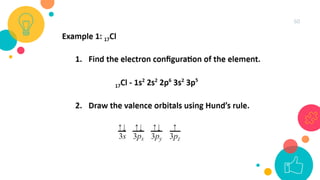
Paramagnetism
60
61
Diamagnetism
- Diamagnetism, on the other hand, is the
magnetic state wherein an atom has no
unpaired electrons.
- As stated in Pauli's Exclusion Principle, no
two identical atoms can fill the same
quantum state/number at the same time.
62
Diamagnetism
- This causes opposite spins in a given orbital.
As a result, there is no magnetic field, and
the material is not attractive.
- In fact, diamagnetism causes a weak
repulsion.
63
Diamagnetism
64
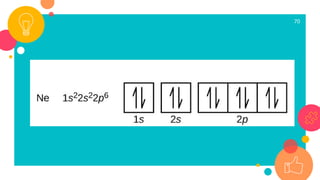
Practice Exercise
65
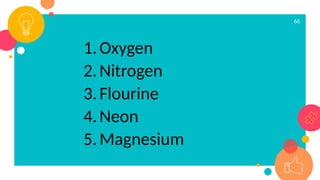
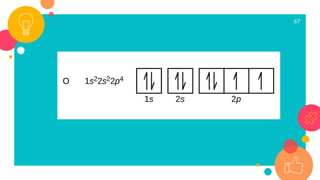
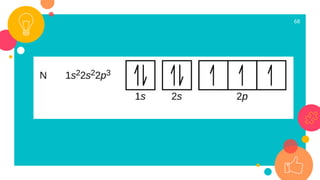
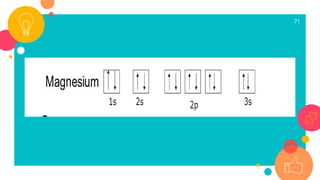
Draw the orbital diagram of
the following using their
electronic configuration.
66
1.Oxygen
2.Nitrogen
3.Flourine
4.Neon
5.Magnesium
67
68
69
70
71
72
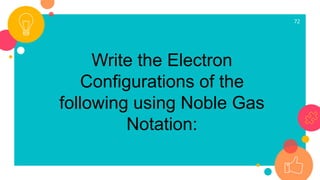
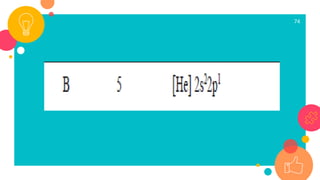
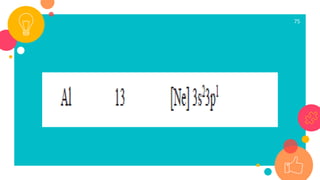
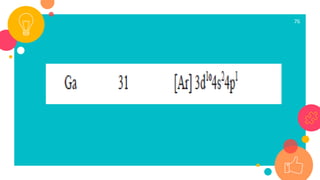
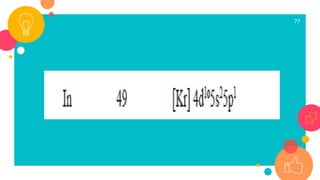
Write the Electron
Configurations of the
following using Noble Gas
Notation:
73
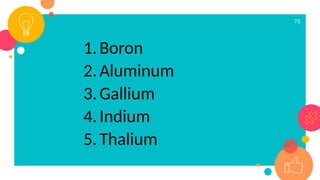
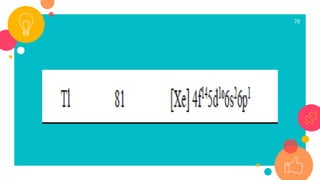
1.Boron
2.Aluminum
3.Gallium
4.Indium
5.Thalium
74
75
76
77
78
79
Generalization
Share one thing that
you’ve learned in
today’s discussion. 80
Generalization
Proceed to google
classroom and
answer the posted
activity. 81
ACTIVITY
Thanks!
82

STEM2_W1Q2.pptxxxxxxxxxxxxxxxxxxxxxxxxxxxxxxxxxxxxxxx

  • 1.
  • 2.
    1. Use quantumnumbers to describe an electron in an atom. (STEM_GC11ESIIa-b-54) 2. Determine the magnetic property of the atom based on its electronic configuration. (STEM_GC11ESIIa-b-57) 3. Draw an orbital diagram to represent the electronic configuration of atoms. (STEM_GC11ESIIa-b-58) 2 Learning Competencies:
  • 3.
  • 4.
    - Quantum numbersdescribe values of conserved quantities of a quantum system. - An important aspect of quantum mechanics is the quantization of observable quantities, which is possible through quantum numbers since they are discrete sets of integers and half-integers (they can approach infinity in some cases). - This makes quantum mechanics different from classical mechanics where mass, charge, or momentum values range 4
  • 5.
    - Particles havequantum numbers that can represent their properties. - This is because the set of quantum numbers is unique for every electron. - Pauli's exclusion principle states that no two identical electrons may occupy the same quantum state in an atom simultaneously. - Thus, no two electrons in an atom can have exactly the same set of quantum numbers. 5
  • 6.
  • 7.
    7 The Four typesof quantum numbers:
  • 8.
    - This describesthe energy level of an electron. - The value of n ranges from 1 to the electron shell or energy level containing the outermost electron of the atom. - The larger the value of n, the farther the distance of the electron in the orbital from the nucleus. 8 1. Principal quantum number (n)
  • 9.
    - Also, asthe distance from the nucleus increases, the energy of each orbital increases. - This means that higher n values have higher energies. 9 1. Principal quantum number (n)
  • 10.
    Example: Fluorine (F) -Fluorine has an electron configuration of 1s2 2s2 2p5 . - Through its electron configuration, we can tell that its outermost electrons or valence electrons are in the second energy level. - Therefore, an electron in fluorine can have an n value of 1 to 2.
  • 11.
    - Angular quantumnumber is also called azimuthal quantum number. - This describes the shape of the orbital and the magnitude of the orbital angular momentum. - l has values ranging from 0 to (n - 1). 11 2. Angular quantum number (ℓ)
  • 12.
    - Thus, thevalue of l depends on the value of n. If n = 1, there is one possible value of l, and that is 0. If n = 2, there are two possible values of l, which are 0 and 1. If n = 3, the three possible values of l are 0, 1, and 2. - The values of I can also be determined by the designated orbital of its valence electrons. 12 2. Angular quantum number (ℓ)
  • 14.
    Example: Fluorine (5F) -Since fluorine has an n value of 2, its possible { values are only 0 and 1. - From its electron configuration, it has its valence electrons in the p orbital. - Therefore, its angular quantum number is 1.
  • 15.
    - This describesthe orientation of the electron cloud. - The value of m, depends on the value of l. Given a value l, the range of m, values is from -l to +l. - Therefore, it can be a negative integer, zero, or a positive integer. 15 3. Magnetic quantum number (m)
  • 16.
    Example: Fluorine (F) -Fluorine has an { value of 1. Therefore, its possible m, values are -1, 0, or 1. - Using the Hund's rule, we can draw its five valence electrons. - Hund's rule states that every orbital in a subshell must be singly occupied before it can be doubly occupied.
  • 18.
    Example: Fluorine (F) -From the orbital diagram of fluorine, we can see that it fills up to the 2p orbital, even if it is only partially filled. - If it has an electron on the 2p, orbital, it will have an ml value of -1.
  • 19.
    Example: Fluorine (F) -If it has an electron on the 2p, orbital, it will have an m, value of 0. Lastly, if it has an electron on the 2p, orbital, it will have an m, value of +1. - Therefore, fluorine has an m, value of +1.
  • 20.
    - This describesthe spin of the electron. Its values can be + 1/2 represented by an upward arrow, or – 1/2 , represented by a downward arrow. - Electrons occupy each orbital singly first before pairing up and filling the other orbitals, as stated by the Hund's rule. 20 4. Electron spin quantum number (m)
  • 21.
    - The lastinserted spin will be the quantum spin of the atom. - An orbital can accommodate only two electrons with opposite spins in each orbital. 21 4. Electron spin quantum number (m)
  • 22.
    Example: Fluorine (F) -Since fluorine has only one electron in the 3p orbital, it will have a "spin down" so its electron spin quantum number is - ½.
  • 23.
    A summary ofthe quantum numbers is given below.
  • 24.
  • 25.
    - The electronconfiguration of an atom is a representation of its arrangement and distribution. - Electron configuration is used not only to describe the orbitals of an atom in its ground state, but also to represent cations or anions by reflecting loss or gain of electrons in their subsequent orbitals. 25 Electron Configuration
  • 26.
    - Many ofthe physical and chemical properties of elements can be explained by their unique electron configuration. - The valence electrons, or the electrons in the outermost shell, determine the unique chemistry of the element. 26 Electron Configuration
  • 27.
  • 28.
    - A simpleway to show the arrangement of electrons around an atom is to arrange the electrons in energy levels or shells around the nucleus of an atom. - Electrons that are closest to the nucleus, or those occupying the first energy level, have the lowest energy. - Electrons that are farther away from the nucleus have higher energy. 28 Shells
  • 29.
  • 30.
    - Although electronscan be represented in shells circling the nucleus of an atom, they in fact, move along complicated paths. - These paths are called orbitals or subshells. - There are four different orbital shapes: s, p, d, and f. 30 Orbitals
  • 31.
  • 32.
  • 33.
    - The nucleusof an atom contains protons and neutrons. Surrounding the nucleus are the electrons. - Electrons have the same negative charge; they also have the same mass. - However, each electron in an atom has a different amount of energy. 33 Rules for Assigning Orbitals
  • 34.
    - The electronsclosest to the nucleus have the lowest energy; the farthest have the highest energy. - Electrons in an atom fill the principal energy levels in order of increasing energy. - The order of levels filled is given below: - 1s2 , 2s2 , 2p6 , 3s2 , 3p6 , 4s2 , 3d10 , 4p6 , 5s2 , 4d, 5p, 6s, 4f, 5d, 6p, 7s, 5f, 6d, 7p 34 Rules for Assigning Orbitals
  • 35.
  • 36.
  • 37.
    - When assigningelectrons to orbitals, each electron will first fill all the orbitals with the same energy or degenerate orbitals before pairing with another electron. - Atoms at ground state tend to have as many unpaired electrons as possible. - When visualizing this process, think about how electrons fill orbitals like most people do on seats of an empty bus. 37 Hund's Rule
  • 38.
    - A passengerwould not sit next to a total stranger if there are still empty rows available. - Only after all the seats are taken would a passenger sit next to someone or pair up. - This is why this rule is also often called, "the empty bus seat rule." 38 Hund's Rule
  • 39.
  • 40.
    - Aufbau isderived from the German word aufbauen, which means "to build." - Electron configurations are written in such a way that orbitals are built up from atom to atom. - In writing the electron configuration of an atom, orbitals are filled in order of increasing atomic number 40 The Aufbau Principle
  • 41.
  • 42.
  • 43.
    - An electronconfiguration is written according to the following considerations: • First, write the energy level (the period). • Then, write the subshell to be filled. • Then, write the superscript -- the number of electrons in that subshell. 43 Writing Electron Configurations
  • 44.
    - The totalnumber of electrons is the atomic number, Z. - The rules above hold for writing the electron configurations of all the elements in the periodic table. 44 Writing Electron Configurations
  • 45.
    - Three methodsare used to write electron configurations: 1. orbital diagram 2. spdf notation 3. noble gas notation - Each method has its advantages and disadvantages. 45 Writing Electron Configurations
  • 46.
  • 47.
    - An orbitaldiagram is a representation of electron configuration by which each of the separate orbitals and the spins of the electrons are shown. - This is carried out by determining the subshell (s, p, d, or f) and then drawing each electron following the three considerations in writing electron configurations. 47 Orbital Diagram
  • 48.
  • 49.
  • 50.
    - The spdfnotation is perhaps the most common way of writing electron configuration ions. - Unlike an orbital diagram, the distribution of electrons in each orbital is not shown. - The total number of electrons in each energy level is indicated by a superscript. 50 spdf Notation
  • 51.
  • 52.
  • 53.
    - Noble gasnotation is a simpler way of writing electron configurations compared to the spdf notation. - Noble gases, which are also known as inert gases, have the most stable electron configurations. - Because noble gases have their subshells filled, they can be used as a simpler way of writing electron configurations for 53 Noble Gas Notation
  • 54.
  • 55.
  • 56.
    - Magnetism isa physical phenomenon produced by the motion of electric charges. - This can result in attraction or repulsion, depending on the force between the atoms. - It is also a property of a material to respond to a particular magnetic field. 56 Magnetic Properties
  • 57.
  • 58.
    - Paramagnetism isthe magnetic state of an atom with one or more unpaired electrons. - According to Hund's rule, each orbital must be filled singly before it can be doubly occupied. - Thus, this results in unpaired electrons. 58 Paramagnetism
  • 59.
    - The unpairedelectrons can orient in either direction causing the material's electrons to align with a magnet. - This allows paramagnetic atoms attracted to magnetic fields. 59 Paramagnetism
  • 60.
  • 61.
  • 62.
    - Diamagnetism, onthe other hand, is the magnetic state wherein an atom has no unpaired electrons. - As stated in Pauli's Exclusion Principle, no two identical atoms can fill the same quantum state/number at the same time. 62 Diamagnetism
  • 63.
    - This causesopposite spins in a given orbital. As a result, there is no magnetic field, and the material is not attractive. - In fact, diamagnetism causes a weak repulsion. 63 Diamagnetism

  • 64.
  • 65.
    65 Draw the orbitaldiagram of the following using their electronic configuration.
  • 66.
  • 67.
  • 68.
  • 69.
  • 70.
  • 71.
  • 72.
    72 Write the Electron Configurationsof the following using Noble Gas Notation:
  • 73.
  • 74.
  • 75.
  • 76.
  • 77.
  • 78.
  • 79.
  • 80.
    Share one thingthat you’ve learned in today’s discussion. 80 Generalization
  • 81.
    Proceed to google classroomand answer the posted activity. 81 ACTIVITY
  • 82.