Atomic Structure and the
Periodic Table
Chapter 3.5
The Periodic Table
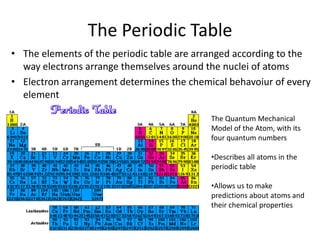
• The elements of the periodic table are arranged according to the
way electrons arrange themselves around the nuclei of atoms
• Electron arrangement determines the chemical behavoiur of every
element
The Quantum Mechanical
Model of the Atom, with its
four quantum numbers
•Describes all atoms in the
periodic table
•Allows us to make
predictions about atoms and
their chemical properties
Multi-electronic Atoms
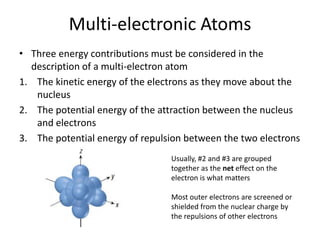
• Three energy contributions must be considered in the
description of a multi-electron atom
1. The kinetic energy of the electrons as they move about the
nucleus
2. The potential energy of the attraction between the nucleus
and electrons
3. The potential energy of repulsion between the two electrons
Usually, #2 and #3 are grouped
together as the net effect on the
electron is what matters
Most outer electrons are screened or
shielded from the nuclear charge by
the repulsions of other electrons
Drawing Energy Level Diagrams
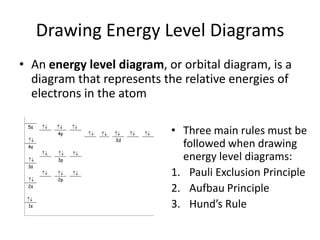
• An energy level diagram, or orbital diagram, is a
diagram that represents the relative energies of
electrons in the atom
• Three main rules must be
followed when drawing
energy level diagrams:
1. Pauli Exclusion Principle
2. Aufbau Principle
3. Hund’s Rule
Aufbau Principle
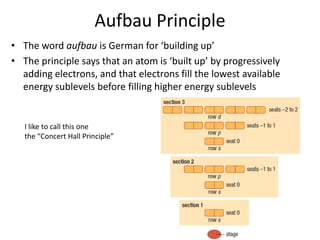
• The word aufbau is German for ‘building up’
• The principle says that an atom is ‘built up’ by progressively
adding electrons, and that electrons fill the lowest available
energy sublevels before filling higher energy sublevels
I like to call this one
the “Concert Hall Principle”
Aufbau Principle
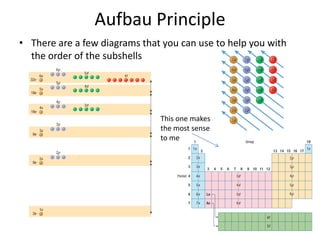
• There are a few diagrams that you can use to help you with
the order of the subshells
This one makes
the most sense
to me
Hund’s Rule
• Hund’s rule states that in orbitals within the same sublevel (having the same
energy), the lowest energy configuration for an atom is the one with the
maximum number of unpaired electrons
• This means that before any two electrons occupy an orbital in a subshell, other
orbitals within the same subshell must first each contain one electron
• These unpaired electrons will have parallel spins
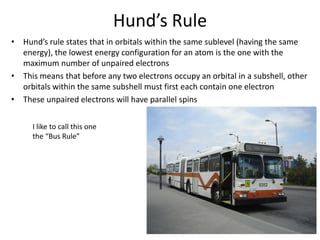
I like to call this one
the “Bus Rule”
Practice
• Draw the energy level diagram for tellurium
Electron Configuration
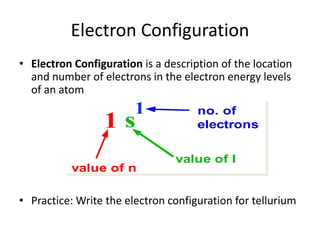
• Electron Configuration is a description of the location
and number of electrons in the electron energy levels
of an atom
• Practice: Write the electron configuration for tellurium
1
1 s
value of n
value of l
no. of
electrons
SPECTROSCOPIC NOTATION
for H, atomic number = 1
Ways of Expressing Electron
Configurations
• Full configuration
– Complete ordered placement starting with 1s2
• 1s2 2s2 2p6 3s2 3p6 4s2 3d4
• 1s2 2s2 2p6 3s2 3p6 4s2 3d10 4p2
• Condensed configuration
– Completed noble gas configuration in brackets followed by
detail for unfilled valence shell
• [Ar]4s2 3d4
• [Ar] 4s2 3d10 4p2
• Orbital diagrams for outer valence shell
– Labeled picture of outer valence shell
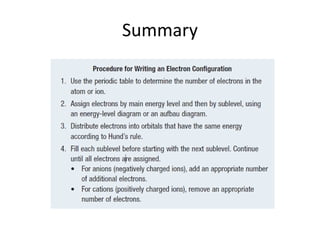
Summary
Explaining the Periodic Table
• Valence electrons are the electrons in the outermost shell
(outermost principal quantum level) of an atom
• The elements in the same group on the periodic table have the
same valence electron configuration
• Elements with the same valence electron configuration show
similar chemical behaviour
• Electron configurations can be used to explain periodic trends
For example:
Why is the atomic radius of potassium larger than that of sodium?
Why is the first ionization energy higher in beryllium than in
lithium?
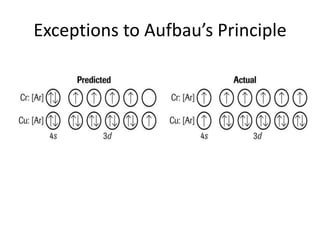
Exceptions to Aufbau’s Principle
Explaining Ion Charges
• Why does cadmium form a +2 ion?
• Why does lead form both a +2 and +4 ion?
Explaining Magnetism
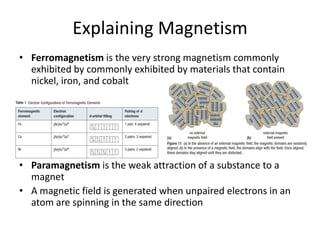
• Ferromagnetism is the very strong magnetism commonly
exhibited by commonly exhibited by materials that contain
nickel, iron, and cobalt
• Paramagnetism is the weak attraction of a substance to a
magnet
• A magnetic field is generated when unpaired electrons in an
atom are spinning in the same direction
HOMEWORK
Required Reading:
p. 160-172
(remember to supplement your notes!)
Questions:
p. 172 #1-10

35 atomicstructureandtheperiodictable

  • 1.
    Atomic Structure andthe Periodic Table Chapter 3.5
  • 2.
    The Periodic Table •The elements of the periodic table are arranged according to the way electrons arrange themselves around the nuclei of atoms • Electron arrangement determines the chemical behavoiur of every element The Quantum Mechanical Model of the Atom, with its four quantum numbers •Describes all atoms in the periodic table •Allows us to make predictions about atoms and their chemical properties
  • 3.
    Multi-electronic Atoms • Threeenergy contributions must be considered in the description of a multi-electron atom 1. The kinetic energy of the electrons as they move about the nucleus 2. The potential energy of the attraction between the nucleus and electrons 3. The potential energy of repulsion between the two electrons Usually, #2 and #3 are grouped together as the net effect on the electron is what matters Most outer electrons are screened or shielded from the nuclear charge by the repulsions of other electrons
  • 4.
    Drawing Energy LevelDiagrams • An energy level diagram, or orbital diagram, is a diagram that represents the relative energies of electrons in the atom • Three main rules must be followed when drawing energy level diagrams: 1. Pauli Exclusion Principle 2. Aufbau Principle 3. Hund’s Rule
  • 5.
    Aufbau Principle • Theword aufbau is German for ‘building up’ • The principle says that an atom is ‘built up’ by progressively adding electrons, and that electrons fill the lowest available energy sublevels before filling higher energy sublevels I like to call this one the “Concert Hall Principle”
  • 6.
    Aufbau Principle • Thereare a few diagrams that you can use to help you with the order of the subshells This one makes the most sense to me
  • 7.
    Hund’s Rule • Hund’srule states that in orbitals within the same sublevel (having the same energy), the lowest energy configuration for an atom is the one with the maximum number of unpaired electrons • This means that before any two electrons occupy an orbital in a subshell, other orbitals within the same subshell must first each contain one electron • These unpaired electrons will have parallel spins I like to call this one the “Bus Rule”
  • 8.
    Practice • Draw theenergy level diagram for tellurium
  • 9.
    Electron Configuration • ElectronConfiguration is a description of the location and number of electrons in the electron energy levels of an atom • Practice: Write the electron configuration for tellurium 1 1 s value of n value of l no. of electrons SPECTROSCOPIC NOTATION for H, atomic number = 1
  • 10.
    Ways of ExpressingElectron Configurations • Full configuration – Complete ordered placement starting with 1s2 • 1s2 2s2 2p6 3s2 3p6 4s2 3d4 • 1s2 2s2 2p6 3s2 3p6 4s2 3d10 4p2 • Condensed configuration – Completed noble gas configuration in brackets followed by detail for unfilled valence shell • [Ar]4s2 3d4 • [Ar] 4s2 3d10 4p2 • Orbital diagrams for outer valence shell – Labeled picture of outer valence shell
  • 11.
  • 12.
    Explaining the PeriodicTable • Valence electrons are the electrons in the outermost shell (outermost principal quantum level) of an atom • The elements in the same group on the periodic table have the same valence electron configuration • Elements with the same valence electron configuration show similar chemical behaviour • Electron configurations can be used to explain periodic trends For example: Why is the atomic radius of potassium larger than that of sodium? Why is the first ionization energy higher in beryllium than in lithium?
  • 13.
  • 14.
    Explaining Ion Charges •Why does cadmium form a +2 ion? • Why does lead form both a +2 and +4 ion?
  • 15.
    Explaining Magnetism • Ferromagnetismis the very strong magnetism commonly exhibited by commonly exhibited by materials that contain nickel, iron, and cobalt • Paramagnetism is the weak attraction of a substance to a magnet • A magnetic field is generated when unpaired electrons in an atom are spinning in the same direction
  • 16.
    HOMEWORK Required Reading: p. 160-172 (rememberto supplement your notes!) Questions: p. 172 #1-10