DOUBLE - GATE MOSFET

BY,
A. POOJA SHUKLA
1821310006
M. Tech ( I Yr )
SRM UNIVERSITY
A BASIC MOSFET:
MOSFET Transistor Fabrication Steps
MOSFET OPERATION
Step 1: Apply Gate Voltage
SiO2 Insulator (Glass)
Gate

Source

Drain
5 volts

holes

N

N

electrons
P
electrons to be
transmitted
Step 2: Excess electrons surface
in channel, holes are repelled.

Step 3: Channel becomes
saturated with electrons.
Electrons in source are able to
flow across channel to Drain.
Scaling limits of BULK MOSFET

 Limit

for supply voltage (<0.6V)

 Limit

for further scaling of tox (<2nm)

 Minimum

 Discrete

channel length Lg=50nm

dopant fluctuations

 Dramatic

short-channels effects (SCE)
Problem 1: Carrier Mobility Decreases as Channel

length decrease and Vertical Electric fields increase
Problem 2: VT Rolloff as Channel length decreases
Problem 3: Tunneling Through Gate Oxide (off state
current)
Problem 4: Wattage/Area increases as density increases
How can we follow Moore’s law ?
 By moving to DG MOSFETs
DG might be the unique viable alternative to build nano
MOSFETs when Lg<50nm
Because:
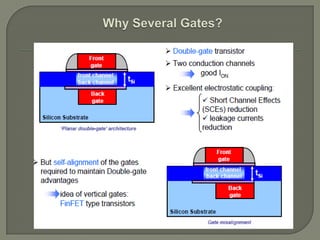
- Better control of the channel from the gates
- Reduced short-channel effects
- Better Ion/Ioff

- Improved sub-threshold slope (60mV/decade)
- No discrete dopant fluctuations
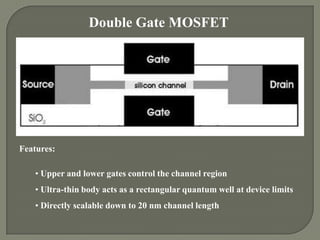
Double Gate MOSFET

Features:
• Upper and lower gates control the channel region
• Ultra-thin body acts as a rectangular quantum well at device limits
• Directly scalable down to 20 nm channel length
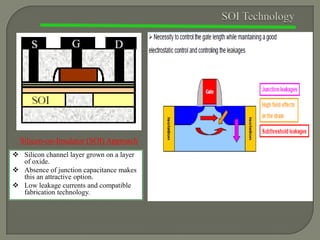
Silicon-on-Insulator (SOI) Approach
 Silicon channel layer grown on a layer
of oxide.
 Absence of junction capacitance makes
this an attractive option.
 Low leakage currents and compatible
fabrication technology.
Silicon-on-Insulator (SOI) Approach
 Silicon channel layer grown on a layer
of oxide.
 Absence of junction capacitance makes
this an attractive option.
 Low leakage currents and compatible
fabrication technology.
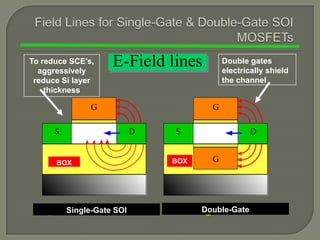
To reduce SCE’s,
aggressively
reduce Si layer
thickness

E-Field lines

G
S

BOX

Double gates
electrically shield
the channel

G
D

S

BOX

D
G

Double-Gate
Regular SOI MOSFET Double-gate MOSFET
Single-Gate SOI
Gate
n+ poly gate

Gate

Vdd

n+ source
n+ drain

Vdd
n+
source

n+
drain

p substrate

Gate

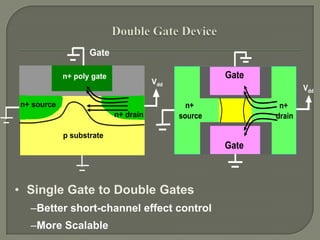
• Single Gate to Double Gates
–Better short-channel effect control
–More Scalable
•
•
•
•

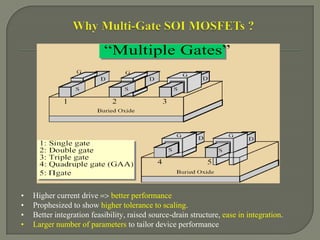
Higher current drive
better performance
Prophesized to show higher tolerance to scaling.
Better integration feasibility, raised source-drain structure, ease in integration.
Larger number of parameters to tailor device performance
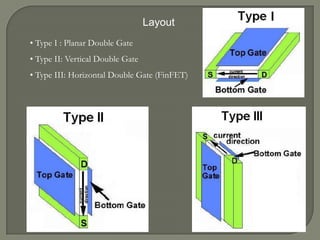
Layout
• Type I : Planar Double Gate
• Type II: Vertical Double Gate
• Type III: Horizontal Double Gate (FinFET)
Reduced Channel and Gate Leakage

• Short channel effects are seen in Standard silicon MOS devices
• DGFET offers greater control of the channel because of the double gate
• Gate leakage current is prevented by a thick gate oxide
Threshold Voltage Control

Silicon MOS Transistor:
• Increased body doping used to control VT for short channel
• Small number of dopant atoms for very short channel
• Lowest VT achievable is .5V

Double Gate FET :
• Increased body doping
• Asymmetric gate work functions (n+ / p+ gates)

• Metal gate
• VT of .1V achievable through work function engineering
Increased Carrier Mobility

Silicon MOS Transistor:
• Carrier scattering from increased body doping
• Transverse electric fields from the source and drain reduce mobility

Double Gate FET:
• Lightly doped channel in a DGFET results in a negligible depletion charge
• Asymmetric gate: experiences some transverse electric fields

• Metal gate: transverse electric field negligible with increased channel control
Reduced Power Consumption
• Double Gate coupling allows for higher drive currents at lower supply
voltage and threshold voltage
• Energy is a quadratic function of supply voltage

• Reduced channel and gate leakage currents in off state translate to huge
power savings
• Separate control of each gate allows dynamic control of VT :
Simplified logic gates would save power and chip area
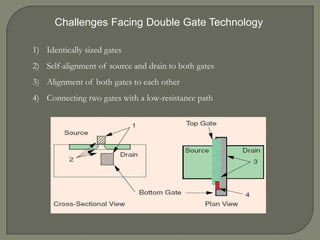
Challenges Facing Double Gate Technology
1) Identically sized gates
2) Self-alignment of source and drain to both gates
3) Alignment of both gates to each other
4) Connecting two gates with a low-resistance path
Ultimate Double Gate Limits
1) Thermionic emission above the channel potential barrier:
Short channel effects lower potential barrier

2) Band-to-band tunneling between body and drain pn junction:
Body-drain electric field increases tunneling probability
3) Quantum mechanical tunneling directly between source and drain:
Extremely small channel lengths correspond to narrow
potential barrier width
4) Other effects of quantum confinement in the thin body
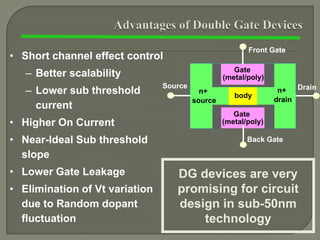
Front Gate

• Short channel effect control
– Better scalability
– Lower sub threshold
current
• Higher On Current

• Near-Ideal Sub threshold
slope
• Lower Gate Leakage

• Elimination of Vt variation
due to Random dopant
fluctuation

Gate
(metal/poly)
Source

n+
source

body

Drain
n+
drain

Gate
(metal/poly)
Back Gate

DG devices are very
promising for circuit
design in sub-50nm
technology
THANK YOU…….!!!

Double gate mosfet

  • 1.
    DOUBLE - GATEMOSFET BY, A. POOJA SHUKLA 1821310006 M. Tech ( I Yr ) SRM UNIVERSITY
  • 2.
  • 3.
  • 4.
    MOSFET OPERATION Step 1:Apply Gate Voltage SiO2 Insulator (Glass) Gate Source Drain 5 volts holes N N electrons P electrons to be transmitted Step 2: Excess electrons surface in channel, holes are repelled. Step 3: Channel becomes saturated with electrons. Electrons in source are able to flow across channel to Drain.
  • 5.
    Scaling limits ofBULK MOSFET  Limit for supply voltage (<0.6V)  Limit for further scaling of tox (<2nm)  Minimum  Discrete channel length Lg=50nm dopant fluctuations  Dramatic short-channels effects (SCE)
  • 6.
    Problem 1: CarrierMobility Decreases as Channel length decrease and Vertical Electric fields increase Problem 2: VT Rolloff as Channel length decreases Problem 3: Tunneling Through Gate Oxide (off state current) Problem 4: Wattage/Area increases as density increases
  • 7.
    How can wefollow Moore’s law ?  By moving to DG MOSFETs DG might be the unique viable alternative to build nano MOSFETs when Lg<50nm Because: - Better control of the channel from the gates - Reduced short-channel effects - Better Ion/Ioff - Improved sub-threshold slope (60mV/decade) - No discrete dopant fluctuations
  • 8.
    Double Gate MOSFET Features: •Upper and lower gates control the channel region • Ultra-thin body acts as a rectangular quantum well at device limits • Directly scalable down to 20 nm channel length
  • 9.
    Silicon-on-Insulator (SOI) Approach Silicon channel layer grown on a layer of oxide.  Absence of junction capacitance makes this an attractive option.  Low leakage currents and compatible fabrication technology.
  • 10.
    Silicon-on-Insulator (SOI) Approach Silicon channel layer grown on a layer of oxide.  Absence of junction capacitance makes this an attractive option.  Low leakage currents and compatible fabrication technology.
  • 12.
    To reduce SCE’s, aggressively reduceSi layer thickness E-Field lines G S BOX Double gates electrically shield the channel G D S BOX D G Double-Gate Regular SOI MOSFET Double-gate MOSFET Single-Gate SOI
  • 13.
    Gate n+ poly gate Gate Vdd n+source n+ drain Vdd n+ source n+ drain p substrate Gate • Single Gate to Double Gates –Better short-channel effect control –More Scalable
  • 14.
    • • • • Higher current drive betterperformance Prophesized to show higher tolerance to scaling. Better integration feasibility, raised source-drain structure, ease in integration. Larger number of parameters to tailor device performance
  • 15.
    Layout • Type I: Planar Double Gate • Type II: Vertical Double Gate • Type III: Horizontal Double Gate (FinFET)
  • 16.
    Reduced Channel andGate Leakage • Short channel effects are seen in Standard silicon MOS devices • DGFET offers greater control of the channel because of the double gate • Gate leakage current is prevented by a thick gate oxide
  • 17.
    Threshold Voltage Control SiliconMOS Transistor: • Increased body doping used to control VT for short channel • Small number of dopant atoms for very short channel • Lowest VT achievable is .5V Double Gate FET : • Increased body doping • Asymmetric gate work functions (n+ / p+ gates) • Metal gate • VT of .1V achievable through work function engineering
  • 18.
    Increased Carrier Mobility SiliconMOS Transistor: • Carrier scattering from increased body doping • Transverse electric fields from the source and drain reduce mobility Double Gate FET: • Lightly doped channel in a DGFET results in a negligible depletion charge • Asymmetric gate: experiences some transverse electric fields • Metal gate: transverse electric field negligible with increased channel control
  • 19.
    Reduced Power Consumption •Double Gate coupling allows for higher drive currents at lower supply voltage and threshold voltage • Energy is a quadratic function of supply voltage • Reduced channel and gate leakage currents in off state translate to huge power savings • Separate control of each gate allows dynamic control of VT : Simplified logic gates would save power and chip area
  • 20.
    Challenges Facing DoubleGate Technology 1) Identically sized gates 2) Self-alignment of source and drain to both gates 3) Alignment of both gates to each other 4) Connecting two gates with a low-resistance path
  • 21.
    Ultimate Double GateLimits 1) Thermionic emission above the channel potential barrier: Short channel effects lower potential barrier 2) Band-to-band tunneling between body and drain pn junction: Body-drain electric field increases tunneling probability 3) Quantum mechanical tunneling directly between source and drain: Extremely small channel lengths correspond to narrow potential barrier width 4) Other effects of quantum confinement in the thin body
  • 22.
    Front Gate • Shortchannel effect control – Better scalability – Lower sub threshold current • Higher On Current • Near-Ideal Sub threshold slope • Lower Gate Leakage • Elimination of Vt variation due to Random dopant fluctuation Gate (metal/poly) Source n+ source body Drain n+ drain Gate (metal/poly) Back Gate DG devices are very promising for circuit design in sub-50nm technology
  • 23.