PREPARED BY
POOJA SHUKLA(190912066)
PRIYANKA RANJAN(190912072)
INTERNAL GUIDE
Mr. Y. BHASKAR RAO
Assistant professor
ECE DEPTARTMENT
TEAM NO: 5, ECE
 The trend of miniaturization in electronics has
led to greater heat densities within computer
chips, demanding high performance heat sinks at
smaller and smaller scales.
 The equation used within VI program is used to
calculate the resistance of thermistor with respect
to the excitation voltage and the temperature
variation can be measured.
TEAM NO: 5, ECE
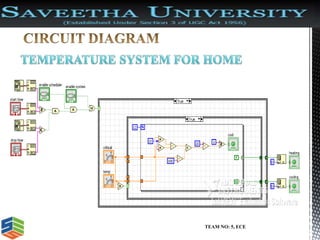
 To Design the Temperature sensor circuit using
Labview simulator.
 Analyzing the variation of temperature at
different intervals of time periods on the basis of
the application used.
TEAM NO: 5, ECE
TEAM NO: 5, ECE
 LabVIEW programs are called as virtual
instruments (VIs)
 Because their appearance and operation imitate
actual instruments
 However, they are analogous to main programs,
functions and subroutines from popular language
like C, Fortran, Pascal, …
TEAM NO: 5, ECE
 Front Panel
• Controls = Inputs
• Indicators = Outputs
 Block Diagram
• Accompanying “program” for front panel
• Components “wired” together
 In many systems, temperature control is
fundamental. There are a number of passive and
active temperature sensors that can be used to
measure system temperature, including:
1. thermocouple
2. resistive temperature detector
3. thermistor
4. silicon temperature sensors
TEAM NO: 5, ECE
• These sensors provide temperature feedback to
the system controller to make decisions such as,
over-temperature shutdown, turn-on/off cooling
fan, temperature compensation or general
purpose temperature monitor.
TEAM NO: 5, ECE
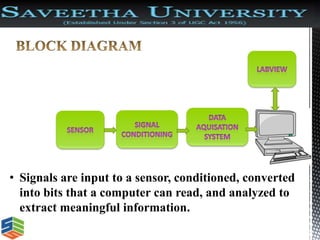
• Signals are input to a sensor, conditioned, converted
into bits that a computer can read, and analyzed to
extract meaningful information.
TEAM NO: 5, ECE
 We can measure temperature more accurately than
using thermistor.
 The sensor circuitry is sealed and not subject to
oxidation.
 The LM35 generates higher output voltage than
thermocouple and may not require the output voltage
to be amplified.
TEAM NO: 5, ECE
 It has an output voltage that is proportional to the Celsius
temperature
 The scale factor is .01V/oC
 They does not require any external calibration or trimming
 It maintains an accuracy
 It draws only 60 micro amps from its supply and possesses a
low self-heating capability
TEAM NO: 5, ECE
TEAM NO: 5, ECE
TEAM NO: 5, ECE
TEAM NO: 5, ECE
TEAM NO: 5, ECE
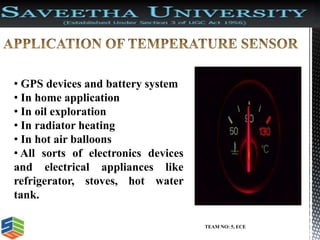
• GPS devices and battery system
• In home application
• In oil exploration
• In radiator heating
• In hot air balloons
• All sorts of electronics devices
and electrical appliances like
refrigerator, stoves, hot water
tank.
“The world is a book and those who do not travel read only
one page.”
― Augustine of Hippo
THANK YOU….!!!

SIMULATION OF TEMPERATURE SENSOR USING LABVIEW

  • 1.
    PREPARED BY POOJA SHUKLA(190912066) PRIYANKARANJAN(190912072) INTERNAL GUIDE Mr. Y. BHASKAR RAO Assistant professor ECE DEPTARTMENT TEAM NO: 5, ECE
  • 2.
     The trendof miniaturization in electronics has led to greater heat densities within computer chips, demanding high performance heat sinks at smaller and smaller scales.  The equation used within VI program is used to calculate the resistance of thermistor with respect to the excitation voltage and the temperature variation can be measured. TEAM NO: 5, ECE
  • 3.
     To Designthe Temperature sensor circuit using Labview simulator.  Analyzing the variation of temperature at different intervals of time periods on the basis of the application used. TEAM NO: 5, ECE
  • 4.
    TEAM NO: 5,ECE  LabVIEW programs are called as virtual instruments (VIs)  Because their appearance and operation imitate actual instruments  However, they are analogous to main programs, functions and subroutines from popular language like C, Fortran, Pascal, …
  • 5.
    TEAM NO: 5,ECE  Front Panel • Controls = Inputs • Indicators = Outputs  Block Diagram • Accompanying “program” for front panel • Components “wired” together
  • 6.
     In manysystems, temperature control is fundamental. There are a number of passive and active temperature sensors that can be used to measure system temperature, including: 1. thermocouple 2. resistive temperature detector 3. thermistor 4. silicon temperature sensors TEAM NO: 5, ECE
  • 7.
    • These sensorsprovide temperature feedback to the system controller to make decisions such as, over-temperature shutdown, turn-on/off cooling fan, temperature compensation or general purpose temperature monitor. TEAM NO: 5, ECE
  • 8.
    • Signals areinput to a sensor, conditioned, converted into bits that a computer can read, and analyzed to extract meaningful information.
  • 9.
    TEAM NO: 5,ECE  We can measure temperature more accurately than using thermistor.  The sensor circuitry is sealed and not subject to oxidation.  The LM35 generates higher output voltage than thermocouple and may not require the output voltage to be amplified.
  • 10.
    TEAM NO: 5,ECE  It has an output voltage that is proportional to the Celsius temperature  The scale factor is .01V/oC  They does not require any external calibration or trimming  It maintains an accuracy  It draws only 60 micro amps from its supply and possesses a low self-heating capability
  • 11.
  • 12.
  • 13.
  • 14.
  • 15.
    TEAM NO: 5,ECE • GPS devices and battery system • In home application • In oil exploration • In radiator heating • In hot air balloons • All sorts of electronics devices and electrical appliances like refrigerator, stoves, hot water tank.
  • 16.
    “The world isa book and those who do not travel read only one page.” ― Augustine of Hippo THANK YOU….!!!