Presentation - 3
TALLINN UNIVERSITY OF TECHNOLOGY
Course : Communicative Electronics
Subject : Microelectronics (IED3030)
Harish Kumar Singh – 177319IVEM
Matching
Pair of device having same property
- Resistor Matching
- Capacitor Matching
- Bipolar Transistor Matching
- Diodes Matching
- MOS Transistor Matching
MOS Transistor Matching
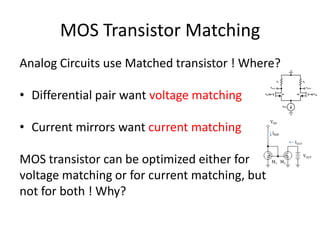
Analog Circuits use Matched transistor ! Where?
• Differential pair want voltage matching
• Current mirrors want current matching
MOS transistor can be optimized either for
voltage matching or for current matching, but
not for both ! Why?
Voltage Matching
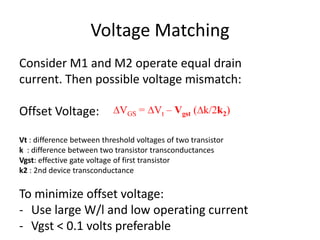
Consider M1 and M2 operate equal drain
current. Then possible voltage mismatch:
Offset Voltage:
Vt : difference between threshold voltages of two transistor
k : difference between two transistor transconductances
Vgst: effective gate voltage of first transistor
k2 : 2nd device transconductance
To minimize offset voltage:
- Use large W/l and low operating current
- Vgst < 0.1 volts preferable
Current matching
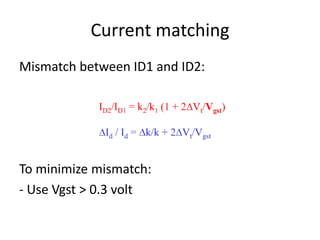
Mismatch between ID1 and ID2:
To minimize mismatch:
- Use Vgst > 0.3 volt
Geometric Effects on Matching
• Increased Gate Area minimizes impact of local
fluctuations
 Large transistors match more precisely.
• Longer channels reduce line width variations
and channel length modulation
 Long-channel transistors match more precisely.
• Gate Area, Oxide thickness, Channel length
modulation, Orientation.
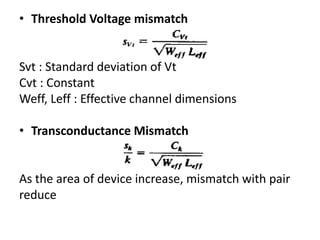
• Threshold Voltage mismatch
Svt : Standard deviation of Vt
Cvt : Constant
Weff, Leff : Effective channel dimensions
• Transconductance Mismatch
As the area of device increase, mismatch with pair
reduce
Orientation
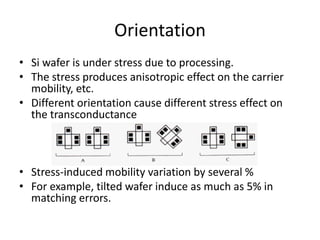
• Si wafer is under stress due to processing.
• The stress produces anisotropic effect on the carrier
mobility, etc.
• Different orientation cause different stress effect on
the transconductance
• Stress-induced mobility variation by several %
• For example, tilted wafer induce as much as 5% in
matching errors.
Contact Placement Effect on Matching
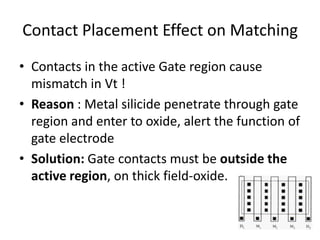
• Contacts in the active Gate region cause
mismatch in Vt !
• Reason : Metal silicide penetrate through gate
region and enter to oxide, alert the function of
gate electrode
• Solution: Gate contacts must be outside the
active region, on thick field-oxide.
Thermal Effects
• Current matching primly depends on
Transconductance matching.
• Transconducatance directly proportional to
carrier mobility, which exhibit large temperature
coefficient.
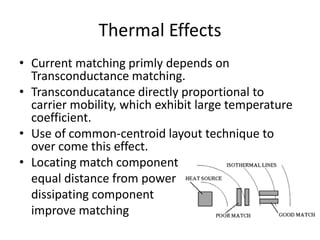
• Use of common-centroid layout technique to
over come this effect.
• Locating match component
equal distance from power
dissipating component
improve matching
Stress Effect
• The fabrication under high temperatures may
leave residual stresses in chip
• Packaging can cause stress in chip
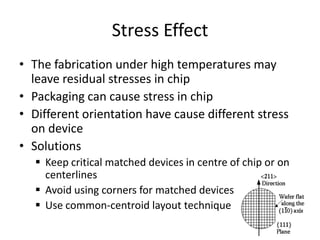
• Different orientation have cause different stress
on device
• Solutions
 Keep critical matched devices in centre of chip or on
centerlines
 Avoid using corners for matched devices
 Use common-centroid layout technique
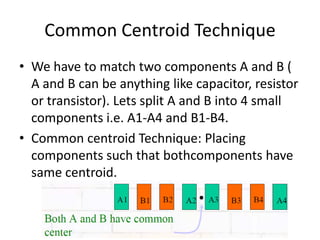
Common Centroid Technique
• We have to match two components A and B (
A and B can be anything like capacitor, resistor
or transistor). Lets split A and B into 4 small
components i.e. A1-A4 and B1-B4.
• Common centroid Technique: Placing
components such that bothcomponents have
same centroid.
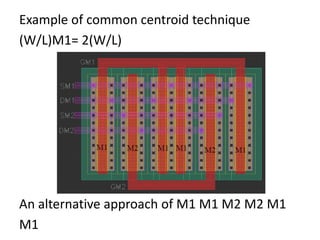
Example of common centroid technique
(W/L)M1= 2(W/L)
An alternative approach of M1 M1 M2 M2 M1
M1
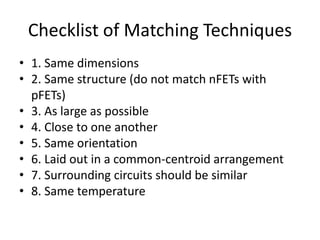
Checklist of Matching Techniques
• 1. Same dimensions
• 2. Same structure (do not match nFETs with
pFETs)
• 3. As large as possible
• 4. Close to one another
• 5. Same orientation
• 6. Laid out in a common-centroid arrangement
• 7. Surrounding circuits should be similar
• 8. Same temperature
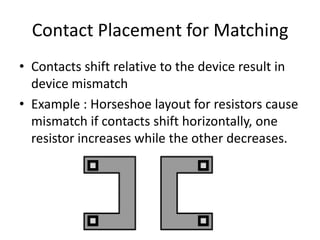
Contact Placement for Matching
• Contacts shift relative to the device result in
device mismatch
• Example : Horseshoe layout for resistors cause
mismatch if contacts shift horizontally, one
resistor increases while the other decreases.
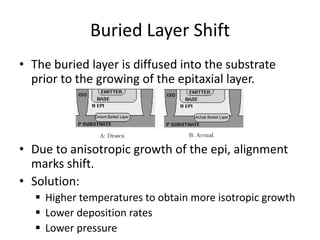
Buried Layer Shift
• The buried layer is diffused into the substrate
prior to the growing of the epitaxial layer.
• Due to anisotropic growth of the epi, alignment
marks shift.
• Solution:
 Higher temperatures to obtain more isotropic growth
 Lower deposition rates
 Lower pressure
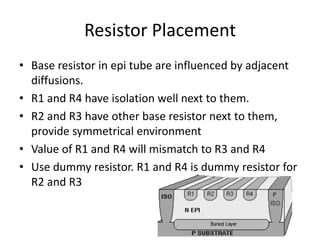
Resistor Placement
• Base resistor in epi tube are influenced by adjacent
diffusions.
• R1 and R4 have isolation well next to them.
• R2 and R3 have other base resistor next to them,
provide symmetrical environment
• Value of R1 and R4 will mismatch to R3 and R4
• Use dummy resistor. R1 and R4 is dummy resistor for
R2 and R3
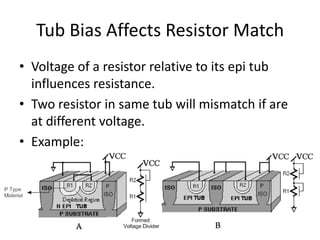
Tub Bias Affects Resistor Match
• Voltage of a resistor relative to its epi tub
influences resistance.
• Two resistor in same tub will mismatch if are
at different voltage.
• Example:
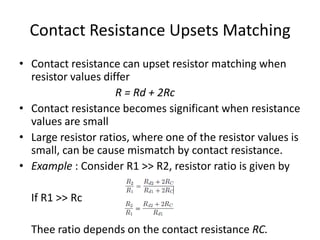
Contact Resistance Upsets Matching
• Contact resistance can upset resistor matching when
resistor values differ
R = Rd + 2Rc
• Contact resistance becomes significant when resistance
values are small
• Large resistor ratios, where one of the resistor values is
small, can be cause mismatch by contact resistance.
• Example : Consider R1 >> R2, resistor ratio is given by
If R1 >> Rc
Thee ratio depends on the contact resistance RC.
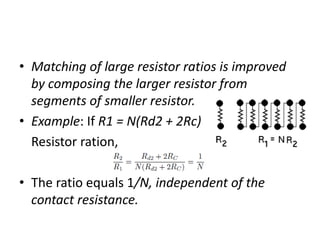
• Matching of large resistor ratios is improved
by composing the larger resistor from
segments of smaller resistor.
• Example: If R1 = N(Rd2 + 2Rc)
Resistor ration,
• The ratio equals 1/N, independent of the
contact resistance.
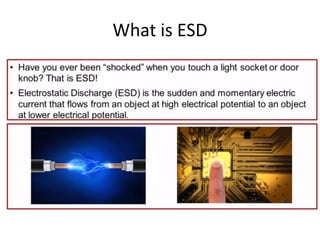
What is ESD
Electrostatic Discharge Protection
(ESD)
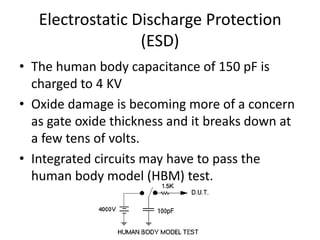
• The human body capacitance of 150 pF is
charged to 4 KV
• Oxide damage is becoming more of a concern
as gate oxide thickness and it breaks down at
a few tens of volts.
• Integrated circuits may have to pass the
human body model (HBM) test.
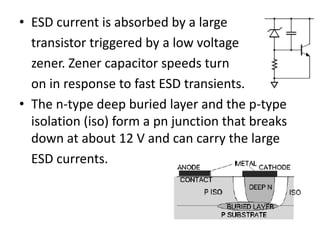
• ESD current is absorbed by a large
transistor triggered by a low voltage
zener. Zener capacitor speeds turn
on in response to fast ESD transients.
• The n-type deep buried layer and the p-type
isolation (iso) form a pn junction that breaks
down at about 12 V and can carry the large
ESD currents.
Aitäh

Matching concept in Microelectronics

  • 1.
    Presentation - 3 TALLINNUNIVERSITY OF TECHNOLOGY Course : Communicative Electronics Subject : Microelectronics (IED3030) Harish Kumar Singh – 177319IVEM
  • 2.
    Matching Pair of devicehaving same property - Resistor Matching - Capacitor Matching - Bipolar Transistor Matching - Diodes Matching - MOS Transistor Matching
  • 3.
    MOS Transistor Matching AnalogCircuits use Matched transistor ! Where? • Differential pair want voltage matching • Current mirrors want current matching MOS transistor can be optimized either for voltage matching or for current matching, but not for both ! Why?
  • 4.
    Voltage Matching Consider M1and M2 operate equal drain current. Then possible voltage mismatch: Offset Voltage: Vt : difference between threshold voltages of two transistor k : difference between two transistor transconductances Vgst: effective gate voltage of first transistor k2 : 2nd device transconductance To minimize offset voltage: - Use large W/l and low operating current - Vgst < 0.1 volts preferable
  • 5.
    Current matching Mismatch betweenID1 and ID2: To minimize mismatch: - Use Vgst > 0.3 volt
  • 6.
    Geometric Effects onMatching • Increased Gate Area minimizes impact of local fluctuations  Large transistors match more precisely. • Longer channels reduce line width variations and channel length modulation  Long-channel transistors match more precisely. • Gate Area, Oxide thickness, Channel length modulation, Orientation.
  • 7.
    • Threshold Voltagemismatch Svt : Standard deviation of Vt Cvt : Constant Weff, Leff : Effective channel dimensions • Transconductance Mismatch As the area of device increase, mismatch with pair reduce
  • 8.
    Orientation • Si waferis under stress due to processing. • The stress produces anisotropic effect on the carrier mobility, etc. • Different orientation cause different stress effect on the transconductance • Stress-induced mobility variation by several % • For example, tilted wafer induce as much as 5% in matching errors.
  • 9.
    Contact Placement Effecton Matching • Contacts in the active Gate region cause mismatch in Vt ! • Reason : Metal silicide penetrate through gate region and enter to oxide, alert the function of gate electrode • Solution: Gate contacts must be outside the active region, on thick field-oxide.
  • 10.
    Thermal Effects • Currentmatching primly depends on Transconductance matching. • Transconducatance directly proportional to carrier mobility, which exhibit large temperature coefficient. • Use of common-centroid layout technique to over come this effect. • Locating match component equal distance from power dissipating component improve matching
  • 11.
    Stress Effect • Thefabrication under high temperatures may leave residual stresses in chip • Packaging can cause stress in chip • Different orientation have cause different stress on device • Solutions  Keep critical matched devices in centre of chip or on centerlines  Avoid using corners for matched devices  Use common-centroid layout technique
  • 12.
    Common Centroid Technique •We have to match two components A and B ( A and B can be anything like capacitor, resistor or transistor). Lets split A and B into 4 small components i.e. A1-A4 and B1-B4. • Common centroid Technique: Placing components such that bothcomponents have same centroid.
  • 13.
    Example of commoncentroid technique (W/L)M1= 2(W/L) An alternative approach of M1 M1 M2 M2 M1 M1
  • 14.
    Checklist of MatchingTechniques • 1. Same dimensions • 2. Same structure (do not match nFETs with pFETs) • 3. As large as possible • 4. Close to one another • 5. Same orientation • 6. Laid out in a common-centroid arrangement • 7. Surrounding circuits should be similar • 8. Same temperature
  • 15.
    Contact Placement forMatching • Contacts shift relative to the device result in device mismatch • Example : Horseshoe layout for resistors cause mismatch if contacts shift horizontally, one resistor increases while the other decreases.
  • 16.
    Buried Layer Shift •The buried layer is diffused into the substrate prior to the growing of the epitaxial layer. • Due to anisotropic growth of the epi, alignment marks shift. • Solution:  Higher temperatures to obtain more isotropic growth  Lower deposition rates  Lower pressure
  • 17.
    Resistor Placement • Baseresistor in epi tube are influenced by adjacent diffusions. • R1 and R4 have isolation well next to them. • R2 and R3 have other base resistor next to them, provide symmetrical environment • Value of R1 and R4 will mismatch to R3 and R4 • Use dummy resistor. R1 and R4 is dummy resistor for R2 and R3
  • 18.
    Tub Bias AffectsResistor Match • Voltage of a resistor relative to its epi tub influences resistance. • Two resistor in same tub will mismatch if are at different voltage. • Example:
  • 19.
    Contact Resistance UpsetsMatching • Contact resistance can upset resistor matching when resistor values differ R = Rd + 2Rc • Contact resistance becomes significant when resistance values are small • Large resistor ratios, where one of the resistor values is small, can be cause mismatch by contact resistance. • Example : Consider R1 >> R2, resistor ratio is given by If R1 >> Rc Thee ratio depends on the contact resistance RC.
  • 20.
    • Matching oflarge resistor ratios is improved by composing the larger resistor from segments of smaller resistor. • Example: If R1 = N(Rd2 + 2Rc) Resistor ration, • The ratio equals 1/N, independent of the contact resistance.
  • 21.
  • 22.
    Electrostatic Discharge Protection (ESD) •The human body capacitance of 150 pF is charged to 4 KV • Oxide damage is becoming more of a concern as gate oxide thickness and it breaks down at a few tens of volts. • Integrated circuits may have to pass the human body model (HBM) test.
  • 23.
    • ESD currentis absorbed by a large transistor triggered by a low voltage zener. Zener capacitor speeds turn on in response to fast ESD transients. • The n-type deep buried layer and the p-type isolation (iso) form a pn junction that breaks down at about 12 V and can carry the large ESD currents.
  • 24.