NT 2005 MOLECULAR AND
NANOELECTRONICS
MOSFET

BY,
A. POOJA SHUKLA
1821310006
M. Tech (I year)
INTRODUCTION TO
TRANSISTOR
 In 1947 by John Bardeen, Walter Brattain and William Shockley
the transistor revolutionized the field of electronics

 A transistor is a semiconductor device used to amplify and switch
electronic signals and electrical power.
 It is composed of semiconductor material with at least three
terminals for connection to an external circuit.
 The transistor is the fundamental building block of modern
electronic devices.
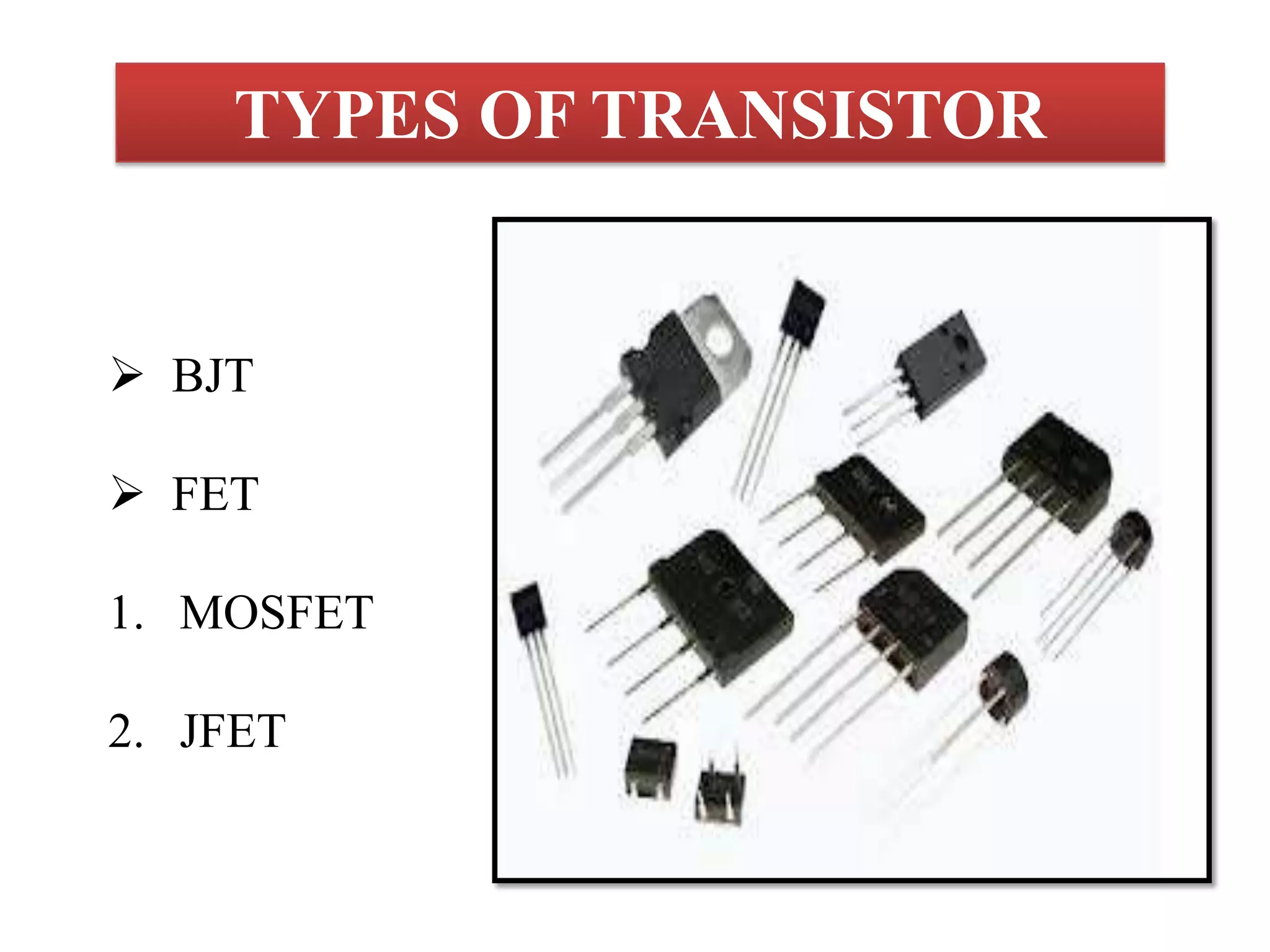
TYPES OF TRANSISTOR

 BJT
 FET
1. MOSFET
2. JFET
FET TERMINALS SYMBOL
BJT AND FET

BJT

FET
WHAT IS MOSFET….???

 The

metal–oxide–semiconductor

field-effect

transistor

(MOSFET, MOS-FET, or MOS FET) is a transistor used for
amplifying or switching electronic signals.
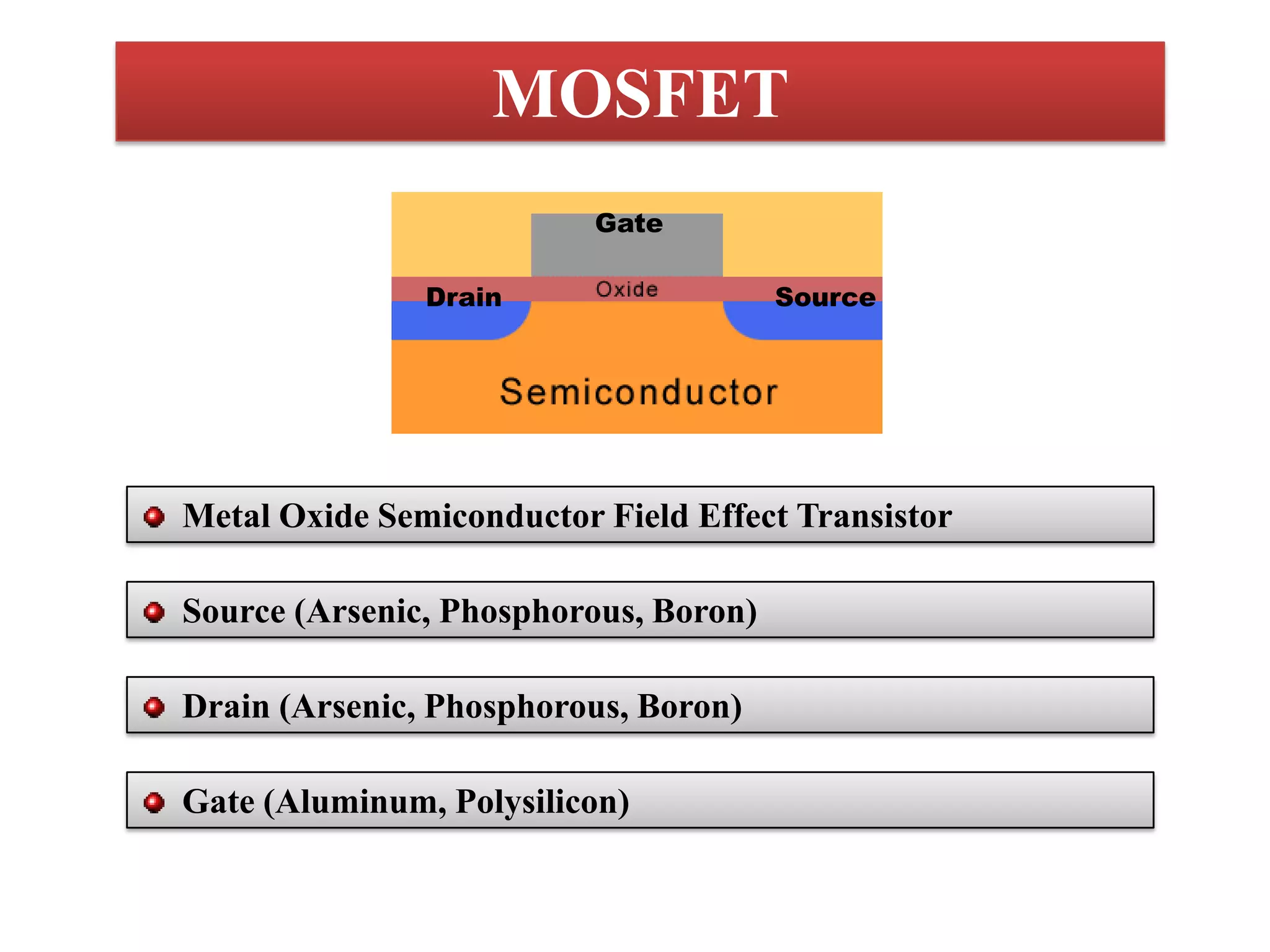
MOSFET
Gate
Drain

Source

Metal Oxide Semiconductor Field Effect Transistor
Source (Arsenic, Phosphorous, Boron)
Drain (Arsenic, Phosphorous, Boron)
Gate (Aluminum, Polysilicon)
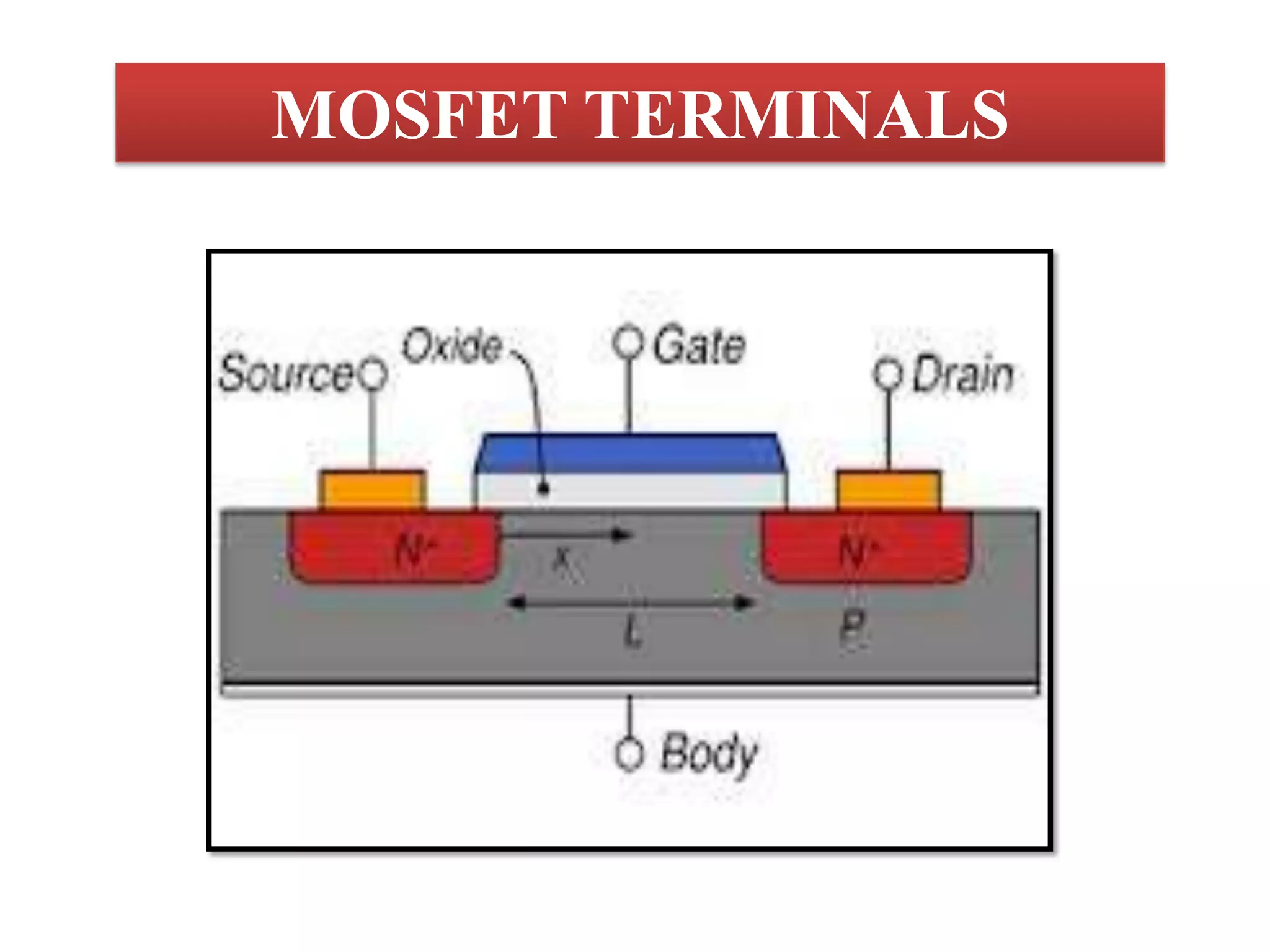
MOSFET TERMINALS
TYPES OF MOSFET

 n - MOS FET
 p – MOS FET
 CMOS FET
MOSFET TERMINALS
SYMBOL
D

D

G

G
S

NMOS Enhancement

S

NMOS Depletion

D

G

D

G

S

PMOS Enhancement

B
S

NMOS with
Bulk Contact

Channel
MOSFET STRUCTURE

• This device is symmetric, so either of the n+ regions can be source
or drain.
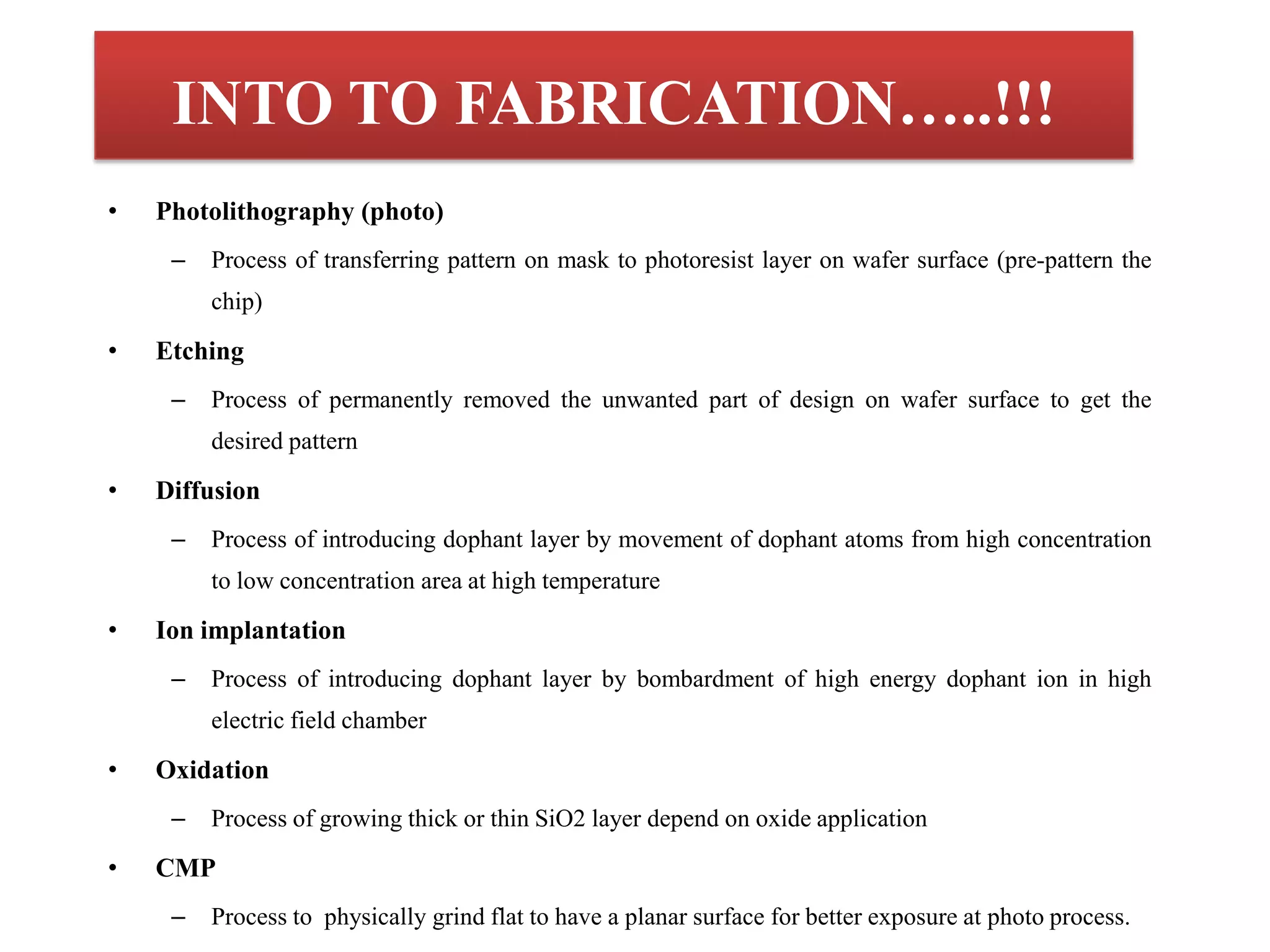
INTO TO FABRICATION…..!!!
•

Photolithography (photo)
–

Process of transferring pattern on mask to photoresist layer on wafer surface (pre-pattern the
chip)

•

Etching
–

Process of permanently removed the unwanted part of design on wafer surface to get the
desired pattern

•

Diffusion
–

Process of introducing dophant layer by movement of dophant atoms from high concentration
to low concentration area at high temperature

•

Ion implantation
–

Process of introducing dophant layer by bombardment of high energy dophant ion in high
electric field chamber

•

Oxidation
–

•

Process of growing thick or thin SiO2 layer depend on oxide application

CMP
–

Process to physically grind flat to have a planar surface for better exposure at photo process.
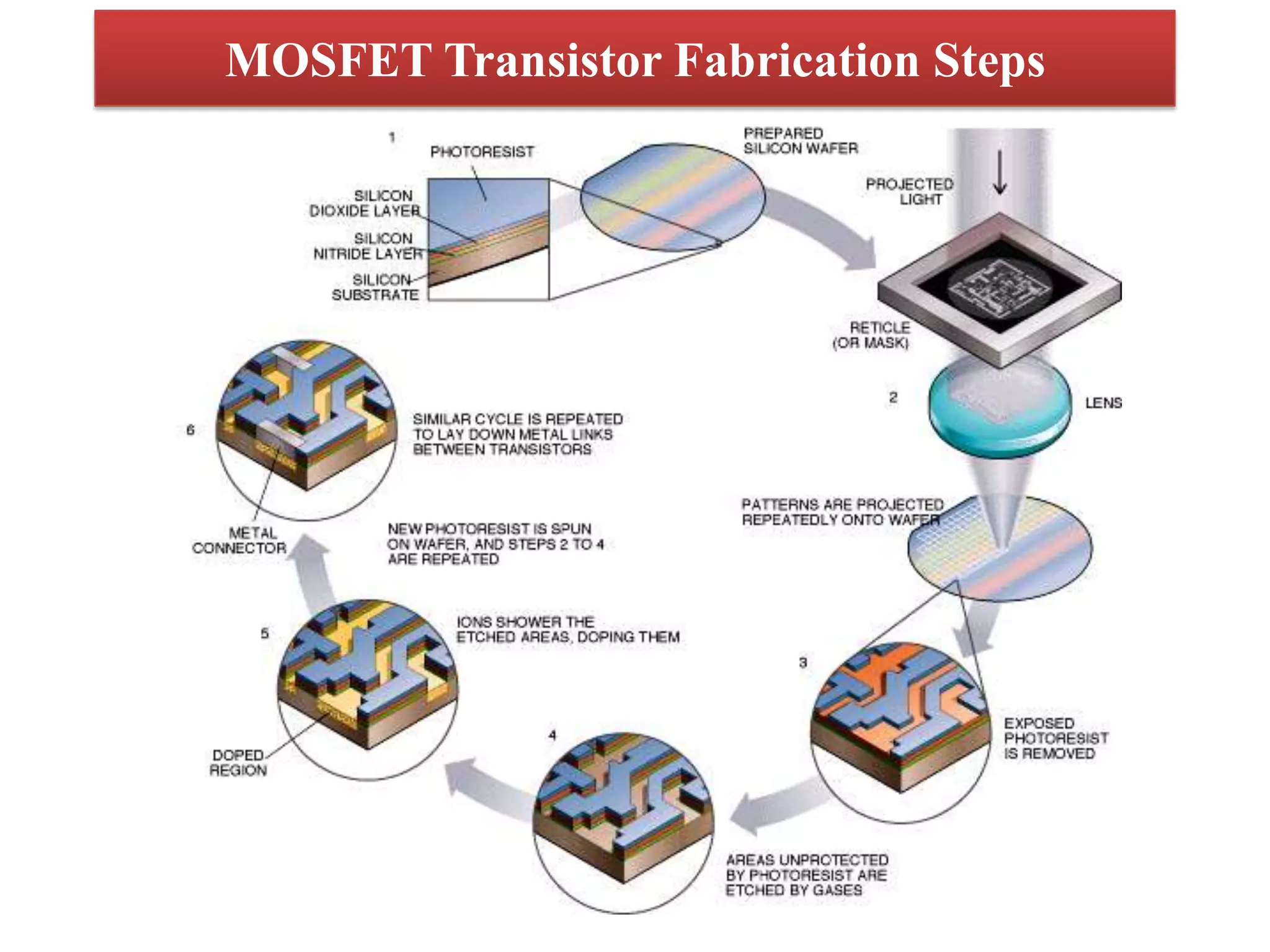
MOSFET Transistor Fabrication Steps
Building A MOSFET Transistor Using Silicon
It is done. Now, how does it
work?
MOSFET OPERATION
Step 1: Apply Gate Voltage
SiO2 Insulator (Glass)
Gate

Source

Drain
5 volts

holes

N

N

electrons
P
electrons to be
transmitted
Step 2: Excess electrons surface in
channel, holes are repelled.

Step 3: Channel becomes saturated
with electrons. Electrons in source
are able to flow across channel to
Drain.
N-MOSFET
– 4 electrical terminals
• Source
• Drain
• Gate
• Substrate
– Connected to Gnd

Gate

Source

Drain
Substrate (Body)

– Source and drain are only different in their interpretation
• Terminal with lower voltage is the source (by convention)

– Simplified symbol omits the substrate

VG

VS

VD
N-MOSFET
Gate Oxide
Gate
Source

Polysilicon

n+

Drain
n+

p-substrate

Bulk Contact

CROSS-SECTION of NMOS Transistor

P-type substrate
N-type dopant for Source & Drain

Inversion layer is formed to conduct electricity

Field-Oxide
(SiO2)

p+ stopper
N-MOSFET
• NMOS Behavior
– When Gate (VG) is high (i.e. 1) the NMOS transistor acts as a
closed switch
• When VG = 0, the NMOS transistor is an open switch
VG

VS

VG = "low"

VD

VG = "high"
P-MOSFET
– Same 4 electrical terminals
• Source
• Drain
• Gate
• Substrate
– Connected to VDD

Gate

Drain
Substrate (Body)

Source
V DD

– Again, source and drain are only different in their interpretation
• Terminal with higher voltage is the source (by convention)

– Simplified symbol omits the substrate

VG

VS

VD
P-MOSFET
Gate Oxide
Gate
Source

Polysilicon

p+

Drain
p+

n-substrate

Bulk Contact

CROSS-SECTION of PMOS Transistor

N-type substrate
P-type dopant for Source & Drain
Inversion layer is formed to conduct electricity

Field-Oxide
(SiO2)

n+ stopper
P-MOSFET
• PMOS Behavior
– When Gate (VG) is low (i.e. 0) the PMOS transistor acts as a closed
switch
• When VG = 1, the PMOS transistor is an open switch
VG

VS

VG = "high"

VD

VG = "low"
CMOSFET PROCESS FLOW
WELL FORMATION

ISOLATION FORMATION

TRANSISTOR MAKING

INTERCONNECTION

PASSIVATION
CMOSFET

A combination of both NMOS & PMOS technology
Most basic example: inverter
CMOS FABRICATION PROCESS
well formation

• Start with clean p-type substrate (p-type wafer)
CMOS FABRICATION PROCESS
well formation

• Grow epitaxy layer (made from SiO2) as mask

layer for well formation
CMOS FABRICATION PROCESS
well formation
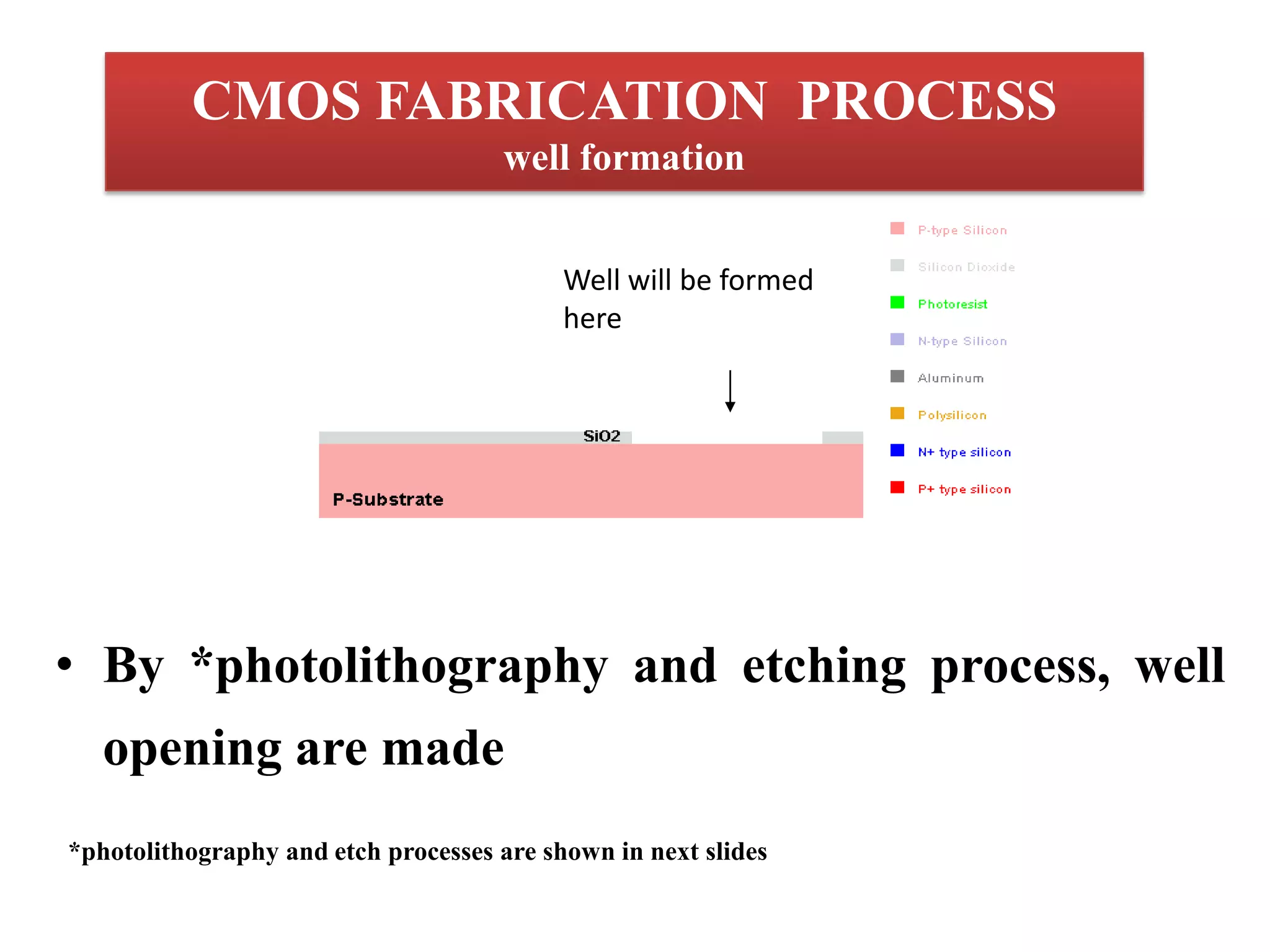
Well will be formed
here

• By *photolithography and etching process, well
opening are made
*photolithography and etch processes are shown in next slides
CMOS FABRICATION PROCESS
photoresist
Si02
P-substrate

• Photoresist coating (C)

UV light

• Masking and exposure under UV
mask
Opaque
area
P-substrate

Transparent
area

light(E)
• Resist dissolved after developed (D)
– Pre-shape the well pattern at resist
layer
ETCHING
• Removing the unwanted
P-substrate

P-substrate

pattern by wet etching

• Resist clean
• Desired pattern formed
CMOS FABRICATION PROCESS
well formation

Phosphorus ion

• Ion bombardment by ion implantation
• SiO2 as mask, uncovered area will exposed to dophant ion
CMOS FABRICATION PROCESS
isolation formation

Thick oxide

• Increase SiO2 thickness by oxidation at high

temperature
• Oxide will electrically isolates nmos and pmos devices
CMOS FABRICATION PROCESS
transistor making

nmos will be
formed here

pmos will be
formed here

LOCOS (isolation structure)

• By photolithography and etching process,
pmos and nmos areas are defined
CMOS FABRICATION PROCESS
transistor making

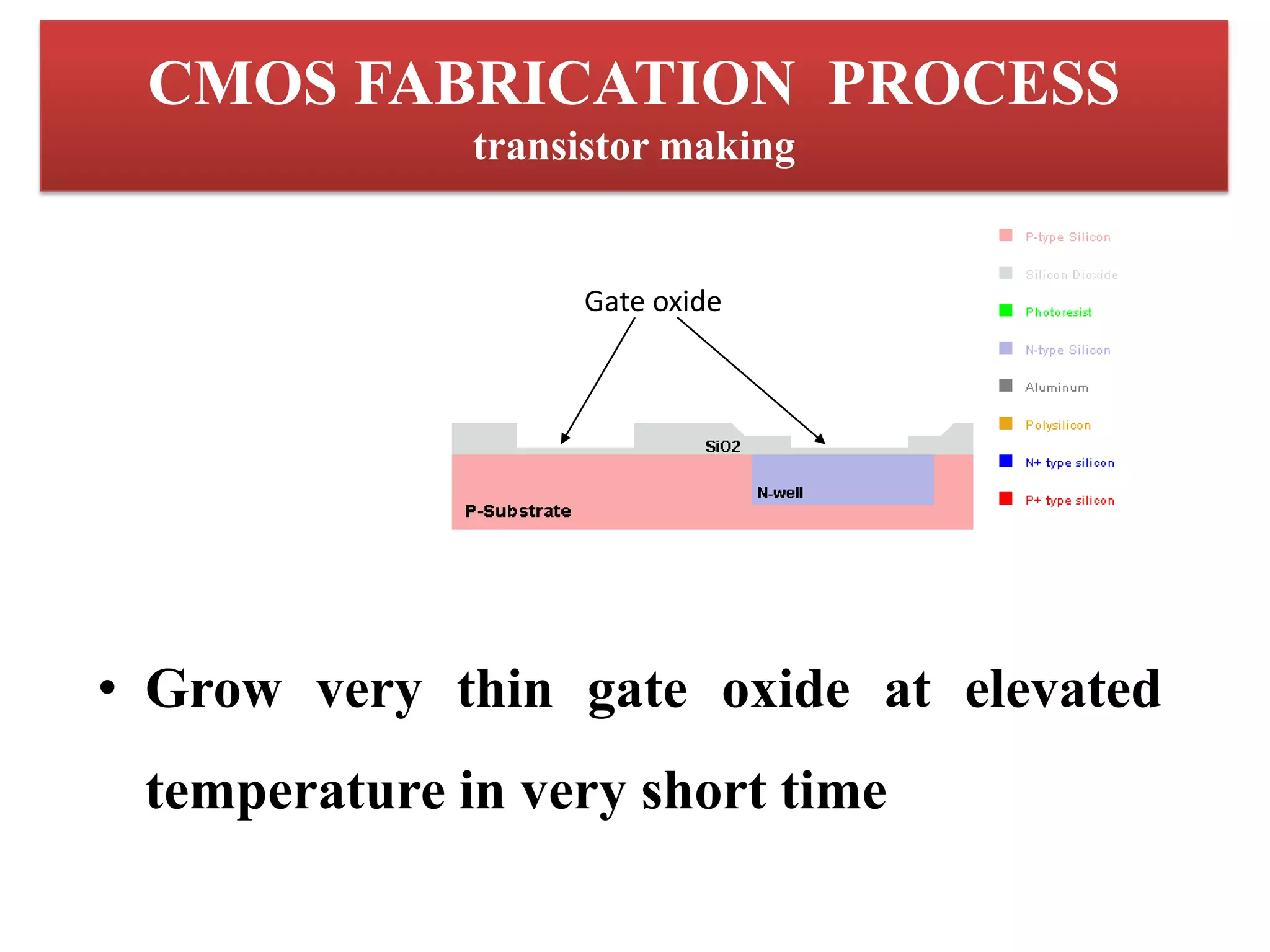
Gate oxide

• Grow very thin gate oxide at elevated

temperature in very short time
CMOS FABRICATION PROCESS
transistor making

polysilicon

• Deposit polysilicon layer
CMOS FABRICATION PROCESS
transistor making

gate

• Photolithography (photo) and etching to

form gate pattern
CMOS FABRICATION PROCESS
transistor making
Arsenic ion

photoresist

• Photo process to define the nmos’s active (source
and drain) area and VDD contact

• Ion implantation with Arsenic ion for n+ dophant.
• Photoresist and polisilicon gate act as mask
CMOS FABRICATION PROCESS
transistor making

source

drain

VDD
contact

• Nmos’s Source and drain with VDD contact formation
• Resist removal
CMOS FABRICATION PROCESS
transistor making

Boron ion

photoresist

• Photo process to define the GND contact and pmos’s active
area (source and drain)
• Ion implantation with boron ionto have p+ dophant
• Photoresist and gate act as mask
CMOS FABRICATION PROCESS
transistor making

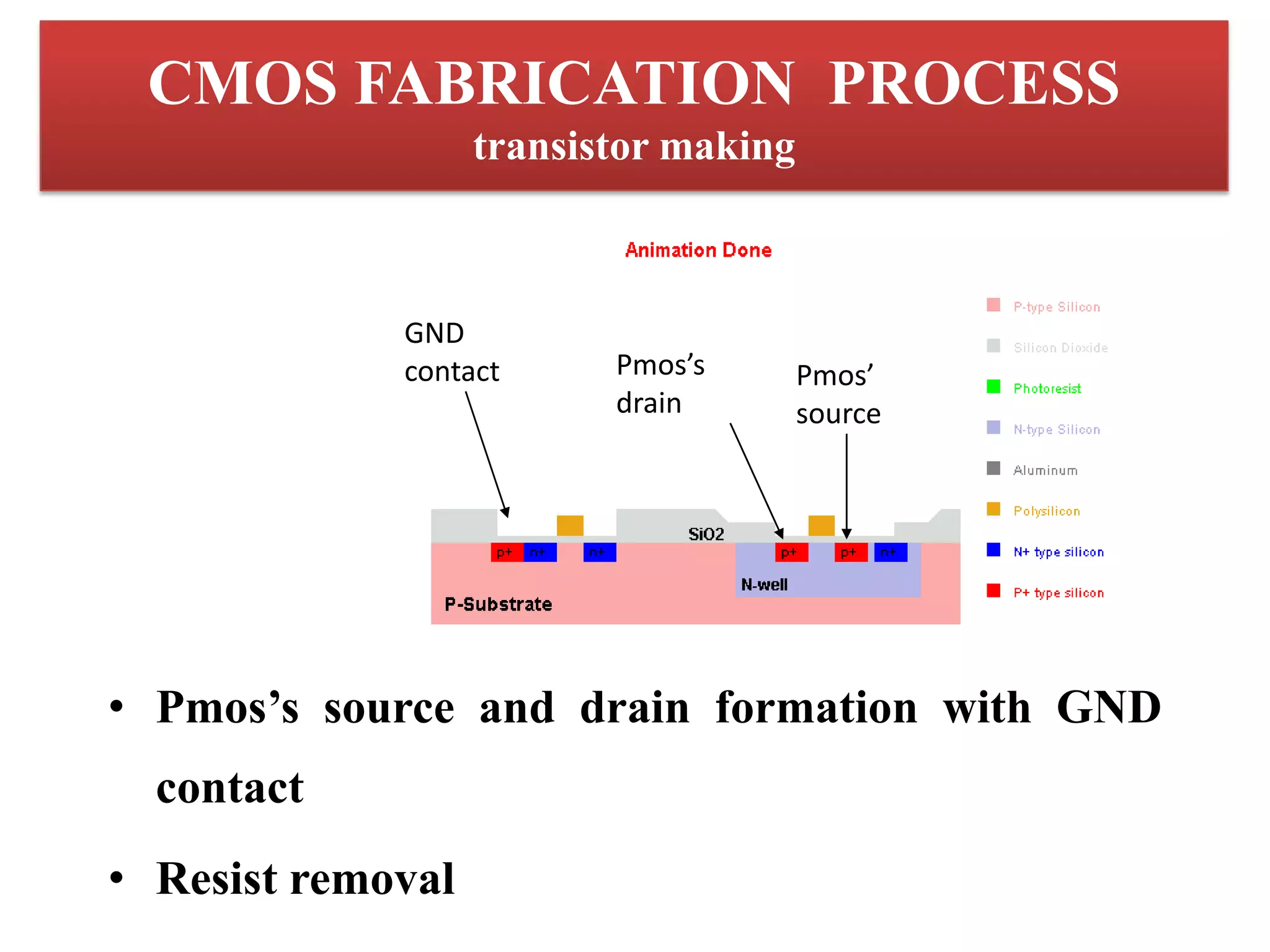
GND
contact

Pmos’s
drain

Pmos’
source

• Pmos’s source and drain formation with GND

contact
• Resist removal
CMOS FABRICATION PROCESS
interconnection

SiO2

• Deposit SiO2 layer through out wafer
surface
CMOS FABRICATION PROCESS
interconnection
contact

• Photo and etching process to make contact
CMOS FABRICATION PROCESS
interconnection
Metal 1

• Metal 1 deposition throughout wafer

surface
CMOS FABRICATION PROCESS
interconnection

• Photo and etching processes to pattern
interconnection
Mask Layout
Mask Layout
Mask Layout
Mask Layout
A’

A

Metal 1
oxide
n+

n+

p+
N-well

p-substrate

p+
THANK YOU…….!!!

Mosfet