From an architectural standpoint, it is
classified as,…

 POINT TO POINT LINKS

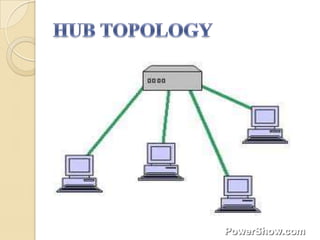
 DISTRIBUTION NETWORKS

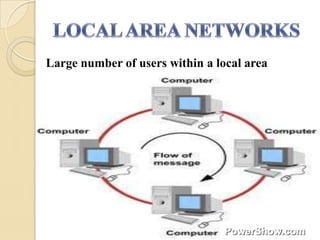
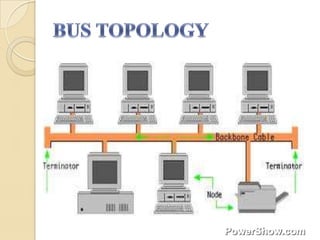
 LOCAL AREA NETWORKS
• They transport information, available in the form
of a digital bit stream

• The link length can vary from less than a
kilometer to 1000’s of kilometer

• They are used for high speed transmission

• Optical regenerators should perform,
          1. Re-amplification
          2. Re-shaping
          3. Re-timing
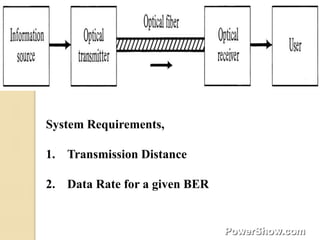
System Requirements,

1. Transmission Distance

2. Data Rate for a given BER
o Attenuation

o Distance Bandwidth Product

o Cost of the connectors

o Splicing

Then decide,
• single or multimode fiber

• step or graded index fiber
Large number of users within a local area
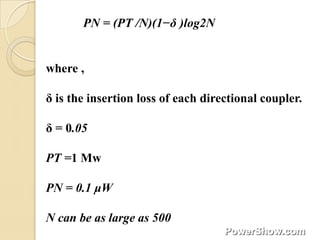
PN = (PT /N)(1−δ )log2N


where ,

δ is the insertion loss of each directional coupler.

δ = 0.05

PT =1 Mw

PN = 0.1 μW

N can be as large as 500
PN = PTC[(1−δ )(1−C)]N−1

where ,
PT is the transmitted power

C is the fraction of power coupled out at each tap

δ accounts for insertion losses, assumed to be the
same at each tap

N should not exceed 60.
   Link Power Budget
    ◦ There is enough power margin in the system
      to meet the given BER


   Rise Time Budget
    ◦ Each element of the link is fast enough to
      meet the given bit rate
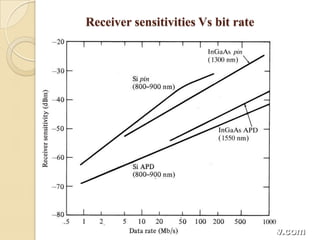
Receiver sensitivities Vs bit rate
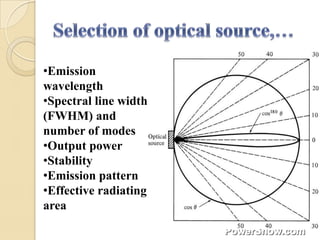
•Emission
wavelength
•Spectral line width
(FWHM) and
number of modes
•Output power
•Stability
•Emission pattern
•Effective radiating
area
 Type of detector
   APD: High sensitivity but complex, high bias
   voltage (40V or more) and expensive
   PIN: Simpler, thermally stable, low bias
   voltage (5V or less) and less expensive
 Responsivity (that depends on the avalanche
gain & quantum efficiency)
 Operating wavelength and spectral selectivity
 Speed (capacitance) and photosensitive area
 Sensitivity (depends on noise and gain)
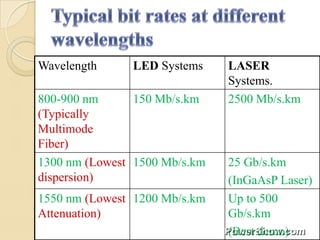
Wavelength     LED Systems     LASER
                               Systems.
800-900 nm      150 Mb/s.km    2500 Mb/s.km
(Typically
Multimode
Fiber)
1300 nm (Lowest 1500 Mb/s.km   25 Gb/s.km
dispersion)                    (InGaAsP Laser)
1550 nm (Lowest 1200 Mb/s.km   Up to 500
Attenuation)                   Gb/s.km
                               (Best demo)
 If the signal is detected by a receiver that
requires a minimum average power at the bit
rate B, the maximum transmission distance is
limited
 The system requirements typically specified in
advance are the bit rate B and the
transmission distance L
 The performance criterion is specified through
the bit-error rate (BER), a typical requirement
being BER < 10−9.
• When the dispersion-limited transmission
distance is shorter than the loss-limited
distance of the system is said to be dispersion
limited.
              BL ≤ (4|D|σλ )−1

• A solution to the dispersion problem is
offered by dispersion-shifted fibers for
which dispersion and loss both are minimum
near 1.55 μm.
o The purpose of the power budget is to ensure
that enough power will reach the receiver to
maintain reliable performance during the entire
system lifetime

o The minimum average power required by the
receiver is the receiver sensitivity

o It is expressed in dBm
• Used to ensure that the system is able to operate
properly at the intended bit rate

• Even if the bandwidth of the individual system
components exceeds the bit rate, it is still possible
that the total system may not be able to operate at
that bit rate

• It is used to allocate the bandwidth among
various components
• The rise time Tr of a linear system is defined as the
time during which the response increases from 10 to
90% of its final output value when the input is
changed abruptly.


• When the input voltage across an RC circuit
changes instantaneously from 0 to V0, the output
voltage changes as,


           Vout(t) =V0[1−exp(−t/RC)]
 Here we focus on the factors that limit the
performance of amplified fiber links

 It depends on following factors,

            1. Performance - limiting factor

            2. Terrestrial light wave systems

            3. Undersea light wave systems
The sensitivity of the optical receiver in a realistic
lightwave system is affected by several physical
phenomena which, in combination with fiber
dispersion, degrade the SNR at the decision circuit
Among the phenomena that degrade the receiver
sensitivity are,

1. Modal noise

2. Dispersion broadening

3. Intersymbol interference

4. Mode-partition noise

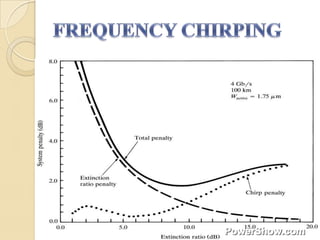
5. Frequency chirp

6. Reflection feedback.
Light wave-system-3855513

Light wave-system-3855513

  • 3.
    From an architecturalstandpoint, it is classified as,…  POINT TO POINT LINKS  DISTRIBUTION NETWORKS  LOCAL AREA NETWORKS
  • 4.
    • They transportinformation, available in the form of a digital bit stream • The link length can vary from less than a kilometer to 1000’s of kilometer • They are used for high speed transmission • Optical regenerators should perform, 1. Re-amplification 2. Re-shaping 3. Re-timing
  • 5.
    System Requirements, 1. TransmissionDistance 2. Data Rate for a given BER
  • 6.
    o Attenuation o DistanceBandwidth Product o Cost of the connectors o Splicing Then decide, • single or multimode fiber • step or graded index fiber
  • 7.
    Large number ofusers within a local area
  • 10.
    PN = (PT/N)(1−δ )log2N where , δ is the insertion loss of each directional coupler. δ = 0.05 PT =1 Mw PN = 0.1 μW N can be as large as 500
  • 11.
    PN = PTC[(1−δ)(1−C)]N−1 where , PT is the transmitted power C is the fraction of power coupled out at each tap δ accounts for insertion losses, assumed to be the same at each tap N should not exceed 60.
  • 15.
    Link Power Budget ◦ There is enough power margin in the system to meet the given BER  Rise Time Budget ◦ Each element of the link is fast enough to meet the given bit rate
  • 16.
  • 18.
    •Emission wavelength •Spectral line width (FWHM)and number of modes •Output power •Stability •Emission pattern •Effective radiating area
  • 19.
     Type ofdetector APD: High sensitivity but complex, high bias voltage (40V or more) and expensive PIN: Simpler, thermally stable, low bias voltage (5V or less) and less expensive  Responsivity (that depends on the avalanche gain & quantum efficiency)  Operating wavelength and spectral selectivity  Speed (capacitance) and photosensitive area  Sensitivity (depends on noise and gain)
  • 20.
    Wavelength LED Systems LASER Systems. 800-900 nm 150 Mb/s.km 2500 Mb/s.km (Typically Multimode Fiber) 1300 nm (Lowest 1500 Mb/s.km 25 Gb/s.km dispersion) (InGaAsP Laser) 1550 nm (Lowest 1200 Mb/s.km Up to 500 Attenuation) Gb/s.km (Best demo)
  • 21.
     If thesignal is detected by a receiver that requires a minimum average power at the bit rate B, the maximum transmission distance is limited  The system requirements typically specified in advance are the bit rate B and the transmission distance L  The performance criterion is specified through the bit-error rate (BER), a typical requirement being BER < 10−9.
  • 22.
    • When thedispersion-limited transmission distance is shorter than the loss-limited distance of the system is said to be dispersion limited. BL ≤ (4|D|σλ )−1 • A solution to the dispersion problem is offered by dispersion-shifted fibers for which dispersion and loss both are minimum near 1.55 μm.
  • 23.
    o The purposeof the power budget is to ensure that enough power will reach the receiver to maintain reliable performance during the entire system lifetime o The minimum average power required by the receiver is the receiver sensitivity o It is expressed in dBm
  • 24.
    • Used toensure that the system is able to operate properly at the intended bit rate • Even if the bandwidth of the individual system components exceeds the bit rate, it is still possible that the total system may not be able to operate at that bit rate • It is used to allocate the bandwidth among various components
  • 25.
    • The risetime Tr of a linear system is defined as the time during which the response increases from 10 to 90% of its final output value when the input is changed abruptly. • When the input voltage across an RC circuit changes instantaneously from 0 to V0, the output voltage changes as, Vout(t) =V0[1−exp(−t/RC)]
  • 27.
     Here wefocus on the factors that limit the performance of amplified fiber links  It depends on following factors, 1. Performance - limiting factor 2. Terrestrial light wave systems 3. Undersea light wave systems
  • 29.
    The sensitivity ofthe optical receiver in a realistic lightwave system is affected by several physical phenomena which, in combination with fiber dispersion, degrade the SNR at the decision circuit
  • 30.
    Among the phenomenathat degrade the receiver sensitivity are, 1. Modal noise 2. Dispersion broadening 3. Intersymbol interference 4. Mode-partition noise 5. Frequency chirp 6. Reflection feedback.