Ankita Wagadre Int. Journal of Engineering Research and Applications www.ijera.com 
ISSN : 2248-9622, Vol. 4, Issue 7( Version 1), July 2014, pp.30-34 
www.ijera.com 30 | P a g e 
Design & Performance Analysis of DG-MOSFET for Reduction of Short Channel Effect over Bulk MOSFET at 20nm Ankita Wagadre*, Shashank Mane** *(Research scholar, Department of Electronics & Communication, SBITM, Betul-460001) ** (Assistant Professor, Department of Electronics & Communication, SBITM, Betul-460001) ABSTRACT An aggressive scaling of conventional MOSFETs channel length reduces below 100nm and gate oxide thickness below 3nm to improved performance and packaging density. Due to this scaling short channel effect (SCEs) like threshold voltage, Subthreshold slope, ON current and OFF current plays a major role in determining the performance of scaled devices. The double gate (DG) MOSFETS are electro-statically superior to a single gate (SG) MOSFET and allows for additional gate length scaling. Simulation work on both devices has been carried out and presented in paper. The comparative study had been carried out for threshold voltage (VT), Subthreshold slope (Sub VT), ION and IOFF Current. It is observed that DG MOSFET provide good control on leakage current over conventional Bulk (Single Gate) MOSFET. The VT (Threshold Voltage) is 2.7 times greater than & ION of DG MOSFET is 2.2 times smaller than the conventional Bulk (Single Gate) MOSFET. 
Keywords - DG MOSFET (Double Gate Metal oxide Field Effect Transistor), Short Channel Effect (SCE), Bulk (Single Gate) MOSFET. 
I. INTRODUCTION 
The downscaling of metal-oxide-semiconductor field-effect transistor, MOSFET has been popular for decades ago to get the well circuit performance and to suit Moore‟s law as well as the direction shown by International Technology Roadmap for Semiconductor, ITRS 2012. From last 4 decade, semiconductor device technology has changed with an amazing speed [1]. There is an exponential growth in integrated circuit performance, the scaling of MOSFET dimensions and its structure has been the primary driver. From the vantage point of today, in the 45 nm process era, we look 5 years into the future and find that the double-gate MOSFET (DG- MOSFET) is widely expected to take over for the long-lasting industrial favorite, than the single-gate MOSFET [2]. As scaling is expected to reach the 14 nm era in a few years, the DGMOSFET becomes necessary in terms of its superior properties in this scaling region [3].Current CMOS technology, conventional MOSFET will be difficult to scale further, even if we use high-k gate dielectrics, metal electrodes, strained silicon and other new materials being considered. Multi Gate Field Effect Transistor (MUGFET) is thought to be the leading new transistor technology which will take over as the leading workhorse in digital electronics. International Technology Roadmap for Semiconductor, devices with gate lengths down to 10 nm can be expected in 2019 [3&6].In fact, over the past 3 decades the number of transistors per chip has been doubled every 2–3 years once a new technology node is introduced. For example 45 nm technology node will 
have double MOSFETs in a microprocessor than a 65 nm technology node [4]. As MOSFET geometries shrink, the voltage that can be applied to the gate must be reduced to maintain reliability. To reduce the power, the threshold voltage of the MOSFET has to be reduced, but As threshold voltage is decreased, the transistor cannot be switched from complete turn-off to complete turn-on with the limited voltage swing available. Hence sub threshold leakage current is major issue of modern high-performance VLSI chips [5]. A. Double Gate MOSFET Single gate device at nanoscale is suffering from short channel effect that can be overcome by various multi gate structures like Double Gate, trigate & Gate All Around structure. The double gate (DG) MOSFETs are electro-statically superior to a single gate (SG) MOSFET and allows for additional gate length scaling [1]. The DG MOSFETs are the devices, which are having two gates on either side of the channel. One in upper side, known as top gate and another one is in the lower side of the channel, known as bottom gate. It gives better control of the channel by the gate electrodes [8]. This ensures that no part of the channel is far away from a gate electrode. The Double- Gate MOSFET (DGMOSFET) structure minimizes short-channel effects that allows more aggressive device downscaling of device up to 10 nm gate length [2]. There are two structures for modeling gate structure i.e Planar& Non-planar [6]. 
RESEARCH ARTICLE OPEN ACCESS
Ankita Wagadre Int. Journal of Engineering Research and Applications www.ijera.com 
ISSN : 2248-9622, Vol. 4, Issue 7( Version 1), July 2014, pp.30-34 
www.ijera.com 31 | P a g e 
Fig. 1. Schematics of a DG MOSFET with a 
planar structure 
The Advantages of using planar structure is 
better uniformity of Silicon channel thickness & can 
use existing fabrication processes. Disadvantages are 
fabrication of back gate and gate dielectric 
underneath the Silicon channel is difficult & 
accessing bottom gate for device wiring is not easy 
(may impact device density).Structure shown in fig.1. 
Fig. 2. Schematics of a DG MOSFET with a non-planar 
structure. 
The advantage of using non- planar structure 
(Shown in fig. 2) is the easier formation and access of 
both gates (wraparound gate) & increases device 
density. Disadvantage are channel thickness defined 
by lithography (poorer uniformity) front and back 
gates cannot be independently biased& from 
conventional fabrication processes [6]. 
As planar structure is easy to design, the DG 
planar structure is used for design & stimulation. The 
voltage applied on the gate terminals controls the 
electric field and determining the current flowing 
through the channel. Fig. 3 shows that there are two 
mode of operation (a) to switch both gates 
simultaneously (b) to switch only one and apply a 
bias to the second gate (this is called (“ground plane” 
(GP) or “back-gate” (BG)) [5]. 
(a) (b) 
Fig. 3. General Operation of DG MOSFET 
structure 
II. DESIGN OF DOUBLE GATE MOSFET 
(DG-MOSFET) 
For designing the proposed device and its 
simulation, ATLAS device simulator tool of Silvaco 
TCAD is used. 
A. Device Design 
The proposed device is Double Gate MOSFET 
with gate length Lg of 20nm, gate oxide thickness of 
1nm, metal gate with work function explicitly set to 
4.17 eV, heavily n-doped (ND=1e+21 CM-3) source 
and drain region, Si is the channel material with 
channel doped (ND=1.5e+19 CM-3) and SiO2 is the 
gate dielectric as per the ITRS 2012 road map. Fig.4 
& Fig. 5 shows the designed DG-MOSFET in 
Silvaco TCAD tool. 
Fig. 4. Schematic structure of DG MOSFET with 
gate length of 20nm 
Fig. 5. Two Dimensional Device Structure of DG 
MOSFET 
B. Device Simulation 
The modeled device is simulated to obtain the 
output (IDS versus VGS curve) and (IDS versus VDS 
curve) for DG MOSFET. Furthermore, some 
parameters are extracted such as VT, Sub-threshold, 
ON current and OFF Current. 
IDS- VGS characteristics 
The Two models as Shockley-Read-Hall (SRH) 
model and Lombardi model (CVT) are recommended
Ankita Wagadre Int. Journal of Engineering Research and Applications www.ijera.com 
ISSN : 2248-9622, Vol. 4, Issue 7( Version 1), July 2014, pp.30-34 
www.ijera.com 32 | P a g e 
for physical models for MOS type FETs. For 
mathematical simulation calculation model, the 
program select model NEWTON and GUMMEL 
with maximum trap 4. To generate IDS versus VGS 
characteristics curve, it is done by obtaining solutions 
at each step bias points first and then solving over the 
swept bias variable at each stepped point. VDS value 
are obtained with VGS = 1.0 V. The outputs from 
these solutions are saved in .log file (solution file). 
For each drain bias, .log file is loaded and ramped 
the gate voltage is performed. The drain voltage 
(VDD) is set to 0.1 V while gate voltage (VGS) is 
ramped from0 V to 1.0 V by a voltage step of 0.1V. 
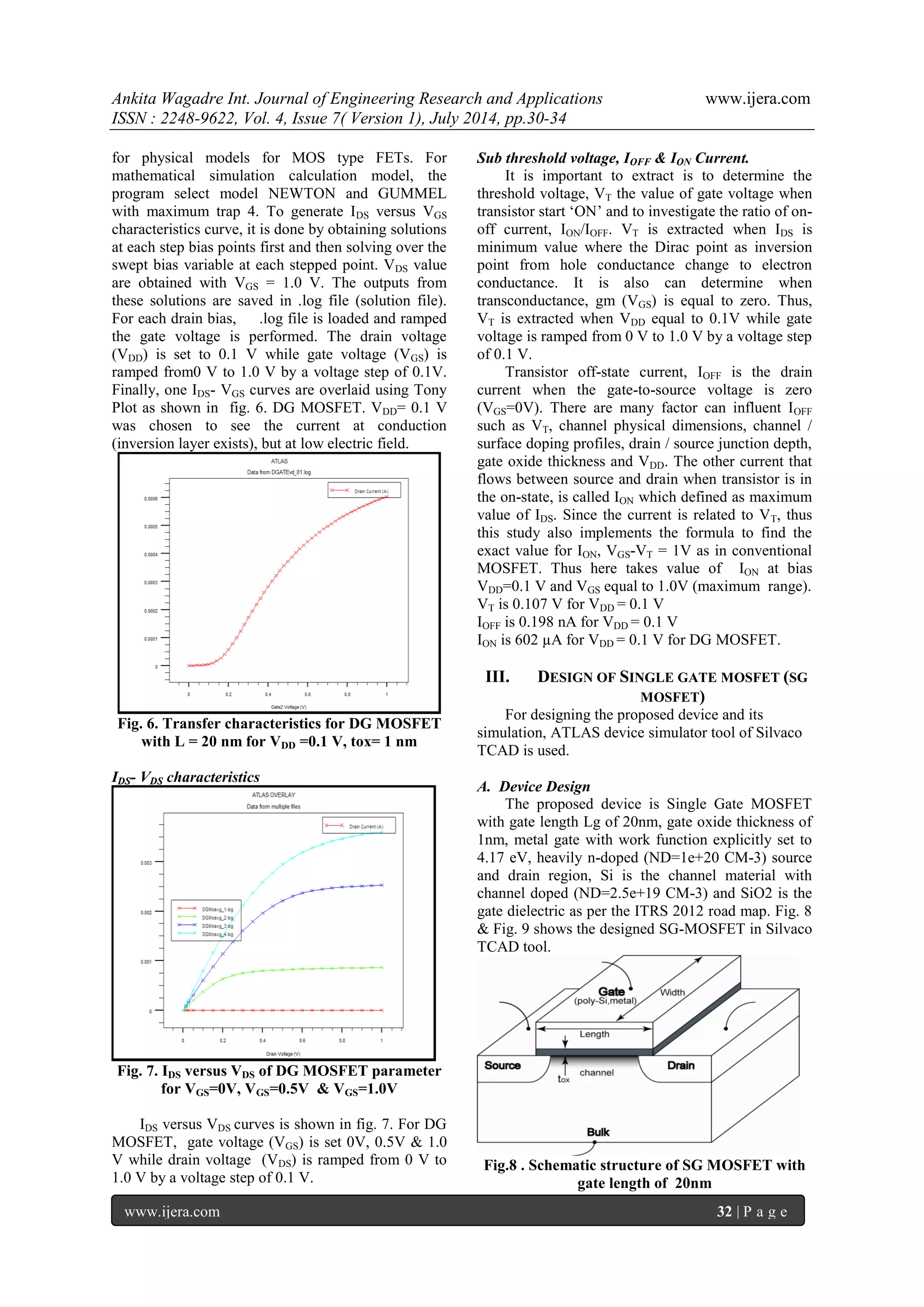
Finally, one IDS- VGS curves are overlaid using Tony 
Plot as shown in fig. 6. DG MOSFET. VDD= 0.1 V 
was chosen to see the current at conduction 
(inversion layer exists), but at low electric field. 
Fig. 6. Transfer characteristics for DG MOSFET 
with L = 20 nm for VDD =0.1 V, tox= 1 nm 
IDS- VDS characteristics 
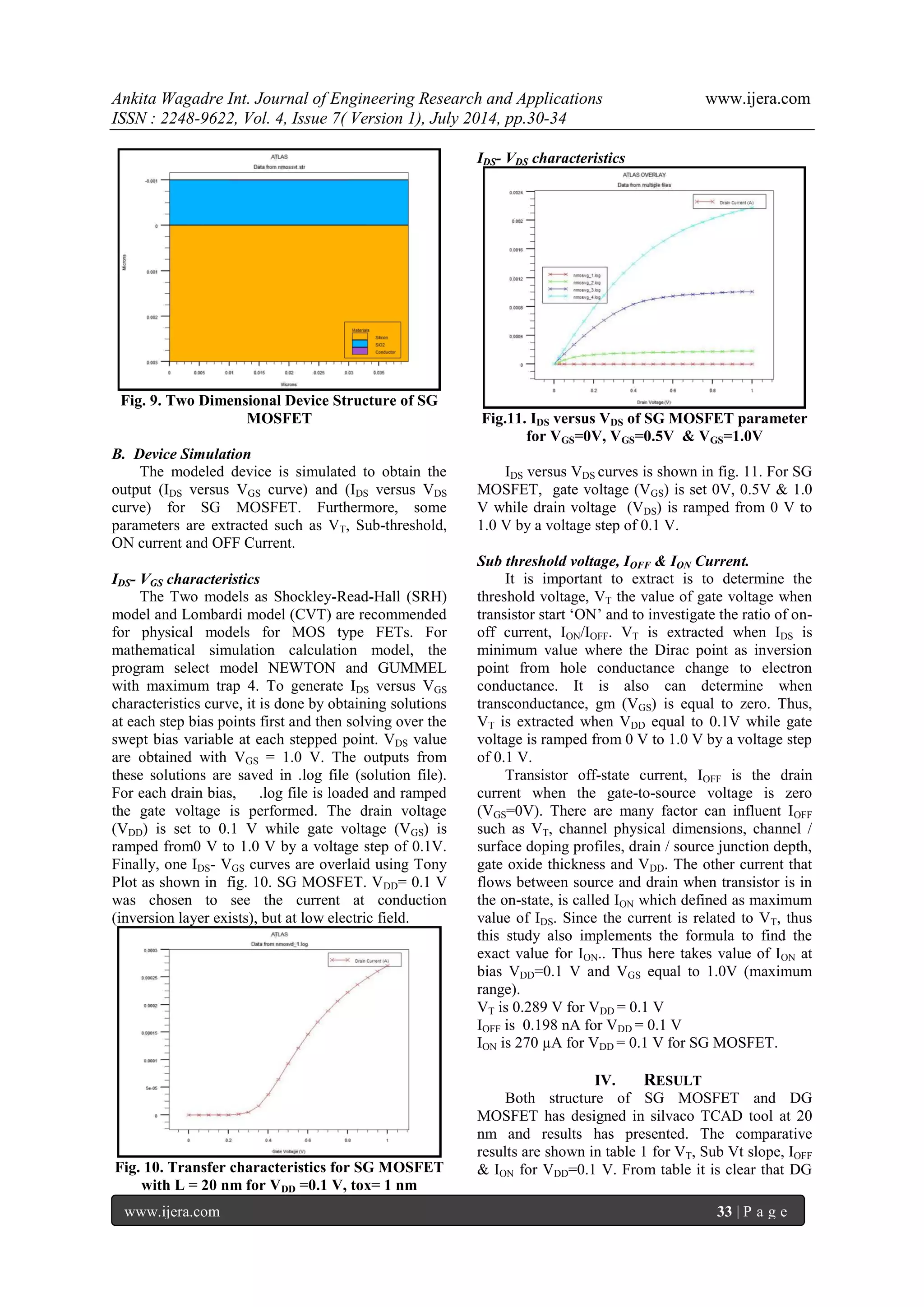
Fig. 7. IDS versus VDS of DG MOSFET parameter 
for VGS=0V, VGS=0.5V & VGS=1.0V 
IDS versus VDS curves is shown in fig. 7. For DG 
MOSFET, gate voltage (VGS) is set 0V, 0.5V & 1.0 
V while drain voltage (VDS) is ramped from 0 V to 
1.0 V by a voltage step of 0.1 V. 
Sub threshold voltage, IOFF & ION Current. 
It is important to extract is to determine the 
threshold voltage, VT the value of gate voltage when 
transistor start „ON‟ and to investigate the ratio of on-off 
current, ION/IOFF. VT is extracted when IDS is 
minimum value where the Dirac point as inversion 
point from hole conductance change to electron 
conductance. It is also can determine when 
transconductance, gm (VGS) is equal to zero. Thus, 
VT is extracted when VDD equal to 0.1V while gate 
voltage is ramped from 0 V to 1.0 V by a voltage step 
of 0.1 V. 
Transistor off-state current, IOFF is the drain 
current when the gate-to-source voltage is zero 
(VGS=0V). There are many factor can influent IOFF 
such as VT, channel physical dimensions, channel / 
surface doping profiles, drain / source junction depth, 
gate oxide thickness and VDD. The other current that 
flows between source and drain when transistor is in 
the on-state, is called ION which defined as maximum 
value of IDS. Since the current is related to VT, thus 
this study also implements the formula to find the 
exact value for ION, VGS-VT = 1V as in conventional 
MOSFET. Thus here takes value of ION at bias 
VDD=0.1 V and VGS equal to 1.0V (maximum range). 
VT is 0.107 V for VDD = 0.1 V 
IOFF is 0.198 nA for VDD = 0.1 V 
ION is 602 μA for VDD = 0.1 V for DG MOSFET. 
III. DESIGN OF SINGLE GATE MOSFET (SG 
MOSFET) 
For designing the proposed device and its 
simulation, ATLAS device simulator tool of Silvaco 
TCAD is used. 
A. Device Design 
The proposed device is Single Gate MOSFET 
with gate length Lg of 20nm, gate oxide thickness of 
1nm, metal gate with work function explicitly set to 
4.17 eV, heavily n-doped (ND=1e+20 CM-3) source 
and drain region, Si is the channel material with 
channel doped (ND=2.5e+19 CM-3) and SiO2 is the 
gate dielectric as per the ITRS 2012 road map. Fig. 8 
& Fig. 9 shows the designed SG-MOSFET in Silvaco 
TCAD tool. 
Fig.8 . Schematic structure of SG MOSFET with 
gate length of 20nm
Ankita Wagadre Int. Journal of Engineering Research and Applications www.ijera.com 
ISSN : 2248-9622, Vol. 4, Issue 7( Version 1), July 2014, pp.30-34 
www.ijera.com 33 | P a g e 
Fig. 9. Two Dimensional Device Structure of SG MOSFET B. Device Simulation The modeled device is simulated to obtain the output (IDS versus VGS curve) and (IDS versus VDS curve) for SG MOSFET. Furthermore, some parameters are extracted such as VT, Sub-threshold, ON current and OFF Current. IDS- VGS characteristics The Two models as Shockley-Read-Hall (SRH) model and Lombardi model (CVT) are recommended for physical models for MOS type FETs. For mathematical simulation calculation model, the program select model NEWTON and GUMMEL with maximum trap 4. To generate IDS versus VGS characteristics curve, it is done by obtaining solutions at each step bias points first and then solving over the swept bias variable at each stepped point. VDS value are obtained with VGS = 1.0 V. The outputs from these solutions are saved in .log file (solution file). For each drain bias, .log file is loaded and ramped the gate voltage is performed. The drain voltage (VDD) is set to 0.1 V while gate voltage (VGS) is ramped from0 V to 1.0 V by a voltage step of 0.1V. Finally, one IDS- VGS curves are overlaid using Tony Plot as shown in fig. 10. SG MOSFET. VDD= 0.1 V was chosen to see the current at conduction (inversion layer exists), but at low electric field. Fig. 10. Transfer characteristics for SG MOSFET with L = 20 nm for VDD =0.1 V, tox= 1 nm 
IDS- VDS characteristics Fig.11. IDS versus VDS of SG MOSFET parameter for VGS=0V, VGS=0.5V & VGS=1.0V IDS versus VDS curves is shown in fig. 11. For SG MOSFET, gate voltage (VGS) is set 0V, 0.5V & 1.0 V while drain voltage (VDS) is ramped from 0 V to 1.0 V by a voltage step of 0.1 V. Sub threshold voltage, IOFF & ION Current. It is important to extract is to determine the threshold voltage, VT the value of gate voltage when transistor start „ON‟ and to investigate the ratio of on- off current, ION/IOFF. VT is extracted when IDS is minimum value where the Dirac point as inversion point from hole conductance change to electron conductance. It is also can determine when transconductance, gm (VGS) is equal to zero. Thus, VT is extracted when VDD equal to 0.1V while gate voltage is ramped from 0 V to 1.0 V by a voltage step of 0.1 V. Transistor off-state current, IOFF is the drain current when the gate-to-source voltage is zero (VGS=0V). There are many factor can influent IOFF such as VT, channel physical dimensions, channel / surface doping profiles, drain / source junction depth, gate oxide thickness and VDD. The other current that flows between source and drain when transistor is in the on-state, is called ION which defined as maximum value of IDS. Since the current is related to VT, thus this study also implements the formula to find the exact value for ION.. Thus here takes value of ION at bias VDD=0.1 V and VGS equal to 1.0V (maximum range). VT is 0.289 V for VDD = 0.1 V IOFF is 0.198 nA for VDD = 0.1 V ION is 270 μA for VDD = 0.1 V for SG MOSFET. 
IV. RESULT 
Both structure of SG MOSFET and DG MOSFET has designed in silvaco TCAD tool at 20 nm and results has presented. The comparative results are shown in table 1 for VT, Sub Vt slope, IOFF & ION for VDD=0.1 V. From table it is clear that DG
Ankita Wagadre Int. Journal of Engineering Research and Applications www.ijera.com 
ISSN : 2248-9622, Vol. 4, Issue 7( Version 1), July 2014, pp.30-34 
www.ijera.com 34 | P a g e 
MOSFET is having good control over current as ION is increased from 270 μA to 602 μA. This will leads to reduction in leakage power in the device & hence to the whole circuit. The VT (Threshold Voltage) is 2.7 times greater than & ION of DG MOSFET 2.2 times smaller than the conventional Bulk (Single Gate) MOSFET. 
TABLE I. EXTRACTED DATA OF DG MOSFET & DG CNFET WITH LG=20NM 
For VDS = 0.1 V 
VT (V) 
Sub Vt Slope (mv/dec) 
IOFF (nA) 
ION (μA) 
SG MOSFET 
0.289 V 
65.5 
0.198 
270 
DG MOSFET 
0.107 V 
64 
158 
602 
V. CONCLUSION 
Short channel effect can be reduced by multigate MOSFETs. Two FET structures have been designed using Silvaco TCAD tool at 20nm technology & comparing the results of Single gate MOSFET & Double Gate MOSFET. Improvement in the device reliability with better reduction of Short Channel Effects has been observed through the simulation results by proper tuning of the channel thickness to ensure the volume inversion. Several structures have been proposed: planar & Non planar. DG MOSFET with planar structure is so far the most promising. Experimental results has presented, the new structure DG MOSFET possesses excellent sub threshold and output characteristics without short-channel effects, demonstrating the shortest gate length. Results shows that leakage current in SG MOSFET is much smaller as compared to that of DG MOSFET, whereas the ON current in DG MOSFET is much larger as compared to that of SG MOSFET. The VT (Threshold Voltage) is 2.7 times greater than & ION of DG MOSFET 2.2 times smaller than the conventional Bulk (Single Gate) MOSFET. 
REFERENCES 
[1] Mr. Sanjay Chopade & M. Shashank Mane " Design of DG-CNFET For Reduction of Short Channel Effect Over DG MOSFET at 20nm " IEEE Trans., December 2013 
[2] Santosh Kumar Gupta et al "Simulation and Analysis of Gate Engineered Triple Metal Double Gate (TM-DG) MOSFET for Diminished Short Channel Effects" IJAST, Vol. 38, January, 2012 
[3] A. S. I. Association, “Itrs - international technology roadmap for semiconductor,” 2003. 
[4] "1965 – "Moore's Law" Predicts the Future of Integrated Circuits". Computer History Museum. 
[5] Kaushik Roy, Kiat Seng Yeo (2004). Low Voltage, Low Power VLSI Subsystems. McGraw-Hill Professional.,p. 4 & 44. ISBN 0-07-143786-X. 
[6] Tsu-Jae King Liu"Introduction to Multi-gate MOSFETs" 6th Annual SOI Fundamentals ClassOctober 3, 2012 
[7] S. Panigrahy & P. k. Sahu "Analytical Modeling of Double Gate MOSFET and Its Application" IJCSI International Journal of Computer Science Issues, Vol.1,Issue 1,November 2011 
[8] Zhihong Chen,et al “Externally Assembled Gate-All-Around Carbon Nanotube Field- Effect Transistor” IEEE electron device letter, Vol. 29, No. 2, 5 February 2008. 
[9] Vaidyanathan Subramanian “Multiple Gate Field Effect Transistor for future CMOS” IETE Technical Review, Vol 27, ISSUE-6, NOV-DEC 2010. 
[10] Prateek Mishra, Anish Muttreja, and Niraj K. Jha "FinFET Circuit Design"Springer Science+Business Media, LLC 2011 
[11] Scott Thompson, Paul Packan, Mark Bohr “MOS Scaling: Transistor Challenges for the 21st Century” Intel Technology Journal Q3‟98 
[12] Gaurav Saini, Ashwani K Rana "Physical Scaling Limits of FinFETStructure: A Simulation Study" International Journal of VLSI design & Communication Systems (VLSICS) Vol.2, No.1, March 2011 
[13] Wen Wu & Mansun Chan "Analysis of Geometry-Dependent Parasitics in Multifin Double-Gate FinFETs"IEEE Trans. on Electron Devices, Vol.54, No. 4, April 2007

Design & Performance Analysis of DG-MOSFET for Reduction of Short Channel Effect over Bulk MOSFET at 20nm

  • 1.
    Ankita Wagadre Int.Journal of Engineering Research and Applications www.ijera.com ISSN : 2248-9622, Vol. 4, Issue 7( Version 1), July 2014, pp.30-34 www.ijera.com 30 | P a g e Design & Performance Analysis of DG-MOSFET for Reduction of Short Channel Effect over Bulk MOSFET at 20nm Ankita Wagadre*, Shashank Mane** *(Research scholar, Department of Electronics & Communication, SBITM, Betul-460001) ** (Assistant Professor, Department of Electronics & Communication, SBITM, Betul-460001) ABSTRACT An aggressive scaling of conventional MOSFETs channel length reduces below 100nm and gate oxide thickness below 3nm to improved performance and packaging density. Due to this scaling short channel effect (SCEs) like threshold voltage, Subthreshold slope, ON current and OFF current plays a major role in determining the performance of scaled devices. The double gate (DG) MOSFETS are electro-statically superior to a single gate (SG) MOSFET and allows for additional gate length scaling. Simulation work on both devices has been carried out and presented in paper. The comparative study had been carried out for threshold voltage (VT), Subthreshold slope (Sub VT), ION and IOFF Current. It is observed that DG MOSFET provide good control on leakage current over conventional Bulk (Single Gate) MOSFET. The VT (Threshold Voltage) is 2.7 times greater than & ION of DG MOSFET is 2.2 times smaller than the conventional Bulk (Single Gate) MOSFET. Keywords - DG MOSFET (Double Gate Metal oxide Field Effect Transistor), Short Channel Effect (SCE), Bulk (Single Gate) MOSFET. I. INTRODUCTION The downscaling of metal-oxide-semiconductor field-effect transistor, MOSFET has been popular for decades ago to get the well circuit performance and to suit Moore‟s law as well as the direction shown by International Technology Roadmap for Semiconductor, ITRS 2012. From last 4 decade, semiconductor device technology has changed with an amazing speed [1]. There is an exponential growth in integrated circuit performance, the scaling of MOSFET dimensions and its structure has been the primary driver. From the vantage point of today, in the 45 nm process era, we look 5 years into the future and find that the double-gate MOSFET (DG- MOSFET) is widely expected to take over for the long-lasting industrial favorite, than the single-gate MOSFET [2]. As scaling is expected to reach the 14 nm era in a few years, the DGMOSFET becomes necessary in terms of its superior properties in this scaling region [3].Current CMOS technology, conventional MOSFET will be difficult to scale further, even if we use high-k gate dielectrics, metal electrodes, strained silicon and other new materials being considered. Multi Gate Field Effect Transistor (MUGFET) is thought to be the leading new transistor technology which will take over as the leading workhorse in digital electronics. International Technology Roadmap for Semiconductor, devices with gate lengths down to 10 nm can be expected in 2019 [3&6].In fact, over the past 3 decades the number of transistors per chip has been doubled every 2–3 years once a new technology node is introduced. For example 45 nm technology node will have double MOSFETs in a microprocessor than a 65 nm technology node [4]. As MOSFET geometries shrink, the voltage that can be applied to the gate must be reduced to maintain reliability. To reduce the power, the threshold voltage of the MOSFET has to be reduced, but As threshold voltage is decreased, the transistor cannot be switched from complete turn-off to complete turn-on with the limited voltage swing available. Hence sub threshold leakage current is major issue of modern high-performance VLSI chips [5]. A. Double Gate MOSFET Single gate device at nanoscale is suffering from short channel effect that can be overcome by various multi gate structures like Double Gate, trigate & Gate All Around structure. The double gate (DG) MOSFETs are electro-statically superior to a single gate (SG) MOSFET and allows for additional gate length scaling [1]. The DG MOSFETs are the devices, which are having two gates on either side of the channel. One in upper side, known as top gate and another one is in the lower side of the channel, known as bottom gate. It gives better control of the channel by the gate electrodes [8]. This ensures that no part of the channel is far away from a gate electrode. The Double- Gate MOSFET (DGMOSFET) structure minimizes short-channel effects that allows more aggressive device downscaling of device up to 10 nm gate length [2]. There are two structures for modeling gate structure i.e Planar& Non-planar [6]. RESEARCH ARTICLE OPEN ACCESS
  • 2.
    Ankita Wagadre Int.Journal of Engineering Research and Applications www.ijera.com ISSN : 2248-9622, Vol. 4, Issue 7( Version 1), July 2014, pp.30-34 www.ijera.com 31 | P a g e Fig. 1. Schematics of a DG MOSFET with a planar structure The Advantages of using planar structure is better uniformity of Silicon channel thickness & can use existing fabrication processes. Disadvantages are fabrication of back gate and gate dielectric underneath the Silicon channel is difficult & accessing bottom gate for device wiring is not easy (may impact device density).Structure shown in fig.1. Fig. 2. Schematics of a DG MOSFET with a non-planar structure. The advantage of using non- planar structure (Shown in fig. 2) is the easier formation and access of both gates (wraparound gate) & increases device density. Disadvantage are channel thickness defined by lithography (poorer uniformity) front and back gates cannot be independently biased& from conventional fabrication processes [6]. As planar structure is easy to design, the DG planar structure is used for design & stimulation. The voltage applied on the gate terminals controls the electric field and determining the current flowing through the channel. Fig. 3 shows that there are two mode of operation (a) to switch both gates simultaneously (b) to switch only one and apply a bias to the second gate (this is called (“ground plane” (GP) or “back-gate” (BG)) [5]. (a) (b) Fig. 3. General Operation of DG MOSFET structure II. DESIGN OF DOUBLE GATE MOSFET (DG-MOSFET) For designing the proposed device and its simulation, ATLAS device simulator tool of Silvaco TCAD is used. A. Device Design The proposed device is Double Gate MOSFET with gate length Lg of 20nm, gate oxide thickness of 1nm, metal gate with work function explicitly set to 4.17 eV, heavily n-doped (ND=1e+21 CM-3) source and drain region, Si is the channel material with channel doped (ND=1.5e+19 CM-3) and SiO2 is the gate dielectric as per the ITRS 2012 road map. Fig.4 & Fig. 5 shows the designed DG-MOSFET in Silvaco TCAD tool. Fig. 4. Schematic structure of DG MOSFET with gate length of 20nm Fig. 5. Two Dimensional Device Structure of DG MOSFET B. Device Simulation The modeled device is simulated to obtain the output (IDS versus VGS curve) and (IDS versus VDS curve) for DG MOSFET. Furthermore, some parameters are extracted such as VT, Sub-threshold, ON current and OFF Current. IDS- VGS characteristics The Two models as Shockley-Read-Hall (SRH) model and Lombardi model (CVT) are recommended
  • 3.
    Ankita Wagadre Int.Journal of Engineering Research and Applications www.ijera.com ISSN : 2248-9622, Vol. 4, Issue 7( Version 1), July 2014, pp.30-34 www.ijera.com 32 | P a g e for physical models for MOS type FETs. For mathematical simulation calculation model, the program select model NEWTON and GUMMEL with maximum trap 4. To generate IDS versus VGS characteristics curve, it is done by obtaining solutions at each step bias points first and then solving over the swept bias variable at each stepped point. VDS value are obtained with VGS = 1.0 V. The outputs from these solutions are saved in .log file (solution file). For each drain bias, .log file is loaded and ramped the gate voltage is performed. The drain voltage (VDD) is set to 0.1 V while gate voltage (VGS) is ramped from0 V to 1.0 V by a voltage step of 0.1V. Finally, one IDS- VGS curves are overlaid using Tony Plot as shown in fig. 6. DG MOSFET. VDD= 0.1 V was chosen to see the current at conduction (inversion layer exists), but at low electric field. Fig. 6. Transfer characteristics for DG MOSFET with L = 20 nm for VDD =0.1 V, tox= 1 nm IDS- VDS characteristics Fig. 7. IDS versus VDS of DG MOSFET parameter for VGS=0V, VGS=0.5V & VGS=1.0V IDS versus VDS curves is shown in fig. 7. For DG MOSFET, gate voltage (VGS) is set 0V, 0.5V & 1.0 V while drain voltage (VDS) is ramped from 0 V to 1.0 V by a voltage step of 0.1 V. Sub threshold voltage, IOFF & ION Current. It is important to extract is to determine the threshold voltage, VT the value of gate voltage when transistor start „ON‟ and to investigate the ratio of on-off current, ION/IOFF. VT is extracted when IDS is minimum value where the Dirac point as inversion point from hole conductance change to electron conductance. It is also can determine when transconductance, gm (VGS) is equal to zero. Thus, VT is extracted when VDD equal to 0.1V while gate voltage is ramped from 0 V to 1.0 V by a voltage step of 0.1 V. Transistor off-state current, IOFF is the drain current when the gate-to-source voltage is zero (VGS=0V). There are many factor can influent IOFF such as VT, channel physical dimensions, channel / surface doping profiles, drain / source junction depth, gate oxide thickness and VDD. The other current that flows between source and drain when transistor is in the on-state, is called ION which defined as maximum value of IDS. Since the current is related to VT, thus this study also implements the formula to find the exact value for ION, VGS-VT = 1V as in conventional MOSFET. Thus here takes value of ION at bias VDD=0.1 V and VGS equal to 1.0V (maximum range). VT is 0.107 V for VDD = 0.1 V IOFF is 0.198 nA for VDD = 0.1 V ION is 602 μA for VDD = 0.1 V for DG MOSFET. III. DESIGN OF SINGLE GATE MOSFET (SG MOSFET) For designing the proposed device and its simulation, ATLAS device simulator tool of Silvaco TCAD is used. A. Device Design The proposed device is Single Gate MOSFET with gate length Lg of 20nm, gate oxide thickness of 1nm, metal gate with work function explicitly set to 4.17 eV, heavily n-doped (ND=1e+20 CM-3) source and drain region, Si is the channel material with channel doped (ND=2.5e+19 CM-3) and SiO2 is the gate dielectric as per the ITRS 2012 road map. Fig. 8 & Fig. 9 shows the designed SG-MOSFET in Silvaco TCAD tool. Fig.8 . Schematic structure of SG MOSFET with gate length of 20nm
  • 4.
    Ankita Wagadre Int.Journal of Engineering Research and Applications www.ijera.com ISSN : 2248-9622, Vol. 4, Issue 7( Version 1), July 2014, pp.30-34 www.ijera.com 33 | P a g e Fig. 9. Two Dimensional Device Structure of SG MOSFET B. Device Simulation The modeled device is simulated to obtain the output (IDS versus VGS curve) and (IDS versus VDS curve) for SG MOSFET. Furthermore, some parameters are extracted such as VT, Sub-threshold, ON current and OFF Current. IDS- VGS characteristics The Two models as Shockley-Read-Hall (SRH) model and Lombardi model (CVT) are recommended for physical models for MOS type FETs. For mathematical simulation calculation model, the program select model NEWTON and GUMMEL with maximum trap 4. To generate IDS versus VGS characteristics curve, it is done by obtaining solutions at each step bias points first and then solving over the swept bias variable at each stepped point. VDS value are obtained with VGS = 1.0 V. The outputs from these solutions are saved in .log file (solution file). For each drain bias, .log file is loaded and ramped the gate voltage is performed. The drain voltage (VDD) is set to 0.1 V while gate voltage (VGS) is ramped from0 V to 1.0 V by a voltage step of 0.1V. Finally, one IDS- VGS curves are overlaid using Tony Plot as shown in fig. 10. SG MOSFET. VDD= 0.1 V was chosen to see the current at conduction (inversion layer exists), but at low electric field. Fig. 10. Transfer characteristics for SG MOSFET with L = 20 nm for VDD =0.1 V, tox= 1 nm IDS- VDS characteristics Fig.11. IDS versus VDS of SG MOSFET parameter for VGS=0V, VGS=0.5V & VGS=1.0V IDS versus VDS curves is shown in fig. 11. For SG MOSFET, gate voltage (VGS) is set 0V, 0.5V & 1.0 V while drain voltage (VDS) is ramped from 0 V to 1.0 V by a voltage step of 0.1 V. Sub threshold voltage, IOFF & ION Current. It is important to extract is to determine the threshold voltage, VT the value of gate voltage when transistor start „ON‟ and to investigate the ratio of on- off current, ION/IOFF. VT is extracted when IDS is minimum value where the Dirac point as inversion point from hole conductance change to electron conductance. It is also can determine when transconductance, gm (VGS) is equal to zero. Thus, VT is extracted when VDD equal to 0.1V while gate voltage is ramped from 0 V to 1.0 V by a voltage step of 0.1 V. Transistor off-state current, IOFF is the drain current when the gate-to-source voltage is zero (VGS=0V). There are many factor can influent IOFF such as VT, channel physical dimensions, channel / surface doping profiles, drain / source junction depth, gate oxide thickness and VDD. The other current that flows between source and drain when transistor is in the on-state, is called ION which defined as maximum value of IDS. Since the current is related to VT, thus this study also implements the formula to find the exact value for ION.. Thus here takes value of ION at bias VDD=0.1 V and VGS equal to 1.0V (maximum range). VT is 0.289 V for VDD = 0.1 V IOFF is 0.198 nA for VDD = 0.1 V ION is 270 μA for VDD = 0.1 V for SG MOSFET. IV. RESULT Both structure of SG MOSFET and DG MOSFET has designed in silvaco TCAD tool at 20 nm and results has presented. The comparative results are shown in table 1 for VT, Sub Vt slope, IOFF & ION for VDD=0.1 V. From table it is clear that DG
  • 5.
    Ankita Wagadre Int.Journal of Engineering Research and Applications www.ijera.com ISSN : 2248-9622, Vol. 4, Issue 7( Version 1), July 2014, pp.30-34 www.ijera.com 34 | P a g e MOSFET is having good control over current as ION is increased from 270 μA to 602 μA. This will leads to reduction in leakage power in the device & hence to the whole circuit. The VT (Threshold Voltage) is 2.7 times greater than & ION of DG MOSFET 2.2 times smaller than the conventional Bulk (Single Gate) MOSFET. TABLE I. EXTRACTED DATA OF DG MOSFET & DG CNFET WITH LG=20NM For VDS = 0.1 V VT (V) Sub Vt Slope (mv/dec) IOFF (nA) ION (μA) SG MOSFET 0.289 V 65.5 0.198 270 DG MOSFET 0.107 V 64 158 602 V. CONCLUSION Short channel effect can be reduced by multigate MOSFETs. Two FET structures have been designed using Silvaco TCAD tool at 20nm technology & comparing the results of Single gate MOSFET & Double Gate MOSFET. Improvement in the device reliability with better reduction of Short Channel Effects has been observed through the simulation results by proper tuning of the channel thickness to ensure the volume inversion. Several structures have been proposed: planar & Non planar. DG MOSFET with planar structure is so far the most promising. Experimental results has presented, the new structure DG MOSFET possesses excellent sub threshold and output characteristics without short-channel effects, demonstrating the shortest gate length. Results shows that leakage current in SG MOSFET is much smaller as compared to that of DG MOSFET, whereas the ON current in DG MOSFET is much larger as compared to that of SG MOSFET. The VT (Threshold Voltage) is 2.7 times greater than & ION of DG MOSFET 2.2 times smaller than the conventional Bulk (Single Gate) MOSFET. REFERENCES [1] Mr. Sanjay Chopade & M. Shashank Mane " Design of DG-CNFET For Reduction of Short Channel Effect Over DG MOSFET at 20nm " IEEE Trans., December 2013 [2] Santosh Kumar Gupta et al "Simulation and Analysis of Gate Engineered Triple Metal Double Gate (TM-DG) MOSFET for Diminished Short Channel Effects" IJAST, Vol. 38, January, 2012 [3] A. S. I. Association, “Itrs - international technology roadmap for semiconductor,” 2003. [4] "1965 – "Moore's Law" Predicts the Future of Integrated Circuits". Computer History Museum. [5] Kaushik Roy, Kiat Seng Yeo (2004). Low Voltage, Low Power VLSI Subsystems. McGraw-Hill Professional.,p. 4 & 44. ISBN 0-07-143786-X. [6] Tsu-Jae King Liu"Introduction to Multi-gate MOSFETs" 6th Annual SOI Fundamentals ClassOctober 3, 2012 [7] S. Panigrahy & P. k. Sahu "Analytical Modeling of Double Gate MOSFET and Its Application" IJCSI International Journal of Computer Science Issues, Vol.1,Issue 1,November 2011 [8] Zhihong Chen,et al “Externally Assembled Gate-All-Around Carbon Nanotube Field- Effect Transistor” IEEE electron device letter, Vol. 29, No. 2, 5 February 2008. [9] Vaidyanathan Subramanian “Multiple Gate Field Effect Transistor for future CMOS” IETE Technical Review, Vol 27, ISSUE-6, NOV-DEC 2010. [10] Prateek Mishra, Anish Muttreja, and Niraj K. Jha "FinFET Circuit Design"Springer Science+Business Media, LLC 2011 [11] Scott Thompson, Paul Packan, Mark Bohr “MOS Scaling: Transistor Challenges for the 21st Century” Intel Technology Journal Q3‟98 [12] Gaurav Saini, Ashwani K Rana "Physical Scaling Limits of FinFETStructure: A Simulation Study" International Journal of VLSI design & Communication Systems (VLSICS) Vol.2, No.1, March 2011 [13] Wen Wu & Mansun Chan "Analysis of Geometry-Dependent Parasitics in Multifin Double-Gate FinFETs"IEEE Trans. on Electron Devices, Vol.54, No. 4, April 2007