TRINITY INSTITUTE OF PROFESSIONAL STUDIES
Sector – 9, Dwarka Institutional Area, New Delhi-75
Affiliated Institution of G.G.S.IP.U, Delhi
DIGITAL ELECTRONICS
Paper Code :- BCA 106
Keywords:
Number System, Binary, Decimal, Octal, Hexa
By :-HARI MOHAN JAIN
TRINITY INSTITUTE OF PROFESSIONAL STUDIES
Sector – 9, Dwarka Institutional Area, New Delhi-75
2
Number System
TRINITY INSTITUTE OF PROFESSIONAL STUDIES
Sector – 9, Dwarka Institutional Area, New Delhi-75
3
Positional Notation
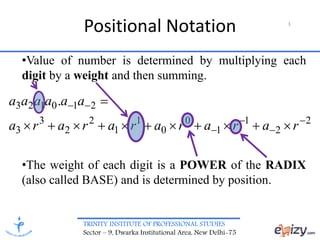
•Value of number is determined by multiplying each
digit by a weight and then summing.
•The weight of each digit is a POWER of the RADIX
(also called BASE) and is determined by position.
2
2
1
1
0
0
1
1
2
2
3
3
210123 .







rararararara
aaaaaa
TRINITY INSTITUTE OF PROFESSIONAL STUDIES
Sector – 9, Dwarka Institutional Area, New Delhi-75
4
Radix (Base) of a Number System
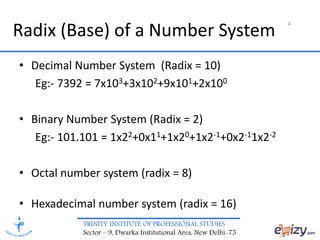
• Decimal Number System (Radix = 10)
Eg:- 7392 = 7x10³+3x10²+9x101+2x100
• Binary Number System (Radix = 2)
Eg:- 101.101 = 1x22+0x11+1x20+1x2-1+0x2-11x2-2
• Octal number system (radix = 8)
• Hexadecimal number system (radix = 16)
TRINITY INSTITUTE OF PROFESSIONAL STUDIES
Sector – 9, Dwarka Institutional Area, New Delhi-75
5
Radix (Base) of a Number System
• When counting upwards in base-10, we increase the
units digit until we get to 10 when we reset the units
to zero and increase the tens digit.
• So, in base-n, we increase the units until we get to n
when we reset the units to zero and increase the n-s
digit.
• Consider hours-minutes-seconds as an example of a
base-60 number system:
– Eg. 12:58:43 + 00:03:20 = 13:02:03
NB. The base of a number is often indicated by a subscript.
E.g. (123)10 indicates the base-10 number 123.
TRINITY INSTITUTE OF PROFESSIONAL STUDIES
Sector – 9, Dwarka Institutional Area, New Delhi-75
6
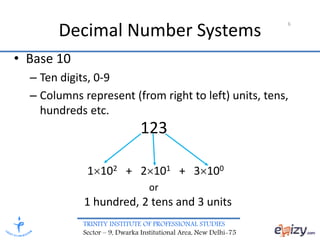
Decimal Number Systems
• Base 10
– Ten digits, 0-9
– Columns represent (from right to left) units, tens,
hundreds etc.
123
1102 + 2101 + 3100
or
1 hundred, 2 tens and 3 units
TRINITY INSTITUTE OF PROFESSIONAL STUDIES
Sector – 9, Dwarka Institutional Area, New Delhi-75
7
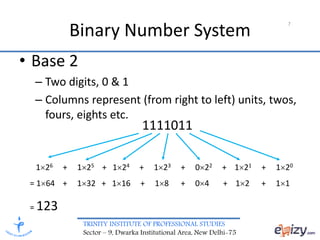
Binary Number System
• Base 2
– Two digits, 0 & 1
– Columns represent (from right to left) units, twos,
fours, eights etc.
1111011
126 + 125 + 124 + 123 + 022 + 121 + 120
= 164 + 132 + 116 + 18 + 04 + 12 + 11
= 123
TRINITY INSTITUTE OF PROFESSIONAL STUDIES
Sector – 9, Dwarka Institutional Area, New Delhi-75
8
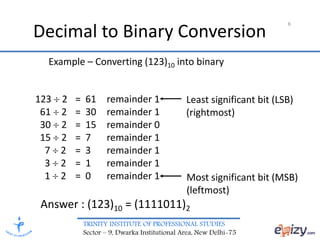
Decimal to Binary Conversion
123  2 = 61 remainder 1
61  2 = 30 remainder 1
30  2 = 15 remainder 0
15  2 = 7 remainder 1
7  2 = 3 remainder 1
3  2 = 1 remainder 1
1  2 = 0 remainder 1
Least significant bit (LSB)
(rightmost)
Most significant bit (MSB)
(leftmost)
Answer : (123)10 = (1111011)2
Example – Converting (123)10 into binary
TRINITY INSTITUTE OF PROFESSIONAL STUDIES
Sector – 9, Dwarka Institutional Area, New Delhi-75
9
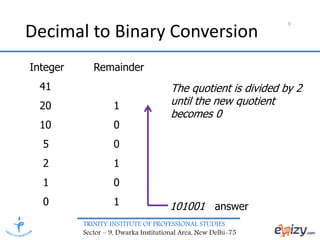
Decimal to Binary Conversion
The quotient is divided by 2
until the new quotient
becomes 0
Integer Remainder
41
20 1
10 0
5 0
2 1
1 0
0 1 101001 answer
TRINITY INSTITUTE OF PROFESSIONAL STUDIES
Sector – 9, Dwarka Institutional Area, New Delhi-75
10
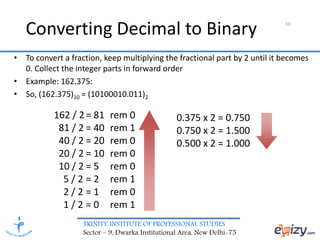
Converting Decimal to Binary
• To convert a fraction, keep multiplying the fractional part by 2 until it becomes
0. Collect the integer parts in forward order
• Example: 162.375:
• So, (162.375)10 = (10100010.011)2
162 / 2= 81 rem 0
81 / 2 = 40 rem 1
40 / 2 = 20 rem 0
20 / 2 = 10 rem 0
10 / 2 = 5 rem 0
5 / 2 = 2 rem 1
2 / 2 = 1 rem 0
1 / 2 = 0 rem 1
0.375 x 2 = 0.750
0.750 x 2 = 1.500
0.500 x 2 = 1.000
TRINITY INSTITUTE OF PROFESSIONAL STUDIES
Sector – 9, Dwarka Institutional Area, New Delhi-75
11
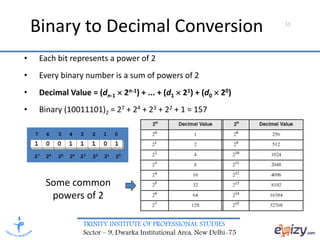
Binary to Decimal Conversion
• Each bit represents a power of 2
• Every binary number is a sum of powers of 2
• Decimal Value = (dn-1  2n-1) + ... + (d1  21) + (d0  20)
• Binary (10011101)2 = 27 + 24 + 23 + 22 + 1 = 157
1 0 0 1 1 1 0 1
27 26 25 24 23 22 21 20
01234567
Some common
powers of 2
TRINITY INSTITUTE OF PROFESSIONAL STUDIES
Sector – 9, Dwarka Institutional Area, New Delhi-75
12
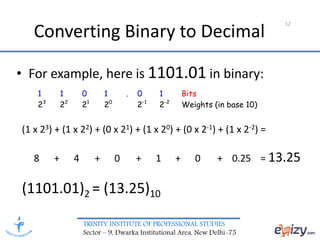
Converting Binary to Decimal
• For example, here is 1101.01 in binary:
1 1 0 1 . 0 1 Bits
23
22
21
20
2-1
2-2
Weights (in base 10)
(1 x 23) + (1 x 22) + (0 x 21) + (1 x 20) + (0 x 2-1) + (1 x 2-2) =
8 + 4 + 0 + 1 + 0 + 0.25 = 13.25
(1101.01)2 = (13.25)10
TRINITY INSTITUTE OF PROFESSIONAL STUDIES
Sector – 9, Dwarka Institutional Area, New Delhi-75
13
Binary and Octal Conversions
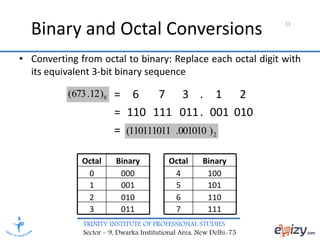
• Converting from octal to binary: Replace each octal digit with
its equivalent 3-bit binary sequence
= 6 7 3 . 1 2
= 110 111 011. 001 010
=
11170113
11060102
10150011
10040000
BinaryOctalBinaryOctal
8)12.673(
2)001010.110111011(
TRINITY INSTITUTE OF PROFESSIONAL STUDIES
Sector – 9, Dwarka Institutional Area, New Delhi-75
14
Binary and Octal Conversions
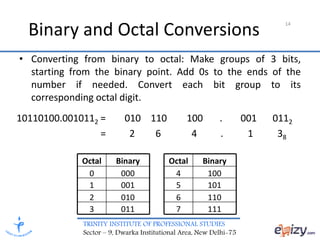
• Converting from binary to octal: Make groups of 3 bits,
starting from the binary point. Add 0s to the ends of the
number if needed. Convert each bit group to its
corresponding octal digit.
10110100.0010112 = 010 110 100 . 001 0112
= 2 6 4 . 1 38
11170113
11060102
10150011
10040000
BinaryOctalBinaryOctal
TRINITY INSTITUTE OF PROFESSIONAL STUDIES
Sector – 9, Dwarka Institutional Area, New Delhi-75
15
Binary and Hex Conversions
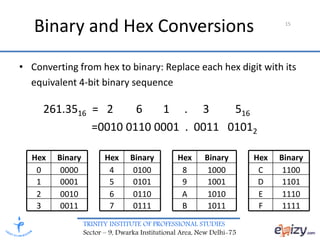
• Converting from hex to binary: Replace each hex digit with its
equivalent 4-bit binary sequence
261.3516 = 2 6 1 . 3 516
=0010 0110 0001 . 0011 01012
1111F1011B0111700113
1110E1010A0110600102
1101D100190101500011
1100C100080100400000
BinaryHexBinaryHexBinaryHexBinaryHex
TRINITY INSTITUTE OF PROFESSIONAL STUDIES
Sector – 9, Dwarka Institutional Area, New Delhi-75
16
Binary and Hex Conversions
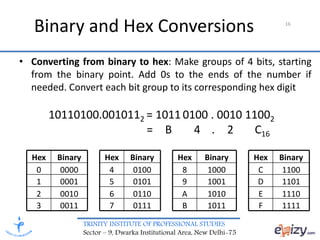
• Converting from binary to hex: Make groups of 4 bits, starting
from the binary point. Add 0s to the ends of the number if
needed. Convert each bit group to its corresponding hex digit
10110100.0010112 = 1011 0100 . 0010 11002
= B 4 . 2 C16
1111F1011B0111700113
1110E1010A0110600102
1101D100190101500011
1100C100080100400000
BinaryHexBinaryHexBinaryHexBinaryHex

DIGITAL ELECTRONICS- Number System

  • 1.
    TRINITY INSTITUTE OFPROFESSIONAL STUDIES Sector – 9, Dwarka Institutional Area, New Delhi-75 Affiliated Institution of G.G.S.IP.U, Delhi DIGITAL ELECTRONICS Paper Code :- BCA 106 Keywords: Number System, Binary, Decimal, Octal, Hexa By :-HARI MOHAN JAIN
  • 2.
    TRINITY INSTITUTE OFPROFESSIONAL STUDIES Sector – 9, Dwarka Institutional Area, New Delhi-75 2 Number System
  • 3.
    TRINITY INSTITUTE OFPROFESSIONAL STUDIES Sector – 9, Dwarka Institutional Area, New Delhi-75 3 Positional Notation •Value of number is determined by multiplying each digit by a weight and then summing. •The weight of each digit is a POWER of the RADIX (also called BASE) and is determined by position. 2 2 1 1 0 0 1 1 2 2 3 3 210123 .        rararararara aaaaaa
  • 4.
    TRINITY INSTITUTE OFPROFESSIONAL STUDIES Sector – 9, Dwarka Institutional Area, New Delhi-75 4 Radix (Base) of a Number System • Decimal Number System (Radix = 10) Eg:- 7392 = 7x10³+3x10²+9x101+2x100 • Binary Number System (Radix = 2) Eg:- 101.101 = 1x22+0x11+1x20+1x2-1+0x2-11x2-2 • Octal number system (radix = 8) • Hexadecimal number system (radix = 16)
  • 5.
    TRINITY INSTITUTE OFPROFESSIONAL STUDIES Sector – 9, Dwarka Institutional Area, New Delhi-75 5 Radix (Base) of a Number System • When counting upwards in base-10, we increase the units digit until we get to 10 when we reset the units to zero and increase the tens digit. • So, in base-n, we increase the units until we get to n when we reset the units to zero and increase the n-s digit. • Consider hours-minutes-seconds as an example of a base-60 number system: – Eg. 12:58:43 + 00:03:20 = 13:02:03 NB. The base of a number is often indicated by a subscript. E.g. (123)10 indicates the base-10 number 123.
  • 6.
    TRINITY INSTITUTE OFPROFESSIONAL STUDIES Sector – 9, Dwarka Institutional Area, New Delhi-75 6 Decimal Number Systems • Base 10 – Ten digits, 0-9 – Columns represent (from right to left) units, tens, hundreds etc. 123 1102 + 2101 + 3100 or 1 hundred, 2 tens and 3 units
  • 7.
    TRINITY INSTITUTE OFPROFESSIONAL STUDIES Sector – 9, Dwarka Institutional Area, New Delhi-75 7 Binary Number System • Base 2 – Two digits, 0 & 1 – Columns represent (from right to left) units, twos, fours, eights etc. 1111011 126 + 125 + 124 + 123 + 022 + 121 + 120 = 164 + 132 + 116 + 18 + 04 + 12 + 11 = 123
  • 8.
    TRINITY INSTITUTE OFPROFESSIONAL STUDIES Sector – 9, Dwarka Institutional Area, New Delhi-75 8 Decimal to Binary Conversion 123  2 = 61 remainder 1 61  2 = 30 remainder 1 30  2 = 15 remainder 0 15  2 = 7 remainder 1 7  2 = 3 remainder 1 3  2 = 1 remainder 1 1  2 = 0 remainder 1 Least significant bit (LSB) (rightmost) Most significant bit (MSB) (leftmost) Answer : (123)10 = (1111011)2 Example – Converting (123)10 into binary
  • 9.
    TRINITY INSTITUTE OFPROFESSIONAL STUDIES Sector – 9, Dwarka Institutional Area, New Delhi-75 9 Decimal to Binary Conversion The quotient is divided by 2 until the new quotient becomes 0 Integer Remainder 41 20 1 10 0 5 0 2 1 1 0 0 1 101001 answer
  • 10.
    TRINITY INSTITUTE OFPROFESSIONAL STUDIES Sector – 9, Dwarka Institutional Area, New Delhi-75 10 Converting Decimal to Binary • To convert a fraction, keep multiplying the fractional part by 2 until it becomes 0. Collect the integer parts in forward order • Example: 162.375: • So, (162.375)10 = (10100010.011)2 162 / 2= 81 rem 0 81 / 2 = 40 rem 1 40 / 2 = 20 rem 0 20 / 2 = 10 rem 0 10 / 2 = 5 rem 0 5 / 2 = 2 rem 1 2 / 2 = 1 rem 0 1 / 2 = 0 rem 1 0.375 x 2 = 0.750 0.750 x 2 = 1.500 0.500 x 2 = 1.000
  • 11.
    TRINITY INSTITUTE OFPROFESSIONAL STUDIES Sector – 9, Dwarka Institutional Area, New Delhi-75 11 Binary to Decimal Conversion • Each bit represents a power of 2 • Every binary number is a sum of powers of 2 • Decimal Value = (dn-1  2n-1) + ... + (d1  21) + (d0  20) • Binary (10011101)2 = 27 + 24 + 23 + 22 + 1 = 157 1 0 0 1 1 1 0 1 27 26 25 24 23 22 21 20 01234567 Some common powers of 2
  • 12.
    TRINITY INSTITUTE OFPROFESSIONAL STUDIES Sector – 9, Dwarka Institutional Area, New Delhi-75 12 Converting Binary to Decimal • For example, here is 1101.01 in binary: 1 1 0 1 . 0 1 Bits 23 22 21 20 2-1 2-2 Weights (in base 10) (1 x 23) + (1 x 22) + (0 x 21) + (1 x 20) + (0 x 2-1) + (1 x 2-2) = 8 + 4 + 0 + 1 + 0 + 0.25 = 13.25 (1101.01)2 = (13.25)10
  • 13.
    TRINITY INSTITUTE OFPROFESSIONAL STUDIES Sector – 9, Dwarka Institutional Area, New Delhi-75 13 Binary and Octal Conversions • Converting from octal to binary: Replace each octal digit with its equivalent 3-bit binary sequence = 6 7 3 . 1 2 = 110 111 011. 001 010 = 11170113 11060102 10150011 10040000 BinaryOctalBinaryOctal 8)12.673( 2)001010.110111011(
  • 14.
    TRINITY INSTITUTE OFPROFESSIONAL STUDIES Sector – 9, Dwarka Institutional Area, New Delhi-75 14 Binary and Octal Conversions • Converting from binary to octal: Make groups of 3 bits, starting from the binary point. Add 0s to the ends of the number if needed. Convert each bit group to its corresponding octal digit. 10110100.0010112 = 010 110 100 . 001 0112 = 2 6 4 . 1 38 11170113 11060102 10150011 10040000 BinaryOctalBinaryOctal
  • 15.
    TRINITY INSTITUTE OFPROFESSIONAL STUDIES Sector – 9, Dwarka Institutional Area, New Delhi-75 15 Binary and Hex Conversions • Converting from hex to binary: Replace each hex digit with its equivalent 4-bit binary sequence 261.3516 = 2 6 1 . 3 516 =0010 0110 0001 . 0011 01012 1111F1011B0111700113 1110E1010A0110600102 1101D100190101500011 1100C100080100400000 BinaryHexBinaryHexBinaryHexBinaryHex
  • 16.
    TRINITY INSTITUTE OFPROFESSIONAL STUDIES Sector – 9, Dwarka Institutional Area, New Delhi-75 16 Binary and Hex Conversions • Converting from binary to hex: Make groups of 4 bits, starting from the binary point. Add 0s to the ends of the number if needed. Convert each bit group to its corresponding hex digit 10110100.0010112 = 1011 0100 . 0010 11002 = B 4 . 2 C16 1111F1011B0111700113 1110E1010A0110600102 1101D100190101500011 1100C100080100400000 BinaryHexBinaryHexBinaryHexBinaryHex