LECTURE - 4
Ms. Maria Saleemi
BINARY CODES
• BCD CODE
• BCD ADDITION
• EXCESS – 3 CODE
• 2421 CODE
• 842’1’ CODE
• GRAY CODE
• ASCII CODE
CODES
• Information given to computer
• Data
• Instructions
• Code must be in Binary
• Computer understand Binary (0 and 1)
CODES
• n-bit Binary Code
• Combination of bits (0’s and 1’s) = 2n
• Each Combination represents a different value
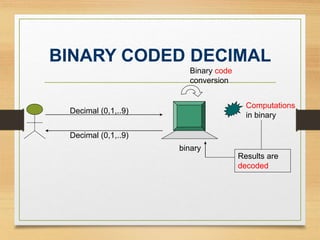
BINARY CODED DECIMAL
Decimal (0,1,..9)
binary
Binary code
conversion
Computations
in binary
Results are
decoded
Decimal (0,1,..9)
BCD
• 4-bit Code
• Each decimal digit (0,1,..9) is written as a 4-bit binary
number
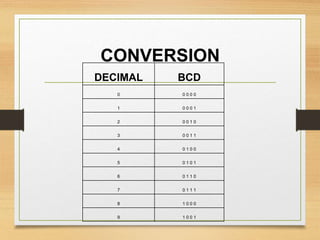
CONVERSION
DECIMAL BCD
0 0 0 0 0
1 0 0 0 1
2 0 0 1 0
3 0 0 1 1
4 0 1 0 0
5 0 1 0 1
6 0 1 1 0
7 0 1 1 1
8 1 0 0 0
9 1 0 0 1
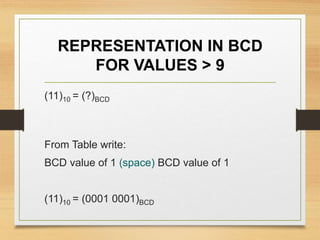
REPRESENTATION IN BCD
FOR VALUES > 9
(11)10 = (?)BCD
From Table write:
BCD value of 1 (space) BCD value of 1
(11)10 = (0001 0001)BCD
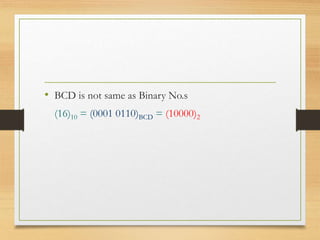
• BCD is not same as Binary No.s
(16)10 = (0001 0110)BCD = (10000)2
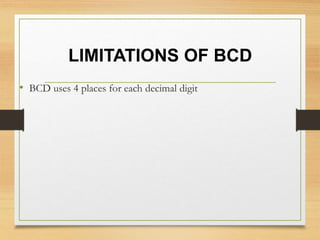
LIMITATIONS OF BCD
• BCD uses 4 places for each decimal digit
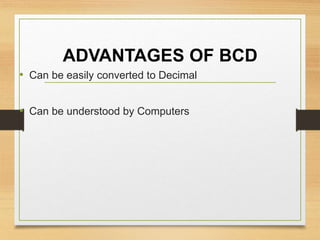
ADVANTAGES OF BCD
• Can be easily converted to Decimal
• Can be understood by Computers
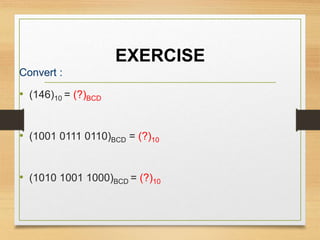
EXERCISE
Convert :
• (146)10 = (?)BCD
• (1001 0111 0110)BCD = (?)10
• (1010 1001 1000)BCD = (?)10
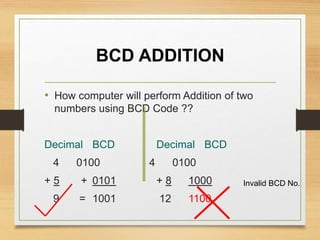
BCD ADDITION
• How computer will perform Addition of two
numbers using BCD Code ??
Decimal BCD Decimal BCD
4 0100 4 0100
+ 5 + 0101 + 8 1000
9 = 1001 12 1100
Invalid BCD No.
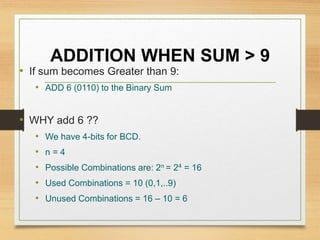
ADDITION WHEN SUM > 9
• If sum becomes Greater than 9:
• ADD 6 (0110) to the Binary Sum
• WHY add 6 ??
• We have 4-bits for BCD.
• n = 4
• Possible Combinations are: 2n = 24 = 16
• Used Combinations = 10 (0,1,..9)
• Unused Combinations = 16 – 10 = 6
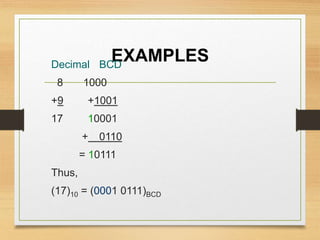
EXAMPLESDecimal BCD
8 1000
+9 +1001
17 10001
+ 0110
= 10111
Thus,
(17)10 = (0001 0111)BCD
EXAMPLES
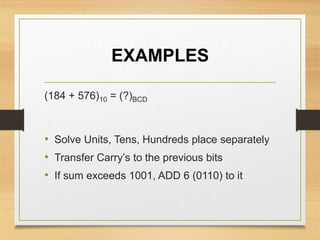
(184 + 576)10 = (?)BCD
• Solve Units, Tens, Hundreds place separately
• Transfer Carry’s to the previous bits
• If sum exceeds 1001, ADD 6 (0110) to it
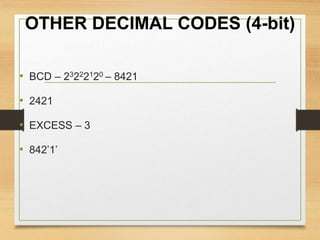
OTHER DECIMAL CODES (4-bit)
• BCD – 23222120 – 8421
• 2421
• EXCESS – 3
• 842’1’
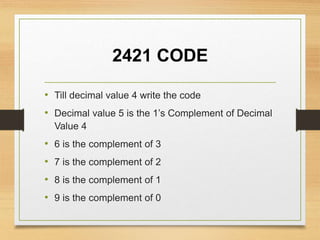
2421 CODE
• Till decimal value 4 write the code
• Decimal value 5 is the 1’s Complement of Decimal
Value 4
• 6 is the complement of 3
• 7 is the complement of 2
• 8 is the complement of 1
• 9 is the complement of 0
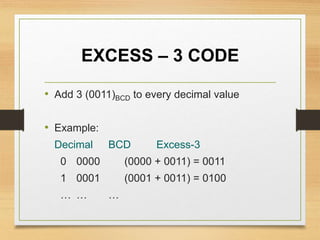
EXCESS – 3 CODE
• Add 3 (0011)BCD to every decimal value
• Example:
Decimal BCD Excess-3
0 0000 (0000 + 0011) = 0011
1 0001 (0001 + 0011) = 0100
… … …
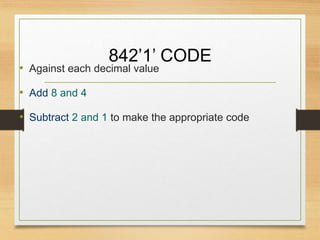
842’1’ CODE
• Against each decimal value
• Add 8 and 4
• Subtract 2 and 1 to make the appropriate code
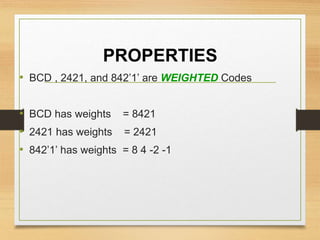
PROPERTIES
• BCD , 2421, and 842’1’ are WEIGHTED Codes
• BCD has weights = 8421
• 2421 has weights = 2421
• 842’1’ has weights = 8 4 -2 -1
Lecture 6
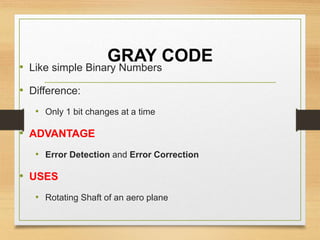
GRAY CODE
• Like simple Binary Numbers
• Difference:
• Only 1 bit changes at a time
• ADVANTAGE
• Error Detection and Error Correction
• USES
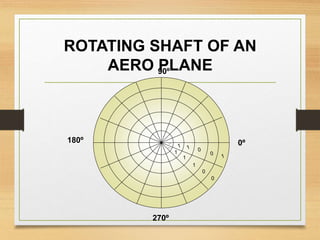
• Rotating Shaft of an aero plane
ROTATING SHAFT OF AN
AERO PLANE
0º
90º
180º
270º
0
0
1
1
1
..
CONVERSIONS
• Binary to Gray Code
• Gray Code to Binary
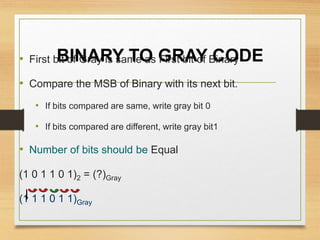
BINARY TO GRAY CODE• First bit of Gray is same as First bit of Binary
• Compare the MSB of Binary with its next bit.
• If bits compared are same, write gray bit 0
• If bits compared are different, write gray bit1
• Number of bits should be Equal
(1 0 1 1 0 1)2 = (?)Gray
(1 1 1 0 1 1)Gray
ERROR DETECTION
• Detection of Errors during transmission
• Binary information is sent through WIRES
• Noise in the Wires can change 0 to 1 and 1 to
0
• A PARITY-BIT is added for error-detection
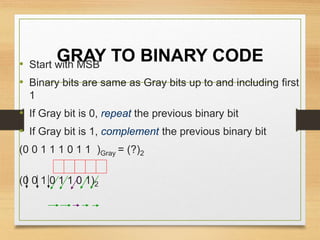
GRAY TO BINARY CODE• Start with MSB
• Binary bits are same as Gray bits up to and including first
1
• If Gray bit is 0, repeat the previous binary bit
• If Gray bit is 1, complement the previous binary bit
(0 0 1 1 1 0 1 1 )Gray = (?)2
(0 0 1 0 1 1 0 1)2
PARITY BIT
• An extra bit added to the information
• Added to make the total no. of 1’s in the coded group,
either ODD or EVEN
• Even Parity
• choose parity bit such that # of 1’s is even
• Odd Parity
• choose parity bit such that # of 1’s is odd
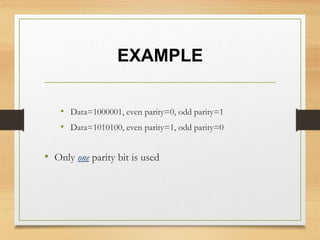
EXAMPLE
• Data=1000001, even parity=0, odd parity=1
• Data=1010100, even parity=1, odd parity=0
• Only one parity bit is used
ALPHANUMERIC CODES
• Upper Case Alphabets (A,B,..,Z)
• Lower Case Alphabets (a,b,..,z)
• Numeric Values (0,1,2…)
• Special Characters (@,$,*,%,#,^,…etc)
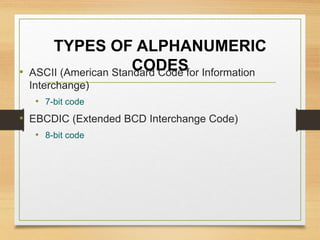
TYPES OF ALPHANUMERIC
CODES• ASCII (American Standard Code for Information
Interchange)
• 7-bit code
• EBCDIC (Extended BCD Interchange Code)
• 8-bit code
Lecture 7
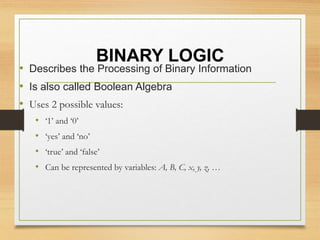
BINARY LOGIC
• Describes the Processing of Binary Information
• Is also called Boolean Algebra
• Uses 2 possible values:
• ‘1’ and ‘0’
• ‘yes’ and ‘no’
• ‘true’ and ‘false’
• Can be represented by variables: A, B, C, x, y, z, …
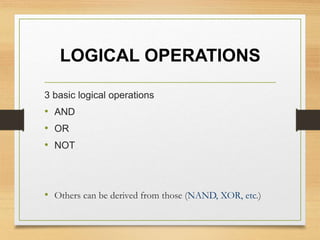
LOGICAL OPERATIONS
3 basic logical operations
• AND
• OR
• NOT
• Others can be derived from those (NAND, XOR, etc.)
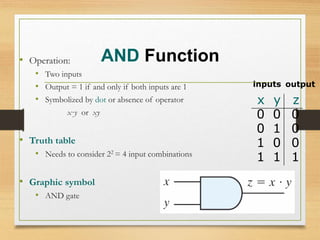
AND Function• Operation:
• Two inputs
• Output = 1 if and only if both inputs are 1
• Symbolized by dot or absence of operator
x·y or xy
• Truth table
• Needs to consider 22 = 4 input combinations
• Graphic symbol
• AND gate
111
001
010
000
zyx
inputs output
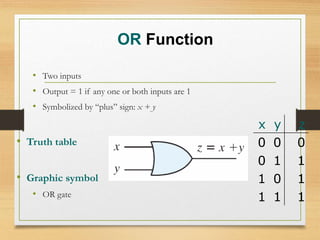
OR Function
• Two inputs
• Output = 1 if any one or both inputs are 1
• Symbolized by “plus” sign: x + y
• Truth table
• Graphic symbol
• OR gate
x y z
0 0 0
0 1 1
1 0 1
1 1 1
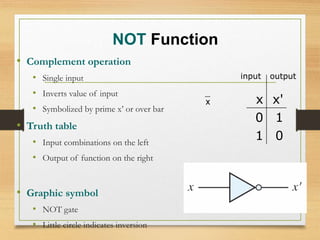
NOT Function
• Complement operation
• Single input
• Inverts value of input
• Symbolized by prime x’ or over bar
• Truth table
• Input combinations on the left
• Output of function on the right
• Graphic symbol
• NOT gate
• Little circle indicates inversion
x x'
0 1
1 0
x
input output
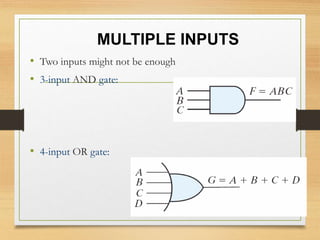
MULTIPLE INPUTS
• Two inputs might not be enough
• 3-input AND gate:
• 4-input OR gate:
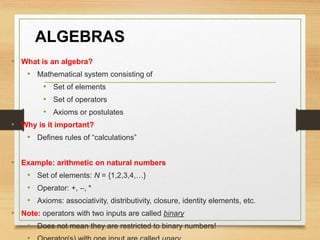
ALGEBRAS
• What is an algebra?
• Mathematical system consisting of
• Set of elements
• Set of operators
• Axioms or postulates
• Why is it important?
• Defines rules of “calculations”
• Example: arithmetic on natural numbers
• Set of elements: N = {1,2,3,4,…}
• Operator: +, –, *
• Axioms: associativity, distributivity, closure, identity elements, etc.
• Note: operators with two inputs are called binary
• Does not mean they are restricted to binary numbers!
CHAPTER – 2
BOOLEAN ALGEBRA AND
LOGIC GATES
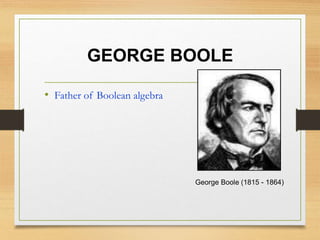
GEORGE BOOLE
• Father of Boolean algebra
George Boole (1815 - 1864)
TOPICS
• Boolean algebra
• Algebra axioms, postulates
• Boolean functions
• Algebraic expression
• Boolean Theorems
• Comparison of Boolean functions
• Canonical and standard forms
• sum of minterms
• Duality: DeMorgan’s theorem
• Dual canonical form (product of maxterms)
• Digital logic gates and integrated circuits
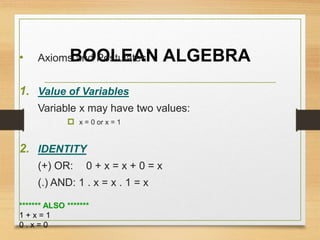
BOOLEAN ALGEBRA• Axioms and Postulates
1. Value of Variables
Variable x may have two values:
 x = 0 or x = 1
2. IDENTITY
(+) OR: 0 + x = x + 0 = x
(.) AND: 1 . x = x . 1 = x
******* ALSO *******
1 + x = 1
0 . x = 0
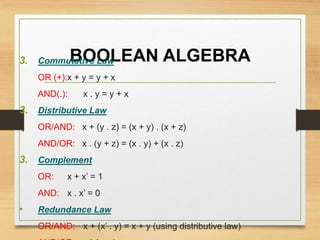
BOOLEAN ALGEBRA3. Commutative Law
OR (+):x + y = y + x
AND(.): x . y = y + x
3. Distributive Law
OR/AND: x + (y . z) = (x + y) . (x + z)
AND/OR: x . (y + z) = (x . y) + (x . z)
3. Complement
OR: x + x’ = 1
AND: x . x’ = 0
• Redundance Law
OR/AND: x + (x’ . y) = x + y (using distributive law)
BOOLEAN ALGEBRA –
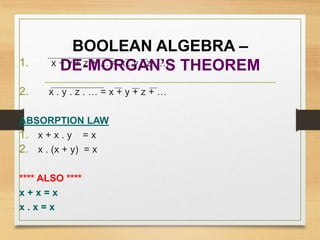
DE-MORGAN’S THEOREM1. x + y + z + … = x . y . z . …
2. x . y . z . … = x + y + z + …
ABSORPTION LAW
1. x + x . y = x
2. x . (x + y) = x
**** ALSO ****
x + x = x
x . x = x
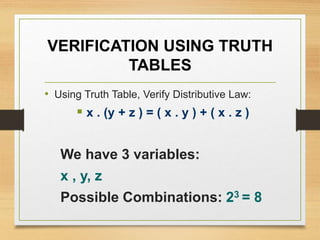
VERIFICATION USING TRUTH
TABLES
• Using Truth Table, Verify Distributive Law:
 x . (y + z ) = ( x . y ) + ( x . z )
We have 3 variables:
x , y, z
Possible Combinations: 23 = 8
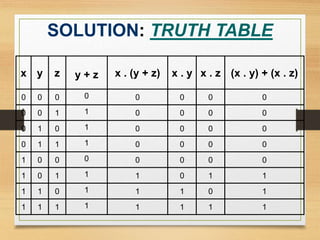
SOLUTION: TRUTH TABLE
x y z y + z x . (y + z) x . y x . z (x . y) + (x . z)
0 0 0 0 0 0 0 0
0 0 1 1 0 0 0 0
0 1 0 1 0 0 0 0
0 1 1 1 0 0 0 0
1 0 0 0 0 0 0 0
1 0 1 1 1 0 1 1
1 1 0 1 1 1 0 1
1 1 1 1 1 1 1 1
EXERCISE
Prove:
• De-Morgan’s Law
• Commutative Law
BOOLEAN FUNCTIONS
• EXPRESSIONS that contain:
• Binary Variable
• Values = 0,1
• Binary Operators
• OR, AND, NOT
• Parenthesis
• Equal Sign
BOOLEAN FUNCTIONS -
REPRESENTATION• Truth Table
• Boolean Expression
TRUTH TABLE
Listing of all possible combinations of INPUTS
and
their resulting OUTPUTS
BOOLEAN EXPRESSION
• Represented as:
Output = Logic Operators ( Inputs )

Binary codes

  • 1.
    LECTURE - 4 Ms.Maria Saleemi
  • 2.
    BINARY CODES • BCDCODE • BCD ADDITION • EXCESS – 3 CODE • 2421 CODE • 842’1’ CODE • GRAY CODE • ASCII CODE
  • 3.
    CODES • Information givento computer • Data • Instructions • Code must be in Binary • Computer understand Binary (0 and 1)
  • 4.
    CODES • n-bit BinaryCode • Combination of bits (0’s and 1’s) = 2n • Each Combination represents a different value
  • 5.
    BINARY CODED DECIMAL Decimal(0,1,..9) binary Binary code conversion Computations in binary Results are decoded Decimal (0,1,..9)
  • 6.
    BCD • 4-bit Code •Each decimal digit (0,1,..9) is written as a 4-bit binary number
  • 7.
    CONVERSION DECIMAL BCD 0 00 0 0 1 0 0 0 1 2 0 0 1 0 3 0 0 1 1 4 0 1 0 0 5 0 1 0 1 6 0 1 1 0 7 0 1 1 1 8 1 0 0 0 9 1 0 0 1
  • 8.
    REPRESENTATION IN BCD FORVALUES > 9 (11)10 = (?)BCD From Table write: BCD value of 1 (space) BCD value of 1 (11)10 = (0001 0001)BCD
  • 9.
    • BCD isnot same as Binary No.s (16)10 = (0001 0110)BCD = (10000)2
  • 10.
    LIMITATIONS OF BCD •BCD uses 4 places for each decimal digit
  • 11.
    ADVANTAGES OF BCD •Can be easily converted to Decimal • Can be understood by Computers
  • 12.
    EXERCISE Convert : • (146)10= (?)BCD • (1001 0111 0110)BCD = (?)10 • (1010 1001 1000)BCD = (?)10
  • 13.
    BCD ADDITION • Howcomputer will perform Addition of two numbers using BCD Code ?? Decimal BCD Decimal BCD 4 0100 4 0100 + 5 + 0101 + 8 1000 9 = 1001 12 1100 Invalid BCD No.
  • 14.
    ADDITION WHEN SUM> 9 • If sum becomes Greater than 9: • ADD 6 (0110) to the Binary Sum • WHY add 6 ?? • We have 4-bits for BCD. • n = 4 • Possible Combinations are: 2n = 24 = 16 • Used Combinations = 10 (0,1,..9) • Unused Combinations = 16 – 10 = 6
  • 15.
    EXAMPLESDecimal BCD 8 1000 +9+1001 17 10001 + 0110 = 10111 Thus, (17)10 = (0001 0111)BCD
  • 16.
    EXAMPLES (184 + 576)10= (?)BCD • Solve Units, Tens, Hundreds place separately • Transfer Carry’s to the previous bits • If sum exceeds 1001, ADD 6 (0110) to it
  • 17.
    OTHER DECIMAL CODES(4-bit) • BCD – 23222120 – 8421 • 2421 • EXCESS – 3 • 842’1’
  • 18.
    2421 CODE • Tilldecimal value 4 write the code • Decimal value 5 is the 1’s Complement of Decimal Value 4 • 6 is the complement of 3 • 7 is the complement of 2 • 8 is the complement of 1 • 9 is the complement of 0
  • 19.
    EXCESS – 3CODE • Add 3 (0011)BCD to every decimal value • Example: Decimal BCD Excess-3 0 0000 (0000 + 0011) = 0011 1 0001 (0001 + 0011) = 0100 … … …
  • 20.
    842’1’ CODE • Againsteach decimal value • Add 8 and 4 • Subtract 2 and 1 to make the appropriate code
  • 21.
    PROPERTIES • BCD ,2421, and 842’1’ are WEIGHTED Codes • BCD has weights = 8421 • 2421 has weights = 2421 • 842’1’ has weights = 8 4 -2 -1
  • 22.
  • 23.
    GRAY CODE • Likesimple Binary Numbers • Difference: • Only 1 bit changes at a time • ADVANTAGE • Error Detection and Error Correction • USES • Rotating Shaft of an aero plane
  • 24.
    ROTATING SHAFT OFAN AERO PLANE 0º 90º 180º 270º 0 0 1 1 1 ..
  • 25.
    CONVERSIONS • Binary toGray Code • Gray Code to Binary
  • 26.
    BINARY TO GRAYCODE• First bit of Gray is same as First bit of Binary • Compare the MSB of Binary with its next bit. • If bits compared are same, write gray bit 0 • If bits compared are different, write gray bit1 • Number of bits should be Equal (1 0 1 1 0 1)2 = (?)Gray (1 1 1 0 1 1)Gray
  • 27.
    ERROR DETECTION • Detectionof Errors during transmission • Binary information is sent through WIRES • Noise in the Wires can change 0 to 1 and 1 to 0 • A PARITY-BIT is added for error-detection
  • 28.
    GRAY TO BINARYCODE• Start with MSB • Binary bits are same as Gray bits up to and including first 1 • If Gray bit is 0, repeat the previous binary bit • If Gray bit is 1, complement the previous binary bit (0 0 1 1 1 0 1 1 )Gray = (?)2 (0 0 1 0 1 1 0 1)2
  • 29.
    PARITY BIT • Anextra bit added to the information • Added to make the total no. of 1’s in the coded group, either ODD or EVEN • Even Parity • choose parity bit such that # of 1’s is even • Odd Parity • choose parity bit such that # of 1’s is odd
  • 30.
    EXAMPLE • Data=1000001, evenparity=0, odd parity=1 • Data=1010100, even parity=1, odd parity=0 • Only one parity bit is used
  • 31.
    ALPHANUMERIC CODES • UpperCase Alphabets (A,B,..,Z) • Lower Case Alphabets (a,b,..,z) • Numeric Values (0,1,2…) • Special Characters (@,$,*,%,#,^,…etc)
  • 32.
    TYPES OF ALPHANUMERIC CODES•ASCII (American Standard Code for Information Interchange) • 7-bit code • EBCDIC (Extended BCD Interchange Code) • 8-bit code
  • 33.
  • 34.
    BINARY LOGIC • Describesthe Processing of Binary Information • Is also called Boolean Algebra • Uses 2 possible values: • ‘1’ and ‘0’ • ‘yes’ and ‘no’ • ‘true’ and ‘false’ • Can be represented by variables: A, B, C, x, y, z, …
  • 35.
    LOGICAL OPERATIONS 3 basiclogical operations • AND • OR • NOT • Others can be derived from those (NAND, XOR, etc.)
  • 36.
    AND Function• Operation: •Two inputs • Output = 1 if and only if both inputs are 1 • Symbolized by dot or absence of operator x·y or xy • Truth table • Needs to consider 22 = 4 input combinations • Graphic symbol • AND gate 111 001 010 000 zyx inputs output
  • 37.
    OR Function • Twoinputs • Output = 1 if any one or both inputs are 1 • Symbolized by “plus” sign: x + y • Truth table • Graphic symbol • OR gate x y z 0 0 0 0 1 1 1 0 1 1 1 1
  • 38.
    NOT Function • Complementoperation • Single input • Inverts value of input • Symbolized by prime x’ or over bar • Truth table • Input combinations on the left • Output of function on the right • Graphic symbol • NOT gate • Little circle indicates inversion x x' 0 1 1 0 x input output
  • 39.
    MULTIPLE INPUTS • Twoinputs might not be enough • 3-input AND gate: • 4-input OR gate:
  • 40.
    ALGEBRAS • What isan algebra? • Mathematical system consisting of • Set of elements • Set of operators • Axioms or postulates • Why is it important? • Defines rules of “calculations” • Example: arithmetic on natural numbers • Set of elements: N = {1,2,3,4,…} • Operator: +, –, * • Axioms: associativity, distributivity, closure, identity elements, etc. • Note: operators with two inputs are called binary • Does not mean they are restricted to binary numbers!
  • 41.
    CHAPTER – 2 BOOLEANALGEBRA AND LOGIC GATES
  • 42.
    GEORGE BOOLE • Fatherof Boolean algebra George Boole (1815 - 1864)
  • 43.
    TOPICS • Boolean algebra •Algebra axioms, postulates • Boolean functions • Algebraic expression • Boolean Theorems • Comparison of Boolean functions • Canonical and standard forms • sum of minterms • Duality: DeMorgan’s theorem • Dual canonical form (product of maxterms) • Digital logic gates and integrated circuits
  • 44.
    BOOLEAN ALGEBRA• Axiomsand Postulates 1. Value of Variables Variable x may have two values:  x = 0 or x = 1 2. IDENTITY (+) OR: 0 + x = x + 0 = x (.) AND: 1 . x = x . 1 = x ******* ALSO ******* 1 + x = 1 0 . x = 0
  • 45.
    BOOLEAN ALGEBRA3. CommutativeLaw OR (+):x + y = y + x AND(.): x . y = y + x 3. Distributive Law OR/AND: x + (y . z) = (x + y) . (x + z) AND/OR: x . (y + z) = (x . y) + (x . z) 3. Complement OR: x + x’ = 1 AND: x . x’ = 0 • Redundance Law OR/AND: x + (x’ . y) = x + y (using distributive law)
  • 46.
    BOOLEAN ALGEBRA – DE-MORGAN’STHEOREM1. x + y + z + … = x . y . z . … 2. x . y . z . … = x + y + z + … ABSORPTION LAW 1. x + x . y = x 2. x . (x + y) = x **** ALSO **** x + x = x x . x = x
  • 47.
    VERIFICATION USING TRUTH TABLES •Using Truth Table, Verify Distributive Law:  x . (y + z ) = ( x . y ) + ( x . z ) We have 3 variables: x , y, z Possible Combinations: 23 = 8
  • 48.
    SOLUTION: TRUTH TABLE xy z y + z x . (y + z) x . y x . z (x . y) + (x . z) 0 0 0 0 0 0 0 0 0 0 1 1 0 0 0 0 0 1 0 1 0 0 0 0 0 1 1 1 0 0 0 0 1 0 0 0 0 0 0 0 1 0 1 1 1 0 1 1 1 1 0 1 1 1 0 1 1 1 1 1 1 1 1 1
  • 49.
  • 50.
    BOOLEAN FUNCTIONS • EXPRESSIONSthat contain: • Binary Variable • Values = 0,1 • Binary Operators • OR, AND, NOT • Parenthesis • Equal Sign
  • 51.
    BOOLEAN FUNCTIONS - REPRESENTATION•Truth Table • Boolean Expression
  • 52.
    TRUTH TABLE Listing ofall possible combinations of INPUTS and their resulting OUTPUTS
  • 53.
    BOOLEAN EXPRESSION • Representedas: Output = Logic Operators ( Inputs )