
CS221: Digital Design
Number SystemNumber System
Dr. A. Sahu
Dept of Comp. Sc. & Engg.Dept of Comp. Sc. & Engg.
Indian Institute of Technology Guwahati
1
OutlineOutline
• Number System
D i l Bi O t l H– Decimal, Binary, Octal, Hex
• Conversion (one to another)
– Decimal to Binary Octal Hex & Vice VersaDecimal to Binary, Octal, Hex   & Vice Versa
– Binary to HEX & vice versa
• Other representation
– Signed, Unsigned, Complement
• Operation
– Add, Sub, Mul, Div, Mod
• How to handle real number efficiently  ?
Float Double– Float, Double
2
What Digit? => Number SystemWhat Digit?   > Number System 
• Famous Number System: Dec Rom BinFamous Number System: Dec, Rom, Bin
• Decimal System: 0 ‐9
M l b h h 10 fi– May evolves: because human have 10 finger 
• Roman System
– May evolves to make easy to look and feel
– Pre/Post Concept: (IV,  V  & VI) is (5‐1, 5 & 5+1) 
• Binary System, Others (Oct, Hex)
– One can cut an apple in to twopp
3
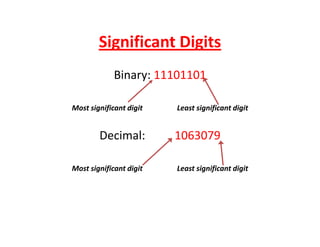
Significant DigitsSignificant Digits
Binary: 11101101Binary: 11101101
Most significant digit Least significant digitMost significant digit                   Least significant digit
Decimal: 1063079Decimal:  1063079
Most significant digit Least significant digitMost significant digit                   Least significant digit
Decimal (base 10)Decimal (base 10)
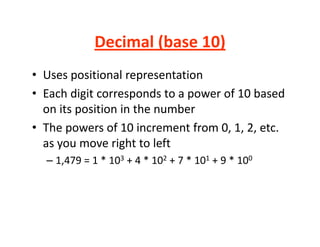
• Uses positional representationUses positional representation
• Each digit corresponds to a power of 10 based 
on its position in the numberon its position in the number
• The powers of 10 increment from 0, 1, 2, etc. 
i h l fas you move right to left
– 1,479 = 1 * 103 + 4 * 102 + 7 * 101 + 9 * 100
Binary (base 2)Binary (base 2) 
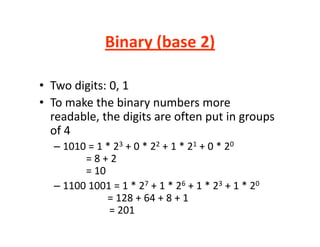
• Two digits: 0, 1
• To make the binary numbers more y
readable, the digits are often put in groups 
of 4
– 1010 = 1 * 23 + 0 * 22 + 1 * 21 + 0 * 20 
= 8 + 2 
= 10= 10 
– 1100 1001 = 1 * 27 + 1 * 26 + 1 * 23 + 1 * 20 
= 128 + 64 + 8 + 1 128   64   8   1 
= 201
How to Encode Numbers: Binary 
NumbersNumbers
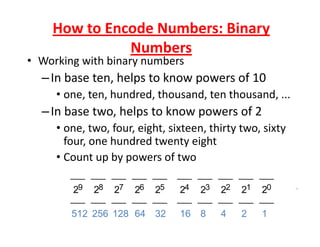
• Working with binary numbers
In base ten helps to know powers of 10–In base ten, helps to know powers of 10
• one, ten, hundred, thousand, ten thousand, ...
I b t h l t k f 2–In base two, helps to know powers of 2
• one, two, four, eight, sixteen, thirty two, sixty 
f h d d t t i htfour, one hundred twenty eight
• Count up by powers of two
24 23 22 21 2029 28 27 26 25 a
16 8 4 2 1512 256 128 64 32
Octal (base 8)Octal (base 8)
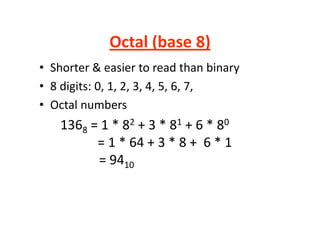
• Shorter & easier to read than binary
• 8 digits: 0, 1, 2, 3, 4, 5, 6, 7, 
• Octal numbersOctal numbers
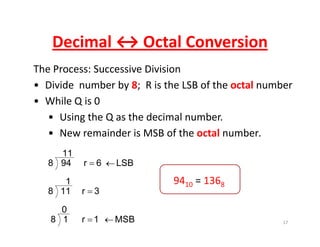
1368 = 1 * 82 + 3 * 81 + 6 * 80 
1 * 64 3 * 8 6 * 1= 1 * 64 + 3 * 8 +  6 * 1
= 9410
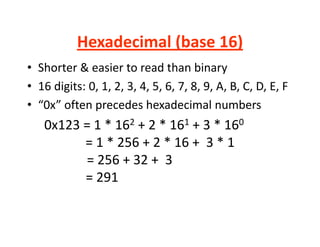
Hexadecimal (base 16)Hexadecimal (base 16)
• Shorter & easier to read than binary
• 16 digits: 0, 1, 2, 3, 4, 5, 6, 7, 8, 9, A, B, C, D, E, F
• “0x” often precedes hexadecimal numbers0x  often precedes hexadecimal numbers
0x123 = 1 * 162 + 2 * 161 + 3 * 160 
1 * 256 2 * 16 3 * 1= 1 * 256 + 2 * 16 +  3 * 1
= 256 + 32 +  3
= 291 
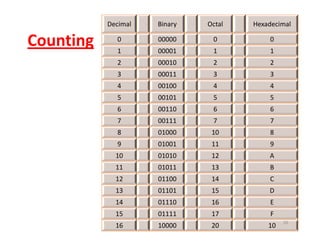
Counting
Decimal Binary Octal Hexadecimal
0 00000 0 0
Counting 1 00001 1 1
2 00010 2 2
3 00011 3 3
4 00100 4 4
5 00101 5 5
6 00110 6 66 00110 6 6
7 00111 7 7
8 01000 10 8
9 01001 11 9
10 01010 12 A
11 01011 13 B
12 01100 14 C
13 01101 15 D
14 01110 16 E14 01110 16 E
15 01111 17 F
16 10000 20 10
10
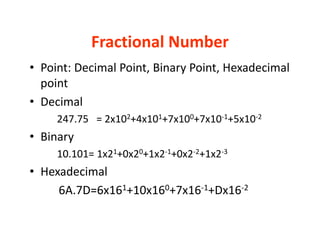
Fractional NumberFractional Number 
• Point: Decimal Point, Binary Point, Hexadecimal 
point
• Decimal
247.75   = 2x10²+4x101+7x100+7x10‐1+5x10‐2
• BinaryBinary
10.101= 1x21+0x20+1x2‐1+0x2‐2+1x2‐3
• Hexadecimal• Hexadecimal
6A.7D=6x161+10x160+7x16‐1+Dx16‐2
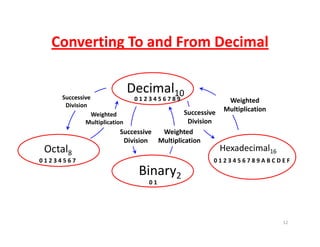
Converting To and From DecimalConverting To and From Decimal
Successive 
Division
Weighted 
M lti li ti
Decimal100 1 2 3 4 5 6 7 8 9
Weighted 
Multiplication
Successive 
Division
Multiplication
Successive 
Di i i
Weighted 
M lti li ti
Octal8
0 1 2 3 4 5 6 7
Hexadecimal16
0 1 2 3 4 5 6 7 8 9 A B C D E F
Division Multiplication
BinaryBinary2
0 1
12
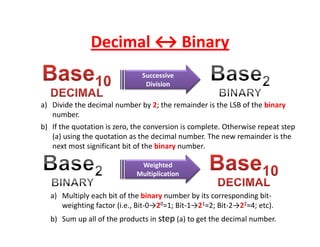
Decimal ↔ BinaryDecimal ↔ Binary
SuccessiveSuccessive
Division
a) Divide the decimal number by 2; the remainder is the LSB of the binary) y ; y
number.
b) If the quotation is zero, the conversion is complete. Otherwise repeat step 
(a) using the quotation as the decimal number. The new remainder is the ( ) g q
next most significant bit of the binary number.
Weighted
a) Multiply each bit of the binary number by its corresponding bit‐
Multiplication
weighting factor (i.e., Bit‐0→20=1; Bit‐1→21=2; Bit‐2→22=4; etc). 
b) Sum up all of the products in step (a) to get the decimal number.  
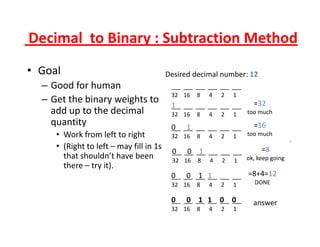
Decimal  to Binary : Subtraction Methody
• Goal Desired decimal number: 12
– Good for human
– Get the binary weights to 
dd t th d i l
Desired decimal number: 12
1 =32
12481632
add up to the decimal 
quantity
• Work from left to right
12481632 too much
12481632
0 =16
too much
1
• (Right to left – may fill in 1s 
that shouldn’t have been 
there – try it). 
a
12481632
0 =8
ok, keep going
0 1
12481632
0 =8+4=12
DONE
0 1 1
0 0 1 1 0 0
12481632
0 answer0 1 1 0 0
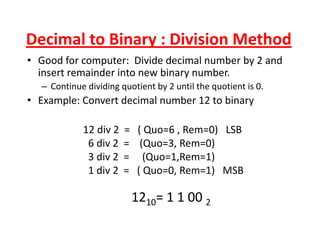
Decimal to Binary : Division Methody
• Good for computer:  Divide decimal number by 2 and 
insert remainder into new binary number.y
– Continue dividing quotient by 2 until the quotient is 0.
• Example: Convert decimal number 12 to binary
12 div 2  =   ( Quo=6 , Rem=0)   LSB
( )6 div 2  =    (Quo=3, Rem=0)
3 div 2  =     (Quo=1,Rem=1)
1 div 2 = ( Quo=0 Rem=1) MSB1 div 2  =   ( Quo=0, Rem=1)   MSB 
1210= 1 1 00 21210  1 1 00 2 
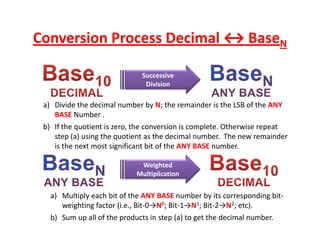
Conversion Process Decimal ↔ BaseNN
SuccessiveSuccessive
Division
a) Divide the decimal number by N; the remainder is the LSB of the ANY ) y ;
BASE Number .
b) If the quotient is zero, the conversion is complete. Otherwise repeat 
step (a) using the quotient as the decimal number.  The new remainder p ( ) g q
is the next most significant bit of the ANY BASE number.
Weighted
a) Multiply each bit of the ANY BASE number by its corresponding bit‐
Multiplication
weighting factor (i.e., Bit‐0→N0; Bit‐1→N1; Bit‐2→N2; etc). 
b) Sum up all of the products in step (a) to get the decimal number.  
Decimal ↔ Octal ConversionDecimal ↔ Octal Conversion
The Process: Successive Division
• Divide  number by 8;  R is the LSB of the octal number 
• While Q is 0 
• Using the Q as the decimal number. 
• New remainder is MSB of the octal number.
LSB6r
11
948 ←=
3r
1
118 =
9410 = 1368
MSB1r
0
18 ←= 17
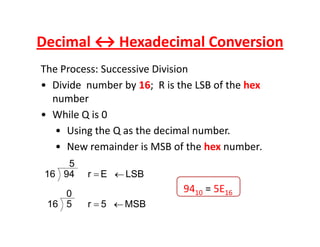
Decimal ↔ Hexadecimal ConversionDecimal ↔ Hexadecimal Conversion
The Process: Successive Division
• Divide  number by 16;  R is the LSB of the hex
number 
• While Q is 0 
• Using the Q as the decimal number.  
• New remainder is MSB of the hex number.
S
5
MSB5
0
516
LSBEr9416 ←=
9410 = 5E16
MSB5r516 ←=
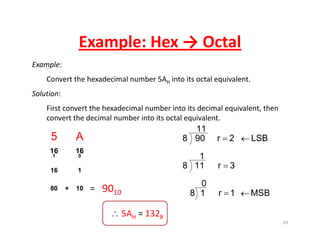
Example: Hex → OctalExample: Hex → Octal
Example:
C h h d i l b 5A i i l i lConvert the hexadecimal number 5AH into its octal equivalent.
Solution:
First convert the hexadecimal number into its decimal equivalent then
5 A
First convert the hexadecimal number into its decimal equivalent, then 
convert the decimal number into its octal equivalent.
LSB2r
11
908 ←=5 A
16
1
16
0
16 1
3r
1
118
LSB2r908
=
←=
16 1
80 + 10 = 9010 MSB1r
0
18 ←=
∴ 5AH = 1328
19
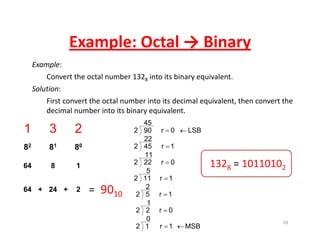
Example: Octal → BinaryExample: Octal → Binary
Example:
Convert the octal number 132 into its binary equivalentConvert the octal number 1328 into its binary equivalent.
Solution:
First convert the octal number into its decimal equivalent, then convert the 
d l b b l
1 3 2
22
LSB0r
45
902 ←=
decimal number into its binary equivalent.
1328 = 10110102
82 81 80
64 8 1
5
0r
11
222
1r
22
452
=
=
64 + 24 + 2 = 9010
1
1r
2
52
1r
5
112
=
=
MSB1r
0
12
0r
1
22
←=
=
20
Binary ↔ Octal ↔ Hex ShortcutBinary ↔ Octal ↔ Hex Shortcut
• Relation
Bi l d h b• Binary, octal, and hex number systems 
• All powers of two
• Exploit (This Relation) 
•Make conversion easier.
21
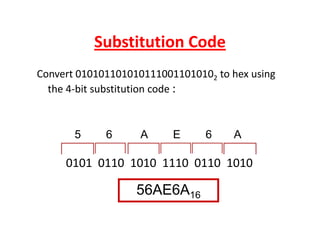
Substitution Code
Convert 0101011010101110011010102 to hex using
Substitution Code
Convert 0101011010101110011010102 to hex using 
the 4‐bit substitution code :
5 6 A E 6 A
0101  0110  1010  1110  0110  1010
56AE6A16
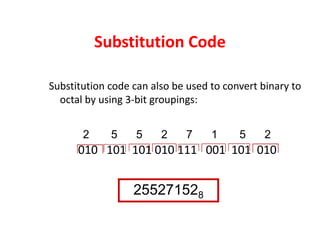
Substitution CodeSubstitution Code
Substitution code can also be used to convert binary to 
octal by using 3‐bit groupings: 
2 5 5 2 7 1 5 2
010   101  101 010 111  001  101  010
255271528
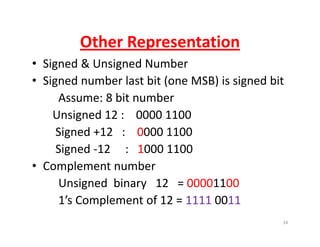
Other RepresentationOther Representation 
• Signed & Unsigned Number
Si d b l bi ( MSB) i i d bi• Signed number last bit (one MSB) is signed bit
Assume: 8 bit number 
Unsigned 12 :    0000 1100 
Signed +12   :    0000 1100   
Signed ‐12     :   1000 1100   
• Complement numberp
Unsigned  binary   12   = 00001100
1’s Complement of 12 = 1111 00111 s Complement of 12 = 1111 0011
24
Thanks
25

Number System Conversion | BCA

  • 1.
    CS221: Digital Design Number SystemNumber System Dr. A. Sahu Dept ofComp. Sc. & Engg.Dept of Comp. Sc. & Engg. Indian Institute of Technology Guwahati 1
  • 2.
    OutlineOutline • Number System D il Bi O t l H– Decimal, Binary, Octal, Hex • Conversion (one to another) – Decimal to Binary Octal Hex & Vice VersaDecimal to Binary, Octal, Hex   & Vice Versa – Binary to HEX & vice versa • Other representation – Signed, Unsigned, Complement • Operation – Add, Sub, Mul, Div, Mod • How to handle real number efficiently  ? Float Double– Float, Double 2
  • 3.
    What Digit? =>Number SystemWhat Digit?   > Number System  • Famous Number System: Dec Rom BinFamous Number System: Dec, Rom, Bin • Decimal System: 0 ‐9 M l b h h 10 fi– May evolves: because human have 10 finger  • Roman System – May evolves to make easy to look and feel – Pre/Post Concept: (IV,  V  & VI) is (5‐1, 5 & 5+1)  • Binary System, Others (Oct, Hex) – One can cut an apple in to twopp 3
  • 4.
    Significant DigitsSignificant Digits Binary: 11101101Binary: 11101101 Mostsignificant digit Least significant digitMost significant digit                   Least significant digit Decimal: 1063079Decimal:  1063079 Most significant digit Least significant digitMost significant digit                   Least significant digit
  • 5.
    Decimal (base 10)Decimal (base 10) •Uses positional representationUses positional representation • Each digit corresponds to a power of 10 based  on its position in the numberon its position in the number • The powers of 10 increment from 0, 1, 2, etc.  i h l fas you move right to left – 1,479 = 1 * 103 + 4 * 102 + 7 * 101 + 9 * 100
  • 6.
    Binary (base 2)Binary (base 2)  •Two digits: 0, 1 • To make the binary numbers more y readable, the digits are often put in groups  of 4 – 1010 = 1 * 23 + 0 * 22 + 1 * 21 + 0 * 20  = 8 + 2  = 10= 10  – 1100 1001 = 1 * 27 + 1 * 26 + 1 * 23 + 1 * 20  = 128 + 64 + 8 + 1 128   64   8   1  = 201
  • 7.
    How to Encode Numbers: Binary  NumbersNumbers • Working with binary numbers In baseten helps to know powers of 10–In base ten, helps to know powers of 10 • one, ten, hundred, thousand, ten thousand, ... I b t h l t k f 2–In base two, helps to know powers of 2 • one, two, four, eight, sixteen, thirty two, sixty  f h d d t t i htfour, one hundred twenty eight • Count up by powers of two 24 23 22 21 2029 28 27 26 25 a 16 8 4 2 1512 256 128 64 32
  • 8.
    Octal (base 8)Octal (base 8) •Shorter & easier to read than binary • 8 digits: 0, 1, 2, 3, 4, 5, 6, 7,  • Octal numbersOctal numbers 1368 = 1 * 82 + 3 * 81 + 6 * 80  1 * 64 3 * 8 6 * 1= 1 * 64 + 3 * 8 +  6 * 1 = 9410
  • 9.
    Hexadecimal (base 16)Hexadecimal (base 16) •Shorter & easier to read than binary • 16 digits: 0, 1, 2, 3, 4, 5, 6, 7, 8, 9, A, B, C, D, E, F • “0x” often precedes hexadecimal numbers0x  often precedes hexadecimal numbers 0x123 = 1 * 162 + 2 * 161 + 3 * 160  1 * 256 2 * 16 3 * 1= 1 * 256 + 2 * 16 +  3 * 1 = 256 + 32 +  3 = 291 
  • 10.
    Counting Decimal Binary OctalHexadecimal 0 00000 0 0 Counting 1 00001 1 1 2 00010 2 2 3 00011 3 3 4 00100 4 4 5 00101 5 5 6 00110 6 66 00110 6 6 7 00111 7 7 8 01000 10 8 9 01001 11 9 10 01010 12 A 11 01011 13 B 12 01100 14 C 13 01101 15 D 14 01110 16 E14 01110 16 E 15 01111 17 F 16 10000 20 10 10
  • 11.
    Fractional NumberFractional Number  • Point: Decimal Point, Binary Point, Hexadecimal  point •Decimal 247.75   = 2x10²+4x101+7x100+7x10‐1+5x10‐2 • BinaryBinary 10.101= 1x21+0x20+1x2‐1+0x2‐2+1x2‐3 • Hexadecimal• Hexadecimal 6A.7D=6x161+10x160+7x16‐1+Dx16‐2
  • 12.
    Converting To andFrom DecimalConverting To and From Decimal Successive  Division Weighted  M lti li ti Decimal100 1 2 3 4 5 6 7 8 9 Weighted  Multiplication Successive  Division Multiplication Successive  Di i i Weighted  M lti li ti Octal8 0 1 2 3 4 5 6 7 Hexadecimal16 0 1 2 3 4 5 6 7 8 9 A B C D E F Division Multiplication BinaryBinary2 0 1 12
  • 13.
    Decimal ↔ BinaryDecimal ↔ Binary SuccessiveSuccessive Division a)Divide the decimal number by 2; the remainder is the LSB of the binary) y ; y number. b) If the quotation is zero, the conversion is complete. Otherwise repeat step  (a) using the quotation as the decimal number. The new remainder is the ( ) g q next most significant bit of the binary number. Weighted a) Multiply each bit of the binary number by its corresponding bit‐ Multiplication weighting factor (i.e., Bit‐0→20=1; Bit‐1→21=2; Bit‐2→22=4; etc).  b) Sum up all of the products in step (a) to get the decimal number.  
  • 14.
    Decimal  to Binary : Subtraction Methody • Goal Desireddecimal number: 12 – Good for human – Get the binary weights to  dd t th d i l Desired decimal number: 12 1 =32 12481632 add up to the decimal  quantity • Work from left to right 12481632 too much 12481632 0 =16 too much 1 • (Right to left – may fill in 1s  that shouldn’t have been  there – try it).  a 12481632 0 =8 ok, keep going 0 1 12481632 0 =8+4=12 DONE 0 1 1 0 0 1 1 0 0 12481632 0 answer0 1 1 0 0
  • 15.
    Decimal to Binary : Division Methody • Good for computer:  Divide decimal number by 2 and  insert remainder into new binary number.y – Continue dividing quotient by 2 until the quotient is 0. •Example: Convert decimal number 12 to binary 12 div 2  =   ( Quo=6 , Rem=0)   LSB ( )6 div 2  =    (Quo=3, Rem=0) 3 div 2  =     (Quo=1,Rem=1) 1 div 2 = ( Quo=0 Rem=1) MSB1 div 2  =   ( Quo=0, Rem=1)   MSB  1210= 1 1 00 21210  1 1 00 2 
  • 16.
    Conversion Process Decimal ↔ BaseNN SuccessiveSuccessive Division a) Divide the decimal number by N; the remainder is the LSB of the ANY ) y; BASE Number . b) If the quotient is zero, the conversion is complete. Otherwise repeat  step (a) using the quotient as the decimal number.  The new remainder p ( ) g q is the next most significant bit of the ANY BASE number. Weighted a) Multiply each bit of the ANY BASE number by its corresponding bit‐ Multiplication weighting factor (i.e., Bit‐0→N0; Bit‐1→N1; Bit‐2→N2; etc).  b) Sum up all of the products in step (a) to get the decimal number.  
  • 17.
    Decimal ↔ OctalConversionDecimal ↔ Octal Conversion The Process: Successive Division • Divide  number by 8;  R is the LSB of the octal number  • While Q is 0  • Using the Q as the decimal number.  • New remainder is MSB of the octal number. LSB6r 11 948 ←= 3r 1 118 = 9410 = 1368 MSB1r 0 18 ←= 17
  • 18.
    Decimal ↔ HexadecimalConversionDecimal ↔ Hexadecimal Conversion The Process: Successive Division • Divide  number by 16;  R is the LSB of the hex number  • While Q is 0  • Using the Q as the decimal number.   • New remainder is MSB of the hex number. S 5 MSB5 0 516 LSBEr9416 ←= 9410 = 5E16 MSB5r516 ←=
  • 19.
    Example: Hex →OctalExample: Hex → Octal Example: C h h d i l b 5A i i l i lConvert the hexadecimal number 5AH into its octal equivalent. Solution: First convert the hexadecimal number into its decimal equivalent then 5 A First convert the hexadecimal number into its decimal equivalent, then  convert the decimal number into its octal equivalent. LSB2r 11 908 ←=5 A 16 1 16 0 16 1 3r 1 118 LSB2r908 = ←= 16 1 80 + 10 = 9010 MSB1r 0 18 ←= ∴ 5AH = 1328 19
  • 20.
    Example: Octal →BinaryExample: Octal → Binary Example: Convert the octal number 132 into its binary equivalentConvert the octal number 1328 into its binary equivalent. Solution: First convert the octal number into its decimal equivalent, then convert the  d l b b l 1 3 2 22 LSB0r 45 902 ←= decimal number into its binary equivalent. 1328 = 10110102 82 81 80 64 8 1 5 0r 11 222 1r 22 452 = = 64 + 24 + 2 = 9010 1 1r 2 52 1r 5 112 = = MSB1r 0 12 0r 1 22 ←= = 20
  • 21.
    Binary ↔ Octal↔ Hex ShortcutBinary ↔ Octal ↔ Hex Shortcut • Relation Bi l d h b• Binary, octal, and hex number systems  • All powers of two • Exploit (This Relation)  •Make conversion easier. 21
  • 22.
    Substitution Code Convert 0101011010101110011010102to hex using Substitution Code Convert 0101011010101110011010102 to hex using  the 4‐bit substitution code : 5 6 A E 6 A 0101  0110  1010  1110  0110  1010 56AE6A16
  • 23.
  • 24.
    Other RepresentationOther Representation  • Signed & Unsigned Number Sid b l bi ( MSB) i i d bi• Signed number last bit (one MSB) is signed bit Assume: 8 bit number  Unsigned 12 :    0000 1100  Signed +12   :    0000 1100    Signed ‐12     :   1000 1100    • Complement numberp Unsigned  binary   12   = 00001100 1’s Complement of 12 = 1111 00111 s Complement of 12 = 1111 0011 24
  • 25.