1. Number Systems
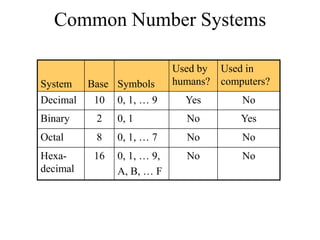
Common Number Systems

System

Base Symbols

Used by
humans?

Used in
computers?

Decimal

10

0, 1, … 9

Yes

No

Binary

2

0, 1

No

Yes

Octal

8

0, 1, … 7

No

No

Hexadecimal

16

0, 1, … 9,
A, B, … F

No

No
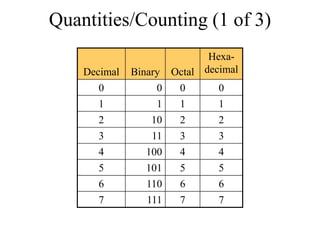
Quantities/Counting (1 of 3)
Decimal

Binary

HexaOctal decimal

0
1
2

0
1
10

0
1
2

0
1
2

3
4
5
6
7

11
100
101
110
111

3
4
5
6
7

3
4
5
6
7
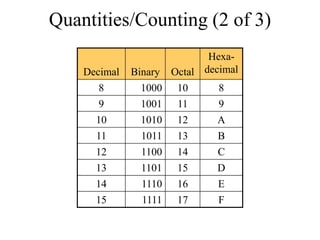
Quantities/Counting (2 of 3)
Decimal

Binary

HexaOctal decimal

8
9
10

1000
1001
1010

10
11
12

8
9
A

11
12
13
14
15

1011
1100
1101
1110
1111

13
14
15
16
17

B
C
D
E
F
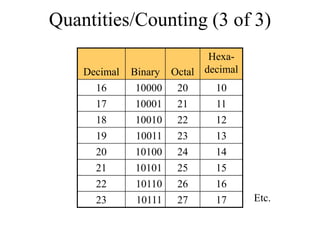
Quantities/Counting (3 of 3)
Decimal

Binary

HexaOctal decimal

16
17
18

10000
10001
10010

20
21
22

10
11
12

19
20
21
22
23

10011
10100
10101
10110
10111

23
24
25
26
27

13
14
15
16
17

Etc.
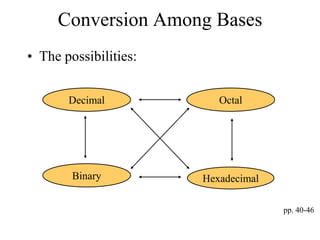
Conversion Among Bases
• The possibilities:
Decimal

Octal

Binary

Hexadecimal
pp. 40-46
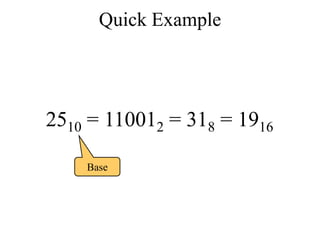
Quick Example

2510 = 110012 = 318 = 1916
Base
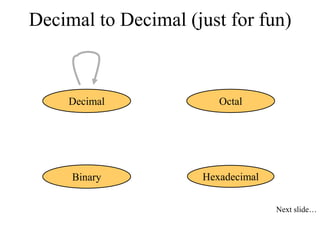
Decimal to Decimal (just for fun)

Decimal

Octal

Binary

Hexadecimal
Next slide…
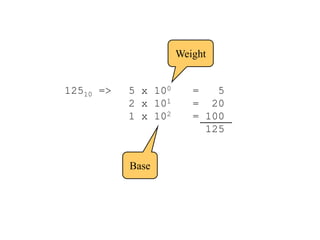
Weight
12510 =>

5 x 100
2 x 101
1 x 10²

Base

=
5
= 20
= 100
125
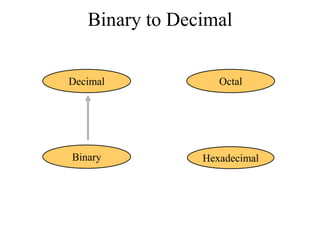
Binary to Decimal
Decimal

Octal

Binary

Hexadecimal
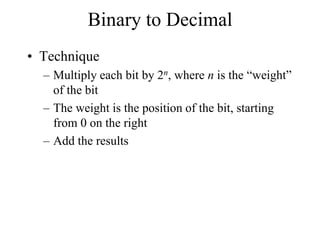
Binary to Decimal
• Technique
– Multiply each bit by 2n, where n is the “weight”
of the bit
– The weight is the position of the bit, starting
from 0 on the right
– Add the results
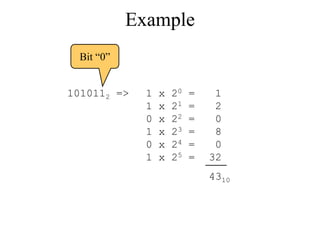
Example
Bit “0”
1010112 =>

1
1
0
1
0
1

x
x
x
x
x
x

20
21
22
23
24
25

=
=
=
=
=
=

1
2
0
8
0
32
4310
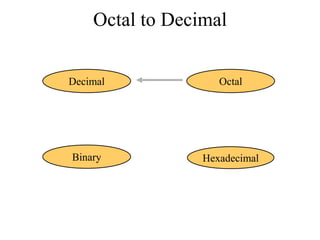
Octal to Decimal
Decimal

Octal

Binary

Hexadecimal
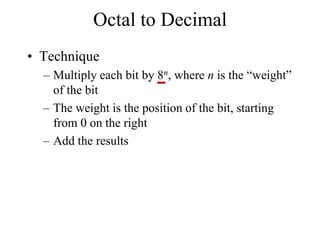
Octal to Decimal
• Technique
– Multiply each bit by 8n, where n is the “weight”
of the bit
– The weight is the position of the bit, starting
from 0 on the right
– Add the results
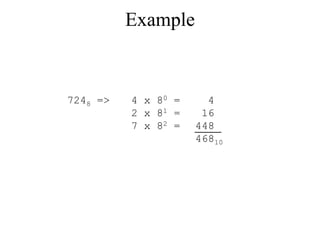
Example

7248 =>

4 x 80 =
2 x 81 =
7 x 82 =

4
16
448
46810
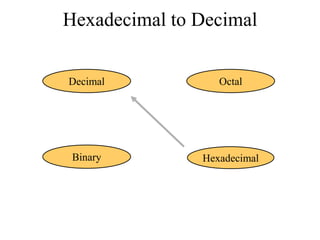
Hexadecimal to Decimal
Decimal

Octal

Binary

Hexadecimal
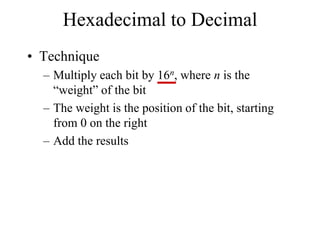
Hexadecimal to Decimal
• Technique
– Multiply each bit by 16n, where n is the
“weight” of the bit
– The weight is the position of the bit, starting
from 0 on the right
– Add the results
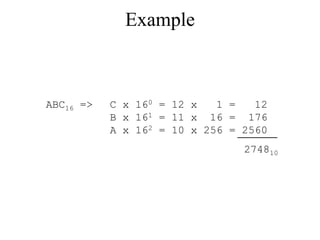
Example

ABC16 =>

C x 160 = 12 x
1 =
12
B x 161 = 11 x 16 = 176
A x 162 = 10 x 256 = 2560
274810
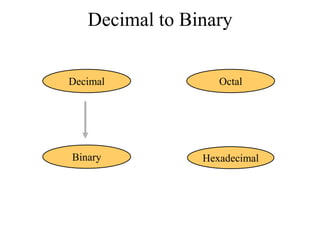
Decimal to Binary
Decimal

Octal

Binary

Hexadecimal
Decimal to Binary
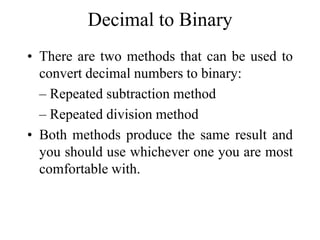
• There are two methods that can be used to
convert decimal numbers to binary:
– Repeated subtraction method
– Repeated division method
• Both methods produce the same result and
you should use whichever one you are most
comfortable with.
The Repeated Subtraction method
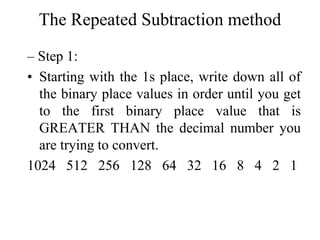
– Step 1:
• Starting with the 1s place, write down all of
the binary place values in order until you get
to the first binary place value that is
GREATER THAN the decimal number you
are trying to convert.
1024 512 256 128 64 32 16 8 4 2 1
The Repeated Subtraction method
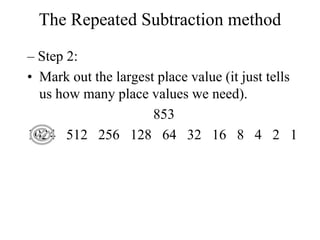
– Step 2:
• Mark out the largest place value (it just tells
us how many place values we need).
853
1024 512 256 128 64 32 16 8 4 2 1
The Repeated Subtraction method
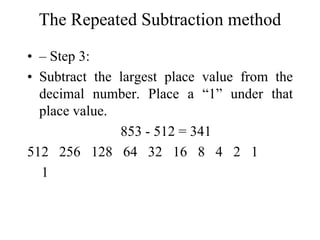
• – Step 3:
• Subtract the largest place value from the
decimal number. Place a “1” under that
place value.
853 - 512 = 341
512 256 128 64 32 16 8 4 2 1
1
The Repeated Subtraction method
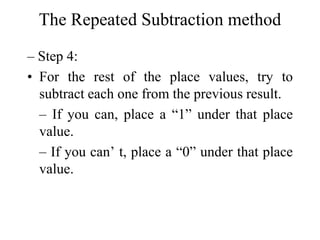
– Step 4:
• For the rest of the place values, try to
subtract each one from the previous result.
– If you can, place a “1” under that place
value.
– If you can’ t, place a “0” under that place
value.
The Repeated Subtraction method
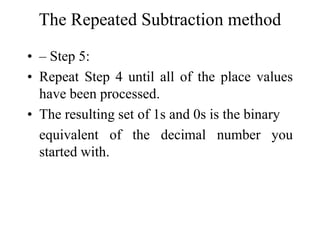
• – Step 5:
• Repeat Step 4 until all of the place values
have been processed.
• The resulting set of 1s and 0s is the binary
equivalent of the decimal number you
started with.
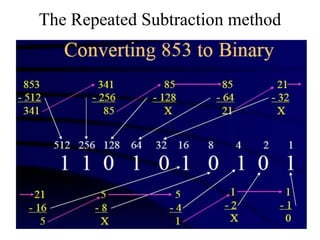
The Repeated Subtraction method
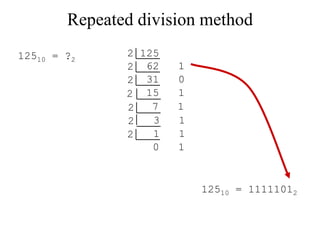
Repeated division method
12510 = ?2

2 125
2 62
2 31
2 15
7
2
3
2
1
2
0

1
0
1
1
1
1
1

12510 = 11111012
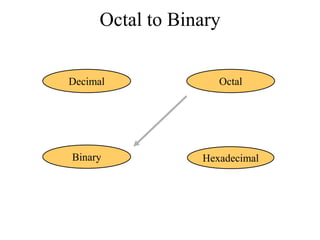
Octal to Binary
Decimal

Octal

Binary

Hexadecimal
Octal to Binary
• Technique
– Convert each octal digit to a 3-bit equivalent
binary representation
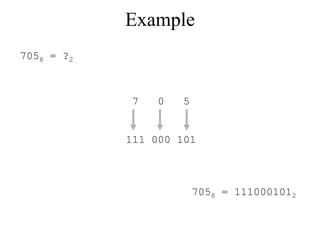
Example
7058 = ?2

7

0

5

111 000 101

7058 = 1110001012
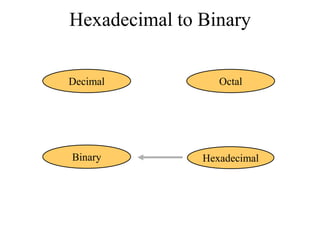
Hexadecimal to Binary
Decimal

Octal

Binary

Hexadecimal
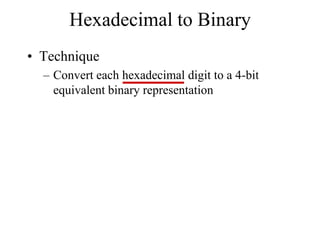
Hexadecimal to Binary
• Technique
– Convert each hexadecimal digit to a 4-bit
equivalent binary representation
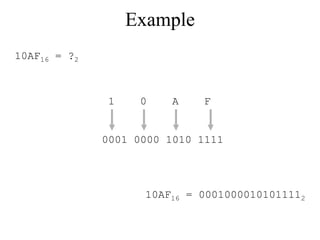
Example
10AF16 = ?2

1

0

A

F

0001 0000 1010 1111

10AF16 = 00010000101011112
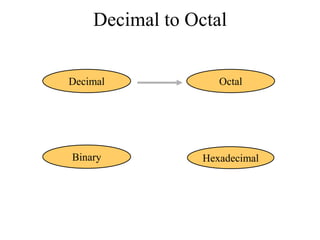
Decimal to Octal
Decimal

Octal

Binary

Hexadecimal
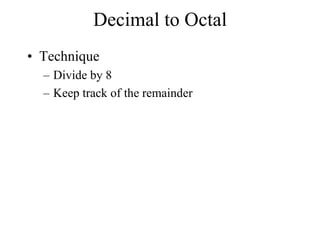
Decimal to Octal
• Technique
– Divide by 8
– Keep track of the remainder
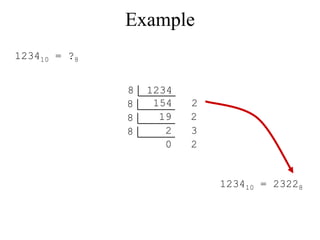
Example
123410 = ?8

8
8
8
8

1234
154
19
2
0

2
2
3
2

123410 = 23228
Decimal to Hexadecimal
Decimal

Octal

Binary

Hexadecimal
Decimal to Hexadecimal
• Technique
– Divide by 16
– Keep track of the remainder
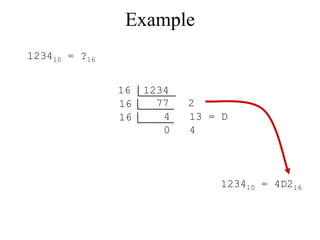
Example
123410 = ?16

16
16
16

1234
77
4
0

2
13 = D
4

123410 = 4D216
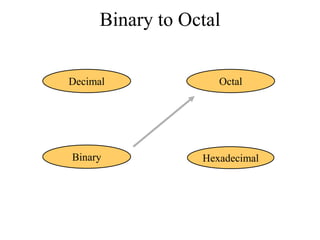
Binary to Octal
Decimal

Octal

Binary

Hexadecimal
Binary to Octal
• Technique
– Group bits in threes, starting on right
– Convert to octal digits
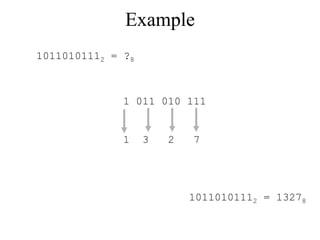
Example
10110101112 = ?8

1 011 010 111

1

3

2

7

10110101112 = 13278
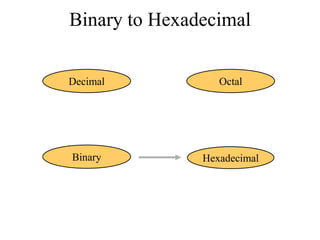
Binary to Hexadecimal
Decimal

Octal

Binary

Hexadecimal
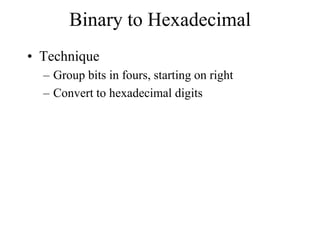
Binary to Hexadecimal
• Technique
– Group bits in fours, starting on right
– Convert to hexadecimal digits
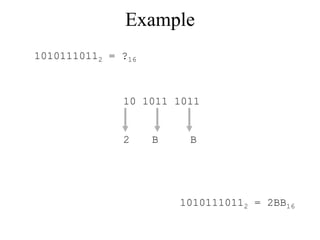
Example
10101110112 = ?16

10 1011 1011

2

B

B

10101110112 = 2BB16
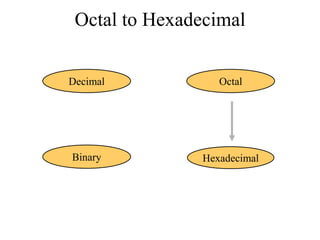
Octal to Hexadecimal
Decimal

Octal

Binary

Hexadecimal
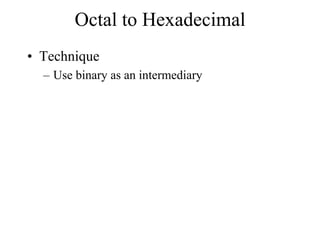
Octal to Hexadecimal
• Technique
– Use binary as an intermediary
Example
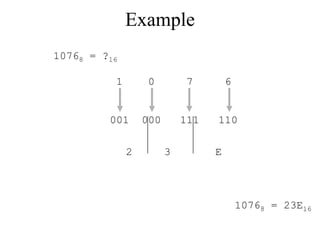
10768 = ?16
1

0

7

6

001

000

111

110

2

3

E

10768 = 23E16
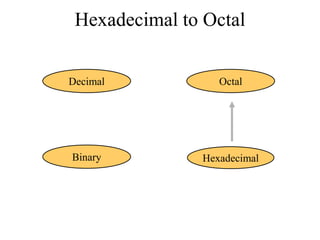
Hexadecimal to Octal
Decimal

Octal

Binary

Hexadecimal
Hexadecimal to Octal
• Technique
– Use binary as an intermediary
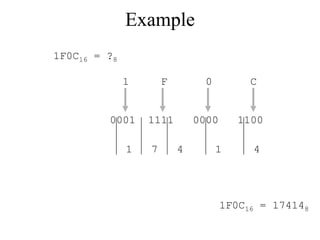
Example
1F0C16 = ?8
1

F

0

C

0001

1111

0000

1100

1

7

4

1

4

1F0C16 = 174148
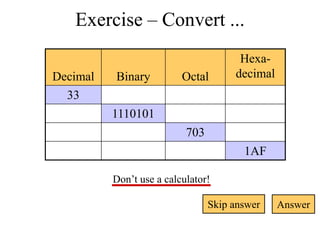
Exercise – Convert ...
Decimal
33

Binary

Octal

Hexadecimal

1110101

703
1AF
Don’t use a calculator!

Skip answer

Answer
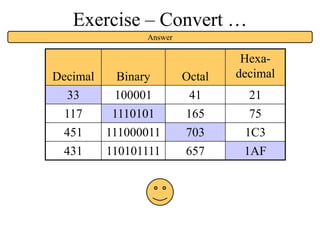
Exercise – Convert …
Answer

Hexadecimal

Decimal
33

Binary
100001

Octal
41

117

1110101

165

75

451

111000011

703

1C3

431

110101111

657

1AF

21

Number systems