DIABETIC FOOT EXAMINATION
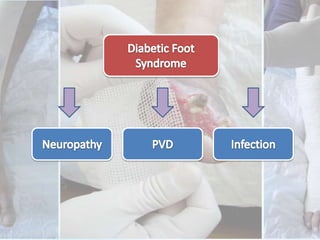
Diabetic Foot SyndromeNeuropathyPVDInfection
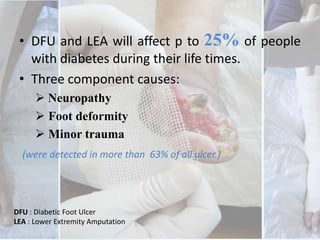
DFU and LEA will affect p to 25% of people with diabetes during their life times.Three component causes:Neuropathy
 Foot deformity
 Minor trauma (were detected in more than  63% of all ulcer.) DFU : Diabetic Foot UlcerLEA : Lower Extremity Amputation
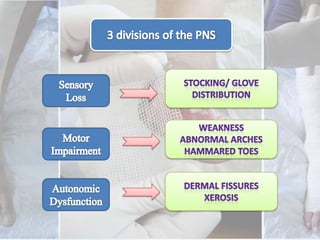
3 divisions of the PNSstocking/ glove distributionSensory LossWeaknessAbnormal ArchesHammared ToesMotor Impairmentdermal fissuresxerosisAutonomic Dysfunction
Important for clinician to ask the following questions:Does the patient have loss of protective sensation?Is foot deformity present?Does the patient have a history of ulceration, amputation or Charcot foot?
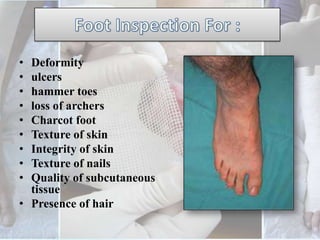
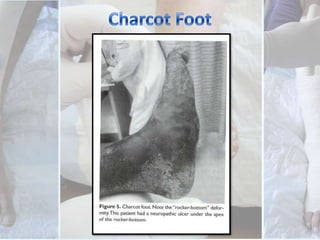
Foot Inspection For :Deformityulcershammer toes loss of archersCharcot foot Texture of skinIntegrity of skinTexture of nailsQuality of subcutaneous tissuePresence of hair
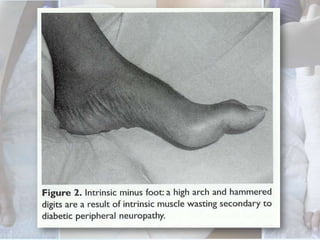
1- DeformityOne must examine the foot for bony prominences and deformities. It is important to determine if a deformity is rigid or flexible as rigid deformities are often more difficult to accommodate conservatively and may need surgery.
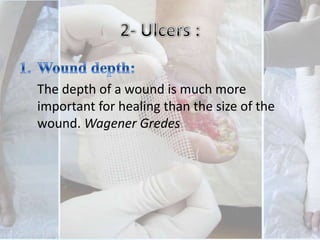
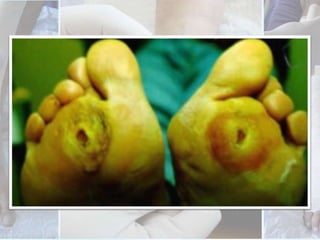
2- Ulcers :Wound depth:	The depth of a wound is much more important for healing than the size of the wound. Wagener Gredes
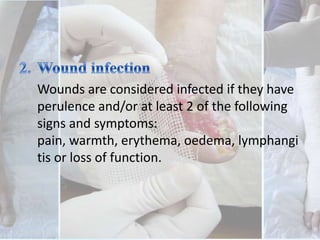
Wound infection 	Wounds are considered infected if they have perulence and/or at least 2 of the following signs and symptoms: pain, warmth, erythema, oedema, lymphangitis or loss of function.
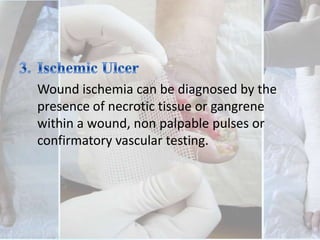
Ischemic Ulcer	Wound ischemia can be diagnosed by the presence of necrotic tissue or gangrene within a wound, non palpable pulses or confirmatory vascular testing.
Charcot Foot
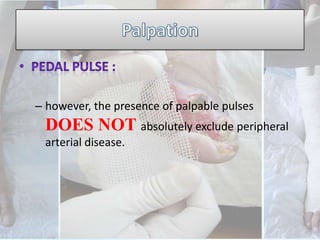
PalpationPedal Pulse :however, the presence of palpable pulses DOES NOT absolutely exclude peripheral arterial disease.
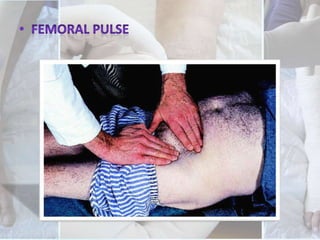
Femoral Pulse
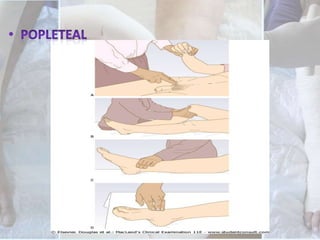
Popleteal
Buergers Elevation Test• Elevate limb until dorsal veins emptied• Plantar surface of foot turns pale (1 min.)• (If severe - ? Widespread Insufficiency)
Special Tests
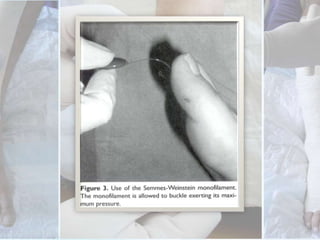
Monofilament Test:The monofilament should be placed against intact skin (without callus) and allowed to buckle.The patient should have his or her eyes closed during testing and be given a forced choice  i.e. asked  “ Do you feel the pressure at time A or time B?”
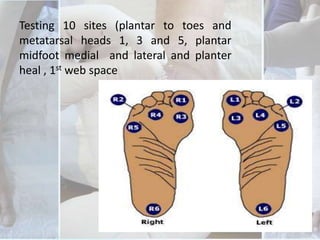
Testing 10 sites (plantar to toes and metatarsal heads 1, 3 and 5, plantar midfoot medial  and lateral and planter heal , 1st web space
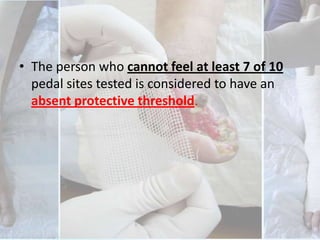
The person who cannot feel at least 7 of 10 pedal sites tested is considered to have an absent protective threshold.
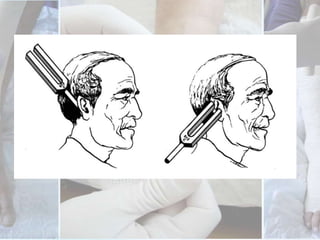
Vibration Test :A 128 Hz tuning fork can be applied to the tip of the hallux and bony prominences.
It is important to give a non vibrating stimulus such as touch to verify that the person is giving a positive response to the vibration sense and not just to the touch sensation.
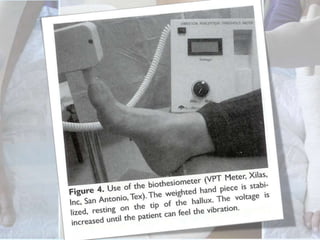
The vibratory perception threshold (VPT) meter or the biothesiometer can be used to quantify sensory loss and the progression of loss of nerve function by measurements at regular intervals.
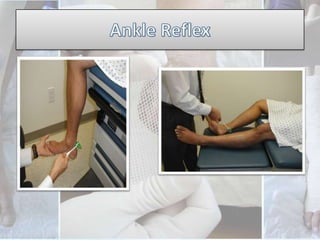
Ankle Reflex
The Ankle Brachial Indexsystolic ankle pressure systolic arm pressureABI =The ABI is 95% sensitive and 99% specific for PAD.
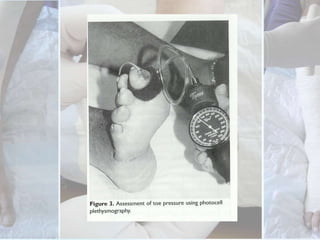
In diabetic patient, the ABI is falsely elevated. Can assess the peripheral circulation by measuring the toe systolic pressure (normal > 40 mmHg) using either a strain gauge sensor or photoplethysmography.
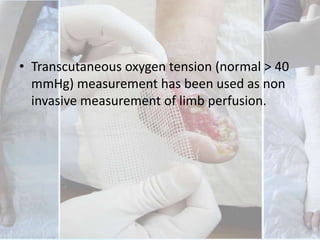
Transcutaneous oxygen tension (normal > 40 mmHg) measurement has been used as non invasive measurement of limb perfusion.

Diabetic Foot Examination

  • 1.
  • 2.
  • 3.
    DFU and LEAwill affect p to 25% of people with diabetes during their life times.Three component causes:Neuropathy
  • 4.
  • 5.
    Minor trauma(were detected in more than 63% of all ulcer.) DFU : Diabetic Foot UlcerLEA : Lower Extremity Amputation
  • 6.
    3 divisions ofthe PNSstocking/ glove distributionSensory LossWeaknessAbnormal ArchesHammared ToesMotor Impairmentdermal fissuresxerosisAutonomic Dysfunction
  • 7.
    Important for clinicianto ask the following questions:Does the patient have loss of protective sensation?Is foot deformity present?Does the patient have a history of ulceration, amputation or Charcot foot?
  • 8.
    Foot Inspection For:Deformityulcershammer toes loss of archersCharcot foot Texture of skinIntegrity of skinTexture of nailsQuality of subcutaneous tissuePresence of hair
  • 9.
    1- DeformityOne mustexamine the foot for bony prominences and deformities. It is important to determine if a deformity is rigid or flexible as rigid deformities are often more difficult to accommodate conservatively and may need surgery.
  • 11.
    2- Ulcers :Wounddepth: The depth of a wound is much more important for healing than the size of the wound. Wagener Gredes
  • 12.
    Wound infection Woundsare considered infected if they have perulence and/or at least 2 of the following signs and symptoms: pain, warmth, erythema, oedema, lymphangitis or loss of function.
  • 13.
    Ischemic Ulcer Wound ischemiacan be diagnosed by the presence of necrotic tissue or gangrene within a wound, non palpable pulses or confirmatory vascular testing.
  • 15.
  • 16.
    PalpationPedal Pulse :however,the presence of palpable pulses DOES NOT absolutely exclude peripheral arterial disease.
  • 17.
  • 18.
  • 19.
    Buergers Elevation Test•Elevate limb until dorsal veins emptied• Plantar surface of foot turns pale (1 min.)• (If severe - ? Widespread Insufficiency)
  • 21.
  • 22.
    Monofilament Test:The monofilamentshould be placed against intact skin (without callus) and allowed to buckle.The patient should have his or her eyes closed during testing and be given a forced choice i.e. asked “ Do you feel the pressure at time A or time B?”
  • 24.
    Testing 10 sites(plantar to toes and metatarsal heads 1, 3 and 5, plantar midfoot medial and lateral and planter heal , 1st web space
  • 25.
    The person whocannot feel at least 7 of 10 pedal sites tested is considered to have an absent protective threshold.
  • 26.
    Vibration Test :A128 Hz tuning fork can be applied to the tip of the hallux and bony prominences.
  • 27.
    It is importantto give a non vibrating stimulus such as touch to verify that the person is giving a positive response to the vibration sense and not just to the touch sensation.
  • 28.
    The vibratory perceptionthreshold (VPT) meter or the biothesiometer can be used to quantify sensory loss and the progression of loss of nerve function by measurements at regular intervals.
  • 29.
  • 30.
    The Ankle BrachialIndexsystolic ankle pressure systolic arm pressureABI =The ABI is 95% sensitive and 99% specific for PAD.
  • 31.
    In diabetic patient,the ABI is falsely elevated. Can assess the peripheral circulation by measuring the toe systolic pressure (normal > 40 mmHg) using either a strain gauge sensor or photoplethysmography.
  • 33.
    Transcutaneous oxygen tension(normal > 40 mmHg) measurement has been used as non invasive measurement of limb perfusion.