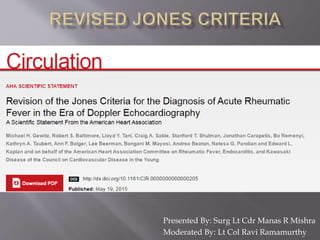






Presented By: Surg Lt Cdr Manas R Mishra
Moderated By: Lt Col Ravi Ramamurthy
 Incidence of ARF: Declined over past 4 to 6 decades.
 Still, one of the most important causes of
cardiovascular morbidity and mortality worldover.
 Affected: socially and economically disadvantaged
populations all over the world, runs in millions
 Multiple changes in criteria.
 An investigative modality included in clinical
criteria. (ECHO)
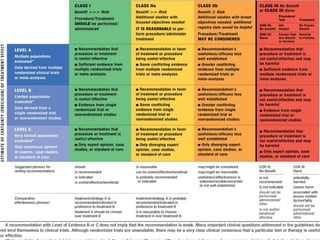
 Use of “Classification of Recommendations
and Levels of Evidence categories.” in
accordance to ACA/AHA
 Heterogeneous;
 certain geographic regions, specific ethnic and
socioeconomic groups experience very high rates of
ARF
 whereas the disease has virtually disappeared in
other regions
 Clinical utility of a diagnostic test is influenced by
 pretest probability
 background disease prevalence
 A single set of diagnostic criteria is not sufficient for all
population groups and in all geographic regions
 Individuals from populations of known low rates of ARF
and RHD: at low risk (Class IIa, Level of Evidence C).
 Low risk:
 ARF incidence <2 per 100,000 school-aged children (5-14
years old) per year, or
 an all-age prevalence of RHD of ≤1 per 1,000
population per year (Class IIa, Level of Evidence C).
 Children not clearly from a low-risk population are at
moderate to high risk depending on their reference
population (Class I, Level of Evidence C).
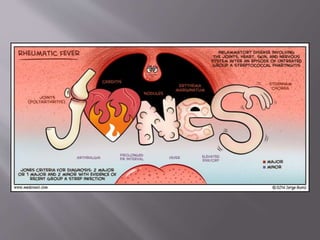
 Carditis (50%–70%)
 Arthritis (35%–66%)
 Chorea (10%–30%), which has been demonstrated to
have a female predominance
 Subcutaneous nodules (0%–10%)
 Erythema marginatum (<6%), which remain much less
common but highly specific manifestations of ARF
 Pancarditis : involves the
 Endocardium,
 Myocardium, and
 Pericardium,
 Valvulitis : most consistent feature of ARF
 Subclinical carditis
 Classic auscultatory findings of valvular dysfunction:
not present/ not recognized by the diagnosing
clinician but
 Echocardiography/Doppler studies reveal mitral or
aortic valvulitis
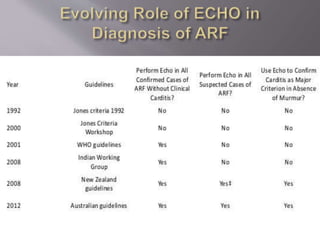
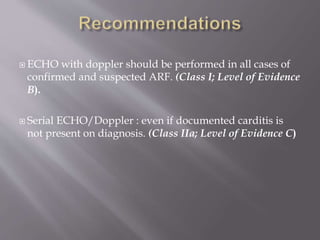
 ECHO with doppler should be performed in all cases of
confirmed and suspected ARF. (Class I; Level of Evidence
B).
 Serial ECHO/Doppler : even if documented carditis is
not present on diagnosis. (Class IIa; Level of Evidence C)
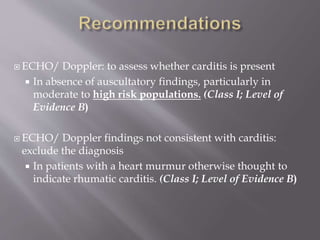
 ECHO/ Doppler: to assess whether carditis is present
 In absence of auscultatory findings, particularly in
moderate to high risk populations. (Class I; Level of
Evidence B)
 ECHO/ Doppler findings not consistent with carditis:
exclude the diagnosis
 In patients with a heart murmur otherwise thought to
indicate rhumatic carditis. (Class I; Level of Evidence B)
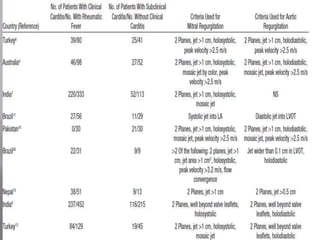
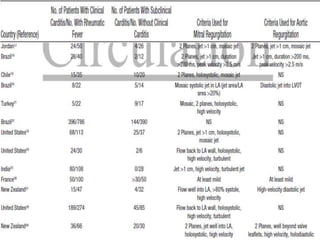
 Doppler Findings in Rheumatic Valvulitis
 Pathological mitral regurgitation (all 4 criteria
met)
 Seen in at least 2 views
 Jet length ≥2 cm in at least 1 view
 Peak velocity >3 m/s
 Pansystolic jet in at least 1 envelope
 Pathological aortic regurgitation (all 4 criteria met)
 Seen in at least 2 views
 Jet length ≥1 cm in at least 1 view
 Peak velocity >3 m/s
 Pan diastolic jet in at least 1 envelope
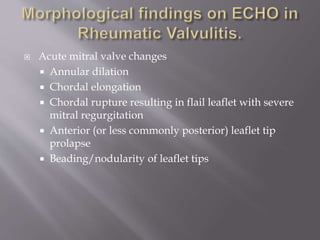
 Acute mitral valve changes
 Annular dilation
 Chordal elongation
 Chordal rupture resulting in flail leaflet with severe
mitral regurgitation
 Anterior (or less commonly posterior) leaflet tip
prolapse
 Beading/nodularity of leaflet tips
 Chronic mitral valve changes: not seen in acute carditis
 Leaflet thickening
 Chordal thickening and fusion
 Restricted leaflet motion
 Calcification
 Aortic valve changes in either acute or chronic carditis
 Irregular or focal leaflet thickening
 Coaptation defect
 Restricted leaflet motion
 Leaflet prolapse
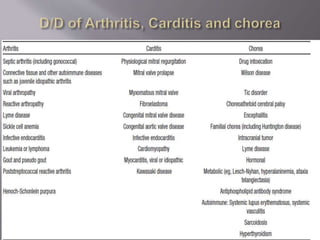
 Typical: migratory polyarthritis, involving larger joints,
(knees, ankles, elbows, wrists)
 Aseptic monoarthritis: 16-18% of confirmed cases of
ARF
 Monoarthritis is a part of the ARF spectrum should be limited
to patients from moderate- to high-risk populations
 Polyarthralgia as a major manifestation is applicable
only for moderate- or high-incidence populations
 Careful consideration and exclusion of causes of
arthralgia such as autoimmune, viral, or reactive
arthropathies.
 No change
 Chorea in ARF is characterized by purposeless,
involuntary, non-stereotypical movements of the
trunk or extremities associated with muscle weakness
and emotional liability.
 Evidence of a recent group A streptococcal infection
may be difficult or impossible to document
 because of the long latent period between the inciting
streptococcal infection and the onset of chorea
 No change
 Unique, evanescent, pink rash seen with pale centers
and rounded or serpiginous margins
 Rash usually is present on the trunk and proximal
extremities and is not facial
 Heat can induce its appearance, and it blanches with
pressure
 No change
 Firm, painless protuberances found on extensor
surfaces at the knees, elbows, wrists, occiput and along
the spinous processes of the thoracic and lumbar
vertebrae
 Nodules are more often observed in patients who also
have carditis, and erythema marginatum
 Subcutaneous nodules almost never occur as the sole
major manifestation of ARF
Fever:
 In a high-risk population, the definition of fever as a
temperature >38°C has resulted in improved sensitivity,
 75% of individuals with ARF meet this criterion
compared with only 25% when an earlier cutoff value of
>39°C
 In low-risk populations, fever associated with ARF
usually exceeds 38.5°C orally
 No differences (between that of low- and higher-risk
populations and geographies)
 Raised C-reactive protein,
 Raised ESR
 Prolonged PR interval on ECG,
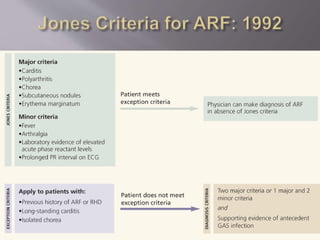
 Past history of rheumatic fever or RHD
For most populations,
 ESR >60 mm in the first hour
 C-reactive protein >3.0 considered typical for ARF
 Laboratory evidence of antecedent group A streptococcal
infection is needed
 Increased or rising anti-streptolysin O titer or other
streptococcal antibodies (anti-DNASE B)
 Rise in titer: better evidence than a single titer result.
 A positive throat culture for group A β-hemolytic streptococci
 A positive rapid group A streptococcal carbohydrate antigen
test in a child whose clinical presentation suggests a high
pretest probability of streptococcal pharyngitis
 A retrospective study in North Queensland, Australia,
investigated the impact of the addition of subclinical
carditis, monoarthritis, and low-grade fever (>37.5°C)
to the 1992 revised Jones criteria.
 36 of the 98 cases with a clinical diagnosis of ARF,
 only 71.4% met the revised Jones criteria.
 Modification of the criteria, increased the proportion of the
cases that satisfied diagnostic criteria to 91.8%.
 Of the 28 people who did not meet the traditional
Jones criteria, 12 (42%) developed evidence of chronic
RHD.
 This study suggest :
 Addition of monoarthritis
 subclinical carditis as major manifestations
 low-grade fever as a minor manifestation to the
Jones criteria could increase sensitivity when applied
specifically to high-risk populations
 Impact of the application of the New Zealand
guidelines resulted in a 16% increase in the diagnosis
of ARF compared with the 1992 revision of the Jones
criteria
 TO START:
In cases of Genuine uncertainty:
 secondary prophylaxis for 12 months
 followed by reevaluation to include a careful history and
physical examination in addition to a repeat
echocardiogram
 TO STOP:
 Patient with recurrent symptoms (particularly
involving the joints)
 Adherent to prophylaxis recommendations
 But lacks serological evidence of group A
streptococcal infection
 Lacks echocardiographic evidence of valvulitis,
 Reasonable to conclude that the recurrent symptoms
are not likely related to ARF
 Discontinuation of antibiotic prophylaxis may be
appropriate
Revised jones criteria

Revised jones criteria

  • 1.
    Presented By: SurgLt Cdr Manas R Mishra Moderated By: Lt Col Ravi Ramamurthy
  • 5.
     Incidence ofARF: Declined over past 4 to 6 decades.  Still, one of the most important causes of cardiovascular morbidity and mortality worldover.  Affected: socially and economically disadvantaged populations all over the world, runs in millions
  • 6.
     Multiple changesin criteria.  An investigative modality included in clinical criteria. (ECHO)  Use of “Classification of Recommendations and Levels of Evidence categories.” in accordance to ACA/AHA
  • 8.
     Heterogeneous;  certaingeographic regions, specific ethnic and socioeconomic groups experience very high rates of ARF  whereas the disease has virtually disappeared in other regions  Clinical utility of a diagnostic test is influenced by  pretest probability  background disease prevalence  A single set of diagnostic criteria is not sufficient for all population groups and in all geographic regions
  • 9.
     Individuals frompopulations of known low rates of ARF and RHD: at low risk (Class IIa, Level of Evidence C).  Low risk:  ARF incidence <2 per 100,000 school-aged children (5-14 years old) per year, or  an all-age prevalence of RHD of ≤1 per 1,000 population per year (Class IIa, Level of Evidence C).  Children not clearly from a low-risk population are at moderate to high risk depending on their reference population (Class I, Level of Evidence C).
  • 10.
     Carditis (50%–70%) Arthritis (35%–66%)  Chorea (10%–30%), which has been demonstrated to have a female predominance  Subcutaneous nodules (0%–10%)  Erythema marginatum (<6%), which remain much less common but highly specific manifestations of ARF
  • 12.
     Pancarditis :involves the  Endocardium,  Myocardium, and  Pericardium,  Valvulitis : most consistent feature of ARF  Subclinical carditis  Classic auscultatory findings of valvular dysfunction: not present/ not recognized by the diagnosing clinician but  Echocardiography/Doppler studies reveal mitral or aortic valvulitis
  • 13.
     ECHO withdoppler should be performed in all cases of confirmed and suspected ARF. (Class I; Level of Evidence B).  Serial ECHO/Doppler : even if documented carditis is not present on diagnosis. (Class IIa; Level of Evidence C)
  • 14.
     ECHO/ Doppler:to assess whether carditis is present  In absence of auscultatory findings, particularly in moderate to high risk populations. (Class I; Level of Evidence B)  ECHO/ Doppler findings not consistent with carditis: exclude the diagnosis  In patients with a heart murmur otherwise thought to indicate rhumatic carditis. (Class I; Level of Evidence B)
  • 15.
     Doppler Findingsin Rheumatic Valvulitis  Pathological mitral regurgitation (all 4 criteria met)  Seen in at least 2 views  Jet length ≥2 cm in at least 1 view  Peak velocity >3 m/s  Pansystolic jet in at least 1 envelope  Pathological aortic regurgitation (all 4 criteria met)  Seen in at least 2 views  Jet length ≥1 cm in at least 1 view  Peak velocity >3 m/s  Pan diastolic jet in at least 1 envelope
  • 16.
     Acute mitralvalve changes  Annular dilation  Chordal elongation  Chordal rupture resulting in flail leaflet with severe mitral regurgitation  Anterior (or less commonly posterior) leaflet tip prolapse  Beading/nodularity of leaflet tips
  • 17.
     Chronic mitralvalve changes: not seen in acute carditis  Leaflet thickening  Chordal thickening and fusion  Restricted leaflet motion  Calcification  Aortic valve changes in either acute or chronic carditis  Irregular or focal leaflet thickening  Coaptation defect  Restricted leaflet motion  Leaflet prolapse
  • 20.
     Typical: migratorypolyarthritis, involving larger joints, (knees, ankles, elbows, wrists)  Aseptic monoarthritis: 16-18% of confirmed cases of ARF  Monoarthritis is a part of the ARF spectrum should be limited to patients from moderate- to high-risk populations  Polyarthralgia as a major manifestation is applicable only for moderate- or high-incidence populations  Careful consideration and exclusion of causes of arthralgia such as autoimmune, viral, or reactive arthropathies.
  • 21.
     No change Chorea in ARF is characterized by purposeless, involuntary, non-stereotypical movements of the trunk or extremities associated with muscle weakness and emotional liability.  Evidence of a recent group A streptococcal infection may be difficult or impossible to document  because of the long latent period between the inciting streptococcal infection and the onset of chorea
  • 22.
     No change Unique, evanescent, pink rash seen with pale centers and rounded or serpiginous margins  Rash usually is present on the trunk and proximal extremities and is not facial  Heat can induce its appearance, and it blanches with pressure
  • 23.
     No change Firm, painless protuberances found on extensor surfaces at the knees, elbows, wrists, occiput and along the spinous processes of the thoracic and lumbar vertebrae  Nodules are more often observed in patients who also have carditis, and erythema marginatum  Subcutaneous nodules almost never occur as the sole major manifestation of ARF
  • 24.
    Fever:  In ahigh-risk population, the definition of fever as a temperature >38°C has resulted in improved sensitivity,  75% of individuals with ARF meet this criterion compared with only 25% when an earlier cutoff value of >39°C  In low-risk populations, fever associated with ARF usually exceeds 38.5°C orally
  • 25.
     No differences(between that of low- and higher-risk populations and geographies)  Raised C-reactive protein,  Raised ESR  Prolonged PR interval on ECG,  Past history of rheumatic fever or RHD For most populations,  ESR >60 mm in the first hour  C-reactive protein >3.0 considered typical for ARF
  • 26.
     Laboratory evidenceof antecedent group A streptococcal infection is needed  Increased or rising anti-streptolysin O titer or other streptococcal antibodies (anti-DNASE B)  Rise in titer: better evidence than a single titer result.  A positive throat culture for group A β-hemolytic streptococci  A positive rapid group A streptococcal carbohydrate antigen test in a child whose clinical presentation suggests a high pretest probability of streptococcal pharyngitis
  • 28.
     A retrospectivestudy in North Queensland, Australia, investigated the impact of the addition of subclinical carditis, monoarthritis, and low-grade fever (>37.5°C) to the 1992 revised Jones criteria.  36 of the 98 cases with a clinical diagnosis of ARF,  only 71.4% met the revised Jones criteria.  Modification of the criteria, increased the proportion of the cases that satisfied diagnostic criteria to 91.8%.  Of the 28 people who did not meet the traditional Jones criteria, 12 (42%) developed evidence of chronic RHD.
  • 29.
     This studysuggest :  Addition of monoarthritis  subclinical carditis as major manifestations  low-grade fever as a minor manifestation to the Jones criteria could increase sensitivity when applied specifically to high-risk populations  Impact of the application of the New Zealand guidelines resulted in a 16% increase in the diagnosis of ARF compared with the 1992 revision of the Jones criteria
  • 31.
     TO START: Incases of Genuine uncertainty:  secondary prophylaxis for 12 months  followed by reevaluation to include a careful history and physical examination in addition to a repeat echocardiogram
  • 32.
     TO STOP: Patient with recurrent symptoms (particularly involving the joints)  Adherent to prophylaxis recommendations  But lacks serological evidence of group A streptococcal infection  Lacks echocardiographic evidence of valvulitis,  Reasonable to conclude that the recurrent symptoms are not likely related to ARF  Discontinuation of antibiotic prophylaxis may be appropriate

Editor's Notes

  • #15 ECHO with doppler should be performed in all cases of confirmed and suspected ARF. Serial ECHO/Doppler in any patient with diagnosed or suspected ARF even if documented carditis is not present on diagnosis. ECHO/ Doppler should be performed to assess whether carditis is present in absence of auscultatory findings, particularly in moderate to high risk populations. ECHO/ Doppler findings not consistent with carditis should exclude the diagnosis in patients with a heart murmur otherwise thought to indicate rhumatic carditis.