Solitary Thyroid NodulePrepared by: Dr. Aisha M. Al-ZuhairSupervised by: Dr. NaifAwadKFHU – Khobar – Saudi ArabiaJan 20, 2010 1
Introduction 2
In the general population, thyroid nodules are discovered by palpation in 3% to 7%, and by US in 20% to 76%More common in women than men Prevalence increases linearly with age, exposure to ionizing radiation, and iodine deficiency3Hegedus L.:  Clinical practice: the thyroid nodule.  N Engl J Med 351. (17): 1764-1771.2004
History and PhysicalMost patients present with an asymptomatic mass discovered by a physician on routine neck palpation or by the patient during self-examination.Newly diagnosed thyroid nodules should be evaleuated primarily to role out malignancy.4
When to suspect malignancy5
History of childhood head/neck irradiationFamily history of PTC, MTC, or MEN2 Age <20 or >70 yearsMale sexEnlarging noduleAbnormal cervical adenopathyFixed nodule6Gharib H - EndocrinolMetabClin North Am - 01-SEP-2007; 36(3): 707-35, vi
Exposure to RadiationThe risk is maximum 20 to 30 years after exposure.Most thyroid carcinomas following radiation exposure are papillary (PTC).There is a 40% chance that patients presenting with a thyroid nodule and a history of radiation to have thyroid cancer.7
Common causes of thyroid nodules8
BenignColloid noduleHashimoto’s thyroiditisSimple or hemorrhagic cystFollicular adenomaSubacutethyroiditis9Ross D.M.:  Diagnostic approach to and treatment of thyroid nodules. I.   In: Rose B.D., ed. UpToDateWellesley (MA)2005
Malignant – PrimaryFollicular cell-derived carcinoma:PTC, FTC, anaplastic thyroid carcinomaC-cell–derived carcinoma:MTCThyroid lymphomaMalignant – SecondaryMetastatic carcinoma10Ross D.M.:  Diagnostic approach to and treatment of thyroid nodules. I.   In: Rose B.D., ed. UpToDateWellesley (MA)2005
Management:Diagnostic workup 11
Imaging 12
Ultrasonography Most sensitive test to detect lesions in the thyroidIt is recommended that all patients who have a nodular thyroid, with a palpable solitary nodule or a multinodulargoiter,be evaluated by USNot indicated as screening test in general population13
Ultrasonography Indicated in:Palpable noduleHistory of radiation to the neckAge<20 & >70Family history of MTC, MEN2, or PTCPresence of cervical lymphadenopathy14
US prediction of malignancySolitary versus multiple nodulesSizeExtracapsular growthComplex or cystic lesionsNodule shapeSuspicious cervical adenopathy15
Solitary vs multiple nodulesThe risk of cancer is not significantly higher for solitary nodules than for glands with several nodules16
SizeCancer is not less frequent in small nodules (diameter <10 mm)17
Extracapsular Growth Hypoechoic nodules with irregular borders, Extension beyond the thyroid capsule,Invasion into perithyroid muscles, andInfiltration of the recurrent laryngeal nerve Are sonographic features suggestive of malignancy18
Complex or Cystic noduleComplex thyroid nodules have solid and cystic components.These are often benign.Some PTCs may be cystic. 19
NoduleShape A rounded appearance   A more tall than wide shape of the nodule A marked hypoechogenicity of a solid lesion are newly described US patterns suggestive of malignancy 20
Cervical L.N.Enlarged rounded cervical L.N.No hilusCystic changes MicrocalcificationChaotic hypervacularity21
Ultrasonography The sensitivity of each feature is around 85%The predictive value of these US features for cancer is in part diminished by their low sensitivityNo US sign by itself can reliably predict malignancy22
23Gharib H - EndocrinolMetabClin North Am - 01-SEP-2007; 36(3): 707-35, vi
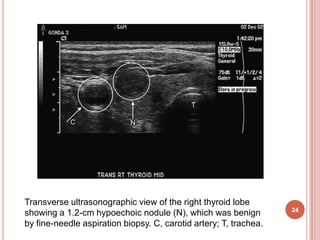
24Transverse ultrasonographic view of the right thyroid lobe showing a 1.2-cm hypoechoic nodule (N), which was benign by fine-needle aspiration biopsy. C, carotid artery; T, trachea.
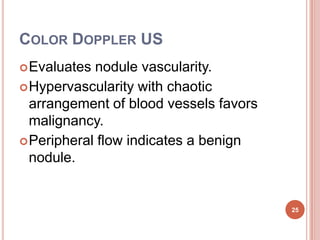
Color Doppler USEvaluates nodule vascularity. Hypervascularity with chaotic arrangement of blood vessels favors malignancy.Peripheral flow indicates a benign nodule.25
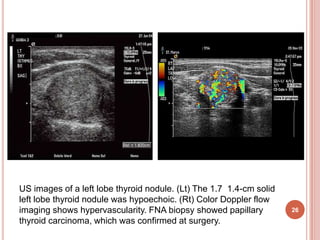
26US images of a left lobe thyroid nodule. (Lt) The 1.7  1.4-cm solid left lobe thyroid nodule was hypoechoic. (Rt) Color Doppler flow imaging shows hypervascularity. FNA biopsy showed papillary thyroid carcinoma, which was confirmed at surgery.
Other imaging techCT and MRI not as routine. Can asses size, retrosternal extension, position and relation to the surrounding structure. RAI scan: To differentiate hot from cold nodulesMalignancy has been shown to occur in 15% to 20% of cold nodules 27
28Images of a large, asymmetric multinodular goiter. (A) Chest radiography shows marked tracheal deviation to the right (arrow). (B) Chest CT confirmed the presence of a large substernal goiter on the left to the level of tracheal bifurcation.
Other imaging techPET scan:3-dimensional reconstruction imagesUse in detecting primary and metastatic thyroid cancerThe clinical role of PET in pre-OP investigation of thyroid nodules and in differentiating between benign and malignant lesions is controversial29Crippa F, Alessi A, Gerali A, et al: FDG-PET in thyroid cancer.  Tumori  2003; 89:540-543Urhan M - PET Clin - July, 2007; 2(3); 295-304.
FNAC 30
US guided FNAIndicated if:Palpation-guided FNA nondiagnosticComplex (solid/cystic) nodulePalpable small nodule (<1.5 cm)Impalpable noduleAbnormal cervical nodesNodule with suspicious US features31
FNAC Specimens70% Benign, 5% Malignant, 10% Suspicious, and 15% Unsatisfactory32Shwartz’s principles of surgery, 8th Ed
FNAC resultsDiagnostic / satisfactoryContains no less than six groups of well-preserved thyroid epithelial cells consisting of at least 10 cells in each groupNondiagnostic / unsatisfactoryInadequate number of cells result from acellular cystic fluid, bloody smears, or poor techniques in preparing slides33
34(A) Benign (colloid) nodule. (B) Hashimoto thyroiditis. (C) Papillary thyroid carcinoma. (D) Unsatisfactory (nondiagnostic) smear. 
Benign (-ve) cytologyMost common findingIndicative of:Colloid noduleMacrofollicular adenomaLymphocysticthyroiditisGranulomatusthyroiditisBenign cyst35
Malignant (+ve) cytology Commonest is PTC:Increased cellularity, Tumor cells arranged in sheets and papillary cell groupsTypical nuclear abnormalities, which include intranuclear holes and groovesOthers include:MTC, anaplastic carcinoma, and high-grade metastatic cancers36
Suspecious cytologyDiagnosis cannot be madeInculdes: Follicular neoplasms, Hürthle cell neoplasms, Atypical PTC, or Lymphoma37
Suspecious cytologyFollicular neoplasms are most common:Hypercellular with microfollicular arrangement and Decreased or absent colloidHürthle cell neoplasm: Almost exclusively Hürthle cellsAbsent or scanty colloid lacking a lymphoid cell population38
39Gharib H - EndocrinolMetabClin North Am - 01-SEP-2007; 36(3): 707-35, vi
Occasionally associated with a minor  hematoma  No serious adverse effect of the FNANo seeding of tumor cells in the needle tract has been reported Because of 5% false –ve, repeat of biopsy is recommended in some situations40Gharib H - EndocrinolMetabClin North Am - 01-SEP-2007; 36(3): 707-35, vi
Indications for repeat biopsyFollow-up of benign noduleEnlarging noduleRecurrent cystNodule >4 cmInitial FNA nondiagnosticNo nodule shrinkage after T4 therapy41 Castro M.R., Gharib H.:  Thyroid fine-needle aspiration biopsy: progress, practice, and pitfalls.  EndocrPract 9. (2): 128-136.2003
Tg of FNA of cervical L.N. Thyroglobulin (Tg) can be measured in lymph node or nodule aspirates.FNA-Tg levels were markedly elevated in metastatic lymph nodes FNA-Tg sensitivity was 84.0%The combination of cytology plus FNA-Tg increased FNA sensitivity from 76% to 92.0%.42Gharib H - EndocrinolMetabClin North Am - 01-SEP-2007; 36(3): 707-35, vi
Immunohistochemical markersSeveral molecular markers and assaysHBME-1 monoclonal antibody stains papillary cancer positively but does not stain benign follicular tumorsGalectin-3acts as a cell-death suppressordistinguish benign from malignant thyroid follicular tumors43
Despite most studies showing markers to have high sensitivity or specificity, no markers have high sensitivity and specificity for correctly diagnosing thyroid cancer44Bartolazzi A., Gasbarri A., PapottiM.Thyroid Cancer Study Group, et al:  Application of an immunodiagnostic method for improving preoperative diagnosis of nodular thyroid lesions.  Lancet 357. (9269): 1644-1650.2001;  Segev D.L., Clark D.P., Zieger M.A., et al:  Beyond the suspicious thyroid fine needle aspirate: a review.  ActaCytol 47. (5): 709-722.2003Castro M.R., Gharib H.:  Continuing controversies in the management of thyroid nodules.  Ann Intern Med 142. (11): 926-931.2005
Laboratory test45
TSHTo detect early or subtle thyroid dysfunction.Inc in hashimotothyroiditis and dec in subacutethyroiditis. If TSH levels abnormal, free T3 & T4 should be measured to confirm the diagnosis.46American Association of Clinical Endocrinologists and Associazione Medici Endocrinologi medical guidelines for clinical practice for the diagnosis and management of thyroid nodules.  EndocrPract 12. (1): 63-102.2006
TPOAbThyroid peroxidase antibodyMeasured in pt with high TSH.High levels of TPOab suggest autoimmune disease – hashimotothyroiditis47
Serum TgCorrelates with iodine intake and the size of the thyroid gland rather than with the nature or function of the noduleSeldom used in nodule diagnosis Extremely elevated levels of Tg may suggest thyroid metastasis.48American Association of Clinical Endocrinologists. EndocrPract 12. (1): 63-102.2006Schwartz's Principles of Surgery; 8ed
Serum CalcitoninGood marker for C-cell disease and correlates well with tumor burdenPrevalence of MTC ranging from 0.4% to 1.4% in patients who have nodular thyroid diseaseRoutine calcitonin measurement in all patients who have a nodular thyroid has been recommended by European studies49Elisei R., Bottici V., Luchetti F., et al:  Impact of routine measurement of serum calcitonin on the diagnosis and outcome of medullary thyroid cancer: experience in 10,864 patients with nodular thyroid disorders.  J ClinEndocrinolMetab 89. (1): 163-168.2004
Management:Treatment50
51Sabiston Textbook of Surgery, 18th ed
FNAC +veAlmost always surgical resectionIf malignancy is secondary, further investigations needed to identify the primary52
Thyroid operationsTotal thyroidectomy = 2 total lobectomy +  isthemusectomySubtotal thyroidectomy =2 subtotal lobectomy + isthemusectomyNear-total thyroidectomy =Total lobectomy + subtotal lobectomy + isthemusectomyLobectomy 53Baily & love’s short practice of surgery; 24thed
 Surgical managementLobectomy + isthemusectomy:In pt with low risk factors & Benign nodulesNear-total or Total thyroidectomy:In pt with high risk factors & Benign nodules Malignant nodules54Gharib H - EndocrinolMetabClin North Am - 01-SEP-2007; 36(3): 707-35, vi
 Surgical managementTotal thyroidectomy + cervical clearance:In MTCPTC and FTC with +ve L.N55Gharib H - EndocrinolMetabClin North Am - 01-SEP-2007; 36(3): 707-35, vi
FNAC -veAdministration of T4 with TSH suppression:shrinking nodule size, arresting further nodule growth, and preventing the appearance of new nodules 56Castro M.R., Caraballo P.J., Morris J.C.:  Effectiveness of thyroid hormone suppressive therapy in benign solitary thyroid nodules: a meta-analysis.  J ClinEndocrinolMetab 87. (9): 4154-4159.2002
FNAC -veT4 therapy not recommended for:As routine For postmenopausal womenpatients with cardiac diseaseLarge nodule or MNG TSH <0.5 mIU/mL57Gharib H - EndocrinolMetabClin North Am - 01-SEP-2007; 36(3): 707-35, vi
FNAC -veMost thyroid nodules do not need specific treatment if malignancy and abnormal thyroid function have been excludedClinical and US follow-up should be performed every 1 to 2 years.58Cooper D.S., Doherty G.M., Haugen B.R.The American Thyroid Association Guidelines Taskforce, et al:  Management guidelines for patients with thyroid nodules and differentiated thyroid cancer.  Thyroid 16. 109-142.2006
FNAC nondiagnostic Cyst: aspirate and follow up 3 months Recurrent cyst: surgical Large cyst >3-4cm: surgicalBenign nodule: surgical59Gharib H - EndocrinolMetabClin North Am - 01-SEP-2007; 36(3): 707-35, vi
Thank you 60
References Shwartz’s principles of surgery, 8th EdSabiston text book of surgery, 18th EdBaily & love’s short practice of surgery; 24thedGharib H - EndocrinolMetabClin North Am - 01-SEP-2007; 36(3): 707-35, viCooper D.S., Doherty G.M., Haugen B.R.The American Thyroid Association Guidelines Taskforce, et al:  Management guidelines for patients with thyroid nodules and differentiated thyroid cancer.  Thyroid 16. 109-142.2006Castro M.R., Caraballo P.J., Morris J.C.:  Effectiveness of thyroid hormone suppressive therapy in benign solitary thyroid nodules: a meta-analysis.  J ClinEndocrinolMetab 87. (9): 4154-4159.2002Elisei R., Bottici V., Luchetti F., et al:  Impact of routine measurement of serum calcitonin on the diagnosis and outcome of medullary thyroid cancer: experience in 10,864 patients with nodular thyroid disorders.  J ClinEndocrinolMetab 89. (1): 163-168.2004American Association of Clinical Endocrinologists. EndocrPract 12. (1): 63-102.200661

Solitary Thyroid Nodule

  • 1.
    Solitary Thyroid NodulePreparedby: Dr. Aisha M. Al-ZuhairSupervised by: Dr. NaifAwadKFHU – Khobar – Saudi ArabiaJan 20, 2010 1
  • 2.
  • 3.
    In the generalpopulation, thyroid nodules are discovered by palpation in 3% to 7%, and by US in 20% to 76%More common in women than men Prevalence increases linearly with age, exposure to ionizing radiation, and iodine deficiency3Hegedus L.:  Clinical practice: the thyroid nodule.  N Engl J Med 351. (17): 1764-1771.2004
  • 4.
    History and PhysicalMostpatients present with an asymptomatic mass discovered by a physician on routine neck palpation or by the patient during self-examination.Newly diagnosed thyroid nodules should be evaleuated primarily to role out malignancy.4
  • 5.
    When to suspectmalignancy5
  • 6.
    History of childhoodhead/neck irradiationFamily history of PTC, MTC, or MEN2 Age <20 or >70 yearsMale sexEnlarging noduleAbnormal cervical adenopathyFixed nodule6Gharib H - EndocrinolMetabClin North Am - 01-SEP-2007; 36(3): 707-35, vi
  • 7.
    Exposure to RadiationTherisk is maximum 20 to 30 years after exposure.Most thyroid carcinomas following radiation exposure are papillary (PTC).There is a 40% chance that patients presenting with a thyroid nodule and a history of radiation to have thyroid cancer.7
  • 8.
  • 9.
    BenignColloid noduleHashimoto’s thyroiditisSimpleor hemorrhagic cystFollicular adenomaSubacutethyroiditis9Ross D.M.:  Diagnostic approach to and treatment of thyroid nodules. I.   In: Rose B.D., ed. UpToDateWellesley (MA)2005
  • 10.
    Malignant – PrimaryFollicularcell-derived carcinoma:PTC, FTC, anaplastic thyroid carcinomaC-cell–derived carcinoma:MTCThyroid lymphomaMalignant – SecondaryMetastatic carcinoma10Ross D.M.:  Diagnostic approach to and treatment of thyroid nodules. I.   In: Rose B.D., ed. UpToDateWellesley (MA)2005
  • 11.
  • 12.
  • 13.
    Ultrasonography Most sensitivetest to detect lesions in the thyroidIt is recommended that all patients who have a nodular thyroid, with a palpable solitary nodule or a multinodulargoiter,be evaluated by USNot indicated as screening test in general population13
  • 14.
    Ultrasonography Indicated in:PalpablenoduleHistory of radiation to the neckAge<20 & >70Family history of MTC, MEN2, or PTCPresence of cervical lymphadenopathy14
  • 15.
    US prediction ofmalignancySolitary versus multiple nodulesSizeExtracapsular growthComplex or cystic lesionsNodule shapeSuspicious cervical adenopathy15
  • 16.
    Solitary vs multiplenodulesThe risk of cancer is not significantly higher for solitary nodules than for glands with several nodules16
  • 17.
    SizeCancer is notless frequent in small nodules (diameter <10 mm)17
  • 18.
    Extracapsular Growth Hypoechoicnodules with irregular borders, Extension beyond the thyroid capsule,Invasion into perithyroid muscles, andInfiltration of the recurrent laryngeal nerve Are sonographic features suggestive of malignancy18
  • 19.
    Complex or CysticnoduleComplex thyroid nodules have solid and cystic components.These are often benign.Some PTCs may be cystic. 19
  • 20.
    NoduleShape A rounded appearance A more tall than wide shape of the nodule A marked hypoechogenicity of a solid lesion are newly described US patterns suggestive of malignancy 20
  • 21.
    Cervical L.N.Enlarged roundedcervical L.N.No hilusCystic changes MicrocalcificationChaotic hypervacularity21
  • 22.
    Ultrasonography The sensitivityof each feature is around 85%The predictive value of these US features for cancer is in part diminished by their low sensitivityNo US sign by itself can reliably predict malignancy22
  • 23.
    23Gharib H - EndocrinolMetabClinNorth Am - 01-SEP-2007; 36(3): 707-35, vi
  • 24.
    24Transverse ultrasonographic viewof the right thyroid lobe showing a 1.2-cm hypoechoic nodule (N), which was benign by fine-needle aspiration biopsy. C, carotid artery; T, trachea.
  • 25.
    Color Doppler USEvaluatesnodule vascularity. Hypervascularity with chaotic arrangement of blood vessels favors malignancy.Peripheral flow indicates a benign nodule.25
  • 26.
    26US images ofa left lobe thyroid nodule. (Lt) The 1.7 1.4-cm solid left lobe thyroid nodule was hypoechoic. (Rt) Color Doppler flow imaging shows hypervascularity. FNA biopsy showed papillary thyroid carcinoma, which was confirmed at surgery.
  • 27.
    Other imaging techCTand MRI not as routine. Can asses size, retrosternal extension, position and relation to the surrounding structure. RAI scan: To differentiate hot from cold nodulesMalignancy has been shown to occur in 15% to 20% of cold nodules 27
  • 28.
    28Images of alarge, asymmetric multinodular goiter. (A) Chest radiography shows marked tracheal deviation to the right (arrow). (B) Chest CT confirmed the presence of a large substernal goiter on the left to the level of tracheal bifurcation.
  • 29.
    Other imaging techPETscan:3-dimensional reconstruction imagesUse in detecting primary and metastatic thyroid cancerThe clinical role of PET in pre-OP investigation of thyroid nodules and in differentiating between benign and malignant lesions is controversial29Crippa F, Alessi A, Gerali A, et al: FDG-PET in thyroid cancer.  Tumori  2003; 89:540-543Urhan M - PET Clin - July, 2007; 2(3); 295-304.
  • 30.
  • 31.
    US guided FNAIndicatedif:Palpation-guided FNA nondiagnosticComplex (solid/cystic) nodulePalpable small nodule (<1.5 cm)Impalpable noduleAbnormal cervical nodesNodule with suspicious US features31
  • 32.
    FNAC Specimens70% Benign,5% Malignant, 10% Suspicious, and 15% Unsatisfactory32Shwartz’s principles of surgery, 8th Ed
  • 33.
    FNAC resultsDiagnostic /satisfactoryContains no less than six groups of well-preserved thyroid epithelial cells consisting of at least 10 cells in each groupNondiagnostic / unsatisfactoryInadequate number of cells result from acellular cystic fluid, bloody smears, or poor techniques in preparing slides33
  • 34.
    34(A) Benign (colloid)nodule. (B) Hashimoto thyroiditis. (C) Papillary thyroid carcinoma. (D) Unsatisfactory (nondiagnostic) smear. 
  • 35.
    Benign (-ve) cytologyMostcommon findingIndicative of:Colloid noduleMacrofollicular adenomaLymphocysticthyroiditisGranulomatusthyroiditisBenign cyst35
  • 36.
    Malignant (+ve) cytologyCommonest is PTC:Increased cellularity, Tumor cells arranged in sheets and papillary cell groupsTypical nuclear abnormalities, which include intranuclear holes and groovesOthers include:MTC, anaplastic carcinoma, and high-grade metastatic cancers36
  • 37.
    Suspecious cytologyDiagnosis cannotbe madeInculdes: Follicular neoplasms, Hürthle cell neoplasms, Atypical PTC, or Lymphoma37
  • 38.
    Suspecious cytologyFollicular neoplasmsare most common:Hypercellular with microfollicular arrangement and Decreased or absent colloidHürthle cell neoplasm: Almost exclusively Hürthle cellsAbsent or scanty colloid lacking a lymphoid cell population38
  • 39.
    39Gharib H - EndocrinolMetabClinNorth Am - 01-SEP-2007; 36(3): 707-35, vi
  • 40.
    Occasionally associated witha minor hematoma No serious adverse effect of the FNANo seeding of tumor cells in the needle tract has been reported Because of 5% false –ve, repeat of biopsy is recommended in some situations40Gharib H - EndocrinolMetabClin North Am - 01-SEP-2007; 36(3): 707-35, vi
  • 41.
    Indications for repeatbiopsyFollow-up of benign noduleEnlarging noduleRecurrent cystNodule >4 cmInitial FNA nondiagnosticNo nodule shrinkage after T4 therapy41 Castro M.R., Gharib H.:  Thyroid fine-needle aspiration biopsy: progress, practice, and pitfalls.  EndocrPract 9. (2): 128-136.2003
  • 42.
    Tg of FNAof cervical L.N. Thyroglobulin (Tg) can be measured in lymph node or nodule aspirates.FNA-Tg levels were markedly elevated in metastatic lymph nodes FNA-Tg sensitivity was 84.0%The combination of cytology plus FNA-Tg increased FNA sensitivity from 76% to 92.0%.42Gharib H - EndocrinolMetabClin North Am - 01-SEP-2007; 36(3): 707-35, vi
  • 43.
    Immunohistochemical markersSeveral molecularmarkers and assaysHBME-1 monoclonal antibody stains papillary cancer positively but does not stain benign follicular tumorsGalectin-3acts as a cell-death suppressordistinguish benign from malignant thyroid follicular tumors43
  • 44.
    Despite most studiesshowing markers to have high sensitivity or specificity, no markers have high sensitivity and specificity for correctly diagnosing thyroid cancer44Bartolazzi A., Gasbarri A., PapottiM.Thyroid Cancer Study Group, et al:  Application of an immunodiagnostic method for improving preoperative diagnosis of nodular thyroid lesions.  Lancet 357. (9269): 1644-1650.2001;  Segev D.L., Clark D.P., Zieger M.A., et al:  Beyond the suspicious thyroid fine needle aspirate: a review.  ActaCytol 47. (5): 709-722.2003Castro M.R., Gharib H.:  Continuing controversies in the management of thyroid nodules.  Ann Intern Med 142. (11): 926-931.2005
  • 45.
  • 46.
    TSHTo detect earlyor subtle thyroid dysfunction.Inc in hashimotothyroiditis and dec in subacutethyroiditis. If TSH levels abnormal, free T3 & T4 should be measured to confirm the diagnosis.46American Association of Clinical Endocrinologists and Associazione Medici Endocrinologi medical guidelines for clinical practice for the diagnosis and management of thyroid nodules.  EndocrPract 12. (1): 63-102.2006
  • 47.
    TPOAbThyroid peroxidase antibodyMeasuredin pt with high TSH.High levels of TPOab suggest autoimmune disease – hashimotothyroiditis47
  • 48.
    Serum TgCorrelates withiodine intake and the size of the thyroid gland rather than with the nature or function of the noduleSeldom used in nodule diagnosis Extremely elevated levels of Tg may suggest thyroid metastasis.48American Association of Clinical Endocrinologists. EndocrPract 12. (1): 63-102.2006Schwartz's Principles of Surgery; 8ed
  • 49.
    Serum CalcitoninGood markerfor C-cell disease and correlates well with tumor burdenPrevalence of MTC ranging from 0.4% to 1.4% in patients who have nodular thyroid diseaseRoutine calcitonin measurement in all patients who have a nodular thyroid has been recommended by European studies49Elisei R., Bottici V., Luchetti F., et al:  Impact of routine measurement of serum calcitonin on the diagnosis and outcome of medullary thyroid cancer: experience in 10,864 patients with nodular thyroid disorders.  J ClinEndocrinolMetab 89. (1): 163-168.2004
  • 50.
  • 51.
    51Sabiston Textbook ofSurgery, 18th ed
  • 52.
    FNAC +veAlmost alwayssurgical resectionIf malignancy is secondary, further investigations needed to identify the primary52
  • 53.
    Thyroid operationsTotal thyroidectomy= 2 total lobectomy + isthemusectomySubtotal thyroidectomy =2 subtotal lobectomy + isthemusectomyNear-total thyroidectomy =Total lobectomy + subtotal lobectomy + isthemusectomyLobectomy 53Baily & love’s short practice of surgery; 24thed
  • 54.
    Surgical managementLobectomy+ isthemusectomy:In pt with low risk factors & Benign nodulesNear-total or Total thyroidectomy:In pt with high risk factors & Benign nodules Malignant nodules54Gharib H - EndocrinolMetabClin North Am - 01-SEP-2007; 36(3): 707-35, vi
  • 55.
    Surgical managementTotalthyroidectomy + cervical clearance:In MTCPTC and FTC with +ve L.N55Gharib H - EndocrinolMetabClin North Am - 01-SEP-2007; 36(3): 707-35, vi
  • 56.
    FNAC -veAdministration ofT4 with TSH suppression:shrinking nodule size, arresting further nodule growth, and preventing the appearance of new nodules 56Castro M.R., Caraballo P.J., Morris J.C.:  Effectiveness of thyroid hormone suppressive therapy in benign solitary thyroid nodules: a meta-analysis.  J ClinEndocrinolMetab 87. (9): 4154-4159.2002
  • 57.
    FNAC -veT4 therapynot recommended for:As routine For postmenopausal womenpatients with cardiac diseaseLarge nodule or MNG TSH <0.5 mIU/mL57Gharib H - EndocrinolMetabClin North Am - 01-SEP-2007; 36(3): 707-35, vi
  • 58.
    FNAC -veMost thyroid nodules do notneed specific treatment if malignancy and abnormal thyroid function have been excludedClinical and US follow-up should be performed every 1 to 2 years.58Cooper D.S., Doherty G.M., Haugen B.R.The American Thyroid Association Guidelines Taskforce, et al:  Management guidelines for patients with thyroid nodules and differentiated thyroid cancer.  Thyroid 16. 109-142.2006
  • 59.
    FNAC nondiagnostic Cyst:aspirate and follow up 3 months Recurrent cyst: surgical Large cyst >3-4cm: surgicalBenign nodule: surgical59Gharib H - EndocrinolMetabClin North Am - 01-SEP-2007; 36(3): 707-35, vi
  • 60.
  • 61.
    References Shwartz’s principlesof surgery, 8th EdSabiston text book of surgery, 18th EdBaily & love’s short practice of surgery; 24thedGharib H - EndocrinolMetabClin North Am - 01-SEP-2007; 36(3): 707-35, viCooper D.S., Doherty G.M., Haugen B.R.The American Thyroid Association Guidelines Taskforce, et al:  Management guidelines for patients with thyroid nodules and differentiated thyroid cancer.  Thyroid 16. 109-142.2006Castro M.R., Caraballo P.J., Morris J.C.:  Effectiveness of thyroid hormone suppressive therapy in benign solitary thyroid nodules: a meta-analysis.  J ClinEndocrinolMetab 87. (9): 4154-4159.2002Elisei R., Bottici V., Luchetti F., et al:  Impact of routine measurement of serum calcitonin on the diagnosis and outcome of medullary thyroid cancer: experience in 10,864 patients with nodular thyroid disorders.  J ClinEndocrinolMetab 89. (1): 163-168.2004American Association of Clinical Endocrinologists. EndocrPract 12. (1): 63-102.200661

Editor's Notes

  • #44 Other markers, such as thyroid peroxidaseand telomerase, have been reported to identify or exclude malignancy with variable success
  • #47 Hypothyroid (inc TSH) in hashimoto…. Hyperthyroid (dec THS) in subacute