Made by:-
Divya chandil
BNYS 3rd year
 It is a pathological condition in which there is injury to
radial nerve resulting in impairment nerve function
causing radial nerve palsy.
 Wrist drop is the characteristic clinical sign of Radial
Nerve palsy.
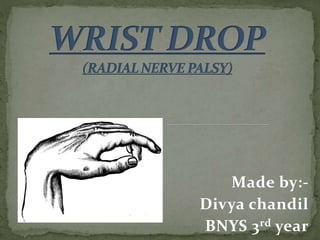
 It is a condition where a person cannot extend their
wrist and it hangs flaccidly.
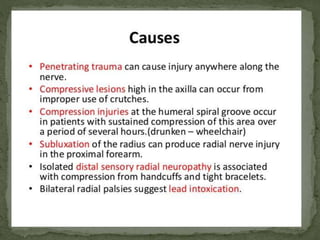
Saturday night palsy
• Alcohol is sometime a facto as a person falls asleep with back
of their arm compressed by a chair back , bar edge etc.
Crutch palsy
• Compression of nerve from walking with crutch
Honeymoon palsy
• From another individual sleeping on one’s arm overnight ,
compressing the nerve.
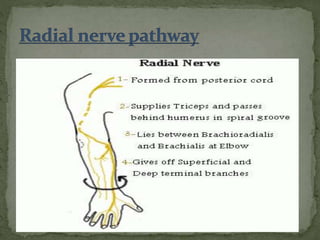
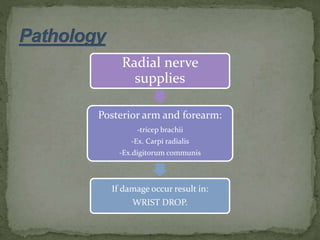
Radial nerve
supplies
Posterior arm and forearm:
-tricep brachii
-Ex. Carpi radialis
-Ex.digitorum communis
If damage occur result in:
WRIST DROP.
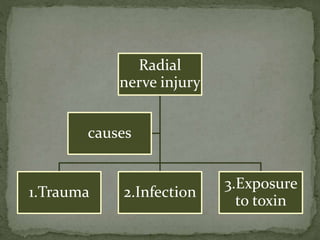
Radial
nerve injury
1.Trauma 2.Infection
3.Exposure
to toxin
causes
 sharp or burning pain
 Numbness or tingling
 Trouble straightening the arm
 Trouble moving the wrist and fingers
 Drooping of wrist and fingers
 Weakness in hand grip
1. ROM of wrist ( to check any weakness or loss of muscle
tone)
2. Blood test
3. CT scan and MRI
4. Electromyography
5. Nerve conduction test
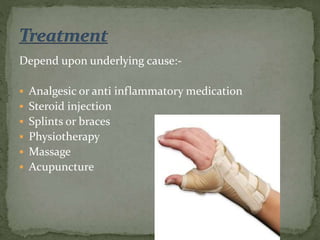
Depend upon underlying cause:-
 Analgesic or anti inflammatory medication
 Steroid injection
 Splints or braces
 Physiotherapy
 Massage
 Acupuncture
Aim of treatment:
To reduce pain or unusual sensation an to increase the
range of motion.
A. Main point: group (1):
1. Yenmen(TW-2)
2. Zhongzhu (TW-3)
3.Waiguan (TW-5)
 B. Main point: group (2): (analgesic points)
1. Hegu (LI-4)
2. Yangxi (LI-5)
3. Quchi (LI-11)
C. Main point: group (3): (As-shi points)
1. Shenmen (H-7)
2. Daling (P-7)
3. Taiyuan (L-9)
D.Supplementry point: Yanglingquan (GB-34)
 E. Ear point:- wrist area (scapha and helix)
 F. Scalp point:- Baihui (GB-20)
 G. Stimulation:
mild electrical stimulation 20-30 min/ day for 10-15 days.
Second course: after rest of 7 days.
THANK
YOU….

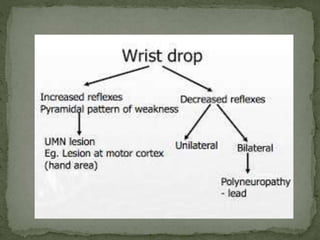
Wrist drop

  • 1.
  • 2.
     It isa pathological condition in which there is injury to radial nerve resulting in impairment nerve function causing radial nerve palsy.  Wrist drop is the characteristic clinical sign of Radial Nerve palsy.  It is a condition where a person cannot extend their wrist and it hangs flaccidly.
  • 4.
    Saturday night palsy •Alcohol is sometime a facto as a person falls asleep with back of their arm compressed by a chair back , bar edge etc. Crutch palsy • Compression of nerve from walking with crutch Honeymoon palsy • From another individual sleeping on one’s arm overnight , compressing the nerve.
  • 5.
    Radial nerve supplies Posterior armand forearm: -tricep brachii -Ex. Carpi radialis -Ex.digitorum communis If damage occur result in: WRIST DROP.
  • 6.
  • 10.
     sharp orburning pain  Numbness or tingling  Trouble straightening the arm  Trouble moving the wrist and fingers  Drooping of wrist and fingers  Weakness in hand grip
  • 11.
    1. ROM ofwrist ( to check any weakness or loss of muscle tone) 2. Blood test 3. CT scan and MRI 4. Electromyography 5. Nerve conduction test
  • 12.
    Depend upon underlyingcause:-  Analgesic or anti inflammatory medication  Steroid injection  Splints or braces  Physiotherapy  Massage  Acupuncture
  • 13.
    Aim of treatment: Toreduce pain or unusual sensation an to increase the range of motion. A. Main point: group (1): 1. Yenmen(TW-2) 2. Zhongzhu (TW-3) 3.Waiguan (TW-5)
  • 14.
     B. Mainpoint: group (2): (analgesic points) 1. Hegu (LI-4) 2. Yangxi (LI-5) 3. Quchi (LI-11) C. Main point: group (3): (As-shi points) 1. Shenmen (H-7) 2. Daling (P-7) 3. Taiyuan (L-9) D.Supplementry point: Yanglingquan (GB-34)
  • 15.
     E. Earpoint:- wrist area (scapha and helix)  F. Scalp point:- Baihui (GB-20)  G. Stimulation: mild electrical stimulation 20-30 min/ day for 10-15 days. Second course: after rest of 7 days.
  • 16.