Massive Blood Transfusion Definition, Indications Complications Dr. Maha AL-Madi Urology Resident
- Massive Blood Transfusion Defined Indications of Blood Transfusion Clinical Practice Guidelines of Blood Transfusion Complications of Blood Transfusion Alternatives to Blood Transfusion Objectives
Definition of MBT… Massive BT is loosely defined as the transfusion  of more than 10 units  of  PRBCs in a  24-hour period .  (ARCH SURG/VOL 143 (NO. 7), JULY 2008)   Massive BT , defined as the replacement of  more than 50 %  of a patient's blood volume in  12 to 24 hours ,  (Massive blood transfusion by Steven Kleinman, MD up to date article Sept. 2009)        
Definition of MBT… Massive BT is defined as a volume equivalent or exceeding the patients own volume transfused within a  12 hour  period  ( Clinical Surgery ,A.Cuscheieri, 2 nd  ed) Massive transfusion implies a single transfusion greater than  2500 mL or 5000 mL  transfused over a period of  24 hours   (Schwartz’s Principles of Surgery, 8 th  ed)  
Definition of MBT…   Massive transfusion is defined as replacement of the patient's blood volume with packed RBCs in  24 hours  or transfusion of  more than 10 units  of blood over a period of a  few hours  (Sabiston Textbook of surgery, 8 th  ed.)
General Indications … In  Hemorrhagic shock  and ongoing hemorrhage and  anemia   (to increase oxygen carrying capacity) In  hemorrhage , the goal of transfusion is restoration of the oxygen-carrying capacity and  NOT  restoration to a specific hemoglobin level.
General Indications …… Anemia  in critical illness is a distinct clinical entity resulting from: 1) excessive phlebotomy for labs 2) active hemorrhage 3) reduced erythropoiesis Most BT in ICU patients is used for treatment of  anemia .
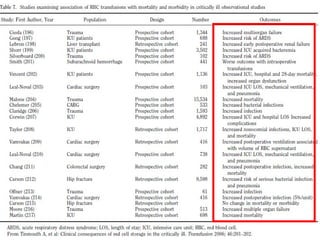
General Indications …… 40-50% of ICU patients receive at least 1, and on average close to 5 units of RBCs  Transfusion is not risk free and there is little evidence that routine BT is beneficial to hemodynamically  stable critically ill patients* * Clinical practice guideline: RBC transfusion in adult trauma and critical care. Crit Care Med 2009 vol.37 No.12
General Indications … Perioperative Transfusion Several factors are involved in the decision to transfuse a patient before surgery Are generally not recommended when the hemoglobin is ≥10 g/dL should be given when less than 7 g/dL * No specific hematocrit is an indication for preoperative transfusion in a stable patient *  Indications for red cell transfusion in the adult, by Steven Kleinman, MD Addison K May, MD, Sept 2009 uptodate article.
Indication for MBT … There is no clear indication for  MBT  in any case The decision to transfuse in poly trauma or other critical cases is based on  -  the physiological state of the patient, - evidence of amount of blood loss  - potential for ongoing hemorrhage
General Indications … No single criterion should be used as an indication for RBC transfusion and that multiple factors related to the patient's clinical status and oxygen delivery needs should be considered* *  Clinical practice guideline: RBC transfusion in adult trauma and critical care. Crit Care Med 2009 vol.37 No.12
Clinical Practice Guidelines and Recommendations *  Clinical practice guideline: RBC transfusion in adult trauma and critical care. Crit Care Med 2009 vol.37 No.12
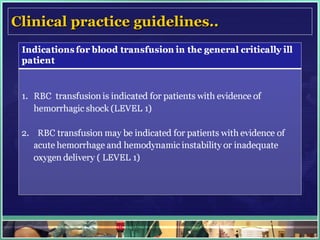
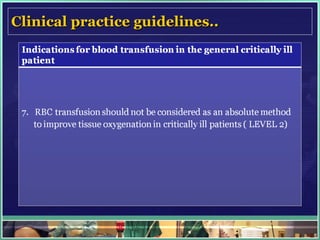
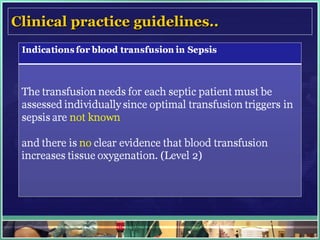
Clinical practice guidelines..
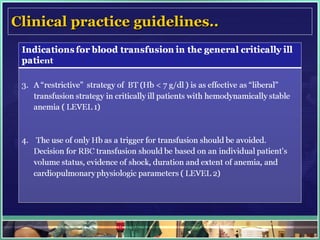
Clinical practice guidelines..…
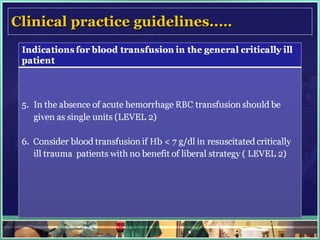
Clinical practice guidelines..
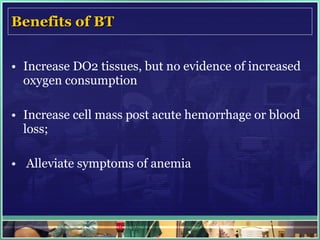
Benefits of BT Increase DO2 tissues, but no evidence of increased oxygen consumption Increase cell mass post acute hemorrhage or blood loss; Alleviate symptoms of anemia
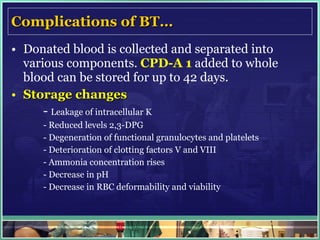
Complications of BT… Donated blood is collected and separated into various components.  CPD-A 1  added to whole blood can be stored for up to 42 days. Storage changes -  Leakage of intracellular K - Reduced levels 2,3-DPG - Degeneration of functional granulocytes and platelets - Deterioration of clotting factors V and VIII - Ammonia concentration rises - Decrease in pH - Decrease in RBC deformability and viability
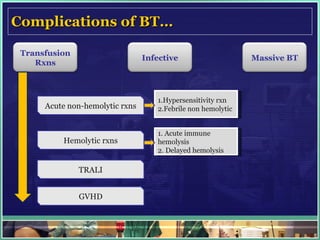
Complications of BT… Acute non-hemolytic rxns Hemolytic rxns TRALI GVHD 1.Hypersensitivity rxn 2.Febrile non hemolytic 1. Acute immune  hemolysis 2. Delayed hemolysis Transfusion Rxns Infective Massive BT
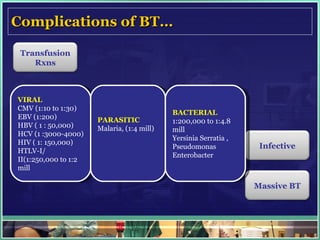
Complications of BT… VIRAL CMV (1:10 to 1:30)  EBV (1:200) HBV ( 1 : 50,000) HCV (1 :3000-4000) HIV ( 1: 150,000) HTLV-I/ II(1:250,000 to 1:2 mill PARASITIC Malaria, (1:4 mill)  BACTERIAL 1:200,000 to 1:4.8 mill Yersinia Serratia ,  Pseudomonas Enterobacter Transfusion Rxns Infective Massive BT
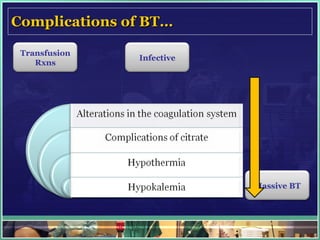
Complications of BT… Transfusion Rxns Infective Massive BT
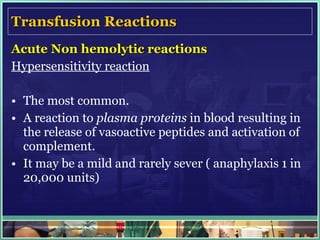
Transfusion Reactions Acute Non hemolytic reactions Hypersensitivity reaction The most common. A reaction to  plasma proteins  in blood resulting in the release of vasoactive peptides and activation of complement. It may be a mild and rarely sever ( anaphylaxis 1 in 20,000 units)
Transfusion Reactions Acute Non hemolytic reactions Febrile  non-hemolytic  reaction in 3-4% of all transfusions development of high fever during or within 24 hours of a transfusion Theories: alloimmunization to leukocyte or platelet antigens formation of cytokines during storage  Self limiting
Transfusion Reactions Hemolytic reactions Acute immune hemolytic reaction The most serious transfusion reaction  Occurs in 1 in 40,000 transfused units.  Recipient’s antibodies to ABO antigens result in a rapid  intravascular  hemolysis of donor RBCs mediated by activation of complement.
Transfusion Reactions Hemolytic reactions Delayed hemolytic reaction Results from an anamnestic Ab response to donor Rh or non-ABO antigens causing an  extravascular  hemolytic reaction Transfused blood cells take days or weeks to hemolyze and typically there are few signs or symptoms other than falling RBC count and elevated bilirubin.
Transfusion Reactions Transfusion related acute lung injury (TRALI) Occurs in 1 in 5000 units transfused Its  is a clinical syndrome with acute hypoxemia and non-cardiogenic pulmonary edema. Usually occurs within 1 to 2 hours of transfusion (anytime up to 6 hours later).  Theories: - Donor blood containing anti-leukocyte Ab. - Mediators of inflammation form in stored blood  
Transfusion Reactions Patient develops fever, SOB, cough and hypoxemia. CXR shows the picture of ARDS with perihilar infiltrates. Support can vary from supplemental oxygen to intubation and ventilation. Most cases resolve on their own but some can be fatal.
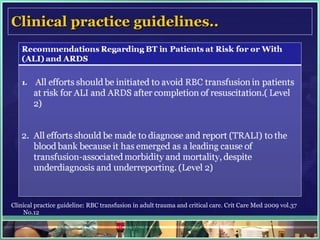
Clinical practice guidelines.. Clinical practice guideline: RBC transfusion in adult trauma and critical care. Crit Care Med 2009 vol.37 No.12
Transfusion Reactions GVHD   Rare (0.15% incidence) but usually fatal complication Donor T lymphocytes mount an immune response against the  recipient's lymphoid tissue.  - When the recipient is immunocompromised or donor    is homozygous and the recipient is heterozygous for      HLA,  normal defense mechanisms fail.  Mortality rate 80%, preventable by irradiation of blood.
Complications of BT… Role of leukoreduction Reduces the number of transfused WBCs.  Leukoreduction is effective in reducing the transmission of cell-associated viruses (eg, CMV, EBV) and post operative infections.
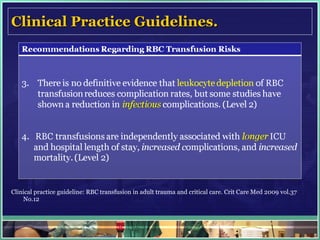
Complications of BT… Role of leukoreduction But studies showed  no  significant effect on mortality, febrile episodes or MOF * Some studies have  suggested it has further  reduced  the already low risk of  transfusion related GVHD *  Clinical practice guideline: RBC transfusion in adult trauma and critical care. Crit Care Med 2009 vol.37 No.12
Complications of MBT A)  Alteration in coagulation system It can be a preexisting or Induced coagulopathy. Effects of acidosis and hypothermia Acidosis  interferes with the assembly of coagulation factor complexes involving calcium Hypothermia  reduces the enzymatic activity of plasma coagulation proteins and prevents plt activation
Complications of MBT Coagulation proteins    Resuscitation results in gradual dilution of plasma clotting proteins Bleeding due to dilution can occur when the level of coagulation proteins falls to 25 % of normal. (8- 10 units)
Complications of MBT Platelet count Each 10 - 12 units can produce a 50 % fall in the platelet count; thus, significant thrombocytopenia can be seen  Also a dilutional effect
Complications of MBT B) Complications Of Citrate Transfusion Metabolic alkalosis At collection pH  7.10 falls 0.1 pH unit/week due to lactic and pyruvic acids.  Acidosis does not develop in a massively bleeding patient even if "acidic" blood is infused.
Complications of MBT Metabolic alkalosis Each 1 mmol of citrate  3 mEq of bicarbonate.  As a result, metabolic alkalosis can occur
Complications of MBT Hypocalcemia  Due to citrate binding of ionized calcium  Clinically significant hypocalcemia does not usually occur unless the rate of transfusion exceeds one unit every five minutes.
Complications of MBT Hypocalcemia  May exhibit transient tetany and hypotension. Calcium should only be given if there is clinical or ECG or lab evidence of hypocalcaemia
Complications of MBT Hypothermia  Blood warmers should be used as the rapid transfusion of multiple units of may reduce the core temperature and can lead to cardiac arrhythmias.  Leads to : - reduction in citrate and lactate metabolism  - increases affinity of haemoglobin for oxygen, - impairment of red cell deformability
Complications of MBT Hyperkalemia  Potassium levels in stored blood increase by approximately 1 meq/L per day ( peaks at 30 meq/L) Not a problem unless very large amounts of blood are given  quickly To minimize the risk: - Use of < 5 days  stored blood - wash unit before transfusion
Complications of MBT… Volume overload In patients with poor cardiac or renal function. Careful monitoring of volume status and diuretic therapy can reduce the risk of this complication.
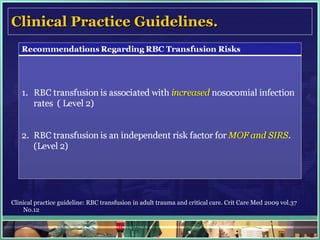
Clinical Practice Guidelines. Clinical practice guideline: RBC transfusion in adult trauma and critical care. Crit Care Med 2009 vol.37 No.12
 
Alternative to BT Hemoglobin-based oxygen carriers are being investigated for use in critically ill and injured patients, not yet approved (level 2). Potential uses: - Elective surgery -Hemorrhagic shock of trauma -  Vaso-occlusive crises
Alternative to BT Side effects: Vasoactivity  Gastrointestinal side effects  Immunosuppression Myocardial infarction and death Further phase III trials of HBOCs will not be conducted until it can be shown that these agents are at least as effective in reducing mortality or serious morbidity as the current standards of care
… Thank You…
References..  Clinical practice guideline : RBC transfusion in adult trauma and critical care. Crit Care Med 2009 vol.37 No.12 ARCH SURG/VOL  143 (NO. 7), JULY 2008 Massive blood transfusion  by Steven Kleinman, MD up to date article Sept. 2009 Transfusion Reactions  by Eric M Kardon, MD ,eMedicine Dec 10, 2009 Indications for red cell transfusion in the adult  by Steven Kleinman, MD up to date September 2009  Clinical Surgery  ,A.Cuscheieri, 2 nd  ed Schwartz’s Principles of Surgery , 8 th  ed

Massive Blood Transfusion

  • 1.
    Massive Blood TransfusionDefinition, Indications Complications Dr. Maha AL-Madi Urology Resident
  • 2.
    - Massive BloodTransfusion Defined Indications of Blood Transfusion Clinical Practice Guidelines of Blood Transfusion Complications of Blood Transfusion Alternatives to Blood Transfusion Objectives
  • 3.
    Definition of MBT…Massive BT is loosely defined as the transfusion of more than 10 units of PRBCs in a 24-hour period . (ARCH SURG/VOL 143 (NO. 7), JULY 2008)   Massive BT , defined as the replacement of more than 50 % of a patient's blood volume in 12 to 24 hours , (Massive blood transfusion by Steven Kleinman, MD up to date article Sept. 2009)        
  • 4.
    Definition of MBT…Massive BT is defined as a volume equivalent or exceeding the patients own volume transfused within a 12 hour period ( Clinical Surgery ,A.Cuscheieri, 2 nd ed) Massive transfusion implies a single transfusion greater than 2500 mL or 5000 mL transfused over a period of 24 hours (Schwartz’s Principles of Surgery, 8 th ed)  
  • 5.
    Definition of MBT… Massive transfusion is defined as replacement of the patient's blood volume with packed RBCs in 24 hours or transfusion of more than 10 units of blood over a period of a few hours (Sabiston Textbook of surgery, 8 th ed.)
  • 6.
    General Indications …In Hemorrhagic shock and ongoing hemorrhage and anemia (to increase oxygen carrying capacity) In hemorrhage , the goal of transfusion is restoration of the oxygen-carrying capacity and NOT restoration to a specific hemoglobin level.
  • 7.
    General Indications ……Anemia in critical illness is a distinct clinical entity resulting from: 1) excessive phlebotomy for labs 2) active hemorrhage 3) reduced erythropoiesis Most BT in ICU patients is used for treatment of anemia .
  • 8.
    General Indications ……40-50% of ICU patients receive at least 1, and on average close to 5 units of RBCs Transfusion is not risk free and there is little evidence that routine BT is beneficial to hemodynamically stable critically ill patients* * Clinical practice guideline: RBC transfusion in adult trauma and critical care. Crit Care Med 2009 vol.37 No.12
  • 9.
    General Indications …Perioperative Transfusion Several factors are involved in the decision to transfuse a patient before surgery Are generally not recommended when the hemoglobin is ≥10 g/dL should be given when less than 7 g/dL * No specific hematocrit is an indication for preoperative transfusion in a stable patient * Indications for red cell transfusion in the adult, by Steven Kleinman, MD Addison K May, MD, Sept 2009 uptodate article.
  • 10.
    Indication for MBT… There is no clear indication for MBT in any case The decision to transfuse in poly trauma or other critical cases is based on - the physiological state of the patient, - evidence of amount of blood loss - potential for ongoing hemorrhage
  • 11.
    General Indications …No single criterion should be used as an indication for RBC transfusion and that multiple factors related to the patient's clinical status and oxygen delivery needs should be considered* * Clinical practice guideline: RBC transfusion in adult trauma and critical care. Crit Care Med 2009 vol.37 No.12
  • 12.
    Clinical Practice Guidelinesand Recommendations * Clinical practice guideline: RBC transfusion in adult trauma and critical care. Crit Care Med 2009 vol.37 No.12
  • 13.
  • 14.
  • 15.
  • 16.
  • 17.
  • 18.
    Benefits of BTIncrease DO2 tissues, but no evidence of increased oxygen consumption Increase cell mass post acute hemorrhage or blood loss; Alleviate symptoms of anemia
  • 19.
    Complications of BT…Donated blood is collected and separated into various components. CPD-A 1 added to whole blood can be stored for up to 42 days. Storage changes - Leakage of intracellular K - Reduced levels 2,3-DPG - Degeneration of functional granulocytes and platelets - Deterioration of clotting factors V and VIII - Ammonia concentration rises - Decrease in pH - Decrease in RBC deformability and viability
  • 20.
    Complications of BT…Acute non-hemolytic rxns Hemolytic rxns TRALI GVHD 1.Hypersensitivity rxn 2.Febrile non hemolytic 1. Acute immune hemolysis 2. Delayed hemolysis Transfusion Rxns Infective Massive BT
  • 21.
    Complications of BT…VIRAL CMV (1:10 to 1:30)  EBV (1:200) HBV ( 1 : 50,000) HCV (1 :3000-4000) HIV ( 1: 150,000) HTLV-I/ II(1:250,000 to 1:2 mill PARASITIC Malaria, (1:4 mill) BACTERIAL 1:200,000 to 1:4.8 mill Yersinia Serratia , Pseudomonas Enterobacter Transfusion Rxns Infective Massive BT
  • 22.
    Complications of BT…Transfusion Rxns Infective Massive BT
  • 23.
    Transfusion Reactions AcuteNon hemolytic reactions Hypersensitivity reaction The most common. A reaction to plasma proteins in blood resulting in the release of vasoactive peptides and activation of complement. It may be a mild and rarely sever ( anaphylaxis 1 in 20,000 units)
  • 24.
    Transfusion Reactions AcuteNon hemolytic reactions Febrile non-hemolytic reaction in 3-4% of all transfusions development of high fever during or within 24 hours of a transfusion Theories: alloimmunization to leukocyte or platelet antigens formation of cytokines during storage Self limiting
  • 25.
    Transfusion Reactions Hemolyticreactions Acute immune hemolytic reaction The most serious transfusion reaction Occurs in 1 in 40,000 transfused units. Recipient’s antibodies to ABO antigens result in a rapid intravascular hemolysis of donor RBCs mediated by activation of complement.
  • 26.
    Transfusion Reactions Hemolyticreactions Delayed hemolytic reaction Results from an anamnestic Ab response to donor Rh or non-ABO antigens causing an extravascular hemolytic reaction Transfused blood cells take days or weeks to hemolyze and typically there are few signs or symptoms other than falling RBC count and elevated bilirubin.
  • 27.
    Transfusion Reactions Transfusionrelated acute lung injury (TRALI) Occurs in 1 in 5000 units transfused Its is a clinical syndrome with acute hypoxemia and non-cardiogenic pulmonary edema. Usually occurs within 1 to 2 hours of transfusion (anytime up to 6 hours later). Theories: - Donor blood containing anti-leukocyte Ab. - Mediators of inflammation form in stored blood  
  • 28.
    Transfusion Reactions Patientdevelops fever, SOB, cough and hypoxemia. CXR shows the picture of ARDS with perihilar infiltrates. Support can vary from supplemental oxygen to intubation and ventilation. Most cases resolve on their own but some can be fatal.
  • 29.
    Clinical practice guidelines..Clinical practice guideline: RBC transfusion in adult trauma and critical care. Crit Care Med 2009 vol.37 No.12
  • 30.
    Transfusion Reactions GVHD Rare (0.15% incidence) but usually fatal complication Donor T lymphocytes mount an immune response against the recipient's lymphoid tissue. - When the recipient is immunocompromised or donor is homozygous and the recipient is heterozygous for HLA, normal defense mechanisms fail. Mortality rate 80%, preventable by irradiation of blood.
  • 31.
    Complications of BT…Role of leukoreduction Reduces the number of transfused WBCs. Leukoreduction is effective in reducing the transmission of cell-associated viruses (eg, CMV, EBV) and post operative infections.
  • 32.
    Complications of BT…Role of leukoreduction But studies showed no significant effect on mortality, febrile episodes or MOF * Some studies have suggested it has further reduced the already low risk of transfusion related GVHD * Clinical practice guideline: RBC transfusion in adult trauma and critical care. Crit Care Med 2009 vol.37 No.12
  • 33.
    Complications of MBTA) Alteration in coagulation system It can be a preexisting or Induced coagulopathy. Effects of acidosis and hypothermia Acidosis interferes with the assembly of coagulation factor complexes involving calcium Hypothermia reduces the enzymatic activity of plasma coagulation proteins and prevents plt activation
  • 34.
    Complications of MBTCoagulation proteins    Resuscitation results in gradual dilution of plasma clotting proteins Bleeding due to dilution can occur when the level of coagulation proteins falls to 25 % of normal. (8- 10 units)
  • 35.
    Complications of MBTPlatelet count Each 10 - 12 units can produce a 50 % fall in the platelet count; thus, significant thrombocytopenia can be seen Also a dilutional effect
  • 36.
    Complications of MBTB) Complications Of Citrate Transfusion Metabolic alkalosis At collection pH 7.10 falls 0.1 pH unit/week due to lactic and pyruvic acids. Acidosis does not develop in a massively bleeding patient even if &quot;acidic&quot; blood is infused.
  • 37.
    Complications of MBTMetabolic alkalosis Each 1 mmol of citrate 3 mEq of bicarbonate. As a result, metabolic alkalosis can occur
  • 38.
    Complications of MBTHypocalcemia  Due to citrate binding of ionized calcium Clinically significant hypocalcemia does not usually occur unless the rate of transfusion exceeds one unit every five minutes.
  • 39.
    Complications of MBTHypocalcemia  May exhibit transient tetany and hypotension. Calcium should only be given if there is clinical or ECG or lab evidence of hypocalcaemia
  • 40.
    Complications of MBTHypothermia  Blood warmers should be used as the rapid transfusion of multiple units of may reduce the core temperature and can lead to cardiac arrhythmias. Leads to : - reduction in citrate and lactate metabolism - increases affinity of haemoglobin for oxygen, - impairment of red cell deformability
  • 41.
    Complications of MBTHyperkalemia  Potassium levels in stored blood increase by approximately 1 meq/L per day ( peaks at 30 meq/L) Not a problem unless very large amounts of blood are given quickly To minimize the risk: - Use of < 5 days stored blood - wash unit before transfusion
  • 42.
    Complications of MBT…Volume overload In patients with poor cardiac or renal function. Careful monitoring of volume status and diuretic therapy can reduce the risk of this complication.
  • 43.
    Clinical Practice Guidelines.Clinical practice guideline: RBC transfusion in adult trauma and critical care. Crit Care Med 2009 vol.37 No.12
  • 44.
    Clinical Practice Guidelines.Clinical practice guideline: RBC transfusion in adult trauma and critical care. Crit Care Med 2009 vol.37 No.12
  • 45.
  • 46.
    Alternative to BTHemoglobin-based oxygen carriers are being investigated for use in critically ill and injured patients, not yet approved (level 2). Potential uses: - Elective surgery -Hemorrhagic shock of trauma - Vaso-occlusive crises
  • 47.
    Alternative to BTSide effects: Vasoactivity  Gastrointestinal side effects  Immunosuppression Myocardial infarction and death Further phase III trials of HBOCs will not be conducted until it can be shown that these agents are at least as effective in reducing mortality or serious morbidity as the current standards of care
  • 48.
  • 49.
    References.. Clinicalpractice guideline : RBC transfusion in adult trauma and critical care. Crit Care Med 2009 vol.37 No.12 ARCH SURG/VOL 143 (NO. 7), JULY 2008 Massive blood transfusion by Steven Kleinman, MD up to date article Sept. 2009 Transfusion Reactions by Eric M Kardon, MD ,eMedicine Dec 10, 2009 Indications for red cell transfusion in the adult by Steven Kleinman, MD up to date September 2009 Clinical Surgery ,A.Cuscheieri, 2 nd ed Schwartz’s Principles of Surgery , 8 th ed