1
THE DIABETIC FOOTTHE DIABETIC FOOT
Channa RatnatungaChanna Ratnatunga
Department of SurgeryDepartment of Surgery
University of PeradeniyaUniversity of Peradeniya
2
 5-15% of Diabetics develop foot5-15% of Diabetics develop foot
ulcersulcers
 70% of healed Diabetic ulcer are70% of healed Diabetic ulcer are
likely to recur within 5 yearslikely to recur within 5 years
 85% of non traumatic lower limb85% of non traumatic lower limb
amputations follow diabetic footamputations follow diabetic foot
ulcersulcers
DIABETIC FOOTDIABETIC FOOT
PREVALANCE AND PROGNOSISPREVALANCE AND PROGNOSIS
3
Why do Diabetics sustain traumaWhy do Diabetics sustain trauma
to feet?to feet?
 Extrinsic -Extrinsic - Poor visionPoor vision
Falls due to joint immobilityFalls due to joint immobility
CVAsCVAs
Oedema due to CardiacOedema due to Cardiac
causescauses
 Intrinsic -Intrinsic -
4
Intrinsic Causes of DiabeticIntrinsic Causes of Diabetic
Foot UlcerationFoot Ulceration
NeuropathyNeuropathy
Arterial DiseaseArterial Disease
Abnormal tissue responseAbnormal tissue response
to trauma and sepsisto trauma and sepsis
5
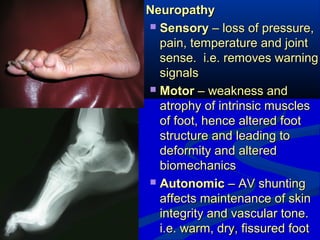
 NeuropathyNeuropathy
 SensorySensory – loss of pressure,– loss of pressure,
pain, temperature and jointpain, temperature and joint
sense. i.e. removes warningsense. i.e. removes warning
signalssignals
 MotorMotor – weakness and– weakness and
atrophy of intrinsic musclesatrophy of intrinsic muscles
of foot, hence altered footof foot, hence altered foot
structure and leading tostructure and leading to
deformity and altereddeformity and altered
biomechanicsbiomechanics
 AutonomicAutonomic – AV shunting– AV shunting
affects maintenance of skinaffects maintenance of skin
integrity and vascular tone.integrity and vascular tone.
i.e. warm, dry, fissured footi.e. warm, dry, fissured foot
6
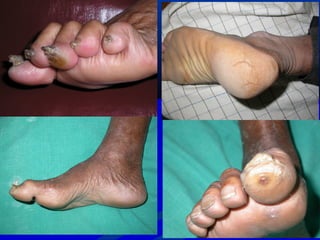
Pes Cavus
Ulceration at the tip
7
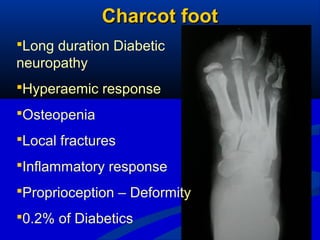
Charcot footCharcot foot
Long duration Diabetic
neuropathy
Hyperaemic response
Osteopenia
Local fractures
Inflammatory response
Proprioception – Deformity
0.2% of Diabetics
8
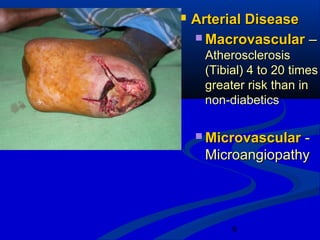
 Arterial DiseaseArterial Disease
 MacrovascularMacrovascular ––
AtherosclerosisAtherosclerosis
(Tibial) 4 to 20 times(Tibial) 4 to 20 times
greater risk than ingreater risk than in
non-diabeticsnon-diabetics
 MicrovascularMicrovascular --
MicroangiopathyMicroangiopathy
9
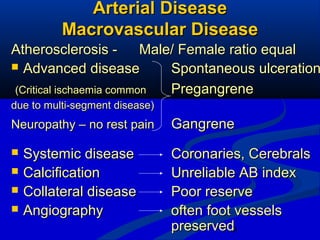
Arterial DiseaseArterial Disease
Macrovascular DiseaseMacrovascular Disease
Atherosclerosis -Atherosclerosis - Male/ Female ratio equalMale/ Female ratio equal
 Advanced diseaseAdvanced disease Spontaneous ulcerationSpontaneous ulceration
(Critical ischaemia common(Critical ischaemia common PregangrenePregangrene
due to multi-segment disease)due to multi-segment disease)
Neuropathy – no rest painNeuropathy – no rest pain GangreneGangrene
 Systemic diseaseSystemic disease Coronaries, CerebralsCoronaries, Cerebrals
 CalcificationCalcification Unreliable AB indexUnreliable AB index
 Collateral diseaseCollateral disease Poor reservePoor reserve
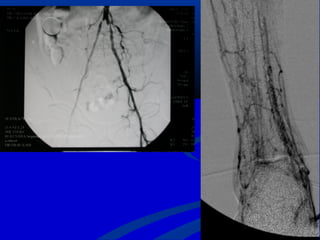
 AngiographyAngiography often foot vesselsoften foot vessels
preservedpreserved
10
11
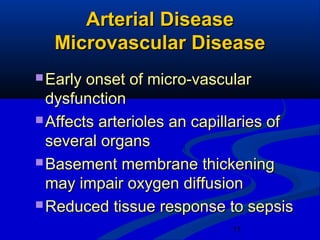
Arterial DiseaseArterial Disease
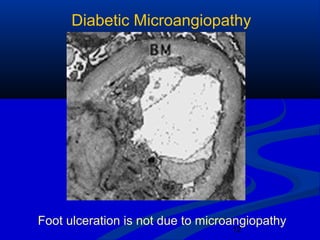
Microvascular DiseaseMicrovascular Disease
 Early onset of micro-vascularEarly onset of micro-vascular
dysfunctiondysfunction
 Affects arterioles an capillaries ofAffects arterioles an capillaries of
several organsseveral organs
 Basement membrane thickeningBasement membrane thickening
may impair oxygen diffusionmay impair oxygen diffusion
 Reduced tissue response to sepsisReduced tissue response to sepsis
12
Diabetic Microangiopathy
Foot ulceration is not due to microangiopathy
13
NeuroischaemiaNeuroischaemia
14
In a Diabetic footIn a Diabetic foot
Wound healing is affected by..Wound healing is affected by..
1.1.
 Growth factors deficiencyGrowth factors deficiency
 Impaired fibroblast responseImpaired fibroblast response
 Abnormalities of Extracellular matrixAbnormalities of Extracellular matrix
2.2. Alterations in..Alterations in..
 Neuroinflammatory responseNeuroinflammatory response
 Hyperaemic responseHyperaemic response
 Thermoregulatory responseThermoregulatory response
15
Diabetic footDiabetic foot
Infections IInfections I
 Cell mediated immunity depressedCell mediated immunity depressed
 Phagocytic function of multinuclearPhagocytic function of multinuclear
leukocytes affectedleukocytes affected
 Leucocyte migration at microcirculatoryLeucocyte migration at microcirculatory
level is affectedlevel is affected
 Hyperglycaemia associated withHyperglycaemia associated with
mycotic infections could contributemycotic infections could contribute
16
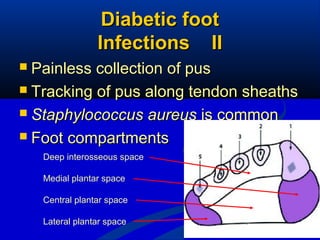
 Painless collection of pusPainless collection of pus
 Tracking of pus along tendon sheathsTracking of pus along tendon sheaths
 Staphylococcus aureusStaphylococcus aureus is commonis common
 Foot compartmentsFoot compartments
Diabetic footDiabetic foot
Infections IIInfections II
Deep interosseous space
Medial plantar space
Central plantar space
Lateral plantar space
17
CLINICAL ASSESSMENT OFCLINICAL ASSESSMENT OF
A DIABETIC FOOT IA DIABETIC FOOT I
 Glycaemic controlGlycaemic control
 SmokingSmoking
 Renal diseaseRenal disease
 Poor social circumstancePoor social circumstance
18
CLINICAL ASSESSMENT OF ACLINICAL ASSESSMENT OF A
DIABETIC FOOT IIDIABETIC FOOT II
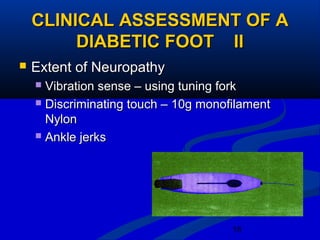
 Extent of NeuropathyExtent of Neuropathy
 Vibration sense – using tuning forkVibration sense – using tuning fork
 Discriminating touch – 10g monofilamentDiscriminating touch – 10g monofilament
NylonNylon
 Ankle jerksAnkle jerks
19
CLINICAL ASSESSMENT OF ACLINICAL ASSESSMENT OF A
DIABETIC FOOT IIIDIABETIC FOOT III
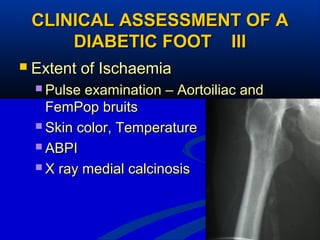
 Extent of IschaemiaExtent of Ischaemia
 Pulse examination – Aortoiliac andPulse examination – Aortoiliac and
FemPop bruitsFemPop bruits
 Skin color, TemperatureSkin color, Temperature
 ABPIABPI
 X ray medial calcinosisX ray medial calcinosis
20
CLINICAL ASSESSMENT OF ACLINICAL ASSESSMENT OF A
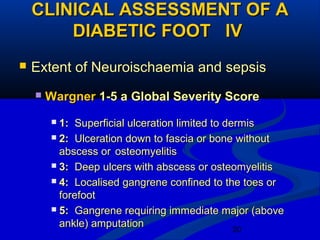
DIABETIC FOOT IVDIABETIC FOOT IV
 Extent of Neuroischaemia and sepsisExtent of Neuroischaemia and sepsis
 WargnerWargner 1-5 a Global Severity Score1-5 a Global Severity Score
 1:1: Superficial ulceration limited to dermisSuperficial ulceration limited to dermis
 2:2: Ulceration down to fascia or bone withoutUlceration down to fascia or bone without
abscess orabscess or osteomyelitisosteomyelitis
 3:3: Deep ulcers with abscess or osteomyelitisDeep ulcers with abscess or osteomyelitis
 4:4: Localised gangrene confined to the toes orLocalised gangrene confined to the toes or
forefootforefoot
 5:5: Gangrene requiring immediate major (aboveGangrene requiring immediate major (above
ankle) amputationankle) amputation
21
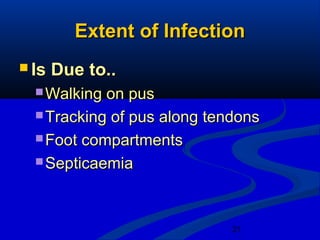
Extent of InfectionExtent of Infection
 Is Due to..Is Due to..
 Walking on pusWalking on pus
 Tracking of pus along tendonsTracking of pus along tendons
 Foot compartmentsFoot compartments
 SepticaemiaSepticaemia
22
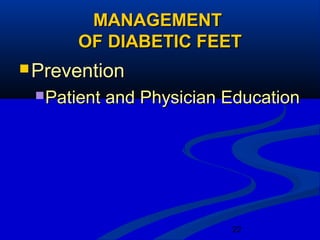
MANAGEMENTMANAGEMENT
OF DIABETIC FEETOF DIABETIC FEET
 PreventionPrevention
Patient and Physician EducationPatient and Physician Education
23
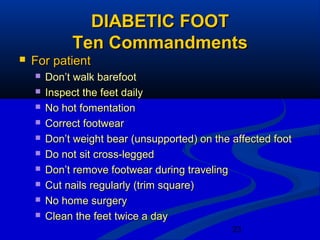
DIABETIC FOOTDIABETIC FOOT
Ten CommandmentsTen Commandments
 For patientFor patient
 Don’t walk barefootDon’t walk barefoot
 Inspect the feet dailyInspect the feet daily
 No hot fomentationNo hot fomentation
 Correct footwearCorrect footwear
 Don’t weight bear (unsupported) on the affected footDon’t weight bear (unsupported) on the affected foot
 Do not sit cross-leggedDo not sit cross-legged
 Don’t remove footwear during travelingDon’t remove footwear during traveling
 Cut nails regularly (trim square)Cut nails regularly (trim square)
 No home surgeryNo home surgery
 Clean the feet twice a dayClean the feet twice a day
24
DIABETIC FOOTDIABETIC FOOT
Six principles of prevention ofSix principles of prevention of
foot ulcersfoot ulcers
 For PhysicianFor Physician
 PPodiatric careodiatric care
 PPulse examinationulse examination
 PProtective shoesrotective shoes
 PPressure reductionressure reduction
 PProphylactic surgeryrophylactic surgery
 PPreventive educationreventive education
25
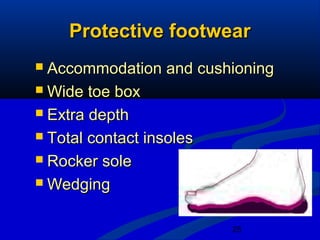
Protective footwearProtective footwear
 Accommodation and cushioningAccommodation and cushioning
 Wide toe boxWide toe box
 Extra depthExtra depth
 Total contact insolesTotal contact insoles
 Rocker soleRocker sole
 WedgingWedging
26
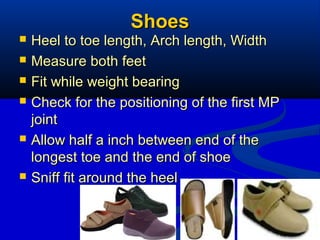
ShoesShoes
 Heel to toe length, Arch length, WidthHeel to toe length, Arch length, Width
 Measure both feetMeasure both feet
 Fit while weight bearingFit while weight bearing
 Check for the positioning of the first MPCheck for the positioning of the first MP
jointjoint
 Allow half a inch between end of theAllow half a inch between end of the
longest toe and the end of shoelongest toe and the end of shoe
 Sniff fit around the heelSniff fit around the heel
27
Therapeutic footwearTherapeutic footwear
 Bed rest, crutches, wheel chair, kneeBed rest, crutches, wheel chair, knee
caliperscalipers
 Total contact cast, Scotchcast bootsTotal contact cast, Scotchcast boots
 Half shoes, Half sandalsHalf shoes, Half sandals
 OrthosesOrthoses
28
ManagementManagement
 Wound careWound care
 Deep swabbing,Deep swabbing,
 Pus culture & ABSTPus culture & ABST
 Hb, TransfusionsHb, Transfusions
 Hyperbaric OHyperbaric O22
 X raysX rays
 MRIMRI
 Leukocyte tagged scansLeukocyte tagged scans
29
ManagementManagement
 Other measuresOther measures
 Weight reductionWeight reduction
 Aggressive debridement and drainage ofAggressive debridement and drainage of
tissue spacetissue space
 IV antibioticsIV antibiotics
PenicillinPenicillin
Co-amoxyclavCo-amoxyclav
MetronidazoleMetronidazole
ClindamycinClindamycin
 Cultured skin dermisCultured skin dermis
 Leukocyte colony stimulating factorsLeukocyte colony stimulating factors
30
ManagementManagement
 Other proceduresOther procedures
 Rest injured areaRest injured area
 Prophylactic surgery to correct BiomechanicalProphylactic surgery to correct Biomechanical
damagedamage
 RevascularizationRevascularization
 AngioplastyAngioplasty
 Distal venous bypassDistal venous bypass
 Prevention of recurrent ulcerationPrevention of recurrent ulceration
 AmputationAmputation
31
Thank youThank you

Diabetic foot

  • 1.
    1 THE DIABETIC FOOTTHEDIABETIC FOOT Channa RatnatungaChanna Ratnatunga Department of SurgeryDepartment of Surgery University of PeradeniyaUniversity of Peradeniya
  • 2.
    2  5-15% ofDiabetics develop foot5-15% of Diabetics develop foot ulcersulcers  70% of healed Diabetic ulcer are70% of healed Diabetic ulcer are likely to recur within 5 yearslikely to recur within 5 years  85% of non traumatic lower limb85% of non traumatic lower limb amputations follow diabetic footamputations follow diabetic foot ulcersulcers DIABETIC FOOTDIABETIC FOOT PREVALANCE AND PROGNOSISPREVALANCE AND PROGNOSIS
  • 3.
    3 Why do Diabeticssustain traumaWhy do Diabetics sustain trauma to feet?to feet?  Extrinsic -Extrinsic - Poor visionPoor vision Falls due to joint immobilityFalls due to joint immobility CVAsCVAs Oedema due to CardiacOedema due to Cardiac causescauses  Intrinsic -Intrinsic -
  • 4.
    4 Intrinsic Causes ofDiabeticIntrinsic Causes of Diabetic Foot UlcerationFoot Ulceration NeuropathyNeuropathy Arterial DiseaseArterial Disease Abnormal tissue responseAbnormal tissue response to trauma and sepsisto trauma and sepsis
  • 5.
    5  NeuropathyNeuropathy  SensorySensory– loss of pressure,– loss of pressure, pain, temperature and jointpain, temperature and joint sense. i.e. removes warningsense. i.e. removes warning signalssignals  MotorMotor – weakness and– weakness and atrophy of intrinsic musclesatrophy of intrinsic muscles of foot, hence altered footof foot, hence altered foot structure and leading tostructure and leading to deformity and altereddeformity and altered biomechanicsbiomechanics  AutonomicAutonomic – AV shunting– AV shunting affects maintenance of skinaffects maintenance of skin integrity and vascular tone.integrity and vascular tone. i.e. warm, dry, fissured footi.e. warm, dry, fissured foot
  • 6.
  • 7.
    7 Charcot footCharcot foot Longduration Diabetic neuropathy Hyperaemic response Osteopenia Local fractures Inflammatory response Proprioception – Deformity 0.2% of Diabetics
  • 8.
    8  Arterial DiseaseArterialDisease  MacrovascularMacrovascular –– AtherosclerosisAtherosclerosis (Tibial) 4 to 20 times(Tibial) 4 to 20 times greater risk than ingreater risk than in non-diabeticsnon-diabetics  MicrovascularMicrovascular -- MicroangiopathyMicroangiopathy
  • 9.
    9 Arterial DiseaseArterial Disease MacrovascularDiseaseMacrovascular Disease Atherosclerosis -Atherosclerosis - Male/ Female ratio equalMale/ Female ratio equal  Advanced diseaseAdvanced disease Spontaneous ulcerationSpontaneous ulceration (Critical ischaemia common(Critical ischaemia common PregangrenePregangrene due to multi-segment disease)due to multi-segment disease) Neuropathy – no rest painNeuropathy – no rest pain GangreneGangrene  Systemic diseaseSystemic disease Coronaries, CerebralsCoronaries, Cerebrals  CalcificationCalcification Unreliable AB indexUnreliable AB index  Collateral diseaseCollateral disease Poor reservePoor reserve  AngiographyAngiography often foot vesselsoften foot vessels preservedpreserved
  • 10.
  • 11.
    11 Arterial DiseaseArterial Disease MicrovascularDiseaseMicrovascular Disease  Early onset of micro-vascularEarly onset of micro-vascular dysfunctiondysfunction  Affects arterioles an capillaries ofAffects arterioles an capillaries of several organsseveral organs  Basement membrane thickeningBasement membrane thickening may impair oxygen diffusionmay impair oxygen diffusion  Reduced tissue response to sepsisReduced tissue response to sepsis
  • 12.
    12 Diabetic Microangiopathy Foot ulcerationis not due to microangiopathy
  • 13.
  • 14.
    14 In a DiabeticfootIn a Diabetic foot Wound healing is affected by..Wound healing is affected by.. 1.1.  Growth factors deficiencyGrowth factors deficiency  Impaired fibroblast responseImpaired fibroblast response  Abnormalities of Extracellular matrixAbnormalities of Extracellular matrix 2.2. Alterations in..Alterations in..  Neuroinflammatory responseNeuroinflammatory response  Hyperaemic responseHyperaemic response  Thermoregulatory responseThermoregulatory response
  • 15.
    15 Diabetic footDiabetic foot InfectionsIInfections I  Cell mediated immunity depressedCell mediated immunity depressed  Phagocytic function of multinuclearPhagocytic function of multinuclear leukocytes affectedleukocytes affected  Leucocyte migration at microcirculatoryLeucocyte migration at microcirculatory level is affectedlevel is affected  Hyperglycaemia associated withHyperglycaemia associated with mycotic infections could contributemycotic infections could contribute
  • 16.
    16  Painless collectionof pusPainless collection of pus  Tracking of pus along tendon sheathsTracking of pus along tendon sheaths  Staphylococcus aureusStaphylococcus aureus is commonis common  Foot compartmentsFoot compartments Diabetic footDiabetic foot Infections IIInfections II Deep interosseous space Medial plantar space Central plantar space Lateral plantar space
  • 17.
    17 CLINICAL ASSESSMENT OFCLINICALASSESSMENT OF A DIABETIC FOOT IA DIABETIC FOOT I  Glycaemic controlGlycaemic control  SmokingSmoking  Renal diseaseRenal disease  Poor social circumstancePoor social circumstance
  • 18.
    18 CLINICAL ASSESSMENT OFACLINICAL ASSESSMENT OF A DIABETIC FOOT IIDIABETIC FOOT II  Extent of NeuropathyExtent of Neuropathy  Vibration sense – using tuning forkVibration sense – using tuning fork  Discriminating touch – 10g monofilamentDiscriminating touch – 10g monofilament NylonNylon  Ankle jerksAnkle jerks
  • 19.
    19 CLINICAL ASSESSMENT OFACLINICAL ASSESSMENT OF A DIABETIC FOOT IIIDIABETIC FOOT III  Extent of IschaemiaExtent of Ischaemia  Pulse examination – Aortoiliac andPulse examination – Aortoiliac and FemPop bruitsFemPop bruits  Skin color, TemperatureSkin color, Temperature  ABPIABPI  X ray medial calcinosisX ray medial calcinosis
  • 20.
    20 CLINICAL ASSESSMENT OFACLINICAL ASSESSMENT OF A DIABETIC FOOT IVDIABETIC FOOT IV  Extent of Neuroischaemia and sepsisExtent of Neuroischaemia and sepsis  WargnerWargner 1-5 a Global Severity Score1-5 a Global Severity Score  1:1: Superficial ulceration limited to dermisSuperficial ulceration limited to dermis  2:2: Ulceration down to fascia or bone withoutUlceration down to fascia or bone without abscess orabscess or osteomyelitisosteomyelitis  3:3: Deep ulcers with abscess or osteomyelitisDeep ulcers with abscess or osteomyelitis  4:4: Localised gangrene confined to the toes orLocalised gangrene confined to the toes or forefootforefoot  5:5: Gangrene requiring immediate major (aboveGangrene requiring immediate major (above ankle) amputationankle) amputation
  • 21.
    21 Extent of InfectionExtentof Infection  Is Due to..Is Due to..  Walking on pusWalking on pus  Tracking of pus along tendonsTracking of pus along tendons  Foot compartmentsFoot compartments  SepticaemiaSepticaemia
  • 22.
    22 MANAGEMENTMANAGEMENT OF DIABETIC FEETOFDIABETIC FEET  PreventionPrevention Patient and Physician EducationPatient and Physician Education
  • 23.
    23 DIABETIC FOOTDIABETIC FOOT TenCommandmentsTen Commandments  For patientFor patient  Don’t walk barefootDon’t walk barefoot  Inspect the feet dailyInspect the feet daily  No hot fomentationNo hot fomentation  Correct footwearCorrect footwear  Don’t weight bear (unsupported) on the affected footDon’t weight bear (unsupported) on the affected foot  Do not sit cross-leggedDo not sit cross-legged  Don’t remove footwear during travelingDon’t remove footwear during traveling  Cut nails regularly (trim square)Cut nails regularly (trim square)  No home surgeryNo home surgery  Clean the feet twice a dayClean the feet twice a day
  • 24.
    24 DIABETIC FOOTDIABETIC FOOT Sixprinciples of prevention ofSix principles of prevention of foot ulcersfoot ulcers  For PhysicianFor Physician  PPodiatric careodiatric care  PPulse examinationulse examination  PProtective shoesrotective shoes  PPressure reductionressure reduction  PProphylactic surgeryrophylactic surgery  PPreventive educationreventive education
  • 25.
    25 Protective footwearProtective footwear Accommodation and cushioningAccommodation and cushioning  Wide toe boxWide toe box  Extra depthExtra depth  Total contact insolesTotal contact insoles  Rocker soleRocker sole  WedgingWedging
  • 26.
    26 ShoesShoes  Heel totoe length, Arch length, WidthHeel to toe length, Arch length, Width  Measure both feetMeasure both feet  Fit while weight bearingFit while weight bearing  Check for the positioning of the first MPCheck for the positioning of the first MP jointjoint  Allow half a inch between end of theAllow half a inch between end of the longest toe and the end of shoelongest toe and the end of shoe  Sniff fit around the heelSniff fit around the heel
  • 27.
    27 Therapeutic footwearTherapeutic footwear Bed rest, crutches, wheel chair, kneeBed rest, crutches, wheel chair, knee caliperscalipers  Total contact cast, Scotchcast bootsTotal contact cast, Scotchcast boots  Half shoes, Half sandalsHalf shoes, Half sandals  OrthosesOrthoses
  • 28.
    28 ManagementManagement  Wound careWoundcare  Deep swabbing,Deep swabbing,  Pus culture & ABSTPus culture & ABST  Hb, TransfusionsHb, Transfusions  Hyperbaric OHyperbaric O22  X raysX rays  MRIMRI  Leukocyte tagged scansLeukocyte tagged scans
  • 29.
    29 ManagementManagement  Other measuresOthermeasures  Weight reductionWeight reduction  Aggressive debridement and drainage ofAggressive debridement and drainage of tissue spacetissue space  IV antibioticsIV antibiotics PenicillinPenicillin Co-amoxyclavCo-amoxyclav MetronidazoleMetronidazole ClindamycinClindamycin  Cultured skin dermisCultured skin dermis  Leukocyte colony stimulating factorsLeukocyte colony stimulating factors
  • 30.
    30 ManagementManagement  Other proceduresOtherprocedures  Rest injured areaRest injured area  Prophylactic surgery to correct BiomechanicalProphylactic surgery to correct Biomechanical damagedamage  RevascularizationRevascularization  AngioplastyAngioplasty  Distal venous bypassDistal venous bypass  Prevention of recurrent ulcerationPrevention of recurrent ulceration  AmputationAmputation
  • 31.