Presenter: Dr. Vinay Jain
Diabetic foot
Introduction
 Diabetes mellitus is a group of metabolic diseases
characterized by hyperglycemia resulting from defects
in insulin secretion, insulin action, or both.
 The chronic hyperglycemia of diabetes is associated
with long-term damage, dysfunction, and failure of
various organs, especially the eyes, kidneys, nerves,
heart, and blood vessels.
 Diabetic foot is defined as any foot pathology that
results directly from diabetes or its long term
complications
Epidemiology
 Lesions of the feet affect ~15% of diabetics in their life
with an amputation rate 15 fold higher than non
diabetics
 Foot ulcerations are the commonest cause of hospital
admission in diabetics
 Atherosclerosis rarely seen in type I diabetics < 40
yrs while it may be present even before diagnosis in
type II
 Indication for lower limb amputation
Diabetes - 17.5%
PVD - 55.3%
Epidemiology – risk factors
 Male sex
 DM > 10 years duration
 Peripheral neuropathy
 Abnormal foot structure
 Peripheral arterial disease
 Smoking
 H/O previous ulceration / amputation
 Poor glycemic control (HbA1c > 7%)
Pathophysiology
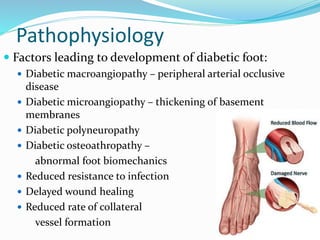
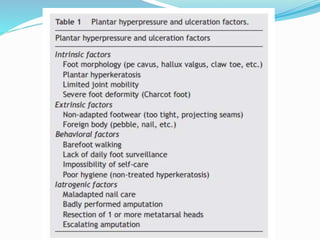
 Factors leading to development of diabetic foot:
 Diabetic macroangiopathy – peripheral arterial occlusive
disease
 Diabetic microangiopathy – thickening of basement
membranes
 Diabetic polyneuropathy
 Diabetic osteoathropathy –
abnormal foot biomechanics
 Reduced resistance to infection
 Delayed wound healing
 Reduced rate of collateral
vessel formation
Peripheral Neuropathy
 Prevalence – 20-60 %
 Increases with chronic hyperglycemia, duration of
diabetes and patient age
 90% of cases of diabetic foot ulcer
 Sensory neuropathy
 Motor neuropathy
 Vegetative neuropathy
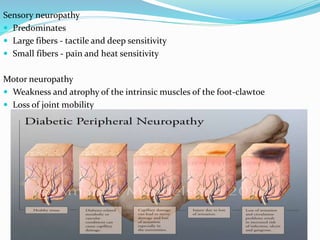
Sensory neuropathy
 Predominates
 Large fibers - tactile and deep sensitivity
 Small fibers - pain and heat sensitivity
Motor neuropathy
 Weakness and atrophy of the intrinsic muscles of the foot-clawtoe
 Loss of joint mobility
 Secondarily, it contributes to loss of joint mobility,
which is also due to conjunctive tissue
glycosylation inducing fibrosis of the joint, soft
tissue and skin
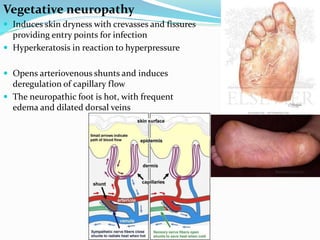
Vegetative neuropathy
 Induces skin dryness with crevasses and fissures
providing entry points for infection
 Hyperkeratosis in reaction to hyperpressure
 Opens arteriovenous shunts and induces
deregulation of capillary flow
 The neuropathic foot is hot, with frequent
edema and dilated dorsal veins
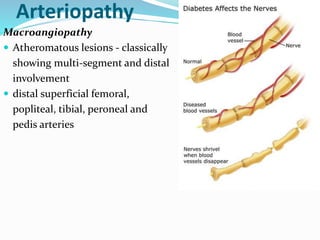
Arteriopathy
Macroangiopathy
 Atheromatous lesions - classically
showing multi-segment and distal
involvement
 distal superficial femoral,
popliteal, tibial, peroneal and
pedis arteries
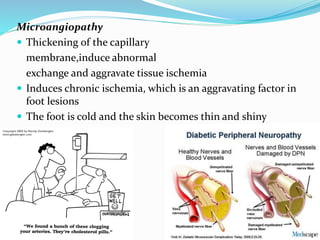
Microangiopathy
 Thickening of the capillary
membrane,induce abnormal
exchange and aggravate tissue ischemia
 Induces chronic ischemia, which is an aggravating factor in
foot lesions
 The foot is cold and the skin becomes thin and shiny
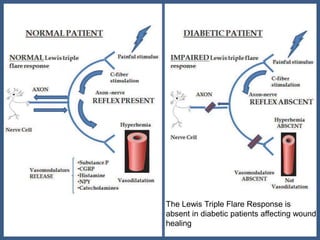
The Lewis Triple Flare Response is
absent in diabetic patients affecting wound
healing
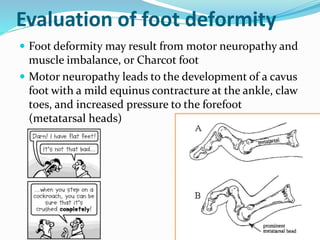
Evaluation of foot deformity
 Foot deformity may result from motor neuropathy and
muscle imbalance, or Charcot foot
 Motor neuropathy leads to the development of a cavus
foot with a mild equinus contracture at the ankle, claw
toes, and increased pressure to the forefoot
(metatarsal heads)
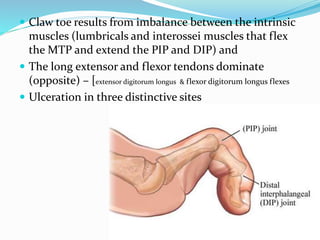
 Claw toe results from imbalance between the intrinsic
muscles (lumbricals and interossei muscles that flex
the MTP and extend the PIP and DIP) and
 The long extensor and flexor tendons dominate
(opposite) – [extensor digitorum longus & flexor digitorum longus flexes
 Ulceration in three distinctive sites
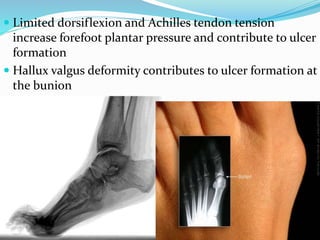
 Limited dorsiflexion and Achilles tendon tension
increase forefoot plantar pressure and contribute to ulcer
formation
 Hallux valgus deformity contributes to ulcer formation at
the bunion
Biomechanics of Ulceration
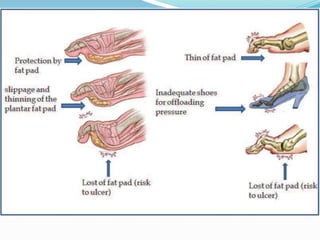
 Loss of pressure and pain sensitivity leads to repeated
local hyperpressure shear stress in the hyperkeratotic
region
 Under which effusion develops and exteriorizes into an
ulcer
 Mechanical, thermal or chemical wound may also lead
to ulceration - diagnosed late due to the absence of
associated pain
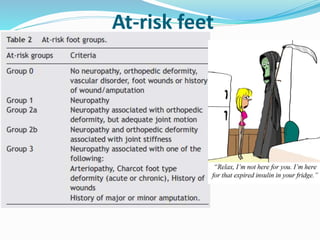
At-risk feet
Ulcer classification
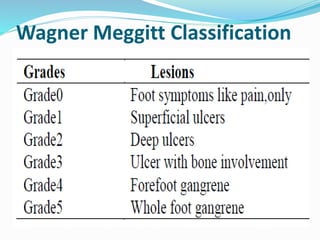
 Wagner Meggitt Classification
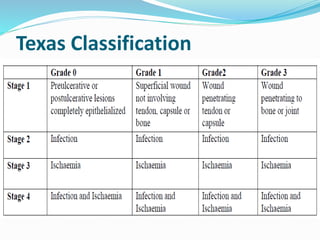
 Texas Classification
 Pedis Classification
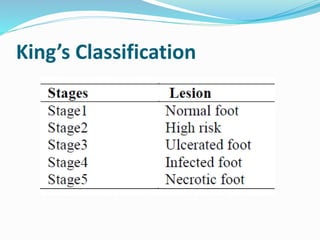
 King’s Classification
 Amit Jain’s Classification
Wagner Meggitt Classification
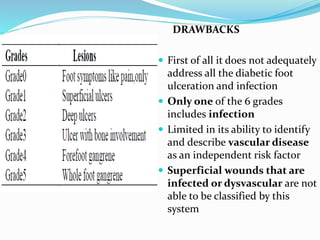
DRAWBACKS
 First of all it does not adequately
address all the diabetic foot
ulceration and infection
 Only one of the 6 grades
includes infection
 Limited in its ability to identify
and describe vascular disease
as an independent risk factor
 Superficial wounds that are
infected or dysvascular are not
able to be classified by this
system
Texas Classification
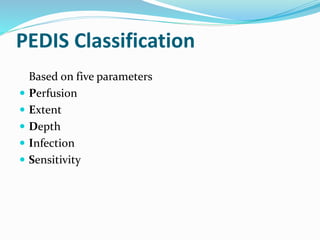
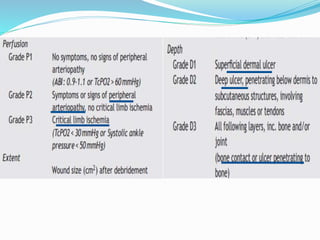
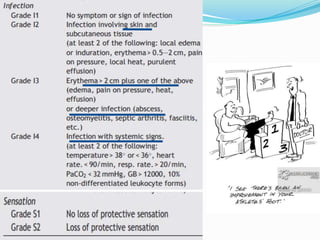
PEDIS Classification
Based on five parameters
 Perfusion
 Extent
 Depth
 Infection
 Sensitivity
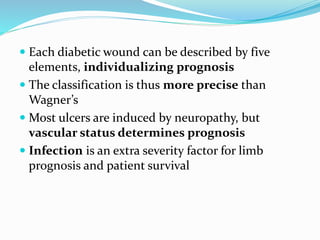
 Each diabetic wound can be described by five
elements, individualizing prognosis
 The classification is thus more precise than
Wagner’s
 Most ulcers are induced by neuropathy, but
vascular status determines prognosis
 Infection is an extra severity factor for limb
prognosis and patient survival
King’s Classification
Amit Jain’s Classification
Proposed mainly to dessiminate the knowledge of
diabetic foot complications especially in developing
Asian countries like India
 Type 1- Diabetic foot complications that are infective.
It includes cellulitis, abscess, necrotizing
fasciitis, wet gangrene, etc
 Type 2-Diabetic foot complications that are non-
infective. It includes diabetic charcot foot,
peripheral arterial disease, neuropathy, etc.
belong to this group
 Type 3- Diabetic foot complications that are mixed,
where both type 1 and type 2 complications can
occur in combination. A common example
might be a callus ulcer with underlying
osteomyelitis
Diagnosis
 Duration of diabetes, glycemic balance (glycemic
 Hemoglobin: Hb A1C > 7% indicates poorly balanced
diabetes
 Associated renal and ocular complications;
 History of ulcer or of minor amputation
Neuropathy
 Systematically looked for as part of any foot
examination in diabetic patients
 Preventive education is mandatory, as neuropathy is a
factor in foot ulcer
 Charcot foot is another consequence of neuropathy
Screening
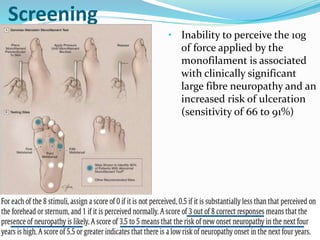
• Inability to perceive the 10g
of force applied by the
monofilament is associated
with clinically significant
large fibre neuropathy and an
increased risk of ulceration
(sensitivity of 66 to 91%)
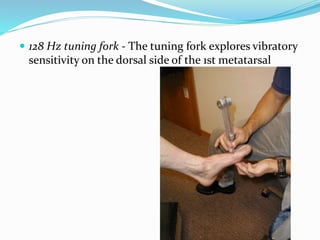
 128 Hz tuning fork - The tuning fork explores vibratory
sensitivity on the dorsal side of the 1st metatarsal
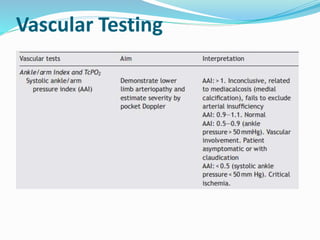
Vascular Testing
Osteo-articular imaging
Infection can be assessed on
 Standard X-ray
 CT
 MRI
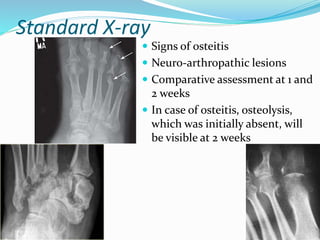
Standard X-ray
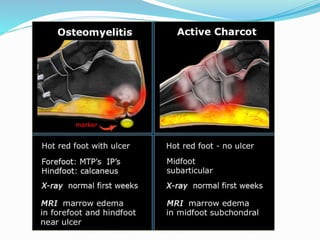
 Signs of osteitis
 Neuro-arthropathic lesions
 Comparative assessment at 1 and
2 weeks
 In case of osteitis, osteolysis,
which was initially absent, will
be visible at 2 weeks
CT Scan
 CT usefully confirms osteolysis in case of ambiguous
X-ray
USG
 Ultrasound diagnoses effusion and abscess, and may
guide puncture for bacteriology
MRI
 It differentiates osteoarthritic from neurogenic osteo-
arthropathic lesions
 Reserve it for ‘‘acute foot’’ with cellulitis
 Examination of choice for diagnosing deep soft-tissue
effusion and extension to tendon sheaths, and serves
to guide surgical drainage
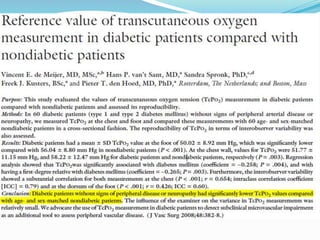
Transcutaneous oxygen
measurement (TcPO2)
 40 mm Hg - For wound healing to occur
 20 - 40 mm Hg - Impaired wound healing is noted
 20 mm Hg - Failure of wound healing
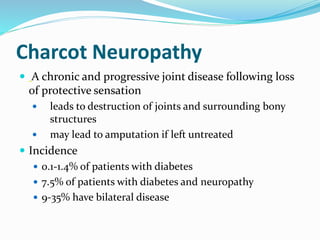
Charcot Neuropathy
 A chronic and progressive joint disease following loss
of protective sensation
 leads to destruction of joints and surrounding bony
structures
 may lead to amputation if left untreated
 Incidence
 0.1-1.4% of patients with diabetes
 7.5% of patients with diabetes and neuropathy
 9-35% have bilateral disease
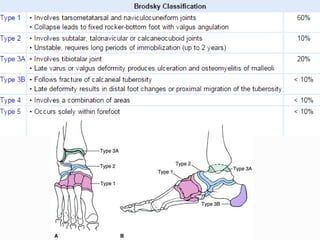
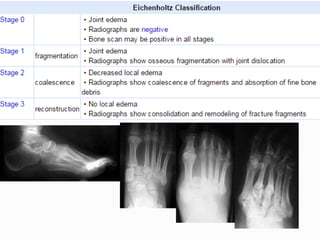
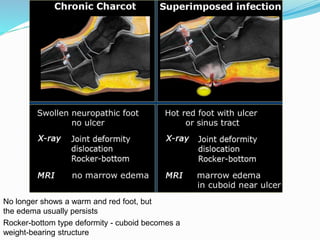
No longer shows a warm and red foot, but
the edema usually persists
Rocker-bottom type deformity - cuboid becomes a
weight-bearing structure
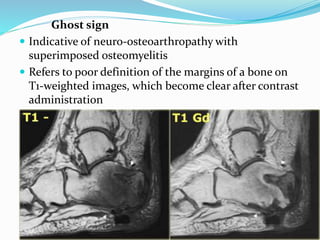
Ghost sign
 Indicative of neuro-osteoarthropathy with
superimposed osteomyelitis
 Refers to poor definition of the margins of a bone on
T1-weighted images, which become clear after contrast
administration
Organization of management
International Consensus on the Diabetic Foot,1999
 Prevention and treatment of complications in diabetic
foot should be organized at three levels
Level 1: GPs, nurses and podiatrists
 Patient awareness of foot problems and prevention, and
of early diagnosis of ulceration
Level 2: Diabetologists, diabetology nurses,
surgeons (general and/or vascular and/or
orthopedic)
 Management of basic preventive and curative care:
Level 3: Reference centers
 Reference centers should be capable of close
multidisciplinary teamwork between diabetologist,
orthopedic surgeon and vascular surgeon, to manage
the most difficult cases:
 deep infected ulcer, severe arteriopathy, Charcot foot
Treatment
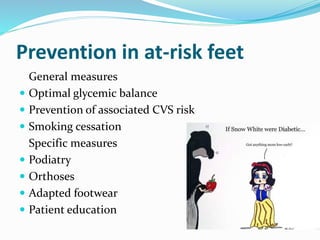
Prevention in at-risk feet
General measures
 Optimal glycemic balance
 Prevention of associated CVS risk
 Smoking cessation
Specific measures
 Podiatry
 Orthoses
 Adapted footwear
 Patient education
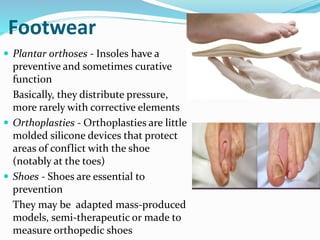
Footwear
 Plantar orthoses - Insoles have a
preventive and sometimes curative
function
Basically, they distribute pressure,
more rarely with corrective elements
 Orthoplasties - Orthoplasties are little
molded silicone devices that protect
areas of conflict with the shoe
(notably at the toes)
 Shoes - Shoes are essential to
prevention
They may be adapted mass-produced
models, semi-therapeutic or made to
measure orthopedic shoes
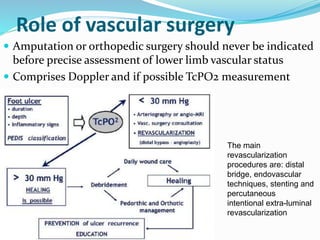
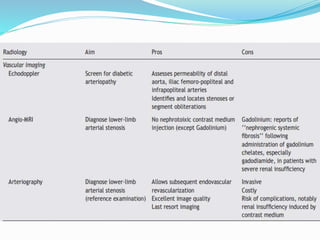
Role of vascular surgery
 Amputation or orthopedic surgery should never be indicated
before precise assessment of lower limb vascular status
 Comprises Doppler and if possible TcPO2 measurement
The main
revascularization
procedures are: distal
bridge, endovascular
techniques, stenting and
percutaneous
intentional extra-luminal
revascularization
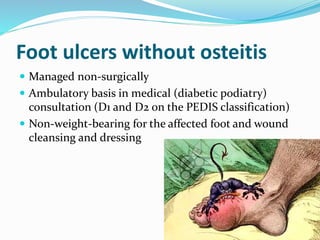
Foot ulcers without osteitis
 Managed non-surgically
 Ambulatory basis in medical (diabetic podiatry)
consultation (D1 and D2 on the PEDIS classification)
 Non-weight-bearing for the affected foot and wound
cleansing and dressing
Foot ulcers without osteitis
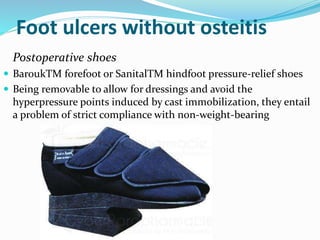
Postoperative shoes
 BaroukTM forefoot or SanitalTM hindfoot pressure-relief shoes
 Being removable to allow for dressings and avoid the
hyperpressure points induced by cast immobilization, they entail
a problem of strict compliance with non-weight-bearing
Foot ulcers without osteitis
Offloading casts
The Total Contact Cast (TTC)
 Treatment for ulcer and acute Charcot foot
 Aim - Achieve homogeneous pressure distribution in
the plantar arch throughout the step: 30 to 50% of
pressure is absorbed by the cast
 Its non-removable 24/24 concept is fundamental to
success, enabling healing in 70 to 85% of cases
 Efficacy in terms of plantar pressure relief and healing
is better in the fore- and mid-foot than in the hindfoot
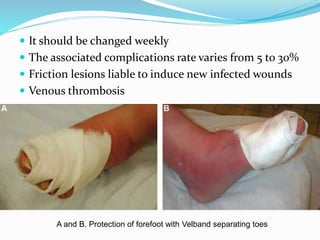
 It should be changed weekly
 The associated complications rate varies from 5 to 30%
 Friction lesions liable to induce new infected wounds
 Venous thrombosis
A and B. Protection of forefoot with Velband separating toes
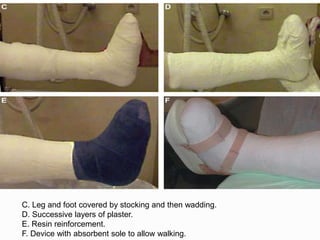
C. Leg and foot covered by stocking and then wadding.
D. Successive layers of plaster.
E. Resin reinforcement.
F. Device with absorbent sole to allow walking.
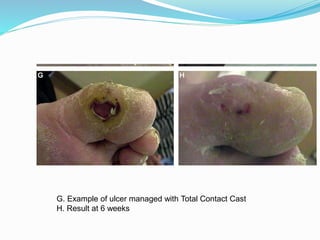
G. Example of ulcer managed with Total Contact Cast
H. Result at 6 weeks
Foot ulcers without osteitis
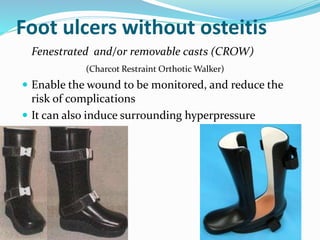
Fenestrated and/or removable casts (CROW)
(Charcot Restraint Orthotic Walker)
 Enable the wound to be monitored, and reduce the
risk of complications
 It can also induce surrounding hyperpressure
Foot ulcers without osteitis
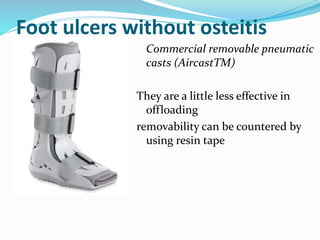
Commercial removable pneumatic
casts (AircastTM)
They are a little less effective in
offloading
removability can be countered by
using resin tape
Foot ulcers without osteitis
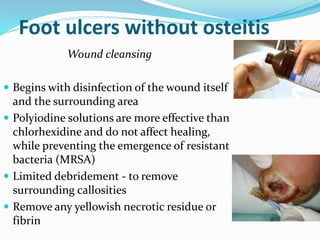
Wound cleansing
 Begins with disinfection of the wound itself
and the surrounding area
 Polyiodine solutions are more effective than
chlorhexidine and do not affect healing,
while preventing the emergence of resistant
bacteria (MRSA)
 Limited debridement - to remove
surrounding callosities
 Remove any yellowish necrotic residue or
fibrin
Foot ulcers without osteitis
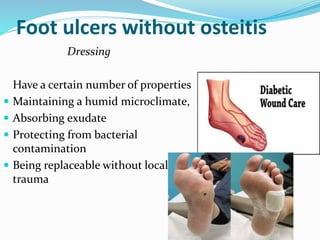
Dressing
Have a certain number of properties
 Maintaining a humid microclimate,
 Absorbing exudate
 Protecting from bacterial
contamination
 Being replaceable without local
trauma
Foot ulcers without osteitis
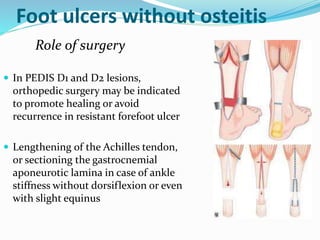
Role of surgery
 In PEDIS D1 and D2 lesions,
orthopedic surgery may be indicated
to promote healing or avoid
recurrence in resistant forefoot ulcer
 Lengthening of the Achilles tendon,
or sectioning the gastrocnemial
aponeurotic lamina in case of ankle
stiffness without dorsiflexion or even
with slight equinus
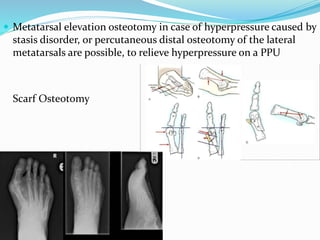
 Metatarsal elevation osteotomy in case of hyperpressure caused by
stasis disorder, or percutaneous distal osteotomy of the lateral
metatarsals are possible, to relieve hyperpressure on a PPU
Scarf Osteotomy
Foot ulcers with osteitis (PEDIS D3)
 Requires prolonged antibiotherapy, generally
beginning with a parenteral course
 Multidisciplinary management may call on surgeons
for revascularization, bone biopsy, bone curettage or
minor amputation
Foot ulcers with osteitis
Amputation
 Obtain a stump that can easily be fitted, to conserve as
great a length as possible while
 Enabling direct closure, and to conserve the patient’s
autonomy
Foot ulcers with osteitis
Partial toe amputation
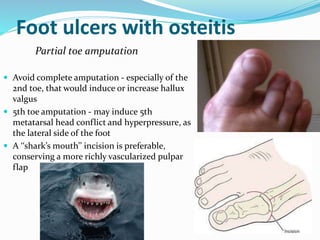
 Avoid complete amputation - especially of the
2nd toe, that would induce or increase hallux
valgus
 5th toe amputation - may induce 5th
metatarsal head conflict and hyperpressure, as
the lateral side of the foot
 A ‘‘shark’s mouth’’ incision is preferable,
conserving a more richly vascularized pulpar
flap
Foot ulcers with osteitis
Transmetatarsal ray amputation
 Alternative to complete toe amputation
 Avoiding hyperpressure in the remaining head, which would
induce recurrence
 The 5th metatarsal should be osteotomized obliquely
 Avoid hallux or even 1st ray amputation, which would impact the
lateral rays, inducing claw toe
 If necessary - 1st metatarsal length should be conserved as much
as possible, so as to allow for possible secondary transmetatarsal
amputation.
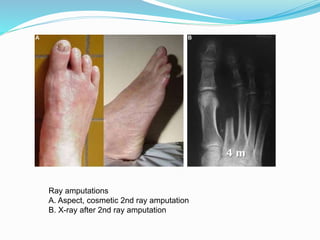
Ray amputations
A. Aspect, cosmetic 2nd ray amputation
B. X-ray after 2nd ray amputation
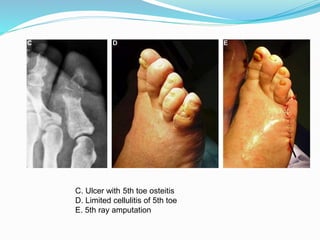
C. Ulcer with 5th toe osteitis
D. Limited cellulitis of 5th toe
E. 5th ray amputation
Foot ulcers with osteitis
Transmetatarsal amputation
 Considered when it is not possible to conserve at least three
metatarsals on the lateral rays or if the 1st ray is resected
 It is associated to plantar extensor tenoplasty to avoid
secondary equinus and conserve active motion in
dorsiflexion
 The level of amputation depends on the septic lesions:
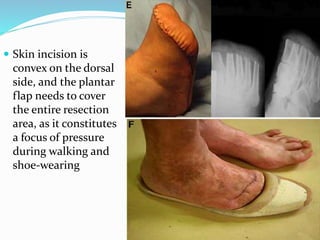
 Skin incision is
convex on the dorsal
side, and the plantar
flap needs to cover
the entire resection
area, as it constitutes
a focus of pressure
during walking and
shoe-wearing
Foot ulcers with osteitis
Mid- and hind-foot
 More difficult
 Amputation beyond the tarso-metatarsal Lisfranc joint
line is less functionally satisfactory
 Heavy antibiotherapy prolonged for several months
 Surgery is complementary
Foot ulcers with osteitis
Lisfranc amputation
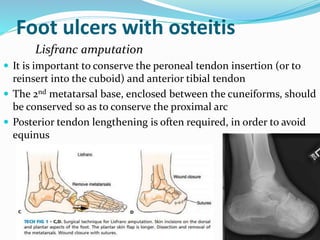
 It is important to conserve the peroneal tendon insertion (or to
reinsert into the cuboid) and anterior tibial tendon
 The 2nd metatarsal base, enclosed between the cuneiforms, should
be conserved so as to conserve the proximal arc
 Posterior tendon lengthening is often required, in order to avoid
equinus
Foot ulcers with osteitis
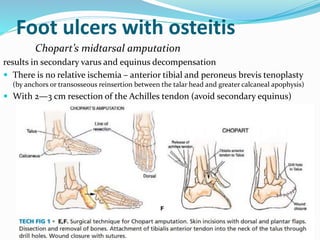
Chopart’s midtarsal amputation
results in secondary varus and equinus decompensation
 There is no relative ischemia – anterior tibial and peroneus brevis tenoplasty
(by anchors or transosseous reinsertion between the talar head and greater calcaneal apophysis)
 With 2—3 cm resection of the Achilles tendon (avoid secondary equinus)
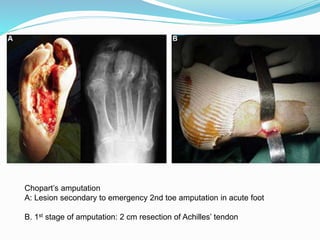
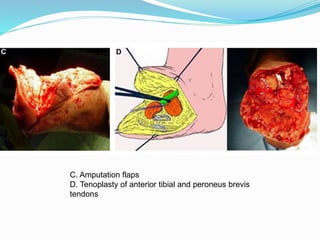
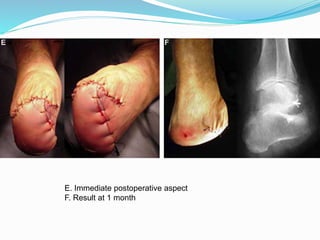
Chopart’s amputation
A: Lesion secondary to emergency 2nd toe amputation in acute foot
B. 1st stage of amputation: 2 cm resection of Achilles’ tendon
C. Amputation flaps
D. Tenoplasty of anterior tibial and peroneus brevis
tendons
E. Immediate postoperative aspect
F. Result at 1 month
Foot ulcers with osteitis
Partial or total calcanectomy
 In case of loss of talar substance associated with
calcaneal osteitis, partial or often total calcaneal
resection
 The soft-tissue gain following bone resection often
allows primary closure
 A talar compensation orthosis is then required
Foot ulcers with osteitis
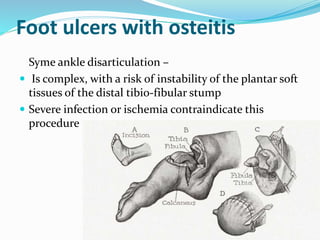
Syme ankle disarticulation –
 Is complex, with a risk of instability of the plantar soft
tissues of the distal tibio-fibular stump
 Severe infection or ischemia contraindicate this
procedure
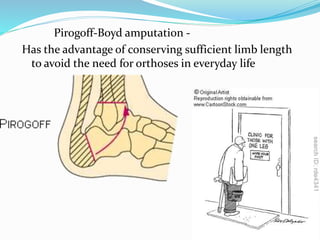
Pirogoff-Boyd amputation -
Has the advantage of conserving sufficient limb length
to avoid the need for orthoses in everyday life
‘‘Acute’’ foot
 Covers ulcer associated with signs of severe
locoregional (PEDIS I3) and/or general infection
(PEDIS I4)
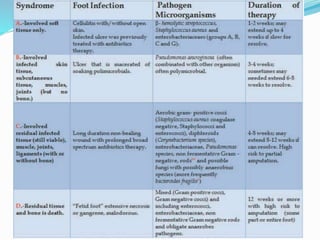
 ‘‘cool’’ acute-foot lesions using parenteral empiric
broad-spectrum bior tri-therapy
Cellulitis
 Amoxicilline—clavulanic acid ± aminoglycosides
(gentamicin or netilmicin) or quinolones
Limb is threatened
 Piperacillin—tazobactam + teicoplanin (or
vancomycin or linezolid) + (quinolones)
Septic shock
 Imipenem (or ertapenem) + (teicoplanin or
vancomycin or linezolid) + (aminoglycosides)
 After 48—72 hours
 locoregional and general infection evolution is
reassessed, and indications for abscess debridement or
iterative amputation are considered
 Emergency gadolinium-enhanced MRI is very useful in
acute foot to diagnose deep soft-tissue effusion and
extension into tendon sheaths so as to guide surgical
drainage
 A revascularization procedure ahead of possible
orthopedic surgery may be considered
Conclusion
Orthopedic surgeon plays a central role in providing a
biomechanical perspective
To avoid creating or leaving areas of hyperpressure that
would induce recurrence of ulceration
In case of ulceration, scheduled surgery is preferable to
emergency intervention, even in ‘‘acute’’ foot; lesions
should always be cooled by antibiotherapy, even if this
has to be empiric
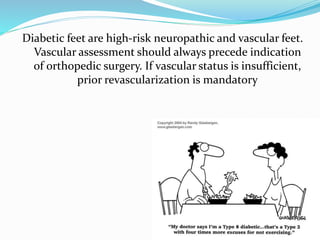
Diabetic feet are high-risk neuropathic and vascular feet.
Vascular assessment should always precede indication
of orthopedic surgery. If vascular status is insufficient,
prior revascularization is mandatory
THANK YOU

Diabetic foot vinay 1

  • 1.
  • 2.
    Diabetic foot Introduction  Diabetesmellitus is a group of metabolic diseases characterized by hyperglycemia resulting from defects in insulin secretion, insulin action, or both.  The chronic hyperglycemia of diabetes is associated with long-term damage, dysfunction, and failure of various organs, especially the eyes, kidneys, nerves, heart, and blood vessels.  Diabetic foot is defined as any foot pathology that results directly from diabetes or its long term complications
  • 3.
    Epidemiology  Lesions ofthe feet affect ~15% of diabetics in their life with an amputation rate 15 fold higher than non diabetics  Foot ulcerations are the commonest cause of hospital admission in diabetics  Atherosclerosis rarely seen in type I diabetics < 40 yrs while it may be present even before diagnosis in type II  Indication for lower limb amputation Diabetes - 17.5% PVD - 55.3%
  • 4.
    Epidemiology – riskfactors  Male sex  DM > 10 years duration  Peripheral neuropathy  Abnormal foot structure  Peripheral arterial disease  Smoking  H/O previous ulceration / amputation  Poor glycemic control (HbA1c > 7%)
  • 5.
    Pathophysiology  Factors leadingto development of diabetic foot:  Diabetic macroangiopathy – peripheral arterial occlusive disease  Diabetic microangiopathy – thickening of basement membranes  Diabetic polyneuropathy  Diabetic osteoathropathy – abnormal foot biomechanics  Reduced resistance to infection  Delayed wound healing  Reduced rate of collateral vessel formation
  • 6.
    Peripheral Neuropathy  Prevalence– 20-60 %  Increases with chronic hyperglycemia, duration of diabetes and patient age  90% of cases of diabetic foot ulcer  Sensory neuropathy  Motor neuropathy  Vegetative neuropathy
  • 7.
    Sensory neuropathy  Predominates Large fibers - tactile and deep sensitivity  Small fibers - pain and heat sensitivity Motor neuropathy  Weakness and atrophy of the intrinsic muscles of the foot-clawtoe  Loss of joint mobility
  • 8.
     Secondarily, itcontributes to loss of joint mobility, which is also due to conjunctive tissue glycosylation inducing fibrosis of the joint, soft tissue and skin
  • 9.
    Vegetative neuropathy  Inducesskin dryness with crevasses and fissures providing entry points for infection  Hyperkeratosis in reaction to hyperpressure  Opens arteriovenous shunts and induces deregulation of capillary flow  The neuropathic foot is hot, with frequent edema and dilated dorsal veins
  • 10.
    Arteriopathy Macroangiopathy  Atheromatous lesions- classically showing multi-segment and distal involvement  distal superficial femoral, popliteal, tibial, peroneal and pedis arteries
  • 11.
    Microangiopathy  Thickening ofthe capillary membrane,induce abnormal exchange and aggravate tissue ischemia  Induces chronic ischemia, which is an aggravating factor in foot lesions  The foot is cold and the skin becomes thin and shiny
  • 12.
    The Lewis TripleFlare Response is absent in diabetic patients affecting wound healing
  • 13.
    Evaluation of footdeformity  Foot deformity may result from motor neuropathy and muscle imbalance, or Charcot foot  Motor neuropathy leads to the development of a cavus foot with a mild equinus contracture at the ankle, claw toes, and increased pressure to the forefoot (metatarsal heads)
  • 14.
     Claw toeresults from imbalance between the intrinsic muscles (lumbricals and interossei muscles that flex the MTP and extend the PIP and DIP) and  The long extensor and flexor tendons dominate (opposite) – [extensor digitorum longus & flexor digitorum longus flexes  Ulceration in three distinctive sites
  • 15.
     Limited dorsiflexionand Achilles tendon tension increase forefoot plantar pressure and contribute to ulcer formation  Hallux valgus deformity contributes to ulcer formation at the bunion
  • 17.
    Biomechanics of Ulceration Loss of pressure and pain sensitivity leads to repeated local hyperpressure shear stress in the hyperkeratotic region  Under which effusion develops and exteriorizes into an ulcer  Mechanical, thermal or chemical wound may also lead to ulceration - diagnosed late due to the absence of associated pain
  • 19.
  • 20.
    Ulcer classification  WagnerMeggitt Classification  Texas Classification  Pedis Classification  King’s Classification  Amit Jain’s Classification
  • 21.
  • 22.
    DRAWBACKS  First ofall it does not adequately address all the diabetic foot ulceration and infection  Only one of the 6 grades includes infection  Limited in its ability to identify and describe vascular disease as an independent risk factor  Superficial wounds that are infected or dysvascular are not able to be classified by this system
  • 23.
  • 24.
    PEDIS Classification Based onfive parameters  Perfusion  Extent  Depth  Infection  Sensitivity
  • 27.
     Each diabeticwound can be described by five elements, individualizing prognosis  The classification is thus more precise than Wagner’s  Most ulcers are induced by neuropathy, but vascular status determines prognosis  Infection is an extra severity factor for limb prognosis and patient survival
  • 28.
  • 29.
    Amit Jain’s Classification Proposedmainly to dessiminate the knowledge of diabetic foot complications especially in developing Asian countries like India
  • 30.
     Type 1-Diabetic foot complications that are infective. It includes cellulitis, abscess, necrotizing fasciitis, wet gangrene, etc  Type 2-Diabetic foot complications that are non- infective. It includes diabetic charcot foot, peripheral arterial disease, neuropathy, etc. belong to this group  Type 3- Diabetic foot complications that are mixed, where both type 1 and type 2 complications can occur in combination. A common example might be a callus ulcer with underlying osteomyelitis
  • 31.
    Diagnosis  Duration ofdiabetes, glycemic balance (glycemic  Hemoglobin: Hb A1C > 7% indicates poorly balanced diabetes  Associated renal and ocular complications;  History of ulcer or of minor amputation
  • 32.
    Neuropathy  Systematically lookedfor as part of any foot examination in diabetic patients  Preventive education is mandatory, as neuropathy is a factor in foot ulcer  Charcot foot is another consequence of neuropathy
  • 33.
    Screening • Inability toperceive the 10g of force applied by the monofilament is associated with clinically significant large fibre neuropathy and an increased risk of ulceration (sensitivity of 66 to 91%)
  • 34.
     128 Hztuning fork - The tuning fork explores vibratory sensitivity on the dorsal side of the 1st metatarsal
  • 35.
  • 37.
    Osteo-articular imaging Infection canbe assessed on  Standard X-ray  CT  MRI
  • 38.
    Standard X-ray  Signsof osteitis  Neuro-arthropathic lesions  Comparative assessment at 1 and 2 weeks  In case of osteitis, osteolysis, which was initially absent, will be visible at 2 weeks
  • 39.
    CT Scan  CTusefully confirms osteolysis in case of ambiguous X-ray USG  Ultrasound diagnoses effusion and abscess, and may guide puncture for bacteriology
  • 40.
    MRI  It differentiatesosteoarthritic from neurogenic osteo- arthropathic lesions  Reserve it for ‘‘acute foot’’ with cellulitis  Examination of choice for diagnosing deep soft-tissue effusion and extension to tendon sheaths, and serves to guide surgical drainage
  • 41.
    Transcutaneous oxygen measurement (TcPO2) 40 mm Hg - For wound healing to occur  20 - 40 mm Hg - Impaired wound healing is noted  20 mm Hg - Failure of wound healing
  • 43.
    Charcot Neuropathy  Achronic and progressive joint disease following loss of protective sensation  leads to destruction of joints and surrounding bony structures  may lead to amputation if left untreated  Incidence  0.1-1.4% of patients with diabetes  7.5% of patients with diabetes and neuropathy  9-35% have bilateral disease
  • 47.
    No longer showsa warm and red foot, but the edema usually persists Rocker-bottom type deformity - cuboid becomes a weight-bearing structure
  • 48.
    Ghost sign  Indicativeof neuro-osteoarthropathy with superimposed osteomyelitis  Refers to poor definition of the margins of a bone on T1-weighted images, which become clear after contrast administration
  • 49.
    Organization of management InternationalConsensus on the Diabetic Foot,1999  Prevention and treatment of complications in diabetic foot should be organized at three levels Level 1: GPs, nurses and podiatrists  Patient awareness of foot problems and prevention, and of early diagnosis of ulceration
  • 50.
    Level 2: Diabetologists,diabetology nurses, surgeons (general and/or vascular and/or orthopedic)  Management of basic preventive and curative care: Level 3: Reference centers  Reference centers should be capable of close multidisciplinary teamwork between diabetologist, orthopedic surgeon and vascular surgeon, to manage the most difficult cases:  deep infected ulcer, severe arteriopathy, Charcot foot
  • 51.
  • 52.
    Prevention in at-riskfeet General measures  Optimal glycemic balance  Prevention of associated CVS risk  Smoking cessation Specific measures  Podiatry  Orthoses  Adapted footwear  Patient education
  • 53.
    Footwear  Plantar orthoses- Insoles have a preventive and sometimes curative function Basically, they distribute pressure, more rarely with corrective elements  Orthoplasties - Orthoplasties are little molded silicone devices that protect areas of conflict with the shoe (notably at the toes)  Shoes - Shoes are essential to prevention They may be adapted mass-produced models, semi-therapeutic or made to measure orthopedic shoes
  • 54.
    Role of vascularsurgery  Amputation or orthopedic surgery should never be indicated before precise assessment of lower limb vascular status  Comprises Doppler and if possible TcPO2 measurement The main revascularization procedures are: distal bridge, endovascular techniques, stenting and percutaneous intentional extra-luminal revascularization
  • 55.
    Foot ulcers withoutosteitis  Managed non-surgically  Ambulatory basis in medical (diabetic podiatry) consultation (D1 and D2 on the PEDIS classification)  Non-weight-bearing for the affected foot and wound cleansing and dressing
  • 56.
    Foot ulcers withoutosteitis Postoperative shoes  BaroukTM forefoot or SanitalTM hindfoot pressure-relief shoes  Being removable to allow for dressings and avoid the hyperpressure points induced by cast immobilization, they entail a problem of strict compliance with non-weight-bearing
  • 57.
    Foot ulcers withoutosteitis Offloading casts The Total Contact Cast (TTC)  Treatment for ulcer and acute Charcot foot  Aim - Achieve homogeneous pressure distribution in the plantar arch throughout the step: 30 to 50% of pressure is absorbed by the cast  Its non-removable 24/24 concept is fundamental to success, enabling healing in 70 to 85% of cases  Efficacy in terms of plantar pressure relief and healing is better in the fore- and mid-foot than in the hindfoot
  • 58.
     It shouldbe changed weekly  The associated complications rate varies from 5 to 30%  Friction lesions liable to induce new infected wounds  Venous thrombosis A and B. Protection of forefoot with Velband separating toes
  • 59.
    C. Leg andfoot covered by stocking and then wadding. D. Successive layers of plaster. E. Resin reinforcement. F. Device with absorbent sole to allow walking.
  • 60.
    G. Example ofulcer managed with Total Contact Cast H. Result at 6 weeks
  • 61.
    Foot ulcers withoutosteitis Fenestrated and/or removable casts (CROW) (Charcot Restraint Orthotic Walker)  Enable the wound to be monitored, and reduce the risk of complications  It can also induce surrounding hyperpressure
  • 62.
    Foot ulcers withoutosteitis Commercial removable pneumatic casts (AircastTM) They are a little less effective in offloading removability can be countered by using resin tape
  • 63.
    Foot ulcers withoutosteitis Wound cleansing  Begins with disinfection of the wound itself and the surrounding area  Polyiodine solutions are more effective than chlorhexidine and do not affect healing, while preventing the emergence of resistant bacteria (MRSA)  Limited debridement - to remove surrounding callosities  Remove any yellowish necrotic residue or fibrin
  • 64.
    Foot ulcers withoutosteitis Dressing Have a certain number of properties  Maintaining a humid microclimate,  Absorbing exudate  Protecting from bacterial contamination  Being replaceable without local trauma
  • 65.
    Foot ulcers withoutosteitis Role of surgery  In PEDIS D1 and D2 lesions, orthopedic surgery may be indicated to promote healing or avoid recurrence in resistant forefoot ulcer  Lengthening of the Achilles tendon, or sectioning the gastrocnemial aponeurotic lamina in case of ankle stiffness without dorsiflexion or even with slight equinus
  • 66.
     Metatarsal elevationosteotomy in case of hyperpressure caused by stasis disorder, or percutaneous distal osteotomy of the lateral metatarsals are possible, to relieve hyperpressure on a PPU Scarf Osteotomy
  • 67.
    Foot ulcers withosteitis (PEDIS D3)  Requires prolonged antibiotherapy, generally beginning with a parenteral course  Multidisciplinary management may call on surgeons for revascularization, bone biopsy, bone curettage or minor amputation
  • 68.
    Foot ulcers withosteitis Amputation  Obtain a stump that can easily be fitted, to conserve as great a length as possible while  Enabling direct closure, and to conserve the patient’s autonomy
  • 69.
    Foot ulcers withosteitis Partial toe amputation  Avoid complete amputation - especially of the 2nd toe, that would induce or increase hallux valgus  5th toe amputation - may induce 5th metatarsal head conflict and hyperpressure, as the lateral side of the foot  A ‘‘shark’s mouth’’ incision is preferable, conserving a more richly vascularized pulpar flap
  • 70.
    Foot ulcers withosteitis Transmetatarsal ray amputation  Alternative to complete toe amputation  Avoiding hyperpressure in the remaining head, which would induce recurrence  The 5th metatarsal should be osteotomized obliquely  Avoid hallux or even 1st ray amputation, which would impact the lateral rays, inducing claw toe  If necessary - 1st metatarsal length should be conserved as much as possible, so as to allow for possible secondary transmetatarsal amputation.
  • 71.
    Ray amputations A. Aspect,cosmetic 2nd ray amputation B. X-ray after 2nd ray amputation
  • 72.
    C. Ulcer with5th toe osteitis D. Limited cellulitis of 5th toe E. 5th ray amputation
  • 73.
    Foot ulcers withosteitis Transmetatarsal amputation  Considered when it is not possible to conserve at least three metatarsals on the lateral rays or if the 1st ray is resected  It is associated to plantar extensor tenoplasty to avoid secondary equinus and conserve active motion in dorsiflexion  The level of amputation depends on the septic lesions:
  • 74.
     Skin incisionis convex on the dorsal side, and the plantar flap needs to cover the entire resection area, as it constitutes a focus of pressure during walking and shoe-wearing
  • 75.
    Foot ulcers withosteitis Mid- and hind-foot  More difficult  Amputation beyond the tarso-metatarsal Lisfranc joint line is less functionally satisfactory  Heavy antibiotherapy prolonged for several months  Surgery is complementary
  • 76.
    Foot ulcers withosteitis Lisfranc amputation  It is important to conserve the peroneal tendon insertion (or to reinsert into the cuboid) and anterior tibial tendon  The 2nd metatarsal base, enclosed between the cuneiforms, should be conserved so as to conserve the proximal arc  Posterior tendon lengthening is often required, in order to avoid equinus
  • 77.
    Foot ulcers withosteitis Chopart’s midtarsal amputation results in secondary varus and equinus decompensation  There is no relative ischemia – anterior tibial and peroneus brevis tenoplasty (by anchors or transosseous reinsertion between the talar head and greater calcaneal apophysis)  With 2—3 cm resection of the Achilles tendon (avoid secondary equinus)
  • 78.
    Chopart’s amputation A: Lesionsecondary to emergency 2nd toe amputation in acute foot B. 1st stage of amputation: 2 cm resection of Achilles’ tendon
  • 79.
    C. Amputation flaps D.Tenoplasty of anterior tibial and peroneus brevis tendons
  • 80.
    E. Immediate postoperativeaspect F. Result at 1 month
  • 81.
    Foot ulcers withosteitis Partial or total calcanectomy  In case of loss of talar substance associated with calcaneal osteitis, partial or often total calcaneal resection  The soft-tissue gain following bone resection often allows primary closure  A talar compensation orthosis is then required
  • 82.
    Foot ulcers withosteitis Syme ankle disarticulation –  Is complex, with a risk of instability of the plantar soft tissues of the distal tibio-fibular stump  Severe infection or ischemia contraindicate this procedure
  • 83.
    Pirogoff-Boyd amputation - Hasthe advantage of conserving sufficient limb length to avoid the need for orthoses in everyday life
  • 84.
    ‘‘Acute’’ foot  Coversulcer associated with signs of severe locoregional (PEDIS I3) and/or general infection (PEDIS I4)  ‘‘cool’’ acute-foot lesions using parenteral empiric broad-spectrum bior tri-therapy
  • 85.
    Cellulitis  Amoxicilline—clavulanic acid± aminoglycosides (gentamicin or netilmicin) or quinolones Limb is threatened  Piperacillin—tazobactam + teicoplanin (or vancomycin or linezolid) + (quinolones) Septic shock  Imipenem (or ertapenem) + (teicoplanin or vancomycin or linezolid) + (aminoglycosides)
  • 86.
     After 48—72hours  locoregional and general infection evolution is reassessed, and indications for abscess debridement or iterative amputation are considered  Emergency gadolinium-enhanced MRI is very useful in acute foot to diagnose deep soft-tissue effusion and extension into tendon sheaths so as to guide surgical drainage  A revascularization procedure ahead of possible orthopedic surgery may be considered
  • 88.
    Conclusion Orthopedic surgeon playsa central role in providing a biomechanical perspective To avoid creating or leaving areas of hyperpressure that would induce recurrence of ulceration In case of ulceration, scheduled surgery is preferable to emergency intervention, even in ‘‘acute’’ foot; lesions should always be cooled by antibiotherapy, even if this has to be empiric
  • 89.
    Diabetic feet arehigh-risk neuropathic and vascular feet. Vascular assessment should always precede indication of orthopedic surgery. If vascular status is insufficient, prior revascularization is mandatory
  • 90.

Editor's Notes

  • #8 Secondarily, it contributes to loss of joint mobility, which is also due to conjunctive tissue glycosylation inducing fibrosis of the joint, soft tissue and skin
  • #18 diagnosed late due to the absence of associated pain
  • #31 Though this classification does not predict the outcome and it dose not guide specific therapy. It definitely helps in decision making in clinical practice [10]. For example, Type 1 complications require immediate care and treatment whereas Type 2 and 3 lesions can wait for detailed investigation and treatment
  • #39 Cortical disruption and osteolysis are present
  • #66 The aim of such surgery is to reduce mechanical stress in the forefoot
  • #70 exerts a braking effect and the hallux a propulsion effect during gait
  • #78 Tendon imbalance creates orthotic problems and cutaneous recurrence around the anterior amputation stump, preventing active dorsiflexion (Fig. 9)
  • #85 We usually avoid any emergency surgery, which leads to extensive debridement or amputation without skin closure. Directed cicatrization then often takes several weeks, with fragile stumps and risk of recurrence of ulcer
  • #87 Meanwhile, assessment is completed, notably with advanced vascular evaluation by TcPO2 and arterial Doppler and, depending on the results, arteriography and/or angio-MRI