BELOW KNEE (TRANSTIBIAL)
      AMPUTATION
OUTLINE
 INTRODUCTION
 EPIDEMIOLOGY
 RELEVANT ANATOMY
 CLASSIFICATION
 INDICATIONS
 LEVEL OF AMPUTATION
 PREOPERATIVE PREPARATIONS
 INTRAOPERATIVE PROCEDURE
 POSTOPERATIVE CARE/REHABILITATION
 COMPLICATIONS
 PROSTHESIS
 SITUATION IN OUR SUBREGION
 CONCLUSION
INTRODUCTION
 Amputation is the surgical removal of a limb or part of a limb
  by cutting through the shaft of the bone.
 It is the most ancient surgical procedures. Early surgical
  amputation was a crude procedure by which a limb was
  rapidly severed from an unanaesthesized patient,the open
  stump was crushed or dipped in boiling oil to obtain
  haemostasis.
 Hippocrates 1st to use ligature which was lost during the dark
  ages.
 1529:Pare reintroduced it & artery forceps.
 1674:Morel introduced tourniquet.
 With the introduction of general anaesthesia & antiseptic
  technique in the late 19th century surgeons could now fashion
  a functional stump.
EPIDEMIOLOGY
 More than 300,000 patients with amputations live in the U S
  according to NCHS and about 65,000 amputations are
  performed annually.
 >90% of amputations performed in western world are
  secondary to PVDx.
 In younger patient trauma is the leading cause followed by
  malignancy.
 1965, AK : BK = 70 : 30
 1980, AK : BK = 30 : 70.
 In FMC Owerri,41 BKA were done in the last 2years with M
  : F = 1.7 : 1.
 Diabetic foot gangrene 88%, Trauma & TBS 5% each, others
  2%
RELEVANT ANATOMY
CLASSIFICATION
 1) Emergency or Elective.
 2)Provisional or Definitive.
 3)End bearing or Non end bearing.
INDICATIONS
Colloquially 3 D’s
 Dead (or Dying)                  Dangerous limb
   Gangrene                         Malignant tumours
   Peripheral Vascular disease        Osteosarcoma
    Atherosclerosis                    Marjolins ulcer
    Embolism                           Melanoma

    DM                               Potentially lethal sepsis
                                     Crush Injury

                                   Damn Nuisance
  Severe Trauma
                                       Pain
  Burns
                                       Gross malformation
  Frost bite                           Recurrent Sepsis
  Bone setters gangrene                Severe loss of function
                                       Madura foot
                                       Elephantiasis
LEVEL OF AMPUTATION
 Determined by : a) Disease process b) Viability of tissues and
  c) Prosthesis available.
 Determination of adequate blood flow:           Clinical : i.)
  lowest palpable pulse                ii.)skin colour and
  temperature                  iii)bleeding at surgery
  Others :
  .Doppler ultrasonography: Ankle : brachial index > 0.5.
 Compression pressure at the calf >65mmHg.
 Transcutaneous oxygen measurement >40mmHg.
 Skin perfusion pressure measurement by infrared
  thermography or laser doppler flowmetry.
 Too short a stump may tend to slip out of prosthesis. Too long
  a stump may have
inadequate circulation & can become painful or ulcerate.
PREOPERATIVE PREPARATION
 Assessment and resuscitation
 Investigate & address co-morbid conditions in consultation
  with physicians, Anaesthetists &
  Physiotherapist(multidisciplinary).
 FBC, FBS, Se/u/c, urinalysis, chest x-ray, ECG, serum
  albumin(>3.5g/dl).
 Informed consent –pathology, inevitability of amputation,
  complications, availability of prosthesis
 Determine the level of amputation.               Goal of the
  surgeon is to:                         a)Find a place where
  healing is mostly to be complete.
  b)To have an ideal stump for prosthesis fitting.
QUALITIES OF AN IDEAL STUMP
 1)Should heal adequately.
 2)Should have rounded, gently contour with adequate muscle
  padding.
 3)Should have sufficient length to bear prosthesis.
 4)Should have thin scar which does not interfere with
  prosthetic function.
 5)Should have adequate adjacent joint movt.
 6)Should have adequate blood supply.
INTRAOPERATIVE PROCEDURE
 ANAESTHESIA : GA/Spinal
 POSITION : Supine
 PREINCISION : prophylactic antibiotics, exsanguinate,
  tourniquet, skin prep & draping.
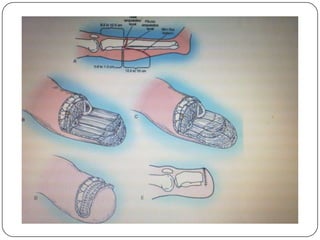
 PROCEDURE:                                              .An
  incision to outline a long posterior flap & a short anterior
  one --- combined length 1 ½ times the diameter of the leg at
  the level of amputation.
 Deepened to the bone. Periosteum raised.
 Section tibia at level of incision, bevel anterior surface.
  Fibular 2-3cm proximally. Smoothen round sharp margins.
 Vessels isolated and double ligated,Nerves pulled down & cut
  with a sharp knife & allowed to retract into the soft tissue.
 Irrigation with N/S, Removal of tourniquet to meticulously
  secure haemostasis.
 Myoplasty or Myodesis done over a drain after trimming the
  muscle to size.
 Close skin with interrupted non absorbable sutures.
 Wound dressing- soft or rigid.
POSTOP CARE/ REHABILITATION
 General care: Control of pain, prevention oedema,
  prevention of infection, DVT prevention, care of concurrent
  medical conditions., Suture removal.
 Physiotherapy: Muscles exercised, joints kept mobile,
  patients taught how to use crutches & prosthesis.
 Stump dressing:                                      .Soft
 dressing: gauze, cotton wool, bandage. Teach patient or
 relative stump bandaging.     .Rigid dressing: POP cast
 can be used with stump socks & padding. A jig could be
 applied that allows attachment and alignment for early pylon
 use where limited weight bearing with BAC is possible.
 Cast changed every 5-7 days for skin care. Within 3-4 wks
  rigid dressing can be changed to a removable temporary
  prosthesis.
 Benefits: a)prevention of oedema                  b)enhanced
  wound healing                        c)early maturation of
  stump                       d)decreased post op pain
  e)allow early ambulation                         f)position
  stump to avoid contracture
 Rehabilitation of the patient is a multidisciplinary approach.
 Aim is to bring the patient to an optimum of physical ,
  mental, emotional, social, vocational, & economic efficiency.
COMPLICATIONS
 Early
    Haemorrhage
    Haematoma
    Infection
 Late
      depression
      Stump ulceration
      Flap necrosis
      Painful scar
      Phantom limb
      Phantom pain
      Joint stiffness
      Osteomyelitis
      Osteoporosis & tendency to fracture
PROSTHESIS
 Is the substitution of a part of the body to achieve optimum
  function. Eg BKA prosthesis                      A)patellar
  tendon bearing                            B)solid ankle cushion
  heel                          Advantages: i) Cosmesis
  ii)Ambulation      iii) Function of the part.
  Disadvantages:
  i)infection ii)pressure ulcer iii) cost
SITUATION IN OUR SUBREGION
 Socio-cultural belief a)re-incarnation            b)Husband
    authority over wife                 c)Children never have
    authority                 d)Males usually decides
   Traditional bone setters
   Few prosthetic centers
   Poverty
   Few centers for microvascular surgeries.
CONCLUSION
 Amputation should be done by surgeons who have
  knowledge of amputation surgical principles,postop
  rehabilitation, & prosthetic design.
 Improved prosthetic design does not compensate for a poorly
  performed surgical procedure.
 Amputation should not be viewed as a failure
of treatment but rather as the 1st step towards a patient’s
return to a more comfortable & productive life.
Below knee amputation

Below knee amputation

  • 1.
  • 2.
    OUTLINE  INTRODUCTION  EPIDEMIOLOGY RELEVANT ANATOMY  CLASSIFICATION  INDICATIONS  LEVEL OF AMPUTATION  PREOPERATIVE PREPARATIONS  INTRAOPERATIVE PROCEDURE
  • 3.
     POSTOPERATIVE CARE/REHABILITATION COMPLICATIONS  PROSTHESIS  SITUATION IN OUR SUBREGION  CONCLUSION
  • 4.
    INTRODUCTION  Amputation isthe surgical removal of a limb or part of a limb by cutting through the shaft of the bone.  It is the most ancient surgical procedures. Early surgical amputation was a crude procedure by which a limb was rapidly severed from an unanaesthesized patient,the open stump was crushed or dipped in boiling oil to obtain haemostasis.
  • 5.
     Hippocrates 1stto use ligature which was lost during the dark ages.  1529:Pare reintroduced it & artery forceps.  1674:Morel introduced tourniquet.  With the introduction of general anaesthesia & antiseptic technique in the late 19th century surgeons could now fashion a functional stump.
  • 6.
    EPIDEMIOLOGY  More than300,000 patients with amputations live in the U S according to NCHS and about 65,000 amputations are performed annually.  >90% of amputations performed in western world are secondary to PVDx.  In younger patient trauma is the leading cause followed by malignancy.  1965, AK : BK = 70 : 30
  • 7.
     1980, AK: BK = 30 : 70.  In FMC Owerri,41 BKA were done in the last 2years with M : F = 1.7 : 1.  Diabetic foot gangrene 88%, Trauma & TBS 5% each, others 2%
  • 8.
  • 9.
    CLASSIFICATION  1) Emergencyor Elective.  2)Provisional or Definitive.  3)End bearing or Non end bearing.
  • 10.
    INDICATIONS Colloquially 3 D’s Dead (or Dying)  Dangerous limb  Gangrene  Malignant tumours  Peripheral Vascular disease  Osteosarcoma Atherosclerosis  Marjolins ulcer Embolism  Melanoma DM  Potentially lethal sepsis  Crush Injury  Damn Nuisance Severe Trauma  Pain Burns  Gross malformation Frost bite  Recurrent Sepsis Bone setters gangrene  Severe loss of function  Madura foot  Elephantiasis
  • 12.
    LEVEL OF AMPUTATION Determined by : a) Disease process b) Viability of tissues and c) Prosthesis available.  Determination of adequate blood flow: Clinical : i.) lowest palpable pulse ii.)skin colour and temperature iii)bleeding at surgery Others : .Doppler ultrasonography: Ankle : brachial index > 0.5.
  • 13.
     Compression pressureat the calf >65mmHg.  Transcutaneous oxygen measurement >40mmHg.  Skin perfusion pressure measurement by infrared thermography or laser doppler flowmetry.  Too short a stump may tend to slip out of prosthesis. Too long a stump may have
  • 14.
    inadequate circulation &can become painful or ulcerate.
  • 15.
    PREOPERATIVE PREPARATION  Assessmentand resuscitation  Investigate & address co-morbid conditions in consultation with physicians, Anaesthetists & Physiotherapist(multidisciplinary).  FBC, FBS, Se/u/c, urinalysis, chest x-ray, ECG, serum albumin(>3.5g/dl).  Informed consent –pathology, inevitability of amputation, complications, availability of prosthesis
  • 16.
     Determine thelevel of amputation. Goal of the surgeon is to: a)Find a place where healing is mostly to be complete. b)To have an ideal stump for prosthesis fitting.
  • 17.
    QUALITIES OF ANIDEAL STUMP  1)Should heal adequately.  2)Should have rounded, gently contour with adequate muscle padding.  3)Should have sufficient length to bear prosthesis.  4)Should have thin scar which does not interfere with prosthetic function.  5)Should have adequate adjacent joint movt.
  • 18.
     6)Should haveadequate blood supply.
  • 19.
    INTRAOPERATIVE PROCEDURE  ANAESTHESIA: GA/Spinal  POSITION : Supine  PREINCISION : prophylactic antibiotics, exsanguinate, tourniquet, skin prep & draping.  PROCEDURE: .An incision to outline a long posterior flap & a short anterior one --- combined length 1 ½ times the diameter of the leg at the level of amputation.
  • 20.
     Deepened tothe bone. Periosteum raised.  Section tibia at level of incision, bevel anterior surface. Fibular 2-3cm proximally. Smoothen round sharp margins.  Vessels isolated and double ligated,Nerves pulled down & cut with a sharp knife & allowed to retract into the soft tissue.  Irrigation with N/S, Removal of tourniquet to meticulously secure haemostasis.
  • 21.
     Myoplasty orMyodesis done over a drain after trimming the muscle to size.  Close skin with interrupted non absorbable sutures.  Wound dressing- soft or rigid.
  • 24.
    POSTOP CARE/ REHABILITATION General care: Control of pain, prevention oedema, prevention of infection, DVT prevention, care of concurrent medical conditions., Suture removal.  Physiotherapy: Muscles exercised, joints kept mobile, patients taught how to use crutches & prosthesis.
  • 25.
     Stump dressing: .Soft dressing: gauze, cotton wool, bandage. Teach patient or relative stump bandaging. .Rigid dressing: POP cast can be used with stump socks & padding. A jig could be applied that allows attachment and alignment for early pylon use where limited weight bearing with BAC is possible.
  • 26.
     Cast changedevery 5-7 days for skin care. Within 3-4 wks rigid dressing can be changed to a removable temporary prosthesis.  Benefits: a)prevention of oedema b)enhanced wound healing c)early maturation of stump d)decreased post op pain e)allow early ambulation f)position stump to avoid contracture
  • 28.
     Rehabilitation ofthe patient is a multidisciplinary approach.  Aim is to bring the patient to an optimum of physical , mental, emotional, social, vocational, & economic efficiency.
  • 29.
    COMPLICATIONS  Early  Haemorrhage  Haematoma  Infection  Late  depression  Stump ulceration  Flap necrosis  Painful scar  Phantom limb  Phantom pain  Joint stiffness  Osteomyelitis  Osteoporosis & tendency to fracture
  • 30.
    PROSTHESIS  Is thesubstitution of a part of the body to achieve optimum function. Eg BKA prosthesis A)patellar tendon bearing B)solid ankle cushion heel Advantages: i) Cosmesis ii)Ambulation iii) Function of the part. Disadvantages: i)infection ii)pressure ulcer iii) cost
  • 32.
    SITUATION IN OURSUBREGION  Socio-cultural belief a)re-incarnation b)Husband authority over wife c)Children never have authority d)Males usually decides  Traditional bone setters  Few prosthetic centers  Poverty  Few centers for microvascular surgeries.
  • 33.
    CONCLUSION  Amputation shouldbe done by surgeons who have knowledge of amputation surgical principles,postop rehabilitation, & prosthetic design.  Improved prosthetic design does not compensate for a poorly performed surgical procedure.  Amputation should not be viewed as a failure
  • 34.
    of treatment butrather as the 1st step towards a patient’s return to a more comfortable & productive life.