Diabetic Foot (siti zarina)
Why you should wake up and focus on this presentation? 2006 Third National Health Morbidity Survey a) prevalence rate of diabetes mellitus has been reported to have increased from 8.3% in 1996 to 14.9% in 2006 1 b) prevalence of lower limb amputation among patients with diabetes was 4.3%. c) Our MBBS exam
HISTORY
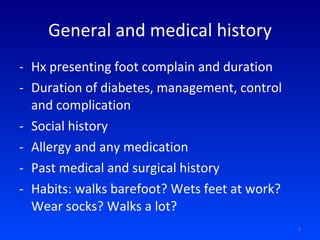
General and medical history Hx presenting foot complain and duration Duration of diabetes, management, control and complication Social history Allergy and any medication Past medical and surgical history Habits: walks barefoot? Wets feet at work? Wear socks? Walks a lot?
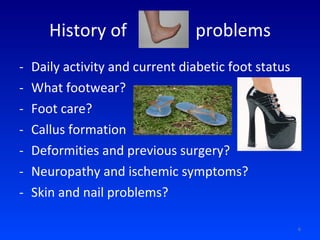
History of  foot  problems Daily activity and current diabetic foot status What footwear? Foot care? Callus formation Deformities and previous surgery? Neuropathy and ischemic symptoms? Skin and nail problems?
History of ulcers Site, size, duration, odour, type of drainage Precipitating factor, trauma? Recurrences? Associated infections symptoms Any hospitalizations and what treatment Wound care Patient compliance Previous trauma or surgery Features of Charcot joint
Physical examination General : any sign of  inflammation Local examination : compare both limbs. Check the normal one first
Musculoskeletal status Attitude and posture Orthopaedic deformities Limited joint mobility, muscle strength Tendo-Archilles contractures/equinus/foot drop Gait evaluation Plantar pressure measurement
Skin and nails of foot Skin appearance: color, texture, turgor, quality and dry skin Calluses, heel fissures, cracking of skin Nail appearances Presence of hair Ulceration, gangrene, infection Interdigital lesions, tinea pedis
Vascular status of foot Pulses  Capillary refill time Edema  Color change  Temperature gradient Venous filling time Changes of ischemia
Neurological status of foot Vibration perception Pressure and touch- monofilament 10gm Semmes Weinstein, cotton wool Pain – pin prick Two point discrimination  Temperature perception Deep tendon reflexes – ankle and knee Clonus testing, Babinski test and Romberg test

Evaluation of foot wear Type and condition of shoes and sandals Fit Shoe wear, pattern of wear, lining wear Foreign bodies Insoles, orthoses
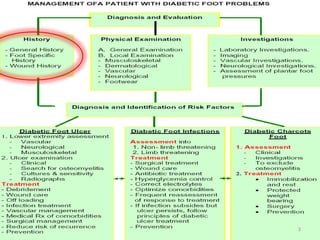
Investigation General Glucometer/ Random Blood Sugar, Fasting blood sugar HbA1C FBC U&E ESR UFEME –Ketonuria, CNS Wound and blood culture and sensitivity IMAGING X-rays of foot (AP, Lateral) (to look for soft tissue gas , Charcot jt, fracture, osteomyelitis) CT scan Bone scan and MRI Vascular assessment Doppler , ankle brachial indices (normal value= 1.1. if <0.9, abnormal) Plantar foot pressure
Diabetic foot ulcer
Neuropathy Peripheral vascular disease Abnormal foot pressure Hyperglycemia Trauma Foot deformity Limited joint mobility Previous ulceration and amputation Poor vision Chronic renal disease Old age Condition of diabetes Neuropathy Peripheral vascular disease Abnormal foot pressure Hyperglycemia Trauma Foot deformity Limited joint mobility Previous ulceration and amputation Poor vision Chronic renal disease Condition of diabetes
Pathogenesis  Somatic neuropathy - reduced perception to pain Diminished proprioception Clawing of toes Autonomic neuropathy Absent sweating Dry skin fissures Altered blood flow and regulation Distended foot veins; warm foot Charcot neuroarthropathy Peripheral vascular disease Claudication Rest pain Cold extremities Reduced foot pulses Increased foot pressure Callus formation Foot ischemia Foot ulceration Gangrene  Infection  Amputation  Connective tissue changes Limited joint mobility Orthopedic disorder
Wagner’s  foot ulcer classification
Treatment  Debridement Wound care Reduction of plantar pressure (Off loading) Treatment of infection Vascular management of ischemia Medical Rx of co-morbidities Surgical management Reduce risk of recurrence
Debridement Surgical debridement Involve removal of all non-viable tissue or bone until healthy bleeding soft tissue or bone are encountered.  Abscess: immediate I & D. Osteomyelitic  bones, joint infection, gangrene digits: require resection or partial amputation. Other type of debridement:  mechanical (surgical debridement, high pressure irrigation, wet to dry dressing), Enzymatic Autolytic
Wound care Done following debridement. Dressing: normal saline and others (e.g: transparent films, foam, hydrocolloids, calcium alginates, gauze pads, collagen dressings) Ulcer is covered to avoid contamination and trauma. Choice of dressings or topical agents depends on the health care provider’s experience, type and site of ulcer, costs involved and patient’s preferences
Off-loading Reduce the pressure to the ulcer. Thus, reducing the trauma to the ulcer and allowing it to heal. Example: Total contact casting Total non-weight bearing Removable walking braces with rocker bottom soles Foot casts or boot Total contact orthoses Healing sandal Patellar tendon bearing braces Half shoe or wedge shoes Healing sandal- surgical shoe with molded plastizote insole Total contact casting Healing sandal Cast boot
Treatment of infection Early incision and drainage Empirical broad-spectrum antibiotic. Vascular management of ischemia - Vascular supply should be assessed early before surgery intervention
Treat other medical co-morbidities DM is a multi-organ systemic disease. Multi-disciplinary approach.
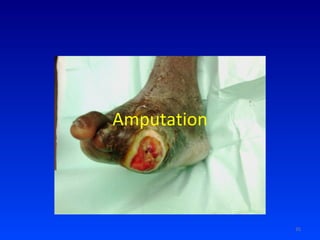
Surgery Remove structurally deformed foot which my give rise to high pressure areas causing ulcers that do not heal with off loading technique or therapeutic foot wear Amputation- gangrene and ulcers with osteomyelitis Includes removal of infected bone or joint e.g: metatarsal head resection, partial calcanectomy, exostectomy, sesamoidectomy and digital arthroplasty
I & D, debridement, amputation Empirical regimen a) Mild mod infection - gram +ve - 1-2 weeks b) Severe and life threatening +ve, -ve, enterococci, anaerobic  More than 2 weeks c) If osteomyelitis and have not been amputated: 2-8 weeks
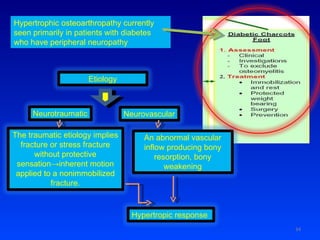
Hypertrophic osteoarthropathy currently seen primarily in patients with diabetes who have peripheral neuropathy An abnormal vascular inflow producing bony resorption, bony weakening Etiology The traumatic etiology implies fracture or stress fracture without protective sensation->inherent motion applied to a nonimmobilized fracture. Neurotraumatic Neurovascular Hypertropic response
Amputation
3 D’s D amned Nuisance - dt pain, gross malformation, recurrent sepsis, severe loss of function D ead - PVD, trauma, burns, frostbite D angerous - malignant tumours, potentially lethal sepsis, crush injury
Complication Early  Breakdown of skin flaps Gas gangrene Late Skin- eczema, ulcer Muscle- improper use of prosthesis Artery- ulcer Nerve- pain & tender Phantom limb
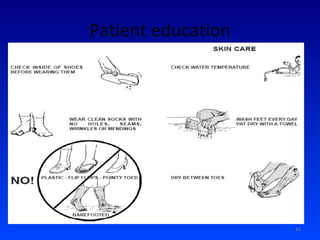
Patient education
Patient education
References  http://www.hrsa.gov/leap/patienteducation.htm   www.emedicine.com Boon et al. Davidson’s principle and Practice of medicine. 20 th  edition, Churchill Livingstone Elsevier 2006. page;844-846. Management of diabetic foot, CPG 2004 http://care.diabetesjournals.org/content/26/10/2848.full   http://www.wagnergradeposter.com/012wagnerpic.jpg
Thank you =)

Diabetic zarina present

  • 1.
  • 2.
    Why you shouldwake up and focus on this presentation? 2006 Third National Health Morbidity Survey a) prevalence rate of diabetes mellitus has been reported to have increased from 8.3% in 1996 to 14.9% in 2006 1 b) prevalence of lower limb amputation among patients with diabetes was 4.3%. c) Our MBBS exam
  • 4.
  • 5.
    General and medicalhistory Hx presenting foot complain and duration Duration of diabetes, management, control and complication Social history Allergy and any medication Past medical and surgical history Habits: walks barefoot? Wets feet at work? Wear socks? Walks a lot?
  • 6.
    History of foot problems Daily activity and current diabetic foot status What footwear? Foot care? Callus formation Deformities and previous surgery? Neuropathy and ischemic symptoms? Skin and nail problems?
  • 7.
    History of ulcersSite, size, duration, odour, type of drainage Precipitating factor, trauma? Recurrences? Associated infections symptoms Any hospitalizations and what treatment Wound care Patient compliance Previous trauma or surgery Features of Charcot joint
  • 10.
    Physical examination General: any sign of inflammation Local examination : compare both limbs. Check the normal one first
  • 11.
    Musculoskeletal status Attitudeand posture Orthopaedic deformities Limited joint mobility, muscle strength Tendo-Archilles contractures/equinus/foot drop Gait evaluation Plantar pressure measurement
  • 12.
    Skin and nailsof foot Skin appearance: color, texture, turgor, quality and dry skin Calluses, heel fissures, cracking of skin Nail appearances Presence of hair Ulceration, gangrene, infection Interdigital lesions, tinea pedis
  • 13.
    Vascular status offoot Pulses Capillary refill time Edema Color change Temperature gradient Venous filling time Changes of ischemia
  • 14.
    Neurological status offoot Vibration perception Pressure and touch- monofilament 10gm Semmes Weinstein, cotton wool Pain – pin prick Two point discrimination Temperature perception Deep tendon reflexes – ankle and knee Clonus testing, Babinski test and Romberg test
  • 15.
    Evaluation of footwear Type and condition of shoes and sandals Fit Shoe wear, pattern of wear, lining wear Foreign bodies Insoles, orthoses
  • 17.
    Investigation General Glucometer/Random Blood Sugar, Fasting blood sugar HbA1C FBC U&E ESR UFEME –Ketonuria, CNS Wound and blood culture and sensitivity IMAGING X-rays of foot (AP, Lateral) (to look for soft tissue gas , Charcot jt, fracture, osteomyelitis) CT scan Bone scan and MRI Vascular assessment Doppler , ankle brachial indices (normal value= 1.1. if <0.9, abnormal) Plantar foot pressure
  • 18.
  • 20.
    Neuropathy Peripheral vasculardisease Abnormal foot pressure Hyperglycemia Trauma Foot deformity Limited joint mobility Previous ulceration and amputation Poor vision Chronic renal disease Old age Condition of diabetes Neuropathy Peripheral vascular disease Abnormal foot pressure Hyperglycemia Trauma Foot deformity Limited joint mobility Previous ulceration and amputation Poor vision Chronic renal disease Condition of diabetes
  • 21.
    Pathogenesis Somaticneuropathy - reduced perception to pain Diminished proprioception Clawing of toes Autonomic neuropathy Absent sweating Dry skin fissures Altered blood flow and regulation Distended foot veins; warm foot Charcot neuroarthropathy Peripheral vascular disease Claudication Rest pain Cold extremities Reduced foot pulses Increased foot pressure Callus formation Foot ischemia Foot ulceration Gangrene Infection Amputation Connective tissue changes Limited joint mobility Orthopedic disorder
  • 22.
    Wagner’s footulcer classification
  • 24.
    Treatment DebridementWound care Reduction of plantar pressure (Off loading) Treatment of infection Vascular management of ischemia Medical Rx of co-morbidities Surgical management Reduce risk of recurrence
  • 25.
    Debridement Surgical debridementInvolve removal of all non-viable tissue or bone until healthy bleeding soft tissue or bone are encountered. Abscess: immediate I & D. Osteomyelitic bones, joint infection, gangrene digits: require resection or partial amputation. Other type of debridement: mechanical (surgical debridement, high pressure irrigation, wet to dry dressing), Enzymatic Autolytic
  • 26.
    Wound care Donefollowing debridement. Dressing: normal saline and others (e.g: transparent films, foam, hydrocolloids, calcium alginates, gauze pads, collagen dressings) Ulcer is covered to avoid contamination and trauma. Choice of dressings or topical agents depends on the health care provider’s experience, type and site of ulcer, costs involved and patient’s preferences
  • 27.
    Off-loading Reduce thepressure to the ulcer. Thus, reducing the trauma to the ulcer and allowing it to heal. Example: Total contact casting Total non-weight bearing Removable walking braces with rocker bottom soles Foot casts or boot Total contact orthoses Healing sandal Patellar tendon bearing braces Half shoe or wedge shoes Healing sandal- surgical shoe with molded plastizote insole Total contact casting Healing sandal Cast boot
  • 28.
    Treatment of infectionEarly incision and drainage Empirical broad-spectrum antibiotic. Vascular management of ischemia - Vascular supply should be assessed early before surgery intervention
  • 29.
    Treat other medicalco-morbidities DM is a multi-organ systemic disease. Multi-disciplinary approach.
  • 30.
    Surgery Remove structurallydeformed foot which my give rise to high pressure areas causing ulcers that do not heal with off loading technique or therapeutic foot wear Amputation- gangrene and ulcers with osteomyelitis Includes removal of infected bone or joint e.g: metatarsal head resection, partial calcanectomy, exostectomy, sesamoidectomy and digital arthroplasty
  • 33.
    I & D,debridement, amputation Empirical regimen a) Mild mod infection - gram +ve - 1-2 weeks b) Severe and life threatening +ve, -ve, enterococci, anaerobic More than 2 weeks c) If osteomyelitis and have not been amputated: 2-8 weeks
  • 34.
    Hypertrophic osteoarthropathy currentlyseen primarily in patients with diabetes who have peripheral neuropathy An abnormal vascular inflow producing bony resorption, bony weakening Etiology The traumatic etiology implies fracture or stress fracture without protective sensation->inherent motion applied to a nonimmobilized fracture. Neurotraumatic Neurovascular Hypertropic response
  • 35.
  • 36.
    3 D’s Damned Nuisance - dt pain, gross malformation, recurrent sepsis, severe loss of function D ead - PVD, trauma, burns, frostbite D angerous - malignant tumours, potentially lethal sepsis, crush injury
  • 37.
    Complication Early Breakdown of skin flaps Gas gangrene Late Skin- eczema, ulcer Muscle- improper use of prosthesis Artery- ulcer Nerve- pain & tender Phantom limb
  • 38.
  • 41.
  • 43.
    References http://www.hrsa.gov/leap/patienteducation.htm www.emedicine.com Boon et al. Davidson’s principle and Practice of medicine. 20 th edition, Churchill Livingstone Elsevier 2006. page;844-846. Management of diabetic foot, CPG 2004 http://care.diabetesjournals.org/content/26/10/2848.full http://www.wagnergradeposter.com/012wagnerpic.jpg
  • 44.

Editor's Notes

  • #14 The time taken for the veins to distend is referred to as the&amp;quot; venous filling time&amp;quot;. Normal limbs will fill then veins on the dorsum of the foot within 15 seconds.
  • #34 Unasyn: ampicillin plus sulbactam