De Quervain’s
Tenosynovitis
Dr. Akshita(PT)
B.P.T
D.C.PT
Yoga Instructor
Nutritionist
INTRODUCTION
• It is named after Swiss surgeon, FRITZ DE
QUERVAIN who first described the condition
in 1895.
• It is a stenosing tenosynovitis which affects
the tendon sheaths of the 1st dorsal
compartment of the wrist.
• It is characterised by degeneration and
fibrosis of the tendon sheath.
Incidence
• Occurs most often in individuals age between
30 and 50 years
• It affects women up to six times more often
than men
• Is commonly associated with dominant hand
Anantomy
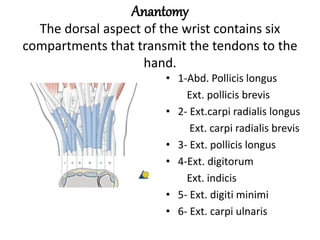
The dorsal aspect of the wrist contains six
compartments that transmit the tendons to the
hand.
• 1-Abd. Pollicis longus
Ext. pollicis brevis
• 2- Ext.carpi radialis longus
Ext. carpi radialis brevis
• 3- Ext. pollicis longus
• 4-Ext. digitorum
Ext. indicis
• 5- Ext. digiti minimi
• 6- Ext. carpi ulnaris
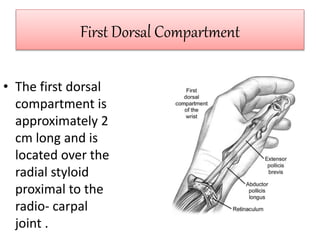
First Dorsal Compartment
• The first dorsal
compartment is
approximately 2
cm long and is
located over the
radial styloid
proximal to the
radio- carpal
joint .
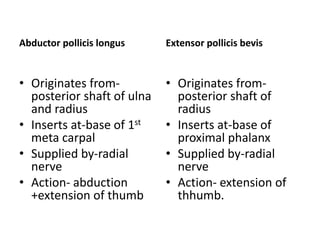
Abductor pollicis longus
• Originates from-
posterior shaft of ulna
and radius
• Inserts at-base of 1st
meta carpal
• Supplied by-radial
nerve
• Action- abduction
+extension of thumb
Extensor pollicis bevis
• Originates from-
posterior shaft of
radius
• Inserts at-base of
proximal phalanx
• Supplied by-radial
nerve
• Action- extension of
thhumb.
Predisposing Factors
• Overuse injury
• Repetitive tasks that involve overexertion of
thumb, radial and ulnar deviation of the wrist
• Arthritis
• pregnancy
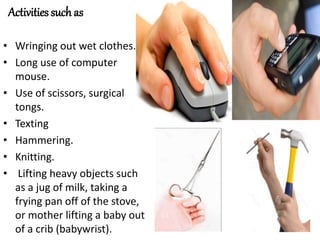
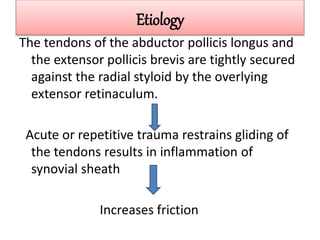
Activities such as
• Wringing out wet clothes.
• Long use of computer
mouse.
• Use of scissors, surgical
tongs.
• Texting
• Hammering.
• Knitting.
• Lifting heavy objects such
as a jug of milk, taking a
frying pan off of the stove,
or mother lifting a baby out
of a crib (babywrist).
Etiology
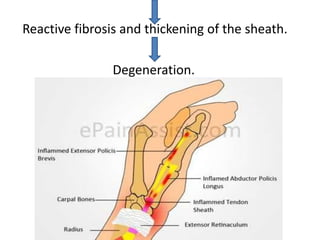
The tendons of the abductor pollicis longus and
the extensor pollicis brevis are tightly secured
against the radial styloid by the overlying
extensor retinaculum.
Acute or repetitive trauma restrains gliding of
the tendons results in inflammation of
synovial sheath
Increases friction
Reactive fibrosis and thickening of the sheath.
Degeneration.
Clinical Features
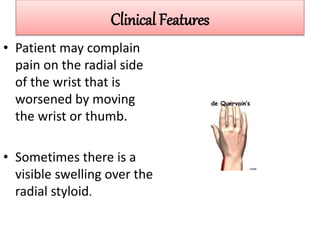
• Patient may complain
pain on the radial side
of the wrist that is
worsened by moving
the wrist or thumb.
• Sometimes there is a
visible swelling over the
radial styloid.
• The tendon sheath may feels thick and
hard.
• Tenderness is mostly acute at the tip of
the radial styloid.
• Pain aggravates on grasping and raising
objects with the wrist
• Wet leather sign
• The Finkelstein test is positive.
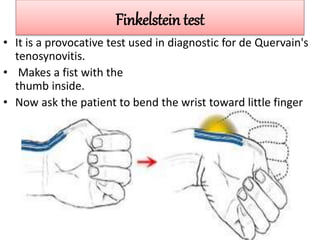
Finkelstein test
• It is a provocative test used in diagnostic for de Quervain's
tenosynovitis.
• Makes a fist with the
thumb inside.
• Now ask the patient to bend the wrist toward little finger
Differential Diagnosis
• CMC arthritis of the thumb: pain and crepitus
present with the thumb "crank and grind test .
• Scaphoid fracture: in this tenderness will be in the
anatomic snuff box.
• Chauffeur's fracture
• Intersection syndrome-tenosynovitis of the second
dorsalcompartment involving the tendons of
extensor carpi radialis brevis (ECRB) and extensor
carpi radialis longus (more proximal pain)
• Extensor pollicis longus (EPL) tendonitis of the third dorsal
compartment: common in patients with rheumatoid arthritis
or with direct injury and distal radius fracture .
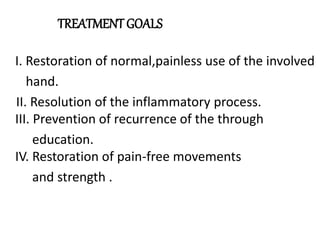
TREATMENTGOALS
I. Restoration of normal,painless use of the involved
hand.
II. Resolution of the inflammatory process.
III. Prevention of recurrence of the through
education.
IV. Restoration of pain-free movements
and strength .
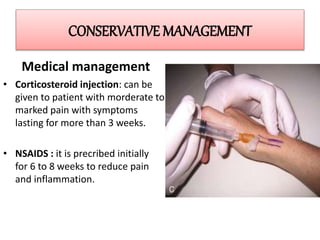
CONSERVATIVE MANAGEMENT
Medical management
• Corticosteroid injection: can be
given to patient with morderate to
marked pain with symptoms
lasting for more than 3 weeks.
• NSAIDS : it is precribed initially
for 6 to 8 weeks to reduce pain
and inflammation.
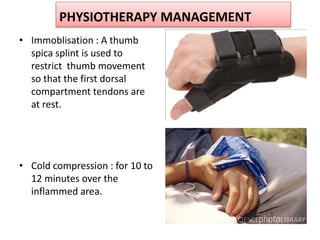
PHYSIOTHERAPY MANAGEMENT
• Immoblisation : A thumb
spica splint is used to
restrict thumb movement
so that the first dorsal
compartment tendons are
at rest.
• Cold compression : for 10 to
12 minutes over the
inflammed area.
• Ultrasonic therapy: pulsed mode, 3 mhz, time-
5min.
• Phonophorersis :with 10% hydrocortisone.
• Gentle active and passive motion of thumb and
wrist encouraged for 5 minutes every hour to
prevent joint contractures and adhesions.
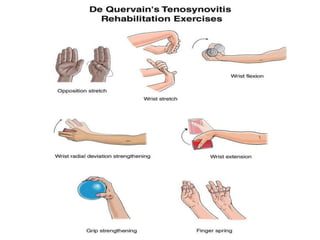
• Strenghtening and stretching exercises after the
initial pain subsides.
Indication for decompression surgery
• Unsatisfactory symptom reduction
• Persistence of symptoms after conservative
interventions.
• Limitations in A.D.Ls due to pain.
After Decompression Surgery
0-2 Days
Immobilization within cast
Active movement of IP joint: Flexion and
Extension.
After 48 hours of surgery dressings are removed.
After this begin with gentle active motion of
the wrist and thumb.
2-14 Days
• Presurgical splint is worn for comfort and
active exercises are continued for Ipjoint,
elbow and shoulder joint .
• By 10- 14 days: sutures are removed.
2-6 Weeks
• Grip and pinch strengthening exercises may
begin at approximately 3 weeks and can be
progressed gradually.
• By the end of 6 week the patient usually is able
to resume full activities.
Ergonomics
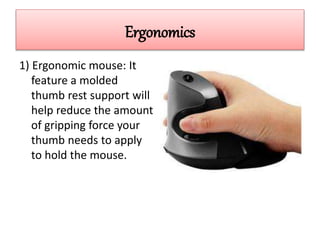
1) Ergonomic mouse: It
feature a molded
thumb rest support will
help reduce the amount
of gripping force your
thumb needs to apply
to hold the mouse.
2) Use the power grip (all fingers in a loose grip)
instead of using a pinch.
3) Minimize repetition and rest arm occasionally
during a repetitive activity or slow down activity.
4) Use a light grip on tools, pens, the mouse.
5) Alternate hands during activities if possible
CaseStudy
• Name - Hemlata
• Age - 45
• Gender- female
• Occupation – housewife
• Dominance-right
• Chief complaint-pain at left thumb and area
below thumb from 20 days which has increased
from last few days.
Pain history
• Mechanism of injury- can’t be recalled by pateint.
• Duration of pain-20 days
• Vas score-6
• Type-sharp pain with movement
• Aggravating factor –doing house hold work like
washing clothes ,brooming etc.
• Relieving factor – pain relieving
ointment(balm,painkiller given by physician)
• Severity-level 4 i.e pain during and after specific
activity that does affect performance
• Past history-The patient reported no past
history of elbow, forearm or wrist pain. No
history of systemic disease.
• No family history of major systemic diseases
On examination
• Swelling –minimal swelling seen on comparing
right wrist ( non pitting).
• Tenderness-present grade :2 i.e patient allows
to touch but it gives pain.
• RIM
Wrist extensor and flexor –strong and painless
Radial deviation ulnar deviation –strong and
painfull
• THUMB
Flexion
Extension STRONG PAINFULL
Abduction
Adduction
• Roms shown no variations.
TREATMENT
Ultrasonic therapy
3mhz
pulsed 1:4
time: 5 minutes
Intensity:8
Cold compression/ Ice massage- for 10 to 12
minutes.
Advice for rest.

De quervain’s

  • 1.
  • 2.
    INTRODUCTION • It isnamed after Swiss surgeon, FRITZ DE QUERVAIN who first described the condition in 1895. • It is a stenosing tenosynovitis which affects the tendon sheaths of the 1st dorsal compartment of the wrist. • It is characterised by degeneration and fibrosis of the tendon sheath.
  • 3.
    Incidence • Occurs mostoften in individuals age between 30 and 50 years • It affects women up to six times more often than men • Is commonly associated with dominant hand
  • 4.
    Anantomy The dorsal aspectof the wrist contains six compartments that transmit the tendons to the hand. • 1-Abd. Pollicis longus Ext. pollicis brevis • 2- Ext.carpi radialis longus Ext. carpi radialis brevis • 3- Ext. pollicis longus • 4-Ext. digitorum Ext. indicis • 5- Ext. digiti minimi • 6- Ext. carpi ulnaris
  • 5.
    First Dorsal Compartment •The first dorsal compartment is approximately 2 cm long and is located over the radial styloid proximal to the radio- carpal joint .
  • 6.
    Abductor pollicis longus •Originates from- posterior shaft of ulna and radius • Inserts at-base of 1st meta carpal • Supplied by-radial nerve • Action- abduction +extension of thumb Extensor pollicis bevis • Originates from- posterior shaft of radius • Inserts at-base of proximal phalanx • Supplied by-radial nerve • Action- extension of thhumb.
  • 7.
    Predisposing Factors • Overuseinjury • Repetitive tasks that involve overexertion of thumb, radial and ulnar deviation of the wrist • Arthritis • pregnancy
  • 8.
    Activities such as •Wringing out wet clothes. • Long use of computer mouse. • Use of scissors, surgical tongs. • Texting • Hammering. • Knitting. • Lifting heavy objects such as a jug of milk, taking a frying pan off of the stove, or mother lifting a baby out of a crib (babywrist).
  • 9.
    Etiology The tendons ofthe abductor pollicis longus and the extensor pollicis brevis are tightly secured against the radial styloid by the overlying extensor retinaculum. Acute or repetitive trauma restrains gliding of the tendons results in inflammation of synovial sheath Increases friction
  • 10.
    Reactive fibrosis andthickening of the sheath. Degeneration.
  • 11.
    Clinical Features • Patientmay complain pain on the radial side of the wrist that is worsened by moving the wrist or thumb. • Sometimes there is a visible swelling over the radial styloid.
  • 12.
    • The tendonsheath may feels thick and hard. • Tenderness is mostly acute at the tip of the radial styloid. • Pain aggravates on grasping and raising objects with the wrist • Wet leather sign • The Finkelstein test is positive.
  • 13.
    Finkelstein test • Itis a provocative test used in diagnostic for de Quervain's tenosynovitis. • Makes a fist with the thumb inside. • Now ask the patient to bend the wrist toward little finger
  • 14.
    Differential Diagnosis • CMCarthritis of the thumb: pain and crepitus present with the thumb "crank and grind test . • Scaphoid fracture: in this tenderness will be in the anatomic snuff box. • Chauffeur's fracture • Intersection syndrome-tenosynovitis of the second dorsalcompartment involving the tendons of extensor carpi radialis brevis (ECRB) and extensor carpi radialis longus (more proximal pain)
  • 15.
    • Extensor pollicislongus (EPL) tendonitis of the third dorsal compartment: common in patients with rheumatoid arthritis or with direct injury and distal radius fracture .
  • 16.
    TREATMENTGOALS I. Restoration ofnormal,painless use of the involved hand. II. Resolution of the inflammatory process. III. Prevention of recurrence of the through education. IV. Restoration of pain-free movements and strength .
  • 17.
    CONSERVATIVE MANAGEMENT Medical management •Corticosteroid injection: can be given to patient with morderate to marked pain with symptoms lasting for more than 3 weeks. • NSAIDS : it is precribed initially for 6 to 8 weeks to reduce pain and inflammation.
  • 18.
    PHYSIOTHERAPY MANAGEMENT • Immoblisation: A thumb spica splint is used to restrict thumb movement so that the first dorsal compartment tendons are at rest. • Cold compression : for 10 to 12 minutes over the inflammed area.
  • 19.
    • Ultrasonic therapy:pulsed mode, 3 mhz, time- 5min. • Phonophorersis :with 10% hydrocortisone. • Gentle active and passive motion of thumb and wrist encouraged for 5 minutes every hour to prevent joint contractures and adhesions. • Strenghtening and stretching exercises after the initial pain subsides.
  • 21.
    Indication for decompressionsurgery • Unsatisfactory symptom reduction • Persistence of symptoms after conservative interventions. • Limitations in A.D.Ls due to pain.
  • 22.
    After Decompression Surgery 0-2Days Immobilization within cast Active movement of IP joint: Flexion and Extension. After 48 hours of surgery dressings are removed. After this begin with gentle active motion of the wrist and thumb.
  • 23.
    2-14 Days • Presurgicalsplint is worn for comfort and active exercises are continued for Ipjoint, elbow and shoulder joint . • By 10- 14 days: sutures are removed. 2-6 Weeks • Grip and pinch strengthening exercises may begin at approximately 3 weeks and can be progressed gradually. • By the end of 6 week the patient usually is able to resume full activities.
  • 24.
    Ergonomics 1) Ergonomic mouse:It feature a molded thumb rest support will help reduce the amount of gripping force your thumb needs to apply to hold the mouse.
  • 25.
    2) Use thepower grip (all fingers in a loose grip) instead of using a pinch. 3) Minimize repetition and rest arm occasionally during a repetitive activity or slow down activity. 4) Use a light grip on tools, pens, the mouse. 5) Alternate hands during activities if possible
  • 26.
    CaseStudy • Name -Hemlata • Age - 45 • Gender- female • Occupation – housewife • Dominance-right • Chief complaint-pain at left thumb and area below thumb from 20 days which has increased from last few days.
  • 27.
    Pain history • Mechanismof injury- can’t be recalled by pateint. • Duration of pain-20 days • Vas score-6 • Type-sharp pain with movement • Aggravating factor –doing house hold work like washing clothes ,brooming etc. • Relieving factor – pain relieving ointment(balm,painkiller given by physician) • Severity-level 4 i.e pain during and after specific activity that does affect performance
  • 28.
    • Past history-Thepatient reported no past history of elbow, forearm or wrist pain. No history of systemic disease. • No family history of major systemic diseases
  • 29.
    On examination • Swelling–minimal swelling seen on comparing right wrist ( non pitting). • Tenderness-present grade :2 i.e patient allows to touch but it gives pain. • RIM Wrist extensor and flexor –strong and painless Radial deviation ulnar deviation –strong and painfull
  • 30.
    • THUMB Flexion Extension STRONGPAINFULL Abduction Adduction • Roms shown no variations.
  • 31.
    TREATMENT Ultrasonic therapy 3mhz pulsed 1:4 time:5 minutes Intensity:8 Cold compression/ Ice massage- for 10 to 12 minutes. Advice for rest.

Editor's Notes

  • #24 Strengthening program