Presented by :  H. Al-Buainain Supervised : Prof. Parashar PATHOGENESIS OF  GALLSTONES
Introduction Anatomy “ liver lobules” . Bile synthesis . Role of bile acid . Clinical significance of bile . Gallstone
Liver is largest & most important metabolic Organ in the body . One of its importance function to the digestive system is synthesis & secretion of bile . ANATOMY
Liver Lobule
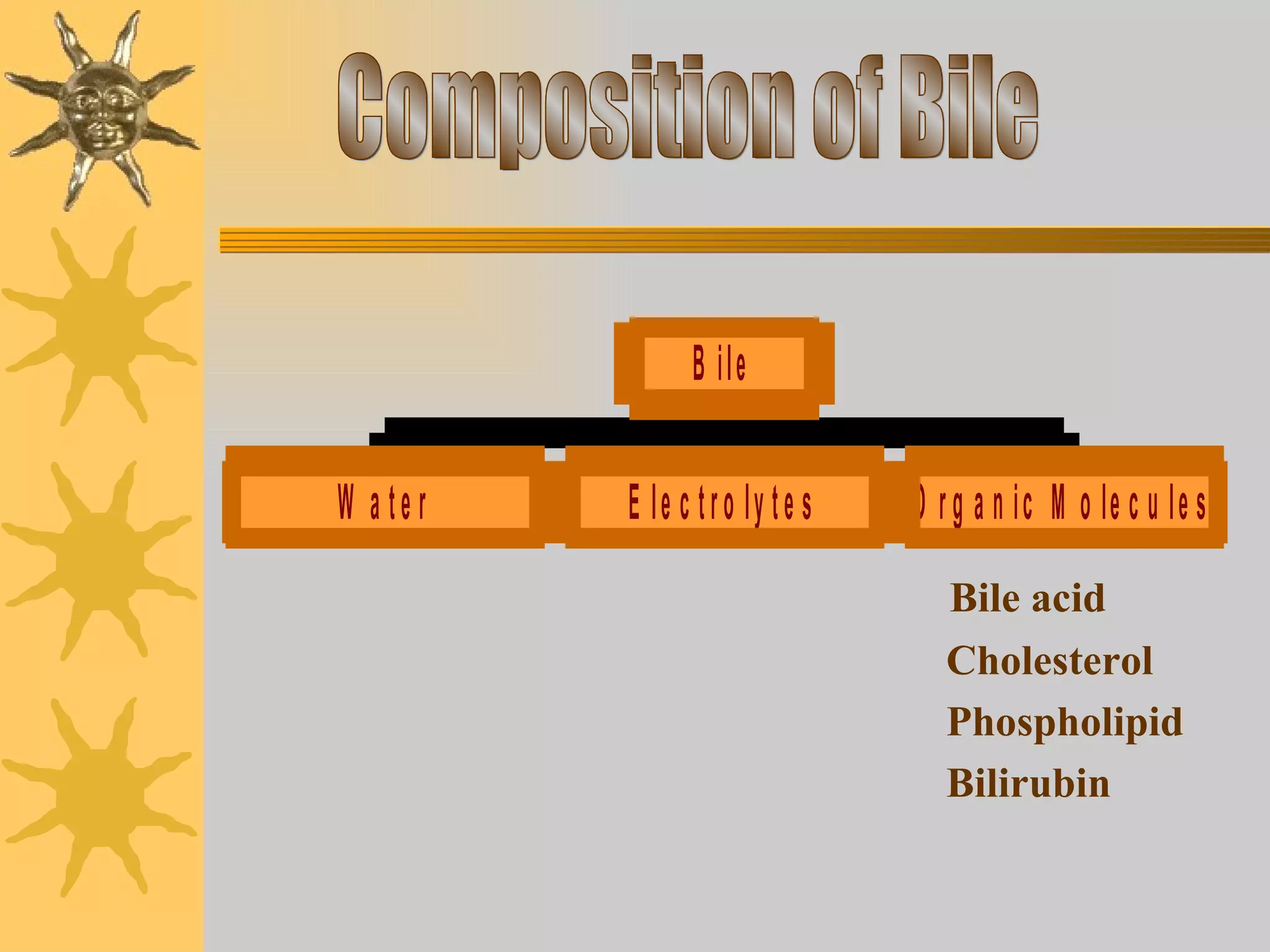
Bile acid  Cholesterol Phospholipid  Bilirubin Composition of Bile
Cholesterol Metabolism Cholesterol is an extremely important molecules in : - membrane structure  - Precursor of Steroid Hormone  and bile acids.
SYNTHESIS OF CHOLESTEROL Less than half of the cholesterol is derived from denovo . 10 % of cholesterol are synthesized in the liver while 15 % from SI.
Synthesis of Cholesterol
So End product of cholesterol  utilization are bile acid Chenodeoxycholic acid cholic acid Glycine or Taurine Glycocholic Acid Taurocolic Acid
Bilirubin synthesis
Adult human produce 400 – 800 ml of bile daily . BILE SECRETION : Occur in two stages : 1- Active secretion from hepatocytes to the canaliculi , bile duct . 2- Modification in the bile duct through addition of H2O & HCO3 During fasting state , bile will be stored in the gallbladder .
Role of Bile In Fat Digestion   Absorption Bile acids are Amphipathic
It is enable bile acid to carry out to important functions : - Emulsification of lipid aggregates - Solubilization & transport of lipid in  aqueous enviroment .
Emulsification
Role Of Bile Acid In Cholesterol    Homeostasis In human , 500 mg of cholesterol are converted to bile acids . This route will eliminate excess amount of cholesterol .
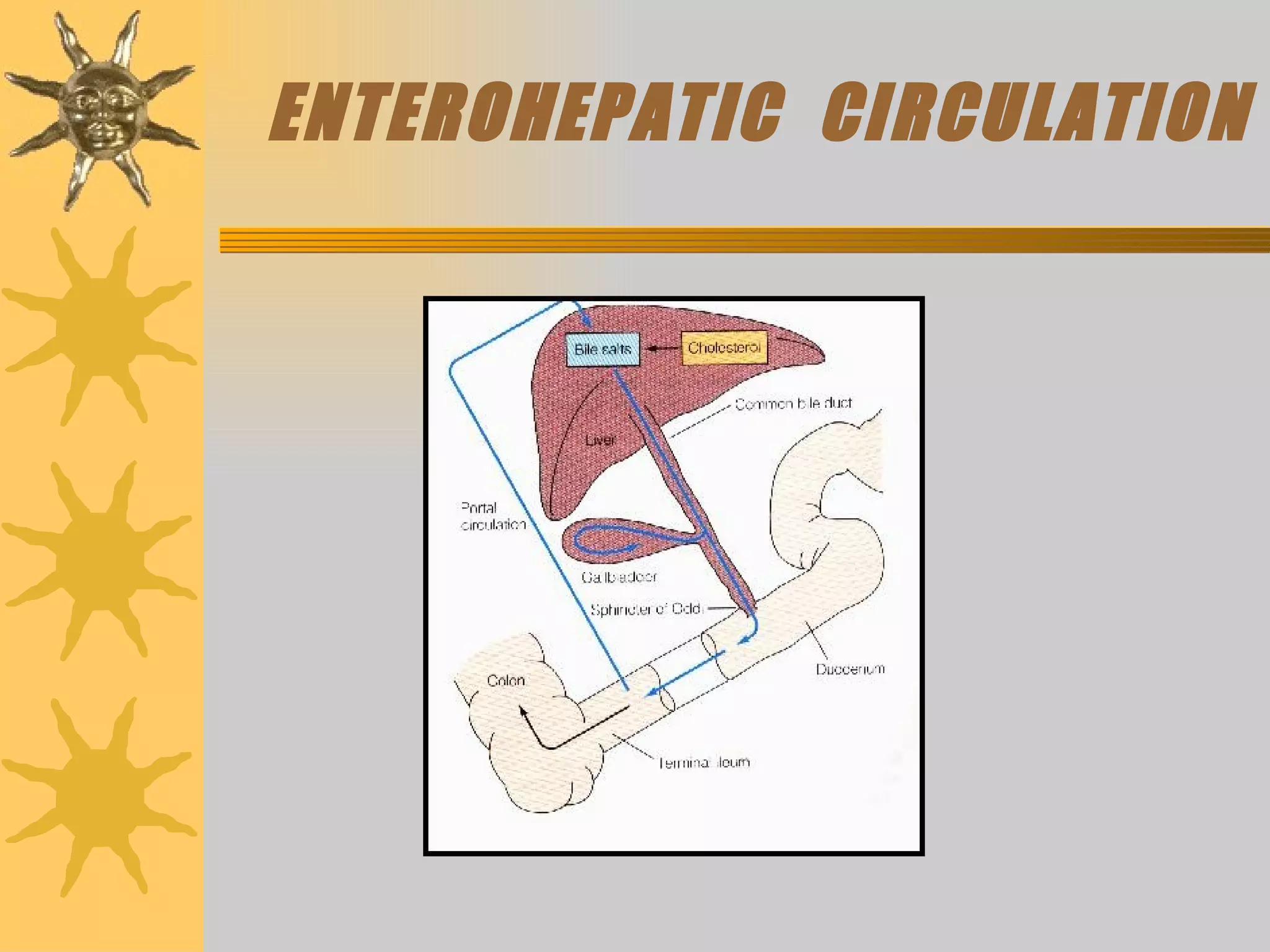
ENTEROHEPATIC  CIRCULATION
CONTROL OF BILE SECRETION Bile secretion regulated by : Cholecystokinin Secretin - Bile salt
SIGNIFICANCE OF BILE   ACID Bile acid play 4 physiological function: 1- Elimination of excess cholesterol. 2- Solubilize cholesterol which prevent  PPT in the GB . 3- Facilitate digestion of TG through  emulsification . 4- Facilitate absorption of fat soluble  vitamines.
It is one of the digestive disorder . more common in females . Classified according to the chemical composition into : - Cholesterol . - Pigment . - Calcium . Each type has particular pathophysiology and special risk factors . GALLSTONES
It is the commonest type of G.stones mainly d/t : Abnormality in liver synthesis of bile : - Reduction in bile salt or phospholipid - Excessive amount of cholesterol. Genetic & dietary factors Cholesterol Stones
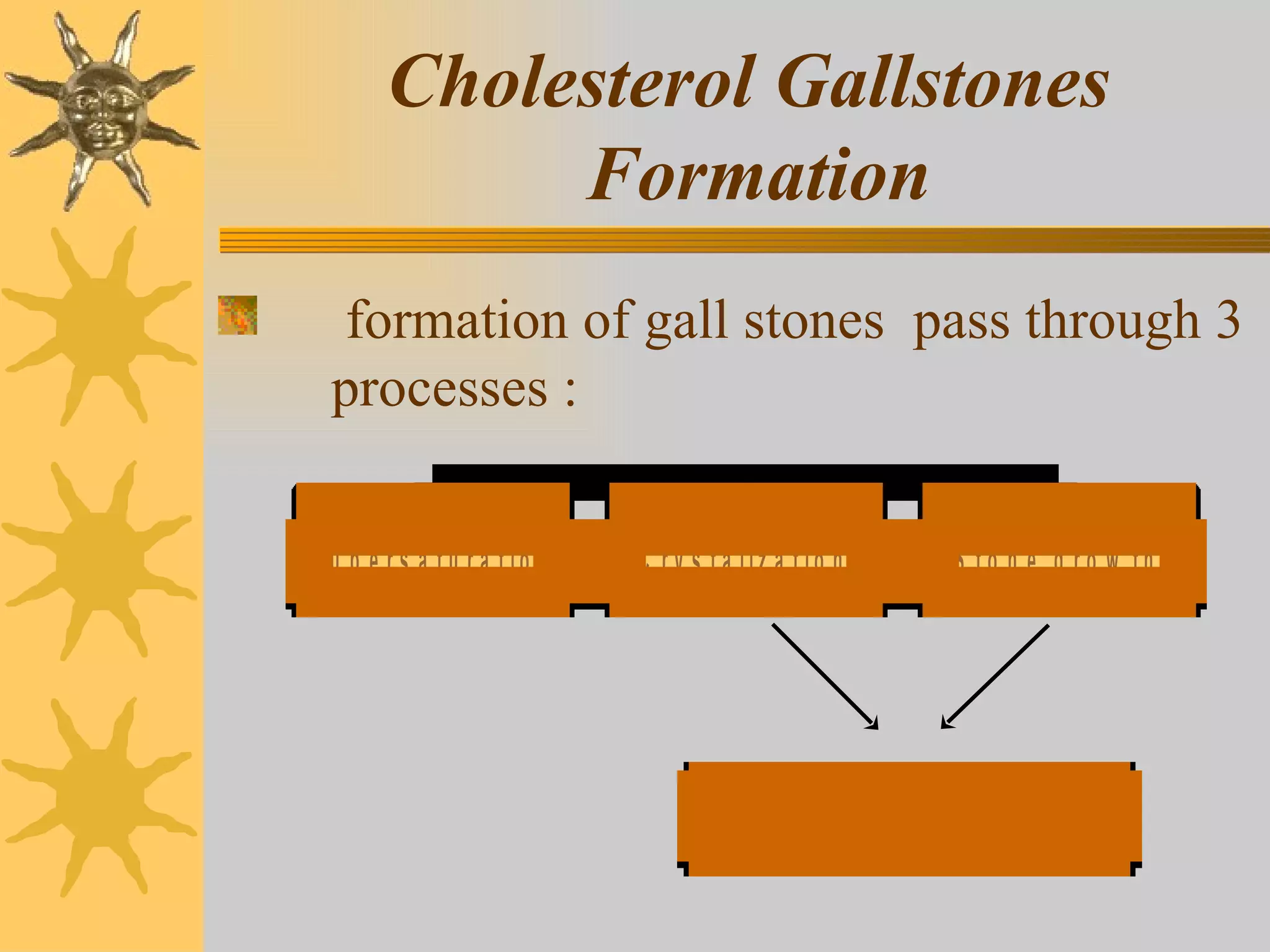
Cholesterol Gallstones  Formation formation of gall stones  pass through 3 processes :
Risk factors Gallstones    Formation
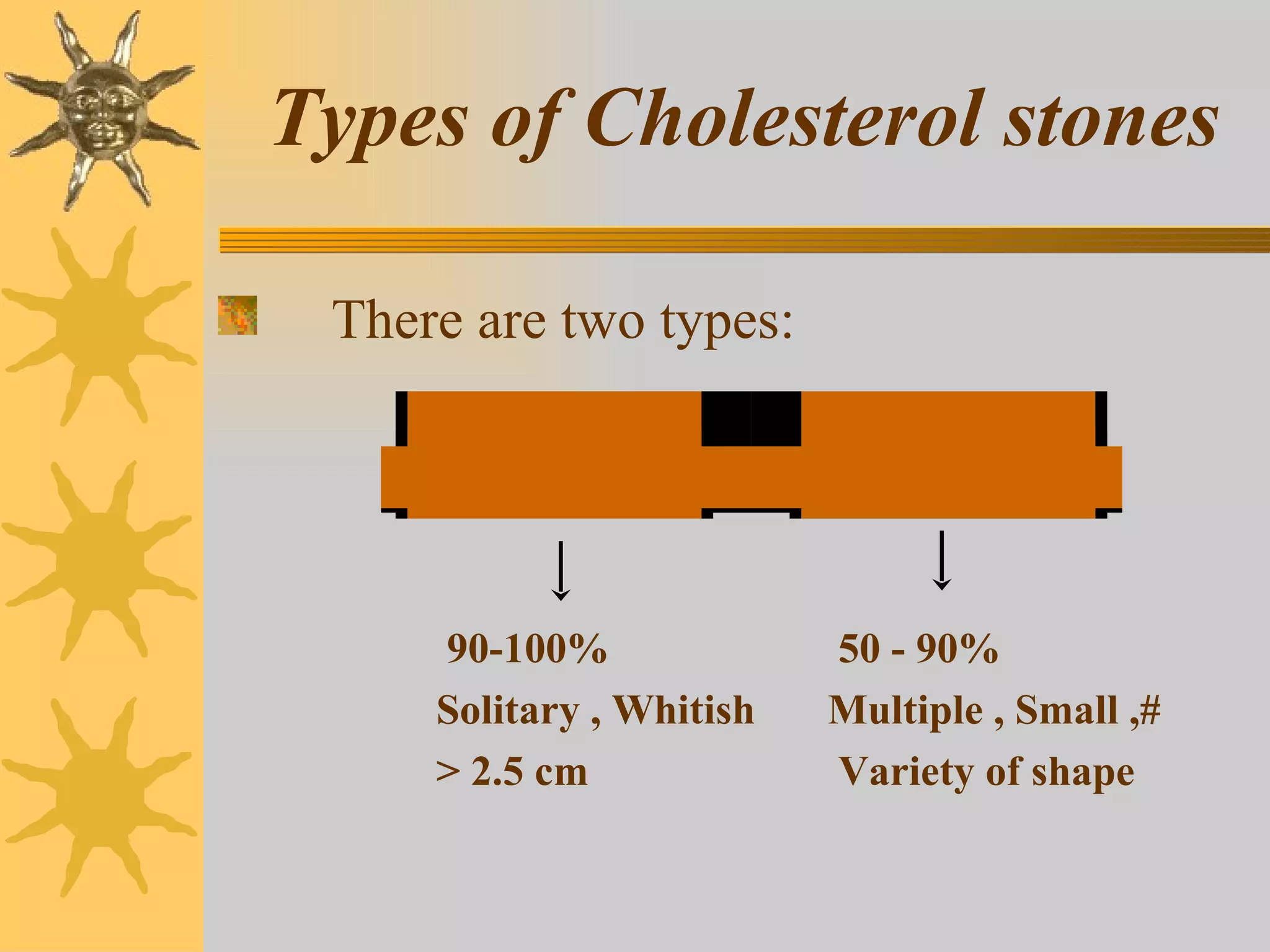
Types of Cholesterol stones There are two types:  90-100% Solitary , Whitish > 2.5 cm 50 - 90% Multiple , Small ,# Variety of shape
PIGMENTED GALLSTONES - Calcium bilirubinate - Ca Soap - Bacteria has role in the synthesis - >  in Asia  - Mainly at bile duct -Periumpullary duodenal diverticula -Excess Bilirubin - > in  : -Elderly Pt. - Chronic haemolysis  - Alcoholic
Asymptomatic . Biliary cholic . Calcular cholecystitis . Cholangitis . Obstructive jaundice . Gallstone ileus Gallstone pancreatitis Complications
Conclusion The bile play a major role in the excretion of cholesterol & absorption of fat sol Vit.  Alteration of bile composition lead to the formation of GS . Finally GB hypomotility & bile stasis promote GS formation .
THANK YOU

Gallstone

  • 1.
    Presented by : H. Al-Buainain Supervised : Prof. Parashar PATHOGENESIS OF GALLSTONES
  • 2.
    Introduction Anatomy “liver lobules” . Bile synthesis . Role of bile acid . Clinical significance of bile . Gallstone
  • 3.
    Liver is largest& most important metabolic Organ in the body . One of its importance function to the digestive system is synthesis & secretion of bile . ANATOMY
  • 4.
  • 5.
    Bile acid Cholesterol Phospholipid Bilirubin Composition of Bile
  • 6.
    Cholesterol Metabolism Cholesterolis an extremely important molecules in : - membrane structure - Precursor of Steroid Hormone and bile acids.
  • 7.
    SYNTHESIS OF CHOLESTEROLLess than half of the cholesterol is derived from denovo . 10 % of cholesterol are synthesized in the liver while 15 % from SI.
  • 8.
  • 9.
    So End productof cholesterol utilization are bile acid Chenodeoxycholic acid cholic acid Glycine or Taurine Glycocholic Acid Taurocolic Acid
  • 10.
  • 11.
    Adult human produce400 – 800 ml of bile daily . BILE SECRETION : Occur in two stages : 1- Active secretion from hepatocytes to the canaliculi , bile duct . 2- Modification in the bile duct through addition of H2O & HCO3 During fasting state , bile will be stored in the gallbladder .
  • 12.
    Role of BileIn Fat Digestion Absorption Bile acids are Amphipathic
  • 13.
    It is enablebile acid to carry out to important functions : - Emulsification of lipid aggregates - Solubilization & transport of lipid in aqueous enviroment .
  • 14.
  • 15.
    Role Of BileAcid In Cholesterol Homeostasis In human , 500 mg of cholesterol are converted to bile acids . This route will eliminate excess amount of cholesterol .
  • 16.
  • 17.
    CONTROL OF BILESECRETION Bile secretion regulated by : Cholecystokinin Secretin - Bile salt
  • 18.
    SIGNIFICANCE OF BILE ACID Bile acid play 4 physiological function: 1- Elimination of excess cholesterol. 2- Solubilize cholesterol which prevent PPT in the GB . 3- Facilitate digestion of TG through emulsification . 4- Facilitate absorption of fat soluble vitamines.
  • 19.
    It is oneof the digestive disorder . more common in females . Classified according to the chemical composition into : - Cholesterol . - Pigment . - Calcium . Each type has particular pathophysiology and special risk factors . GALLSTONES
  • 20.
    It is thecommonest type of G.stones mainly d/t : Abnormality in liver synthesis of bile : - Reduction in bile salt or phospholipid - Excessive amount of cholesterol. Genetic & dietary factors Cholesterol Stones
  • 21.
    Cholesterol Gallstones Formation formation of gall stones pass through 3 processes :
  • 22.
  • 23.
    Types of Cholesterolstones There are two types: 90-100% Solitary , Whitish > 2.5 cm 50 - 90% Multiple , Small ,# Variety of shape
  • 24.
    PIGMENTED GALLSTONES -Calcium bilirubinate - Ca Soap - Bacteria has role in the synthesis - > in Asia - Mainly at bile duct -Periumpullary duodenal diverticula -Excess Bilirubin - > in : -Elderly Pt. - Chronic haemolysis - Alcoholic
  • 25.
    Asymptomatic . Biliarycholic . Calcular cholecystitis . Cholangitis . Obstructive jaundice . Gallstone ileus Gallstone pancreatitis Complications
  • 26.
    Conclusion The bileplay a major role in the excretion of cholesterol & absorption of fat sol Vit. Alteration of bile composition lead to the formation of GS . Finally GB hypomotility & bile stasis promote GS formation .
  • 27.