Epilepsy
Post graduate medicine Jan 2002
What is epilepsy
 Occurance of two or more unprovoked seizures is
called epilepsy
 Epileptic seizures are behavioral changes resulting
from paroxysmal, excessive discharges from brain
 Single or occasional epileptic seizures or febrile fits
should not be classified as epilepsy
 Not all jerks , shakes and episodic behaviors are
seizures
 Tics, tremors, dystonias and sustained clonus in a
stroke pt may mimic epilepsy
Non epileptic paroxysmal dissorders that
can mimic epilepsy
 Syncope
 Reflex(vasovagal, carotid sinus,
glossopharyngeal, cough)
 cardiac output
 Decreased LV filling
(hypovolumia, orthostatic
hypotensio, PE)
 Cardiac arrhythmias
 Migraine (classic, basillar and
confusional)
 Cerebrovascular event (TIA)
 Periodic paralysis
 Sleep dissorders
 GI disorders (Reflux, motility
disorders)
 Movement disorders
 Tics
 Tourette’s synd
 Non epileptic myoclonus
 Parox. Choreoathetosis
 Psychiatric disorders
 Panic
 Somatization
 Dissociation
 Conversion (non epileptic psychogenic
fits)
 Drug toxicity et subs abuse
 Breath holding spells
Non epileptic psychogenic
seizure
 How to differentiate
 Cannot reliably differrentiate
 Gradual onset
 Stopping & restarting
 Out of phase clonic movements of extremities
 Vocalization in the middle of the seizure
 Pelvic thrusting and lack of whole body rigidity
But frontal lobe cpx seizures may be
misdiagnosed (rocking, kicking, bicycling,
pelvic thrusting, genital manipulation and
cursing)
Aetiology
 Unknown in 2/3rd
 Head injury
 Stroke
 Brain tumor
 Cortical dysplasia
 Infection eg:neurocysticercosis
 Alcohol related
Diagnostic workup
 Firist diagnose seizure
 Then determine
 Seizure type
 Syndromic classification
 Etiology
 Likelyhood of recurrence
 Is treatment needed
Diagnostic workup
 History taking
 Physical examination
 Neurological examination
 Diagnostic testing
Establishing the diagnosis
 Is a paroxysmal event with impairement of
awareness
 Diagnosis is clinical
 Eye witness is very essential
 There is no substitute for detailed Hx
 Circumstance of the episode
 Patterns of occurance
 Preceding symptoms that may localise or suggest other
conditions
 Timing, pattern and tempo of evolution of symptoms
 Reported behaviour before, during and after the
event
History- before the event
Unusual stress (eg, severe emotional trauma)
Sleep deprivation
Recent illness
Unusual stimuli (eg, flickering lights)
Use of medications and drugs
Activity immediately before event (eg, change
in posture, exercise)
History during the event
 Symptoms at onset (eg, aura)
Temporal mode of onset: gradual versus
sudden
Duration: brief (ictal phase <5 min) versus
prolonged
Stereotypy: duration and features of episodes
nearly identical versus frequently changing
Time of day: related to sleep or occuring on
awakening
History during the event
 Ability to talk and respond appropriately
Ability to comprehend
Ability to recall events during the
seizure
Abnormal movements of the eyes,
mouth, face, head, arms, and legs
Bowel or bladder incontinence
Bodily injury
History after the event
 Confusion
Lethargy
Abnormal speech
Focal weakness or sensory loss (ie,
Todd's paralysis)
Headache, muscle soreness, or
physical injury
Episode is more likely to be
syncopal if
 Is precipitated by anxiety or pain (eg, venipuncture)
 Occurs after the patient assumes an upright position
 Occurs only when the patient is standing or sitting
 Is associated with facial pallor and diaphoresis
 Is not associated with sustained tonic or clonic
movements, bladder incontinence, or biting of the
tongue or cheek
 Is not followed by postictal confusion, lethargy,
muscle soreness, and headache
 Is followed by a relatively rapid return to baseline
Past medical history
 Prolonged febrile fit
 Meningitis
 Encephalitis
 Head injury
 Cancer
 Stroke
 In diabetic pts hypo/hyperglycemia
 Hyponatremia, hypocalcemia, hypo
parathyroidism and hypothyroidism can cause
fits
Drug history
 Theophyllin
 INAH
 Phenothiazine
 Clozapine
 Radiocontrast dye
 Alkylating agents
 Beta lactam antibiotics
 Others : lignocain, general anesthetics,
Tricyclics, SSRI, Acyclovir, beta blockers,
decongestants, ectasy(MDMA)
Physical examination
 Examine the patient for injuries from the seizure or
fall.
 Check oxygen saturation and auscultate the chest for
possible aspiration.
 Measure heart rhythm and rate, blood pressure, and
orthostatic changes for assessment of syncope.
 Auscultate for carotid murmurs or carotid bruits and
sources of embolic stroke.
 Check for rapid pulses, which are often present after
seizure and may help in evaluation of psychogenic
seizures.
Neurological examination
 Purpose is to identify focal or diffuse cerebral
dysfunction
 Certain features will suggest focus of fit
 Aphasia – frontal lobe, temporal or parietal
 Right or left hemiparesis – contralateral motor cortex
 Sensory deficit – parietal lobe dysfunction
 Should be observed for
 Fluency of language
 Facial asymetry
 Gaze preference
 Pupilary asymetry (Herniation of brain)
 Extensor plantar for some time - normal
Diagnostic testing
 All pts should have
 FBC
 Ca, SE
 Glucose
 LFT
 ECG – important to detect prolonged QT
(Morning generalised tonic clonic seizure)
Diagnostic testing
 Toxicity screening and alcohol level in
appropriate pts
 Lumbar puncture infection or fever
present, HIV or malignancy
Diagnostic testing -EEG
 Role misunderstood
 Detection of abnormality does not
equate epilepsy
 Absence of inter ictal abnormality does
not exclude epilepsy
 Only 1/3rd
of epileptics show
abnormalities
 Ictal EEG could also be normal
Diagnostic testing -EEG
 EEG is diagnostic in certain conditions
 Generalised 3Hz spike and wave activity
-- 1ry generalised epilepsy
 Ictal recordings are not routinely done
except in incidental situations
EEG telemetry
 Ambualtory or video telemetry if
diagnosis remains in doubt
 Presurgical
 Intracranial amytal testing to test memory
and language function
 Intracranial EEG to localise the focus
Imaging studies
 Immediately after fit CT scan– bleeding or
structural lesions
 MRI is the Ix of choice – sensitive & specific
for evaluation of structural lesions and brain
parenchyma
 Mesial temporal sclerosis – hippocampus
 Dysplasia – cortical architectural abnormalities
 Better if could be done for all partial seizures
 Reveals abnormality in

30% with generalised epilepsy

70% with focal epilepsy
Detailed investigations
 Few pts will need
 Hypoglycemia – early morning fits
 ECHO
 Ambulatory ECG
 Urinary catecholamines
 Porphyrins
Implications of diagnosis
 May loose job
 Life restricted
 Mental trauma
 Driving licence
 Marriage
So all differential diagnosis should
be carefully considered
Classification
 Generalised
 Arise from both sides of the brain
simultaneously
 Partial or focal
 Occurs within one or more restricted
regions of the brain and effect of a
localised physiologic or structural
abnormality of brain (Eg: tumor, dysplasia,
stroke, trauma)
Classification
 Generalised
seizures
 Absence
 Atonic
 Myoclonic
 Clonic
 Tonic
 Tonic clonic (Grand
mal)
 Partial
 Simple partial
consciousness not
affected
 Complex partial
consciousness
impaired
 Partial with 2ry
generalization
can be tonic clonic,
tonic or clonic
When to treat
 Once diagnosed decide wether to treat or not
 Recurrece
 After a single tonic clonic fit 15-60%
 After 2 fits – 85%
 Probability of recurrence increases if
 Family history +
 Spike and wave pattern in EEG
 Hx of prior neurological insult
 Todd’s paralysis
 Status epilepticus
 Acute symp fit (occuring after brain insult)
First fit - to treat or not
 What is the risk of treating and non
treating
 What is the risk of recurrence
 Occupation- heavy vehicle drivers – yes
 In children – initial fit during sleep – no
need to treat
 Patients preference
Management - aim
 Prevent fits without causing adverse
effects
 Optimise patients quality of life
 Fits could be life threatening
 Pts with epilepsy are at risk of sudden
unexpected death (1/200/yr in refractory
epilepsy)
Management - Principles
 Rx is usually not given after a single
unprovoked seizure, unless recurrence
risk high
 Avoid precipitating factors
 Identify underlying conditions and Rx
 Treatment strategies should be
explained to the pt
Management – Principles
(Drugs)
 Choice – pts individual circumstance, syndrome and
side effect profile
 Low dose – slowly increase over weeks, minimising
side effects and promoting compliance
 If 1st
line drug fails, add another 1st
line drug while
gradually withdrawing the 1st
drug
 If unsuccessful add 2nd
line drug
 Vigabatrin and barbiturates should not be combined
 Refer refractory cases for evaluation for surgery
Monotherapy vs polytherapy
 47% fit free with one drug
 14% fit free with addition 2nd
or 3rd
drug
 If 2nd
drug fails refer for evaluation of
surgery
 If not willing for surgery – consider
polytherapy
.
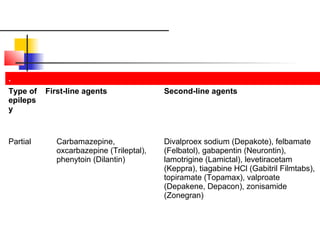
Type of
epileps
y
First-line agents Second-line agents
Partial Carbamazepine,
oxcarbazepine (Trileptal),
phenytoin (Dilantin)
Divalproex sodium (Depakote), felbamate
(Felbatol), gabapentin (Neurontin),
lamotrigine (Lamictal), levetiracetam
(Keppra), tiagabine HCl (Gabitril Filmtabs),
topiramate (Topamax), valproate
(Depakene, Depacon), zonisamide
(Zonegran)
Initial treatment for partial and generalized epilepsies
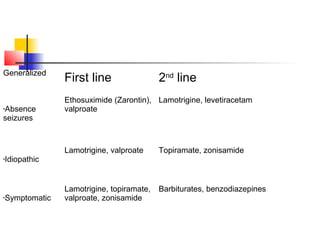
Generalized
First line 2nd
line
•Absence
seizures
Ethosuximide (Zarontin),
valproate
Lamotrigine, levetiracetam
•Idiopathic
Lamotrigine, valproate Topiramate, zonisamide
•Symptomatic
Lamotrigine, topiramate,
valproate, zonisamide
Barbiturates, benzodiazepines
Seccond line drugs
 All of the newer AEDs, including
felbamate, gabapentin, lamotrigine,
levetiracetam, oxcarbazepine,
topiramate, tiagabine, and zonisamide,
have demonstrated efficacy when used
as adjunctive therapy in patients with
poorly controlled seizures of partial
onset
Seccond line drugs
 Lamotrigine
 Could be used as 1st
line
 Gabapentin
 Safe, tolerable
 Monotherapy in liver disease, cutaneous
allergies, porphyria, immune deficiencies,
elderly
Drug interactions
 No interaction
Gabapentin (Neurontin)
Levetiracetam (Keppra)
 Inducers
Carbamazepine
Phenobarbital (Bellatal, Luminal Sodium,
Solfoton)
Phenytoin (Dilantin)
Primidone (Mysoline)
Drug interactions
 Inhibitors
Felbamate (Felbatol)
Valproate (Depakene, Depacon)
 Affected by enzyme-inducing drugs
Carbamazepine
Felbamate
Lamotrigine (Lamictal)
Oxcarbazepine (Trileptal)
Phenobarbital
Phenytoin
Primidone
Tiagabine HCl (Gabitril Filmtabs)
Topiramate (Topamax)
Valproate
Zonisamide (Zonegran)
Healthcare issues for patients with
epilepsy
Coping with the diagnosis
Observing and recording seizures
Identifying potential triggers and high-
risk times
Maintaining personal safety
Handling seizure emergencies
Managing adverse drug effects
Understanding the nonmedical options
for seizure management
Issues in social relationships and community living for
patients with epilepsy
Personal adjustment to epilepsy
Sexuality issues
Education and employment
Recreational opportunities
Disclosure of epilepsy to employers
Stigma and discrimination
Independent living
Transportation
Respite care
Healthcare issues for
patients with epilepsy
Managing concomitant illness
Understanding the relationship
between seizures and hormonal states
Practicing family planning
Managing pregnancy and menopause
Maintaining bone health
Withdrawl of treatment
 >70% on Rx enter prolonged long term
remission
 Even untreated 50% undergo remission
 Why withdrawl
 Side effects
 Social restrictions
 cost
 Assess the patient
 Do a follow up EEG
 Counsel pt and family
Withdrawl of treatment
 Pts fit free for >2yrs to be considered
 2/3rd
are fit free
 Recurrences occur
 50% within 6/12
 Majority within 1 year
Surgical treatment
 Is not a recent development
 If refractory refer to specialist epilepsy
clinic for evaluation
 Prolonged video telemetry is the gold
standard for assesment of seizure
before surgery
 Fit free >60%
Presurgical evaluation for
epilepsy
 Routine electroencephalography (EEG)
Video-EEG monitoring
Magnetic resonance imaging
Positron emission tomography*
Single-photon emission computed
tomography*
Neuropsychological evaluation
Intracarotid amobarbital test (ie, Wada's test)
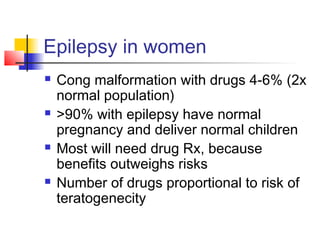
Epilepsy in women
 Cong malformation with drugs 4-6% (2x
normal population)
 >90% with epilepsy have normal
pregnancy and deliver normal children
 Most will need drug Rx, because
benefits outweighs risks
 Number of drugs proportional to risk of
teratogenecity
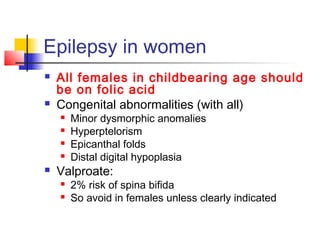
Epilepsy in women
 All females in childbearing age should
be on folic acid
 Congenital abnormalities (with all)
 Minor dysmorphic anomalies
 Hyperptelorism
 Epicanthal folds
 Distal digital hypoplasia
 Valproate:
 2% risk of spina bifida
 So avoid in females unless clearly indicated
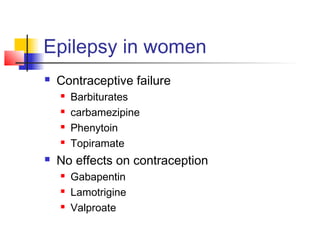
Epilepsy in women
 Contraceptive failure
 Barbiturates
 carbamezipine
 Phenytoin
 Topiramate
 No effects on contraception
 Gabapentin
 Lamotrigine
 Valproate

Epilepsy post graduate medi

  • 1.
  • 2.
    What is epilepsy Occurance of two or more unprovoked seizures is called epilepsy  Epileptic seizures are behavioral changes resulting from paroxysmal, excessive discharges from brain  Single or occasional epileptic seizures or febrile fits should not be classified as epilepsy  Not all jerks , shakes and episodic behaviors are seizures  Tics, tremors, dystonias and sustained clonus in a stroke pt may mimic epilepsy
  • 3.
    Non epileptic paroxysmaldissorders that can mimic epilepsy  Syncope  Reflex(vasovagal, carotid sinus, glossopharyngeal, cough)  cardiac output  Decreased LV filling (hypovolumia, orthostatic hypotensio, PE)  Cardiac arrhythmias  Migraine (classic, basillar and confusional)  Cerebrovascular event (TIA)  Periodic paralysis  Sleep dissorders  GI disorders (Reflux, motility disorders)  Movement disorders  Tics  Tourette’s synd  Non epileptic myoclonus  Parox. Choreoathetosis  Psychiatric disorders  Panic  Somatization  Dissociation  Conversion (non epileptic psychogenic fits)  Drug toxicity et subs abuse  Breath holding spells
  • 4.
    Non epileptic psychogenic seizure How to differentiate  Cannot reliably differrentiate  Gradual onset  Stopping & restarting  Out of phase clonic movements of extremities  Vocalization in the middle of the seizure  Pelvic thrusting and lack of whole body rigidity But frontal lobe cpx seizures may be misdiagnosed (rocking, kicking, bicycling, pelvic thrusting, genital manipulation and cursing)
  • 5.
    Aetiology  Unknown in2/3rd  Head injury  Stroke  Brain tumor  Cortical dysplasia  Infection eg:neurocysticercosis  Alcohol related
  • 6.
    Diagnostic workup  Firistdiagnose seizure  Then determine  Seizure type  Syndromic classification  Etiology  Likelyhood of recurrence  Is treatment needed
  • 7.
    Diagnostic workup  Historytaking  Physical examination  Neurological examination  Diagnostic testing
  • 8.
    Establishing the diagnosis Is a paroxysmal event with impairement of awareness  Diagnosis is clinical  Eye witness is very essential  There is no substitute for detailed Hx  Circumstance of the episode  Patterns of occurance  Preceding symptoms that may localise or suggest other conditions  Timing, pattern and tempo of evolution of symptoms  Reported behaviour before, during and after the event
  • 9.
    History- before theevent Unusual stress (eg, severe emotional trauma) Sleep deprivation Recent illness Unusual stimuli (eg, flickering lights) Use of medications and drugs Activity immediately before event (eg, change in posture, exercise)
  • 10.
    History during theevent  Symptoms at onset (eg, aura) Temporal mode of onset: gradual versus sudden Duration: brief (ictal phase <5 min) versus prolonged Stereotypy: duration and features of episodes nearly identical versus frequently changing Time of day: related to sleep or occuring on awakening
  • 11.
    History during theevent  Ability to talk and respond appropriately Ability to comprehend Ability to recall events during the seizure Abnormal movements of the eyes, mouth, face, head, arms, and legs Bowel or bladder incontinence Bodily injury
  • 12.
    History after theevent  Confusion Lethargy Abnormal speech Focal weakness or sensory loss (ie, Todd's paralysis) Headache, muscle soreness, or physical injury
  • 13.
    Episode is morelikely to be syncopal if  Is precipitated by anxiety or pain (eg, venipuncture)  Occurs after the patient assumes an upright position  Occurs only when the patient is standing or sitting  Is associated with facial pallor and diaphoresis  Is not associated with sustained tonic or clonic movements, bladder incontinence, or biting of the tongue or cheek  Is not followed by postictal confusion, lethargy, muscle soreness, and headache  Is followed by a relatively rapid return to baseline
  • 14.
    Past medical history Prolonged febrile fit  Meningitis  Encephalitis  Head injury  Cancer  Stroke  In diabetic pts hypo/hyperglycemia  Hyponatremia, hypocalcemia, hypo parathyroidism and hypothyroidism can cause fits
  • 15.
    Drug history  Theophyllin INAH  Phenothiazine  Clozapine  Radiocontrast dye  Alkylating agents  Beta lactam antibiotics  Others : lignocain, general anesthetics, Tricyclics, SSRI, Acyclovir, beta blockers, decongestants, ectasy(MDMA)
  • 16.
    Physical examination  Examinethe patient for injuries from the seizure or fall.  Check oxygen saturation and auscultate the chest for possible aspiration.  Measure heart rhythm and rate, blood pressure, and orthostatic changes for assessment of syncope.  Auscultate for carotid murmurs or carotid bruits and sources of embolic stroke.  Check for rapid pulses, which are often present after seizure and may help in evaluation of psychogenic seizures.
  • 17.
    Neurological examination  Purposeis to identify focal or diffuse cerebral dysfunction  Certain features will suggest focus of fit  Aphasia – frontal lobe, temporal or parietal  Right or left hemiparesis – contralateral motor cortex  Sensory deficit – parietal lobe dysfunction  Should be observed for  Fluency of language  Facial asymetry  Gaze preference  Pupilary asymetry (Herniation of brain)  Extensor plantar for some time - normal
  • 18.
    Diagnostic testing  Allpts should have  FBC  Ca, SE  Glucose  LFT  ECG – important to detect prolonged QT (Morning generalised tonic clonic seizure)
  • 19.
    Diagnostic testing  Toxicityscreening and alcohol level in appropriate pts  Lumbar puncture infection or fever present, HIV or malignancy
  • 20.
    Diagnostic testing -EEG Role misunderstood  Detection of abnormality does not equate epilepsy  Absence of inter ictal abnormality does not exclude epilepsy  Only 1/3rd of epileptics show abnormalities  Ictal EEG could also be normal
  • 21.
    Diagnostic testing -EEG EEG is diagnostic in certain conditions  Generalised 3Hz spike and wave activity -- 1ry generalised epilepsy  Ictal recordings are not routinely done except in incidental situations
  • 22.
    EEG telemetry  Ambualtoryor video telemetry if diagnosis remains in doubt  Presurgical  Intracranial amytal testing to test memory and language function  Intracranial EEG to localise the focus
  • 23.
    Imaging studies  Immediatelyafter fit CT scan– bleeding or structural lesions  MRI is the Ix of choice – sensitive & specific for evaluation of structural lesions and brain parenchyma  Mesial temporal sclerosis – hippocampus  Dysplasia – cortical architectural abnormalities  Better if could be done for all partial seizures  Reveals abnormality in  30% with generalised epilepsy  70% with focal epilepsy
  • 24.
    Detailed investigations  Fewpts will need  Hypoglycemia – early morning fits  ECHO  Ambulatory ECG  Urinary catecholamines  Porphyrins
  • 25.
    Implications of diagnosis May loose job  Life restricted  Mental trauma  Driving licence  Marriage So all differential diagnosis should be carefully considered
  • 26.
    Classification  Generalised  Arisefrom both sides of the brain simultaneously  Partial or focal  Occurs within one or more restricted regions of the brain and effect of a localised physiologic or structural abnormality of brain (Eg: tumor, dysplasia, stroke, trauma)
  • 27.
    Classification  Generalised seizures  Absence Atonic  Myoclonic  Clonic  Tonic  Tonic clonic (Grand mal)  Partial  Simple partial consciousness not affected  Complex partial consciousness impaired  Partial with 2ry generalization can be tonic clonic, tonic or clonic
  • 28.
    When to treat Once diagnosed decide wether to treat or not  Recurrece  After a single tonic clonic fit 15-60%  After 2 fits – 85%  Probability of recurrence increases if  Family history +  Spike and wave pattern in EEG  Hx of prior neurological insult  Todd’s paralysis  Status epilepticus  Acute symp fit (occuring after brain insult)
  • 29.
    First fit -to treat or not  What is the risk of treating and non treating  What is the risk of recurrence  Occupation- heavy vehicle drivers – yes  In children – initial fit during sleep – no need to treat  Patients preference
  • 30.
    Management - aim Prevent fits without causing adverse effects  Optimise patients quality of life  Fits could be life threatening  Pts with epilepsy are at risk of sudden unexpected death (1/200/yr in refractory epilepsy)
  • 31.
    Management - Principles Rx is usually not given after a single unprovoked seizure, unless recurrence risk high  Avoid precipitating factors  Identify underlying conditions and Rx  Treatment strategies should be explained to the pt
  • 32.
    Management – Principles (Drugs) Choice – pts individual circumstance, syndrome and side effect profile  Low dose – slowly increase over weeks, minimising side effects and promoting compliance  If 1st line drug fails, add another 1st line drug while gradually withdrawing the 1st drug  If unsuccessful add 2nd line drug  Vigabatrin and barbiturates should not be combined  Refer refractory cases for evaluation for surgery
  • 33.
    Monotherapy vs polytherapy 47% fit free with one drug  14% fit free with addition 2nd or 3rd drug  If 2nd drug fails refer for evaluation of surgery  If not willing for surgery – consider polytherapy
  • 34.
    . Type of epileps y First-line agentsSecond-line agents Partial Carbamazepine, oxcarbazepine (Trileptal), phenytoin (Dilantin) Divalproex sodium (Depakote), felbamate (Felbatol), gabapentin (Neurontin), lamotrigine (Lamictal), levetiracetam (Keppra), tiagabine HCl (Gabitril Filmtabs), topiramate (Topamax), valproate (Depakene, Depacon), zonisamide (Zonegran) Initial treatment for partial and generalized epilepsies Initial treatment for partial and generalized epilepsies
  • 35.
    Generalized First line 2nd line •Absence seizures Ethosuximide(Zarontin), valproate Lamotrigine, levetiracetam •Idiopathic Lamotrigine, valproate Topiramate, zonisamide •Symptomatic Lamotrigine, topiramate, valproate, zonisamide Barbiturates, benzodiazepines
  • 36.
    Seccond line drugs All of the newer AEDs, including felbamate, gabapentin, lamotrigine, levetiracetam, oxcarbazepine, topiramate, tiagabine, and zonisamide, have demonstrated efficacy when used as adjunctive therapy in patients with poorly controlled seizures of partial onset
  • 37.
    Seccond line drugs Lamotrigine  Could be used as 1st line  Gabapentin  Safe, tolerable  Monotherapy in liver disease, cutaneous allergies, porphyria, immune deficiencies, elderly
  • 38.
    Drug interactions  Nointeraction Gabapentin (Neurontin) Levetiracetam (Keppra)  Inducers Carbamazepine Phenobarbital (Bellatal, Luminal Sodium, Solfoton) Phenytoin (Dilantin) Primidone (Mysoline)
  • 39.
    Drug interactions  Inhibitors Felbamate(Felbatol) Valproate (Depakene, Depacon)  Affected by enzyme-inducing drugs Carbamazepine Felbamate Lamotrigine (Lamictal) Oxcarbazepine (Trileptal) Phenobarbital Phenytoin Primidone Tiagabine HCl (Gabitril Filmtabs) Topiramate (Topamax) Valproate Zonisamide (Zonegran)
  • 40.
    Healthcare issues forpatients with epilepsy Coping with the diagnosis Observing and recording seizures Identifying potential triggers and high- risk times Maintaining personal safety Handling seizure emergencies Managing adverse drug effects Understanding the nonmedical options for seizure management
  • 41.
    Issues in socialrelationships and community living for patients with epilepsy Personal adjustment to epilepsy Sexuality issues Education and employment Recreational opportunities Disclosure of epilepsy to employers Stigma and discrimination Independent living Transportation Respite care
  • 42.
    Healthcare issues for patientswith epilepsy Managing concomitant illness Understanding the relationship between seizures and hormonal states Practicing family planning Managing pregnancy and menopause Maintaining bone health
  • 43.
    Withdrawl of treatment >70% on Rx enter prolonged long term remission  Even untreated 50% undergo remission  Why withdrawl  Side effects  Social restrictions  cost  Assess the patient  Do a follow up EEG  Counsel pt and family
  • 44.
    Withdrawl of treatment Pts fit free for >2yrs to be considered  2/3rd are fit free  Recurrences occur  50% within 6/12  Majority within 1 year
  • 45.
    Surgical treatment  Isnot a recent development  If refractory refer to specialist epilepsy clinic for evaluation  Prolonged video telemetry is the gold standard for assesment of seizure before surgery  Fit free >60%
  • 46.
    Presurgical evaluation for epilepsy Routine electroencephalography (EEG) Video-EEG monitoring Magnetic resonance imaging Positron emission tomography* Single-photon emission computed tomography* Neuropsychological evaluation Intracarotid amobarbital test (ie, Wada's test)
  • 48.
    Epilepsy in women Cong malformation with drugs 4-6% (2x normal population)  >90% with epilepsy have normal pregnancy and deliver normal children  Most will need drug Rx, because benefits outweighs risks  Number of drugs proportional to risk of teratogenecity
  • 49.
    Epilepsy in women All females in childbearing age should be on folic acid  Congenital abnormalities (with all)  Minor dysmorphic anomalies  Hyperptelorism  Epicanthal folds  Distal digital hypoplasia  Valproate:  2% risk of spina bifida  So avoid in females unless clearly indicated
  • 50.
    Epilepsy in women Contraceptive failure  Barbiturates  carbamezipine  Phenytoin  Topiramate  No effects on contraception  Gabapentin  Lamotrigine  Valproate