Popliteal Cyst (Baker’s Cyst)
Siwaporn Khureerung
What is a Baker's cyst?
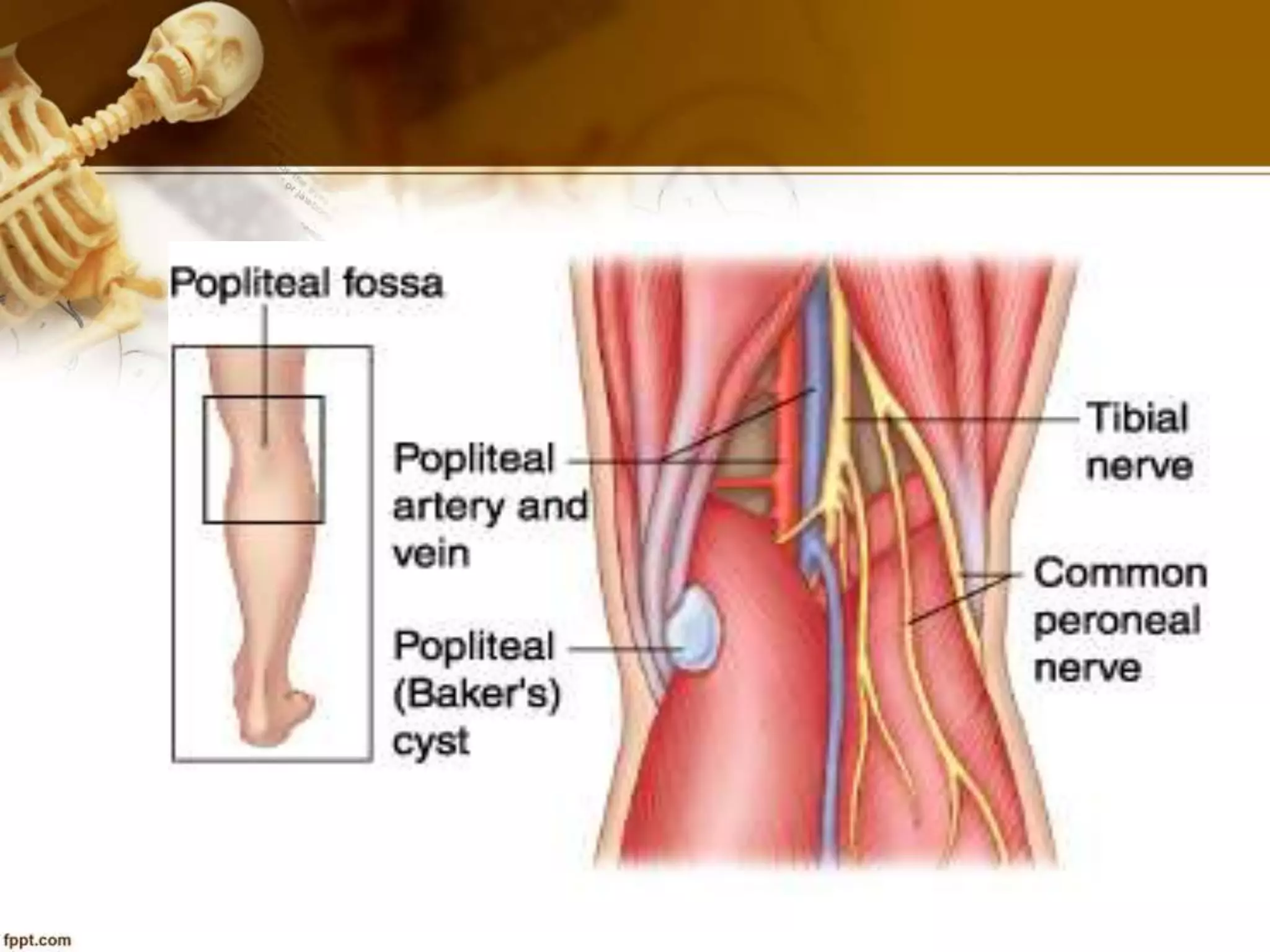
Popliteal cyst is a distend bursa or herniation of
synovial membrane through the posterior part of capsule
of the knee or escape of fluid through normal
communication of bursa with the knee. It is filled with
synovial inside the knee joint. (semimembranosus or
medial gastrocnemius bursa)
 most common in children aged 4 to 7 years and in
adults aged 35 to 70 years.
 more common in adults than in children.
Causes of a Baker's cyst
• A primary Baker's cyst  idiopathic Baker's cyst. It
usually develops in younger people and children.
• A secondary Baker's cyst  most common type.
Develop if there is underlying problem within the
knee, such as arthritis (osteoarthritis and rheumatoid
arthritis), or a tear in the meniscal cartilage that lines
the inside of the knee joint. or an infection within the
knee joint.
Symptoms
 Some people do not have any symptoms.
 Symptoms can include pain, swelling and tightness
behind the knee especially when standing up.
 Larger the Baker's cyst, the more likely it is to produce
symptoms
 symptoms related to underlying knee problem such as
arthritis  ‘knee pain’
 Less commonly, you may feel a sensation of clicking or
locking of your knee.
Physical Examination
 The popliteal fossa (area behind the knee) may be
swollen
 Translumination test :: Positive
 If the lump grows quickly or have night pain ,severe
pain ,fever need more test to make sure other type
of tumors
Differencial diagnosis
 Thrombophlebitis ,thrombosis
 Benign soft tissue tumor
peripheral nerve sheath tumor (neurolemmoma)
 Lopoma , malignancy , vascular mass
Ultrasound scan
good investigation to show a Baker's cyst
and to help to exclude a DVT
MRI SCAN
used to confirm the diagnosis.
Appears as a high signal intensity
homogenous cystic mass
Arthroscopy
Management
• No specific treatment is needed.
• Treatment of any underlying knee problem
• Treatment to help relieve symptoms
 Support stockings NSAIDs
 Physiotherapy  ICE
 Fluid drainage  Crutches
 Cortisone (steroid) injection
 Surgery
Complications
 Rupture (split open).
 Deep vein thrombosis even if the cyst does not
rupture.
 Infected.
 Posterior compartment syndrome
 Common peroneal nerve and tibial nerve
compression
Home care
R.I.C.E
- R est your leg
- I ce the inflamed area
- C ompress your knee
- E levate your leg ,especially at night

Baker's cyst

  • 1.
    Popliteal Cyst (Baker’sCyst) Siwaporn Khureerung
  • 2.
    What is aBaker's cyst? Popliteal cyst is a distend bursa or herniation of synovial membrane through the posterior part of capsule of the knee or escape of fluid through normal communication of bursa with the knee. It is filled with synovial inside the knee joint. (semimembranosus or medial gastrocnemius bursa)  most common in children aged 4 to 7 years and in adults aged 35 to 70 years.  more common in adults than in children.
  • 5.
    Causes of aBaker's cyst • A primary Baker's cyst  idiopathic Baker's cyst. It usually develops in younger people and children. • A secondary Baker's cyst  most common type. Develop if there is underlying problem within the knee, such as arthritis (osteoarthritis and rheumatoid arthritis), or a tear in the meniscal cartilage that lines the inside of the knee joint. or an infection within the knee joint.
  • 6.
    Symptoms  Some peopledo not have any symptoms.  Symptoms can include pain, swelling and tightness behind the knee especially when standing up.  Larger the Baker's cyst, the more likely it is to produce symptoms  symptoms related to underlying knee problem such as arthritis  ‘knee pain’  Less commonly, you may feel a sensation of clicking or locking of your knee.
  • 7.
    Physical Examination  Thepopliteal fossa (area behind the knee) may be swollen  Translumination test :: Positive  If the lump grows quickly or have night pain ,severe pain ,fever need more test to make sure other type of tumors
  • 8.
    Differencial diagnosis  Thrombophlebitis,thrombosis  Benign soft tissue tumor peripheral nerve sheath tumor (neurolemmoma)  Lopoma , malignancy , vascular mass
  • 9.
    Ultrasound scan good investigationto show a Baker's cyst and to help to exclude a DVT
  • 10.
    MRI SCAN used toconfirm the diagnosis. Appears as a high signal intensity homogenous cystic mass
  • 11.
  • 12.
    Management • No specifictreatment is needed. • Treatment of any underlying knee problem • Treatment to help relieve symptoms  Support stockings NSAIDs  Physiotherapy  ICE  Fluid drainage  Crutches  Cortisone (steroid) injection  Surgery
  • 13.
    Complications  Rupture (splitopen).  Deep vein thrombosis even if the cyst does not rupture.  Infected.  Posterior compartment syndrome  Common peroneal nerve and tibial nerve compression
  • 14.
    Home care R.I.C.E - Rest your leg - I ce the inflamed area - C ompress your knee - E levate your leg ,especially at night