GASTRIC CARCINOMA  PRESENTED BY: Dr.Afnan Fahad AlMuhanna KFHU – Khobar - SA
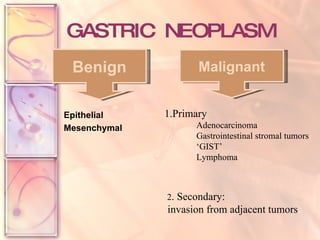
GASTRIC  NEOPLASM Epithelial  Mesenchymal 1.Primary Adenocarcinoma Gastrointestinal stromal tumors ‘GIST’ Lymphoma  2 . Secondary: invasion from adjacent tumors . Benign Malignant
GASTRIC CA
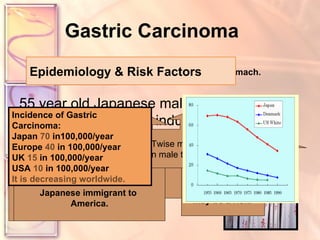
Gastric Carcinoma 55 year old Japanese male who is living in Japan & working in industry. DEFINITION Malignant lesion of the stomach. Epidemiology & Risk Factors Can occur at any age But Peak incidece Is  50-70  years old. It is more aggressive In younger ages. Japan has the world  highest Rate of  gastric cancer. Studies have confirmed  that incidence decline in Japanese immigrant to  America. dust ingestion from a variety  of industrial  processes  may be a risk. Twise more common In male than in female Incidence of Gastric Carcinoma: Japan  70  in100,000/year Europe  40  in 100,000/year UK  15  in 100,000/year USA  10  in 100,000/year It is decreasing worldwide.

Gastric Carcinoma: Risk Factors Predisposing : 1.  Pernicious anemia & atrophic gastritis (achlorhydra) 2.  Previous gastric  resection 3.  Chronic peptic ulcer (give rise to 1%) 4 . Smoking. 5.  Alcohol.  Environmental: 1. H.pylori infection Sero(+)patients have 6-9 folds risk 2. low  socioeconomic  Status 3.  notionality (JAPAN) 4 . Diet (prevention) Genetic: 1. Blood group A 2. HNPCC:  Heriditory non-polyposis colon cancer.
Clinical Presentation Most patients present with advanced stage..  why? They are often  asymptomatic  in early stages. Common clinical Presentation: The patient complained of  loss of appetite  that was followed by  weight loss  of 10Kg in 4 weeks.  He had notice  epigastric discomfort & postprandial fullness. He presented to the ER complaining of  vomiting  of large quantities of undigested food & epigastric distension. Dyspepsia  epigastric pain Bloating early satiety nausea & vomiting* dysphagia* anorexia weight loss upper GI bleeding  (hematemesis, melena,  iron deficiency anemia)
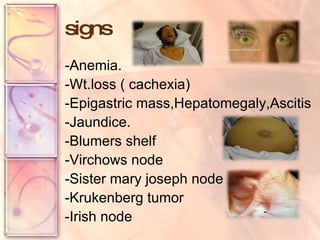
signs -Anemia. -Wt.loss ( cachexia) -Epigastric mass,Hepatomegaly,Ascitis  -Jaundice. -Blumers shelf  -Virchows node -Sister mary joseph node  -Krukenberg tumor -Irish node
Pathology  DIO Classification Lauren Classification: 1.  Intestinal Gastric ca. It arises in areas of intestinal metaplasia to form  polypoid  tumors or  ulcers .  2.  Diffuse Gastric ca.  It infiltrates deeply in the stomach without forming obvious mass lesions but spreads widely in the gastric wall “Linitis Plastica” & it has much more worse prognosis 3.  Mixed Morphology.
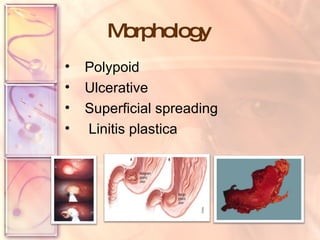
Morphology Polypoid Ulcerative Superficial spreading Linitis plastica
Gastric cancer can be devided into: Early: Limited to mucosa & submucosa with or without LN (T1, any N) >> curable with 5 years survival rate in 90%. Advanced: It involves the Mascularis. It has 4  types( Bormann’s classification). Type III & IV are incurable.
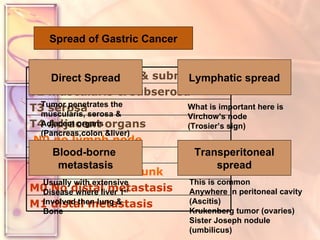
Staging of gastric cancer Spread of Gastric Cancer Direct Spread Blood-borne  metastasis Lymphatic spread Transperitoneal spread Tumor penetrates the muscularis, serosa &  Adjacent organs (Pancreas,colon &liver) What is important here is Virchow’s node  (Trosier’s sign) Usually with extensive  Disease where liver 1 st Involved then lung & Bone This is common Anywhere in peritoneal cavity (Ascitis) Krukenberg tumor (ovaries) Sister Joseph nodule (umbilicus) T1 lamina propria & submucosa T2 muscularis & subserosa T3 serosa T4 Adjacent organs N0 no lymph node  N1 Epigastric node N2 main arterial trunk M0 No distal metastasis M1 distal metastasis
Complications  Peritoneal and pleural effusion Obstruction of gastric outlet or small bowel Bleeding  Intrahepatc jaundice by hepatomegaly
Differential Diagnosis 1.Gastric ulcer 2.Other gastric neoplasms 3.Gastritis 4.Gastric Polyp 5.Crohns disease. From history, Cancer is not relieved by antacids Not periodic Not releived by eating or vomiting.
INVESTIGATIONS Full blood count –IDA-  LFT,RFT Amylase & lipase. Serum tumor markers (CA 72-4,CEA,CA19-9) not specific Stool examination for occult blood CXR ,Bone scan.
Specific: UGI endoscopy with biopsy  Double contrast study CT, MRI & US Laparoscopry
EGD  esophago gastro duodeno scopy Diagnostic accuracy is  98% if upto 7 biopsies is taken. Double Contrast barium upper GI x-ray Diagnostic accuracy  90% WHY? Diagnostic study of Choise 1.Early superficial gastric mucosal lesion can be missed . 2.  can’t differentiate  b/w benign ulcer &  Ulcerating adenocarcinoma.
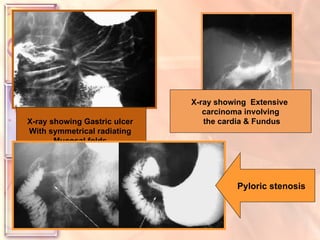
X-ray showing Gastric ulcer  With symmetrical radiating  Mucosal folds. By histology, no evidence of  Malignancies was observed. X-ray showing  Extensive  carcinoma involving the cardia & Fundus Pyloric stenosis
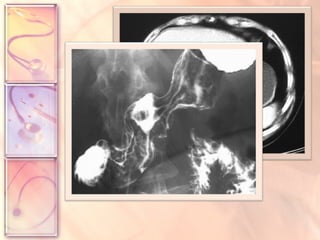
CT,MRI & US: Laparoscopy: Help in assessment of wall thickness, metastases (peritoneum ,liver  & LNs) Detection of peritoneal metastases
 
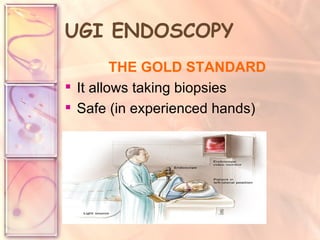
THE GOLD STANDARD   It allows taking biopsies  Safe (in experienced hands) UGI ENDOSCOPY
 
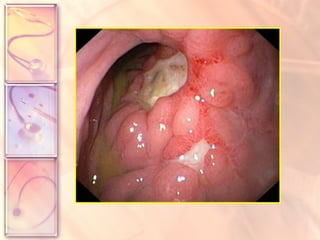
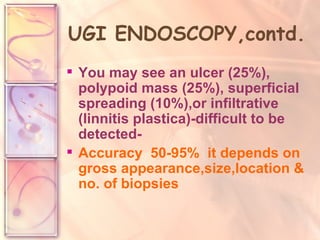
UGI ENDOSCOPY,contd. You may see an ulcer (25%), polypoid mass (25%), superficial spreading (10%),or infiltrative (linnitis plastica)-difficult to be detected- Accuracy  50-95%  it depends on gross appearance,size,location & no. of biopsies
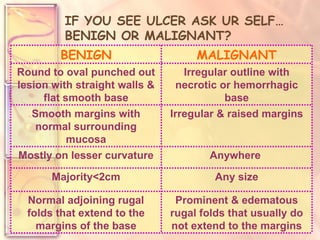
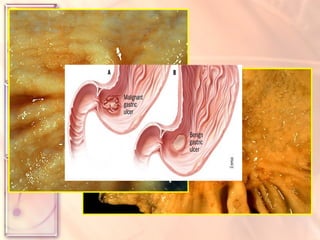
IF YOU SEE ULCER ASK UR SELF…BENIGN OR MALIGNANT? MALIGNANT BENIGN Irregular outline with necrotic or hemorrhagic base Round to oval punched out lesion with straight walls & flat smooth base Irregular & raised margins Smooth margins with normal surrounding mucosa Anywhere  Mostly on lesser curvature Any size Majority<2cm Prominent & edematous rugal folds that usually do not extend to the margins Normal adjoining rugal folds that extend to the margins of the base
 
Management Surgery Chemotherapy NO PROVEN BENEFIT Radiotherapy
Treatment Initial treatment: 1.Improve  nutrition  if needed by parentral or enteral feeding. 2. Correct  fluid  &electrolyte & anemia if they are present. Preoperative Care Preoperative Staging is important because we don’t want to subject the patient to radical surgery that can’t help him.
PRE-OPERATIVE CARE Careful preoperative staging Screen for any nutritional deficiencies & consider nutritional support Symptomatic control  Blood transfusion in symptomatic anemia Hydration Prophylactic antibiotics ABO & crossmatch Ask about current medications & allergies Cessation of smoking
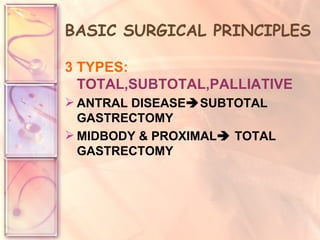
BASIC SURGICAL PRINCIPLES 3 TYPES:   TOTAL,SUBTOTAL,PALLIATIVE ANTRAL DISEASE  SUBTOTAL GASTRECTOMY MIDBODY & PROXIMAL   TOTAL GASTRECTOMY
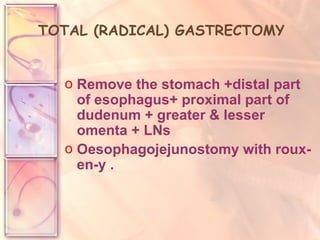
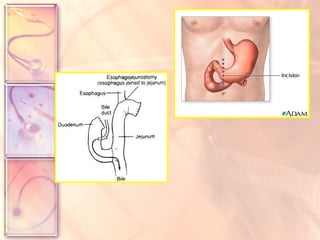
TOTAL (RADICAL) GASTRECTOMY Remove the stomach +distal part of esophagus+ proximal part of dudenum + greater & lesser omenta + LNs  Oesophagojejunostomy with roux-en-y .
 
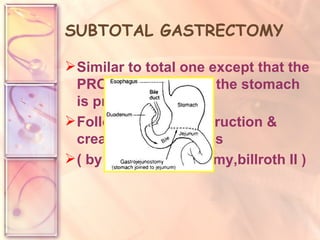
SUBTOTAL GASTRECTOMY Similar to total one except that the PROXIMAL PART of the stomach is preserved Followed by reconstruction & creating anastomosis  ( by gastrojejunostomy,billroth II )
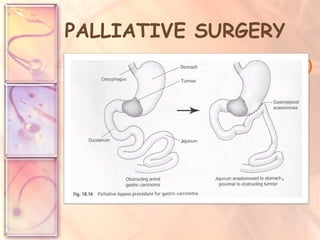
PALLIATIVE SURGERY For pts with advanced (inoperable) disease & suffering significant symptoms e.g. obstruction, bleeding. Palliative gastrectomy not necessarily to be radical, remove resectable masses & reconstruct (anastomosis/intubation/stenting/ recanalisation)
POSTOPERATIVE ORDERS Admit to PACU Detailed nutritional advise (small frequent meals)
Post-Operative Complications 1. Leakage from duodenal stump. 2. Secondary hemorrhage. 3. Nutritional deficiency in long term.
2.Chemotherapy:  Responds well, but there is no effect on servival. Marsden Regimen Epirubicin, cisplatin &5-flurouracil (3 wks) 6 cycles Response rate : 40% . 3. Radiotherapy: Postperative-radiotherpy:  may decrease the recurrence.
Preventive measures By diet Convincing: vegetable & fruits. Probable:   Vit.C &E Possible   Carotenoids,whole grean cereals and green tea.   Smoking cessation  Cessation of alcohol intake Early diagnosis remains the Key Problem
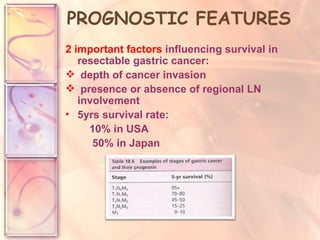
PROGNOSTIC FEATURES 2 important factors  influencing survival in resectable gastric cancer:  depth of cancer invasion  presence or absence of regional LN involvement 5yrs survival rate:  10% in USA 50% in Japan
GIST
Gastrointestinal Stromal Tumor ‘GIST’ Previously  leiomyoma & leomyosarcoma . <1 % Rarly cause bleeding or obstruction. The origion: Intestinal Cells of Cajal ‘ICC;s’ autonomic nervous system. The distinction b\w benign & malignant is unclear. In general terms, the larger the tumor & greater mitotic activity, the more likely to metastases. The stomach is the most common site of GIST.
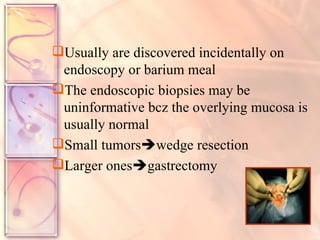
Usually are discovered incidentally on endoscopy or barium meal The endoscopic biopsies may be uninformative bcz the overlying mucosa is usually normal Small tumors  wedge resection Larger ones  gastrectomy
GASTRIC LYMPHOMA
Gastric Lymphoma Most common primary GI Lymphoma . It’s increasing in frequency. Presentation: Similar to gastric carcinoma. May reveal peripheral adenopathy, abdominal mass or spleenomegaly.
Diagnosis: 1. EGD  2. contrast GI x-ray. 3. CT guided fine needle biopsy. Treatment :   1.   surgery:  total or subtotal gastrectomy with spleenectomy or palliative resection. 2. Adjunct  radiotherapy:  may improve 5 year survival  3. Adjunct  Chemotherapy:  may prevent recurrance.
THANK U E-medicine web site The Washington Manual of Surgery Bailey & Love’s short practice of surgery Clinical surgery ( A.cuschieri).

Gastric Carcinoma

  • 1.
    GASTRIC CARCINOMA PRESENTED BY: Dr.Afnan Fahad AlMuhanna KFHU – Khobar - SA
  • 2.
    GASTRIC NEOPLASMEpithelial Mesenchymal 1.Primary Adenocarcinoma Gastrointestinal stromal tumors ‘GIST’ Lymphoma 2 . Secondary: invasion from adjacent tumors . Benign Malignant
  • 3.
  • 4.
    Gastric Carcinoma 55year old Japanese male who is living in Japan & working in industry. DEFINITION Malignant lesion of the stomach. Epidemiology & Risk Factors Can occur at any age But Peak incidece Is 50-70 years old. It is more aggressive In younger ages. Japan has the world highest Rate of gastric cancer. Studies have confirmed that incidence decline in Japanese immigrant to America. dust ingestion from a variety of industrial processes may be a risk. Twise more common In male than in female Incidence of Gastric Carcinoma: Japan 70 in100,000/year Europe 40 in 100,000/year UK 15 in 100,000/year USA 10 in 100,000/year It is decreasing worldwide.
  • 5.
    Gastric Carcinoma: RiskFactors Predisposing : 1. Pernicious anemia & atrophic gastritis (achlorhydra) 2. Previous gastric resection 3. Chronic peptic ulcer (give rise to 1%) 4 . Smoking. 5. Alcohol. Environmental: 1. H.pylori infection Sero(+)patients have 6-9 folds risk 2. low socioeconomic Status 3. notionality (JAPAN) 4 . Diet (prevention) Genetic: 1. Blood group A 2. HNPCC: Heriditory non-polyposis colon cancer.
  • 6.
    Clinical Presentation Mostpatients present with advanced stage.. why? They are often asymptomatic in early stages. Common clinical Presentation: The patient complained of loss of appetite that was followed by weight loss of 10Kg in 4 weeks. He had notice epigastric discomfort & postprandial fullness. He presented to the ER complaining of vomiting of large quantities of undigested food & epigastric distension. Dyspepsia epigastric pain Bloating early satiety nausea & vomiting* dysphagia* anorexia weight loss upper GI bleeding (hematemesis, melena, iron deficiency anemia)
  • 7.
    signs -Anemia. -Wt.loss( cachexia) -Epigastric mass,Hepatomegaly,Ascitis -Jaundice. -Blumers shelf -Virchows node -Sister mary joseph node -Krukenberg tumor -Irish node
  • 8.
    Pathology DIOClassification Lauren Classification: 1. Intestinal Gastric ca. It arises in areas of intestinal metaplasia to form polypoid tumors or ulcers . 2. Diffuse Gastric ca. It infiltrates deeply in the stomach without forming obvious mass lesions but spreads widely in the gastric wall “Linitis Plastica” & it has much more worse prognosis 3. Mixed Morphology.
  • 9.
    Morphology Polypoid UlcerativeSuperficial spreading Linitis plastica
  • 10.
    Gastric cancer canbe devided into: Early: Limited to mucosa & submucosa with or without LN (T1, any N) >> curable with 5 years survival rate in 90%. Advanced: It involves the Mascularis. It has 4 types( Bormann’s classification). Type III & IV are incurable.
  • 11.
    Staging of gastriccancer Spread of Gastric Cancer Direct Spread Blood-borne metastasis Lymphatic spread Transperitoneal spread Tumor penetrates the muscularis, serosa & Adjacent organs (Pancreas,colon &liver) What is important here is Virchow’s node (Trosier’s sign) Usually with extensive Disease where liver 1 st Involved then lung & Bone This is common Anywhere in peritoneal cavity (Ascitis) Krukenberg tumor (ovaries) Sister Joseph nodule (umbilicus) T1 lamina propria & submucosa T2 muscularis & subserosa T3 serosa T4 Adjacent organs N0 no lymph node N1 Epigastric node N2 main arterial trunk M0 No distal metastasis M1 distal metastasis
  • 12.
    Complications Peritonealand pleural effusion Obstruction of gastric outlet or small bowel Bleeding Intrahepatc jaundice by hepatomegaly
  • 13.
    Differential Diagnosis 1.Gastriculcer 2.Other gastric neoplasms 3.Gastritis 4.Gastric Polyp 5.Crohns disease. From history, Cancer is not relieved by antacids Not periodic Not releived by eating or vomiting.
  • 14.
    INVESTIGATIONS Full bloodcount –IDA- LFT,RFT Amylase & lipase. Serum tumor markers (CA 72-4,CEA,CA19-9) not specific Stool examination for occult blood CXR ,Bone scan.
  • 15.
    Specific: UGI endoscopywith biopsy Double contrast study CT, MRI & US Laparoscopry
  • 16.
    EGD esophagogastro duodeno scopy Diagnostic accuracy is 98% if upto 7 biopsies is taken. Double Contrast barium upper GI x-ray Diagnostic accuracy 90% WHY? Diagnostic study of Choise 1.Early superficial gastric mucosal lesion can be missed . 2. can’t differentiate b/w benign ulcer & Ulcerating adenocarcinoma.
  • 17.
    X-ray showing Gastriculcer With symmetrical radiating Mucosal folds. By histology, no evidence of Malignancies was observed. X-ray showing Extensive carcinoma involving the cardia & Fundus Pyloric stenosis
  • 18.
    CT,MRI & US:Laparoscopy: Help in assessment of wall thickness, metastases (peritoneum ,liver & LNs) Detection of peritoneal metastases
  • 19.
  • 20.
    THE GOLD STANDARD It allows taking biopsies Safe (in experienced hands) UGI ENDOSCOPY
  • 21.
  • 22.
    UGI ENDOSCOPY,contd. Youmay see an ulcer (25%), polypoid mass (25%), superficial spreading (10%),or infiltrative (linnitis plastica)-difficult to be detected- Accuracy 50-95% it depends on gross appearance,size,location & no. of biopsies
  • 23.
    IF YOU SEEULCER ASK UR SELF…BENIGN OR MALIGNANT? MALIGNANT BENIGN Irregular outline with necrotic or hemorrhagic base Round to oval punched out lesion with straight walls & flat smooth base Irregular & raised margins Smooth margins with normal surrounding mucosa Anywhere Mostly on lesser curvature Any size Majority<2cm Prominent & edematous rugal folds that usually do not extend to the margins Normal adjoining rugal folds that extend to the margins of the base
  • 24.
  • 25.
    Management Surgery ChemotherapyNO PROVEN BENEFIT Radiotherapy
  • 26.
    Treatment Initial treatment:1.Improve nutrition if needed by parentral or enteral feeding. 2. Correct fluid &electrolyte & anemia if they are present. Preoperative Care Preoperative Staging is important because we don’t want to subject the patient to radical surgery that can’t help him.
  • 27.
    PRE-OPERATIVE CARE Carefulpreoperative staging Screen for any nutritional deficiencies & consider nutritional support Symptomatic control Blood transfusion in symptomatic anemia Hydration Prophylactic antibiotics ABO & crossmatch Ask about current medications & allergies Cessation of smoking
  • 28.
    BASIC SURGICAL PRINCIPLES3 TYPES: TOTAL,SUBTOTAL,PALLIATIVE ANTRAL DISEASE  SUBTOTAL GASTRECTOMY MIDBODY & PROXIMAL  TOTAL GASTRECTOMY
  • 29.
    TOTAL (RADICAL) GASTRECTOMYRemove the stomach +distal part of esophagus+ proximal part of dudenum + greater & lesser omenta + LNs Oesophagojejunostomy with roux-en-y .
  • 30.
  • 31.
    SUBTOTAL GASTRECTOMY Similarto total one except that the PROXIMAL PART of the stomach is preserved Followed by reconstruction & creating anastomosis ( by gastrojejunostomy,billroth II )
  • 32.
    PALLIATIVE SURGERY Forpts with advanced (inoperable) disease & suffering significant symptoms e.g. obstruction, bleeding. Palliative gastrectomy not necessarily to be radical, remove resectable masses & reconstruct (anastomosis/intubation/stenting/ recanalisation)
  • 33.
    POSTOPERATIVE ORDERS Admitto PACU Detailed nutritional advise (small frequent meals)
  • 34.
    Post-Operative Complications 1.Leakage from duodenal stump. 2. Secondary hemorrhage. 3. Nutritional deficiency in long term.
  • 35.
    2.Chemotherapy: Respondswell, but there is no effect on servival. Marsden Regimen Epirubicin, cisplatin &5-flurouracil (3 wks) 6 cycles Response rate : 40% . 3. Radiotherapy: Postperative-radiotherpy: may decrease the recurrence.
  • 36.
    Preventive measures Bydiet Convincing: vegetable & fruits. Probable: Vit.C &E Possible Carotenoids,whole grean cereals and green tea. Smoking cessation Cessation of alcohol intake Early diagnosis remains the Key Problem
  • 37.
    PROGNOSTIC FEATURES 2important factors influencing survival in resectable gastric cancer: depth of cancer invasion presence or absence of regional LN involvement 5yrs survival rate: 10% in USA 50% in Japan
  • 38.
  • 39.
    Gastrointestinal Stromal Tumor‘GIST’ Previously leiomyoma & leomyosarcoma . <1 % Rarly cause bleeding or obstruction. The origion: Intestinal Cells of Cajal ‘ICC;s’ autonomic nervous system. The distinction b\w benign & malignant is unclear. In general terms, the larger the tumor & greater mitotic activity, the more likely to metastases. The stomach is the most common site of GIST.
  • 40.
    Usually are discoveredincidentally on endoscopy or barium meal The endoscopic biopsies may be uninformative bcz the overlying mucosa is usually normal Small tumors  wedge resection Larger ones  gastrectomy
  • 41.
  • 42.
    Gastric Lymphoma Mostcommon primary GI Lymphoma . It’s increasing in frequency. Presentation: Similar to gastric carcinoma. May reveal peripheral adenopathy, abdominal mass or spleenomegaly.
  • 43.
    Diagnosis: 1. EGD 2. contrast GI x-ray. 3. CT guided fine needle biopsy. Treatment : 1. surgery: total or subtotal gastrectomy with spleenectomy or palliative resection. 2. Adjunct radiotherapy: may improve 5 year survival 3. Adjunct Chemotherapy: may prevent recurrance.
  • 44.
    THANK U E-medicineweb site The Washington Manual of Surgery Bailey & Love’s short practice of surgery Clinical surgery ( A.cuschieri).