Cerebrospinal
fluid
Introduction
• CSF is clear, colorless and transparent
• Circulates through cavity of the:
– Brain
– Subarachnoid space
– Central canal of spinal cord
• Part of Extracellular fluid (ECF)
Properties
• Volume : approximately 150 mL
• Rate of formation: approximately 0.3 mL/min
• Specific gravity : 1.005
• Reaction : Alkaline
Composition
Cerebrospinal Fluid
Water - 99.13% Solids - 0.87%
Inorganic substances
1.Sodium
2.Calcium
3.Potassium
4.Magnesium
5.Chlorides
6.Phosphate
7.Bicarbonates
8.Sulfates
Organic substances
1.Proteins
2.Amino acids
3.Sugar
4.Cholesterol
5.Urea
6.Uric acid
7.Creatinine
8.Lactic acid
Lymphocytes in CSF : 6/ cu mm
Continued…
• As CSF is part of ECF therefore it contain more
amount of Sodium than Potassium.
• Contains some lymphocytes.
• CSF secreted by ventricles does not contain
any cell.
• The lymphocytes are added when it flows in
the spinal cord.
Formation of CSF
• Site of formation
– Formed by the choroid plexus situated within the
ventricles.
– The choroid plexus are tuft of capillary projections present
inside ventricles and covered by:
• Pia mater
• Ependymal covering.
Continued...
Mechanism of formation
• Formed by process of secretion.
• Does not involve ultrafiltration or dialysis.
• Uses energy.
• Active transport mechanism is involved in secretion.
Circulation of CSF
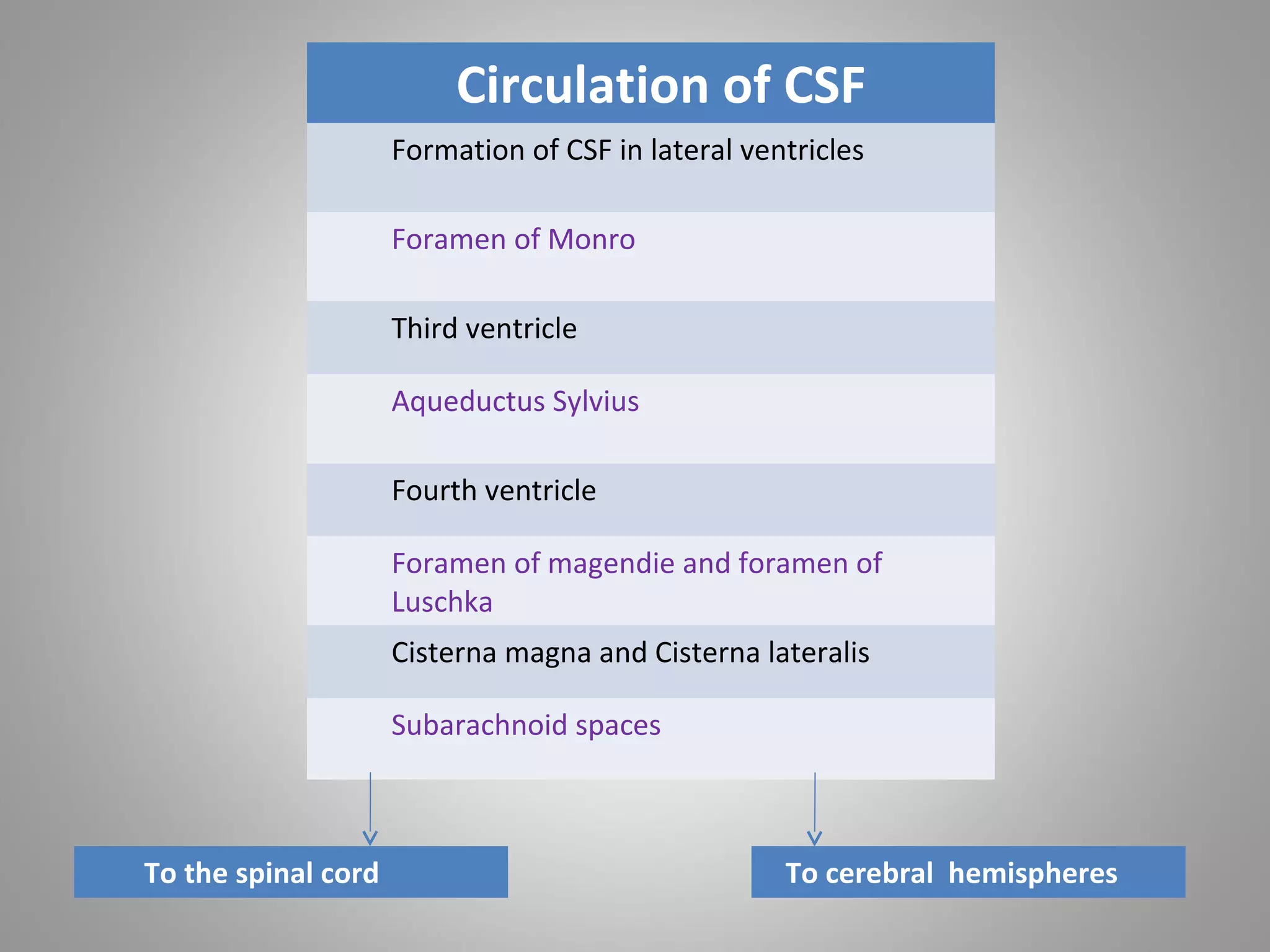
Formation of CSF in lateral ventricles
Foramen of Monro
Third ventricle
Aqueductus Sylvius
Fourth ventricle
Foramen of magendie and foramen of
Luschka
Cisterna magna and Cisterna lateralis
Subarachnoid spaces
To cerebral hemispheresTo the spinal cord
Absorption of CSF
• Mostly absorbed by the Arachnoid villi into
Dural sinuses and Spinal veins.
• Small amount is absorbed along the
perineural spaces into cervical lymphatics and
in to the perivascular spaces.
• Normally, 500 mL of CSF is formed everyday
and equal amount is absorbed.
Pressure exerted by CSF
• Varies in different position:
Lateral recumbent position = 10-18 cm of H2O
Lying position = 13 cm of H2O
Sitting position = 30 cm of H2O
Coughing and crying increases the pressure by
decreasing the absorption.
Compression of internal jugular vein also raises
the CSF pressure.
Function of CSF
• Protective Function:
– Acts as buffer
– Protects the brain from shock
• If brain receives severe blow , countercoup
injury may take place.
Continued…
• Medium of Exchange
• CSF is the medium through which substances
like :
– Nutritive substances
– Waste materials
are exchanged between blood and brain tissues.
CSF disorders
• Hydrocephalus
– Abnormal accumulation of CSF in the skull with
enlargement of head.
• 2 types of Hydrocephalus
1. non-communicating
2. communicating
Continued…
Non-communicating Hydrocephalus or
Internal Hydrocephalus
Due to the obstruction of any of the foramen through
which CSF escapes results in dilation of ventricular
cavity.
Communicating Hydrocephalus or External
Hydrocephalus
Due to blockage of Arachnoid villi.
Continued…
Symptoms of Hydrocephalus:
Headache
Vomiting
Atrophy of brain
Mental weakness
Convulsions
Cerebro Spinal Fluid- CSF

Cerebro Spinal Fluid- CSF

  • 1.
  • 2.
    Introduction • CSF isclear, colorless and transparent • Circulates through cavity of the: – Brain – Subarachnoid space – Central canal of spinal cord • Part of Extracellular fluid (ECF)
  • 3.
    Properties • Volume :approximately 150 mL • Rate of formation: approximately 0.3 mL/min • Specific gravity : 1.005 • Reaction : Alkaline
  • 4.
    Composition Cerebrospinal Fluid Water -99.13% Solids - 0.87% Inorganic substances 1.Sodium 2.Calcium 3.Potassium 4.Magnesium 5.Chlorides 6.Phosphate 7.Bicarbonates 8.Sulfates Organic substances 1.Proteins 2.Amino acids 3.Sugar 4.Cholesterol 5.Urea 6.Uric acid 7.Creatinine 8.Lactic acid Lymphocytes in CSF : 6/ cu mm
  • 5.
    Continued… • As CSFis part of ECF therefore it contain more amount of Sodium than Potassium. • Contains some lymphocytes. • CSF secreted by ventricles does not contain any cell. • The lymphocytes are added when it flows in the spinal cord.
  • 6.
    Formation of CSF •Site of formation – Formed by the choroid plexus situated within the ventricles. – The choroid plexus are tuft of capillary projections present inside ventricles and covered by: • Pia mater • Ependymal covering.
  • 7.
    Continued... Mechanism of formation •Formed by process of secretion. • Does not involve ultrafiltration or dialysis. • Uses energy. • Active transport mechanism is involved in secretion.
  • 8.
    Circulation of CSF Formationof CSF in lateral ventricles Foramen of Monro Third ventricle Aqueductus Sylvius Fourth ventricle Foramen of magendie and foramen of Luschka Cisterna magna and Cisterna lateralis Subarachnoid spaces To cerebral hemispheresTo the spinal cord
  • 10.
    Absorption of CSF •Mostly absorbed by the Arachnoid villi into Dural sinuses and Spinal veins. • Small amount is absorbed along the perineural spaces into cervical lymphatics and in to the perivascular spaces. • Normally, 500 mL of CSF is formed everyday and equal amount is absorbed.
  • 11.
    Pressure exerted byCSF • Varies in different position: Lateral recumbent position = 10-18 cm of H2O Lying position = 13 cm of H2O Sitting position = 30 cm of H2O Coughing and crying increases the pressure by decreasing the absorption. Compression of internal jugular vein also raises the CSF pressure.
  • 12.
    Function of CSF •Protective Function: – Acts as buffer – Protects the brain from shock • If brain receives severe blow , countercoup injury may take place.
  • 13.
    Continued… • Medium ofExchange • CSF is the medium through which substances like : – Nutritive substances – Waste materials are exchanged between blood and brain tissues.
  • 14.
    CSF disorders • Hydrocephalus –Abnormal accumulation of CSF in the skull with enlargement of head. • 2 types of Hydrocephalus 1. non-communicating 2. communicating
  • 15.
    Continued… Non-communicating Hydrocephalus or InternalHydrocephalus Due to the obstruction of any of the foramen through which CSF escapes results in dilation of ventricular cavity. Communicating Hydrocephalus or External Hydrocephalus Due to blockage of Arachnoid villi.
  • 16.