Body fluid & composition
Dr. Amruta N. Kumbhar
Assistant Professor
Dept. Of Physiology
Specific learning objectives
• Distribution of total body water in the body
• Ionic composition of body fluids
• Define: moles; equivalents; osmoles
• Concepts of pH; H+ concentration, Buffer system
Introduction
• The normal body in an average adult male is composed of water
(60%)
• minerals (7%)
• protein and related substances (18%)
• fat (15%)
• The water, denoted by the term total body water (TBW), the
electrolytes need special emphasis
• TBW 10% lower in young females
• In infants TBW is 65-75 % of body weight
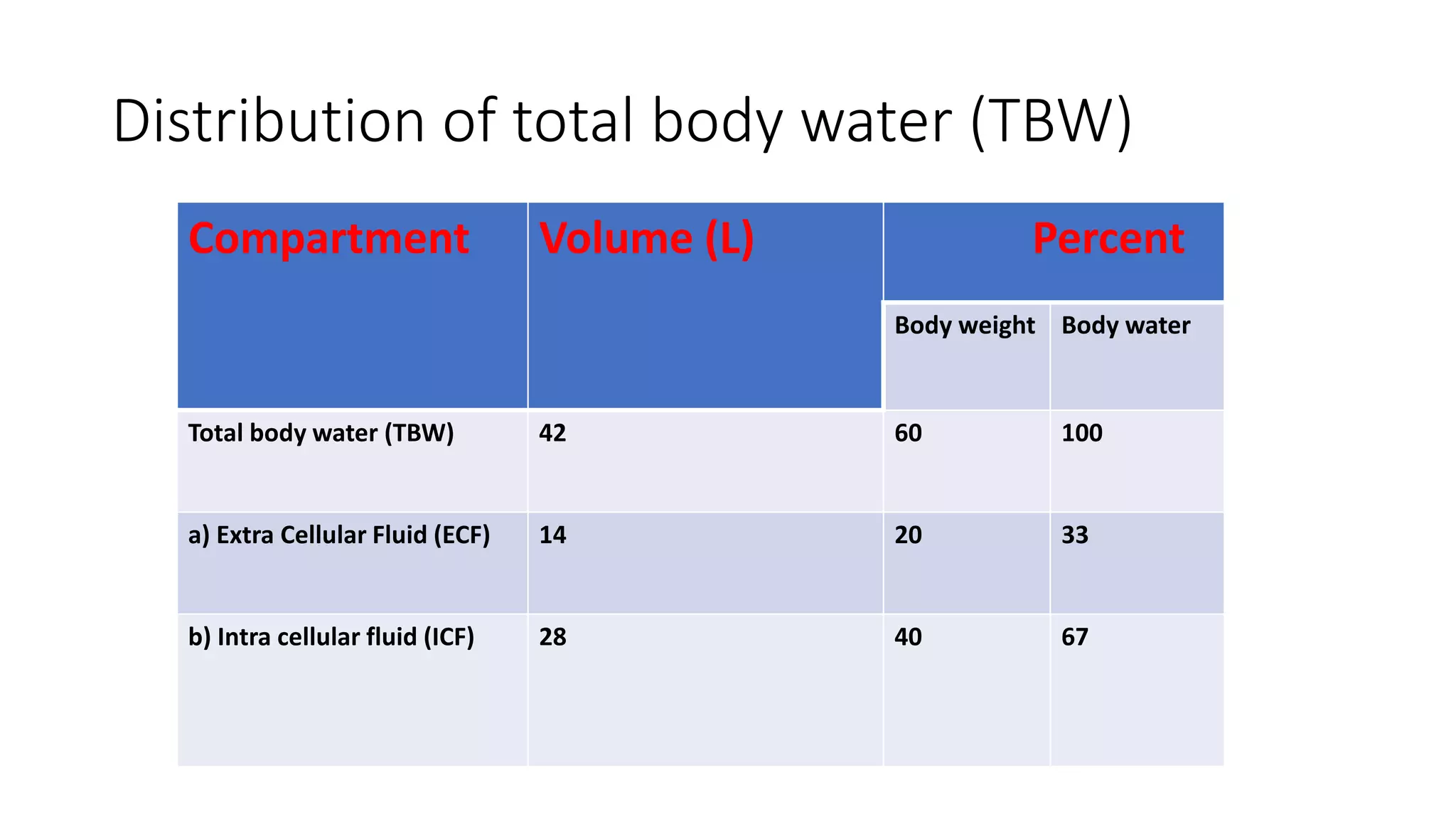
Distribution of total body water (TBW)
Compartment Volume (L) Percent
Body weight Body water
Total body water (TBW) 42 60 100
a) Extra Cellular Fluid (ECF) 14 20 33
b) Intra cellular fluid (ICF) 28 40 67
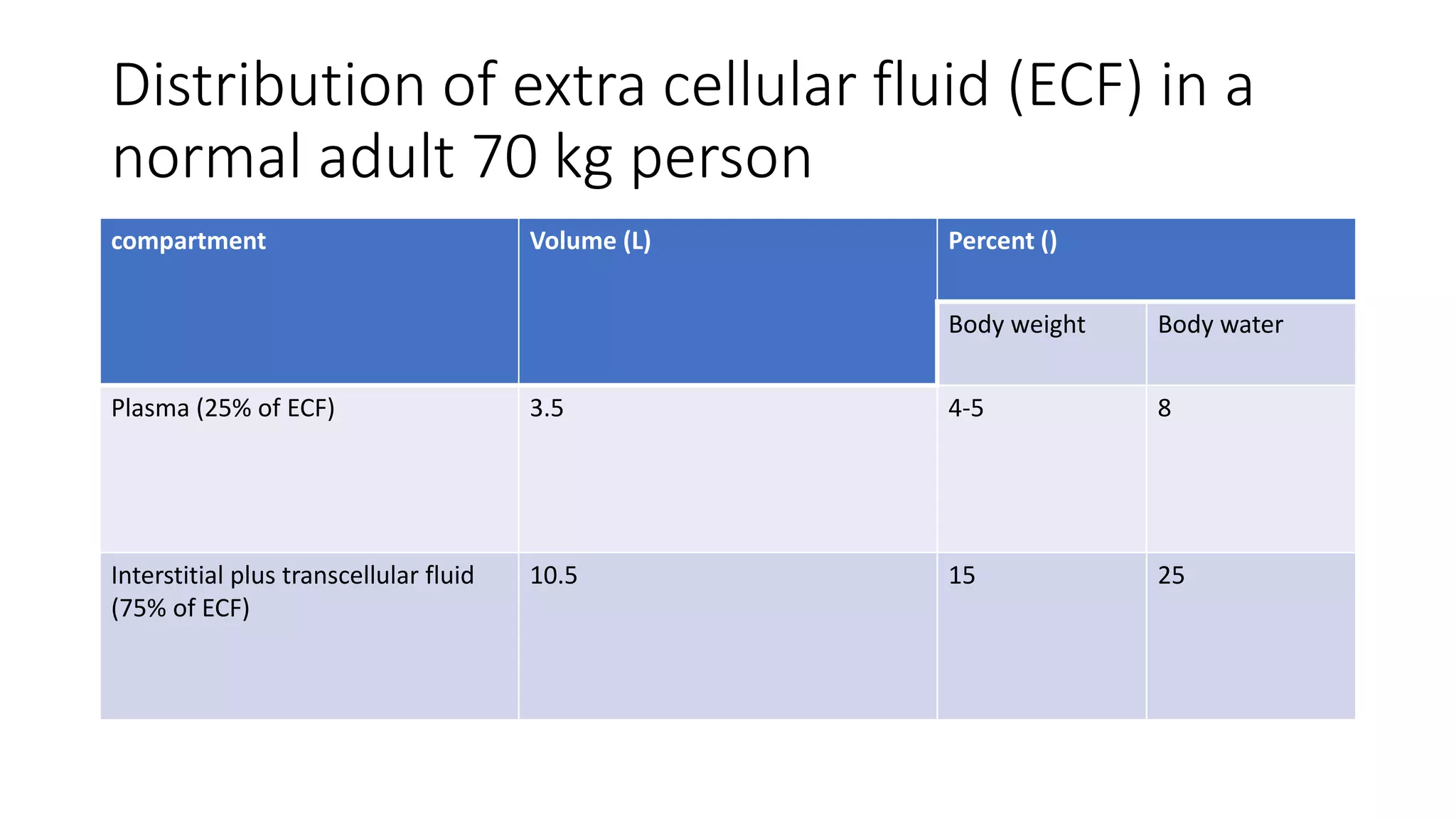
Distribution of extra cellular fluid (ECF) in a
normal adult 70 kg person
compartment Volume (L) Percent ()
Body weight Body water
Plasma (25% of ECF) 3.5 4-5 8
Interstitial plus transcellular fluid
(75% of ECF)
10.5 15 25
ECF
1. Plasma :
100- Hematocrit (PCV)
Plasma volume (L) = blood volume(L)x
100
• comprises about 5% of the body weight (i.e. 25% of the ECF).
• On an average out of 5 L of total blood volume 3.5 L is plasma.
2. Interstitial fluid
• part of the ECF i.e outside the vascular system
• It constitutes the major portion (about 3/4) of the ECF.
• The composition of interstitial fluid is the same as that of plasma
except it has little protein.
• Thus, interstitial fluid is an ultrafiltrate of plasma
• Lymph constitute 2-3% of body wt.
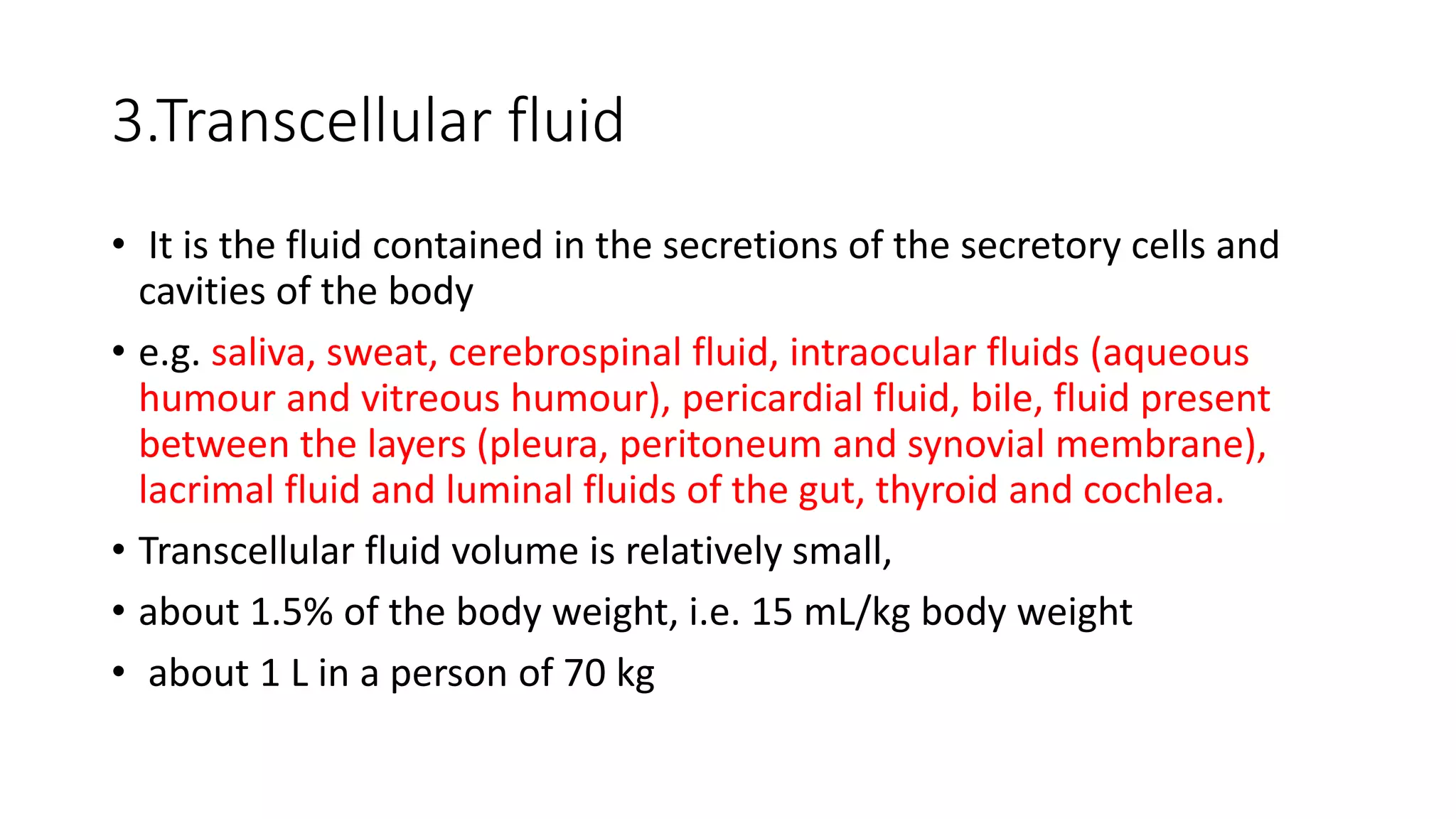
3.Transcellular fluid
• It is the fluid contained in the secretions of the secretory cells and
cavities of the body
• e.g. saliva, sweat, cerebrospinal fluid, intraocular fluids (aqueous
humour and vitreous humour), pericardial fluid, bile, fluid present
between the layers (pleura, peritoneum and synovial membrane),
lacrimal fluid and luminal fluids of the gut, thyroid and cochlea.
• Transcellular fluid volume is relatively small,
• about 1.5% of the body weight, i.e. 15 mL/kg body weight
• about 1 L in a person of 70 kg
4. Mesenchymal tissue fluid
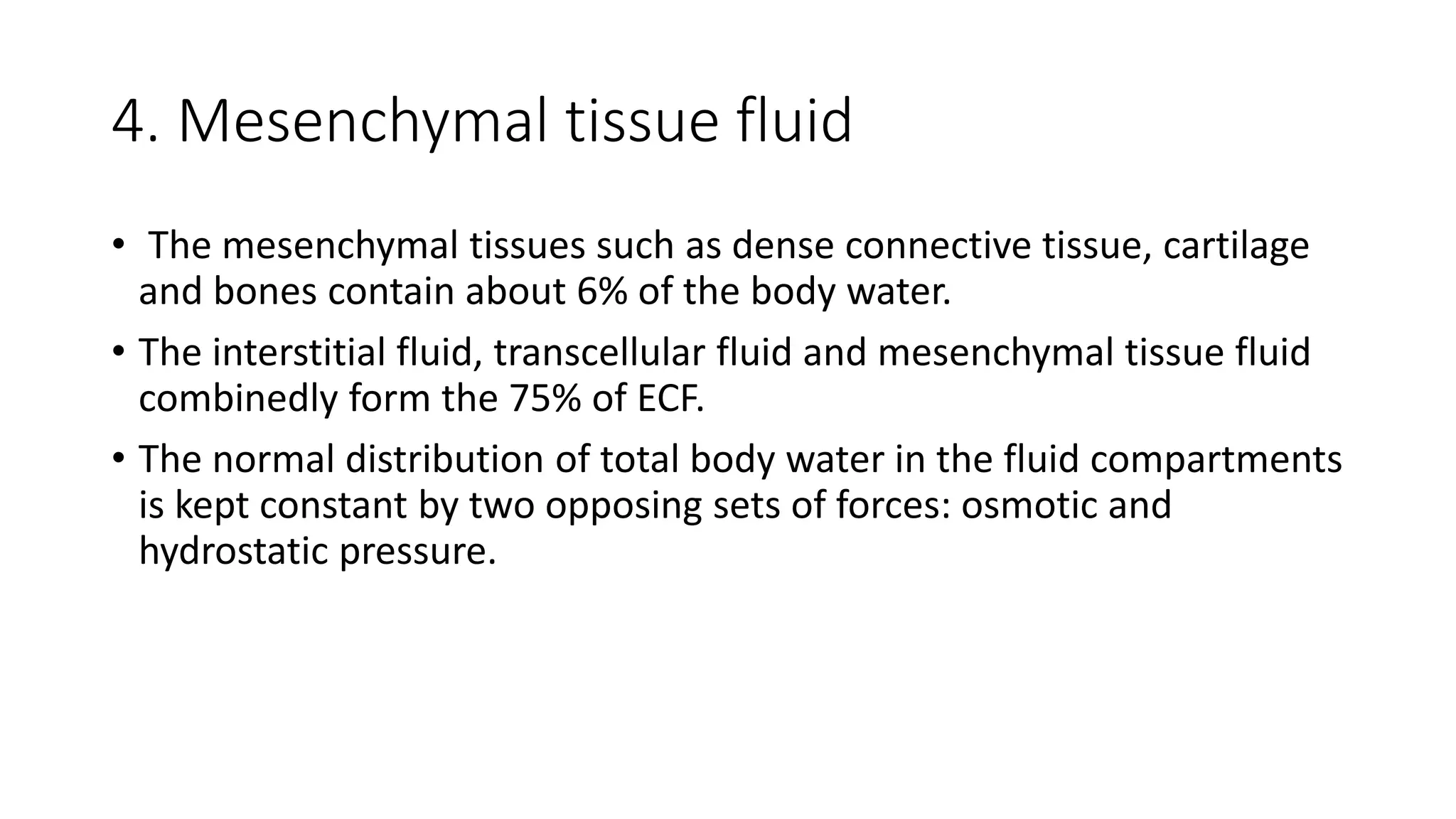
• The mesenchymal tissues such as dense connective tissue, cartilage
and bones contain about 6% of the body water.
• The interstitial fluid, transcellular fluid and mesenchymal tissue fluid
combinedly form the 75% of ECF.
• The normal distribution of total body water in the fluid compartments
is kept constant by two opposing sets of forces: osmotic and
hydrostatic pressure.
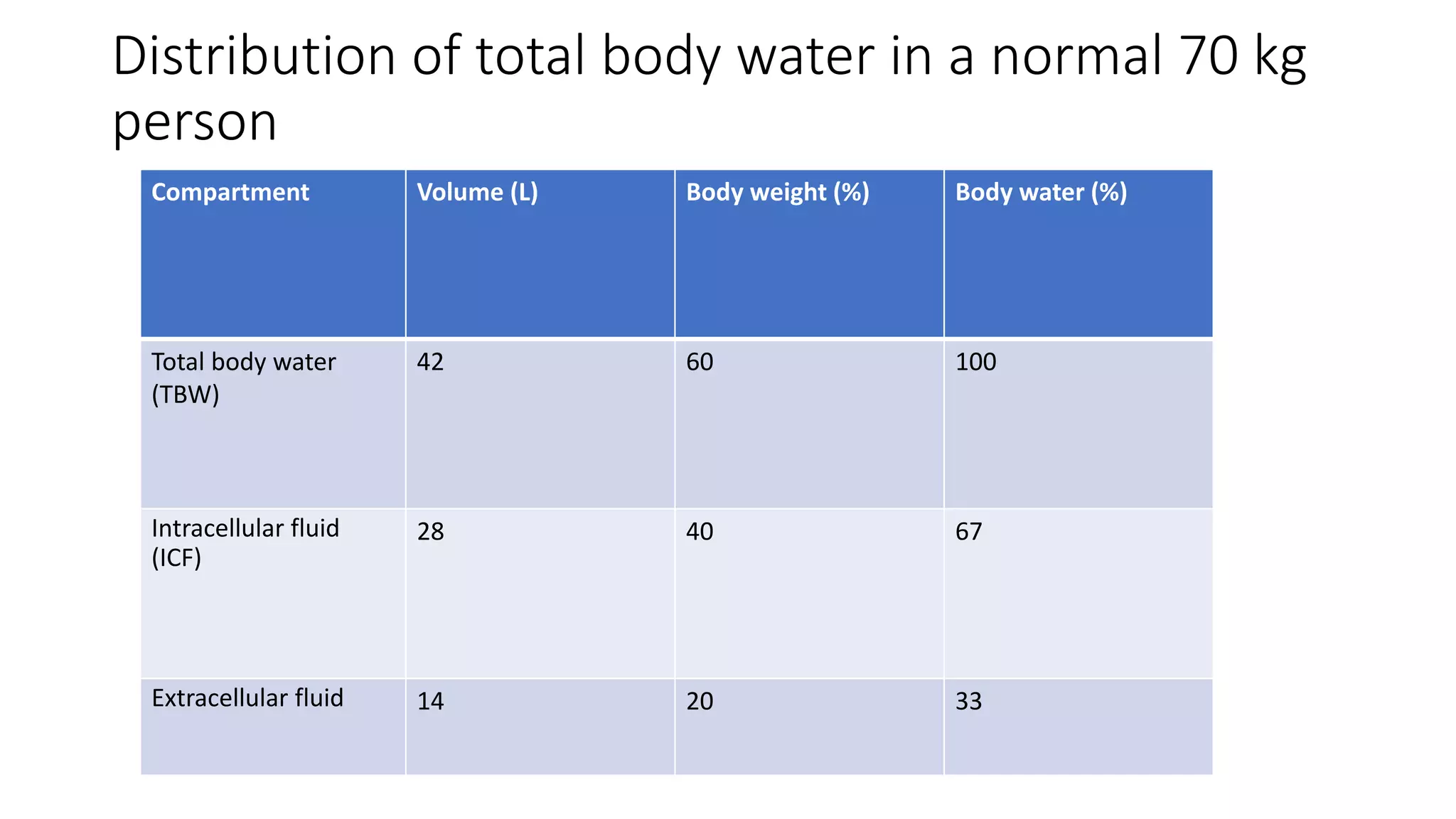
Distribution of total body water in a normal 70 kg
person
Compartment Volume (L) Body weight (%) Body water (%)
Total body water
(TBW)
42 60 100
Intracellular fluid
(ICF)
28 40 67
Extracellular fluid 14 20 33
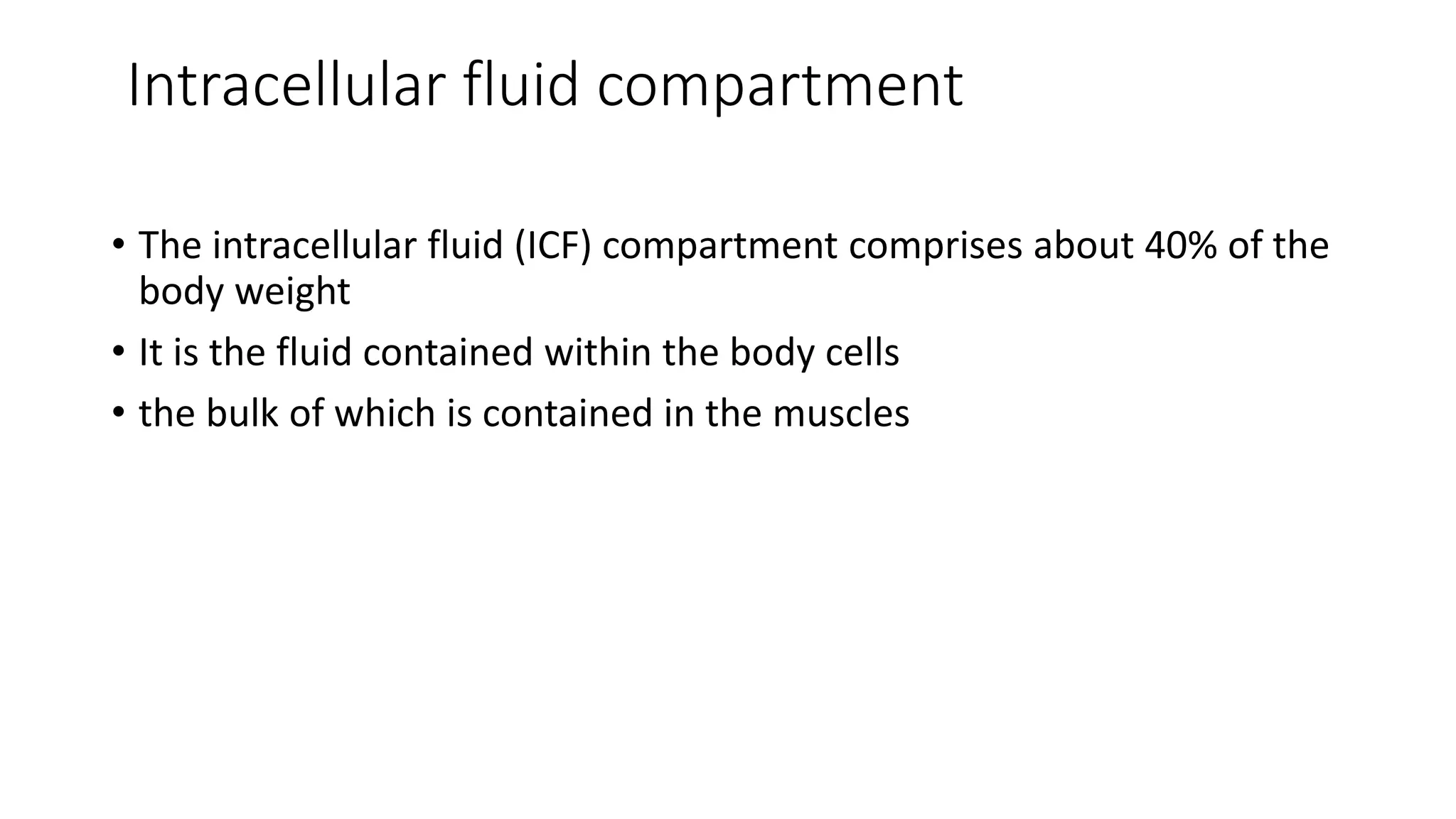
Intracellular fluid compartment
• The intracellular fluid (ICF) compartment comprises about 40% of the
body weight
• It is the fluid contained within the body cells
• the bulk of which is contained in the muscles
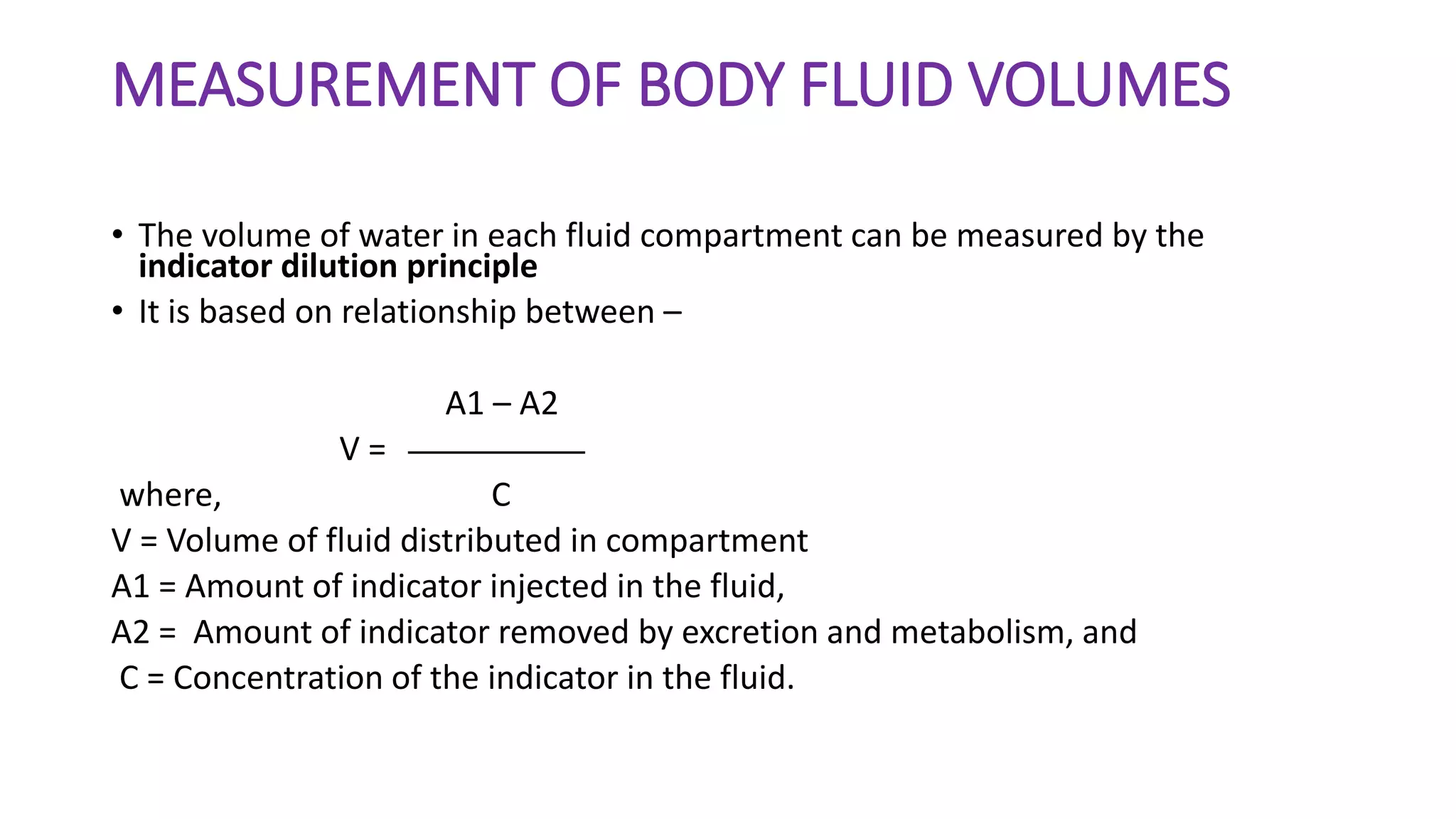
MEASUREMENT OF BODY FLUID VOLUMES
• The volume of water in each fluid compartment can be measured by the
indicator dilution principle
• It is based on relationship between –
A1 – A2
V =
where, C
V = Volume of fluid distributed in compartment
A1 = Amount of indicator injected in the fluid,
A2 = Amount of indicator removed by excretion and metabolism, and
C = Concentration of the indicator in the fluid.
Q. If 150 mg of sucrose (A1) is injected into a 70 kg man, 10 mg
sucrose (A2) has been excreted or metabolized and the concentration
of plasma sucrose (C) measured is 0.01 mg/mL; then the volume
distribution of sucrose is ?
Characteristics of the Indicator (marker) used
• It should be non-toxic.
• It must mix evenly throughout the compartment being measured.
• It should be relatively easy to measure its concentration.
• It must have no effect of its own on the distribution of water or other
substances in the body.
• Either it must be unchanged by the body during the mixing period or
the amount changed (excreted and/or metabolized) must be known.
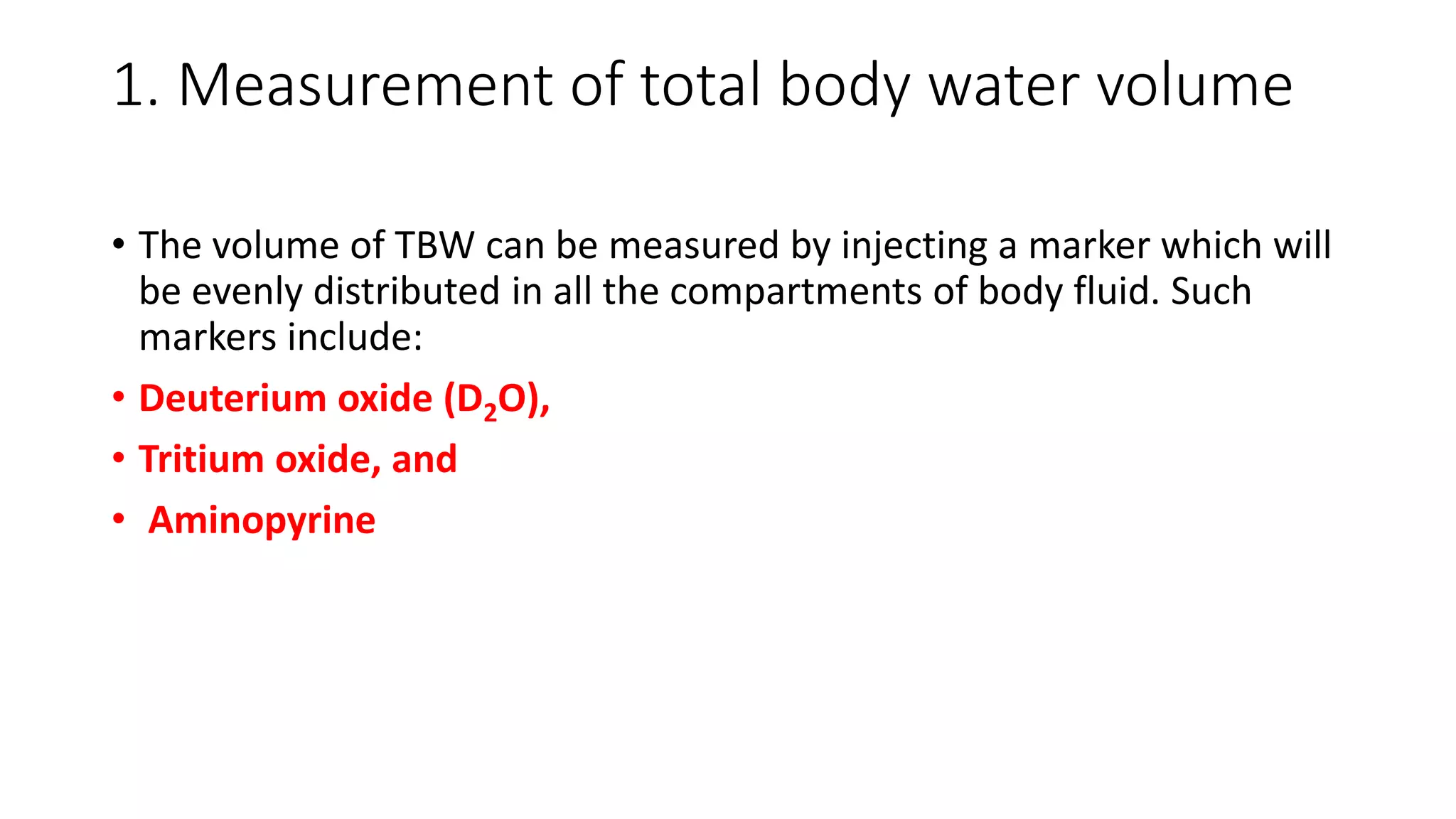
1. Measurement of total body water volume
• The volume of TBW can be measured by injecting a marker which will
be evenly distributed in all the compartments of body fluid. Such
markers include:
• Deuterium oxide (D2O),
• Tritium oxide, and
• Aminopyrine
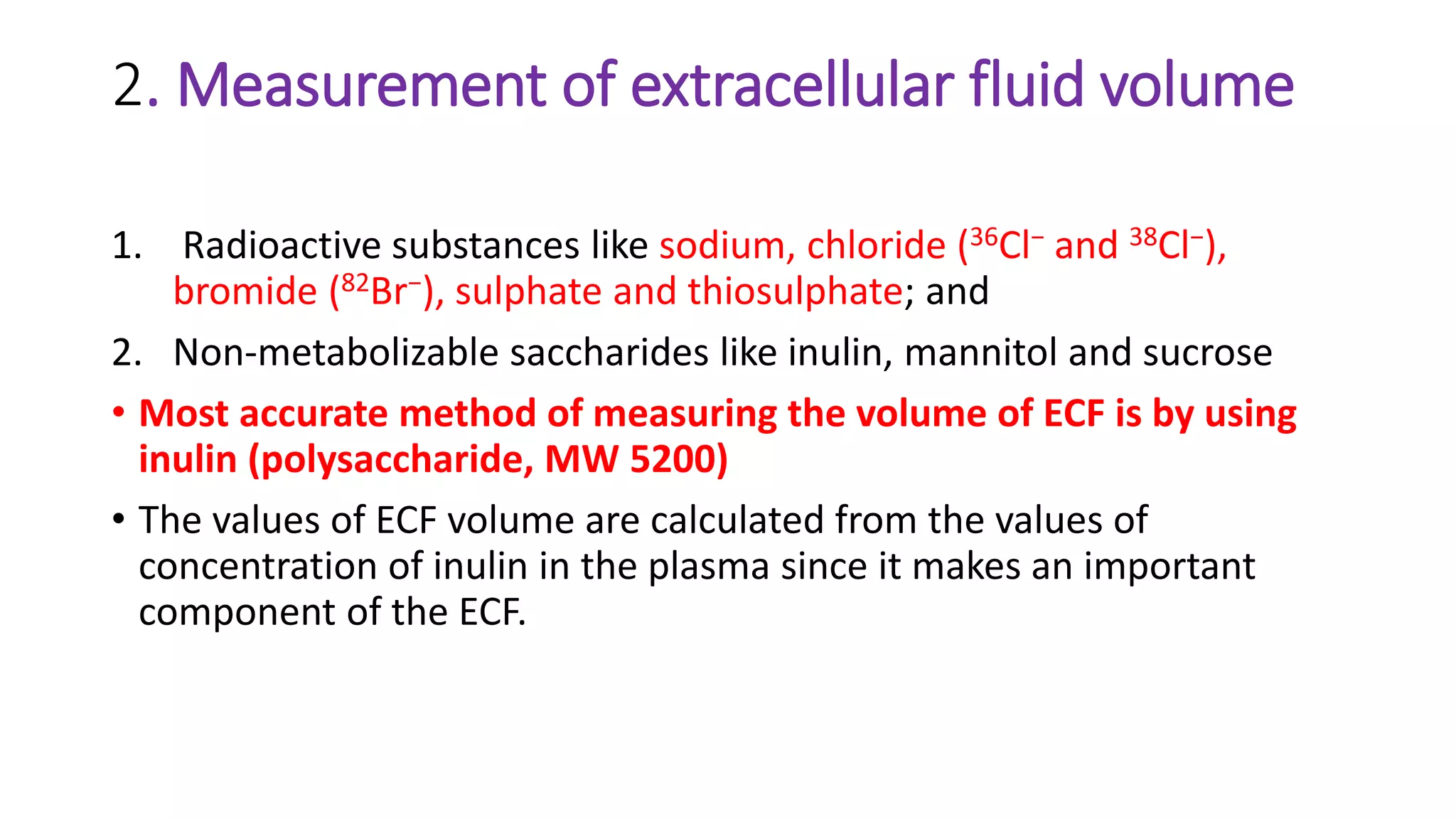
2. Measurement of extracellular fluid volume
1. Radioactive substances like sodium, chloride (36Cl− and 38Cl−),
bromide (82Br−), sulphate and thiosulphate; and
2. Non-metabolizable saccharides like inulin, mannitol and sucrose
• Most accurate method of measuring the volume of ECF is by using
inulin (polysaccharide, MW 5200)
• The values of ECF volume are calculated from the values of
concentration of inulin in the plasma since it makes an important
component of the ECF.
3. Measurement of plasma volume
• The plasma volume can be measured by injecting those markers which bind
strongly with the plasma protein
• either do not diffuse or diffuse only in small quantities into the interstitium.
These substances are
1. Radioactive iodine – 131I, and
2. The dye Evan’s blue – T-1824.
3. radioactive isotopes of chromium (51Cr)
4. Radio iodinated human serum albumin (RISA)
5. Radio iodinated gamma globulin & fibrinogen- do not leak out of blood
stream 100 - PCV
6. plasma volume= blood volume x
100
4. Measurement of intracellular fluid volume
• values of ICF volume are calculated from the values of TBW and ECF
as
• ICF volume = TBW volume − ECF volume.
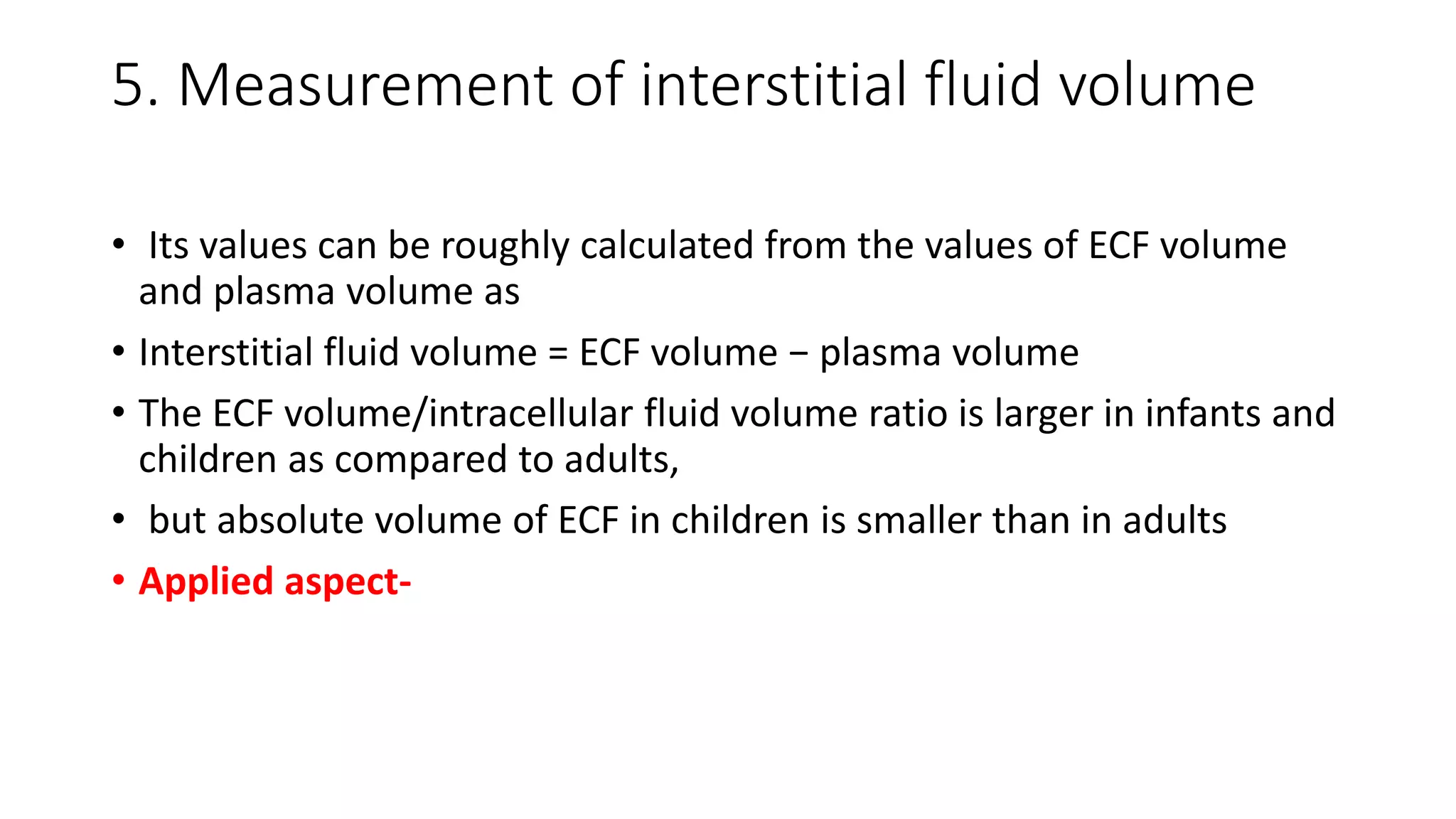
5. Measurement of interstitial fluid volume
• Its values can be roughly calculated from the values of ECF volume
and plasma volume as
• Interstitial fluid volume = ECF volume − plasma volume
• The ECF volume/intracellular fluid volume ratio is larger in infants and
children as compared to adults,
• but absolute volume of ECF in children is smaller than in adults
• Applied aspect-
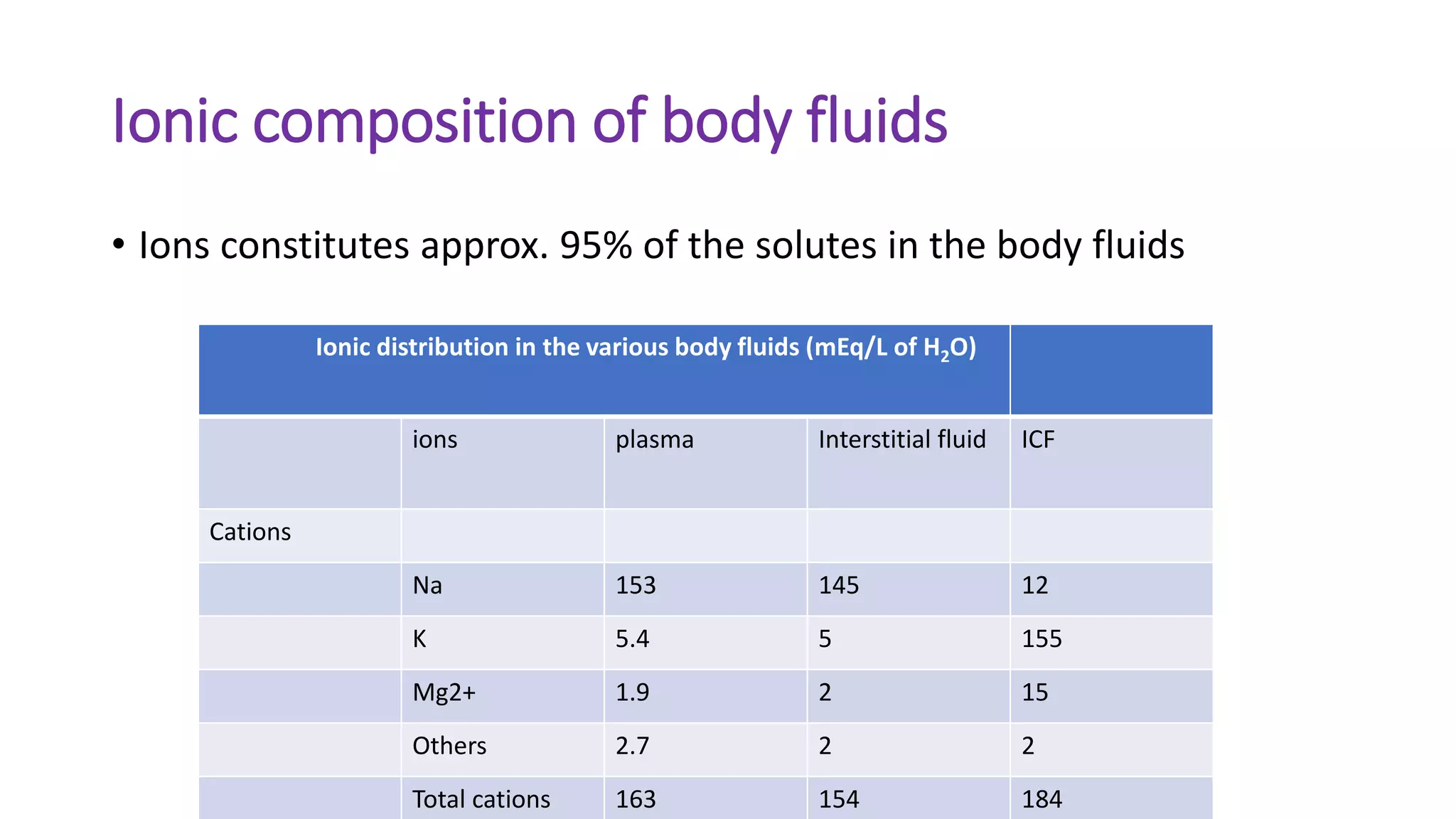
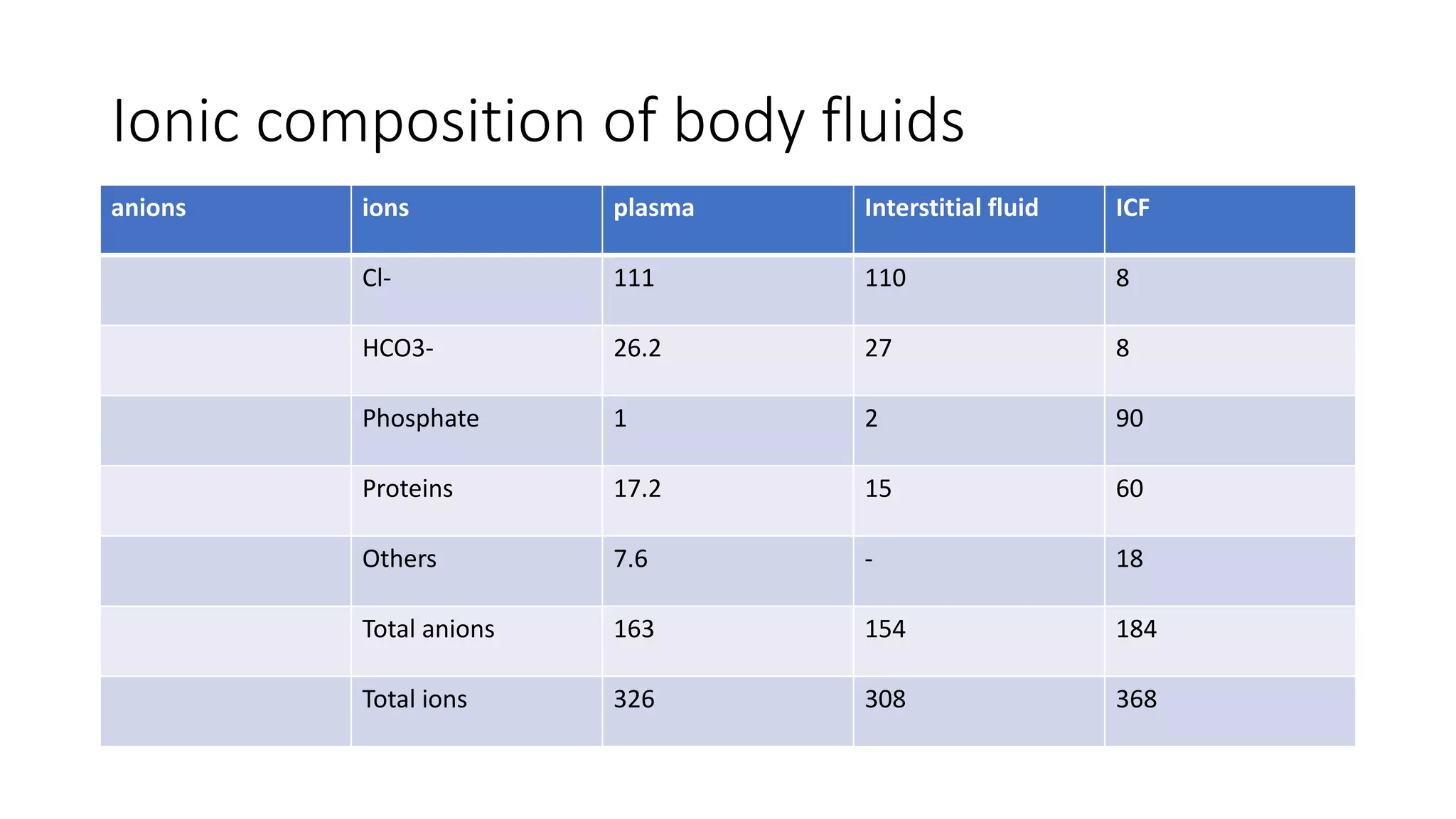
Ionic composition of body fluids
• Ions constitutes approx. 95% of the solutes in the body fluids
Ionic distribution in the various body fluids (mEq/L of H2O)
ions plasma Interstitial fluid ICF
Cations
Na 153 145 12
K 5.4 5 155
Mg2+ 1.9 2 15
Others 2.7 2 2
Total cations 163 154 184
Ionic composition of body fluids
anions ions plasma Interstitial fluid ICF
Cl- 111 110 8
HCO3- 26.2 27 8
Phosphate 1 2 90
Proteins 17.2 15 60
Others 7.6 - 18
Total anions 163 154 184
Total ions 326 308 368
• Na+, ca2+ Cl-,& HCO-
3 are largely extracellular
• whereas K+, Mg2+, organic phosphates & proteins are predominantly
present in ICF
• Essentially all of the body K+ is in the exchangeable pool whereas
• Only 65- 70% of body Na+ is exchangeable
• Only the exchangeable solutes are osmotically active
• Almost all of the body Ca2+ & most of the body Mg2+ are non
exchangeable
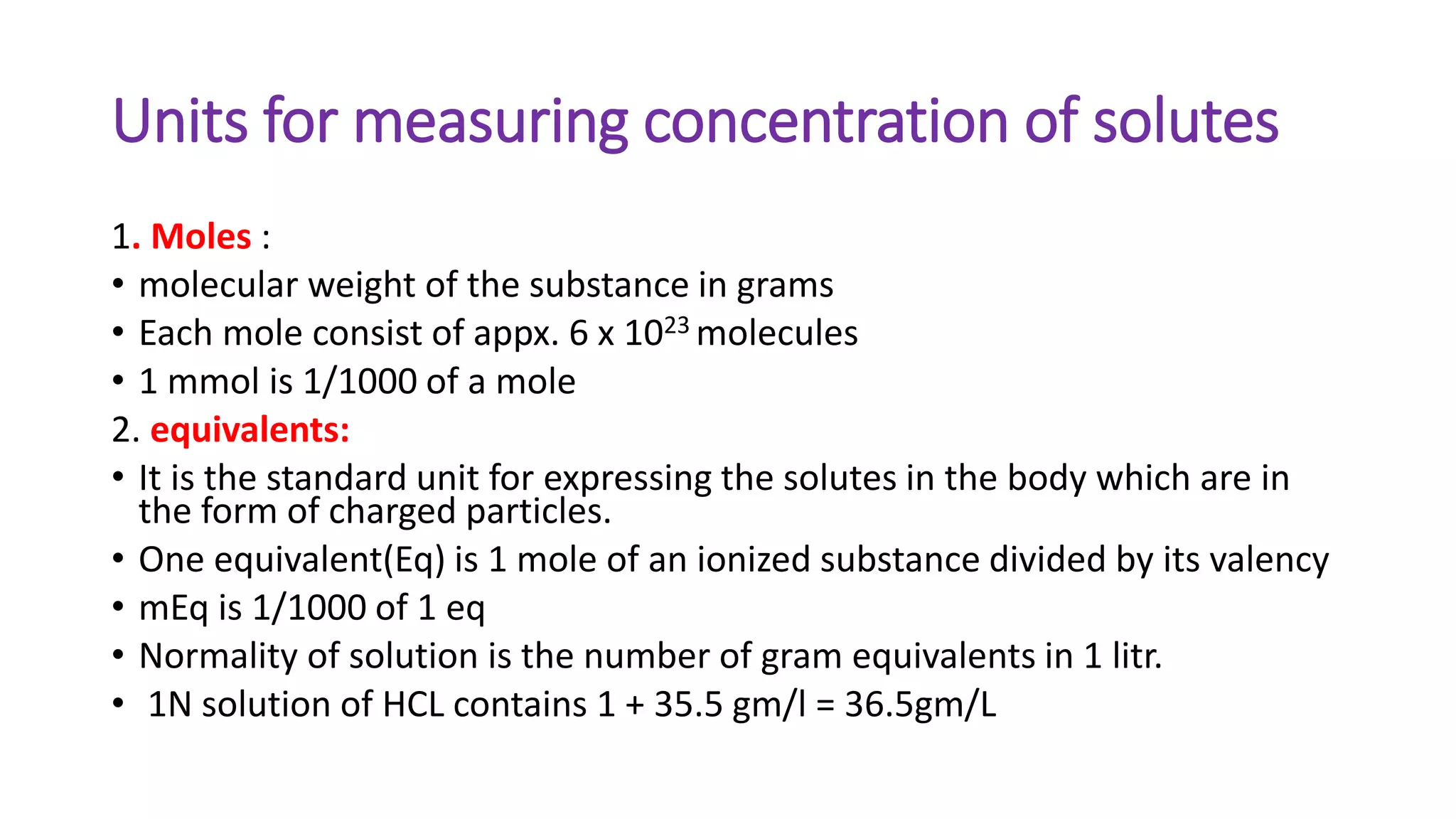
Units for measuring concentration of solutes
1. Moles :
• molecular weight of the substance in grams
• Each mole consist of appx. 6 x 10²³ molecules
• 1 mmol is 1/1000 of a mole
2. equivalents:
• It is the standard unit for expressing the solutes in the body which are in
the form of charged particles.
• One equivalent(Eq) is 1 mole of an ionized substance divided by its valency
• mEq is 1/1000 of 1 eq
• Normality of solution is the number of gram equivalents in 1 litr.
• 1N solution of HCL contains 1 + 35.5 gm/l = 36.5gm/L
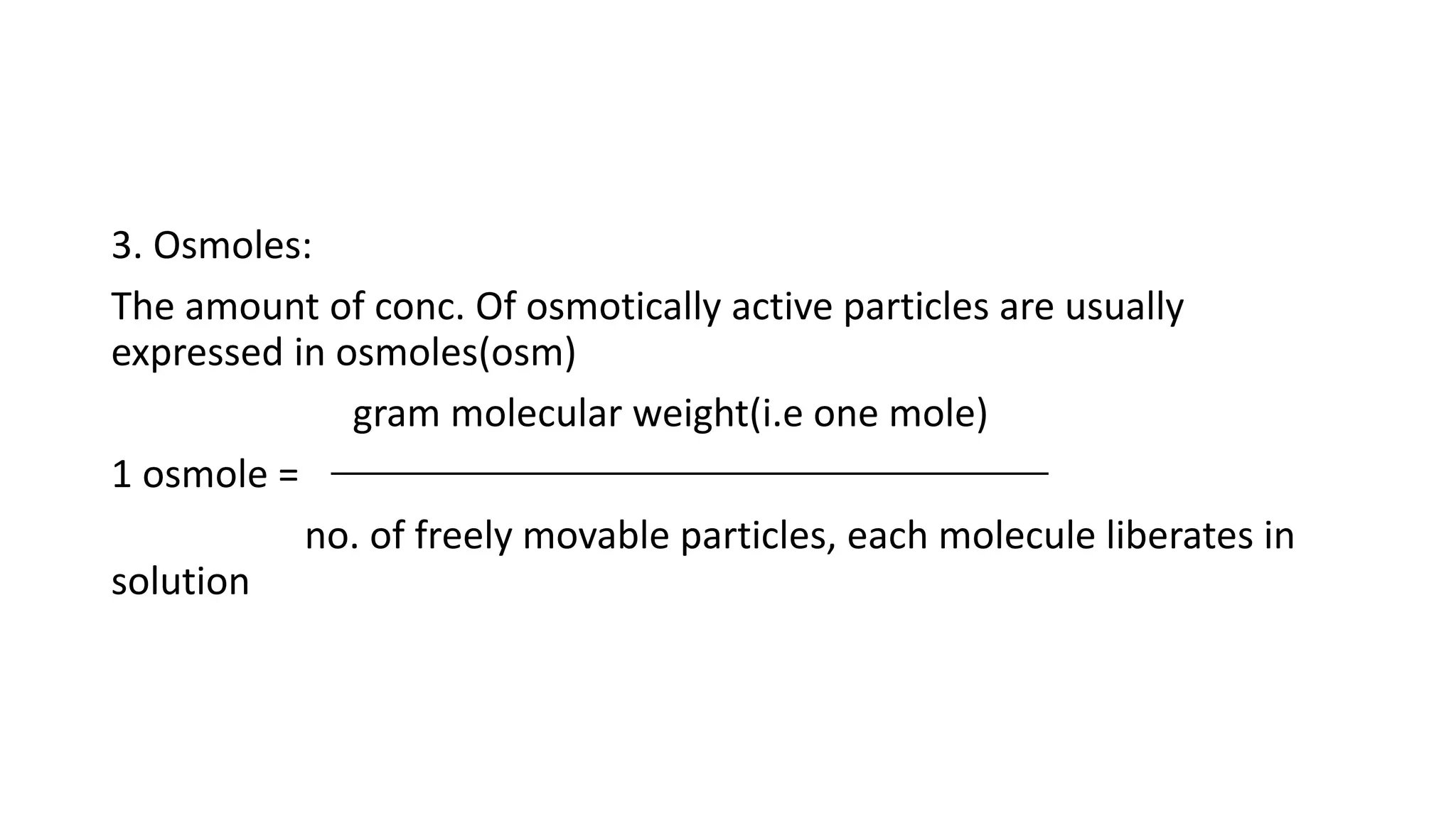
3. Osmoles:
The amount of conc. Of osmotically active particles are usually
expressed in osmoles(osm)
gram molecular weight(i.e one mole)
1 osmole =
no. of freely movable particles, each molecule liberates in
solution
Concept of pH & H+ concentration
• pH stands for power of hydrogen
• Refers to negative logarithm of the H+
i. pH= log10 1/[H+]
ii. pH= - log10[H+]
• For decrease in each pH unit (from 7 to 6, [H+] is increased 10 fold vice
versa
• pH & [H+] are inversely related
• Advantage of pH concept : when pK of buffer system is known, it is
immediately possible to determine effective pH range of the buffer
• K= ionisation or dissociation constant
• pK= negative log of K (-log K) & is equal to the pH at which half of the acid
molecules are dissociated & half undissociated
• Blood pH always refers to plasma pH(7.4)
• Range of [H+] compatible with life is 20-126 mEq/L i.e pH 7.7 to 6.9
• Optimum pH range at which human body functions properly is 7.45
• Clinically blood pH <7.35 is referred as acidosis
• Blood pH > 7.45 as alkalosis
Concept of buffer system
• A buffer is a substance that has ability to bind or release H+ in
solution
• Buffer is solution consist of a weak acid & its conjugate base, keeping
pH of solution constant
• It is a primary means by which large changes in [H+] are minimized
within a fraction of seconds
Dynamics of buffering
• Handerson- Hasselbalch Equation
• HA H+ + A-
• A- represent any anion & HA the undissociated acid
Handerson Hasselbalch equation
• Text book of Medical Physiology
• Guyton & Hall
• Text book of Medical Physiology
• A.K.Jain
• Text Book of Medical Physiology
• Sembulingam
• Net sources
Thank you

Body fluid &amp; composition

  • 1.
    Body fluid &composition Dr. Amruta N. Kumbhar Assistant Professor Dept. Of Physiology
  • 2.
    Specific learning objectives •Distribution of total body water in the body • Ionic composition of body fluids • Define: moles; equivalents; osmoles • Concepts of pH; H+ concentration, Buffer system
  • 3.
    Introduction • The normalbody in an average adult male is composed of water (60%) • minerals (7%) • protein and related substances (18%) • fat (15%) • The water, denoted by the term total body water (TBW), the electrolytes need special emphasis • TBW 10% lower in young females • In infants TBW is 65-75 % of body weight
  • 4.
    Distribution of totalbody water (TBW) Compartment Volume (L) Percent Body weight Body water Total body water (TBW) 42 60 100 a) Extra Cellular Fluid (ECF) 14 20 33 b) Intra cellular fluid (ICF) 28 40 67
  • 5.
    Distribution of extracellular fluid (ECF) in a normal adult 70 kg person compartment Volume (L) Percent () Body weight Body water Plasma (25% of ECF) 3.5 4-5 8 Interstitial plus transcellular fluid (75% of ECF) 10.5 15 25
  • 6.
    ECF 1. Plasma : 100-Hematocrit (PCV) Plasma volume (L) = blood volume(L)x 100 • comprises about 5% of the body weight (i.e. 25% of the ECF). • On an average out of 5 L of total blood volume 3.5 L is plasma.
  • 7.
    2. Interstitial fluid •part of the ECF i.e outside the vascular system • It constitutes the major portion (about 3/4) of the ECF. • The composition of interstitial fluid is the same as that of plasma except it has little protein. • Thus, interstitial fluid is an ultrafiltrate of plasma • Lymph constitute 2-3% of body wt.
  • 8.
    3.Transcellular fluid • Itis the fluid contained in the secretions of the secretory cells and cavities of the body • e.g. saliva, sweat, cerebrospinal fluid, intraocular fluids (aqueous humour and vitreous humour), pericardial fluid, bile, fluid present between the layers (pleura, peritoneum and synovial membrane), lacrimal fluid and luminal fluids of the gut, thyroid and cochlea. • Transcellular fluid volume is relatively small, • about 1.5% of the body weight, i.e. 15 mL/kg body weight • about 1 L in a person of 70 kg
  • 9.
    4. Mesenchymal tissuefluid • The mesenchymal tissues such as dense connective tissue, cartilage and bones contain about 6% of the body water. • The interstitial fluid, transcellular fluid and mesenchymal tissue fluid combinedly form the 75% of ECF. • The normal distribution of total body water in the fluid compartments is kept constant by two opposing sets of forces: osmotic and hydrostatic pressure.
  • 10.
    Distribution of totalbody water in a normal 70 kg person Compartment Volume (L) Body weight (%) Body water (%) Total body water (TBW) 42 60 100 Intracellular fluid (ICF) 28 40 67 Extracellular fluid 14 20 33
  • 11.
    Intracellular fluid compartment •The intracellular fluid (ICF) compartment comprises about 40% of the body weight • It is the fluid contained within the body cells • the bulk of which is contained in the muscles
  • 12.
    MEASUREMENT OF BODYFLUID VOLUMES • The volume of water in each fluid compartment can be measured by the indicator dilution principle • It is based on relationship between – A1 – A2 V = where, C V = Volume of fluid distributed in compartment A1 = Amount of indicator injected in the fluid, A2 = Amount of indicator removed by excretion and metabolism, and C = Concentration of the indicator in the fluid.
  • 13.
    Q. If 150mg of sucrose (A1) is injected into a 70 kg man, 10 mg sucrose (A2) has been excreted or metabolized and the concentration of plasma sucrose (C) measured is 0.01 mg/mL; then the volume distribution of sucrose is ?
  • 14.
    Characteristics of theIndicator (marker) used • It should be non-toxic. • It must mix evenly throughout the compartment being measured. • It should be relatively easy to measure its concentration. • It must have no effect of its own on the distribution of water or other substances in the body. • Either it must be unchanged by the body during the mixing period or the amount changed (excreted and/or metabolized) must be known.
  • 15.
    1. Measurement oftotal body water volume • The volume of TBW can be measured by injecting a marker which will be evenly distributed in all the compartments of body fluid. Such markers include: • Deuterium oxide (D2O), • Tritium oxide, and • Aminopyrine
  • 16.
    2. Measurement ofextracellular fluid volume 1. Radioactive substances like sodium, chloride (36Cl− and 38Cl−), bromide (82Br−), sulphate and thiosulphate; and 2. Non-metabolizable saccharides like inulin, mannitol and sucrose • Most accurate method of measuring the volume of ECF is by using inulin (polysaccharide, MW 5200) • The values of ECF volume are calculated from the values of concentration of inulin in the plasma since it makes an important component of the ECF.
  • 17.
    3. Measurement ofplasma volume • The plasma volume can be measured by injecting those markers which bind strongly with the plasma protein • either do not diffuse or diffuse only in small quantities into the interstitium. These substances are 1. Radioactive iodine – 131I, and 2. The dye Evan’s blue – T-1824. 3. radioactive isotopes of chromium (51Cr) 4. Radio iodinated human serum albumin (RISA) 5. Radio iodinated gamma globulin & fibrinogen- do not leak out of blood stream 100 - PCV 6. plasma volume= blood volume x 100
  • 18.
    4. Measurement ofintracellular fluid volume • values of ICF volume are calculated from the values of TBW and ECF as • ICF volume = TBW volume − ECF volume.
  • 19.
    5. Measurement ofinterstitial fluid volume • Its values can be roughly calculated from the values of ECF volume and plasma volume as • Interstitial fluid volume = ECF volume − plasma volume • The ECF volume/intracellular fluid volume ratio is larger in infants and children as compared to adults, • but absolute volume of ECF in children is smaller than in adults • Applied aspect-
  • 20.
    Ionic composition ofbody fluids • Ions constitutes approx. 95% of the solutes in the body fluids Ionic distribution in the various body fluids (mEq/L of H2O) ions plasma Interstitial fluid ICF Cations Na 153 145 12 K 5.4 5 155 Mg2+ 1.9 2 15 Others 2.7 2 2 Total cations 163 154 184
  • 21.
    Ionic composition ofbody fluids anions ions plasma Interstitial fluid ICF Cl- 111 110 8 HCO3- 26.2 27 8 Phosphate 1 2 90 Proteins 17.2 15 60 Others 7.6 - 18 Total anions 163 154 184 Total ions 326 308 368
  • 22.
    • Na+, ca2+Cl-,& HCO- 3 are largely extracellular • whereas K+, Mg2+, organic phosphates & proteins are predominantly present in ICF • Essentially all of the body K+ is in the exchangeable pool whereas • Only 65- 70% of body Na+ is exchangeable • Only the exchangeable solutes are osmotically active • Almost all of the body Ca2+ & most of the body Mg2+ are non exchangeable
  • 23.
    Units for measuringconcentration of solutes 1. Moles : • molecular weight of the substance in grams • Each mole consist of appx. 6 x 10²³ molecules • 1 mmol is 1/1000 of a mole 2. equivalents: • It is the standard unit for expressing the solutes in the body which are in the form of charged particles. • One equivalent(Eq) is 1 mole of an ionized substance divided by its valency • mEq is 1/1000 of 1 eq • Normality of solution is the number of gram equivalents in 1 litr. • 1N solution of HCL contains 1 + 35.5 gm/l = 36.5gm/L
  • 24.
    3. Osmoles: The amountof conc. Of osmotically active particles are usually expressed in osmoles(osm) gram molecular weight(i.e one mole) 1 osmole = no. of freely movable particles, each molecule liberates in solution
  • 25.
    Concept of pH& H+ concentration • pH stands for power of hydrogen • Refers to negative logarithm of the H+ i. pH= log10 1/[H+] ii. pH= - log10[H+] • For decrease in each pH unit (from 7 to 6, [H+] is increased 10 fold vice versa • pH & [H+] are inversely related • Advantage of pH concept : when pK of buffer system is known, it is immediately possible to determine effective pH range of the buffer • K= ionisation or dissociation constant • pK= negative log of K (-log K) & is equal to the pH at which half of the acid molecules are dissociated & half undissociated
  • 26.
    • Blood pHalways refers to plasma pH(7.4) • Range of [H+] compatible with life is 20-126 mEq/L i.e pH 7.7 to 6.9 • Optimum pH range at which human body functions properly is 7.45 • Clinically blood pH <7.35 is referred as acidosis • Blood pH > 7.45 as alkalosis
  • 27.
    Concept of buffersystem • A buffer is a substance that has ability to bind or release H+ in solution • Buffer is solution consist of a weak acid & its conjugate base, keeping pH of solution constant • It is a primary means by which large changes in [H+] are minimized within a fraction of seconds
  • 28.
    Dynamics of buffering •Handerson- Hasselbalch Equation • HA H+ + A- • A- represent any anion & HA the undissociated acid
  • 29.
  • 30.
    • Text bookof Medical Physiology • Guyton & Hall • Text book of Medical Physiology • A.K.Jain • Text Book of Medical Physiology • Sembulingam • Net sources
  • 31.

Editor's Notes

  • #4 Water is the principle & essential constituent if the human body TBW is 10% less in a normal young adult female (average about 50%) than that in avg adult male (60%due to re;atively greater amount of fat / adepose tissue In both sexes value tend to decrease with age
  • #5 Distribution in an avg normal adult 70 kg wt.
  • #7 Plasma is the fluid portion of the blood . It represent 25% of ecf Blood volume i.e plasma & blood cells , is approx. 80 ml/kg weight or 8% of total body weight
  • #8 It is in constant motion through out body
  • #9 Represents fluid in the lumen of structures lined by epithelium
  • #10 The normal cell function depends upon the constancy of the fluid that forms the actual fluid environment of the cells. For this reason blood is called the internal environment of the body or milieu interior
  • #12 This is largest of 2 major compartments Volume of ICF compartment varies
  • #15 This method of measuring body fluids is called ‘indicator dilution method’ and can be used to measure the volume of different compartments of the body fluid by using the suitable indicator/marker which will get distributed in that particular compartment as follows
  • #16 The volume of the TBW can be calculated from the values of the concentration of the marker in the plasma
  • #17 Ecfv is difficult to measure bcoz limits are not defined & few substances are mix rapidly in all parts whereas few remain exclusively extracellular. The volume of ECF can be measured by injecting those marker substances which cannot enter the cells but can freely pass through the capillary membrane, and thus can distribute evenly in all the compartments of ECF. Such substances include Cl- is largely extracellular , RA isotopes of Cl are used for ECF however some Cl is intracellular also so ECFV determined by cl is greater than actual
  • #18 The plasma volume can also be calculated from the values of the Red Blood Cells which can be measured using radioactive isotopes of chromium (51Cr).
  • #19 The volume of ICF cannot be measured directly, since there is no substance which can be confined exclusively to this compartment after intravenous injection. Therefore,
  • #20 1.Like ICF volume, the volume of interstitial fluid also cannot be measured directly for the same reasons 2.Note.. Therefore, dehydration develops rapidly, more frequently and severe in children than in adults.
  • #22 The distribution of electrolytes in various body compartments differs markedly. However the sum of the concentration of the cations equals the sum of the conc. Of the anions in each compartment, making the fluid in each compartment electrically neutral
  • #26 H+ ion conc. Of various body fluids is expressed in two different ways, either directly as H+ or indirectly as pH
  • #29 If an acid stronger than HA is added to a solution containing buffer system, the equilibrium is shifted to the left.H+ are tied up in the formation of more undissociated HA, so the decrease in H+ ion is much less than it would be otherwise be. If base is added to solution H+ & OH will react to form H2O but more H+ dissociates , limiting decrease in H+ conc.