
Cerebrospinal fluid (CSF)
Prepared by :-Bipul Kumar Mahto
Introduction of CSF
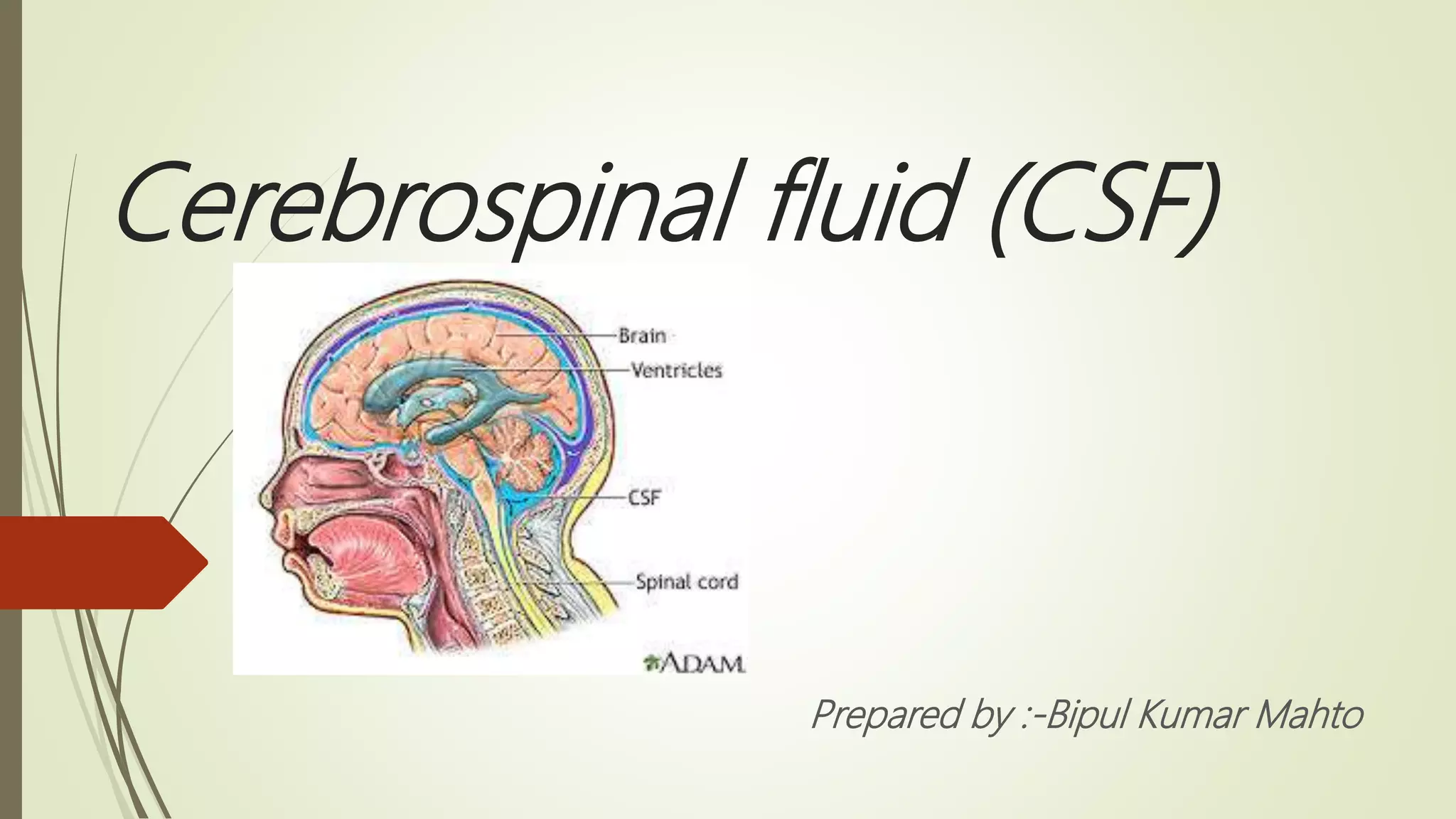
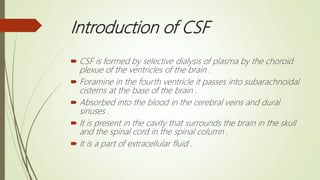
 CSF is formed by selective dialysis of plasma by the choroid
plexue of the ventricles of the brain .
 Foramine in the fourth ventricle it passes into subarachnoidal
cisterns at the base of the brain .
 Absorbed into the blood in the cerebral veins and dural
sinuses .
 It is present in the cavity that surrounds the brain in the skull
and the spinal cord in the spinal column .
 It is a part of extracellular fluid .
Human Brain : Cerebrospinal fluid (CSF) synthesis
Function of CSF
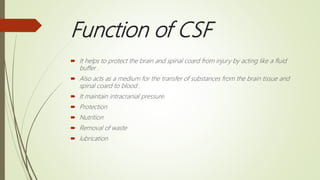
 It helps to protect the brain and spinal coard from injury by acting like a fluid
buffer .
 Also acts as a medium for the transfer of substances from the brain tissue and
spinal coard to blood .
 It maintain intracranial pressure.
 Protection
 Nutrition
 Removal of waste
 lubrication
Formation of CSF
 CSF is formed by the Choroid plexuses , Situated within the ventricles.
 Choroid plexuses are tuft of capillaries present inside the ventricles.
 A large amount of CSF is formed in the lateral ventricles.
 Dura meter
 Arachnoid
 Pia
Properties of csf
 Color :-. Colorless
 pH. :-. 7.3 – 7.4
 Appearance. :-. Clear
 Volume. :-. 90 – 150 ml (Adult)
 Clot formation. :-. No clot formation on standing
 Specific gravity :-. 1.003 – 1.008
 Reaction : - slightly
Location of csf
 Two lateral ventricles
 Third ventricles
 Fourth ventricles
 Spinal cord central canal
 Subarachnoid space
 Contineous with extracellular fluid of brain parenchyma
Specimen collection for CSF
 Specimen should be collected by a physician,a specially trained technician or
nurse.
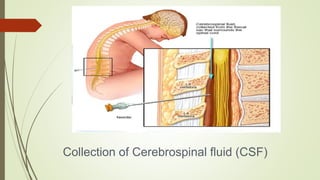
 Sterile lumbar puncture needle is inserted between the 3rd and 4th lumbar
vertebrae to a depth of 4-5 cm
 Stylet the fluid is collected through the needle into 2 test tube .
 Tube 1st : (sterile tube ) : About 0.5ml or few drops of csf.
 Tube 2nd : About 3-5ml of csf
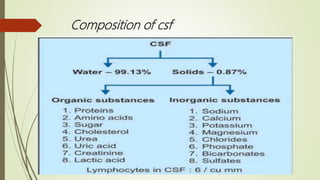
Composition of csf
1. 99.1% H2O
2. 0.1 % solids
1. Organic
 Sugar
 Creatinine , Cholesterol, Faty Acid
 Amino acid
 Lactic Acid
 Protein
 Urea , Uric acid
2. Inorganic
 Sodium
 Potassium
 Bicarbonates
 megnasium
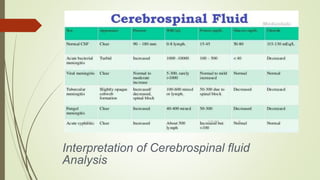
Interpretation of Cerebrospinal fluid
Analysis
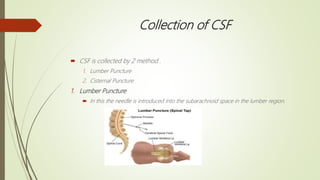
Collection of CSF
 CSF is collected by 2 method .
1. Lumber Puncture
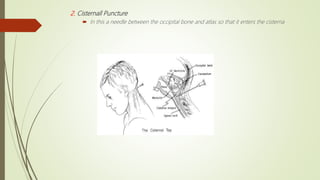
2. Cisternal Puncture
1. Lumber Puncture
 In this the needle is introduced into the subarachnoid space in the lumber region.
2. Cisternall Puncture
 In this a needle between the occipital bone and atlas so that it enters the cisterna
Important Precautions
 The collected CSF specimen must be examined immediately (within 1
hours).
 Specimen collected for bacterial culture should not be stored in the
refrigerator (Neisseria meningitis is killed by exposure to cold).
 Cells are trypanosomes are rapidly lysed after the collection of csf .
Routine examination of csf
 There are 3 examination of csf
1. Physical Examination
2. Chemical Examination
3. Microscopic examination
Physical examination
 Observe the specimen
1. Color
2. Appearance
3. Presence of blood
4. Thick viscosity – presence of protein in csf
5. PH – 7.38 – 7.42
 Fibrin clot formation takes place due to the presence of fibrinogen (blood brain
barrier disturbance )
Chemical Examination
1. Glucose
2. Protein
3. Globulin
4. Fats
5. Lactose
6. Chlorides in csf
Microscopic examination
 Direct wet mount
1. Candida
2. Anaerobic encepharits
 Indian ink
 Gram stain
 Zein neilsen stain
 Acid fast staining
 Leishman stain
 Differentail leukocyte count
Collection of Cerebrospinal fluid (CSF)
bipulkrmahto5@gmail.com

Cerebrospinal fluid (csf)

  • 1.
    Cerebrospinal fluid (CSF) Preparedby :-Bipul Kumar Mahto
  • 2.
    Introduction of CSF CSF is formed by selective dialysis of plasma by the choroid plexue of the ventricles of the brain .  Foramine in the fourth ventricle it passes into subarachnoidal cisterns at the base of the brain .  Absorbed into the blood in the cerebral veins and dural sinuses .  It is present in the cavity that surrounds the brain in the skull and the spinal cord in the spinal column .  It is a part of extracellular fluid .
  • 3.
    Human Brain :Cerebrospinal fluid (CSF) synthesis
  • 4.
    Function of CSF It helps to protect the brain and spinal coard from injury by acting like a fluid buffer .  Also acts as a medium for the transfer of substances from the brain tissue and spinal coard to blood .  It maintain intracranial pressure.  Protection  Nutrition  Removal of waste  lubrication
  • 5.
    Formation of CSF CSF is formed by the Choroid plexuses , Situated within the ventricles.  Choroid plexuses are tuft of capillaries present inside the ventricles.  A large amount of CSF is formed in the lateral ventricles.  Dura meter  Arachnoid  Pia
  • 6.
    Properties of csf Color :-. Colorless  pH. :-. 7.3 – 7.4  Appearance. :-. Clear  Volume. :-. 90 – 150 ml (Adult)  Clot formation. :-. No clot formation on standing  Specific gravity :-. 1.003 – 1.008  Reaction : - slightly
  • 7.
    Location of csf Two lateral ventricles  Third ventricles  Fourth ventricles  Spinal cord central canal  Subarachnoid space  Contineous with extracellular fluid of brain parenchyma
  • 8.
    Specimen collection forCSF  Specimen should be collected by a physician,a specially trained technician or nurse.  Sterile lumbar puncture needle is inserted between the 3rd and 4th lumbar vertebrae to a depth of 4-5 cm  Stylet the fluid is collected through the needle into 2 test tube .  Tube 1st : (sterile tube ) : About 0.5ml or few drops of csf.  Tube 2nd : About 3-5ml of csf
  • 9.
    Composition of csf 1.99.1% H2O 2. 0.1 % solids 1. Organic  Sugar  Creatinine , Cholesterol, Faty Acid  Amino acid  Lactic Acid  Protein  Urea , Uric acid 2. Inorganic  Sodium  Potassium  Bicarbonates  megnasium
  • 10.
  • 11.
    Collection of CSF CSF is collected by 2 method . 1. Lumber Puncture 2. Cisternal Puncture 1. Lumber Puncture  In this the needle is introduced into the subarachnoid space in the lumber region.
  • 12.
    2. Cisternall Puncture In this a needle between the occipital bone and atlas so that it enters the cisterna
  • 13.
    Important Precautions  Thecollected CSF specimen must be examined immediately (within 1 hours).  Specimen collected for bacterial culture should not be stored in the refrigerator (Neisseria meningitis is killed by exposure to cold).  Cells are trypanosomes are rapidly lysed after the collection of csf .
  • 14.
    Routine examination ofcsf  There are 3 examination of csf 1. Physical Examination 2. Chemical Examination 3. Microscopic examination
  • 15.
    Physical examination  Observethe specimen 1. Color 2. Appearance 3. Presence of blood 4. Thick viscosity – presence of protein in csf 5. PH – 7.38 – 7.42  Fibrin clot formation takes place due to the presence of fibrinogen (blood brain barrier disturbance )
  • 16.
    Chemical Examination 1. Glucose 2.Protein 3. Globulin 4. Fats 5. Lactose 6. Chlorides in csf
  • 17.
    Microscopic examination  Directwet mount 1. Candida 2. Anaerobic encepharits  Indian ink  Gram stain  Zein neilsen stain  Acid fast staining  Leishman stain  Differentail leukocyte count
  • 18.
  • 19.